 4D / 3N
 All World Heritage Sites
UNESCO World Heritage · Cultural · inscribed 1989
Buddhist Monuments at Sanchi
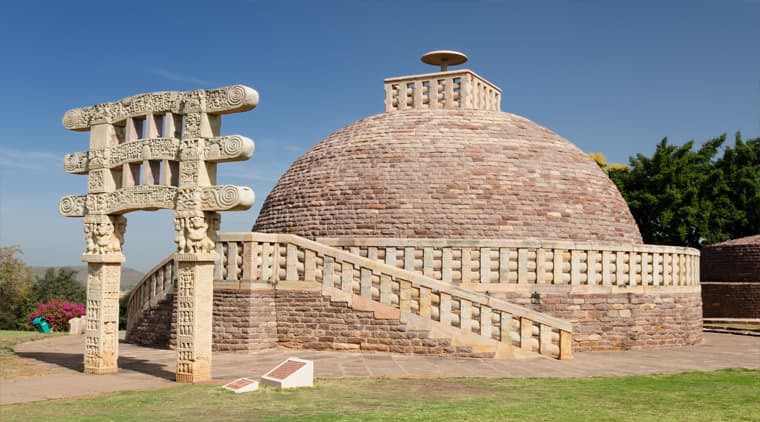
On a quiet hill about 45 km from Bhopal stands the Great Stupa of Sanchi, raised by Emperor Ashoka more than 2,200 years ago. It is the oldest Buddhist sanctuary in existence, and its four carved gateways are among the finest stone work ever done in India. When you walk around the stupa in the morning light, you feel the peace that has lived on this hill for centuries.
The story of this place
In the 3rd century BCE, Emperor Ashoka, the great Mauryan ruler who turned to the path of the Buddha, chose this hill near Vidisha for a sacred centre. He raised a brick stupa here and set up a polished stone pillar with a beautiful lion capital. The tradition recorded in the Sri Lankan Buddhist chronicles says that his son Mahindra halted at this hill, called Cetiyagiri, before he sailed to Sri Lanka to carry the teaching of the Buddha there.
The rulers who came after Ashoka kept adding to Sanchi. In the Sunga period, around the 2nd century BCE, the brick stupa was enlarged and covered with stone, and given its railings, staircase and the harmika and chhatra on top. Then, in the 1st century CE under the Satavahanas, the four gateways, the famous toranas, were carved. Later the Gupta kings added temples and shrines. In this way Sanchi remained a living centre of Buddhism for more than a thousand years, until about the 12th and 13th centuries, after which the hill fell silent and was forgotten.
In 1818 a British officer noticed the ruins, and in the early twentieth century the Archaeological Survey of India carefully restored the stupas. UNESCO placed the Buddhist Monuments at Sanchi on the World Heritage List in 1989. One thing makes this hill specially moving. Stupa 3 held the relics of Sariputra and Maudgalyayana, the two chief disciples of Lord Buddha, and pilgrims from Sri Lanka and across the Buddhist world still come here to honour them.
What you will see
The Great Stupa, called Stupa 1, is the heart of Sanchi. It is a huge solid dome of stone, about 36 metres across, with a railed path around it for pradakshina. Walk around it slowly, the way pilgrims have done for over two thousand years.
The real wonder is the four toranas, the carved gateways facing the four directions. Every inch of them is covered with scenes from the life of the Buddha and the Jataka stories. Here is something interesting to notice: in this early period the Buddha was never shown in human form. The carvers showed him through symbols, a bodhi tree, an empty throne, a wheel, a pair of footprints. Stand before the eastern gateway and find the graceful shalabhanjika, the tree maiden, leaning out from the bracket. Your guide will help you read these stories one by one, and the carvings come alive.
Beyond the Great Stupa you will see Stupa 3, which held the relics of the two chief disciples, the broken but still elegant Ashoka pillar near the south gateway, Temple 17 from the Gupta period, which is one of the earliest structural temples of India, and the remains of monasteries where monks once lived and studied. The site museum near the entrance keeps the famous lion capital of the Ashoka pillar and other finds from the hill. Give the museum half an hour; it completes the story.
Best time to visit
October to March is the best season, when the weather in Madhya Pradesh is cool and pleasant. Winter mornings on the hill are lovely, with mist in the fields below. April to June is very hot, so if you come then, visit early in the morning. July to September brings the monsoon, which makes the countryside green and is not a bad time if you do not mind some rain.
The stupa complex is open every day, roughly from sunrise to sunset. The site museum remains closed on Fridays. Timings and entry rules change from time to time, so please check the current details with your consultant before you go. There is an entry fee; please check the current rate on the official website.
How to reach
Bhopal is the gateway to Sanchi. The city has a well connected airport, Raja Bhoj Airport, with flights from Delhi, Mumbai and other cities, and Bhopal Junction is a major railway station on the Delhi to Chennai main line. From Bhopal, Sanchi is about 45 km by road, a drive of around one to one and a half hours.
Sanchi also has its own small railway station about 1.5 km from the stupa hill, and the town of Vidisha, about 10 km away, is a bigger railhead. But for most of our guests the simple plan works best: fly or take the train to Bhopal, and let us arrange the car for the day. The same day trip can cover Sanchi in the morning and the Udayagiri rock-cut caves near Vidisha after lunch, or Sanchi and Bhimbetka together if you start early.
Tips from our travel experts
Reach the hill when it opens. The morning light falls beautifully on the toranas, and you will have the path around the stupa almost to yourself. Two to three hours are enough for the main monuments and the museum.
Take a good guide, at the site or through us. Without a guide the toranas are beautiful stone; with a guide they become the life of the Buddha told panel by panel. Wear comfortable shoes, carry water and a cap, and keep some patience for the climb; the walk up from the parking is short but on a slope, and elders should take it slowly.
Sanchi pairs naturally with Bhimbetka, the prehistoric rock shelters on the other side of Bhopal. Together they let you see, in one day, cave paintings made by people thousands of years before the Buddha, and the stupa raised by Ashoka. Very few places in the world can offer such a day.
For our NRI and OCI travellers
Bhopal is an easy add-on to the usual Delhi and Agra circuit. There are direct flights from Delhi, and the overnight trains are comfortable. If you are showing your children the roots of Indian civilisation, Sanchi is one of the best classrooms in the country: the script of Ashoka, the earliest Buddhist art and a hill that pilgrims from Sri Lanka still visit. Carry your OCI card or passport; ASI ticket counters ask for ID, and entry rates differ for Indian citizens and foreign nationals, so check the current rule at the counter.
Questions travellers ask us
Who built the Sanchi Stupa?
Emperor Ashoka raised the first brick stupa here in the 3rd century BCE. Later rulers enlarged it in stone, and the four carved gateways, the toranas, were added around the 1st century CE. So what you see today grew over several centuries.
Is Sanchi closed on any day?
The stupa complex is open every day, roughly from sunrise to sunset. The site museum near the entrance is closed on Fridays. Please check current timings before you plan your day.
How far is Sanchi from Bhopal?
About 45 km, a drive of around one to one and a half hours. Bhopal is the practical base, with a good airport and a major railway junction.
Why is the Buddha not shown in human form at Sanchi?
The carvings belong to the early, aniconic phase of Buddhist art. The Buddha was shown through symbols such as the bodhi tree, an empty throne, the wheel of dharma and footprints. This is one of the things that makes Sanchi so precious to art historians.
Can I combine Sanchi and Bhimbetka in one day?
Yes, if you start early from Bhopal. Sanchi is about 45 km to the north-east and Bhimbetka about 45 km to the south, so the day involves a fair amount of driving, but it is a rewarding pairing of prehistoric art and early Buddhist art.
What is the entry fee at Sanchi?
There is an entry fee, with different rates for Indian citizens and foreign nationals. Rates are revised from time to time, so please check the current rate on the official ASI channels or ask your Way to India consultant.
A note on the tours below. These packages travel close to Buddhist Monuments at Sanchi, but a package may not include a guided visit to the site itself. If you would like this place added to your journey, please tell your Way to India travel consultant and they will happily build it into your itinerary for you.
Tours where you stay right by it
4D / 3NYou stay at Sanchi
Tours with it an easy day trip away
 4D / 3N
Bandhavgarh Wildlife Safari Tour From Ahmedabad
● Starts Ahmedabad
From₹19,622* / person
Explore →EMI from ₹961/mo
About 42 km from your stay at Bhopal