 10D / 9N
 All World Heritage Sites
UNESCO World Heritage · Cultural · inscribed 2002
Mahabodhi Temple Complex at Bodh Gaya
Bodh Gaya is the place where Prince Siddhartha sat under a peepal tree and rose as Lord Buddha, the Enlightened One. The Mahabodhi Temple Complex marks that very spot, and UNESCO placed it on the World Heritage List in 2002. Whatever your faith, when you sit near the Bodhi tree in the early morning, with monks chanting softly around you, something in you becomes quiet.
The story of this place
About two and a half thousand years ago, Prince Siddhartha of Kapilavastu gave up his palace to search for the truth of suffering. After years of wandering, he sat in meditation under a peepal tree on the bank of a river here, and attained supreme enlightenment. From that moment he was the Buddha, and this place became the holiest site of Buddhist pilgrimage in the world.
Emperor Ashoka came here in the 3rd century BC and built the first temple, along with the carved stone railings and the memorial column. The grand brick temple you see today dates from the 5th to 6th centuries, in the late Gupta period, and it is one of the earliest Buddhist temples built entirely in brick that still stands in India. Its tall tower has influenced temple building for centuries.
The site passed through long neglect between the 13th and 18th centuries and was extensively restored in the 19th century. Today the complex is managed by the Bodhgaya Temple Management Committee under the Bodh Gaya Temple Act of 1949, and it is open to people of all faiths. UNESCO inscribed it as a World Heritage Site in 2002 for its unique place in human history.
What you will see
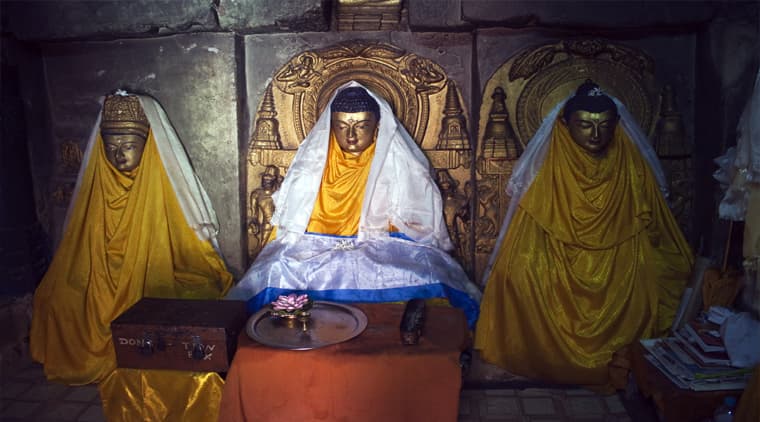
The main temple rises about 50 metres, a slender brick tower unlike the temples of most of India, with a gilded statue of the seated Buddha in the sanctum, his right hand touching the earth as witness to his enlightenment. You descend a flight of steps from the entrance, because the whole sacred area lies below the level of the land around it, and this descent itself feels like entering another time.
Behind the temple, to its west, stands the great Bodhi tree. The tradition and the official record hold it to be a descendant of the original tree under which the Buddha sat; the old accounts tell how Emperor Ashoka's daughter Sanghamitta carried a branch of the first tree to Anuradhapura in Sri Lanka, where its descendant still grows. Beside the tree is the Vajrasana, the Diamond Throne, a polished sandstone slab first placed by Ashoka to mark the exact seat of enlightenment.
The tradition says the Buddha spent seven weeks here after his awakening, and each spot is marked: the Animeshlochan Chaitya where he gazed at the tree without blinking, the Ratnachakrama or Jewelled Walk where carved lotuses mark his steps, the Ajapala Nigrodh pillar, the Lotus Pond to the south, and the Rajyatana tree. All around stand hundreds of votive stupas raised by kings and pilgrims over two thousand years. Give yourself time to walk slowly among them.
Darshan, timings and temple etiquette
The temple is open every day, and the pattern published by the temple management runs from 5 in the morning to 9 at night, with sutta chanting and meditation in the early morning, an offering of kheer at mid-morning, and chanting again in the evening. Sitting through the evening chanting near the Bodhi tree is the experience we most recommend.
One rule you must know before you go: mobile phones and electronic gadgets have been restricted inside the complex since 2013 for security reasons, and visitors deposit them at the counter near the entrance. Rules do get revised, so check the current position on the official website, bodhgayatemple.com, or ask your consultant before you visit. Cameras are allowed with a ticket for a fee; check the current rule when you go.
Entry to the complex is open to all faiths. Dress modestly, keep your voice low, remove footwear where marked, and walk clockwise around the temple and the tree, as the pilgrims do. Please do not pluck leaves from the Bodhi tree; if a fallen leaf comes to you, accept it as your blessing.
Best time to visit
November to February is the best season, when Bihar is cool and the town fills with monks and pilgrims from Sri Lanka, Thailand, Myanmar, Tibet, Japan and beyond; the whole town hums softly with chanting. Summer, from April to June, is very hot, and we do not suggest it unless your dates leave no choice.
Buddha Purnima, in April or May, marks the birth, enlightenment and mahaparinirvana of the Buddha and is the most sacred day here, with special prayers and big crowds. Within the day, early morning and the evening chanting hours are the most peaceful times inside the complex.
How to reach
Bodh Gaya is one of the easier pilgrimage sites to reach. Gaya airport is only a short drive away, with seasonal international flights that bring Buddhist pilgrims from Asia, and Gaya Junction, about 15 km from Bodh Gaya, is a major railway station on the Delhi to Howrah line. Patna, the state capital with a bigger airport, is about 115 km away.
Many of our guests combine Bodh Gaya with Rajgir and Nalanda, the other great Buddhist sites of Bihar, in an easy two to three day circuit, and some continue to Varanasi and Sarnath, where the Buddha gave his first sermon. We plan these roads so that no single day tires you out.
Tips from our travel experts
Since phones stay outside, fix a meeting time and place with your group before entering, and carry a printed copy or a written note of anything you need inside. Keep your deposit token safely.
Give the complex at least two to three hours: one round of the temple and sanctum, a long quiet sit near the Bodhi tree, and a slow walk through the seven sacred spots and the votive stupas. Then keep another half day for the town itself, where monasteries built by many Buddhist nations, each in its own style, welcome visitors.
Hire an authorised guide at the complex if you want the history told well, and sit in on the evening chanting even if you understand no word of it. Peace does not need translation.
For our NRI and OCI travellers
Bodh Gaya is open to everyone, so this is a site the whole family can share, whatever each member's faith. Many of our overseas guests weave it into a Varanasi journey: darshan and Ganga aarti at Kashi, then the calm of Bodh Gaya, two very different faces of India's spiritual life within one trip.
If your parents came to India for a Char Dham or Kashi yatra, a day at Bodh Gaya adds depth without adding strain, since the site needs no climbing and wheelchairs can be arranged. December and January bring teachers and pilgrims from across the Buddhist world, and the town at that time is an experience in itself; book rooms early for those weeks.
Questions travellers ask us
Can people of all faiths enter the Mahabodhi Temple?
Yes. The complex is open to everyone, of every faith and country. Hindus, Buddhists and visitors from all over the world pray and sit here side by side. Dress modestly and keep the quiet of the place.
Is the Bodhi tree the original tree of the Buddha?
The tree you see today is held, by tradition and by the official record, to be a descendant of the original tree under which the Buddha attained enlightenment. The old accounts tell how a branch of the first tree was carried to Anuradhapura in Sri Lanka in Emperor Ashoka's time, and that lineage has been kept alive ever since.
Can I take my mobile phone inside?
Mobile phones and electronic gadgets have been restricted inside the complex since 2013 for security reasons, and visitors deposit them at the counter near the entrance. Rules are revised from time to time, so check bodhgayatemple.com or ask your consultant shortly before your visit.
What are the temple timings?
The complex is open every day, from 5 in the morning to 9 at night as per the schedule published by the temple management, with chanting and meditation in the early morning and again in the evening. Check the official website for the current schedule when you plan.
Is there an entry fee?
Entry to the complex is open to all, and cameras need a ticket for a fee. Fees and rules change from time to time, so please check the current position on the official website or with your consultant before you go.
What else should I see around Bodh Gaya?
Keep half a day for the international monasteries in the town, built by Thailand, Japan, Bhutan, Tibet and other Buddhist nations, each in its own style. With a day or two more you can add Rajgir and Nalanda, and many travellers continue to Varanasi and Sarnath.
A note on the tours below. These packages travel close to Mahabodhi Temple Complex at Bodh Gaya, but a package may not include a guided visit to the site itself. If you would like this place added to your journey, please tell your Way to India travel consultant and they will happily build it into your itinerary for you.
Tours where you stay right by it
10D / 9NYou stay at Bodh Gaya