Bhandardara Travel Guide
The green season people come for is the monsoon and just after , roughly June to February, but the two set-pieces, the waterfalls and the fireflies , run in their own short...
When to visit Bhandardara, and the monsoon truth
The green season people come for is the monsoon and just after, roughly June to February, but the two set-pieces, the waterfalls and the fireflies, run in their own short windows. Decide which you want before you book.
- Monsoon, roughly July to September: the falls runThis is Bhandardara at its most dramatic, when the Umbrella Falls forms below the dam, Randha Falls thunders, and the hills turn a deep green under mist. It is also the wettest and most slippery time, so plan for rain, drive in daylight, and read the safety section before a self-drive.
- Post-monsoon, October to February: green and calmThe greenery lingers, the lake is full, the air is cool and clear, and the roads are far safer than in peak rain. The big waterfalls thin out but the lake, the dam, the forts and the star-filled night skies are at their best. This is the gentlest window for families and seniors.
- The firefly window, roughly mid-May to mid-JuneFor a few pre-monsoon weeks the forests light up with fireflies, the Kajwa season. It is a specific, short spell that shifts a little each year with the first rains, and it is a night-time, camp-based experience rather than a daytime sight. Treat it as its own trip and book ahead.
- March to early May: dry and plainerOutside the firefly weeks, high summer is the quiet, brown season: the falls are thin, the heat builds, and only the treks and the lake really reward a visit. Sandhan Valley, which cannot be done in the rain, is best attempted in these drier months with a guide.
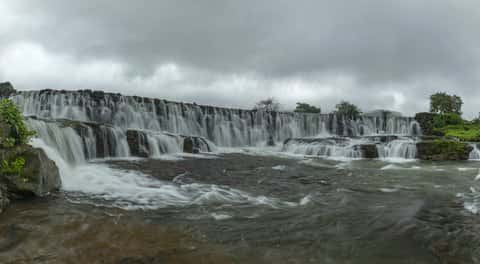
The Umbrella Falls below the Wilson Dam is not a year-round waterfall. It appears only when the dam overflows or its gates are opened in peak monsoon, roughly July to September, and can be dry or a trickle at other times. Randha Falls and the smaller cascades follow the same rule. If seeing the falls in full is the point of your trip, come in the heart of the monsoon and accept the rain and the road risk that come with it, and check the recent weather before you set out rather than trusting a photo taken in August.
How to reach Bhandardara
Bhandardara has no airport or station of its own. Almost everyone arrives by road from Mumbai, Pune or Nashik, usually via Igatpuri or Ghoti and then up a hill road.
- From Mumbai by roadMumbai is about 185 km away, roughly 5 to 6 hours, on the Mumbai-Nashik highway to Igatpuri or Ghoti, then a hill road in to Bhandardara. Most visitors self-drive or book a car or a tempo, and a Friday-evening start suits a weekend, though the last stretch is slow and best done in daylight.
- From Pune by roadPune is roughly 160 to 175 km, about 4 to 5 hours, usually via Sangamner and Rajur or via Ghoti. It is a comfortable drive outside the monsoon; in heavy rain, allow extra time and check that the approach bridges are open.
- From Nashik, the closest cityNashik is only about 70 km, roughly 2 hours, which makes Bhandardara an easy add-on to a Nashik or Shirdi trip. This is the shortest approach and a good option if you are already in the region.
- Nearest railhead and airportsThe nearest railway station is Igatpuri at about 45 km, on the busy Mumbai-Nashik line, with Kasara and Nashik Road also used; from there it is a taxi or a state transport bus up to Bhandardara. The nearest airports are Nashik at about 70 km and Mumbai at about 185 km. There are no flights or trains into Bhandardara itself.
Fly into Mumbai, the main international gateway, then drive about 5 to 6 hours to Bhandardara, or break the trip in Nashik. There are no international flights nearby, and the final leg is always by road.
Fly into Mumbai, then drive up via Igatpuri, or combine Bhandardara with Nashik and the Shirdi pilgrimage on a wider Maharashtra loop. A private car with a driver is the simplest way to handle the hill road.
Drive from Mumbai, Pune or Nashik, or take a train to Igatpuri and a taxi up. The Igatpuri railhead, well served by the Mumbai and Nashik lines, is the simplest way in by rail.
The dam, the lake, and the waterfalls
Bhandardara is the Wilson Dam and Arthur Lake at its centre, the monsoon waterfalls around it, and the old temple and forts on its rim. A few facts help you time each one right.
- Wilson Dam and Arthur LakeThe Wilson Dam, also called Bhandardara Dam, was built by the British from about 1910 across the Pravara River and is among the oldest dams in India, still used for irrigation and power. It created Arthur Lake, the calm, forest-ringed reservoir that is the soul of the place, good for boating, fishing and quiet lakeside evenings.
- Umbrella Falls, a monsoon-only sightRight below the old masonry dam wall, which stands roughly 58 to 85 metres high depending on whether it is measured from the river bed or the deepest foundation, the Umbrella Falls fans out over rocks in an umbrella shape, but only when the dam overflows or its gates open in peak monsoon, roughly July to September. Come in the heavy rain to see it in full; in the dry months it is thin or absent.
- Randha FallsA short drive away, the Pravara drops about 170 feet into a gorge at Randha Falls, one of the larger waterfalls in Maharashtra and a source for a small hydroelectric project. It is spectacular in the monsoon and quiet the rest of the year.
- Amruteshwar temple and Ratangad fortAcross the lake at Ratanwadi stands the Amruteshwar temple, an old black-basalt Shiva temple in the Hemadpanthi style, widely dated to around the 9th century and described as over 1,000 years old. It is the base for the Ratangad fort trek, which climbs to about 4,255 feet for a wide Sahyadri view.
The single thing that decides a good Bhandardara day is the season. The dam, the lake, the temple and the forts reward you year-round, but the waterfalls are a monsoon show, and the fireflies a pre-monsoon one. Match your trip to what you most want to see, covered in the best-time and experiences sections, and you will not stand at a dry Umbrella Falls in December wondering where the water went.
Signature experiences in Bhandardara
Beyond the dam, these are the experiences people remember, from the Kalsubai sunrise to the firefly night walk, and how to arrange each one safely.
- Kalsubai, the sunrise trek to the top of MaharashtraMount Kalsubai, about 10 to 12 km away, is the highest peak in Maharashtra at about 1,646 metres. The classic trek is a round trip of about 13 km from Bari village, with iron ladders on the steep final section. Many do it as a pre-dawn climb for sunrise, with a headlamp and a local guide, and it is demanding but hugely rewarding.
- Sandhan Valley, the Valley of ShadowsFrom Samrad village, about 20 to 25 km away, the Sandhan Valley is a narrow 200-foot rock gorge where sunlight barely reaches the floor. The guided descent involves rappelling patches of roughly 45 to 85 feet and takes about 4 to 5 hours. It is done only in the dry months with an operator, never in the monsoon.
- The firefly night walk, in seasonIn the pre-monsoon weeks, roughly mid-May to mid-June, a guided walk after dark shows the forests pulsing with fireflies. The forest gate closes in the early evening, commonly around 6:30 pm, so you camp overnight, and the display is best on darker, moonless nights after about 8 pm. Book with an operator and expect no alcohol at the camp.
- Boating and a slow lake dayArthur Lake is made for a slow morning: a boat ride, fishing, or simply sitting by the water as mist lifts off the hills. Boating and fishing are arranged at the lakeside near the MTDC resort. This is the gentle, do-nothing pleasure that balances the hard treks.
- The forts around the basinBeyond Ratangad, the basin is ringed by big Sahyadri forts, Harishchandragad with its famous Konkan Kada cliff, and the tough Alang-Madan-Kulang range, all serious treks in their own right. Pick one, go with a guide, and give it a full day.
- Stargazing and photographyAway from city lights, Bhandardara has some of the darkest, most star-filled skies within reach of Mumbai. Photographers come for the misty monsoon greens, the falls, the firefly long-exposures and the night sky. Bring a tripod and a rain cover.
If you do only one thing slowly, make it a sunrise, whether from the top of Kalsubai after a night climb or simply from the lakeshore with a chai as the mist burns off. The forts and the falls are the headline, but the quiet dawn over Arthur Lake and the Sahyadris is what people remember long after. Give yourself one unhurried morning and Bhandardara opens up in a way a quick photo-stop never allows.
Where to stay in Bhandardara, and how many nights
Choose the reliable MTDC lakeside resort or a private tented camp for the outdoor experience. One to two nights is the sweet spot for most visitors.
- MTDC Bhandardara, the reliable anchorThe Maharashtra Tourism resort on the lake is the oldest and most dependable stay, with non-AC and AC rooms, cottages and a dormitory, and the better rooms and cottages face Arthur Lake. It is the safe choice for families, seniors and anyone who wants a proper room rather than a tent, and boating is arranged right there.
- Private tented campsOperators run lakeside and hillside tented camps, especially in the firefly season and the pleasant post-monsoon months, usually as an overnight package with meals and activities. This is the way to do the full outdoor, campfire, stargazing experience, but check the operator is authorised and the site is a safe distance from the water.
- Village homestays and small resortsA handful of homestays and small resorts around the lake and at nearby villages give a simpler, local stay. They are basic but warm, and often the best base for an early Kalsubai or Ratangad start. Carry cash, as card and online payment can be patchy out here.
- How many nightsOne full day and night covers the dam, the lake, Randha Falls and a short walk. Add a second night for the Kalsubai sunrise trek, Sandhan Valley or the Amruteshwar temple and Ratangad. The fireflies are a specific late-May-to-mid-June overnight in their own right.
In the firefly weeks and on monsoon long weekends, the MTDC rooms and the good camps sell out well ahead and prices climb. If your dates fall on the firefly season or a holiday weekend, book early, confirm the operator is authorised for the sanctuary, and avoid turning up hoping to find a bed on the day.
Bhandardara costs and a realistic budget
Bhandardara is gentle on the wallet outside peak weekends. Here is what the main things cost, so you can plan and avoid being overcharged.
- The firefly and camping packagesA widely quoted 2026 firefly-camping rate is about 1,199 rupees per person for an adult with a vegetarian meal, about 1,399 rupees with a non-vegetarian meal and about 899 rupees for a child, covering a tent stay, meals and a guided walk. Rates vary by operator and rise on peak weekends, so confirm what is included before you pay.
- Stays and roomsThe MTDC rooms and cottages, private camps and homestays span a wide range depending on season and view, with lake-facing MTDC cottages and firefly-season camps at the top of it. Off-season midweek is much cheaper than a monsoon or firefly long weekend, so travel off-peak if budget matters.
- Transport is the big variableBecause nearly everyone comes by road, your main cost is the car, tempo or bus and its fuel and tolls. A self-drive from Mumbai or Pune is economical for a group; a booked car with a driver costs more but saves you the hill road in the rain.
- Cash and cardsCarry enough cash for the trip. Village stays, small eateries, boating and local guides often take cash only, and mobile signal for UPI or cards can be weak. Draw money in Igatpuri, Ghoti or Nashik before you head up rather than relying on an ATM in the village.
The single habit that keeps a Bhandardara trip smooth is to sort the big three, stay, transport and cash, before you leave the city. Book the room or camp ahead, agree the car or tempo rate in advance, and carry cash drawn in a bigger town. Do that and the only variable left is the weather, which no amount of planning controls but which the best-time and safety sections help you read.
Practical logistics: signal, cash, food and getting around
The small things that make a Bhandardara trip smooth, from thin mobile signal to cash, food and how you move between the scattered sights.
- Mobile signal is thin, so plan offlineCoverage around the lake and in the villages is patchy and drops out in the valleys. Download offline maps, share your plan and camp details before you go, and do not count on a live connection for navigation or payment once you are up in the hills.
- Getting around the scattered sightsThe dam, the lake, Randha Falls, Bari for Kalsubai, Samrad for Sandhan Valley and Ratanwadi for Amruteshwar are spread out and thinly served by public transport. A car or a hired tempo is by far the easiest way to link them; without your own wheels, plan on local jeeps and long waits.
- Food and waterFood is simple and local, village-style Maharashtrian meals at homestays, camps and small dhabas, rather than a restaurant scene. Carry your own water and snacks for the treks and the drive, and take your rubbish back out with you, as this is a wildlife sanctuary area.
- Footwear, layers and leechesBring sturdy, grippy footwear for wet rock, a rain layer in the monsoon and a warm layer for cold post-monsoon nights. In heavy rain, leeches on the trails are common, so cover up and carry salt or a repellent, and check yourself after a wet walk.
Safety, the monsoon roads, and trekking sensibly
Bhandardara is safe and welcoming, but the monsoon that makes it beautiful is also its main hazard. A little care with the roads, the water and the treks keeps the trip happy.
- Flooded bridges and slippery ghat roadsIn heavy rain the ghat roads turn slippery and landslide-prone, and low Irish bridges on the approach can go underwater, occasionally cutting the village off for a time. Travel in daylight, check the forecast, drive slowly, and never cross a flooded causeway, wait for the water to drop instead.
- Respect the waterWaterfalls, the lake edge and river pools look inviting but can have strong currents, sudden depth and slippery rock, and drownings do happen at Sahyadri falls in the monsoon. Do not swim below the falls or at unmarked spots, keep children well back from the edge, and follow any barriers or local warnings.
- Trek with a guide and the right kitKalsubai, Sandhan Valley and the big forts are proper treks with exposure, ladders and rappelling. Go with a reputable operator or local guide, especially for a night climb or the Sandhan descent, carry water, a headlamp and grippy shoes, and start early so you are off the exposed sections before dark or before rain sets in.
- The firefly-camp rulesFirefly-season camping runs inside a wildlife sanctuary, so the forest department gates and rules apply: arrive before the evening gate closing, commonly around 6:30 pm, keep noise and lights low so as not to disturb the fireflies, and remember alcohol is banned at these camps. Book only with an authorised operator.
Bhandardara is a low-crime rural area and generally relaxed for solo and small-group travellers; the real risks here are the weather, the water and the treks rather than personal safety. On crowded monsoon weekends, watch your belongings at busy campsites, keep to authorised camps, and tell someone your plan given the thin mobile signal. Go prepared for the outdoors and it is one of the gentler wild corners near Mumbai to travel.
Bhandardara for every kind of traveller, and on access
Bhandardara suits very different visitors in different ways. Here is what it offers you, and the one tip that matters for each, including how a senior or a family enjoys it without the hard trek.
- CouplesQuiet, green and romantic: misty lake mornings, a rooftop or lakeside sunset, and the firefly night in season. An overnight rather than a day trip lets you catch both the still dawn and the dark, star-filled night.
- Families with childrenThe dam, the lake, a boat ride and Randha Falls make an easy, colourful day without a hard climb. Skip the Kalsubai and Sandhan treks with young children, keep them well back from the water and falls, and base at the MTDC resort for comfort.
- Senior travellers and on accessibilityVery doable if you skip the treks. Stay in a lake-facing MTDC room, enjoy the dam, the lake and a gentle boat ride, and drive rather than climb to the viewpoints. The ghat road is winding, so travel by day with an unhurried driver, and choose the calm post-monsoon months over peak rain.
- Trekkers and adventure travellersThis is prime Sahyadri trekking country: Kalsubai for the highest peak in Maharashtra, Sandhan Valley for rappelling, and Harishchandragad, Ratangad and the Alang-Madan-Kulang range nearby. Go with a guide, respect the monsoon closures on the technical routes, and give each fort a full day.
- Backpackers and budget travellersA well-loved weekend escape from Mumbai and Pune, best done with a group to split the car and camp costs. Village stays and dorms keep it cheap, and the treks and the lake fill a full, active weekend.
- PhotographersMonsoon greens and mist, the falls in spate, firefly long-exposures in season and some of the darkest night skies near Mumbai. Bring a tripod and a rain cover, and plan around the dawn and dark rather than the harsh midday.
A suggested Bhandardara itinerary
How to shape one or two days so you catch the lake and dam at their best light and pair in a trek or the temple without rushing.
- Day one, arrival and the lakeDrive up in daylight, settle in at the MTDC resort or your camp, then spend the afternoon on the dam, Arthur Lake and a boat ride, ending with sunset over the water. In the monsoon, add Umbrella Falls and Randha Falls while the light holds.
- Day two, the trek or the templeFor the active, start pre-dawn for the Kalsubai sunrise climb, or spend the day on Sandhan Valley in the dry season with an operator. For a gentler day, cross to Ratanwadi for the Amruteshwar temple and, if you are fit, the Ratangad fort walk.
- The firefly overnightIn the mid-May-to-mid-June window, come specifically for the fireflies: reach the camp before the evening forest gate closes, join the guided night walk after dark, camp over, and drive back the next morning. It is a trip in its own right, not a bolt-on.
- The one-day versionIf you only have a day, come from Nashik, about 2 hours, do the dam, the lake and Randha Falls, and head back before dark. You will miss the treks and the night sky, but you will still get the heart of the place.
The thing that breaks a Bhandardara plan is arriving or driving in the dark or in a downpour on a slippery ghat road, especially near the flood-prone Irish bridges. Build your day so all the driving is in daylight, keep the treks to the early hours, and hold a flexible hour for weather. Do that and you avoid the one genuine risk here while still fitting in the dam, the lake and a trek or the temple.
The real questions travellers ask about Bhandardara
Straight answers to the questions that come up again and again on traveller forums, so you arrive already knowing the score.
- Will the waterfalls be running when I go?Only in the monsoon. Umbrella Falls appears when the Wilson Dam overflows or its gates open, roughly July to September, and Randha Falls is at its best then too. In the dry months they are thin or gone, so come in the heavy rain if the falls are your reason to visit, and check the recent weather first.
- When is the firefly festival, and can I go on my own?The Kajwa season runs roughly mid-May to mid-June and shifts a little each year with the rains. It is inside a wildlife sanctuary with a forest gate that closes in the early evening, so it is done as an overnight camp with an authorised operator rather than a casual drop-in. Book ahead and confirm the current rules.
- Is one night enough?One night and day covers the dam, the lake, Randha Falls and a short walk comfortably. Add a second night if you want the Kalsubai sunrise trek, Sandhan Valley or the Amruteshwar temple and Ratangad. The fireflies are their own overnight trip.
- MTDC resort or a private camp?Choose the MTDC lakeside resort for a proper room, families, seniors and reliability, and a private tented camp for the full campfire-and-stargazing outdoor experience. In the firefly season the good camps and MTDC rooms both sell out early, so book well ahead.
- Can I self-drive up in the monsoon?You can, but with care. The ghat roads are slippery and landslide-prone in heavy rain, and low Irish bridges can flood. Drive only in daylight, check the forecast, never cross a flooded causeway, and if you are unsure, book a car with a local driver who knows the road.
- How does it fit with Nashik or Shirdi?Bhandardara is only about 70 km from Nashik, roughly 2 hours, so it pairs naturally with Nashik and the Shirdi pilgrimage or the vineyards. Many domestic travellers add a night here to a Nashik or Shirdi trip rather than making it a standalone journey.
Planning Bhandardara from abroad
Bhandardara is the green, waterfall-and-fort heart of the Sahyadris, an easy add-on to a Mumbai or Nashik trip. A little preparation makes the remoteness and the monsoon timing easy to handle.
- Know it is remote and monsoon-drivenThis is a rural hill area, not a resort town. The waterfalls run only in the monsoon, roughly July to September, the fireflies only in a short pre-monsoon window, and the greenery follows the rain. Come in the season that matches what you want to see, and accept the rain that makes it green.
- Expect thin signal and carry cashMobile coverage is patchy in the hills and villages, and many stays and guides take cash only. Get an Indian SIM or eSIM in Mumbai, download offline maps, and draw enough cash in Igatpuri or Nashik before you head up, rather than relying on an ATM or a live connection.
- Pair it with Mumbai, Nashik or ShirdiFly into Mumbai, then drive about 5 to 6 hours up, or combine Bhandardara with Nashik, its vineyards and the Shirdi pilgrimage on a wider Maharashtra loop. A private car with a driver is the easiest way to handle the winding hill road.
- Gentle and senior-friendly if you skip the treksYou do not have to climb anything. Stay at the lake-facing MTDC resort, enjoy the dam, the lake and a boat ride, and drive to the viewpoints. Choose the calm post-monsoon months and Bhandardara is one of the easier, greener escapes near Mumbai for parents and grandparents.
Timing, weather and safety for foreign visitors
The practical basics an overseas traveller needs for a remote Sahyadri retreat: when to come, how to handle the monsoon, and how many days to give it on a wider India trip.
- Match the month to what you wantFor the full waterfalls and the deepest green, come in the monsoon, roughly July to September, and pack for serious rain. For the fireflies, come in the mid-May-to-mid-June window. For the calmest weather and the safest roads, come October to February, when the falls are quieter but the lake and forts shine.
- Take the monsoon roads seriouslyThe rain that makes Bhandardara beautiful also floods the low bridges and loosens the ghat slopes. Travel only in daylight, check the forecast, use a driver who knows the road, and never cross a flooded causeway. This is the one real hazard, and it is easily managed with care.
- How long to give it on a bigger tripOne to two nights is the right weight on a wider Maharashtra itinerary: enough for the dam, the lake and one trek or the temple, without slowing a Mumbai, Nashik and Shirdi loop. The fireflies, if you want them, need their own dedicated overnight.
- Pack for the outdoorsBring sturdy waterproof footwear, a rain shell, a warm layer for cold nights, a headlamp and any medication you need, since shops and pharmacies are limited. Treat it as a light outdoor trip rather than a city break, and you will be comfortable.
Bhandardara is an unusually green, quiet contrast to urban India and the desert north: lakes, waterfalls, old forts and dark skies within a few hours of Mumbai. Slot it after Mumbai or alongside Nashik and Shirdi, give it a night or two, and let it be the slow, outdoor chapter of the trip. Many overseas visitors say the misty Sahyadri mornings end up being the part of Maharashtra they remember most warmly.
The village girl who became the goddess of the highest peak
The tallest mountain in Maharashtra takes its name from Kalsubai, and the hills tell her story rather than any single scripture. In the best-known telling, Kalsubai was a young woman who came to work in a village below the peak, on the one condition that she would never be made to do certain household chores. For a time all was well, but the day she was pressed to break that condition she left the house, climbed higher and higher into the Sahyadris, and vanished at the summit, taken into the mountain as a goddess. The villagers built a small shrine to her at the very top, and to this day trekkers who climb the iron ladders to the highest point in Maharashtra find her temple waiting, garlanded and tended, at about 1,646 metres. Local people still keep her fasts and bring offerings, and the sunrise from her shrine, over range after range of the Western Ghats, is the reward at the end of the climb.
Planning a Bhandardara trip?
Our Maharashtra travel experts plan your full journey for you: route, hotels, darshan timings and transport. You get a free day-by-day plan and an exact quote on WhatsApp, usually within a few hours. No payment is needed to get your plan.