Warangal Travel Guide
The comfortable window is October to March , when the open fort ruins and the long Ramappa drive are pleasant. Summer is fierce and the monsoon can disrupt the out-of-town...
When to visit Warangal, and the months to avoid
The comfortable window is October to March, when the open fort ruins and the long Ramappa drive are pleasant. Summer is fierce and the monsoon can disrupt the out-of-town excursions.
- October to March: cool and clearThe best months by far, with pleasant days roughly between 13 and 32 degrees Celsius and cooler evenings, so carry a light layer in December and January. This is when the exposed fort gateways, the temple courtyards and the drive out to Ramappa are all comfortable, and when most festivals and the heritage calendar fall.
- April to June: hot, and tiringHigh summer on the Telangana plateau is harsh, often above 40 degrees Celsius, and the open ruins of Warangal Fort offer almost no shade. If you must come then, start at dawn, keep the middle of the day for a meal or a rest, and carry plenty of water and sun protection.
- July to September: green but disruptiveThe monsoon turns the lakes and countryside lush and is lovely around Pakhal Lake and the Ramappa fields, but heavy rain can make the longer drives slow and the unpaved approaches muddy. Keep the out-of-town excursions flexible if you visit in the rains.
- Decide your trip shape before you bookWarangal splits into a compact city cluster and the longer Ramappa and Pakhal excursions. If you only have the cool months for the out-of-town drives, plan them first and slot the city sights around them, rather than the other way round.
Warangal is a working Telangana city of temples and ruins, so the weather matters mostly for comfort at the open-air monuments rather than for scenery. The single planning lesson is to treat the hot middle of the day with respect at the fort and to keep the longer Ramappa drive for a cool, clear morning, which is exactly when its dolerite carvings catch the light best.
How to reach Warangal, and the Kazipet question
Warangal has no airport, so everyone comes through Hyderabad. The train is the easy way in, but check whether your service stops at Warangal city station or at Kazipet Junction.
- By train, the simple way inDozens of trains a day link Warangal with Secunderabad and Hyderabad, covering the roughly 140 to 150 km in about 1 hour 40 minutes on the fastest services and 2 to 2.5 hours on most others. It is one of the most train-friendly heritage day trips in India, and second-class fares are very cheap, though you should book reserved seats ahead in season on IRCTC.
- Kazipet Junction versus Warangal city stationThis trips up first-timers. Kazipet Junction is a separate major station about 10 to 13 km from the city, while Warangal city station is closer to the sights. Many long-distance trains stop at one and not the other, so check your exact halt when you book and keep a little time and an auto fare in hand for the hop into town.
- By road from HyderabadIt is about 145 to 150 km on National Highway 163, roughly 3 hours by car, and an easy self-drive or chauffeured day. Telangana state buses (TGSRTC) run very frequently from Hyderabad, with fares commonly from about 188 rupees on the Rajdhani service up to around 245 rupees and more on Garuda and AC coaches, taking about 2.5 to 3 hours.
- Nearest airportThere is no commercial airport at Warangal. Hyderabad's Rajiv Gandhi International Airport, about 150 to 175 km away because it lies south of Hyderabad, and roughly 2.5 to 3.5 hours by road or about 2 hours by train, is the only practical gateway, so every overseas and most domestic plans route through Hyderabad.
Fly into Hyderabad (Rajiv Gandhi International Airport), the regional gateway, then reach Warangal by train in about 2 hours or by road in about 3 hours. There are no international or useful direct domestic flights to Warangal itself.
Fly into Hyderabad, which has wide Gulf and Asian connections, then take a fast train or a car to Warangal. It pairs naturally with two or three days in Hyderabad on a first South India trip.
Take a train to Warangal or Kazipet from Hyderabad, Secunderabad and beyond, or drive on NH 163. The Hyderabad rail and road links are the simplest way in, and many domestic visitors come as a day or weekend trip.
Warangal Fort, the temples and the Kakatiya legacy
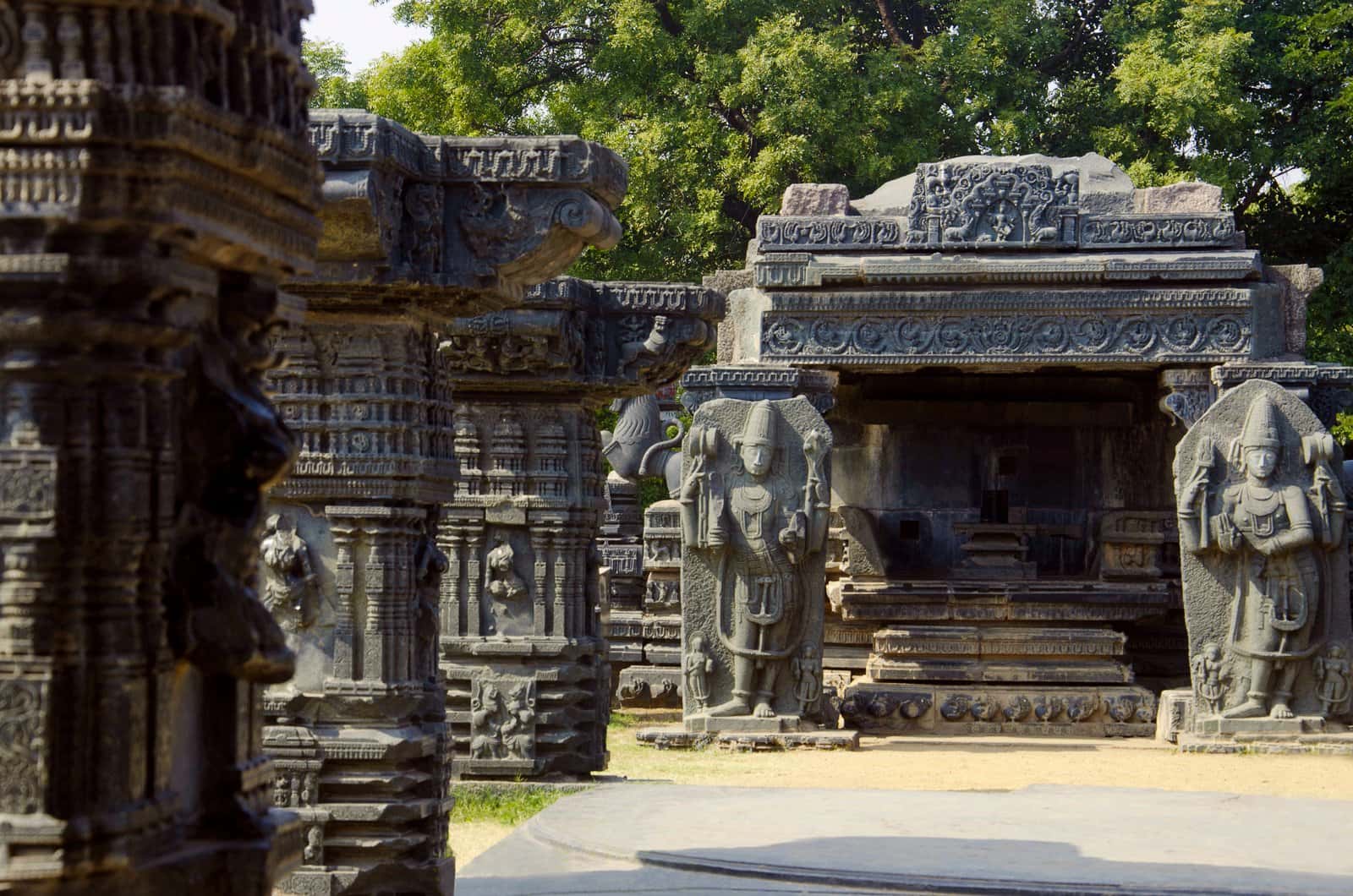
The heart of Warangal is the ruined fort with its famous gateways, the Thousand Pillar Temple and the Bhadrakali Temple, all in a compact belt, with the UNESCO Ramappa Temple a longer drive out.
- Warangal Fort and the Kakatiya Kala ThoranamThe old Kakatiya capital's fort is now an archaeological zone, and its highlight is the four great stone gateways, the Kakatiya Kala Thoranam, the surviving 'char kaman' of the Swayambhu Shiva temple that was destroyed in the 1323 invasion. The arch was adopted into the official emblem of Telangana, so you are looking at the state's defining symbol. It is an ASI monument, generally open daily, with a modest entry fee.
- The Thousand Pillar Temple, HanamkondaBuilt about 1163 CE by the Kakatiya ruler Rudra Deva in the Chalukyan style, this star-shaped trikutalaya is dedicated to Shiva, Vishnu and Surya, with a large monolithic black-basalt Nandi in the courtyard. Entry is free, it is ASI-maintained, and per Telangana Tourism it is open daily about 5 am to 9 pm. It is a few kilometres from the fort in the Hanamkonda part of the city.
- Ramappa Temple, the UNESCO marvelThe Kakatiya Rudreshwara (Ramappa) Temple at Palampet, about 66 to 70 km from the city in Mulugu district, is the one unmissable sight and a UNESCO World Heritage Site. It is a separate half-day excursion, covered in its own section below, and is well worth the drive for the floating-brick tower and the dolerite carvings.
- Bhadrakali Temple and the lakesThe hilltop Bhadrakali Temple, beside its lake between Warangal and Hanamkonda, is a much-loved local shrine and an easy add-on to the city cluster. Further out, Pakhal Lake and its wildlife sanctuary make a green half-day for families and nature lovers, again as a separate trip rather than a quick stop.
Several websites wrongly call the Thousand Pillar Temple a UNESCO World Heritage Site. It is not. The only UNESCO-inscribed monument in Telangana is the Kakatiya Rudreshwara (Ramappa) Temple at Palampet, listed on 25 July 2021 as India's 39th World Heritage Site. The Fort and the Thousand Pillar Temple are magnificent ASI monuments, but the World Heritage tag belongs to Ramappa alone, so plan the drive out to see it.
Ramappa Temple: why it is a World Heritage Site
The Kakatiya Rudreshwara (Ramappa) Temple is the reason Warangal belongs on a heritage itinerary. Here is what makes it extraordinary, and how to plan the drive out.
- What it is, and why UNESCO listed itRamappa is the main Shiva temple in a walled Kakatiya complex at Palampet. UNESCO inscribed it on 25 July 2021 under cultural criteria for being a masterpiece of Kakatiya temple architecture and an exceptional testimony to the dynasty's artistic and engineering achievement. The presiding deity is Ramalingeswara Swamy, and unusually the temple is named after its sculptor, Ramappa, who is said to have worked on it for some 40 years.
- The floating bricks and the sandbox foundationThe pyramidal tower is built of lightweight porous 'floating bricks' that reduced the roof weight, and the temple sits on a sandbox foundation thought to help it resist earthquakes. Construction began in 1213 CE under Recharla Rudra, a general of king Ganapati Deva. These are not just trivia: they are why an 800-year-old sandstone temple still stands so complete.
- The carvings to look forThe bracket figures, the Madanikas and Gaja-Vyalas, are carved from hard dolerite and finished to a metal-like lustre that catches the light, with figures illustrating Kakatiya dance customs. Take your time in the morning when the low sun rakes across them, and bring a guide or read up first, because the detail rewards a slow look.
- How to reach itPalampet is about 66 to 70 km from Warangal city and roughly 200 km from Hyderabad. The simplest way is a hired car or taxi from Warangal for a half-day round trip, often combined with Pakhal Lake or the Ghanpur temples; the temple is generally open about 6 am to 6 pm daily and is managed by the ASI. There is no reliable direct public transport timed for visitors, so a car is worth it.
The most common mistake is treating Ramappa as a quick stop on a day trip. At about 66 to 70 km each way from the city, plus an unhurried hour or more at the temple, it is a half-day excursion of its own, and the carvings deserve that time. Build your trip so the city cluster fills one day and Ramappa, ideally with Pakhal Lake, fills another, and you will leave satisfied rather than rushed.
Signature experiences in and around Warangal
Beyond ticking off monuments, these are the experiences that make a Warangal trip memorable, from the fort gateways at golden hour to a slow morning at Ramappa.
- Read the four fort gatewaysSpend an unhurried hour among the Kakatiya Kala Thoranam, walking between the four gateways and the scattered temple ruins. The carved lotus buds, garlands and mythical creatures repay a close look, and the late-afternoon light is kindest on the stone. This is the image you will recognise later as the Telangana emblem.
- A slow morning at RamappaIf you do one thing properly, make it an early, unhurried visit to Ramappa, when the low sun brings out the lustre on the dolerite figures and the crowds are thin. It is the highlight of the whole trip and the reason to give the drive its own half-day.
- The Thousand Pillar Temple and its NandiWalk the star-shaped plan, look up at the carved pillars, and find the large black-basalt Nandi in the courtyard. As a free, ASI-maintained living temple in the city, it is an easy and rewarding stop between the fort and Bhadrakali.
- Bhadrakali Temple and lake boatingThe hilltop Bhadrakali Temple gives a calm view over its lake, where boating is offered, a gentle pause in a heritage-heavy day. It is a popular local shrine, busiest at festival times, and sits naturally on the city loop.
- Pakhal Lake and the sanctuaryAbout 50 km east of the city, the Kakatiya-built Pakhal Lake and its wildlife sanctuary make a green half-day, with boating and birdlife and the chance of spotting deer and other wildlife. It suits families and nature lovers and pairs well with the Ramappa side of the district.
- Family stops in the cityFor a relaxed second day, the Kakatiya Rock Garden, the musical garden and the planetarium in the city give children and tired feet a change of pace from temples and ruins, and are easy, low-cost city outings.
If you remember one thing from Warangal, let it be the carvings, the dolerite bracket figures at Ramappa and the stone gateways of the fort, both at the soft ends of the day. The monuments are not numerous, so the reward here is depth rather than breadth: go slowly, look closely, and let the Kakatiya craftsmanship rather than a long checklist be the point of the visit.
Where to stay in Warangal, and how many nights
Almost everyone stays in the Hanamkonda and station belt, which is one continuous city. One night is enough for the city cluster, with a second night if you want Ramappa and Pakhal unhurried.
- Hanamkonda: the practical baseHanamkonda, which runs into Warangal as one city, is where most hotels are and is close to the Thousand Pillar and Bhadrakali temples, with the fort a few kilometres away. It is the convenient, central choice for almost every traveller, with restaurants and shops on hand.
- Near the stations, for early trainsThe Warangal and Kazipet station areas have plenty of budget hotels and are handy if you arrive late or have an early train out. They are a little less central for sightseeing, so weigh the convenience of the platform against the short hop to the sights.
- The government Haritha hotelTelangana Tourism's Haritha Kakatiya hotel in the city is a reliable, fair-value government-run option, often a sensible pick for families and senior travellers who want a known quantity. Book through the official Telangana Tourism channel in season.
- Room budgets and how many nightsBudget rooms commonly run from about 700 to 1,500 rupees and comfortable mid-range hotels roughly 1,500 to 4,000 rupees. One night covers the city cluster comfortably; add a second night if you want Ramappa and Pakhal Lake without rushing, which is the version we recommend for anyone who has come this far.
Warangal costs and a realistic daily budget
Warangal is easy on the wallet. Here is what the main things cost, so you can plan and reconfirm the official fees before you go.
- Entry fees at the monumentsThe Thousand Pillar Temple is free. Warangal Fort, an ASI monument, charges a modest entry, commonly cited at about 20 to 25 rupees for Indian visitors and about 250 rupees for foreign nationals, with a small camera charge of about 25 rupees. These ASI tariffs do change, so reconfirm the current rate at the gate or on the ASI ticketing portal before you go.
- Getting there and aroundTrains from Hyderabad are very cheap in second class, and TGSRTC buses run from about 188 rupees up to around 245 rupees and more for premium coaches. Within the city, autos and a hired car for the Ramappa and Pakhal excursions are the main costs; agree the car rate for the out-of-town drives in advance.
- A rough daily budgetExcluding your room and the Hyderabad transfer, plan on about 800 to 1,500 rupees a day as a budget traveller and about 2,500 to 4,000 rupees for a comfortable day with a hired car, meals and entry fees. The biggest single variable is the car for Ramappa and Pakhal, which is shared cheaply between a group.
- Cash, cards and UPIHotels and bigger restaurants take cards and UPI, but autos, small eateries and the monument counters often run on cash, so carry enough for the day. ATMs are plentiful in Hanamkonda and around the stations.
The single number worth checking on the day is the Warangal Fort entry fee. ASI tariffs are revised from time to time and are quoted inconsistently across travel sites, so treat the figures here, about 20 to 25 rupees for Indians and about 250 rupees for foreign nationals, as a guide and confirm the current rate at the counter or the official ASI ticketing portal. Everything else in Warangal is cheap and predictable.
Practical logistics: getting around, food, money and language
The small things that make a Warangal day smooth, from hiring a car for Ramappa to ATMs, food and the local language.
- Getting around the city and the districtThe city cluster of the fort, the Thousand Pillar Temple and Bhadrakali is best done by auto-rickshaw or a half-day hired car, as the sights are a few kilometres apart. For Ramappa and Pakhal Lake, a hired car or taxi is the only sensible option, since they are 50 to 70 km out with no traveller-timed public transport.
- Food and waterWarangal is good for South Indian and Telangana food, with plenty of vegetarian and non-vegetarian options in Hanamkonda. Drink bottled or filtered water, carry water and snacks for the out-of-town drives where stops are limited, and take the usual care with street food.
- Money, SIM and signalATMs are easy to find in Hanamkonda and near the stations, and mobile coverage in the city is good for maps and calls, though it can thin out around Pakhal and parts of the Ramappa road. Carry cash for autos, monument counters and small eateries.
- Language and etiquetteTelugu is the main language, with Hindi and English widely understood in the tourist and hotel trade. At the temples, dress modestly, remove shoes where asked, and be respectful at the living shrines, which are places of worship as well as monuments.
Safety, health and the things to watch in Warangal
Warangal is a calm, low-hassle heritage city. The real risks are the summer heat, the open ruins and the long drives rather than crime or scams.
- Heat is the main hazardThe open fort ruins and the temple courtyards offer little shade, and summers regularly top 40 degrees Celsius. Visit the exposed sites early or late, carry water and sun protection, wear a hat, and keep the hot middle of the day for a meal or a rest, especially with children or older travellers.
- Uneven ground and stepsThe fort is a ruin with rubble, uneven stone and few railings, and several temples have steps. Wear sturdy shoes, watch your footing, and take the climbs slowly. None of it is dangerous with care, but it is not a polished, level tourist site.
- On the roadThe Ramappa and Pakhal drives are long; use a reliable car and driver, avoid night driving on rural roads, and build in time so no one is rushing. In the monsoon, check that the approach roads are passable before setting out.
- Low-hassle, but stay sensibleWarangal sees relatively few foreign tourists and is generally relaxed and free of the aggressive touting found at bigger sites, with little reported beyond ordinary big-town caution. Keep an eye on valuables in crowds at festival times, use metered or agreed auto fares, and ordinary precautions are enough.
Warangal is a working Telangana city rather than a tourist hotspot, and most travellers, including solo women, find it calm and straightforward with standard precautions. Dress modestly at the temples, prefer agreed auto fares, and keep the long out-of-town drives to daylight with a trusted driver. The main thing to manage is heat and logistics, not safety.
Warangal for every kind of traveller, and on access
Warangal suits history lovers most of all, but families, seniors and photographers each get something different. Here is the one tip that matters for each, including how a senior visits comfortably.
- History and architecture loversThis is the trip for you: the Kakatiya capital, the fort gateways that became a state emblem, and the UNESCO Ramappa Temple are a serious dose of Deccan history. Give it two days, read up first, and consider a guide at Ramappa to read the carvings properly.
- Families with childrenBalance the temples with the lighter stops: the Kakatiya Rock Garden, the musical garden, the planetarium and boating at Bhadrakali or Pakhal Lake. Keep the heavy heritage to the cool hours and let a second day be slower and more varied so children stay happy.
- Senior travellers and on accessibilityVery doable with planning. Base in Hanamkonda to keep distances short, do the city cluster in the cool hours, and seriously consider skipping the all-day Ramappa and Pakhal haul if heat or long car journeys are tiring. The fort is uneven underfoot, so take it slowly, and the Thousand Pillar Temple is the gentlest of the major sights.
- PhotographersThe fort gateways at golden hour and the dolerite bracket figures at Ramappa in the early morning are the standout frames. The light, not the number of sites, is what makes the difference, so plan to be at the open monuments at the soft ends of the day.
- Couples and weekendersAn easy two-day heritage break from Hyderabad: the city cluster, a slow Ramappa morning and a calm evening by Bhadrakali or Pakhal Lake. It is unhurried and uncrowded, a quiet alternative to the busier tourist circuits.
- Solo and budget travellersCheap trains, cheap rooms in Hanamkonda and a compact city make Warangal easy to do alone and on a budget. Share a hired car for Ramappa and Pakhal with other travellers from your hotel to keep the one real cost down.
A suggested Warangal itinerary
How to shape one or two days so the city cluster and the longer Ramappa drive each get the time they need, without a rushed dash.
- Day one: the city clusterStart early at Warangal Fort and the Kakatiya Kala Thoranam before the heat, then the Thousand Pillar Temple in Hanamkonda, a midday meal and rest, and the Bhadrakali Temple and lake in the late afternoon. This is a comfortable full day on foot and by auto within a few kilometres.
- Day two: Ramappa and PakhalHire a car and head out early to Ramappa Temple, about 66 to 70 km away, for an unhurried morning among the carvings, then loop to Pakhal Lake or the Ghanpur group of temples on the way back. This is the half to full day that makes the trip, and the reason to stay a second night.
- The one-day version from HyderabadIf you only have a day from Hyderabad, do the city cluster only: train or drive in, see the fort, the Thousand Pillar Temple and Bhadrakali, and return. Be honest with yourself that Ramappa does not fit a single day trip alongside the city, so save it for a proper visit.
- Pairing with HyderabadMost visitors slot Warangal onto a Hyderabad trip: two or three days in the city for Charminar, Golconda and the museums, then one or two days for Warangal and Ramappa, with the easy train hop between them.
The single thing that ruins a tight Warangal plan is trying to add Ramappa, about 66 to 70 km each way, onto the same day as the fort and the city temples. It leaves you racing and short-changes the one genuine World Heritage Site on the trip. Treat the city cluster and Ramappa as two separate outings, and the whole visit relaxes into its proper shape.
The real questions travellers ask about Warangal
Straight answers to the questions that come up again and again on traveller forums, so you arrive already knowing the score.
- Is Warangal worth visiting?Yes, if you care about history and architecture; less so if you want polished tourist comforts. The Kakatiya fort gateways and the UNESCO Ramappa Temple are genuinely special, and the city is calm and uncrowded. Reviewers who call it an 'average day trip' usually did only the city cluster and skipped Ramappa, which is the highlight.
- Can I do it as a day trip from Hyderabad?You can do the city cluster, the fort, the Thousand Pillar Temple and Bhadrakali, comfortably as a day trip by train or car. You cannot also fit Ramappa, which is about 66 to 70 km further out, into the same day without rushing, so stay a night if you want to see it.
- How many days do I need?One day for the city cluster, two days if you want Ramappa and Pakhal Lake without hurrying. Two days, ideally added to a Hyderabad trip, is the version we recommend for anyone who has travelled this far.
- Kazipet or Warangal station?Both serve the city, but Kazipet Junction is about 10 to 13 km out while Warangal city station is closer to the sights. Many trains stop at only one, so check your exact halt when booking and keep a short auto hop in mind.
- Is the Thousand Pillar Temple a UNESCO site?No. Only the Kakatiya Rudreshwara (Ramappa) Temple at Palampet is UNESCO-inscribed, on 25 July 2021. The Thousand Pillar Temple and the fort are protected ASI monuments, but they do not carry the World Heritage tag.
- What are the Warangal Fort timings and fee?The fort is an ASI site generally open daily, with a modest entry of about 20 to 25 rupees for Indians and about 250 rupees for foreign nationals and a small camera charge of about 25 rupees. Reconfirm the current ASI tariff at the gate, as these change.
Planning Warangal from abroad
Warangal is the under-visited Kakatiya capital with a real UNESCO temple, best paired with Hyderabad. A little preparation makes the heat, the distances and the working-city feel easy to handle.
- Pair it with HyderabadFly into Hyderabad, the only practical gateway, give the city two or three days for Charminar, Golconda and the museums, then take the fast train or a car to Warangal for one or two days. It is the natural shape of a first South India heritage trip and avoids any need for domestic flights to Warangal, which do not usefully exist.
- Set your expectations honestlyWarangal is a working Telangana city, not a manicured tourist town. The monuments are superb but spread out, the fort is a real ruin underfoot, and English is understood in the tourist trade but not everywhere. Come for the Kakatiya history and the UNESCO Ramappa Temple, and the rough edges become part of the charm.
- The ASI foreigner fee and RamappaForeign nationals pay a higher ASI entry at Warangal Fort, commonly about 250 rupees against about 20 to 25 rupees for Indians, which is normal across Indian monuments; reconfirm the current rate. Give Ramappa, about 66 to 70 km out, its own half-day with a hired car, since it is the World Heritage highlight of the whole trip.
- Beat the heat and the distancesCome between October and March, do the open monuments early, and use a reliable car with a driver for the longer Ramappa and Pakhal drives rather than improvising local transport. With those two decisions made, Warangal is an easy and deeply rewarding stop.
Money, connectivity and timing for foreign visitors
The practical basics an overseas traveller needs for a heritage city without an airport: cash, a SIM, and how many days to give Warangal on a wider India trip.
- Carry cash, but cards work in the cityHotels and bigger restaurants in Hanamkonda take cards and UPI, but autos, small eateries and the monument counters run on cash, so draw enough at the city ATMs. The out-of-town drives have few places to pay by card, so keep small notes for the day.
- Get a SIM in HyderabadPick up an Indian tourist SIM or an eSIM when you land in Hyderabad rather than hunting for one in Warangal. Coverage in the city is fine for maps and calls, though it can thin out on the Ramappa and Pakhal roads, so download offline maps before you set out.
- How long to give it on a bigger tripOn a first South India trip, one to two nights in Warangal is the right weight after Hyderabad: enough for the city cluster and an unhurried Ramappa morning, without slowing the whole itinerary. History lovers can happily stretch it with Pakhal Lake and the Ghanpur temples.
- Time it to the cool monthsOctober to March is the comfortable window for the open monuments and the long drives. Avoid April to June, when the heat is punishing at the exposed ruins, and keep the monsoon excursions flexible. Cool, clear mornings are also when Ramappa photographs best.
Warangal is an unusually rewarding detour for a heritage traveller: a former imperial capital, a genuine UNESCO temple and a calm, uncrowded city, all an easy train hop from Hyderabad. Slot it after the Hyderabad sights, give it a night or two, and let the Kakatiya story, the fort gateways, the floating bricks, the dolerite carvings, be the quiet highlight of a South India trip that most overseas visitors never make.
The arch that became a state, and the temple named for its maker
Warangal was the imperial capital of the Kakatiya dynasty, roughly 1123 to 1323 CE, and two things it left behind tell its whole story. The first is the Kakatiya Kala Thoranam, the great carved stone gateways of the ruined Swayambhu Shiva temple in the fort, toppled in the 1323 invasion; when Telangana became a state in 2014, this Kakatiya arch was chosen for the official state emblem, so a 13th-century gateway is now the symbol of a 21st-century state. The second is the Ramappa Temple at Palampet, the only temple in India widely known by the name of its sculptor rather than a king or a god, built from 1213 CE on a sandbox foundation with a tower of porous 'floating bricks', and inscribed by UNESCO on 25 July 2021 as a masterpiece of Kakatiya art and engineering. Between the arch and the temple lies everything Warangal asks you to come and see: that craftsmanship, given time and care, outlasts empires.
Planning a Warangal trip?
Our Andhra Pradesh travel experts plan your full journey for you: route, hotels, darshan timings and transport. You get a free day-by-day plan and an exact quote on WhatsApp, usually within a few hours. No payment is needed to get your plan.