Majuli Travel Guide
The clear winter months of October to March are the time to come, built around the great Raas festival in November. The monsoon from June to September floods the island and...
When to visit Majuli, and the monsoon window to avoid
The clear winter months of October to March are the time to come, built around the great Raas festival in November. The monsoon from June to September floods the island and disrupts the ferry, so plan around the river.
- October to March: cool, clear and aliveThe most comfortable window by far. The Brahmaputra is calm, the skies are clear, the rice fields are gold, and the migratory birds arrive in the wetlands. Nights get genuinely cold in December and January, so carry a warm layer, but the days are perfect for cycling between satras and villages.
- November for the Raas festivalThe Raas Mahotsav, the dramatised retelling of the life of Krishna staged across the satras, usually falls in November and is the island at its most vivid. Dakhinpat and Garamur satras are famous for it. Rooms are scarce and booked far ahead in this window, so plan early if you want the festival.
- April to May: hot and humid, but passableThe pre-monsoon weeks are hot and sticky and quieter on visitors. The island is still green and the ferry still runs, so it is workable if you do not mind the heat, but it lacks the crispness of winter.
- June to September: the monsoon, best avoidedHeavy rain swells the Brahmaputra, floods large parts of low-lying Majuli, and disrupts or suspends the ferry. Travel is unpredictable and at times risky, and many cottages close. Unless you have a specific reason and local guidance, do not plan a monsoon visit.
Majuli is a low river island that floods in the monsoon, roughly June to September, when the Brahmaputra runs high. The ferry that is your only way across can be disrupted or stopped for days, roads on the island turn to mud, and stays close. This is not a small caveat, it is the single most important planning fact for Majuli. Aim for the October to March window, reconfirm the ferry is running before you commit, and never gamble a tight itinerary on a monsoon crossing.
How to reach Majuli, and the truth about the bridge
Majuli has no open bridge yet. Almost everyone flies or trains to Jorhat, drives to Nimati Ghat, and crosses on the Brahmaputra ferry. The road bridge is still being built.
- To Jorhat first, by air or railJorhat (Rowriah airport, code JRH) is the nearest airport and railhead, about 7 km from Jorhat town, with limited daily flights mainly to Kolkata, Guwahati and Delhi. Guwahati, about 310 to 320 km and roughly 6 to 7 hours away by road, is the bigger gateway with far more flights and trains if Jorhat is not convenient.
- Jorhat to Nimati Ghat, then the ferryFrom Jorhat town it is about 12 to 14 km to Nimati Ghat (also spelled Neamati or Nimatighat), roughly 30 to 40 minutes by taxi or shared auto. From the ghat the government ferry crosses the Brahmaputra to Kamalabari Ghat on Majuli in about 1 to 1.5 hours. This crossing is the way onto the island.
- The bridge is not open yetA road bridge between Jorhat and Majuli is under construction but not open to traffic. Work began in February 2021, stalled badly, and was handed to a new contractor in late 2025 with a multi-year target. Do not plan on driving across, and reconfirm the status before you travel, as it will change the journey when it finally opens.
- By bus from Guwahati or LakhimpurOvernight and day buses run Guwahati to Jorhat, from where you continue to the ghat and ferry. There is also a longer northern road approach via North Lakhimpur, which avoids the main ferry but is a much longer drive; most travellers use the Jorhat ferry as the simplest way in.
Fly into Delhi or Kolkata, connect to Jorhat (or to Guwahati and drive), then taxi to Nimati Ghat and take the ferry. No Inner Line Permit is needed for Assam, so the journey is straightforward on a standard Indian visa.
Fly into Guwahati via Delhi or Kolkata, then take a short connecting flight or the 6 to 7 hour drive to Jorhat, and cross by ferry. Majuli pairs naturally with Kaziranga on the same Upper Assam loop.
Fly or train to Jorhat, or take an overnight bus from Guwahati, then drive to Nimati Ghat and cross on the ferry. The Jorhat railhead and airport are the simplest way in.
The Nimati Ghat ferry: timings, fares and taking a vehicle
The ferry across the Brahmaputra is the heart of a Majuli trip. Timings and fares shift with the river, so treat the numbers as a guide and reconfirm at the ghat.
- Timings shift with the riverFerries from Nimati Ghat run through the day from roughly about 8 am or 8:30 am, with the last useful boat in the mid afternoon, around 3 pm to 4 pm. The last boat back from Kamalabari on the island typically leaves by about 3 pm to 3:30 pm. These are not fixed, so always reconfirm the day's schedule at the ghat and never plan to leave the island late.
- Fares are low, carry small cashA foot passenger pays roughly about 15 to 30 rupees on the government Inland Water Transport ferry, a bicycle about 10 rupees and a motorcycle about 45 rupees. Fares vary a little by vessel and have crept up over the years, so treat these as a guide and pay at the counter or on board in small notes.
- Taking a car or bike acrossYou can carry a motorcycle, and on the vehicle ferry a car or light vehicle too, for roughly about 700 to 800 rupees, but vehicle space is limited and not on every boat. If you want your car on the island, arrive early, ask which sailing takes vehicles, and be ready to wait. Many travellers leave the car in Jorhat and hire transport on the island instead.
- The Ro-Pax optionAlongside the older passenger ferries there is a roll-on roll-off Ro-Pax service that carries vehicles and passengers more comfortably. Capacity is still limited and sailings are weather dependent, so the same rule applies: reconfirm locally and do not build a tight plan around a single crossing.
More than almost anywhere we cover, the printed ferry timings and fares for Majuli go out of date and change with the season and river level. Use the figures here to plan and budget, then reconfirm the actual schedule and tariff at Nimati Ghat or with your homestay on the day. The golden rules never change: cross in the morning, keep small cash, and be off the last boat back well before mid afternoon.
The satras of Majuli, the soul of the island
Majuli is the cradle of Assam's neo-Vaishnavite culture. The satras, living monasteries founded from the 16th century, are the reason to come, and a few are unmissable.
- What a satra isA satra is a Vaishnavite monastery founded in the tradition of the 16th century saint Srimanta Sankardev, who made Majuli the heart of a devotional movement of song, dance and theatre. Of around 65 once founded on the island only about 22 to 23 are still active. They are not museums but working communities of celibate monks, so visit with respect.
- Samaguri Satra, for the masksSamaguri (also spelled Chamaguri) is the living centre of Majuli mask-making, where monks shape bamboo, clay and cloth into expressive masks of gods and demons from the epics. You can usually watch a mask being made and buy one. The craft is renowned enough that examples have been shown at the Victoria and Albert Museum in London.
- Kamalabari and Uttar KamalabariKamalabari Satra is a centre of art, literature and classical study near the main ghat, and its branch Uttar Kamalabari is famed for Sattriya dance, performed by its monks across India and abroad. If a rehearsal or performance is on, it is a highlight.
- Auniati, Dakhinpat and GaramurAuniati Satra keeps a museum of old Assamese artefacts, utensils and jewellery and is known for the Paalnaam and Apsara dances. Dakhinpat and Garamur are the great venues for the November Raas festival, and Garamur preserves medieval weapons including old cannon.
Satras are living religious communities, not tourist attractions. Dress modestly with shoulders and knees covered, remove your shoes where asked, lower your voice, and ask before photographing monks, prayer halls or a mask in progress. Some inner sanctums are not open to all visitors, and a few satras traditionally restrict entry, so follow the lead of those around you. A small donation in the box is welcome but never demanded, and watching a dance or a mask take shape is the real reward.
Signature experiences on Majuli
Beyond the satras, Majuli is about slow days: cycling between villages, watching masks and pottery being made, and the wide light over the river.
- Watch a mask being made at SamaguriThe single most memorable thing to do: sit with the monks at Samaguri as a face of bamboo and clay slowly becomes a god or a demon. They are happy to explain the craft, and a mask bought here, small or large, is the most meaningful souvenir you can carry off the island.
- Cycle through Mising villagesHire a bicycle and roll along the flat lanes through Mising and Deori tribal villages, past stilt houses, looms and rice fields. The islanders are famously warm and may wave you in for red tea or rice beer. This unhurried wandering, more than any single sight, is the essence of Majuli.
- See the pottery at SalmoraThe potters of Salmora still shape vessels by hand from the river clay without a wheel, a craft tied to the island and the Brahmaputra. It is a quiet, human counterpoint to the satras and worth the detour if you have a day.
- Birdwatching in the wetlandsFrom November to March the wetlands and beels of southern Majuli draw migratory birds, including storks, pelicans and ducks. Early morning by the water, with a local who knows the spots, is the time to go.
- A Sattriya dance, if it is onIf a performance or rehearsal of the classical Sattriya dance is happening at Uttar Kamalabari or another satra, do not miss it. It is one of India's classical dance forms, born in these very monasteries.
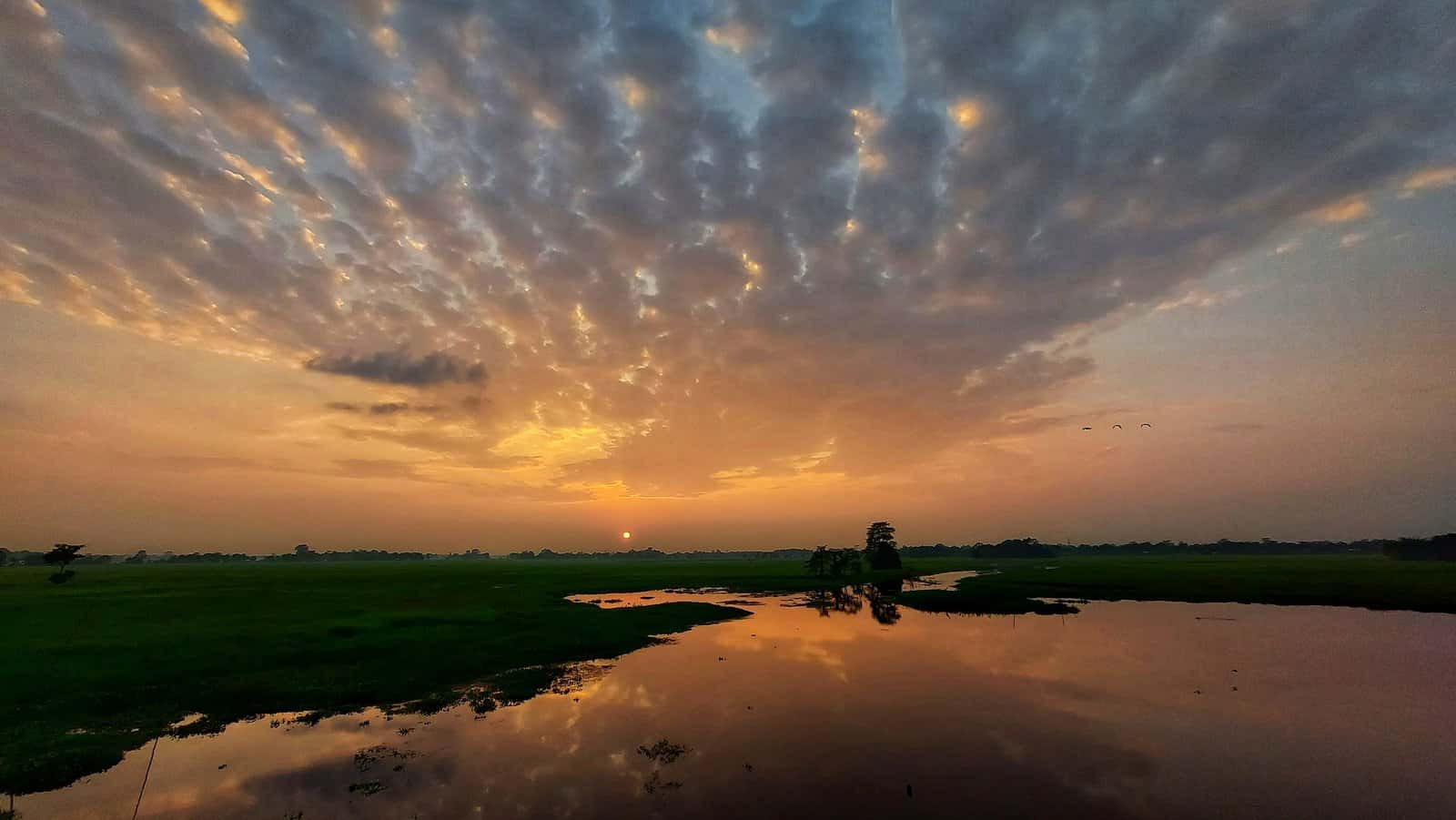
- Sunset over the BrahmaputraEnd a day at the river's edge as the light goes gold and the ferries cross. It costs nothing and is the image of Majuli most travellers carry home.
If you do only one thing slowly on Majuli, make it a day on a bicycle with no fixed plan. The island rewards drift more than ticking off satras: a loom clacking in a Mising village, a potter at Salmora, red tea pressed on you by a stranger, the long light over the rice. Give yourself an unhurried day to wander and the island opens up in a way a hurried satra tour never allows.
Where to stay on Majuli, and how many nights
There are no big hotels on Majuli, only bamboo cottages, eco-stays and family homestays, mostly around Kamalabari and Garamur. Two nights is the sweet spot.
- Bamboo cottages and homestaysAccommodation on Majuli is simple and characterful: Mising-style bamboo cottages on stilts, small eco-resorts and family homestays, often with home-cooked island food included. Many cluster around Kamalabari and Garamur, within reach of the satras. This is part of the experience, so embrace the simplicity rather than expecting a hotel.
- Room budgetsA bed in a homestay or bamboo cottage runs roughly about 800 to 2,500 rupees a night, with a few more comfort-focused cottages going higher, usually including meals. Prices rise and rooms vanish around the November Raas festival, so book well ahead for that window.
- How many nightsTwo nights is the sweet spot: a full day for the key satras and the masks, a second day to cycle the villages, see the pottery and slow down. One night is enough for the headline satras if you are tight, but Majuli is a place that rewards lingering. Day trips from Jorhat are possible but feel rushed once you count the ferry.
- Book ahead and confirm the ferryGood cottages are few and fill fast in winter and at festival time. Book ahead, confirm your host can arrange a pickup from Kamalabari Ghat, and double-check the ferry is running, especially at the shoulders of the monsoon.
Around the November Raas festival, the island's limited cottages and homestays sell out months in advance at higher prices. If your dates fall on the festival, book very early. If you cannot find a bed on the island, you can in theory base in Jorhat and cross for long days, but you will miss the quiet evenings that are the best of Majuli, so securing an island stay is worth the effort.
Majuli costs and a realistic daily budget
Majuli is gentle on the wallet, but it runs on cash. Here is what the main things cost so you can plan and carry enough money before you cross.
- A rough daily budgetExcluding long-distance travel, plan on roughly about 1,500 to 2,500 rupees a day as a budget traveller for a homestay bed, island meals and a cycle, and about 3,000 to 5,000 rupees a day for a more comfortable cottage, a hired car and guided satra visits. There is little to spend money on beyond stay, food, transport and a mask or two.
- Getting around the islandA hired bicycle is roughly about 100 to 200 rupees a day, a scooter about 300 to 500 rupees a day, and a car or tempo for a half or full day of satra-hopping roughly about 1,500 rupees and up. The satras are spread along a long, flat island, so budget for some form of transport.
- The ferry and the small thingsThe ferry itself is cheap, roughly about 15 to 30 rupees as a foot passenger, with a car around 700 to 800 rupees. Village meals, red tea and a handmade mask are all modest. A mask makes the one souvenir worth budgeting for, priced by size.
- Carry cash before you crossThis is the budgeting rule that matters most on Majuli. ATMs on the island are few and often empty, and card or UPI acceptance is patchy, so withdraw the cash you expect to need in Jorhat before you take the ferry.
Majuli runs on cash. There are only a handful of ATMs on the island and they are unreliable, often out of money or out of network, and most cottages, cycle-hire stalls, ferries and village kitchens do not take cards or UPI. Work out roughly what you will need for your whole stay, add a buffer, and draw it from an ATM in Jorhat before you board the ferry. Arriving on the island short of cash is the most common avoidable headache travellers report.
Practical logistics: getting around, food, SIM and money
The small things that make a Majuli day smooth, from hiring a cycle to the cash-only reality, the food, and mobile coverage on the island.
- Getting aroundThere is little public transport, so most travellers hire a bicycle for short loops, a scooter for more range, or a car with a driver for a full day of satra-hopping. Your homestay can usually arrange any of these. The island is flat, which makes cycling easy, but the roads are rough and dusty in parts.
- Food and rice beerIsland food is simple and good: rice, fish, pork with bamboo shoot, herbs from the kitchen garden, and apong, the local rice beer, in Mising homes. Most cottages cook for guests, which is the best way to eat here, as restaurants are few. Tell your host of any dietary needs in advance.
- Money and ATMsCarry cash from Jorhat. ATMs on Majuli are few and unreliable and card or UPI acceptance is limited, so do not rely on plastic once you are across the river.
- SIM, signal and languageMobile coverage is patchy but generally workable for calls and basic data in the main villages, weaker in the interior. Assamese and Mising are the local languages, with Hindi and some English understood in the tourist and homestay trade. A postpaid Indian SIM tends to work better than prepaid in the Northeast.
Safety, the river, and travelling responsibly on a shrinking island
Majuli is gentle and very safe, with no scam culture to speak of. The real cautions are the river, the monsoon, and travelling lightly on an eroding island.
- A safe, low-hassle placeMajuli is one of the safest, most relaxed destinations in India, with warm hosts and little of the tout or scam pressure you meet at busier sights. The main risks are practical, not personal: the river, the weather and being caught short of cash.
- Respect the river and the ferryThe Brahmaputra is vast and powerful, and there have been serious overcrowded-boat accidents in the past. Use the regular government ferry rather than an overloaded private boat, do not board a clearly overcrowded vessel, and never attempt a crossing in bad weather or high water.
- Health and the basicsDrink bottled or filtered water, take normal care with food, and carry any personal medicines, as pharmacies and medical facilities on the island are basic. In winter nights are cold, so pack a warm layer; in the shoulder months carry sun cover and mosquito repellent.
- Travel responsiblyMajuli is shrinking from erosion and its culture is fragile. Carry your plastic out, support the homestays, satras and craftspeople directly, ask before photographing people, and tread lightly. Responsible, low-impact travel is not optional here, it is part of why the island can keep welcoming visitors.
Majuli is widely regarded as one of the easier and safer places in India to travel solo, including for women, thanks to its calm pace and the genuine warmth of island hosts. The usual sensible precautions apply: stay in a known homestay, keep your host informed of your plans, do not be out alone on dark rural roads late at night, and watch the ferry timings so you are never stranded. Within those, it is a gentle and welcoming place to explore on your own.
Majuli for every kind of traveller, and on access
Majuli suits very different visitors in different ways. Here is what it offers each, and the one tip that matters, including how a senior visits comfortably.
- Couples and slow travellersQuiet, soulful and unhurried, with bamboo cottages, river sunsets and long cycle rides. An overnight rather than a day trip lets you catch the still evenings that are the best of the island.
- Families with childrenGentle and hands-on, with the masks, pottery and looms to watch and the ferry ride itself a small adventure. Keep an eye on children near the river and the ghat, and pick a homestay used to families.
- Senior travellers and on accessibilityVery doable with planning. Hire a car with a driver for the day rather than cycling, choose a homestay with easy ground-floor rooms, take the ferry mid morning when it is calm, and avoid the monsoon entirely. The island is flat, but roads are rough and the ferry involves some steps, so allow time and take it slowly.
- Backpackers and budget travellersA long-loved slow-travel stop with cheap homestays, cycle hire and warm hosts. Easy to reach by bus and ferry via Jorhat, and a place to settle for several unhurried days.
- Solo travellersOne of India's easier solo destinations, calm and friendly, popular with independent travellers. Mind the ferry timings and the cash rule, and you will find it relaxed and rewarding alone.
- PhotographersA dream of soft river light, masks in the making, looms, stilt houses and the satras. Ask before photographing monks and villagers, especially during prayer, and the golden hours by the Brahmaputra are unbeatable.
A suggested Majuli itinerary
How to shape one or two unhurried days so you catch the key satras, the masks and the village life without fighting the ferry clock.
- Day one, arrival and the satrasTake a morning ferry from Nimati Ghat so you reach the island with the day ahead. Check into your cottage, then visit Samaguri for the mask-making and Kamalabari or Uttar Kamalabari for the culture and any dance. End at the river for sunset.
- Day two, the villages and craftsHire a bicycle or scooter and roll through the Mising villages, stop at Auniati for its museum, see the pottery at Salmora, and in winter look for birds in the southern wetlands early. Keep the afternoon loose.
- Leaving the islandPlan your departure ferry for the morning or early afternoon, never the last possible boat, and confirm the day's timing with your host the night before. Build in a buffer for the crossing back to Jorhat before any onward train or flight.
- The one-night versionIf you have only one night, do the morning ferry, the key satras and the masks on the first afternoon, a short cycle the next morning, and the early-afternoon ferry back. It works, but Majuli rewards a second night if you can spare it.
The single thing that breaks a Majuli plan is misjudging the ferry. The last useful boat back to Nimati Ghat leaves the island by about mid afternoon, roughly 3 pm to 3:30 pm, and timings shift with the river. Confirm the day's schedule with your host, aim for a boat with hours to spare before any onward connection from Jorhat, and never bank on a late crossing. A missed last ferry means an unplanned extra night on the island.
The real questions travellers ask about Majuli
Straight answers to the questions that come up again and again on traveller forums, so you arrive already knowing the score.
- Is the Jorhat-Majuli bridge open yet?No. As of mid 2026 the road bridge is still under construction and not open to traffic. It stalled badly under its first contractor and was handed to a new one in late 2025 with a multi-year target, so for now the ferry from Nimati Ghat is the way across. Reconfirm before you travel, as it will change the journey once it opens.
- How many days do I need?Two nights is ideal: one day for the satras and masks, one for the villages and crafts. One night covers the headline satras if you are tight. A day trip from Jorhat is possible but feels rushed once the ferry is counted.
- Do I need a permit, and is there an ATM?No permit is needed for Assam or Majuli, unlike some other Northeast states. But ATMs on the island are few and unreliable, so carry the cash you need from Jorhat before you cross.
- Is it worth it, or too remote and slow?If you want a checklist of monuments, Majuli is not it. If you want living culture, masks taking shape, classical dance born in these monasteries, warm villages and wide river light, it is one of the most rewarding places in the Northeast. The slowness is the point.
- Can I take my car across?Yes, on the vehicle ferry, for roughly about 700 to 800 rupees, but space is limited and not on every sailing. Many travellers leave the car in Jorhat and hire a cycle, scooter or car on the island instead, which is simpler.
- Can I pair Majuli with Kaziranga and Sibsagar?Yes, and it is the classic Upper Assam loop: Kaziranga for the rhinos, Sibsagar for the Ahom-era monuments, and Majuli for the river island and its culture, all reachable on a single road circuit based around Jorhat.
Planning Majuli from abroad
Majuli is the soulful, slow heart of an Assam trip and needs no special permit. A little preparation around the ferry, the cash reality and the season makes it easy.
- No special permit neededUnlike Arunachal Pradesh or Nagaland, Assam needs no Inner Line Permit, so you can visit Majuli freely on a standard Indian visa. This makes it one of the easiest, most welcoming first steps into Northeast India for an overseas or NRI traveller.
- Understand the ferry-only accessThere is no open bridge yet. You reach the island by ferry from Nimati Ghat near Jorhat, a crossing of about 1 to 1.5 hours whose timings shift with the river. Plan a morning crossing, do not arrive expecting a road, and build a buffer around the last boat back.
- Carry cash, expect simplicityATMs are few and unreliable and cards rarely work, so draw cash in Jorhat first. Accommodation is bamboo cottages and homestays, not hotels, and meals are home-cooked. This simplicity is the charm, not an inconvenience, so come ready to slow down.
- Pair it with KazirangaFly into Guwahati or Jorhat, loop Kaziranga for the one-horned rhino and Sibsagar for the Ahom monuments, and give Majuli two nights as the cultural, restful chapter. It is an easy and rewarding Upper Assam circuit.
Money, connectivity and timing for foreign visitors
The practical basics an overseas traveller needs for a remote river island: cash, a SIM, the season to choose, and how many days to give it on a wider trip.
- Sort money before you crossDraw enough cash in Jorhat for your whole stay plus a buffer. On the island ATMs are few and often empty and cards and UPI rarely work, so plastic is not a backup here. Keep small notes for the ferry, cycle hire and village meals.
- Get a SIM in advancePick up an Indian tourist SIM or eSIM when you land in a major city; a postpaid plan tends to work better in the Northeast. Coverage on Majuli is patchy, fine in the main villages and weaker in the interior, so download offline maps before you cross.
- Choose the season carefullyCome October to March for clear weather, the migratory birds and the November Raas festival. Avoid June to September, when the monsoon floods the island and disrupts the ferry. The season choice matters more here than at most Indian destinations.
- How long to give itOn a first Northeast trip, two nights on Majuli is the right weight: enough for the satras, the masks and a day of village cycling, slotted between Kaziranga and the rest of your Assam loop without rushing.
Majuli is an unusually gentle introduction to the Northeast: no permit, very safe, deeply atmospheric, and slow in the best way. Slot it after Kaziranga, give it two nights, and let it be the cultural, restful chapter of an Assam trip. Many overseas visitors say the masks of Samaguri, the river light and the warmth of the island stay with them longer than any single monument elsewhere.
Why a clay-and-bamboo mask carries the soul of Majuli
Of everything Majuli makes, it is the masks of Samaguri Satra that travel furthest. For generations the monks here have shaped faces of gods and demons, Ravana with his many heads, the bird-king Garuda, the lion-man Narasimha, from nothing more than bamboo strips, river clay, cloth and cow dung, to be worn in the bhaona, the devotional theatre that Srimanta Sankardev gave Assam in the 16th century. A mask begins as a frame of split bamboo, is layered with clay and cloth, dried in the island sun, and painted into life over many days. The craft was nearly lost, kept alive by a handful of families, until a revival carried these masks to museums abroad, including the Victoria and Albert Museum in London. To sit in the satra and watch a face emerge is to watch a 500-year-old island tradition still breathing. Carry one home and you carry a piece of Majuli that the river cannot take.
Planning a Majuli trip?
Our Assam travel experts plan your full journey for you: route, hotels, darshan timings and transport. You get a free day-by-day plan and an exact quote on WhatsApp, usually within a few hours. No payment is needed to get your plan.