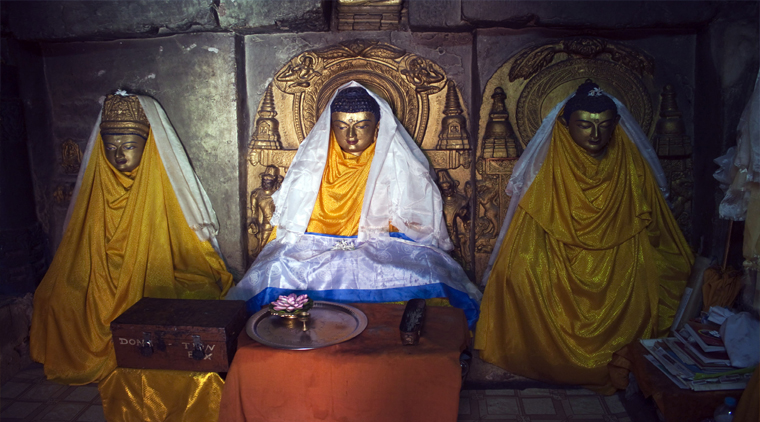
Bodh Gaya Travel Guide
The comfortable months are October to March , which is also the main pilgrimage and teaching season. Summer on the Bihar plain is fierce, so plan the cool months if you can.
When to visit Bodh Gaya
The comfortable months are October to March, which is also the main pilgrimage and teaching season. Summer on the Bihar plain is fierce, so plan the cool months if you can.
- October to March: cool and the heart of the seasonThis is when Bodh Gaya is at its best and busiest. January days are mild, around 22 to 24 C, with genuinely cold nights around 8 to 10 C, so carry a warm layer. The international monasteries are full of pilgrims, the winter teachings draw crowds, and the town hums with chanting in many languages.
- Late September and April: shoulder warmthStill workable, with thinner crowds than peak winter. By April the afternoons heat up quickly, so do the temple and the open sites early and rest through the middle of the day.
- April to June: very hot, best avoidedHigh summer on the plain is harsh, with daytime highs commonly around 40 to 45 C, tiring for the open complex and the caves. If you must come then, keep the hot middle of the day for shade and water, and visit the temple at dawn or after dusk.
- The monsoon and the Falgu riverJuly to September brings the rains, which can be humid and sticky, though the countryside greens up. The Niranjana, also called the Falgu or Phalgu, runs mostly as a wide sandy bed for much of the year and fills only with the monsoon, which surprises first-timers expecting a flowing river by the Sujata Stupa.
Bodh Gaya's Kalachakra Teaching Ground is where the Dalai Lama has given winter teachings, most recently confirmed over 29 to 31 December 2023. We could not verify any teaching scheduled for the 2025 to 2026 winter on an official source, and mid-2026 reports describe the Dalai Lama recovering from surgery and staying in Ladakh. Do not plan a trip around a teaching unless it is announced on the official schedules at dalailama.com or tibet.net. If a teaching is on, expect the town to be very full and rooms scarce.
How to reach Bodh Gaya
Gaya airport is right next door but its international flights are mostly seasonal charters. Most travellers arrive by train to Gaya Junction or by road from Patna and Varanasi.
- Gaya airport, the closest but seasonal for internationalGaya Airport, also called Bodhgaya Airport, is only about 5 km from town and has immigration and customs. The Airports Authority of India describes it as operating mainly seasonal pilgrimage flights from Thailand, Myanmar and Bhutan, so year-round scheduled service is largely domestic and the international charters cluster in the cool pilgrimage season, roughly November to April. Reconfirm any international route close to travel rather than assuming a regular flight.
- Gaya Junction, the practical railheadGaya Junction is the workhorse railhead, about 12 to 17 km from Bodh Gaya, roughly 25 to 50 minutes by road. It is well connected by train to Delhi, Kolkata, Varanasi and Patna. From the station, take a pre-paid taxi or an auto-rickshaw, roughly 300 to 450 rupees and negotiable, or a cheaper shared auto.
- Patna airport and the road inPatna's Jay Prakash Narayan Airport, about 110 to 135 km away, roughly 3 to 4 hours by road via NH-83, is the reliable year-round air gateway with wide domestic and some international links. Many travellers fly to Patna and drive down, and we can arrange a car with an experienced driver.
- From Varanasi by road or railVaranasi, with Sarnath, is about 250 to 260 km away, roughly 5.5 to 6.5 hours by road, and is the classic next or previous stop on a Buddhist trip. Trains also link Varanasi and Gaya, making the two easy to pair.
In the cool season you may find a seasonal pilgrimage charter straight into Gaya from Bangkok, Yangon or Paro, which is the dream arrival for a Buddhist pilgrim. Confirm the route for your dates; otherwise fly to Kolkata or Delhi and connect to Gaya or Patna.
Fly into Delhi or Kolkata, then take a domestic flight to Gaya or Patna, or a train to Gaya Junction. There is no year-round direct long-haul flight to Gaya.
Take a train to Gaya Junction, well served from Delhi, Kolkata, Varanasi and Patna, then the short road hop into Bodh Gaya. Patna is the nearest big airport for domestic flyers.
The Mahabodhi Temple, the Bodhi Tree, and the rules to know
The Mahabodhi Temple and the Bodhi Tree are why the Buddhist world comes here. Entry is free, but phones and cameras are not allowed inside, so know the rule before you arrive.
- The temple, the tower and the VajrasanaThe main temple, a UNESCO World Heritage Site inscribed in 2002, rises about 50 m and dates in its present brick form from about the 5th to 6th century AD, though the first temple here was built by Emperor Ashoka in the 3rd century BC. At its heart is the Vajrasana, the Diamond Throne, beside the spot of the enlightenment, a platform of polished sandstone traditionally linked to Ashoka.
- The Bodhi TreeThe sacred Bodhi Tree, descended from the original under which the Buddha is said to have attained enlightenment, stands on the west side of the main temple behind the Vajrasana. Pilgrims circumambulate, sit quietly and meditate around it. It is the single most revered tree in the Buddhist world, so keep your voice down and your movements calm.
- Timings and the daily rhythmEntry is free and the complex is open every day, about 5:00 am to 9:00 pm, with no weekly closure. The main shrine opens about 5:00 am, with Sutta chanting and meditation roughly 5:30 am to 6:00 am, an offering of kheer about 10:00 am, and evening Sutta chanting about 6:00 pm to 7:00 pm. Dawn and the evening chanting are the most moving hours.
- Dress and behave for the holiest of sitesCover shoulders and knees, remove footwear before entering, keep silence near the shrine and the tree, and do not point your feet at the temple or step over seated pilgrims. This is an active place of worship for millions, not a backdrop.
This is the single most important practical rule and the most-asked traveller question. The Bodhgaya Temple Management Committee states that using any electronic equipment, including mobiles, cameras and laptops, is prohibited inside the complex, and that free storage is available at the entrance. You deposit your phone and shoes at the free cloakroom window at the gate, then pass through metal detectors and a frisking. Bihar Tourism likewise lists mobile, camera and electronic gadgets as prohibited. Many travel pages still claim a paid camera ticket of about 100 rupees, but the official line is that electronics are not allowed, so plan to leave them at the gate rather than relying on a camera pass.
The seven sacred sites of the enlightenment, as a walk
After his enlightenment the Buddha is said to have spent seven weeks around this spot, and each week is marked by a sacred place inside the complex. Walking them in order is the quiet heart of a Bodh Gaya visit.
- Weeks one and twoWeek one is the Bodhi Tree and the Vajrasana, the place of the enlightenment itself. Week two is the Animeshlochan Chaitya, a small prayer shrine north of the central path, marking where the Buddha is said to have stood and gazed at the tree in gratitude without blinking.
- Weeks three and fourWeek three is the Ratnachakrama, the Jewelled Ambulatory, a raised stone walk near the north wall marked by carved lotuses where the Buddha is said to have paced in meditation. Week four is the Ratnaghar Chaitya in the north-east, where he is said to have meditated and the six-coloured aura associated with Buddhist flags arose.
- Weeks five, six and sevenWeek five is the Ajapala Nigrodh tree, marked by a pillar near the east entrance. Week six is the Lotus Pond, the Muchalinda Sarovar, just south of the enclosure, with its statue of the serpent king sheltering the meditating Buddha. Week seven is the Rajyatana tree to the south-east, where two merchants are said to have become the first lay disciples.
- How to walk itGive yourself an unhurried hour or two, ideally early morning. The sites are sourced to UNESCO and the temple committee and are signposted within the complex. Walking them in order turns a single temple visit into a small pilgrimage and is the reason a half-day stop sells Bodh Gaya short.
The Lotus Pond, Muchalinda Sarovar, is counted among the seven sacred places but sits just outside the main enclosure to the south, which is why some pilgrims miss it. The famous image of the serpent king Muchalinda raising his hood to shelter the Buddha from a storm during his sixth week comes from here. It is a short, peaceful walk from the main gate and well worth adding to the circuit.
Signature experiences in Bodh Gaya
Beyond the main temple, these are the experiences people remember: the monasteries of many nations, the Great Buddha, sitting in meditation, and the quiet sites across the river.
- A walk among the monasteries of the Buddhist worldWithin a short stroll of the temple, Buddhist nations have built monasteries in their own styles, including the Thai Monastery with its gleaming roof, the Tibetan and Karmapa temples, the Japanese Indosan Nipponji, the Royal Bhutan Monastery, and the Burmese, Vietnamese and Chinese temples. Each is open to respectful visitors and together they make Bodh Gaya feel like the whole Buddhist world in one town.
- The Great Buddha StatueThe 80 ft, about 25 m, seated Great Buddha, built by the Daijokyo sect of Japan and consecrated in 1989, is the landmark second only to the temple. The grounds are open about 7:00 am to noon and 2:00 pm to 6:00 pm, closing about 5:30 pm in winter. It is a calm, photogenic spot, and unlike the main temple you can take your camera here.
- Sitting in meditationMany visitors come above all to sit. You can meditate quietly around the Bodhi Tree within the complex, and the temple runs a Meditation Park with huts and gardens that the committee says is for serious meditators, open about sunrise to sunset at a small charge. Retreat centres such as the Root Institute and Tergar run longer courses; book ahead in the busy winter season.
- Across the river: Sujata and DungeshwariTwo short pilgrimages reward a half-day. The Sujata Stupa in Bakraur, about 2 km across the Niranjana river, marks where the milkmaid Sujata offered the Buddha milk-rice and ended his fast. The Dungeshwari or Mahakala caves, about 12 to 15 km out, are where he is believed to have practised six years of severe austerities before coming to Bodh Gaya.
If you do only one thing slowly, make it an unhurried morning at the Bodhi Tree before the day fills, then the evening chanting. Deposit your phone at the gate, sit on the marble within sight of the tree, and let the chanting in a dozen languages wash over you. That stillness, free and open to everyone, is what pilgrims carry home long after the monasteries and the statue fade.
Where to stay in Bodh Gaya, and how many nights
The real choice here is a monastery guesthouse or a hotel. Most pilgrims spend one to two nights, more if they are on retreat or adding the wider circuit.
- Monastery guesthouses: simple, quiet, donation-basedSeveral international monasteries run guesthouses for pilgrims, including the Thai Monastery, the Royal Bhutan Monastery and the Burmese Vihara, with the Tibetan, Japanese, Vietnamese, Chinese and Mahabodhi Society houses also commonly offering rooms. Expect simple, clean rooms, often around 500 to 800 rupees or by donation, with house rules on quiet hours, modest dress and sometimes a curfew. Confirm availability directly, as rooms are limited and fill in season.
- Hotels and the temple stripIf you want comfort, air-conditioning or flexible hours, the hotel strip near the temple is the easier choice. Budget rooms run roughly 500 to 1,500 rupees, mid-range hotels roughly 2,000 to 5,000 rupees, and the few premium properties roughly 5,000 to 8,000 rupees or more. All rise in the cool pilgrimage season, so book ahead.
- Which suits youChoose a monastery guesthouse for atmosphere, an early start at the temple and a contemplative stay, and a hotel for families, seniors who want comfort, or anyone who values privacy and a late return. Many travellers do a night of each.
- How many nightsOne full day and night covers the Mahabodhi Temple, the seven sacred sites, the Great Buddha and a monastery walk. A second night adds the Sujata Stupa, Dungeshwari and an unhurried pace, or a meditation course. Add two more for Rajgir and Nalanda.
In the cool October-to-March pilgrimage season, and especially if a major teaching is on at the Kalachakra Ground, rooms and monastery guesthouses fill weeks ahead and prices climb. Book early, confirm monastery stays directly rather than assuming a walk-in, and have a backup hotel in mind. Outside season the town is quiet and rooms are easy.
Bodh Gaya costs and a realistic daily budget
Bodh Gaya is gentle on the wallet, with the holiest site of all free to enter. Here is what the main things cost so you can plan and avoid being overcharged.
- A rough daily budgetFrom aggregated traveller data, plan on around 2,000 to 2,500 rupees a day as a budget traveller, around 5,000 to 5,500 rupees mid-range, and around 10,000 rupees and up for a comfortable day, excluding long-distance transport. Monastery stays and the free temple keep costs low for the contemplative traveller.
- What is free, and what is notEntry to the Mahabodhi Temple is free, as is sitting at the Bodhi Tree. The Meditation Park has a small charge for serious meditators. The Great Buddha grounds are a short, low-cost visit. The biggest variable is your room, which swings with the season.
- Transport costsA taxi or auto from Gaya Junction to Bodh Gaya runs roughly 300 to 450 rupees and is negotiable; shared autos are cheaper. A day cab to cover Rajgir and Nalanda is the main road expense, so agree the rate and the route before you set off.
- Cash, cards and donationsCarry cash for autos, small eateries, monastery donations and the bazaar, as not everyone takes cards or UPI. There are ATMs in town. Donations at the temple and monasteries are voluntary; give what you wish and do not feel pressured by anyone collecting at the gate.
You will see pages quoting a camera ticket of about 100 rupees and a video fee of about 500 rupees for the Mahabodhi Temple. The official position from the temple committee and Bihar Tourism is that phones, cameras and laptops are not allowed inside at all and are deposited free at the gate, so budget nothing for a camera pass and plan to photograph the complex only from permitted outer areas. If the rule has changed on the day, follow the signs and the staff at the entrance.
Practical logistics: food, money, SIM and getting around
The small things that make a Bodh Gaya day smooth, from the no-electronics temple rule to ATMs, food and local transport.
- Leave the phone at the gate, plan around itBecause phones, cameras and laptops must be deposited at the temple gate, do not rely on your phone for the time, maps or notes while inside. Carry a little cash in a pocket, agree where to meet anyone you are with before you go in, and pick up your deposited items on the way out.
- Food and the vegetarian leanBodh Gaya has plenty of simple vegetarian and pilgrim-friendly food, plus Tibetan, Thai and other cuisines near the monasteries reflecting the international crowd. Drink bottled or filtered water, take the usual care with street food, and you will eat well and cheaply.
- Getting around townThe temple, the monasteries and the Great Buddha are close together and walkable. Auto-rickshaws, e-rickshaws and cycle-rickshaws handle the hop to Sujata, Dungeshwari and Gaya Junction. Agree fares before you ride, as visitor rates are quoted high.
- Money, SIM and languageATMs are in town; carry cash for autos, donations and small shops. Mobile coverage is generally fine for calls and data outside the temple complex. Hindi is the local language, but English and several Buddhist-country languages are understood in the pilgrim trade, so communicating is easy.
Safety, touts, and staying well in Bodh Gaya
Bodh Gaya is broadly safe and welcoming, but the touts and begging at the temple gate catch first-timers. A little awareness keeps the visit calm.
- Touts, guides and begging at the gateAround the Mahabodhi gate and the busy lanes you will meet self-appointed guides, sellers and persistent begging, including from people with children. The reported friction on traveller forums is hustling and petty overcharging rather than violent crime. A polite, firm no is enough, agree any guide fee in advance, and do not feel obliged to give at the gate.
- Getting from Gaya to Bodh Gaya safelyUse a pre-paid taxi or a recognised auto from Gaya Junction rather than an unmarked offer, agree the fare first, and travel in daylight where you can. Travellers on forums report the Gaya-to-Bodh-Gaya transfer as routine when you book a trusted ride.
- Solo female travellersMost solo women report Bodh Gaya as manageable with standard precautions, on a par with other Indian pilgrim towns, with many independent travellers and pilgrims around. Dress modestly for the temples, book a reliable taxi, keep to busier areas after dark, and be firm with touts. The recurring issue is sales pressure, not danger.
- Heat, mosquitoes and healthDrink bottled or filtered water and take the usual care with street food. In the warm months carry sun protection and water for the open complex and the caves. Winter evenings can be cold, and a repellent is useful in the muggier months. The caves involve a climb, so go early and pace yourself in the heat.
Bodh Gaya is the most sacred place in the Buddhist world and an active place of worship, not a sightseeing set. Keep silence near the Bodhi Tree and the shrine, do not climb on the stupas or touch offerings, ask before photographing monks or praying pilgrims in the permitted areas, and follow the no-electronics rule inside the temple without argument. Quiet respect is repaid with a far deeper visit.
Bodh Gaya for every kind of traveller, and on access
Bodh Gaya suits very different visitors in different ways. Here is what it offers you, and the one tip that matters for each, including how a senior visits comfortably.
- Pilgrims and meditatorsThis is the centre of the Buddhist world, so for a pilgrim or a meditator it is the trip of a lifetime. Plan an early morning at the Bodhi Tree, the seven sacred sites in order, and a course at the Root Institute or Tergar if you want depth. Book retreats well ahead in winter.
- Families with childrenManageable and meaningful, with the open complex, the Great Buddha and the monasteries to explore. Prepare children for the silence and the no-phone rule inside the temple, keep them close near the gate touts, and visit in the cooler hours.
- Senior travellers and on accessibilityVery doable with planning. Stay near the temple to limit walking, visit the complex in the cool of morning or evening, take the seven sites slowly, and use an auto for Sujata and the caves rather than walking far. The main complex is largely flat, but the Dungeshwari caves involve a climb, so seniors may admire those from the base.
- Budget backpackersBodh Gaya is kind to a tight budget, with monastery guesthouses, cheap vegetarian food and a free, world-class temple. Reach it easily by train via Gaya Junction, and stay a few unhurried days for the meditation and the circuit.
- Solo female travellersGenerally relaxed and well used to independent and overseas pilgrims. Dress modestly, book a trusted taxi for the Gaya transfer, keep to busier areas after dark, and be firm with the gate touts. The friction here is sales pressure, not danger.
- PhotographersWonderful for the monasteries, the Great Buddha and the pilgrims in their national robes, but remember the camera ban inside the Mahabodhi complex. Shoot the outer architecture, the statue and the monasteries, ask before photographing people at prayer, and catch the golden light at either end of the day.
A suggested Bodh Gaya itinerary, with Rajgir and Nalanda
How to shape one to three days so you catch the temple at its calmest, walk the seven sites, and add the wider Buddhist circuit if you have time.
- Day one: the temple and the seven sitesStart at the Mahabodhi Temple at dawn, after depositing your phone, for the calmest hour at the Bodhi Tree and the morning chanting. Walk the seven sacred sites in order, then visit the Great Buddha and a cluster of monasteries in the late afternoon, and return for the evening chanting around 6:00 pm.
- Day two: across the river and a slower paceCross to the Sujata Stupa and out to the Dungeshwari caves in the morning, then spend the afternoon on a meditation course, a longer monastery visit, or simply sitting at the tree again. A second night is what separates a tick-the-box stop from a real Bodh Gaya.
- Days three and four: Rajgir and NalandaAdd Rajgir, about 70 to 78 km and 2 to 2.5 hours, for the Vulture's Peak, the hot springs and the Vishwa Shanti Stupa, and Nalanda, about 95 to 105 km, for the great ancient university ruins and museum. Two unhurried days do them justice; doing both in one day from Bodh Gaya is possible but tiring.
- The half-day version, and the wider circuitIf you only have a few hours, see the main temple and the Bodhi Tree, but you will miss the seven sites and the monasteries. For the full Buddhist circuit, link Bodh Gaya with Rajgir, Nalanda, Varanasi and Sarnath, and on to Kushinagar and Lumbini in Nepal.
The two things that make a Bodh Gaya day are the dawn quiet at the Bodhi Tree and the evening chanting around 6:00 pm to 7:00 pm. Plan to be at the temple for both, keep the hot middle of the day for the monasteries, the museum or a rest, and remember the phone goes in at the gate. Get those two windows right and even a single day feels complete rather than rushed.
The real questions travellers ask about Bodh Gaya
Straight answers to the questions that come up again and again on traveller forums, so you arrive already knowing the score.
- Can I take my phone or camera inside the temple?No. The temple committee and Bihar Tourism say phones, cameras and laptops are prohibited inside the Mahabodhi complex; you deposit them free at a window at the gate and collect them on the way out. Ignore pages promising a camera ticket and plan to photograph only from permitted outer areas.
- How many days do I need, with Rajgir and Nalanda?One full day covers Bodh Gaya's essentials, two let you slow down and add Sujata and the caves, and a further two comfortably add Rajgir and Nalanda. Doing all three in a single day from Gaya is possible but hectic, with three to six hours lost in transit.
- Should I stay in a monastery or a hotel?Choose a monastery guesthouse for atmosphere, quiet and an early temple start, accepting house rules and sometimes a curfew, and a hotel for comfort, air-conditioning and flexibility. Confirm monastery rooms directly, as they are limited and fill in season.
- Are there international flights into Gaya?Gaya is a real international airport but its overseas flights are mostly seasonal pilgrimage charters from Thailand, Myanmar and Bhutan in the cool months; year-round scheduled service is largely domestic. Do not assume a regular international flight; check the route for your dates, or route via Kolkata or Delhi.
- How do I get from Gaya Junction to Bodh Gaya?It is a short hop of about 12 to 17 km, roughly 25 to 50 minutes. Take a pre-paid taxi or auto, around 300 to 450 rupees and negotiable, or a cheaper shared auto. Book a trusted ride and agree the fare first.
- Is Bodh Gaya worth it, or is it just one temple?It is far more than one temple: the seven sacred sites, the monasteries of many nations, the Great Buddha, the meditation, and the sites across the river. For anyone drawn to the Buddha's story it is deeply rewarding, provided you manage the gate touts and give it more than a rushed half-day.
Planning Bodh Gaya from abroad
Bodh Gaya is the single holiest place in the Buddhist world and the spiritual heart of a pilgrimage to India. A little preparation on the airport season, the temple rule and the monasteries makes the trip smooth.
- Mind the airport seasonGaya airport offers seasonal pilgrimage charters from Thailand, Myanmar and Bhutan mostly in the cool months, roughly November to April, but no guaranteed year-round international service. Check whether a charter serves your dates; if not, fly into Kolkata or Delhi and connect to Gaya or Patna. Carry your e-visa and onward details, as Gaya runs immigration only when international flights operate.
- Be ready for the no-electronics temple rulePhones, cameras and laptops are not allowed inside the Mahabodhi complex and are deposited free at the gate. This surprises many first-time pilgrims, so plan your photographs for the monasteries and the Great Buddha, and treat the temple itself as a place to be present rather than to film.
- Stay in your nation's monastery, or a neighbour'sThe Thai, Bhutanese, Tibetan, Japanese, Vietnamese, Chinese, Burmese and Mahabodhi Society houses welcome pilgrims, often by donation or at low cost, which is a meaningful and economical way to stay among your own tradition. Confirm rooms directly and well ahead, as they fill in the winter season.
- Walk the wider Buddhist circuitBodh Gaya is the centre, but the full pilgrimage links it with Rajgir and Nalanda nearby, Varanasi and Sarnath where the Buddha first taught, and on to Kushinagar and Lumbini in Nepal. Give Bodh Gaya at least two nights and build the rest of the circuit around it.
Money, connectivity and timing for foreign pilgrims
The practical basics an overseas pilgrim needs for a small temple town: cash, cards, a SIM, and how to time the visit on a wider India trip.
- Carry cash, use ATMs in townCards and UPI work in bigger hotels and some shops, but autos, monastery donations, small eateries and the bazaar run on cash. Draw rupees at the town ATMs and keep small notes for rides, offerings and tips. Do not count on a card everywhere in a pilgrim town.
- Get a SIM at your arrival cityPick up an Indian tourist SIM or an eSIM when you land in Kolkata, Delhi or Patna rather than hunting for one in Bodh Gaya. Coverage in town is fine for maps, calls and ride-hailing, though remember your phone goes in at the temple gate.
- Time it to the cool seasonOctober to March is the comfortable and devotional window, with the monasteries full and the climate kind; summer is harsh on the open complex. If a Dalai Lama teaching is announced for the Kalachakra Ground, expect a very full town and book far ahead, but do not assume a teaching without an official announcement.
- How long to give it on a bigger tripOn a Buddhist circuit, give Bodh Gaya at least two nights as the spiritual anchor, then weave in Rajgir, Nalanda, Varanasi and Sarnath, and on to Kushinagar and Lumbini. It is the one stop most pilgrims wish they had given more time.
Bodh Gaya is the natural beginning and the emotional heart of a Buddhist journey through India. Small, walkable and built entirely around the enlightenment, it rewards a slow, attentive visit far more than a quick stop. Deposit the phone, sit at the tree at dawn, walk the seven weeks in order, and stay among the monasteries of the world, and many pilgrims find it the part of India they hold closest long after they return home.
The night of the enlightenment under the Bodhi Tree
Tradition holds that the wandering ascetic Siddhartha Gautama, after years of severe austerity in the Dungeshwari hills, gave up self-mortification, accepted a bowl of milk-rice from the milkmaid Sujata by the Niranjana river, and sat beneath a pipal tree at this spot resolved not to rise until he understood the nature of suffering. Through the night he is said to have faced the temptations and armies of Mara, touched the earth as his witness, and at dawn attained enlightenment, becoming the Buddha, the awakened one. He then spent seven weeks around the tree in contemplation, the weeks now marked by the seven sacred sites. The present Bodhi Tree is held to descend from that original, and the Mahabodhi Temple beside it, first raised by Emperor Ashoka in the 3rd century BC, makes Bodh Gaya the single holiest place in the Buddhist world. The narrative is drawn from the early Buddhist tradition as preserved across the Pali and later sources rather than from any single attributable verse, and we have followed the widely accepted account rather than any one school's wording.
Planning a Bodh Gaya trip?
Our Bihar travel experts plan your full journey for you: route, hotels, darshan timings and transport. You get a free day-by-day plan and an exact quote on WhatsApp, usually within a few hours. No payment is needed to get your plan.
Tour packages that visit Bodh Gaya
Every journey below is private, hand-crafted and fully customizable. Tell us your dates and we tailor the itinerary, the pace and the priests or guides around you.