Nalanda Travel Guide
The comfortable months are October to February , with the season stretching to roughly September to April. You walk the ruins in the open sun, so the season matters more here...
When to visit Nalanda, and the heat to plan around
The comfortable months are October to February, with the season stretching to roughly September to April. You walk the ruins in the open sun, so the season matters more here than at most sights.
- October to February: cool and clearThe most comfortable window, pleasant by day and cool at night, so carry a light layer for early mornings. This is when walking the open, shadeless brick ruins is genuinely enjoyable rather than a test of stamina.
- September and March to April: warm but workableBihar Tourism extends the window to about September to April. The shoulder weeks are warmer but still fine if you do the ruins early in the morning and keep the hot middle of the day for the museum or a rest.
- April to June: fiercely hot, best avoidedHigh summer on the Bihar plain is severe, often around 38 to 40 degrees Celsius and higher, with hot loo winds. The ruins offer almost no shade, so this is the worst time to come unless you have no choice.
- July to September: heavy monsoonThe monsoon is wet and roads around the circuit can flood, which slows the Patna to Rajgir to Nalanda hops. The brick is slippery and the light is grey, so most travellers skip these months too.
Unlike a temple you duck into, Nalanda is a slow, open-air walk across more than a square kilometre of excavated monasteries and temples with very little shade. In the cool months it is a calm, contemplative couple of hours; in May or June the same walk is exhausting by mid-morning. Plan the visit for the cool half of the year and start early, and the place rewards you. The official best season on the ASI board is October to February.
How to reach Nalanda
Nalanda has no airport and no useful station of its own. Almost everyone arrives by road from Patna, Rajgir or Bodh Gaya as part of a Buddhist-circuit loop.
- Nearest airport: PatnaPatna airport is the nearest, about 90 km away, roughly 2.5 to 3 hours by road. It has wide domestic links and is the practical air gateway. There are no flights to Nalanda or Rajgir themselves.
- By rail: Rajgir is closest, Gaya is convenientRajgir station is the closest railhead at about 12 to 15 km, but the nearest convenient mainline railhead is often Gaya at about 95 km, well served by trains. From either, you finish the journey by road.
- From Bodh Gaya and GayaBodh Gaya, the great pilgrimage town, is about 110 km from Nalanda and a common base for the wider Buddhist circuit; Gaya is about 95 km. A car covers the run in roughly 2.5 to 3 hours on the circuit roads.
- From Rajgir, the natural hubRajgir is only about 12 to 15 km away and is where most travellers actually sleep. Auto-rickshaws, taxis and tongas link Rajgir, Nalanda, Pawapuri and Bihar Sharif on short hops, and we can arrange a car with an experienced driver for the loop.
Fly into Delhi or Kolkata, then to Patna, and drive the circuit through Rajgir to Nalanda. Many overseas visitors chain Nalanda with Bodh Gaya and Varanasi on a single Buddhist-circuit trip.
Pilgrims from China, Thailand, Sri Lanka, Japan and Vietnam usually fly into Delhi or Kolkata and on to Patna or Gaya, then loop Bodh Gaya, Rajgir and Nalanda by road.
Take a train to Rajgir for the short hop, or to Gaya or Patna and drive. The IRCTC Buddhist circuit trains and Bihar State Tourism (BSTDC) coach trips from Patna also cover Nalanda and Rajgir.
The ruins, the museum, and how to read them
Nalanda is the great excavated Mahavihara, its site museum, and the Hiuen Tsang Memorial nearby. A little context turns a field of brick into one of the most moving sites in India.
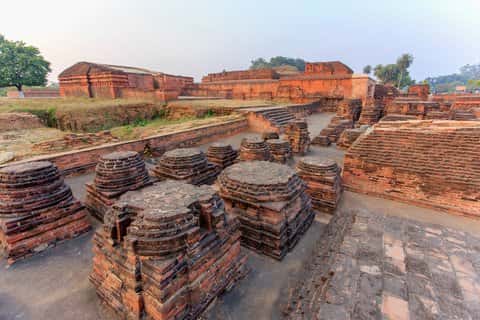
- The Mahavihara ruins and Temple Site 3The heart of Nalanda is the excavated row of 11 monasteries on the east and 14 temples on the west, along a wide north-south passage. The great Temple Site 3, surrounded by votive stupas with its surviving corner towers and stucco Buddhas, is the largest and most imposing structure; climb its steps for the best overview of the layout.
- The Nalanda Archaeological MuseumThe ASI site museum, established in 1917, displays sculptures in stone, bronze, stucco and terracotta excavated here and at Rajgir, a small fraction of the thousands of antiquities recovered. It is the piece that makes the ruins come alive, so do not skip it. It closes on Fridays, so plan accordingly.
- The Hiuen Tsang (Xuanzang) Memorial HallAbout 1 to 2 km from the ruins, this India-China memorial honours the 7th-century Chinese pilgrim-scholar Xuanzang, who studied and taught at Nalanda and left the detailed account that helped archaeologists find it. Murals and a central statue tell his journey. It too is reported closed on Fridays.
- How to read the layoutWalk the central passage first to grasp the temples-on-one-side, monasteries-on-the-other plan. In each monastery look for the courtyard ringed by cells, the verandah, the well, the kitchen and the shrine; this was a residential university, and the plan repeats. A licensed guide, agreed in advance, brings it to life.
Nalanda is a UNESCO World Heritage Site and an ASI-protected monument. Do not climb on or sit on the ancient brick where it is not allowed, keep silence around the shrines, and stay on the paths. Bihar Tourism notes that electronic gadgets need ASI permission, so confirm at the ticket counter before using a tripod or drone, and never fly a drone over the site without written permission.
Nalanda entry fees, timings and the closed-Friday rule
The ruins are ASI-ticketed with a clear Indian-versus-foreign split, and online tickets are cheaper. The museum and the Hiuen Tsang Memorial close on Fridays while the ruins stay open.
- Ruins entry fee, Indian and foreignPer the ASI Must See site, the ruins ticket is about Rs.25 in cash or about Rs.20 booked online for Indian, SAARC and BIMSTEC nationals, and about Rs.300 in cash or about Rs.250 online for other foreign visitors. A combined ticket with amenities is about Rs.400. Children up to 15 are free. Booking online is the cheaper route. Reconfirm on the ASI portal before you travel.
- Ruins timingsThe ruins are open daily, about 09:00 to 17:00 in practice, and crucially they are not closed on Fridays. Come soon after opening to walk the site before the heat and the day-trip coaches arrive.
- Museum: about Rs.5, closed FridaysThe Nalanda Archaeological Museum is open about 10:00 to 17:00 and is closed every Friday and on national holidays, with entry about Rs.5. This is the single rule that catches Friday day-trippers, who find the ruins open but the museum shut.
- Hiuen Tsang MemorialThe memorial hall is reported closed on Fridays like the museum, with a small entry fee of around Rs.10 to 20 by various accounts. Treat the fee as approximate, pair the hall with a non-Friday visit, and reconfirm locally on the day.
If your only free day is a Friday, you can still walk the ruins, but the Nalanda Archaeological Museum and the Hiuen Tsang Memorial Hall will be closed, and the museum is what makes the ruins make sense. Where you can, plan the Nalanda day for any day except Friday. If Friday is unavoidable, do the ruins and the modern Nalanda University area, and save the museum for another time. The ruins themselves stay open every day.
Nalanda, Rajgir and the circuit experiences
Nalanda is best enjoyed as part of a short circuit. These are the experiences people remember, and how to arrange them through the official channels.
- A slow morning walk through the MahaviharaGive the ruins an unhurried two to three hours soon after opening. The early light over the brick, the calm, and the scale of Temple Site 3 are the experience; this is a place to walk slowly and imagine, not to tick off.
- The Rajgir ropeway to the World Peace PagodaAt Rajgir, the oldest ropeway in India carries you up Ratnagiri Hill to the gleaming Vishwa Shanti Stupa. Go early; the BSTDC site shows hours that vary between notices, around 08:00 to 17:00 or 10:00 to 16:00 depending on the board, so check on the day.
- The Rajgir Glass Bridge and Nature SafariRajgir's glass bridge and nature safari, on the Vaibhagiri hills, are open about 09:00 to 17:00 Tuesday to Sunday and closed Mondays. Book only through the official Bihar government portal rajgirsafari.bihar.gov.in, as the daily quota sells out and copycat sites are not genuine.
- The Hiuen Tsang Memorial and the modern campusPair the ruins with the Xuanzang Memorial Hall nearby, and if you are curious about the revival, the modern Nalanda University campus near Rajgir is a striking contrast, a living net-zero campus inaugurated in 2024 about 12 to 15 km from the ancient site.
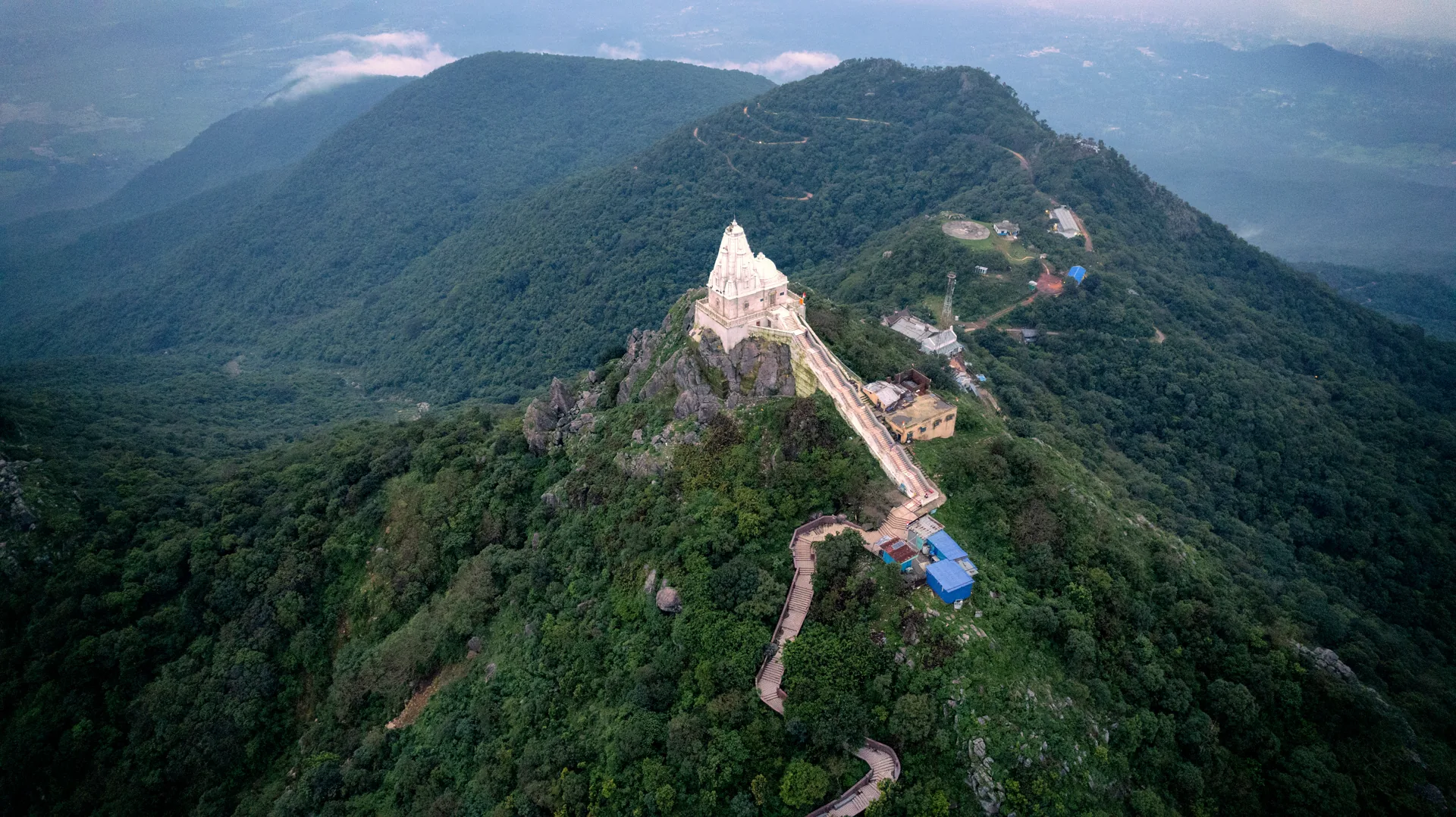
- Pawapuri and the Jal MandirAbout 13 to 20 km away by road, the white-marble Jain Jal Mandir floats in a lotus tank at Pawapuri, where Lord Mahavira attained nirvana. Entry is free, it is open through the day, and it makes a serene half-day add-on with Bihar Sharif.
- Rajgir's hot springs and Buddhist sitesRajgir adds the warm-water Brahmakund springs, Griddhakuta (Vulture's Peak) where the Buddha preached, and Venuvana. It is the reason most people base in Rajgir rather than rushing Nalanda as a single stop.
If you do only one thing slowly, make it the ruins at Nalanda in the first hour after opening, before the coaches and the heat. The quiet, the early light on the brick, and the sense of standing where students came from across Asia for 800 years are what stay with people long after the ropeway and the bridge fade. Give it an unhurried morning and let the museum fill in the story afterwards.
Where to stay for Nalanda, and how many nights
You do not sleep at Nalanda itself. Base in Rajgir for the circuit hub, or in Patna for city comforts and the airport. One to two nights covers the area well.
- Rajgir: the natural baseAbout 12 to 15 km from the ruins, Rajgir has the most hotels on the circuit plus the ropeway, hot springs and glass bridge on its doorstep. It is the practical and pleasant place to sleep if you want Nalanda and Rajgir together without long daily drives.
- Patna: city comforts and the airportAbout 90 km away, Patna has the widest hotel choice, from budget to business class, and the nearest airport. Good if you arrive by air and want a comfortable city base, though it means a longer day trip out to the ruins.
- Bodh Gaya: the pilgrimage baseAbout 110 km away, Bodh Gaya suits travellers doing the wider Buddhist circuit, with monastery guesthouses and hotels. Many visitors sleep in Bodh Gaya and take in Nalanda and Rajgir on the way to or from Patna.
- How many nightsOne full day covers the Nalanda ruins, the museum and the Hiuen Tsang Memorial comfortably. Add a night in Rajgir to fold in the ropeway, glass bridge, hot springs and Pawapuri; two to three days does the whole Rajgir-Nalanda-Pawapuri-Bodh Gaya circuit without rushing.
Nalanda village has the ruins, the museum and a few basic eateries, but it is not a place to stay; there is no hotel cluster and nothing open in the evening. This is the single planning fact most guides miss. Treat Nalanda as a daytime stop, sleep in Rajgir or Patna, and you avoid the trap of looking for rooms in a village that does not really have them.
Nalanda costs and a realistic daily budget
Nalanda is inexpensive to visit. Here is what the fixed things cost and a realistic daily figure, so you can plan and avoid being overcharged for a car or a guide.
- A rough daily budgetExcluding your room and long-distance transport, plan on about Rs.1,500 to 2,500 a day as a careful traveller, about Rs.3,000 to 5,000 mid-range, and about Rs.6,000 and up for a comfortable day with a hired car and a guide for the circuit.
- The fixed entry costsThe ruins ticket is about Rs.25 cash or Rs.20 online for Indians and SAARC and BIMSTEC nationals, and about Rs.300 cash or Rs.250 online for foreigners; the museum is about Rs.5. These are the anchor prices, set by ASI, that you can rely on.
- Guides and local transportA licensed guide at the ruins is typically about Rs.500 to 1,000 for the site, agreed before you start. A car with driver for the Rajgir-Nalanda-Pawapuri loop is the comfortable way to do it; settle the day rate in advance, as quotes to visitors start high.
- Cash and cardsCarry cash. ATMs are in Rajgir, Bihar Sharif and Patna rather than at the ruins, and small eateries, guides and local transport run on cash, though larger hotels take cards and UPI. Keep small notes for the ticket counter and tips.
Outside the ASI tickets, almost everything on the circuit, the car, the guide, the auto hops, is negotiable, so the single habit that keeps costs down is to agree the price before anything begins. A day rate for the car and a flat fee for the guide, settled in advance, turns the only friction on a Bihar trip into a non-event, and the verified entry fees give you a fair anchor for the rest.
Practical logistics: food, water, gadgets and getting around
The small things that make a Nalanda day smooth, from carrying water for the shadeless walk to the ASI gadget rule, ATMs and how the local hops work.
- Carry water and sun coverThe ruins are open and shadeless, so carry water, a hat and sun protection even in winter. There are basic refreshment stalls near the entrance, but little inside, so do not rely on finding shade or a cold drink mid-walk.
- The electronic-gadget rulePer Bihar Tourism, electronic gadgets at the ruins need ASI permission. A phone or simple camera for personal photos is generally fine, but confirm at the ticket counter for a tripod or professional camera, and never fly a drone over the protected site without written permission.
- Getting around the circuitAuto-rickshaws, taxis and tongas link Rajgir, Nalanda, Pawapuri and Bihar Sharif on short hops, but they are sparse, so a hired car with driver for the day is the comfortable way to chain the sites without waiting around.
- Money, SIM and languageDraw cash in Rajgir, Bihar Sharif or Patna, as ATMs are not at the ruins. Mobile coverage is generally fine on the circuit. Hindi is the working language; English is understood at hotels and by guides, less so with drivers and stallholders.
Safety, health and solo travel on the Bihar circuit
Nalanda and Rajgir are calm, lightly touristed and welcoming. The real risks are the heat, the open walk and ordinary travel caution rather than crime.
- Heat and the open walkThe biggest practical risk is heat and dehydration on the shadeless ruins, especially from March onward. Walk early, carry water, pace yourself, and use the cool months. Steady, even ground means the ruins are manageable, but the sun is relentless by mid-morning.
- Ordinary travel cautionThis is a quiet heritage and pilgrimage circuit, not a hustle hotspot. Keep valuables close in crowds at Rajgir, agree car and guide rates in advance, and use the official portals for glass-bridge and safari tickets to avoid fake-ticket sites.
- Food and waterDrink bottled or filtered water, eat at busier eateries and your hotel, and take the usual care with street food. Bihar's vegetarian thalis and litti-chokha are excellent; ease into local food rather than diving in on day one.
- Booking tickets safely onlineFor the Rajgir glass bridge and nature safari, book only at rajgirsafari.bihar.gov.in or naturesafarirajgir.bihar.gov.in. Several look-alike websites sell tickets that may not be honoured, so use the official Bihar government portal and keep the e-ticket on your phone.
Bihar is less touristed than Rajasthan or Kerala, so expect more curiosity and fewer English speakers, but the Buddhist circuit is generally calm. Solo and female travellers usually find Rajgir and Nalanda manageable with standard precautions: dress modestly at the sites, travel between towns by day, use a trusted car and driver rather than hitching short hops, and keep to busier areas after dark. A pre-arranged car for the circuit removes most of the friction.
Nalanda for every kind of traveller, and on access
Nalanda suits very different visitors. Here is what it offers you and the one tip that matters for each, including how a senior covers the open ruins comfortably.
- History and culture loversThis is the headline draw: the oldest residential university in the subcontinent, with the layout still legible and a museum full of Gupta and Pala sculpture. Hire a guide or read up first, and give the ruins and museum a full unhurried morning.
- Families with childrenThe open ruins are easy for kids to roam, and the Rajgir ropeway, glass bridge and hot springs nearby keep them engaged. Keep little ones hydrated and shaded on the walk, and pace the day around the heat.
- Senior travellers and on accessibilityDoable with planning. The ruins are a long but level walk on even ground, and ASI lists ramps, wheelchairs and toilets among the amenities, so come early in the cool, carry water, and rest in the museum during the hot middle of the day. At Rajgir, use the ropeway rather than the climb to the stupa.
- Students and pilgrimsFor Buddhist pilgrims and students of Indian history, Nalanda is a place of deep significance, the seat of Sariputta and a centre that shaped monasteries across Asia. The Hiuen Tsang Memorial and the modern university add the living thread.
- Solo female travellersGenerally calm and manageable with standard precautions on a lightly touristed circuit. Use a trusted car and driver for the loop, dress modestly at the sites, travel between towns by day, and keep to busier areas after dark.
- PhotographersEarly light on the brick of Temple Site 3, the monastery cells and the museum sculpture are the shots. Remember the ASI electronic-gadget permission rule for tripods and drones, and ask before photographing people at prayer at Pawapuri or the stupa.
A suggested Nalanda and Rajgir itinerary
How to shape one to three unhurried days so you catch the ruins in the cool morning, avoid the Friday museum closure, and chain Nalanda with Rajgir and Bodh Gaya.
- Day one, morningFrom your Rajgir base, reach the Nalanda ruins soon after opening and walk the Mahavihara for two to three hours in the cool. Then visit the Nalanda Archaeological Museum (any day but Friday) and the Hiuen Tsang Memorial nearby.
- Day one, afternoonAdd Pawapuri's Jal Mandir, about 13 to 20 km away and free, and Bihar Sharif if time allows. Keep the hottest part of the day for the air-conditioned museum or a lunch break, then return to Rajgir.
- Day two: RajgirGive Rajgir its own day: the ropeway to the Vishwa Shanti Stupa early, the glass bridge and nature safari (booked online, closed Mondays), the hot springs, and the Buddhist sites at Griddhakuta and Venuvana.
- Adding Bodh GayaFor the full circuit, add a night in Bodh Gaya, about 110 km away, for the Mahabodhi Temple, then loop back through Gaya or Patna. Two to three days does Rajgir, Nalanda, Pawapuri and Bodh Gaya without rushing.
The single thing that breaks a tight Nalanda plan is arriving on a Friday, when the Nalanda Archaeological Museum and the Hiuen Tsang Memorial are closed even though the ruins are open. Build your circuit so the Nalanda day falls on any day except Friday, and keep Monday for the ruins or Patna rather than the Rajgir glass bridge, which closes on Mondays. Stagger the two closures and you never stand at a shut gate.
The real questions travellers ask about Nalanda
Straight answers to the questions that come up again and again on traveller forums, so you arrive already knowing the score.
- How many days, and can I do a day trip?Nalanda itself is a half-day to a full day with the museum and the Hiuen Tsang Memorial. You can day-trip from Patna or Bodh Gaya, but it is better to base in Rajgir for a night or two and fold in the ropeway, glass bridge and Pawapuri. Two to three days does the whole circuit comfortably.
- Where should I base myself?Sleep in Rajgir, about 12 to 15 km away, for the natural circuit hub, or in Patna, about 90 km, for city comforts and the airport. Bodh Gaya, about 110 km, suits the wider Buddhist circuit. You do not stay at Nalanda village itself.
- Is it just a field of brick foundations?It is largely foundations and lower walls, yes, but on a vast and legible scale, with the towering Temple Site 3 and stucco Buddhas, and the museum brings the sculpture and the story alive. For anyone who reads up or hires a guide, it is one of the most moving historical sites in India, not a let-down.
- Is the ancient Nalanda the same as the new university?No. The ancient ruins are the UNESCO World Heritage Site at Nalanda village; the modern Nalanda University is a separate living campus near Rajgir, re-established in 2010 and inaugurated in its new form in 2024. They are about 12 to 15 km apart, so do not confuse the two when planning.
- What does it cost to enter for a foreigner?About Rs.300 in cash or Rs.250 booked online for foreign visitors at the ruins, against about Rs.25 cash or Rs.20 online for Indians, SAARC and BIMSTEC nationals, with the museum about Rs.5. Booking the ruins ticket online is the cheaper route. Reconfirm on the ASI portal.
- When should I avoid going?Avoid April to June, when the Bihar plain is fiercely hot, often around 38 to 40 degrees Celsius and the ruins offer no shade, and July to September, the heavy monsoon. Come October to February for the comfortable walking weather.
Planning Nalanda from abroad
Nalanda is the intellectual heart of India's Buddhist circuit and pairs naturally with Bodh Gaya, Rajgir and Varanasi. A little preparation makes the fees, the season and the where-to-stay reality easy.
- Know the foreigner entry feeThe ruins cost about Rs.300 in cash or about Rs.250 booked online for foreign visitors, against about Rs.25 cash or Rs.20 online for Indians and SAARC and BIMSTEC nationals, with the museum about Rs.5. It is modest, but knowing the split and that online is cheaper saves confusion at the gate.
- You sleep in Rajgir or PatnaThere is no hotel cluster at Nalanda. Base in Rajgir, about 12 to 15 km away, for the circuit, or in Patna, about 90 km, for the airport and city hotels. Visit the ruins as a daytime stop, not as a place to stay over.
- Chain it with the Buddhist circuitFly into Delhi or Kolkata, then Patna, and loop Bodh Gaya, Rajgir and Nalanda, often adding Varanasi and Sarnath. Nalanda is the scholarly chapter between the enlightenment site at Bodh Gaya and the Buddha's discourses at Rajgir's Vulture's Peak.
- Come in the cool monthsOctober to February is the comfortable window for the open, shadeless walk; avoid April to June heat and the monsoon. The cool, calm mornings are when an overseas visitor sees Nalanda at its most moving.
Money, gadgets and the modern Nalanda for foreign visitors
The practical basics an overseas traveller needs for a heritage stop in rural Bihar: cash, the ASI gadget rule, and the difference between the ancient ruins and the modern revival.
- Carry cash, draw it in townATMs are in Rajgir, Bihar Sharif and Patna, not at the ruins, and guides, autos and small eateries run on cash. Draw enough for the day in town, keep small notes for the ticket counter, and expect cards and UPI only at larger hotels.
- Respect the electronic-gadget ruleBihar Tourism notes that electronic gadgets at the ruins need ASI permission. A phone or simple camera is generally fine for personal photos, but confirm at the counter for a tripod or professional rig, and never fly a drone over the protected site without written permission.
- Ancient ruins versus modern universityThe UNESCO ruins at Nalanda village are the ancient Mahavihara; the modern Nalanda University, a net-zero campus inaugurated in 2024, is a separate institution about 12 to 15 km away near Rajgir. If you want to see the revival, it is a short add-on, but it is not the historical site.
- How long to give it on a bigger tripOn a Buddhist-circuit trip, a half-day to a full day at Nalanda is the right weight, with a Rajgir base for the ropeway and glass bridge. Chain it with Bodh Gaya and Varanasi over four to seven days for the full pilgrimage loop.
Nalanda is not a grand standing monument like the Taj or a living temple like Bodh Gaya; it is a vast, quiet field of foundations where, for 800 years, scholars from across Asia came to learn. Read a little about Xuanzang's journey before you arrive, walk it slowly in the cool morning, and let the museum fill in the faces and the art. Many overseas visitors say it ends up the most thought-provoking stop on the whole Buddhist circuit.
Why the world came to a Bihar village to learn
Long before Oxford or Bologna, Nalanda was the great residential university of the ancient world. Founded by Kumaragupta I of the Gupta dynasty in the 5th century CE, it grew over some 700 to 800 years into a monastic-and-scholastic city of monasteries and temples, where students from China, Tibet, Korea, Central Asia and beyond came to study theology, logic, grammar, astronomy, medicine and metaphysics. It was the birth and nirvana place of Sariputta, one of the Buddha's two chief disciples. The Chinese pilgrim-scholar Xuanzang, known here as Hiuen Tsang, studied and taught at Nalanda in the 7th century and left an account so detailed that it later helped archaeologists find the buried site. Around 1200 CE the invasion associated with Bakhtiyar Khalji put the great library and halls to the torch, and Nalanda fell silent under the soil until the Archaeological Survey of India excavated it in the 20th century. In 2016 UNESCO inscribed it as a World Heritage Site, and today its 11 monasteries and 14 temples stand again in the open air, a quiet field of brick that once held the learning of half a continent.
Planning a Nalanda trip?
Our Bihar travel experts plan your full journey for you: route, hotels, darshan timings and transport. You get a free day-by-day plan and an exact quote on WhatsApp, usually within a few hours. No payment is needed to get your plan.
Tour packages that visit Nalanda
Every journey below is private, hand-crafted and fully customizable. Tell us your dates and we tailor the itinerary, the pace and the priests or guides around you.