Dantewada Travel Guide
The comfortable window is October to February , and the calendar has two set-pieces: Bastar Dussehra in October, when the goddess herself travels to Jagdalpur, and Fagun Madai...
When to visit Dantewada, and the festivals to plan around
The comfortable window is October to February, and the calendar has two set-pieces: Bastar Dussehra in October, when the goddess herself travels to Jagdalpur, and Fagun Madai, the temple's own ten-day spring festival before Holi.
- October to February: the sweet spotCool mornings, clear skies and every experience open: the temple, the Barsur ruins, the haats and the Dholkal climb, which is at its kindest in this weather. October adds Sharad Navratri and the Bastar Dussehra rituals; late February can catch the start of Fagun Madai. If you can choose freely, choose this window.
- February to March: Fagun MadaiThe temple's own ten-day festival runs from Sashti to Chaudas of the bright half of Fagun, ending just before Holi, when the goddess's palanquin processes out daily with the visiting tribal deities and the later nights bring the mock-hunt rites. In 2026 it began in the last week of February. Dates move with the lunar calendar, so reconfirm with the temple before you book.
- April to June: fierce heatThe Bastar plain bakes in high summer and the open climb to Dholkal becomes a genuine slog. The temple itself stays comfortable enough in the early morning and evening aarti hours, but this is the season to avoid if you have a choice, and to plan around dawn if you do not.
- July to September: green, wet and limitedThe monsoon turns the forests and the Indravati country luminous, and waterfalls like Fulpad fill, but the district itself advises skipping Dholkal in the rains, and the forest roads slow right down. Come now for atmosphere and the temple, not for the trek.
Bastar Dussehra is celebrated in Jagdalpur, but its heart is Dantewada: on navami evening the chhatra of Danteshwari travels from this temple to Jagdalpur in the goddess's doli for the Mavli Parghav welcome, and the Doli Vidai farewell later sends her home. The 75-day festival honours Danteshwari, not the Ramayana story, and in 2026 its climax falls around 20 October. If your dates are near navami, being in Dantewada for the send-off is a rarer experience than the Jagdalpur crowds, though ritual dates shift each year, so reconfirm before travelling.
How to reach Dantewada
Dantewada is remote but better connected than most pages admit: its own railway station on the scenic Kirandul line, a good highway from Raipur, and Jagdalpur's small airport about 84 to 88 km away.
- By train: Dantewada has its own stationIgnore the pages that send you to Jagdalpur for the nearest railhead. Dantewada sits on the Kirandul to Kottavalasa (KK) line, and the district administration lists two daily trains to and from Visakhapatnam: an overnight express of roughly 10 to 12 hours and a slower day passenger. The line climbs through the Eastern Ghats past Araku Valley and is one of India's most scenic rides. Timings change, so check IRCTC or NTES when you book, and in the monsoon recheck close to travel: landslides on the ghat section periodically suspend or short-terminate services for days at a time.
- By road from Raipur or JagdalpurRaipur is about 400 km by the district's reckoning (the temple estate quotes about 350 km), roughly 7 to 8 hours by bus with overnight AC sleeper services available, or 6 to 7 hours by own vehicle on a good NH30 road. From Jagdalpur it is an easy 2 hours, about 80 to 90 km, turning at the junction town of Geedam, which is also where the Barsur road branches off.
- By air: Jagdalpur, then Raipur or VisakhapatnamJagdalpur's Maa Danteswari Airport, about 84 to 88 km away, is the nearest strip, but the district itself calls it a mini airport with limited services; Alliance Air links to Raipur and Hyderabad have operated, and in mid-2026 the Raipur hop was running only a few days a week. Treat a Jagdalpur flight as a bonus and Raipur or Visakhapatnam, both about 400 km by road, as the reliable gateways.
- By bus from the southInterstate buses run from Hyderabad and Visakhapatnam, and within Chhattisgarh from Bilaspur, Durg, Dhamtari, Kanker and Jagdalpur. For travellers from Telangana and coastal Andhra this is often simpler than it looks on a map, and the Vizag train remains the more memorable way in.
Fly into Delhi or Hyderabad, connect to Raipur and drive down NH30, or connect to Visakhapatnam and take the forest train up the Kirandul line. There are no international flights anywhere near Dantewada, so build in a transfer day.
Fly into Hyderabad or Visakhapatnam; from Hyderabad it is a domestic hop to Raipur or Jagdalpur (when operating) plus a road transfer, and from Vizag the overnight train drops you at Dantewada's own station.
Fly or train to Raipur and drive about 7 hours, take the direct train from Visakhapatnam, or base at Jagdalpur about 2 hours away and visit as part of a Bastar circuit. Check current Jagdalpur (JGB) flight schedules before counting on them.
The Danteshwari temple, Barsur and Dholkal
One of the 52 Shakti Peethas, a ruined Naga capital, and a solitary hilltop Ganesha: Dantewada packs three sights of genuine national weight into one forested corner of Bastar.
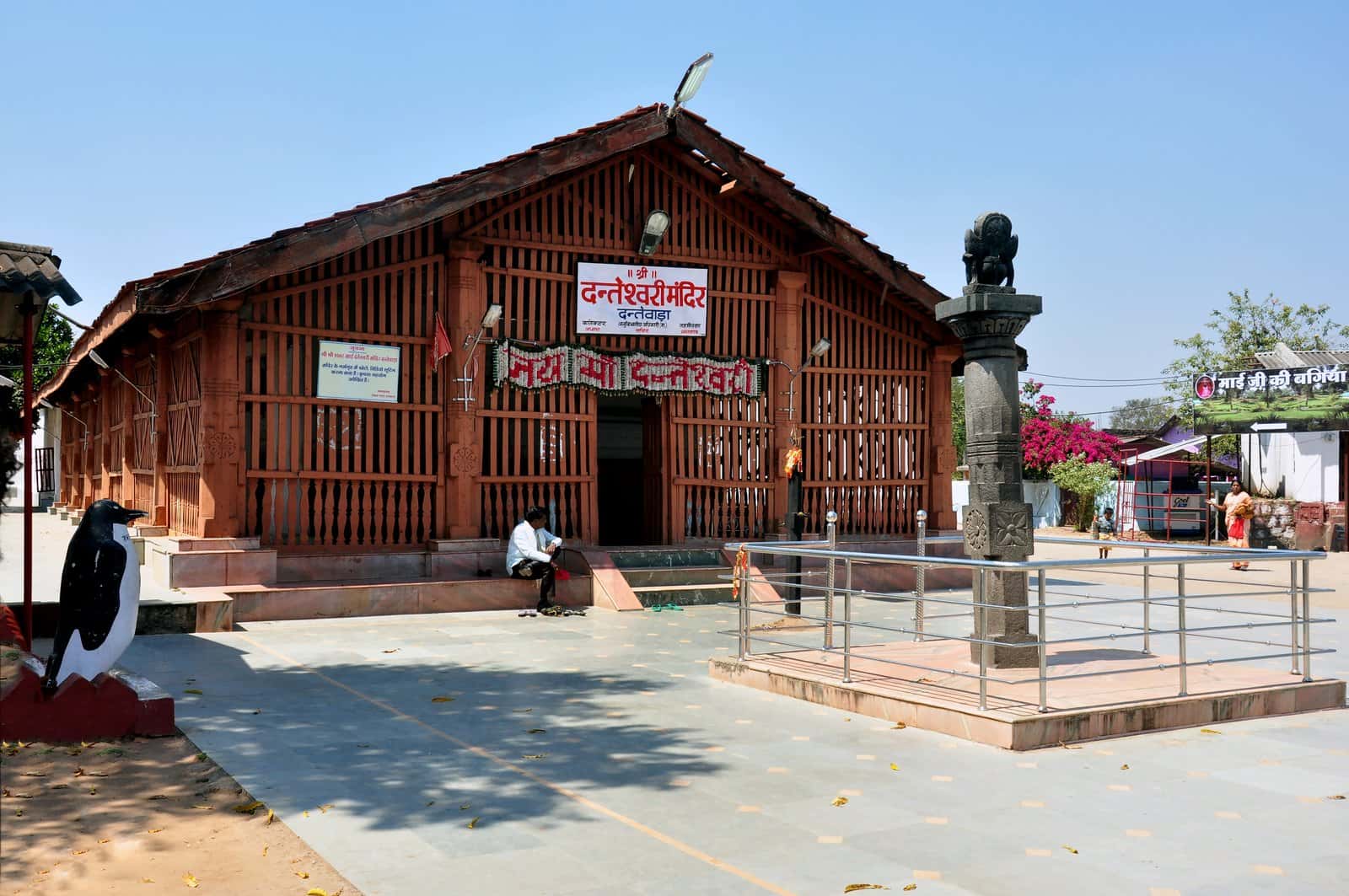
- Danteshwari temple, the Shakti PeethaTradition holds that Sati's tooth fell here, naming both goddess and town. The 14th-century shrine, attributed to the Kakatiya-descended kings of Bastar, is laid out in four mandaps with a black-stone idol of the goddess, and stands near the meeting of the Shankhini and Dankini rivers. Entry is free. Read the temple-rules note below before you go; the dress rule for the inner mandap is real and enforced.
- Barsur, the city of 147 templesAbout 30 to 40 km away via Geedam, Barsur was the Chhindak Naga capital from roughly the 10th to 13th century, remembered in legend as a city of 147 temples and tanks. What survives is remarkable: the Battisa temple on its 32 stone pillars with a fine Nandi, the Mama-Bhanja temple, the Chandraditya temple, and a pair of huge carved Ganesha statues that are among the largest in India, sitting quietly in a village square.
- Dholkal Ganesh, the sentinel on the cliffA roughly 3-foot Naga-period Ganesha of the 10th to 11th century sits alone on a rock summit at about 3,000 feet in the Bailadila range, reached by a forest trek from Faraspal village. Toppled in January 2017 and found in 56 pieces, it was restored to its summit within weeks, joins still visible. The trek is the best half-day in the district; details in the experiences section.
- The quieter cornersThe ancient Samlur Shiva temple sits about 9 km out and is largely intact; the Fulpad waterfall gives an easy trekking excursion in and after the rains; and Bacheli, about 28 km away, is the NMDC township under the Bailadila hills, whose iron ore is the reason the railway exists at all. None takes long, and together they round out a second day.
Men are commonly required to change into a dhoti to enter the inner mandap for close darshan, and the temple provides dhotis free of cost with a changing room, so the rule is easy to follow once you know it exists. Traditional dress is preferred for women. Leave leather belts and bags behind, and keep the camera down inside; sanctum photography is restricted. The temple estate lists morning aarti at roughly 8:30 am to 10:30 am and evening aarti about 6 pm to 7:30 pm, with prasad distribution through the middle of the day, and hours stretch during Navratri. Reconfirm on maadanteshwari.in around festivals.
Signature experiences in and around Dantewada
Beyond darshan, the experiences that make this corner of Bastar worth the journey: the Dholkal climb at dawn, the train through the Ghats, a weekly haat, and the goddess's own festivals.
- Climb to Dholkal for sunriseStart from Faraspal, about 14 km from town, where local guides are hired and a small Parashuram temple marks the trailhead village. Local motorcycles cover the first stretch of the roughly 7 km forest track, then it is a stiff climb of about 2 to 3 hours, with the final 150 to 200 metres a steep rocky scramble that needs both hands. The reward is a lone thousand-year-old Ganesha above a sea of forest, with the Bailadila ridges layered behind. Go at first light, carry water, and skip it in the rains, as the district itself advises.
- Ride the Kirandul lineThe railway that serves Dantewada was built in the 1960s to haul Bailadila iron ore down to Visakhapatnam port, and it happens to be one of the most beautiful lines in India, climbing through the Eastern Ghats past Araku Valley. Even riding a single daylight section is worth it, and Vistadome coaches have run on this route; check current schedules and coach composition on IRCTC when you book.
- Attend an aarti at the Shakti PeethaThe morning aarti window, roughly 8:30 am to 10:30 am, and the evening aarti, about 6 pm to 7:30 pm, are when the temple is most alive. Arrive a little early, change into the dhoti if you want close darshan, and afterwards walk to the river confluence behind the temple and the Bhairav shrine that pilgrims traditionally visit to complete the darshan.
- Time a weekly haatThe rotating weekly markets are Bastar's living culture: Geedam's big haat is commonly cited on Sundays and Barsur's on Fridays, though days can change, so confirm locally. Go on foot, buy some fruit or a bell-metal piece, and ask before photographing anyone. A haat hour teaches more about Bastar than any monument.
- Give Barsur an unhurried half dayThe temple group rewards slowness: the twin Ganeshas first, then the Battisa temple's pillared hall, then Mama-Bhanja and Chandraditya. There is a district-listed homestay in Barsur if you want to sleep among the ruins, and the drive back along the Indravati in late light is a quiet pleasure.
- Come for a festival if you canFagun Madai in February to March fills ten days with palanquin processions and mock-hunt rites, and the run-up to Dussehra in October lets you watch the goddess's doli and chhatra leave for Jagdalpur. Both are living rituals, not staged shows, which is exactly why they are worth planning around.
If you do only one thing slowly, make it Dholkal at dawn. The climb through waking forest, the scramble, and then the small god alone on his rock with the Bailadila range going blue behind him: this is the image of Dantewada people carry home. Budget the whole morning, hire the Faraspal guide, and let the descent be as unhurried as the climb.
Where to stay: Dantewada's thin options and the Jagdalpur base
Be honest with yourself here: Dantewada's own accommodation is basic and limited. The district's homestay list is the characterful choice, and Jagdalpur, 2 hours away, is the comfortable base most travellers actually use.
- In Dantewada town: simple and functionalThe district's official list for the town runs to dharamshalas, government rest houses, a transit hostel and a couple of private hotels such as Hotel Madhuban and Ambar Lodge. Simple rooms commonly run about 500 to 1,500 rupees. Expect clean-enough basics rather than comfort, and book by phone rather than expecting online listings for the smaller places.
- The district homestay listThe administration publishes a small registered homestay list with hosts' phone numbers on dantewada.nic.in, including homestays at Barsur, at Muchnar near Barsur on the Indravati, and at Faraspal, the Dholkal base village. Sleeping at the trailhead the night before a dawn climb, or among Barsur's ruins, is the characterful way to do this region, and the money goes straight to local families.
- Geedam, Bacheli and the townshipsGeedam, the junction town about 12 to 14 km away, has a CG Tourism motel and basic lodges, and the NMDC mining townships of Bacheli and Kirandul keep guest houses that travellers can sometimes access. These are practical rather than atmospheric options, useful if the town is full during festivals.
- The Jagdalpur base strategyMost travellers sleep in Jagdalpur, about 2 hours away, where budget rooms run roughly 900 to 2,000 rupees and mid-range hotels about 2,000 to 4,000 rupees, and day-trip to Dantewada, Barsur and Dholkal. It costs you two early starts but buys comfort, food choice and connectivity, and it slots Dantewada neatly into a wider Bastar circuit with Chitrakote and Kanger Valley.
The town's thin room stock disappears when the pilgrimage calendar peaks: both Navratris, the Dussehra weeks in October and the ten days of Fagun Madai before Holi. If your dates touch a festival, fix your room well ahead or plan to commute from Jagdalpur, and reconfirm homestay bookings by phone a few days out, as these are small family operations, not hotels with front desks.
Dantewada costs and a realistic daily budget
The region is cheap on the ground; the budget lives and dies on transport, because the temple, Barsur and Dholkal are spread across forest roads with no useful public links between them.
- A rough daily budgetExcluding the long journey in and your room, plan on about 1,500 to 2,500 rupees a day travelling frugally, and about 3,500 to 6,000 rupees for a comfortable day with a hired car. Food, darshan and the sights themselves cost next to nothing; it is the distances that shape the number.
- The car is the big line itemA car with a driver commonly runs about 2,500 to 4,000 rupees a day and is close to essential for stringing together the temple, Barsur, Dholkal and a haat in limited time. Shared across three or four travellers it becomes very reasonable, and it is the single best-value decision in the region.
- The near-free thingsTemple entry is free, with donations entirely your choice; Barsur's temples ask little or nothing; and the Dholkal climb costs only the guide you hire at Faraspal, a modest fee you should agree before setting off, plus a bike drop for the first stretch if you take one.
- Cash first, alwaysOutside the bigger Jagdalpur hotels this is a cash economy. Draw what you need in Jagdalpur or Dantewada town before heading out, keep small notes for haats, guides and homestays, and do not count on card machines or reliable UPI connectivity at the villages and trailheads.
Dantewada rewards the traveller who fixes transport first and lets everything else stay simple. A shared car, a homestay bed and haat food make this one of the cheapest genuinely extraordinary trips in India; a solo traveller paying for a full car alone will find the same days noticeably dearer. Decide your group and your car before you fine-tune anything else, and agree every fare and guide fee in advance, which is the local norm rather than a negotiation trick.
Practical logistics: connectivity, language, dress and etiquette
The small print that makes a Dantewada trip smooth: patchy signal, thin English, temple dress rules, and the etiquette of visiting living tribal communities respectfully.
- Connectivity fades fastMobile data is workable in Dantewada town and Geedam but drops away on the forest roads, on the Dholkal track and around the villages. Download offline maps, keep your hotel's and driver's numbers written down, and tell someone your day plan before heading for the trek. Treat a dead zone as normal, not alarming.
- Language and guidesHindi works everywhere and Halbi and Gondi are the languages of the villages; English is thin outside the bigger hotels. A local guide, hired through your hotel, the district's listed homestay hosts or at Faraspal for the trek, earns their fee many times over as translator, fixer and route-keeper.
- Dress and temple etiquetteDress modestly as a default; at the temple, men should expect the dhoti rule for the inner mandap (dhotis are provided free) and everyone should leave leather items and sanctum photography aside. At the river confluence and Bhairav shrine, behave as you would at any living place of worship rather than a monument.
- Respect at haats and villagesThe haats and hamlets are homes, not attractions. Ask before photographing people, buy something rather than only shooting, and never photograph rituals or deities without explicit permission. Travelling with a local guide makes all of this easy and welcome rather than awkward.
The honest safety picture in 2026, and staying well
Dantewada's name carried India's insurgency headlines for two decades, so the question deserves a straight answer: what changed in March 2026, what foreign advisories still say, and what the real day-to-day risks are now.
- The history, without varnishThis district was for years among the most affected by the Maoist (Naxal) insurgency; the 2010 ambush that killed 76 CRPF personnel happened here, and that is the association many readers still carry. Pretending otherwise would be dishonest, and the region's story only makes sense against it.
- What changed in March 2026The government set itself a 31 March 2026 deadline to end Naxalism, and met it: the Bastar police say the region has been free of armed Naxal activity since March 2026, and in May 2026 the Union Home Minister formally proclaimed Bastar Naxal-free at a Jagdalpur press conference, after years of operations and surrenders. The focus has publicly shifted to de-mining remote interior tracts and to development and tourism, and the core visitor circuit of the temple, Barsur, Dholkal, Geedam and the main roads has been travelled routinely for years and is busier than ever.
- What foreign advisories still sayAdvisories lag events, and in mid-2026 they point in different directions. The UK FCDO softened its India pages in spring 2026: it no longer advises against all but essential travel to the Naxal-affected districts, and instead says to seek advice from your travel provider and the local authorities if you plan to visit affected pockets of Chhattisgarh and its neighbours. The US State Department is stricter: within an India advisory that sits at exercise-increased-caution overall, it still lists parts of central and east India, including rural Chhattisgarh, as do-not-travel because of Naxalite terrorism. For foreign passport holders this can affect travel insurance validity, so read your government's current page before booking and decide with open eyes.
- The everyday risks are the real onesFor today's visitor the practical hazards are ordinary: the steep, hands-on final pitch of the Dholkal scramble, heat from March onwards, slippery rocks in the rains, long forest drives, and limited medical facilities outside the towns. Carry water and a basic kit, climb early, keep to daylight for rural driving, and stay on the established visitor circuit rather than improvising into remote interior tracts where de-mining work continues.
Be neither scared off by 2010 nor breezy because of 2026. The declaration is real, the change on the ground is real, and pilgrims, trekkers and festival crowds move through Dantewada constantly; equally, foreign advisories still differ (the UK now says seek local advice, while the US still marks parts of the region do-not-travel), insurance small print follows the advisories, and remote interior tracts are still being cleared of old mines. Stick to the visitor circuit, travel by day, go with local guides, check your government's current advice, and Dantewada in 2026 is a trip the previous decade simply did not allow.
Dantewada for every kind of traveller, and on access
A Shakti Peetha, a trek and a ruined capital pull very different people to the same small town. Here is the honest note for each, including what a senior can and cannot comfortably do.
- PilgrimsThis is one of the 52 Shakti Peethas with an unbroken living tradition, and the aarti windows, the dhoti rule, the river confluence and the Bhairav shrine give a complete darshan. Time your visit to Navratri, Fagun Madai or the Dussehra doli send-off and the pilgrimage becomes something you will not find at the famous crowded Peethas.
- Trekkers and the activeDholkal is the draw: a genuine forest climb with a scramble finish and one of India's most photogenic summits. It needs basic fitness and sure feet rather than technical skill. Pair it with Fulpad's easier waterfall walk and you have a proper active weekend.
- History and temple-architecture loversBarsur alone justifies the trip: a Naga capital's surviving temples and the twin Ganeshas, almost always without another visitor in sight. Add Samlur's ancient Shiva temple and the 14th-century Shakti Peetha and you have a day of serious material with none of the rope-and-ticket apparatus of the famous sites.
- Families with childrenThe temple, Barsur and the haats suit children well; the Dholkal scramble does not suit small ones, and the distances mean long car days. Older children who can handle a 2 to 3 hour climb will remember Dholkal for life. Keep days short, carry snacks and water, and base in Jagdalpur for easier food and rooms.
- Senior travellers and on accessibilityThe temple involves modest walking and is very doable; Barsur is gentle, mostly flat village ground. Dholkal, honestly, is not for anyone unsteady: it is a real climb with a hands-on rocky finish. Seniors should plan the temple and Barsur, enjoy Dholkal through a younger companion's photographs, travel with a car and driver, and keep the long drives broken and in daylight.
- Solo travellers and photographersRewarding for the self-reliant: hire the guide, tell your hotel your plans, and the region is welcoming and quietly proud of its new openness. Photographers get the two great frames of south Bastar, the Dholkal Ganesha at dawn and the Barsur twins, plus the haats, where consent comes first.
A suggested Dantewada itinerary, and how long to give it
One full day covers the essentials from Jagdalpur; a night in the district transforms the trip. Here is how to shape it so the temple, Barsur and Dholkal each get their best hours.
- The day trip from JagdalpurLeave early, reach the temple for the tail of the morning aarti window, do the dhoti-and-darshan properly, then drive back via Geedam to Barsur for the temple group in the early afternoon, and return by evening. It is a full but unhurried day of about 2 hours' driving each way plus the Barsur detour. Dholkal does not fit honestly into this version.
- The one-night version, done rightDay one: temple in the aarti hours, the river confluence and Bhairav shrine, then Barsur through the afternoon; sleep at a district-listed homestay in Barsur or Faraspal, or simply in Dantewada town. Day two: dawn start for Dholkal, 2 to 3 hours up with the Faraspal guide, down by early afternoon, then away. This is the shape that fits everything without strain.
- Two nights for festivals or slownessA second night lets you time a weekly haat (Geedam's is commonly cited on Sundays, Barsur's on Fridays, but confirm locally), add Samlur and Fulpad, or simply attend both aartis in one day. During Fagun Madai or the Dussehra doli days, the second night is what lets you actually witness the rituals rather than drive past them.
- As part of the Bastar circuitMost travellers fold Dantewada into a three-to-four-day Bastar loop from Jagdalpur with Chitrakote Falls and Kanger Valley. Give Dantewada the day-and-a-dawn treatment above, remember Kanger's caves keep a dry-season calendar, and the whole circuit composes naturally: falls, caves, haats, and the goddess's town.
The single scheduling mistake here is treating Dholkal as an afternoon add-on. The climb wants first light: cooler air, kinder light on the summit, and time in hand if the scramble goes slowly. Whatever else moves in your plan, fix the Dholkal dawn first, sleep as close to Faraspal as you can the night before, and let the temple and Barsur arrange themselves around it.
The real questions travellers ask about Dantewada
Straight answers to the questions that come up on TripAdvisor and the trekking forums, so you arrive already knowing the score.
- Is it actually safe now?The visitor circuit, yes, by every current on-the-ground measure: the Bastar police date the end of armed Naxal activity to March 2026, the Union Home Minister proclaimed Bastar Naxal-free in May 2026, and the tourist sites have been visited routinely for years. Foreign passport holders should still read their government's current advisory: the UK has softened to seek-local-advice wording, but the US still marked parts of central and east India do-not-travel at the time of writing, and insurance follows the advisory.
- Can men really not enter in trousers?For ordinary darshan the outer halls are open to respectfully dressed visitors, but for the inner mandap men are commonly asked to change into a dhoti, which the temple provides free with a changing room. Treat it as part of the experience rather than an obstacle; the rule reflects how alive this shrine is.
- How hard is Dholkal, really?A stiff 2 to 3 hour forest climb after a bike-assisted first stretch, finishing in a 150 to 200 metre rocky scramble that needs both hands and sure feet. Fit walkers of any age manage it; anyone unsteady should not attempt the final pitch. Hire the Faraspal guide, go at dawn, and skip it entirely in the rains.
- Day trip or overnight?Temple plus Barsur day-trips comfortably from Jagdalpur. Add Dholkal and you need the overnight, ideally at a homestay near the trailhead. If you have come this far, the overnight is worth it.
- Which is the right railhead?Dantewada's own station, not Jagdalpur. The district lists two daily trains to and from Visakhapatnam, the overnight express taking roughly 10 to 12 hours, and the ride through the Eastern Ghats is a highlight in itself. Check IRCTC for current timings.
- Is Barsur worth the detour?Emphatically. The twin Ganeshas and the Battisa temple are nationally significant sculpture and architecture, seen in village quiet. If you must choose between rushing three sights and doing the temple plus Barsur well, choose the latter and return for Dholkal.
Planning Dantewada from abroad
For the overseas pilgrim or culture traveller, Dantewada is a rare thing: a living Shakti Peetha and a tribal region barely touched by international tourism. It asks two pieces of homework: the advisory question and the logistics.
- Do the advisory homework firstNo permit is needed; Dantewada is open to foreign visitors like any Indian district. But check your government's current advice before booking: India declared the region free of armed Naxal activity in 2026, and the UK FCDO has since softened to seek-local-advice wording for affected pockets, yet the US State Department still lists parts of central and east India, including rural Chhattisgarh, as do-not-travel for Naxalite terrorism, and many travel-insurance policies quietly exclude places under such advisories. Read your government's current page, call your insurer if in doubt, and make the decision explicitly rather than discovering the small print later.
- Route in via Raipur, Hyderabad or the Vizag trainFly into Delhi or Hyderabad, connect to Raipur and drive about 7 hours down NH30, or connect to Visakhapatnam and take the overnight train up the forest line to Dantewada's own station. The Jagdalpur airstrip, about 84 to 88 km away, has had Alliance Air links but is not dependable enough to build an international itinerary around.
- Set expectations: this is not the tourist trailEnglish is thin, hotels are basic, cards rarely work, and nobody is performing for visitors, which is precisely the appeal. Carry cash, book a car with a driver, consider the district-listed homestays, and travel with a local guide who can translate at the temple, the haats and the villages. Modest dress everywhere; dhoti rule at the sanctum for men.
- For NRI families tracing the Shakti Peetha circuitDanteshwari is among the most atmospheric of the 52 Peethas precisely because it is the least commercialised: no queues sold, no VIP darshan industry, a goddess whose festivals still structure the region's year. Pair it with Jagdalpur's Bastar Dussehra season for the fullest version of the tradition, and build in slack for the distances.
Money, connectivity and timing for foreign visitors
The practical basics for a remote district: cash strategy, SIM and signal reality, how many days to give it, and where it fits in a wider India journey.
- Cash strategyDraw well before you need it: Raipur, Visakhapatnam or Jagdalpur are the reliable ATM stops, with a top-up in Dantewada town. Keep small notes for guides, haats, homestays and temple offerings, and assume card machines and payment apps stop working the moment you leave the towns.
- SIM and signalBuy an Indian tourist SIM or eSIM at your arrival airport rather than locally. Coverage is fine in the towns, patchy to absent on the forest roads and the Dholkal track, so download offline maps and share your plan each morning. Treat the disconnection as part of the trip.
- How long to give itTwo nights in the district, or one night here plus a Jagdalpur base, is the right weight: the temple and Barsur on day one, Dholkal at dawn on day two. Inside a two-week India trip, Dantewada plus the Bastar circuit deserves four to five days including transfers, and the Vizag train can carry you onward to Araku and the coast.
- When to come from abroadNovember to February is the comfortable, everything-open window. If ritual draws you, target Fagun Madai just before Holi or the Dussehra doli days in October, and book rooms early for both; if the trek is the point, any dry cool month serves, and the rains rule it out.
Dantewada is not a first-timer's stop, and it does not pretend to be. It is for the traveller who has done the Golden Triangle and wants the India that does not appear in brochures: a tooth of the goddess in a forest town, a thousand-year-old Ganesha alone on a cliff, markets that have run on the same weekdays for centuries. Come with patience, cash and respect, and it repays you with the least performed pilgrimage experience in the country.
Two tooth legends, one forest town
Dantewada's very name is a tooth. Tradition counts the Danteshwari temple among the 52 Shakti Peethas, the places where parts of Sati fell to earth as a grieving Shiva carried her body across the sky; here it was her tooth, the daant, and the goddess who rose from it, Danteshwari, became the presiding deity of all Bastar, the one for whom the 75-day Bastar Dussehra is held and whose doli still travels each autumn from Dantewada to Jagdalpur to be welcomed in the Mavli Parghav. And on the Dholkal summit above Faraspal, local lore tells a second tooth story: that Ganesha and Parashuram duelled on this hill, that the axe broke one of Ganesha's tusks, and that the lone stone Ganesha was seated on the cliff a thousand years ago to remember it, with a Parashuram temple in the village below completing the pair. Two teeth, a goddess and a god, holding one forested corner of India. No single scriptural verse reliably fixes either tale; they live in the Shakti Peetha tradition, the district's own telling and the mouths of the guides who walk you up at dawn.
Planning a Dantewada trip?
Our Chhattisgarh travel experts plan your full journey for you: route, hotels, darshan timings and transport. You get a free day-by-day plan and an exact quote on WhatsApp, usually within a few hours. No payment is needed to get your plan.