Janjgir Travel Guide
The comfortable months are October to March , and the one set-piece is the Magh Purnima fair at Shivrinarayan in February. Decide first whether you want the fair crowd or the...
When to visit Janjgir, and the fair to plan around
The comfortable months are October to March, and the one set-piece is the Magh Purnima fair at Shivrinarayan in February. Decide first whether you want the fair crowd or the quiet town.
- November to February: cool and easyThis is the pleasant window on the Chhattisgarh plain, roughly 10 to 25 degrees by day and cool at night, so carry a light layer. It is the best time to walk the open temple platform at Janjgir and to stand at the river confluence at Shivrinarayan without the heat wearing you down.
- October and March: warm but fineStill comfortable for the temples and the looms, with clear skies. By late March the afternoons begin to heat up quickly, so do the open sites in the morning and keep the middle of the day for a slow lunch or the Champa silk shops.
- April to June: fierce heat, best avoidedHigh summer here is punishing, climbing to about 45 degrees, and the Vishnu temple platform and the Sangam offer little shade. If you must come then, start at first light and rest through the afternoon.
- July to September: green but slowThe monsoon greens the fields and fills the Mahanadi, which is lovely at Shivrinarayan, but rural roads and the drive out from Bilaspur can be slow and muddy, so keep your plans flexible.
The big pilgrimage day at Shivrinarayan is Magh Purnima, the full moon of the month of Magh, which usually falls in February. In 2027 it falls on about 20 February. On that day pilgrims bathe at the meeting of the Mahanadi, Jonk and Shivnath rivers and a large mela fills the town. The exact date shifts each year with the Hindu calendar, so treat 20 February 2027 as the expected date and reconfirm the panchang and the local district notices before you plan around it. If you want the calm rather than the crowd, come on any ordinary winter week instead.
How to reach Janjgir and Champa
Janjgir has no airport of its own. Almost everyone comes by train to Janjgir Naila or Champa Junction, or drives out from Bilaspur or Raipur.
- By train, the natural way inJanjgir has its own small station, Janjgir Naila, right in the town. The bigger and busier stop is Champa Junction, about 7 to 10 km away on the main South East Central Railway line between Howrah and Mumbai, so it has far more trains. Akaltara is another nearby station. For most travellers a train to Champa or Bilaspur is the simplest arrival.
- From Bilaspur, the practical baseBilaspur is only about 65 to 67 km away and is a major railway junction with fast trains, including a Vande Bharat. Many visitors sleep in Bilaspur, where hotels are plentiful, and drive out to Janjgir, Shivrinarayan and the Champa looms for the day.
- From Raipur by roadThe state capital Raipur is about 150 to 175 km away, roughly 3.5 hours by road, and has the region's reliable airport. Janjgir sits near National Highway 49, and there are direct buses to Raipur, Bilaspur, Raigarh and Korba, though a hired car with a driver is far easier for the scattered sites.
- Nearest airportsSwami Vivekananda Airport at Raipur, about 15 km from the city, is the dependable air gateway with flights to Delhi, Mumbai, Kolkata and other metros. Bilaspur also has a small airport at Chakarbhata, but its flights are limited and change often, so check current routes before you count on it.
Fly to Delhi or Mumbai, then take a domestic flight to Raipur. From Raipur it is a road drive of about 3.5 hours, or a train, to the Janjgir and Champa area. There are no international flights into Chhattisgarh.
Fly to Delhi, Mumbai or Kolkata, then connect to Raipur by a domestic flight. Base in Bilaspur or Raipur and day trip out to the temples and the silk town.
Take a train to Champa Junction or Bilaspur on the Howrah to Mumbai main line, or fly to Raipur and drive. Bilaspur makes the easiest hub for a comfortable base.
The Nakata Mandir, its carvings, and the Shiva temple
Janjgir is really one great monument, the unfinished Vishnu temple, plus its small Shiva twin across the road. The reward is the carving, once you know what to look for.
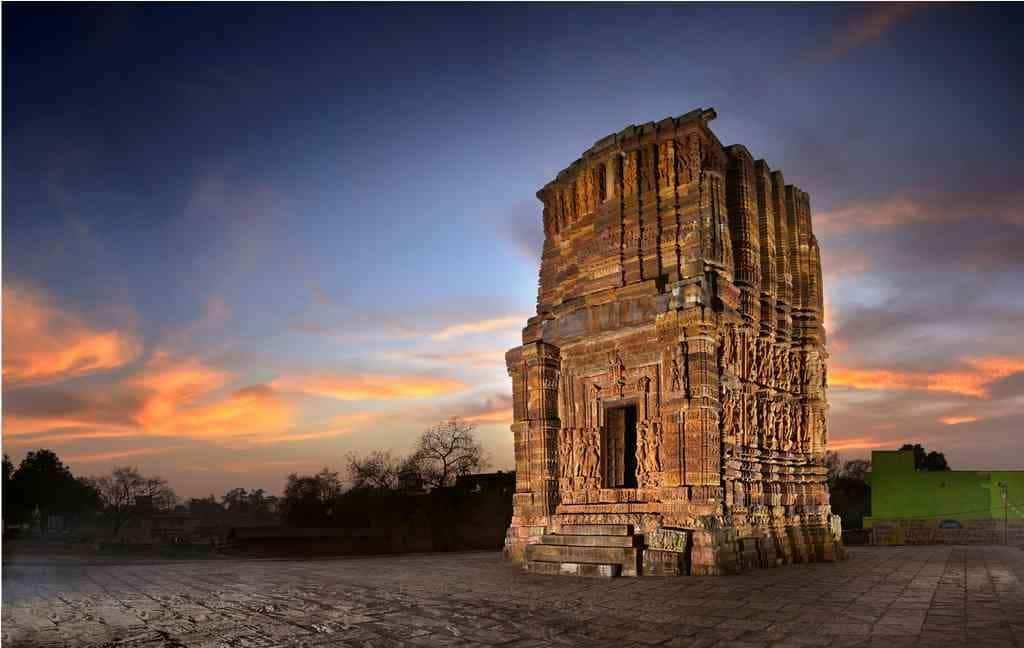
- The unfinished Vishnu temple, or Nakata MandirThe town's headline sight stands on a high platform of about 10 feet in the old quarter near the Bhima Talab tank. It is generally dated to the Kalachuri king Jajalladeva I, who ruled about 1090 to 1120 CE. Locals call it the Nakata Mandir, the temple without a nose, because its tower was left without its crowning top. Give it an unhurried hour and read the platform.
- Read the carvings on the platformThe high platform carries carved panels you can actually decode. Look for scenes from the Ramayana, such as Rama piercing the seven sala trees and the golden deer episode, along with a Mahabharata panel of the Pandavas worshipping a Shiva linga, all worn but readable in good light. This carving, not the height, is the real reason to come.
- The great doorwayThe temple doorway is richly carved with the river goddesses Ganga and Yamuna, their guardian dvarapalas, and the nine planets, the nava-graha, framing the entrance. The plan is a sapta-ratha, with seven projections stepping out from the walls, a signature of the Kalachuri temples of this region.
- The small Shiva temple oppositeAcross the road stands a smaller Shiva temple, tied to an inscription of Jajalladeva I dated 1114 CE, so the two form one compact heritage cluster. It is quieter and often overlooked, but its own carved doorway rewards a few minutes before you move on.
The town tells two stories. In one, the celestial architect Vishvakarma began the temple at dusk meaning to finish it by dawn, and could not. In another, recorded by the early surveyor J. D. Beglar, this temple and the temple at Shivrinarayan were built in a race, the god to live in whichever finished first, and Shivrinarayan won, so Janjgir was left as it stands. Both are local tradition, not documented history. What is certain is simpler: the tower, the shikhara, was never completed. Enjoy the legends as legends, and let the plain unfinished stone tell its own honest story.
Shivrinarayan, Kharod, the Champa looms and the crocodile park
Beyond the Janjgir temple, the district holds a river pilgrimage town, a lakh-linga shrine, the Kosa silk looms of Champa, and an easy crocodile park for families.
- Shivrinarayan and the Triveni SangamAbout 45 km south of Janjgir, Shivrinarayan sits where the Mahanadi, Jonk and Shivnath rivers meet. Its 11th century temple is often called the Jagannath of Chhattisgarh, and tradition places the meeting of Lord Ram and Mata Shabri here. Walk down to the confluence, watch the pilgrims, and see the cluster of Narayan temples that give the town its name.
- Kharod, the Kashi of ChhattisgarhJust about 4 km from Shivrinarayan, Kharod holds the Laxmaneshwar Mahadev temple, where the shivling is said to carry a lakh, one hundred thousand, small lingas, and by tradition even more, one and a quarter lakh, which earns the town its nickname, the Kashi of Chhattisgarh. Shivrinarayan and Kharod are paired as an identified stop on the state's Ram Van Gaman Path, so do them together.
- The Champa Kosa silk loomsThe twin town of Champa is the Kosa silk capital of Chhattisgarh. Ask for a working pit loom rather than only a showroom, and you can watch the wild tussar thread being woven by hand. It is one of the few places in India where you can buy this golden silk almost at its source.
- Kotmi Sonar crocodile parkAbout 35 km from Janjgir near Akaltara, this small park, set up around 2006, keeps mugger crocodiles in a natural tank. It is a gentle, easy add on for families travelling by car, and a pleasant break between the temples.
If you have only one day for the district beyond Janjgir town, give it to Shivrinarayan and Kharod together. The river confluence, the Jagannath of Chhattisgarh and the lakh-linga shrine sit within a few kilometres of each other and tell one connected story on the Ram Van Gaman Path. Go in the morning while the light is soft on the water, and you will have seen the soul of Janjgir-Champa district in a single unhurried half day.
Where to stay for Janjgir, and how long to give it
Janjgir and Champa have only simple hotels, so most travellers base in Bilaspur or Raipur and day trip out. One full day covers the town, two days adds Shivrinarayan and Kharod.
- Bilaspur: the practical baseOnly about 65 to 67 km from Janjgir, Bilaspur has the widest choice of hotels, from budget to comfortable business properties, plus good trains and restaurants. For most travellers it is the sensible place to sleep and the natural hub for day trips into the district.
- Raipur: the airport cityThe state capital, about 150 to 175 km away, has the region's best hotels and the reliable airport. Base here if you are flying in and out and pairing Janjgir with other Chhattisgarh sights like Sirpur or Ratanpur on a wider loop.
- Champa, Janjgir or Akaltara: simple and localIf you would rather sleep close to the sites, Champa, Janjgir and Akaltara have simple budget hotels from about 800 to 1500 rupees and a few mid range business hotels around 1500 to 3000 rupees. They are plain and functional rather than touristy, but they put you on the doorstep of the temples and the looms.
- How many daysHalf a day covers the Janjgir Vishnu temple and its Shiva twin. One full day adds the Champa silk looms and the Kotmi Sonar crocodile park. A second day lets you drive down to Shivrinarayan and Kharod at an unhurried pace, which is the fullest way to see the district.
This is not a place with resorts or heritage stays. The hotels in Janjgir and Champa are basic and aimed at business and pilgrimage travel, not tourism. If comfort matters to you, sleep in Bilaspur or Raipur and treat Janjgir-Champa as a day-trip district. If you value being on the spot over comfort, the local hotels are clean enough and cost little. Either way, book ahead around the Magh Purnima fair, when Shivrinarayan and the whole area fill up.
Janjgir costs and a realistic daily budget
This is a gentle, inexpensive district. The main costs are your bed, a hired car for the scattered sites, and whatever Champa Kosa silk you cannot resist.
- RoomsSimple local hotels in Champa, Janjgir and Akaltara run from about 800 to 1500 rupees for budget rooms and about 1500 to 3000 rupees for a mid range business hotel. Bilaspur and Raipur offer the same and much better besides, so your bed is rarely the big cost here.
- Getting aroundThe sites are spread out, so the single most useful spend is a hired car with a driver for the day, which turns a scattered district into an easy loop. Buses and shared autos connect the towns cheaply if you have time and patience, but a car saves a whole day.
- The temples are freeThe Janjgir Vishnu temple, the Shiva temple, Shivrinarayan and Kharod are open religious and heritage sites with no ticket to enter, so sightseeing itself costs nothing. Carry small change for shoe minding, donations and the occasional guide who may offer to walk you through the carvings.
- Champa Kosa silkA genuine handwoven Champa Kosa saree ranges widely, from roughly about 2000 rupees for a simple piece to about 15000 rupees and well above for fine pure Kosa work. Buying from a weaver or a handloom cooperative usually beats a city showroom on both price and authenticity.
On a Janjgir-Champa trip the two costs that matter are your car for the day and any silk you buy. Sightseeing is free, food is cheap and simple, and the local hotels are modest. So the honest budget question is not how much the temples cost, since they cost nothing, but whether you hire a car to link the scattered sites in comfort and how much Champa Kosa you carry home. Settle both before you set out and there are no surprises.
Practical logistics: food, money, SIM and language
The small things that make a Janjgir day smooth, from the plain honest food to ATMs, mobile signal and the language you will hear.
- Food is simple and honestExpect plain, tasty Chhattisgarhi and North Indian vegetarian food, dhabas and small restaurants rather than cafes. Try local specialities where you can. Carry water and a few snacks for the drives, since the stretches between towns have little on offer.
- Money and ATMsBank ATMs are in Janjgir, Champa and Bilaspur, and UPI works in most shops, but smaller vendors, the silk weavers and rural stops run on cash. Carry enough for the day so you are never stuck at a loom with only a card.
- SIM, signal and getting around townMobile coverage is generally fine for calls, maps and data in the towns, patchier on rural roads. The sites are spread out, so a hired car with a driver is the smoothest way to link them; autos handle short local hops.
- LanguageHindi and Chhattisgarhi are the everyday languages. English is understood in hotels and by younger people but not everywhere, so a little Hindi, or a driver who speaks it, goes a long way in the villages and at the looms.
Safety, holy-site etiquette and staying well
Janjgir is calm, friendly and low on hassle. The main things to mind are the heat, plain travel health sense, and respectful behaviour at the temples and the river.
- A calm, low-hassle placeThis is small-town and rural Chhattisgarh, not a tourist honeypot, so the aggressive touts and scams of famous sites are largely absent. People are curious and welcoming. Normal travel sense is enough: watch your belongings in crowds at the fair, and agree any car or guide price before you start.
- Mind the heat and the sunThe Vishnu temple platform and the river Sangam are open and shadeless. From March onward the sun is strong, so carry water, a hat and sunscreen, and do the open sites early. In the monsoon, steps and riverbanks can be slippery, so tread carefully at Shivrinarayan.
- Water, food and basic healthDrink bottled or filtered water, take the usual care with street food, and carry a small kit for stomach upsets and any personal medicines, since pharmacies are limited outside Bilaspur and Raipur. For anything serious, the bigger hospitals are in those two cities.
- At the temples and the riverThese are living places of worship. Dress modestly, cover shoulders and knees, remove shoes where asked, and ask before photographing people at prayer or bathing at the Sangam. A quiet, respectful manner is always welcome and opens doors to a warmer visit.
Chhattisgarh's small towns are generally calm and hospitable, and Janjgir-Champa sees few tourists, so you are more likely to draw friendly curiosity than trouble. Standard precautions apply: prefer daytime travel between towns, keep someone informed of your plan, choose a reputable driver, and dress modestly at the religious sites. A hired car with a trusted local driver is the single best comfort and safety decision for a woman travelling this offbeat district.
Janjgir for every kind of traveller, and on access
This is a niche, offbeat heritage trip. Here is exactly who it rewards, and the one tip that matters for each, including how a senior does it comfortably.
- Heritage and history loversThis is your kind of place. The unfinished Nakata Mandir and its carved platform reward slow reading, and the Kalachuri story ties together with Shivrinarayan and Ratanpur across the region. Bring a little background and the stones come alive.
- Temple and architecture photographersSoft morning and late-afternoon light on the Vishnu temple platform, the great carved doorway, and the river confluence at Shivrinarayan are the frames to chase. Ask before photographing worshippers, and give yourself both ends of the day.
- Pilgrims and familiesShivrinarayan and Kharod on the Ram Van Gaman Path are the draw for pilgrims, and the Kotmi Sonar crocodile park gives children a break between temples. During the Magh Purnima fair the whole area turns devotional and lively.
- Textile lovers and shoppersChampa is a rare chance to buy Kosa silk close to the loom. Seek out a working weaver or a handloom cooperative rather than only a showroom, ask about the GI Champa silk saree, and you will carry home something genuine.
- Senior travellers and on accessibilityVery doable with a car and a driver. The Janjgir temple sits on a platform with some steps, but you can enjoy much of the carving from ground level, and the towns are flat. Base in comfortable Bilaspur, keep drives short, and visit the open sites in the cool of the day.
- Offbeat and solo travellersIf you like places with almost no other tourists, this district delivers. Accept that facilities are basic, hire a car to link the sites, and enjoy a corner of India that the crowds have not found.
A suggested Janjgir-Champa itinerary
How to shape one or two unhurried days from a Bilaspur or Raipur base so you see the temple, the looms and the river pilgrimage without rushing.
- Day one, morningDrive out early from Bilaspur to Janjgir and spend an unhurried hour at the unfinished Vishnu temple, reading the Ramayana panels on the platform and the carved doorway, then cross to the small Shiva temple opposite. Soft morning light is best for the carving.
- Day one, afternoonMove to Champa for the Kosa silk looms, watching the weaving and shopping directly from a weaver, then, if you have children or time, add the Kotmi Sonar crocodile park near Akaltara on the way back. Return to Bilaspur for the night.
- Day two: the Ram Van Gaman Path pairingDrive south to Shivrinarayan, about 45 km from Janjgir, for the river Sangam and the Jagannath of Chhattisgarh, then the short hop to Kharod for the lakh-linga Laxmaneshwar temple. Go in the morning, and you will have done the district's pilgrimage heart in a half day.
- The half-day versionShort on time on a wider Chhattisgarh trip? Stop only at the Janjgir Vishnu temple and its Shiva twin for a focused hour of Kalachuri carving, then move on to Bilaspur, Ratanpur or Raipur, saving Shivrinarayan and the silk for another visit.
Janjgir-Champa is at its best as part of a bigger central Chhattisgarh circuit rather than a trip on its own. Pair it with Bilaspur, the old Kalachuri capital of Ratanpur, the Buddhist and temple ruins of Sirpur, and the temples of Rajim or Malhar, all reachable from a Bilaspur or Raipur base. Seen that way, the unfinished temple at Janjgir becomes one memorable chapter in a rich, uncrowded heritage state that few travellers ever reach.
The real questions travellers ask about Janjgir
Straight answers to the questions that come up when people plan this offbeat district, so you arrive already knowing the score.
- Why is the Vishnu temple incomplete?Historically, its tower was simply never finished, which is why locals call it the Nakata Mandir, the temple without a nose. The town also tells legends, the one about Vishvakarma building it in a single night, and the one about a race with Shivrinarayan, but those are tradition, not documented fact. Enjoy them as stories.
- What is the difference between Janjgir, Champa and Shivrinarayan?Janjgir is the district headquarters with the Vishnu temple. Champa is its twin town, the Kosa silk capital, a few kilometres away. Shivrinarayan is a separate river-confluence pilgrimage town about 45 km south. People often confuse the three, but they are distinct stops.
- Is Janjgir worth visiting?For a lover of temple carving, textile heritage or the Ramayana trail, yes, very much. For someone wanting resorts, nightlife or a packed sightseeing list, no. Be honest with yourself about the kind of trip you want and this district either delights you or disappoints you.
- Where do I sleep?Most travellers base in Bilaspur, about 65 to 67 km away, or Raipur, and day trip out. Janjgir and Champa have only simple hotels. Sleep where the comfort is and drive to the sites.
- When is the Shivrinarayan fair?On Magh Purnima, the February full moon, which in 2027 falls on about 20 February. Reconfirm the exact date each year, since it moves with the Hindu calendar. Come for the mela, or come on a quiet week for calm.
- Where do I buy real Champa Kosa silk?In Champa itself, ideally from a working weaver or a handloom cooperative rather than only a showroom. Ask about the GI-tagged Champa silk saree. Expect roughly about 2000 rupees for a simple piece up to about 15000 rupees and above for fine pure Kosa.
Planning Janjgir from abroad
Janjgir is a specialist detour for lovers of temple carving, textiles and the Ramayana trail. A little preparation on basing, cars and language makes this low-infrastructure district easy and rewarding.
- Know it is offbeat, and base smartThis is not a polished tourist destination. Fly into Raipur, base in comfortable Bilaspur or Raipur, and day trip out by car. Do not expect resorts or English-language tourist services on the ground. Come for the carving and the heritage, and the roughness becomes part of the reward.
- Hire a car with a driverThe single best decision for an overseas visitor is a car with a good local driver for each day. The sites are scattered, signage and public transport are basic, and a driver who speaks Hindi turns a confusing district into an easy, comfortable loop. We can arrange this as part of a wider Chhattisgarh trip.
- For roots and pilgrimage travellersIf your family is from Chhattisgarh, or you are following the Ram Van Gaman Path, Shivrinarayan and Kharod are deeply meaningful stops, and the Magh Purnima fair is a powerful time to be there. The temples need no explanation for a devout Indian or NRI visitor.
- Buy Kosa silk at the sourceChampa is one of the best places in the world to buy genuine Kosa tussar silk. For an NRI or overseas visitor this is a rare, authentic keepsake. Buy from a weaver or a cooperative, ask about the GI Champa silk saree, and you carry home the real thing.
Money, connectivity and timing for foreign visitors
The practical basics an overseas traveller needs for a low-infrastructure district: cash, a SIM, and how many days to give it on a wider India trip.
- Carry cash, expect the basicsCards and UPI work in hotels and larger shops in Bilaspur and Raipur, but the weavers, small eateries and rural stops around Janjgir run on cash. Draw money at the town ATMs and keep small notes for the looms, shoe minding and tips.
- Get a SIM in the metroPick up an Indian tourist SIM or an eSIM when you land in Delhi, Mumbai or Raipur, not in a small town. Coverage around Janjgir is fine in the towns for maps and calls, and patchier on the rural roads between sites.
- How long to give itOn a wider central India trip, one to two days in Janjgir-Champa is the right weight: one day for the temple and the silk, a second for Shivrinarayan and Kharod. It slots neatly between Bilaspur, Ratanpur and Sirpur on a Chhattisgarh heritage loop.
- Time it to the cool seasonOctober to March is the comfortable window, with pleasant days around 10 to 25 degrees. Avoid the April to June heat, which climbs to about 45 degrees on the open temple platform. Time it to Magh Purnima in February if you want the Shivrinarayan fair.
Chhattisgarh is one of India's least-visited states, and Janjgir-Champa is offbeat even within it. That is exactly its appeal for the right traveller: uncrowded temples, living craft, and warm curiosity rather than tourist hustle. Come with a good driver, a flexible attitude, and an eye for carving and textiles, base yourself in comfort, and this quiet corner rewards you with a side of India that very few overseas visitors ever see.
The temple that lost the race, and never grew its crown
Janjgir's great Vishnu temple has stood unfinished for some nine hundred years, and the town has two ways of explaining it. In one, the celestial architect Vishvakarma began the temple one evening, meaning to raise the whole thing between dusk and dawn, and when the night ran out before the work was done he laid down his tools and left it as it stood. In the other, recorded by the early surveyor J. D. Beglar, this temple and the temple at Shivrinarayan were built in a race, and it was declared that the god would take up residence in whichever was finished first. Shivrinarayan won, Narayan settled there, and the Janjgir temple was abandoned, its tower forever without its crowning top, which is why people call it the Nakata Mandir, the temple without a nose. Both are stories the town tells, not history that can be proved. What is certain is that a Kalachuri king set carvers to work here around the turn of the twelfth century, that they covered the platform and the doorway with the Ramayana and the river goddesses, and that they stopped before the end, leaving behind one of the most quietly moving unfinished monuments in India.
Planning a Janjgir trip?
Our Chhattisgarh travel experts plan your full journey for you: route, hotels, darshan timings and transport. You get a free day-by-day plan and an exact quote on WhatsApp, usually within a few hours. No payment is needed to get your plan.