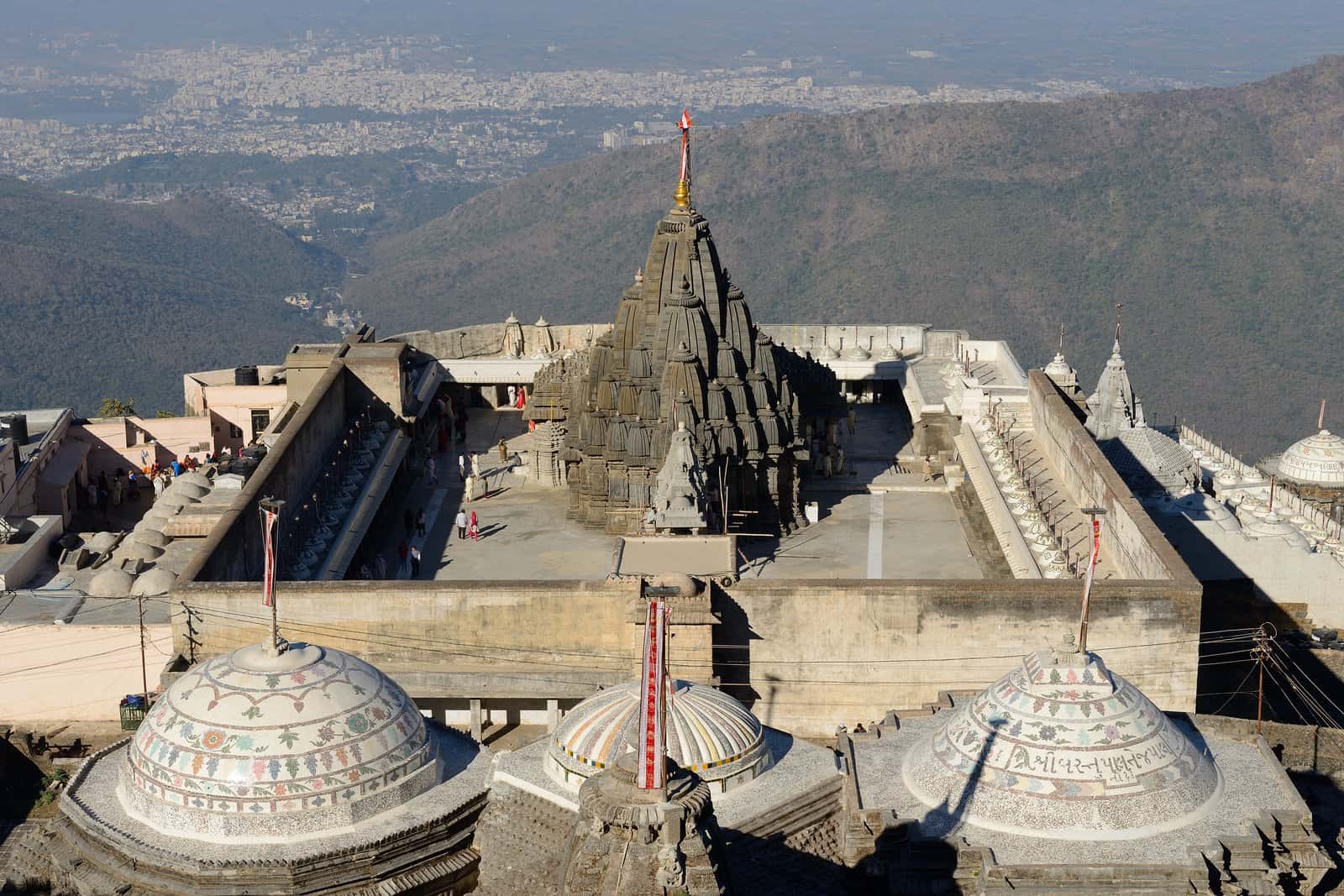
Girnar Travel Guide
The comfortable window is October to March , and the great set-piece is the Lili Parikrama around Kartik in November. Decide early whether you want the pilgrim crowds or a quiet...
When to visit Girnar, and the walk to plan around
The comfortable window is October to March, and the great set-piece is the Lili Parikrama around Kartik in November. Decide early whether you want the pilgrim crowds or a quiet climb.
- November to February: cool and clearThe most comfortable months, pleasant by day and cold at dawn, which is exactly when you want to be on the steps. This is peak pilgrim and tourist season, so the ropeway queues are longer and Junagadh's limited rooms fill, but the climate is the only sensible one for a big climb.
- October and March: warm but fineStill good for the mountain, with thinner crowds than the deep-winter peak. By late March the Saurashtra afternoons heat up fast, so start any climb before dawn and be off the open steps by mid-morning.
- April to June: fierce heat, best avoidedHigh summer on the Saurashtra plain is punishing, and the thousands of open stone steps offer little shade. If you must come then, use the ropeway, keep the middle of the day for rest, and do not attempt the full summit climb.
- The monsoon, roughly June to SeptemberThe hills turn green and beautiful, but the steps are slippery, low cloud can hide the summit, and heavy weather can suspend the ropeway. It is also when the nearby Gir lion safari is closed, so most visitors skip the monsoon for a serious Girnar trip.
The Lili Parikrama, the 36 km circumambulation of the Girnar range, is timed to Kartik month and starts from the Bhavnath temple at the taleti. In 2026 it is widely expected around 20 to 24 November, but those dates are not the confirmed official calendar, so treat them as expected only and reconfirm on Gujarat Tourism or the Junagadh administration site before you book. If you want the spectacle, come for it and expect well over a lakh pilgrims on the route; if you want a quiet climb, avoid those days entirely, because the mountain and the town are overwhelmed.
How to reach Girnar and Junagadh
Girnar sits just outside Junagadh town in Saurashtra. There is no airport or station at the mountain, so almost everyone comes through Junagadh Junction or Rajkot.
- By train to Junagadh JunctionJunagadh Junction is the practical railhead, roughly about 5 to 7 km from the Bhavnath taleti where the climb and the ropeway begin. It has direct trains from Mumbai, Ahmedabad, Rajkot and beyond. From the station take an auto-rickshaw or taxi to the taleti, a short hop of about 15 to 20 minutes.
- By air via Rajkot or AhmedabadThe nearest airport is Rajkot at about 100 km, roughly 2 to 2.5 hours by road, with limited domestic flights. For wide connections, including international, use Ahmedabad at about 320 to 330 km and drive or take a train down. There are no flights to Junagadh itself.
- By road across SaurashtraJunagadh is well linked by state and private buses to Rajkot, Ahmedabad, Somnath and Diu, and sits naturally on a Saurashtra loop. Roads are decent, and a hired car with a driver is the easiest way to string Girnar together with Somnath and Gir.
- The last leg to the mountainFrom Junagadh town it is a short drive to the Bhavnath taleti, the base of Girnar, where the stone stairway and the ropeway lower station both start. Autos are easy to find; agree the fare first, as with anywhere in India.
Fly into Ahmedabad (or Mumbai), then continue to Junagadh by train or road, about 320 to 330 km. Girnar has no international flights of its own, and pairs naturally with Somnath and a Gir lion safari on a Saurashtra loop.
Fly into Ahmedabad, the nearest wide-connection airport, then drive or take a train down to Junagadh. Rajkot airport, about 100 km from Junagadh, has limited domestic links if your route allows a change there.
Take a train to Junagadh Junction, the simplest way in, or fly to Rajkot or Ahmedabad and drive. Junagadh sits on the Saurashtra rail and road network with Rajkot, Somnath and Ahmedabad all easy to reach.
The temples of the mountain, and the summit truth
Girnar is a stack of shrines up one sacred mountain: the Jain cluster, then the Ambaji, Gorakhnath and Dattatreya peaks. The one rule to know is that the ropeway does not reach the top.
- The Jain temples at Dev-kotAbout a third to halfway up, the Dev-kot cluster is among the oldest and most revered Jain pilgrimage sites in western India, a group of carved marble temples with the great Neminath shrine at its heart. Some Jain temples do not allow shorts, so dress accordingly.
- Ambaji temple, where the ropeway landsThe Ambaji (Ambika) temple sits at about 5,000 steps, and this is where the ropeway upper station is. For many visitors this is the natural turnaround: darshan at Ambaji, the view over Junagadh and the plain, then back down.
- Gorakhnath peak and Kamandal KundHigher up the ridge, the Gorakhnath peak (the highest point of the range) and the Kamandal Kund lie beyond Ambaji, reached only on foot by climbing on and then down into a saddle and up again. This is the hard middle of the climb.
- Dattatreya, the summit shrineThe Guru Dattatreya (Datta) shrine on the highest temple peak, at about 9,999 steps from the base, is the summit goal for Hindu pilgrims. It is a long, steep climb well beyond where the ropeway can take you, so plan for it honestly or turn back at Ambaji.
This is the fact that surprises most first-timers and that competitor pages bury. The Girnar ropeway lands at the Ambaji stage, a little over halfway up at about 5,000 steps. The Gorakhnath peak and the summit Dattatreya shrine are still several thousand steps higher and can only be reached on foot. The cable car saves you the first, easier half of the climb; it does not save you the mountain. Decide before you buy a ticket whether Ambaji is your goal or whether you are climbing on to the summit.
The Girnar ropeway: fares, hours and what it really does
Asia's longest passenger ropeway turns a punishing half-climb into a seven-minute ride to Ambaji. Here are the official fares and hours, and the limits worth knowing.
- FaresThe base return adult ticket is about 700 rupees and a one-way ticket about 400 rupees; a child aged 5 to 10 is about 350 rupees and children under 5 (or under about 110 cm) ride free. Note that about 18 percent GST is added for non-local visitors, so a return adult ticket comes to roughly about 826 rupees in practice. Buy online on the official Udan Khatola site to skip the counter queue, and reconfirm the current fare before you travel, as the operator raised it in late 2024 and discounts it during the Shivratri mela.
- TimingsThe official Udan Khatola site lists timings of about 7 am to 5 pm, with the ticket window closing around 5 pm and riders expected down by early evening, all subject to weather. Go early: the queue builds through the morning in season, and afternoon wind or cloud can pause the ride.
- What the ride isIt is about a 7 to 8 minute glide over roughly 2,320 metres of cable in an eight-seat cabin, run by Usha Breco and opened in October 2020. The views over Junagadh and the ridge are superb, and it saves around 5,000 steps of climbing to the Ambaji stage.
- What it does not doIt does not reach the Gorakhnath or Dattatreya summit; those are a foot climb above Ambaji. If your goal is the summit, the ropeway is a head start, not a substitute for the climb.
During the annual Mahashivratri Mela, when the Bhavnath area at the taleti fills with sadhus and hundreds of thousands of pilgrims, online ropeway booking is suspended and the ride runs at a crush. In 2026 the fair fell around 11 to 15 February. If your dates land on the mela, expect very long queues and plan to buy at the counter or, better, avoid the ropeway on those days. Reconfirm the exact mela dates and any booking rules on the official Udan Khatola site before you travel.
Climbing Girnar: the steps, the hours and the descent
The full climb to Dattatreya is about 9,999 stone steps and a real mountain day. Here is how the steps stack up, when to start, and the honest truth about coming down.
- The step ladder, temple by templeFrom the taleti base it is roughly 5,000 steps to the Ambaji stage (where the ropeway also lands), then on and up to the Gorakhnath peak, the Kamandal Kund, and finally the Dattatreya summit shrine at about 9,999 steps. Between Ambaji and Dattatreya you climb down into a saddle and back up, which is why the second half feels harder than the numbers suggest.
- How long it takesA reasonably fit walker takes about 5 to 7 hours up and down from the base. Using the ropeway to Ambaji and climbing only the upper section cuts hours off and spares the worst of the ascent, and is what many people now do.
- When to startStart in the dark, around 4 to 5 am, if you want to reach the summit for sunrise and beat the heat on the open steps. There are tea and refreshment stalls along the way, but carry water. In summer, a pre-dawn start is not optional but essential.
- The descent, honestlyComing down is faster but is where the day catches up with you: thousands of stone steps punish the knees, and many people feel the descent more than the climb the next day. Trekking poles or a stick, and taking the steps slowly, help a great deal.
Wear proper trainers or trekking shoes with a decent sole, not sandals, and loose, modest clothing; remember some Jain temples do not allow shorts. Carry water, a little cash for the stalls, sun protection for the open steps, and a light layer for the cold summit at dawn. Leather belts, wallets and bags should come off before you enter the temples.
Uparkot Fort, the Ashokan edicts and Junagadh town
Girnar is the headline, but Junagadh town rewards a full day: a restored fort with ancient caves and stepwells, a rare set of Ashokan edicts, and a fairytale mausoleum.
- Uparkot FortReopened in late 2023 after a large restoration, Uparkot is the essential half-day sight: ancient rock-cut Buddhist caves, the Adi Kadi Vav and the deep spiral Navghan Kuvo stepwells, and ramparts over the old town. It is open roughly about 8 am to 6 pm; entry is about 25 rupees for Indian visitors and about 300 rupees for foreign visitors, so reconfirm the current fee on site.
- The Ashokan Rock EdictsOn the road between Junagadh town and the taleti, a large boulder carries the edicts of Emperor Ashoka from the 3rd century BCE, still in their original place. It is a short, rewarding stop for anyone interested in history, and easy to fold into the drive to or from the mountain.
- Mahabat MaqbaraIn the town, the Mahabat Maqbara is a wildly ornate 19th-century mausoleum of the Nawabs of Junagadh, with spiralling minaret staircases and a mix of styles. Check locally whether the interior is open, as access varies, but the exterior alone is a highlight.
- How to fit it inGive the mountain one full day and the town another. Uparkot Fort, the Ashokan edicts and Mahabat Maqbara make an easy, walkable second day, and leave you fresh for the climb rather than trying to cram everything into one exhausting push.
Junagadh is the gateway to Gir, the last wild home of the Asiatic lion, about 60 to 65 km away. Most people who come for Girnar also do a Gir safari, but it is a separate trip with its own booking and timing, covered in the itinerary section. If lions are on your list, plan the extra night before you fix your dates.
Where to stay for Girnar, and how many nights
Base yourself in Junagadh town for choice and comfort, or near the taleti to be first on the steps. Two nights is the sweet spot for the mountain and the town.
- Junagadh town: the practical baseThe town has the widest choice of hotels and guesthouses, restaurants and ATMs, and is a short drive from the taleti. This is the sensible base for most visitors, with more comfort and food options than the trailhead area.
- Near the Bhavnath taleti: first on the stepsSimple dharamshalas and basic lodges sit near the base of the mountain, handy if you want to start the climb before dawn without an early drive. Expect pilgrim-basic rather than comfort, and book ahead in season and around the mela.
- How many nightsOne full day covers the mountain if you use the ropeway and climb only the upper section. Two nights in Junagadh is the comfortable plan: the mountain one day, Uparkot Fort and the town the next. Add a further night if you want a Gir lion safari.
- Room budgetsJunagadh is a working town, not a resort, so rooms are modest and good value: basic lodges from about 800 to 1,500 rupees, decent mid-range hotels about 2,000 to 4,000 rupees, and the better business hotels around 4,000 to 7,000 rupees. Prices and availability tighten sharply around the mela and the Parikrama.
During the Shivratri Mela in February and the Lili Parikrama around November, Junagadh's limited rooms and the taleti lodges sell out weeks ahead and rates jump. If your dates fall on either, book well in advance, or base yourself in Rajkot and drive in for the day. On normal winter dates there is plenty of choice and no need to rush a booking.
Girnar and Junagadh costs and a realistic daily budget
Junagadh is gentle on the wallet outside the big fairs. Here is what the main things cost, so you can plan and avoid being overcharged for a doli or a ride.
- A rough daily budgetExcluding long-distance transport, plan on about 1,500 to 2,500 rupees a day as a budget traveller, about 3,500 to 6,000 rupees mid-range, and more once you add a Gir safari. Junagadh's food is cheap and good, and the sights are inexpensive, so the mountain day itself costs little beyond the ropeway.
- The fixed-price thingsThe Girnar ropeway is about 700 rupees return for an adult and about 350 rupees for a child. Uparkot Fort is about 25 rupees for Indian visitors and about 300 rupees for foreign visitors. These are the rare set prices in Junagadh and make a useful anchor for the rest.
- The doli or palanquinIf you cannot climb, porters carry a doli or palanquin up the mountain for a negotiated rate commonly quoted from about 4,000 to 5,000 rupees or more, depending on how high you go and the number of bearers. Agree the price and the exact destination temple before you set off, because how far up you go changes everything.
- Cash and cardsJunagadh town has plenty of bank ATMs and cards or UPI work in hotels and bigger restaurants, but the mountain stalls, autos and the doli are cash. Carry enough cash for the climbing day, as there is nothing to draw on once you are on the steps.
The only real friction in Junagadh is the negotiable stuff, above all the doli and the autos. Agree the price and, for the doli, the exact temple you will be carried to before anything begins. A rate settled in advance, ideally with the number of bearers named, turns the mountain's one sore point into a non-event, and quotes to visitors always start high and come down without drama.
Safety, health and the climb's real risks
Girnar is safe and welcoming, and the real risks are physical: the heat, the steps, and overdoing a big climb. A little care keeps the day a joy.
- Know your limit on the stepsThe climb is long and steep and the descent is hard on the knees. Be honest about your fitness, use the ropeway to Ambaji if in doubt, and turn back rather than push a summit attempt you are not ready for. Chest pain, dizziness or breathlessness means stop and rest, and come down.
- Heat, sun and waterThe stone steps are open and exposed. Start in the cool before dawn, carry water and sun protection, and refill at the stalls on the way. In the hotter months, heat exhaustion is the genuine danger, far more than any crime.
- Food, water and monkeysDrink bottled or filtered water and take normal care with street food. Monkeys along the steps will snatch food and loose bags, so keep snacks zipped away and do not tease or feed them.
- Crowds and footingOn mela and Parikrama days the steps are crowded and the pace is slow, so keep children close and mind your footing on worn stone, especially coming down. After rain the steps can be slick, and the ropeway may pause in high wind.
Girnar is a pilgrimage mountain with a steady flow of families and devotees, and most solo travellers, including women, find it comfortable with standard precautions. The steps are busy in daylight; simply avoid starting a solo climb in the dark unless you are with others, dress modestly for the temples, and you will find Junagadh a friendly, low-hassle place by Indian standards.
Girnar for every kind of traveller, and on access
Girnar suits very different visitors in different ways. Here is what it offers you and the one tip that matters for each, including how far up an older pilgrim can comfortably get.
- Senior travellers and on accessibilityThe ropeway gets an older pilgrim comfortably to the Ambaji temple, which for many is the goal, without the 5,000-step climb. Beyond Ambaji is a foot climb that is not realistic for most seniors, and a doli is the only alternative. Plan Ambaji darshan by ropeway, keep the summit for the fit, and be honest about the knees on any steps.
- Families with childrenThe ropeway to Ambaji is a hit with children and the sane choice with little ones. The full summit climb is too much for small children; older kids who like a challenge can do the upper section with plenty of breaks. Keep everyone close on crowded mela days.
- Trekkers and the fitThe full base-to-Dattatreya climb of about 9,999 steps is a proper mountain day and a rewarding one, best done from a pre-dawn start for sunrise. Skip the ropeway if the climb is the point, and pace the descent to save your knees.
- Jain pilgrimsThe Dev-kot temple cluster is the heart of a Jain visit, one of the great pilgrimage sites of western India, reached partway up. You can climb to it directly, or take the ropeway toward Ambaji and walk across. Observe the temple dress rules; shorts are not allowed in some shrines.
- Solo travellersAn easy, friendly place to travel alone, with a constant flow of pilgrims on the steps by day. Start the climb with others rather than alone in the dark, and Junagadh town is relaxed and low-hassle for solo stays.
- PhotographersThe ropeway glide, the sunrise from the summit, the carved Jain marble and the ramparts of Uparkot are the shots. Ask before photographing people at prayer, and mind the temple rules on cameras inside the shrines.
A suggested Girnar and Junagadh itinerary
How to shape one, two or three days so you get the mountain at the right hours and fold in the fort, the edicts and, if you want, the lions of Gir.
- Day one: the mountainReach the taleti before dawn. Fit climbers start the steps around 4 to 5 am for a summit sunrise and a slow descent by late morning. Everyone else takes the first ropeway to Ambaji, does darshan and the view, and is back down by lunch. Rest in the afternoon; the climb earns it.
- Day two: Junagadh townA gentler day for Uparkot Fort with its caves and stepwells, the Ashokan Rock Edicts on the taleti road, and the Mahabat Maqbara in town. All are close together and walkable, and it is a good recovery day after the steps.
- Day three: the lions of GirIf you want a Gir lion safari, add a third day and, ideally, a night at Sasan Gir, about 60 to 65 km away. Book the safari online well ahead on the official Gujarat forest portal, and remember it is closed from about 16 June to 15 October for the monsoon.
- The Saurashtra loop versionOn a wider trip, string Junagadh and Girnar with Somnath, about 85 km south, and Gir in between, or continue to Diu on the coast. Two to four days in this corner covers the mountain, the great Shiva temple and the lions comfortably.
The single thing that ruins a Girnar day is starting the climb too late. The steps are open and shadeless, so a summit attempt means being on the stairs before dawn to catch sunrise and be down before the heat. If you are only going to Ambaji by ropeway, take the first ride of the day to beat both the queue and the sun, and keep the hot middle of the day for the fort or a rest. Build the day around the light and you will never be caught baking on the steps with hours still to climb.
The real questions travellers ask about Girnar
Straight answers to the questions that come up again and again on traveller forums and trek blogs, so you arrive already knowing the score.
- Does the ropeway go all the way to the top?No. It lands at the Ambaji stage, a little over halfway up at about 5,000 steps. The Gorakhnath peak and the Dattatreya summit are still thousands of steps higher on foot. If the summit is your goal, the ropeway is a head start, not the whole answer.
- How hard is the trek, really?Hard but doable if you are reasonably fit: about 9,999 steps to the summit and roughly 5 to 7 hours up and down. The middle section, where you climb down and back up to reach Dattatreya, is the sting, and the descent hits the knees. Train a little, start early, and pace it.
- Can my older parents or my children do it?By ropeway, yes, to the Ambaji temple, which is a satisfying goal in itself. Beyond that is a foot climb that suits neither small children nor most seniors, and a doli is the only carried option, at a negotiated cost. Plan Ambaji as the turnaround unless everyone is fit for the summit.
- When should I start the climb?Around 4 to 5 am if you want the summit for sunrise and to beat the heat. Ropeway-only visitors should take one of the first rides, from about 7 am, to skip the queue. In summer an early start is essential, not optional.
- How do I get there and how many days do I need?Train to Junagadh Junction, or fly to Rajkot or Ahmedabad and drive. Give Girnar itself one full day, add a second for Uparkot Fort and the town, and a third if you want a Gir lion safari, which is a separate booking.
- Should I aim for the Parikrama or avoid it?The Lili Parikrama around November is an extraordinary sight but brings well over a lakh pilgrims and overwhelms the town and mountain. Come for it deliberately if the crowd is the experience you want; otherwise avoid those dates and climb in the quiet.
Planning Girnar from abroad
Girnar is the great spiritual mountain of Saurashtra and pairs naturally with Somnath and a Gir lion safari. A little preparation makes the climb, the ropeway limit and the temple rules easy to handle.
- Understand the ropeway, then the climbThis is the one thing to grasp before you go: the ropeway reaches the Ambaji temple only, about halfway up, and the summit Dattatreya shrine is a further foot climb of thousands of steps. Decide whether Ambaji by cable car is enough for you or whether you are here to climb, and plan the day accordingly.
- Expect a pilgrim mountain, not a resortJunagadh is a working Gujarati town, not a tourist resort, so lodging is modest and food is simple vegetarian Gujarati fare. That is part of the character. Eat well and cheaply, keep expectations realistic on hotels, and treat the mountain as the main event.
- Pair it with Somnath and GirFly into Ahmedabad, then loop down through Junagadh and Girnar, the Somnath Shiva temple about 85 km away, and a Gir lion safari in between. It is one of the richest short circuits in western India: a sacred mountain, a great coastal temple, and the last wild Asiatic lions.
- Foreign visitor fees and rulesSome sights charge more for foreign visitors, for example Uparkot Fort at about 300 rupees against about 25 rupees for Indian visitors, so carry cash and your passport for ID. Observe temple etiquette: remove leather and shoes where asked, dress modestly, and note that some Jain shrines do not allow shorts.
Money, connectivity and timing for foreign visitors
The practical basics an overseas traveller needs for a small pilgrim town and a big climb: cash, a SIM, and how many days to give Girnar on a wider Gujarat trip.
- Carry cash for the mountainCards and UPI work in Junagadh's hotels and bigger restaurants, but the mountain stalls, the autos and the doli are cash. Draw cash at a town ATM before your climbing day, because there is nothing to draw on once you are on the steps.
- Get a SIM in the cityPick up an Indian tourist SIM or an eSIM when you land in Ahmedabad rather than hunting for one in Junagadh. Coverage in town and on the lower mountain is generally fine for maps and calls, though it thins near the summit.
- How long to give it on a bigger tripOn a Gujarat or Saurashtra itinerary, give Girnar and Junagadh one full day for the mountain and one for the town, then a day for Gir if you want the lions. Two to four days covers this corner comfortably alongside Somnath, without rushing the climb.
- Time it to the cool monthsOctober to March is the only comfortable window for the climb or even the ropeway, with a cold pre-dawn on the summit. Avoid the April to June heat and the monsoon, and decide whether you want the November Parikrama crowd or a quiet mountain before you fix your dates.
Girnar is an unusually rewarding introduction to spiritual Gujarat: a mountain stacked with Jain and Hindu shrines, reached by Asia's longest ropeway or by an honest hard climb, in a friendly working town rather than a tourist bubble. Slot it into a Saurashtra loop with Somnath and Gir, give the mountain the early morning it deserves, and be clear-eyed that the ropeway is a head start and not the summit. Many overseas visitors find this corner of Gujarat, with its lions and its sacred peak, the part of the trip they remember most.
Why Girnar is holy to Jains and Hindus alike
Girnar is one of the rare mountains that two great traditions climb together. For Jains, the Dev-kot cluster partway up enshrines Neminath, the twenty-second Tirthankara, who is held to have renounced the world and attained liberation on this peak, which makes Girnar among the most sacred of all Jain tirthas in western India. For Hindus, the summit belongs to Guru Dattatreya, the three-in-one form of Brahma, Vishnu and Mahesh, whose footprints are venerated on the highest temple peak; below him stand the shrines of Ambaji the mother goddess and of the yogi Gorakhnath, and at the taleti the Bhavnath temple that gathers sadhus for the Shivratri mela. So the same 9,999 steps carry Jain and Hindu pilgrims past one another all the way up. The exact chronology of these shrines is a matter of tradition and inscription rather than a single dated text, so we tell it as the living pilgrimage tradition of the mountain, not as a claim to one authoritative source.
Planning a Girnar trip?
Our Gujarat travel experts plan your full journey for you: route, hotels, darshan timings and transport. You get a free day-by-day plan and an exact quote on WhatsApp, usually within a few hours. No payment is needed to get your plan.