Jamnagar Travel Guide
The best months are October to March . If the Marine National Park is your reason to come, there is a second rule that matters more than the season: the coral walk only works at...
When to visit Jamnagar, and the tide rule for the marine park
The best months are October to March. If the Marine National Park is your reason to come, there is a second rule that matters more than the season: the coral walk only works at low tide.
- November to February: cool and clearThe most comfortable time on the Gulf of Kutch coast, pleasant by day and cool in the mornings. This is also the prime window for the migratory birds at Khijadiya and for the intertidal walk in the marine park, when the light is clean and the heat is gone.
- October and March: warm but fineStill good for sightseeing and the temples, with the heat building by late March. The marine-park walking season runs about October to March, so these are the shoulder months. Do the open ghats, the lake and the reef walk early in the day before the sun climbs.
- Time the marine park to the tide, not just the seasonWhatever the month, the coral and intertidal walk at Narara or Pirotan is only possible at low tide, when the reef is exposed. The good low-tide window shifts by roughly an hour each day, so the exact date and hour have to be chosen around the tide table, not just the weather. We check the tide tables for your dates so you are at the reef when it is walkable.
Skip April to June, when the coastal afternoons turn hot and sticky and the open reef is punishing, and the June to September monsoon, when the marine park is effectively closed for walking and the winter birds have not yet arrived. October to March is the season for everything Jamnagar does well, and within it a cool clear morning at low tide is the prize.
How to reach Jamnagar
Jamnagar has its own airport and railway station, and sits on the Saurashtra road network, so it is an easy base for the Dwarka and Somnath circuit.
- By airJamnagar airport is about 10 km from the city. IndiGo began a daily direct Navi Mumbai to Jamnagar service from 23 April 2026, flown from the new Navi Mumbai airport (NMIA) and not from Mumbai CSMIA, so check current schedules and the correct airport; otherwise Rajkot, about 90 km away, and Ahmedabad, about 305 to 315 km away, are the larger airports with wider connections. Flight routes change, so reconfirm before you rely on a direct flight.
- By trainJamnagar Junction is on the Saurashtra rail network with trains from Ahmedabad, Rajkot and Mumbai. Book ahead on IRCTC in the October to March season, which is busy with pilgrims for the Dwarka and Somnath circuit, and aim for a daytime arrival so you can settle in before an early temple or tide start the next morning.
- By road, and as a circuit baseBy road it is about 90 km from Rajkot and about 305 to 315 km, roughly 6 to 7 hours, from Ahmedabad on NH947 and NH27. From Jamnagar, Dwarka is about 130 to 150 km, roughly 3 hours, and Somnath about 210 to 230 km, which makes the city a comfortable base for the Jyotirlinga loop. We arrange a car with an experienced driver for the temple legs.
Fly into Mumbai or Ahmedabad, the main gateways for Gujarat, then continue to Jamnagar by a short domestic flight, train or car. Jamnagar's own airport now has a daily direct link to Navi Mumbai (the new NMIA airport, distinct from Mumbai CSMIA), handy for the onward leg.
Fly into Ahmedabad or Mumbai and continue to Jamnagar by road or rail. From there the Dwarka and Somnath Jyotirlinga circuit is an easy two to three day loop.
Jamnagar is well linked by train and road across Saurashtra and Gujarat, about 90 km from Rajkot and about 305 to 315 km from Ahmedabad, and now has a daily direct flight to Navi Mumbai (the new NMIA airport, not Mumbai CSMIA).
The Marine National Park: Narara the easy way, Pirotan the permit way
The Gulf of Kutch off Jamnagar holds India's first marine national park, where you walk out over a living reef at low tide. There are two ways in, and choosing the right one is the whole game.
- Narara, the easy no-boat walkNarara is the simple choice. You reach it by road and walk out on foot over the exposed reef at low tide, no boat and no diving, to find coral, sea anemones, octopus, starfish and crabs in shallow water. The coral walk takes roughly 3 to 4 hours and is timed to the tide. Charges vary by source and change, so reconfirm with the Forest Department for your date; commonly cited figures are about 40 to 100 rupees per person for Indians and around 10 US dollars for foreign nationals, about 300 rupees for the guide and about 200 rupees for a still camera, with roughly 25 percent more on weekends and holidays.
- Take the local guide, it is mandatory and worth itA Forest Department naturalist guide is required at Narara and genuinely worth the fee. They know the safe low-tide window, where the best creatures are that morning, and how to walk the slippery reef without harming it or yourself. Carry your original ID, as it is checked at entry. We can arrange the guide and the timing for you.
- Pirotan, the permit-heavy islandPirotan is about 18 nautical miles by boat from Bedi port and is the harder, more pristine option. It needs several permits booked well in advance, from the Forest Department plus Customs and the Ports authority, and foreign nationals also need police clearance. It must be arranged ahead through the Conservator of Forests office in Jamnagar and is entirely tide-dependent, so it is for the keen wildlife traveller with time, not a casual add-on.
- When the park worksThe walking season is about October to March, and any walk only works at low tide. Outside that window, in the heat and the monsoon, the park is effectively closed for walking. Plan the date around the tide table first, then the calendar.
Declared in stages, sanctuary in 1980 and national park in 1982, this was India's first marine national park, covering roughly 162 sq km across about 42 islands with coral reefs and mangroves. It is a rare place where you can walk into the intertidal world rather than dive to it. For most visitors Narara delivers nearly all of that magic with none of the Pirotan permit effort, so we usually steer first-timers there.
Bala Hanuman, Lakhota Lake and the city sights
In the city itself, the unbroken Ramdhun at Bala Hanuman and the island palace on Lakhota Lake are the heart of a Jamnagar day, with one closure to plan around.
- Bala Hanuman and the living recordBeside Ranmal (Lakhota) Lake, Bala Hanuman temple holds a Guinness World Record for the continuous chanting of the Ramdhun, Shri Ram Jai Ram Jai Jai Ram, going on without a break since 1 August 1964 (some local sources say 1956, so we cite the widely recorded 1964 date). It is open daily, roughly 6 am to 9 pm. Sitting in the chant for a while, especially at evening aarti, is the city's signature moment.
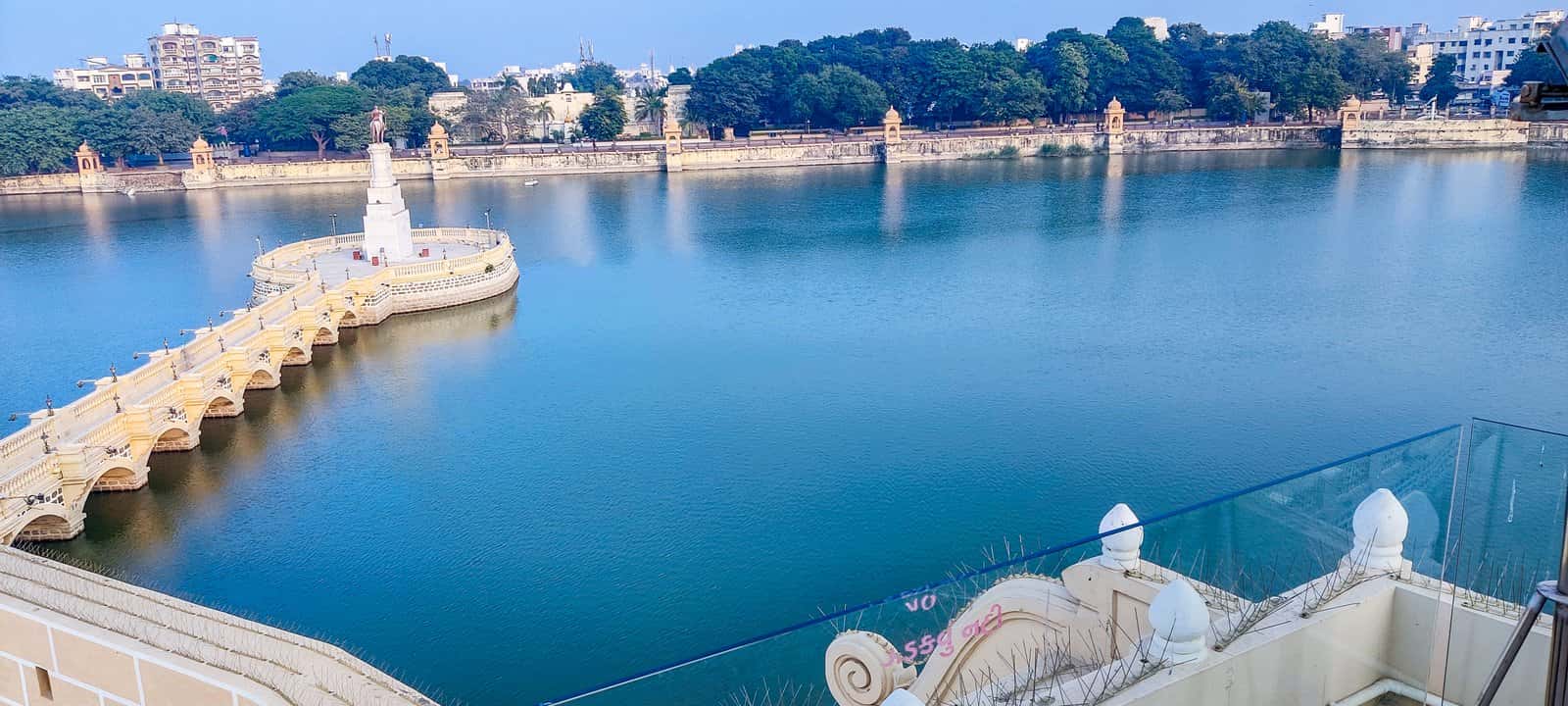
- Lakhota Palace and MuseumOn a little island in the middle of Ranmal (Lakhota) Lake, this old royal palace is now a museum of the region's history, with pottery, swords and even a whale skeleton among the exhibits. Entry is small, about 10 rupees for Indians and about 50 rupees for foreign visitors. It makes an easy stroll across the causeway, but plan around the closure days noted below.
- The lake, the laser show and the old cityRanmal (Lakhota) Lake is the green lung of the city, with a nominal entry of about 10 rupees per adult and 5 per child, around 75 bird species including flamingos and pelicans, and a fountain and laser show with about 3 shows daily at roughly 25 rupees per adult and 15 per child. The surrounding old town carries Jamnagar's brass-working and Bandhani heritage, and a short guided walk brings the trades and the lake palace to life.
Lakhota Palace and Museum is closed on Wednesdays and on the 2nd and 4th Saturday of the month, as well as on public holidays. The fountain and laser show is also closed on Wednesdays. Bala Hanuman and the lakeside walk stay open, so build the museum and the show around those closed days, and keep a Wednesday for the temple, the bazaar or the marine park instead.
Signature experiences in and around Jamnagar
Beyond the headline sights, these are the experiences people remember, and how to arrange them without guesswork.
- Walk the reef at Narara at low tideThe standout experience: walking out over a living reef in ankle-deep water to find octopus, starfish, anemones and coral, no boat and no diving. Go with the mandatory guide at the right low tide, wear old shoes you do not mind soaking, and step carefully so the reef stays unharmed. Children and grandparents alike manage it on a calm morning.
- Watch the birds at KhijadiyaKhijadiya Bird Sanctuary, India's 49th Ramsar site since 2 February 2022, supports over 300 species where freshwater and marine wetlands meet. Early morning in winter is best, and a local guide turns a quiet marsh into a procession of flamingos, pelicans, ducks and, if you are lucky, the rare Pallas's fish-eagle or Indian skimmer.
- Sit in the Ramdhun at Bala HanumanSpend a little while with the unbroken chant that has run since 1964. It is a moving, very local experience, especially at the evening aarti, and costs nothing but a few quiet minutes. It is the kind of small, true moment that a fast Dwarka run skips entirely.
- Shop for brass and BandhaniJamnagar is the Brass City and a historic home of Bandhani tie-and-dye. Pick up brass decorative pieces and a genuine Bandhani saree or dupatta from the old-city bazaars; ask your guide which workshops are the real makers rather than resellers, and bargain gently, as it is welcomed.
- Use Jamnagar as a Jyotirlinga baseFrom here, Dwarka with the Dwarkadhish temple and Nageshwar Jyotirlinga is a comfortable day out (Nageshwar is about 18 km beyond Dwarka, near Bet Dwarka), and Somnath is reachable on a longer drive. We can build the temple circuit around a restful Jamnagar base so you are not changing hotels every night.
If you do one thing slowly, make it the low-tide reef walk at Narara. The window is short and tide-bound, so give it a full unhurried morning rather than squeezing it between two temple drives. People remember kneeling over a live octopus in ankle-deep water long after the rest of the trip blurs, and rushing it to the clock is the surest way to miss the magic.
Where to stay in Jamnagar, and how many nights
Stay near the lake and the old city to be close to the sights, or out by the highway for newer business hotels. One to two nights is the sweet spot for the city, more if you base the whole circuit here.
- Near the lake and old cityStaying close to Ranmal (Lakhota) Lake and the bazaars keeps Bala Hanuman, the palace museum and the brass and Bandhani lanes within easy reach, which suits a short city stay and an early start for the marine park or birding. It is the most atmospheric base for first-timers.
- Business hotels on the city edgeJamnagar is a refinery and industrial city, so it has a good spread of clean, comfortable mid-range and business hotels on the outer roads, often better value and quieter than the centre, though you will want a car for the sights. A natural choice for families and for circuit travellers who want space.
- How many nightsTwo days is the right weight for Jamnagar itself: one for the city (Bala Hanuman, the lake and palace, the bazaars) and one tide-timed marine morning at Narara or a Khijadiya birding morning. If you base the Jyotirlinga circuit here, add nights for the Dwarka and Somnath day trips rather than moving hotels each evening.
- Book ahead in seasonOctober to March is pilgrim and birding season, and good rooms fill on weekends and around festivals. Book a little ahead, especially if your dates fall on a long weekend or a temple festival on the Dwarka and Somnath circuit, when the whole of Saurashtra is busy.
The quiet advantage of Jamnagar is that it is comfortable enough to settle into and central enough to reach both Dwarka and Somnath. Rather than a different hotel every night across Saurashtra, many travellers do better basing two or three nights in Jamnagar and running the temples and the marine park as day trips, returning to the same calm lakeside city each evening. It is gentler on seniors and far less tiring with children.
Jamnagar costs and what to budget
Jamnagar is gentle on the wallet. The sights cost little, the real expense is the car for the temple legs. Here are the numbers so you can plan and avoid being overcharged.
- The small fixed costsMost city sights are inexpensive. Ranmal (Lakhota) Lake entry is about 10 rupees per adult and 5 per child, the Lakhota Museum about 10 rupees for Indians and 50 for foreign visitors, and the fountain and laser show about 25 and 15 rupees. Bala Hanuman is free. These are nominal, so the museum and lake are easy to fit in even on a tight budget.
- The marine parkNarara is the main paid experience and the one that varies, so reconfirm for your date: commonly about 40 to 100 rupees per person for Indians and around 10 US dollars for foreign nationals, about 300 rupees for the mandatory guide and about 200 rupees for a still camera, with roughly 25 percent more on weekends and holidays. Pirotan adds boat hire and permit costs and is in a different bracket.
- The real expense: the carThe biggest line on a Jamnagar trip is usually the car and driver for the Dwarka, Nageshwar and Somnath day trips, since the temples are 130 to 230 km out and back. A full-day car with driver, fuel and tolls is the sensible way to do those legs comfortably; we quote it for your dates and group size.
- Cash, cards and the dry-state noteCards and UPI work in hotels and bigger shops, but the bazaars, the marine-park guide and small eateries run on cash, so carry enough for the day. Remember Gujarat is a dry state, so there is no bar bill to budget for unless you have applied for a liquor permit, covered in the overseas section.
Almost everything in Jamnagar is cheap and fixed, so there is little to haggle over in the city. The one number worth pinning down before you commit is the car for the temple circuit, because the distances to Dwarka and Somnath are what shape the budget far more than any entry fee. Agree the full-day car rate, inclusions and the route in advance, and the trip has no nasty surprises.
Practical logistics: food, money, getting around and the dry-state rule
The small things that make a Jamnagar day smooth, from the vegetarian Gujarati thali to ATMs, getting around, and the one rule that surprises visitors: it is a dry city in a dry state.
- Eat the Gujarati thali, drink nothing strongerSaurashtra food is excellent and largely vegetarian; a proper Gujarati thali is the meal to seek out. Gujarat is a dry state, so alcohol is not sold or served openly, and you will not find a bar. If you want a drink you must hold a liquor permit, covered in the overseas section, so plan meals around the food rather than the drink.
- Getting around the city and out to the sightsThe city core, the lake, Bala Hanuman and the bazaars, is compact and walkable, with auto-rickshaws for short hops. The marine park, Khijadiya and the temple circuit are out of town, so a car with a driver is the practical way to do them, especially with the tide-timed early start at Narara.
- Money, ATMs and connectivityBank ATMs are easy to find in the city, and cards and UPI work in hotels and larger shops, but carry cash for the bazaars, the marine guide and small eateries. Mobile coverage in the city is good for maps, calls and data; out at Narara and Khijadiya it can be patchy, so download maps and tide times before you set off.
- Carry ID and start earlyCarry an original photo ID, which is checked for the marine-park permit and useful at temples and hotels. The two things that go wrong in Jamnagar are arriving at the reef on the wrong tide and reaching the museum on a closed day, so confirm the tide and the closures the day before and start your marine or temple mornings early.
Safety, the reef, and staying well
Jamnagar is a calm, low-hassle city with little of the tout pressure of bigger tourist towns. The main risks are practical: the slippery reef, the sun, and the dry-state liquor rule.
- On the reef: footing, sun and the tideThe intertidal reef at Narara is slippery and sharp in places, so wear old closed shoes you can soak, step where the guide steps, and never wander out alone or against the incoming tide. Carry water, a hat and sun protection; the open reef has no shade and the sun is strong even in winter. Watch children closely around the pools.
- Do not handle the wildlifeIt is tempting to pick up an octopus or a starfish, but handling stresses the animals, some can sting or bite, and it damages a protected ecosystem. Look, photograph, and let the guide show you, but do not touch or remove anything. This is a national park, and the reef is what you came to protect as well as to see.
- The dry-state rule is enforcedGujarat prohibits alcohol, and carrying or buying liquor without a valid permit is a genuine offence, not a formality. Foreign tourists and NRIs can apply online for a temporary permit (see the overseas section). Do not bring liquor across the state line without one, and do not assume a hotel can quietly arrange a drink.
- Everyday health and comfortDrink bottled or filtered water, take the usual care with street food, and pace the temple day trips, which are long drives. The city is safe and easy to walk by day and evening, with low hassle compared with the big tourist circuits, so the main thing to manage is the heat and the driving distances rather than any real risk.
Jamnagar is a working Gujarati city rather than a tourist hotspot, and most solo travellers, including women, find it relaxed and low-pressure with standard precautions. Dress modestly at the temples, keep to the busier lanes and the lakeside in the evening, and arrange the out-of-town marine and temple trips through your hotel or us with a known driver. The friction here is logistical, the tides and the distances, far more than any safety worry.
Jamnagar for every kind of traveller, and on access
Jamnagar rewards very different visitors in different ways. Here is what it offers you, and the one tip that matters for each, including how a senior pilgrim does it comfortably.
- Pilgrims on the Jyotirlinga circuitJamnagar is the natural comfortable base between Dwarka with Nageshwar Jyotirlinga and Somnath, two of the twelve Jyotirlingas. Stay here, do the temples on day trips with verified timings, and return to a calm lakeside city each evening rather than changing hotels every night.
- Senior travellers and on accessibilityVery doable as a restful base. Keep the city sights gentle, use a car with a driver for the Dwarka and Somnath legs, and pick a calm low-tide morning at Narara rather than the long boat trip to Pirotan. The reef walk is flat but uneven and slippery, so take it slowly with the guide, and build in unhurried mornings between the long temple drives.
- Families with childrenThe Narara reef walk is a genuine thrill for children, finding live octopus and starfish in the shallows, and the lake, palace museum and laser show make an easy afternoon. Go at low tide with a guide and old shoes, and keep little ones in sight on the reef and near the water.
- Nature and wildlife loversA rare double bill: India's first marine national park and the Ramsar-listed Khijadiya wetlands, both at their best October to March. Plan the marine walk to the tide and the birds to the early morning, and consider the Pirotan permits ahead if you want the wilder island.
- PhotographersReef textures and tide pools at Narara, flamingos at Khijadiya, the lake palace at golden hour, and the brass bazaars. Early light and the low-tide window give the cleanest marine shots; carry a still camera and the camera fee for the marine park, and ask before photographing people at prayer.
- Culture and craft loversThe Brass City and a long Bandhani tradition reward a slow old-city walk. Seek out the genuine brass workshops and Bandhani makers rather than the resellers, and let a local guide open the lanes and the lake palace, where a whale skeleton sits among the royal exhibits.
A suggested Jamnagar itinerary
How to shape two days in and around Jamnagar so you catch the reef at the right tide and the temples at the right hours, with the Dwarka and Somnath legs slotted in cleanly.
- Day one: the cityStart at Bala Hanuman for the morning chant, then cross to Lakhota Palace and Museum on the lake island (avoid Wednesday and the 2nd and 4th Saturday). Spend the afternoon in the brass and Bandhani bazaars, and end at the lake for the evening birds and, on an open day, the fountain and laser show.
- Day two: the marine morningGo out early to Narara for the low-tide reef walk with the mandatory guide, timed to the tide table, or to Khijadiya for the winter birds at dawn. Keep the afternoon gentle, since the morning is the long part, and rest before the temple day trips.
- The Dwarka and Nageshwar day tripFrom a Jamnagar base, drive about 130 to 150 km to Dwarka for the Dwarkadhish temple (roughly 6 am to 1 pm and 4 pm to 8 pm) and Nageshwar Jyotirlinga about 18 km on (roughly 6 am to 12 pm and 4 pm to 8 pm). Leave early for a calm darshan and you are back by the lake the same evening.
- The Somnath legSomnath is the longer drive, about 210 to 230 km, with the temple open roughly 5 am to 12 pm and 4 pm to 9 pm and a famous evening sound-and-light show. Many travellers give it an overnight near Somnath rather than a same-day return, then loop back through Saurashtra; we can shape it either way.
The single thing that breaks a Jamnagar plan is fixing the day before checking the tide, then arriving at Narara at high water with nothing to see. Build the whole two days around the low-tide window first, then drop the city sights, the bazaars and the temple drives into the hours around it. Confirm the tide and the museum closures the day before, and the plan holds together without a wasted morning.
The real questions travellers ask about Jamnagar
Straight answers to the questions that come up again and again on traveller forums, so you arrive already knowing the score.
- How many days, and is it worth it?Two days suits Jamnagar: one for the city and one tide-timed marine or birding morning, plus the temple day trips on either side. It is well worth more than the one-night halt the OTA packages give it, especially if the marine park, the birds or a restful circuit base appeal to you.
- Narara or Pirotan?For almost everyone, Narara. It needs no boat and far less paperwork, you walk straight out over the reef at low tide, and it delivers most of the marine magic. Pirotan is for keen wildlife travellers with time to arrange the Forest, Customs and Ports permits well ahead.
- Why does the tide matter so much?The reef is only exposed and walkable at low tide; at high tide there is simply nothing to see and it is unsafe. The good window shifts about an hour each day, so the visit is planned around the tide table, not a fixed opening time. Always confirm the tide for your date.
- How do foreign tourists and NRIs get a drink?Gujarat is dry, but non-residents aged 21 and over can apply online for a temporary liquor permit at eps.gpeonline.co.in, usually valid about 7 days for a small fee of around 70 rupees (often free for foreign tourists). Carry your passport and the receipt, and never carry liquor without the permit.
- What are the temple timings from here?Dwarkadhish opens roughly 6 am to 1 pm and 4 pm to 8 pm, Nageshwar roughly 6 am to 12 pm and 4 pm to 8 pm, and Somnath roughly 5 am to 12 pm and 4 pm to 9 pm, all with morning and evening aarti. Go early for a calm darshan, and reconfirm timings on festival days when they change.
- When is the Lakhota Museum closed?The museum is closed on Wednesdays and on the 2nd and 4th Saturday of the month, and on public holidays, and the lake laser show is also closed on Wednesdays. Keep a Wednesday for Bala Hanuman, the bazaar or the marine park, and slot the museum and show on an open day.
Planning Jamnagar from abroad
For the overseas pilgrim and the diaspora family, Jamnagar is the restful base for the Dwarka and Somnath Jyotirlinga circuit. A little planning, and one online permit, make it smoother.
- Gujarat is a dry state: get the permit onlineAlcohol is prohibited in Gujarat, but non-residents aged 21 and over, including foreign tourists and NRIs, can apply online for a temporary liquor permit on the Gujarat prohibition portal (eps.gpeonline.co.in). The visitor permit is commonly issued for about 7 days for a small fee of around 70 rupees, and foreign tourists are often charged nothing. Carry your passport and the receipt, and never carry liquor without a valid permit, as it is a serious offence.
- Arrive through Mumbai or AhmedabadFly into Mumbai or Ahmedabad, the main gateways for Gujarat, then continue to Jamnagar by a short domestic flight, train or car. Jamnagar's own airport now has a daily direct link to Navi Mumbai (the new NMIA airport, distinct from Mumbai CSMIA) for the onward leg, which shortens the journey for families coming a long way.
- Use Jamnagar for the Jyotirlinga circuitDwarka with the Dwarkadhish temple and Nageshwar Jyotirlinga is about 130 to 150 km away, and Somnath, another of the twelve Jyotirlingas, about 210 to 230 km. Basing in Jamnagar lets diaspora families do the temples by day with verified timings and rest by a calm lake each night, rather than packing and moving constantly.
- Gentle and senior-friendlyWith a car and driver for the temple legs and the easy no-boat Narara walk rather than the permit-heavy Pirotan trip, Jamnagar is comfortable for parents and grandparents. Just plan the marine walk to a low tide, carry passports for ID checks, and keep the temple day trips unhurried, with morning starts to beat the heat and the crowds.
Money, connectivity and timing for foreign visitors
The practical basics an overseas traveller needs for a Saurashtra base: cash and cards in a small city, a SIM, ID for the marine permit, and how many days to give Jamnagar on a wider Gujarat trip.
- Carry cash, expect cards in bigger placesHotels and larger shops take cards and UPI, but the bazaars, the marine-park guide and small eateries are cash places. Draw cash at the city ATMs and keep small notes for entry fees, guides and tips. Out at Narara and Khijadiya there is no card facility, so go with cash for the day.
- Get a SIM at the airportPick up an Indian tourist SIM or an eSIM when you land in Mumbai or Ahmedabad rather than hunting for one in Jamnagar. Coverage in the city is good for maps and calls, but it can be patchy out at the reef and the wetlands, so download offline maps and the tide times before you head out.
- Carry your passport for ID checksCarry an original passport: it is needed for the marine-park permit, useful at hotels and helpful with the liquor permit. Keep a copy separately. The marine guide checks ID at entry, so do not leave it locked in the hotel safe on a Narara or Pirotan morning.
- How long to give it on a bigger tripOn a Gujarat or Saurashtra loop, two to three nights in Jamnagar is the right weight: enough for the city, a tide-timed marine morning and the Dwarka, Nageshwar and Somnath day trips, without slowing the wider itinerary. Time the visit to October to March for the season and a workable low tide.
Jamnagar is an easy, low-hassle introduction to Saurashtra: a calm working city with little tout pressure, a rare marine national park you can walk into, and the great Krishna and Shiva temples within day-trip reach. For a diaspora family doing the Jyotirlinga pilgrimage, it makes a gentler, more restful base than rushing the coast hotel to hotel, and the two practical things to sort before you arrive are the tide window for Narara and, if you want a drink, the online liquor permit.
The Ramdhun that has not stopped since 1964
Beside the lake in the heart of Jamnagar, in the Bala Hanuman temple, a single line has been sung without a break for more than sixty years: Shri Ram Jai Ram Jai Jai Ram. Relays of devotees keep it going through every hour of every day and night, and the unbroken Ramdhun, recorded as running continuously since 1 August 1964, holds a place in the Guinness World Records for the longest non-stop chanting of a mantra. Some local accounts give the start year as 1956, so the honest position is to cite the widely recorded 1964 date and note the difference. Whichever year you take, the meaning is the same: step in off the lakeside, sit a while, and you join a sound that has not fallen silent in the lifetimes of most people reading this, a small, true, unhurried thing that the fast Dwarka and Somnath run drives straight past.
Planning a Jamnagar trip?
Our Gujarat travel experts plan your full journey for you: route, hotels, darshan timings and transport. You get a free day-by-day plan and an exact quote on WhatsApp, usually within a few hours. No payment is needed to get your plan.
Tour packages that visit Jamnagar
Every journey below is private, hand-crafted and fully customizable. Tell us your dates and we tailor the itinerary, the pace and the priests or guides around you.
Nageshwar Somnath Jyotirlinga Tour Package
- Visit Sabarmati Ashram
- Visit Lakhota Palace
 19D / 18N
12 Jyotirlinga Tour Package from Delhi
- All Jyotirlinga darshans
- Ganga Aarti experiences
Char Dham Yatra In India
- Puri
- Dwarka
 6D / 5N
Gujarat Holiday Packages
- Visit Somnath and Nageshwar Jyotirlinga.
- Visit Dwarkadheesh Temple and Bhet Dwarka.