Junagadh Travel Guide
The comfortable months are October to March , and they are also the only window when the Sasan Gir lion safaris run. If lions are on your list, that season is not optional.
When to visit Junagadh, and the season that governs Gir
The comfortable months are October to March, and they are also the only window when the Sasan Gir lion safaris run. If lions are on your list, that season is not optional.
- November to February: cool and clearThe most comfortable time by far, pleasant by day and cool at night, and the peak season for the Girnar climb and the Gir safaris. Book safari permits and rooms ahead, as this is when everyone comes.
- October and March: warm shoulderStill good, with fewer crowds. Gir safaris run from about mid October, so late October is a fine time to arrive. By late March the afternoons warm up quickly, so do the climb and the fort early in the day.
- April to June: fierce heatHigh summer on the Saurashtra plain is punishing, up to about 40 degrees, and the open climb and the fort are hard going. Gir stays open until about mid June, but a safari in that heat is uncomfortable and the lions lie low.
- July to September: monsoon, and Gir shutsThe rains bring greenery but also the Gir jeep-safari closure. If your trip falls in the monsoon and you still want lions, the Devalia safari park is the only option, covered in the safari section below.
Sasan Gir jeep safaris are closed from about 16 June to 15 October every year, for the monsoon and the lions' breeding season. This is the single most common trip-wrecker for visitors who plan a summer or monsoon lion safari and only discover the closure on arrival. If you want a Gir safari, build your trip firmly into the mid October to mid June window, and reconfirm the exact reopening date on the official state portal. In the closed window, only the Devalia Interpretation Zone safari park runs, and it is itself shut on Wednesday.
How to reach Junagadh
Junagadh sits in the heart of Saurashtra, on the rail map and a couple of hours from the new Rajkot airport. Most travellers come by train or drive in on a Somnath and Gir loop.
- By train to Junagadh JunctionJunagadh Junction, station code JND on the Western Railway, has direct trains from Ahmedabad, roughly 316 to 350 km and about 7 hours, and frequent services from Rajkot, about 100 to 103 km. Book on IRCTC a little ahead in the October to March season.
- Nearest airportsThe closest airport is Keshod, about 39 km away, but it is thin and unreliable with limited flights, so do not build a plan around it. The practical air gateway is the new Rajkot Hirasar international airport, about 100 km away, with Ahmedabad the larger hub a longer drive off.
- By road on a Saurashtra loopJunagadh slots naturally into a Saurashtra drive with Somnath, about 90 km on, and Diu beyond, plus Gondal and Rajkot to the north. Roads are good and the distances are manageable, and we can arrange a car with an experienced driver.
- Onward to Sasan GirSasan Gir is about 60 km from Junagadh, roughly 1.5 hours by road. A taxi is the most reliable way across, from roughly 2,000 rupees one way and more often about 3,000 to 3,500 rupees for a full safari day of drop, wait and return; buses are irregular and shared jeeps run from near the station.
Fly into Mumbai or Delhi, then connect to Rajkot or Ahmedabad and drive to Junagadh. There are no international flights into Junagadh itself, and the small Keshod airport is unreliable.
Fly into Ahmedabad, the nearest large airport with wide connections, then drive or take a train down to Junagadh. It sits easily on a Saurashtra circuit with Somnath, Gir and Diu.
Take a train to Junagadh Junction from Ahmedabad, Rajkot or Mumbai, or fly to Rajkot and drive about 100 km. The rail route through Rajkot is the simplest way in for most domestic travellers.
Girnar, Uparkot Fort, the Ashoka edicts and the Nawabs' tombs
Junagadh packs a sacred mountain, a restored ancient fort with rock-cut stepwells, some of India's oldest inscriptions, and one of the country's most extravagant tombs into one compact town.
- Girnar and its shrinesThe sacred mountain above town, with a stone stairway of roughly 9,999 to 10,000 steps climbing past a cluster of Jain temples to the Hindu shrines at Amba Mata, Gorakhnath at about 1,117 metres, and the Guru Dattatreya peak. It is both a pilgrimage and one of India's great climbs, described in full in the experiences and safety sections.
- Uparkot FortAn ancient hill fort believed founded around 319 BC and besieged many times, reopened on 30 September 2023 after a major restoration. Inside are old Buddhist caves and two extraordinary rock-cut stepwells, the Adi-Kadi Vav about 41 metres deep and the Navghan Kuvo about 52 metres deep with a spiral stair down to the water.
- The Ashoka rock edictsOn the road towards Girnar, a single large boulder carries the 14 Major Rock Edicts of Emperor Ashoka in Brahmi from about 250 BC, along with the later Rudradaman and Skandagupta inscriptions. It is one of the most important epigraphic sites in India and easy to fit in on the way up to the mountain.
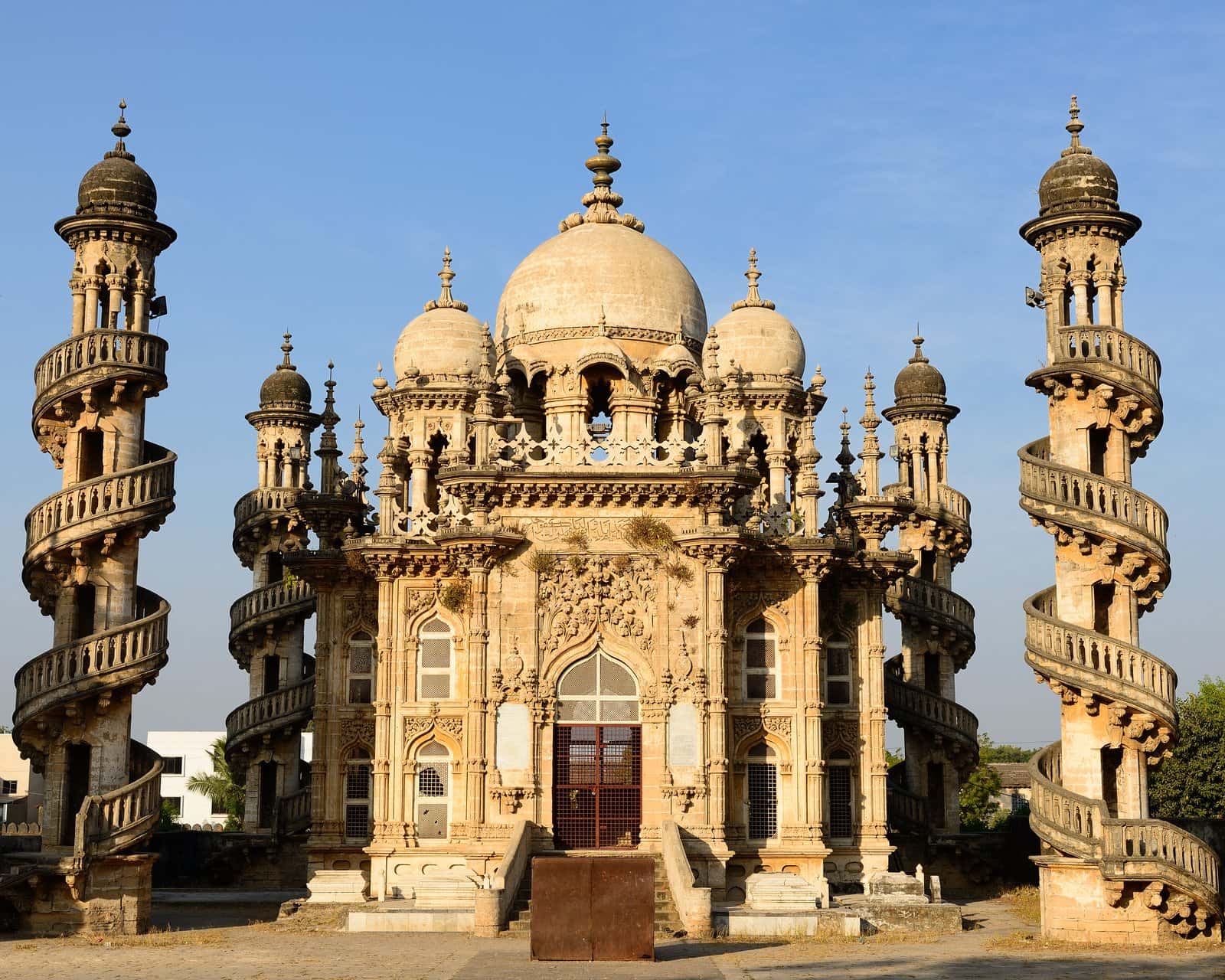
- Mahabat Maqbara and SakkarbaugMahabat Maqbara is a wildly ornate Nawabi mausoleum with minarets wrapped in spiral staircases, best viewed from outside as the interior is usually locked. Sakkarbaug Zoo, founded in 1863, is the oldest zoo in Gujarat and runs the famous Asiatic lion breeding programme.
The Ashoka edict boulder is a rare thing: three of India's most important inscriptions on one stone. Ashoka's 14 edicts came first, around 250 BC. Roughly four centuries later the Western Kshatrapa ruler Rudradaman added his inscription, about 150 CE, recording repairs to the ancient Sudarshana Lake. Later still, around 455 to 467 CE, a Skandagupta inscription noted further repairs. Standing before it you are reading three empires on a single rock, which is why the site is protected by the Archaeological Survey of India.
Signature experiences: the Girnar climb, the ropeway and the lions
The two things people come for are the Girnar mountain and the Gir lions. Here is how to do each honestly, without the tourist-trap or the turned-away-at-the-gate version.
- Climb Girnar, if you are fit for itThe full climb of roughly 9,999 steps to the Guru Dattatreya peak is a serious 8 to 10 hour round trip. Seasoned climbers start in the dark, around 2:30 to 3 am, to reach the top by sunrise and be down before the heat. Water and lemon-soda stalls line the route, but bring your own too. Be warned that the descent is harder on the legs than the climb.
- Take the ropeway to AmbajiThe Girnar ropeway carries you in about 7 to 8 minutes to the Maa Ambaji temple partway up, saving roughly the first two-thirds of the steps. It does not reach the summit, so if you want Gorakhnath or Dattatreya you still climb on foot from Ambaji. A round trip for an adult is commonly about 700 rupees, with a child or concessional fare around 350 to 400 rupees; reconfirm the live fare on the official site.
- A Gir lion safariThe reason many people come to this corner of Gujarat: a jeep safari in Sasan Gir, the last wild home of the Asiatic lion. Book the permit only on the official state portal, go for a morning slot for the best sightings, and read the dedicated safari section below for fees, closures and the Devalia fallback.
- Wander Uparkot and the old townGive the restored Uparkot Fort a couple of unhurried hours for the Buddhist caves and the two deep stepwells, then walk the old bazaar lanes below. Fit the Ashoka edicts in on the way, and Sakkarbaug Zoo if you have children or a soft spot for the lion breeding story.
The single most common misunderstanding, repeated by many blogs, is that the ropeway takes you to the summit of Girnar. It does not. The cabin ends at the Maa Ambaji temple, which is roughly two-thirds of the way up. From there, reaching Gorakhnath, the Guru Dattatreya shrine and the very top is still a stiff climb on foot of several hundred to a few thousand more steps. Plan for that if the peaks are your goal, and take the ropeway simply as a way to skip the long lower staircase.
The Sasan Gir lion safari, done right
Sasan Gir is the only place on earth with wild Asiatic lions. The safari is superb but tightly regulated, with an official permit portal, exact fees, three daily slots and a firm monsoon closure. Get these right and it is the trip of a lifetime.
- Book only on the official portalPermits are issued only through the state portal girlion.gujarat.gov.in, which itself warns against fraudulent third-party sites. Book ahead in season, as slots sell out, and carry the same photo ID you booked with.
- What the permit costsOne permit covers a gypsy of up to six people. For Indians it is about 800 rupees on a weekday and about 1,000 rupees on a weekend or holiday. For foreign nationals it is much higher, around 7,440 rupees on a weekday and about 9,300 rupees on a weekend. None of these include the gypsy hire or the compulsory guide, which you pay locally on top.
- The three daily slotsSafaris run in three slots, two in the morning and one in the evening, with exact times shifting between winter and summer. Morning slots give the best chance of a sighting. A day-tripper from Junagadh, about 60 km and 1.5 hours away, should leave around 6:30 am to make about the 9 am slot.
- The Devalia fallbackIf you visit during the monsoon closure or cannot get a core-zone permit, the Devalia Interpretation Zone is a fenced safari park near Sasan Gir where sightings are close to guaranteed. It stays open through the monsoon but is closed every Wednesday, so plan around that.
The core Gir jeep safari is closed from about 16 June to 15 October each year for the monsoon and the breeding season. Do not plan a summer or monsoon trip around a core-zone safari. In that window, only the Devalia safari park runs, and Devalia is itself closed on Wednesday. Always reconfirm the reopening date and the current fees on the official portal before you book flights or rooms, as the fees for foreign nationals in particular have changed over time.
Where to stay, and Junagadh versus Sasan Gir as a base
Base in Junagadh for the mountain, the fort and city comforts, or stay out at Sasan Gir for easy early safaris. The right choice depends on what you have come for.
- Base in Junagadh: the town hubJunagadh has the widest choice of hotels, from budget to comfortable mid-range, and puts Girnar, Uparkot, the edicts and Sakkarbaug on your doorstep. The trade-off for a Gir safari is the early 6:30 am start to drive the 60 km across in time for a morning slot.
- Base in Sasan Gir: for the lionsStaying at Sasan Gir, from forest lodges to resorts, means an easy short hop to the safari gate and the best chance of both a morning and an evening slot. The town itself is sleepy, so this suits travellers whose priority is the wildlife rather than the heritage.
- How many daysTwo to three days is the honest answer. Girnar alone eats a full day, whether you climb or take the ropeway. Add a day for Uparkot, the edicts, Mahabat Maqbara and Sakkarbaug, and a further day or overnight at Sasan Gir for the safari. One rushed day only scratches the surface.
- The split-stay optionA common and sensible pattern is one or two nights in Junagadh for the mountain and the monuments, then a night at Sasan Gir for the lions, before carrying on to Somnath and Diu. It saves the daily 120 km round trip and lets you do the safari at a civilised hour.
Rooms at Sasan Gir, especially the better lodges near the gate, fill up fast in the October to March high season and around long weekends, and prices rise with demand. If a lion safari is the heart of your trip, secure both the permit on the official portal and your Sasan Gir room well ahead, or base in Junagadh and accept the early morning drive.
Junagadh costs and a realistic daily budget
Junagadh is easy on the wallet apart from the Gir safari, which is the one big-ticket item. Here is what the main things cost so you can plan and avoid being overcharged.
- The fixed-price sightsThe Ashoka edicts carry only a small nominal fee, quoted variously from about 5 to 25 rupees for Indians and about 100 to 250 rupees for foreign nationals depending on the source, so treat it as a token amount and reconfirm at the gate. Sakkarbaug Zoo charges a small entry fee, also to reconfirm at the gate. Uparkot Fort has a modest ticket. These heritage entries are minor next to the mountain and the safari.
- The mountainClimbing Girnar is free beyond your own water and snacks. The ropeway to Ambaji is commonly about 700 rupees return for an adult and around 350 to 400 rupees for a child or concessional fare; a doli or palki chair to be carried up is a separate, negotiated cost covered in the traveller-type section.
- The safari, the big itemThe Gir permit is about 800 rupees on a weekday and about 1,000 rupees on a weekend for Indians, and around 7,440 to 9,300 rupees for foreign nationals, plus the gypsy and guide hire paid locally. A taxi from Junagadh for a safari day runs from roughly 2,000 rupees one way and more often about 3,000 to 3,500 rupees for the full day. Budget the safari as your one splurge.
- Food, cash and cardsGujarati thali meals are excellent value. Cafes and bigger hotels take cards and UPI, but keep cash for the mountain stalls, autos and small eateries. Bank ATMs are easy to find in Junagadh town.
Practical logistics: the dry-state rule, food, money and getting around
The small things that make a Junagadh trip smooth, from the Gujarat alcohol rule to autos, ATMs and the language.
- Gujarat is a dry stateAlcohol is not sold openly anywhere in Gujarat under the Gujarat Prohibition Act of 1949. Overseas tourists and out-of-state Indian visitors who want a drink must obtain a permit online through the state e-permit portal, within a few days of arrival and with ID and proof of travel. Plan around this rather than assume a hotel bar; the permit and its limits are covered in the overseas section.
- Getting around townJunagadh town is compact and auto-rickshaws are the easy way between the fort, the edicts, the tombs and the base of Girnar. For Sasan Gir, Somnath and the wider loop you will want a hired car with driver, which is also the most reliable way to make an early safari slot.
- Food and waterThe Kathiawadi and Gujarati vegetarian food is a highlight, from thalis to fafda and jalebi. Drink bottled or filtered water, take the usual care with street food, and carry plenty of water and some salt or lemon soda for the Girnar climb.
- Money, SIM and languageBank ATMs are easy in town, and cards and UPI work in bigger places while the mountain and the autos run on cash. Mobile coverage is good in town and patchier on the mountain and in Gir. Gujarati and Hindi are the languages, with English understood in the tourist and hotel trade.
Safety, the Girnar climb, and staying well
Junagadh is a safe, welcoming town, and the main risks are physical: the sheer effort of the Girnar climb and the Saurashtra heat. A little preparation keeps the trip happy.
- Respect the Girnar climbThe full climb is genuinely demanding: roughly 9,999 steps, an 8 to 10 hour round trip, and a descent that leaves many people with sore legs for three to four days. Do not attempt it unfit or unprepared. Start pre-dawn, pace yourself, carry water and electrolytes, and turn back honestly if your body says so. The ropeway to Ambaji is the sensible option if the full climb is beyond you.
- Heat and hydrationFrom April to June the heat reaches about 40 degrees and is a real hazard on the open mountain and the fort. Do strenuous things at dawn, rest through the middle of the day, wear a hat and sunblock, and drink far more water than feels necessary.
- On safari, follow the rulesIn Gir, stay in the vehicle, keep quiet near lions, do not feed or bait wildlife, and follow your guide. These are wild animals in their last stronghold; the rules exist to keep both you and the lions safe.
- General safetyJunagadh is a low-crime, family town with the usual small-city precautions. Watch your footing on the worn steps of the fort stepwells and the mountain, keep valuables close in crowds during the Bhavnath fair, and agree taxi and doli prices before you set off.
Traveller forums are full of accounts of the Girnar climb, and the honest picture is this: it is doable by a reasonably fit person of almost any age who starts early and takes it slowly, but it is not a stroll. Expect 8 to 10 hours up and down, the worst of it on the knees during the descent, and legs that ache for days. If that does not appeal, the ropeway to Ambaji plus a short onward climb still gives you the temples and the views without the full ordeal, and there is no shame at all in taking it.
Junagadh for every kind of traveller, and on access
Junagadh suits very different visitors in different ways. Here is what it offers you, and the one tip that matters for each, including how a senior does Girnar comfortably.
- Wildlife loversThis is your town: the only wild Asiatic lions on earth are an hour away at Sasan Gir, plus the breeding story at Sakkarbaug. Book a morning safari slot on the official portal and, ideally, spend a night at Sasan Gir for two safaris.
- History and heritage buffsUparkot Fort, the Ashoka edicts, the Nawabi tombs and the layered story of Girnar make Junagadh one of the richest heritage towns in Gujarat. Give the fort and the edicts a full unhurried half-day.
- Senior travellers and on accessibilityGirnar's full climb is not realistic for most seniors, but the mountain is still open to you. Take the ropeway to the Ambaji temple, which removes the long lower staircase, and stop there or go a little further at your own pace. For those set on the higher shrines, a doli or palki, a chair carried by porters, is available for a negotiated fee, commonly a few thousand rupees; agree the price and the route before you start. The town sights and the safari jeep are otherwise easy on older travellers.
- Families with childrenPace it: the Gir safari and Sakkarbaug Zoo thrill children, the ropeway is a treat, and the fort stepwells fascinate. Skip the full climb with young kids, keep the middle of the day cool, and carry water and snacks everywhere.
- PilgrimsGirnar is sacred to Jains and Hindus alike, with the Neminath Jain temples partway up and the Dattatreya shrine at the peak. Time a visit to the Bhavnath fair around Maha Shivratri for the Naga sadhu procession, but expect big crowds.
- Solo and budget travellersJunagadh is safe and cheap, well connected by train, with budget rooms and superb inexpensive Gujarati food. Shared jeeps and buses make the region affordable, though a taxi is worth it for an early Gir safari.
A suggested Junagadh itinerary
How to shape two or three days so you catch the mountain at the right hour, the fort at leisure, and a lion safari at its best.
- Day one: the mountainGive Girnar its own day. Climbers start pre-dawn for the full stairway; everyone else takes the ropeway to Ambaji in the cool early morning and climbs on as far as they wish. Fit the Ashoka edicts in at the foot of the mountain on the way back, and rest through the hot afternoon.
- Day two: the fort and the townA relaxed day for Uparkot Fort and its stepwells and Buddhist caves, Mahabat Maqbara from the outside, and Sakkarbaug Zoo with the lion breeding centre. Eat a proper Kathiawadi thali and wander the old bazaar.
- Day three: the lionsEither drive out to Sasan Gir before dawn for a 9 am safari and return, or, better, have moved to a Sasan Gir lodge the night before for an easy morning slot. Carry on afterwards to Somnath, about 90 km on, if you are looping Saurashtra.
- The compressed versionWith only two days, do Girnar by ropeway and the fort on day one, and the Gir safari as a very early day trip on day two. It works, but it is a full and tiring pair of days, and you will wish you had the third.
The two things that break a Junagadh plan are the Gir monsoon closure, about 16 June to 15 October, and the early safari slots. Confirm Gir is open for your dates, book the permit on the official portal, and if you are day-tripping from Junagadh leave by about 6:30 am for about the 9 am slot. Get those two right and the rest of the itinerary is forgiving.
The real questions travellers ask about Junagadh
Straight answers to the questions that come up again and again on traveller forums, so you arrive already knowing the score.
- How hard is the Girnar climb?Hard but doable for a reasonably fit person who starts early and paces it. Expect roughly 9,999 steps, an 8 to 10 hour round trip, and aching legs afterwards, with the descent the worst part. If that is too much, the ropeway to Ambaji plus a short climb still gives you temples and views.
- Ropeway or steps, and does the ropeway reach the top?The ropeway is not cheating; it simply skips the long lower staircase and lands you at the Ambaji temple partway up. It does not reach the summit, so for Gorakhnath or Dattatreya you climb on from Ambaji. Many people ride up, climb a little, and ride down happily.
- Is Junagadh a good base for Sasan Gir?Yes for the town sights and if you do not mind an early start, since Gir is about 60 km and 1.5 hours away and you must leave by about 6:30 am for about the 9 am slot. If the lions are your priority, stay a night at Sasan Gir instead for easier morning and evening safaris.
- When is Gir closed?The core jeep safari is closed from about 16 June to 15 October for the monsoon and breeding season. Only the Devalia safari park runs then, and it is shut on Wednesday. Plan any lion trip into the mid October to mid June window and reconfirm dates officially.
- Is one day enough for Junagadh?Not really. Girnar alone is a full day, and the fort, edicts, tombs and zoo need another, with the Gir safari a third. Two to three days is the honest length; a single day forces hard choices.
- How do I get from Junagadh to Sasan Gir?A hired taxi is the most reliable and lets you make an early slot, from roughly 2,000 rupees one way and more often about 3,000 to 3,500 rupees for a full safari day of drop, wait and return. Buses are irregular and slow, and shared jeeps run from near the station but are best for the flexible and budget-minded.
Planning Junagadh from abroad
Junagadh is the practical hub for the last wild Asiatic lions and a spectacular sacred mountain, and pairs naturally with Somnath and Diu. A little preparation makes the safari permit, the closure and the dry-state rule easy to handle.
- Know the Gir closure and foreigner feesThe core Gir safari is closed about 16 June to 15 October, so time your trip to the open season. Foreign-national permits are far higher than the Indian rate, around 7,440 rupees on a weekday and about 9,300 rupees on a weekend, plus gypsy and guide, and are booked only on the official state portal. Budget and book ahead.
- The Gujarat dry-state permitGujarat is a dry state, and as an overseas tourist you may buy and consume alcohol only with a permit, applied for online through the state e-permit portal within a few days of arrival, with your passport, visa and proof of travel. It is valid for a short window and a small quantity, and even hotel bars require it, so plan your drinks around it or simply enjoy the trip dry.
- Pair it with Somnath and DiuFly into Ahmedabad or Rajkot, then loop Junagadh, Sasan Gir, Somnath, about 90 km on, and the old Portuguese island of Diu. Junagadh is the heritage-and-lions heart of a Saurashtra circuit that most overseas visitors never reach, which is part of its appeal.
- Gentle enough with planningThe town sights, the safari jeep and the ropeway are all comfortable for older overseas travellers; only the full Girnar climb is demanding. English is understood in the hotel and tour trade, and a car with driver makes the whole loop easy.
Money, connectivity and timing for foreign visitors
The practical basics an overseas traveller needs for a Saurashtra heritage town: cash, cards, a SIM, and how many days to give Junagadh on a wider Gujarat trip.
- Carry cash, use cards where you canCards and UPI work in bigger hotels and shops, but the mountain stalls, autos, doli porters and small eateries are cash places. Draw cash at the town ATMs and keep small notes for tips and the climb.
- Get a SIM at the airportPick up an Indian tourist SIM or an eSIM when you land in Ahmedabad or Rajkot rather than hunting for one in a small town. Coverage in Junagadh is fine for maps and calls, and patchier on the mountain and inside Gir.
- How long to give itOn a Gujarat trip, two to three days in Junagadh and Sasan Gir is the right weight: enough for the mountain, the fort and a lion safari, before moving on to Somnath and Diu or back to Ahmedabad. Do not try to do it as a single rushed day.
- Time it to the safari seasonOctober to March is both the comfortable weather and the open Gir season, so aim for that window. If you can only come in the monsoon, accept that the core safari is shut and rely on the Devalia park, closed Wednesdays, for your lions.
Junagadh and Sasan Gir sit well off the usual Golden Triangle first-trip route, which is exactly why they reward the effort. You get the last wild Asiatic lions, a sacred mountain of nearly 10,000 steps, an ancient fort with astonishing stepwells, and some of India's oldest inscriptions, all in a friendly, low-key town that sees few foreign tourists. Give it two or three days on a Saurashtra loop and it becomes the part of Gujarat travellers talk about most.
A mountain sacred to Jains, Hindus and the last lions alike
Girnar is older than almost any story told about it. Jains hold it among their most sacred hills, where the 22nd Tirthankara Neminath renounced the world, and their marble temples cluster two-thirds of the way up the stone stairway. Hindus climb higher, to Amba Mata, to Gorakhnath at the highest point in Gujarat, and to the three-faced shrine of Guru Dattatreya at the very peak. At the foot of it all lies Damodar Kund, where the 15th-century poet-saint Narsinh Mehta, the Adi Kavi of Gujarati, is remembered, and where families still come to immerse the ashes of the dead. Around the mountain roam the last wild Asiatic lions on earth, saved from extinction in the Gir forest by the very Nawabs whose extravagant tombs stand in the town below. Few places knot together faith, history and wilderness so tightly. There is no single verse that captures Girnar; the mountain is its own scripture, read one worn step at a time.
Planning a Junagadh trip?
Our Gujarat travel experts plan your full journey for you: route, hotels, darshan timings and transport. You get a free day-by-day plan and an exact quote on WhatsApp, usually within a few hours. No payment is needed to get your plan.