Kurukshetra Travel Guide
The comfortable window is the winter of about October to March . The standout time is Gita Jayanti and the International Gita Mahotsav around late November to December.
When to visit Kurukshetra, and the Gita Mahotsav
The comfortable window is the winter of about October to March. The standout time is Gita Jayanti and the International Gita Mahotsav around late November to December.
- October to March: the pleasant seasonThis is the season to come. The north-Indian plains are cool and comfortable for the spread-out sites, the sarovar ghats and the museums. It also overlaps with the Gita Jayanti period, so you can pair pleasant weather with the town at its most alive. Carry a warm layer for December and January mornings and evenings, which can be genuinely cold.
- Gita Jayanti and the Gita MahotsavThe biggest draw is Gita Jayanti, which marks the giving of the Bhagavad Gita and falls on the Shukla Ekadashi of Margashirsha, usually in December. The International Gita Mahotsav around it fills the town with the Geeta Path, aarti at Brahma Sarovar, a Shilp Mela crafts fair and cultural programmes. It is the most atmospheric time to come, and also the most crowded, so book ahead.
- April to June: hot on the plainsHaryana's summer is hot, often very hot by midday, which makes the open sarovars and the walking between sites hard going. If you can only come then, start early, rest through the afternoon, and save the museums, which are indoors, for the hottest hours.
- July to September: monsoonThe monsoon greens the plains and is generally less crowded, but rain can interrupt the open-air sites and the evening shows. It is a workable time for a quick visit, but most travellers are better served by the winter window and the festival season.
One thing to plan around beyond the weather: on solar-eclipse days, vast numbers of pilgrims gather to bathe at Brahma Sarovar and Sannihit Sarovar, as a dip during an eclipse is held to be especially purifying. If an eclipse falls during your dates, expect enormous crowds and tight logistics, which is wonderful if you have come for exactly that and overwhelming if you have not. Check the eclipse calendar against your plans, and book rooms and transport well ahead if you are timing the trip to one.
Where is Kurukshetra, and how to reach it
Kurukshetra is in Haryana, about 160 to 170 km north of Delhi on NH-44. Most people come by road or train from Delhi; the living town is Thanesar.
- Where Kurukshetra isKurukshetra is a city and sacred region in the state of Haryana in north India, about 160 to 170 km north of Delhi on the NH-44 Grand Trunk Road towards Chandigarh and Amritsar. The everyday town at its heart is Thanesar, so hotels and stations are often listed under both names. Knowing it sits on the main Delhi to Chandigarh road is the key to planning the trip.
- By road from DelhiThe drive from Delhi is about 160 to 170 km and roughly 2.5 to 3 hours on NH-44, a fast modern highway, which makes Kurukshetra a comfortable day trip or an easy halt on the way north. We can arrange a car with a driver who knows the Gita sites and the museums so you cover them efficiently.
- By train, to Kurukshetra JunctionKurukshetra Junction is a major railhead about 2 km from the centre, with frequent trains from New Delhi taking roughly under two hours on the fastest services, and good links to Ambala, Chandigarh, Ludhiana and Amritsar. The train is often the easiest way in for a day trip. Book ahead on IRCTC (irctc.co.in), especially around the Gita Mahotsav.
- By air, via Chandigarh or DelhiThe nearest airport is Chandigarh International at about 90 km, useful for domestic connections. Delhi's Indira Gandhi International, about 160 km away, has far more domestic and international flights and is the gateway most overseas visitors use, driving or training up from there.
Fly into Delhi, then reach Kurukshetra in about 2.5 to 3 hours by road or under two hours by train. It slots neatly into a Delhi stay or a Golden-Triangle trip as the Bhagavad-Gita chapter.
Fly into Delhi, or sometimes Chandigarh, and continue by road or rail. Pairing Kurukshetra with Chandigarh, Amritsar or a Himachal leg makes an easy north-India loop.
Drive or take a train from Delhi, Chandigarh, Ambala or Amritsar; Kurukshetra Junction is well connected, and the town sits right on the main NH-44 corridor for self-drivers.
Jyotisar, the sarovars, and the Mahabharata museums
The heart of Kurukshetra is Jyotisar, where the Gita was given, the vast Brahma and Sannihit sarovars, and museums that make the Mahabharata tangible.
- Jyotisar, where the Gita was givenThe most venerated site, revered as the very spot where Krishna delivered the Bhagavad Gita to Arjuna, marked by an ancient banyan tree held to have witnessed the discourse. An evening light-and-sound show retells the story, and a large new Gita experiential complex has been developed here. This is the place that gives Kurukshetra its meaning, so give it unhurried time.
- Brahma SarovarA vast sacred water tank, one of the largest in Asia, often cited at about 3,600 feet long, ringed by ghats and a focus of devotion. Evenings bring aarti, and solar-eclipse days and the Gita Mahotsav draw enormous gatherings of pilgrims who come to bathe. Even on a quiet day, the sheer scale of the reservoir is striking.
- Sannihit SarovarAnother sacred tank, held to be the meeting point of seven sacred Saraswati streams, and especially significant for eclipse-day bathing and for ancestral rites. It sits near the Sri Krishna Museum and the other town sites, so it folds easily into a half-day on foot or by car.
- The museums and the Thanesar templesThe Sri Krishna Museum and the Kurukshetra Panorama and Science Centre, with its 360-degree Mahabharata-war depiction, make the epic tangible, especially for families. In Thanesar town, the ancient Sthaneshwar Mahadev Temple, the Bhadrakali Shakti Peeth and the Mughal-era Sheikh Chilli's Tomb add Shaiva, Shakta and Indo-Islamic heritage layers.
Kurukshetra's sites are spread across the town and its edges rather than clustered in one spot: Jyotisar is a few kilometres out, while Brahma Sarovar, Sannihit Sarovar and the museums sit closer to the centre and Thanesar. Knowing that, plan a logical loop by car, putting Jyotisar and its evening show at one end of the day, so you are not crossing the town twice. A local guide or driver who knows the sequence saves real time here.
Signature experiences in Kurukshetra
Beyond seeing the sites, this is the Jyotisar light-and-sound show, the Brahma Sarovar aarti, the Mahabharata museums and, if you can time it, the Gita Mahotsav.
- The Jyotisar light-and-sound showThe evening light-and-sound show at Jyotisar retells the Gita and the Mahabharata at the spot where the discourse is believed to have happened, and is the signature experience of a Kurukshetra visit. Check the current show timings and language schedule on arrival, as they vary by season, and plan your day so you are at Jyotisar for the evening.
- Aarti and a quiet hour at Brahma SarovarSpend an unhurried hour at Brahma Sarovar, ideally for the evening aarti, when the vast tank and its ghats are at their most atmospheric. It is a place to sit and take in the scale and the devotion rather than tick off in five minutes, and the light at either end of the day is best for both the mood and photographs.
- Make the museums the family centrepieceThe Sri Krishna Museum and the Panorama and Science Centre turn the Mahabharata from a story into something children can see and walk through, with the 360-degree war panorama a particular hit. Build them into the middle of the day, both as the cool indoor option and as the part that makes the trip educational rather than only devotional.
- Time it with the Gita MahotsavIf your dates allow, the International Gita Mahotsav around late November to December, centred on Gita Jayanti, is the town at its fullest: the Geeta Path, aarti, the Shilp Mela crafts fair and cultural programmes over several days. It is crowded and vivid, so book ahead and be ready for the press, but it is the most complete way to experience Kurukshetra.
- Walk the Thanesar heritage layerAdd the ancient Sthaneshwar Mahadev Temple, the Bhadrakali Shakti Peeth and the Mughal-era Sheikh Chilli's Tomb in Thanesar for a fuller sense of the town beyond the Gita sites. The tomb in particular is an unexpected Indo-Islamic note in this Mahabharata-age landscape, and rewards a short detour.
- Use it as a meaningful road-trip haltBecause Kurukshetra sits on the Delhi to Chandigarh and Amritsar road, it works beautifully as a half-day cultural halt on a longer north-India drive: break the journey, do Jyotisar and a sarovar, and carry on. It turns a long highway day into one with a memorable, meaningful pause.
If you do only one thing slowly in Kurukshetra, make it Jyotisar in the late afternoon and the evening show: stand under the banyan where the Gita is believed to have been given, then let the light-and-sound retelling settle the place into context. That unhurried hour, more than a quick circuit of every site, is what most visitors remember, so build the day so Jyotisar gets the evening rather than a rushed midday stop on the way to somewhere else.
Where to stay in Kurukshetra, and how long you need
Stay in Thanesar town near the sites, or in a Haryana Tourism resort, or visit on a day trip from Delhi or Chandigarh. Half a day to one night covers it.
- Thanesar town hotelsMost of the practical hotels are in Thanesar, the living town, within easy reach of the sarovars, the museums and the temples. They range from simple lodges to comfortable mid-range hotels, and suit anyone who wants to be close to the sites for an early start or the evening show at Jyotisar.
- Haryana Tourism resorts and trust roomsHaryana Tourism runs resort-style properties in and around Kurukshetra, and trust and dharamshala accommodation near the sarovars offers plain, affordable, well-located rooms for pilgrims. These are practical and central, and they fill up around the Gita Mahotsav and on eclipse days, so reserve ahead for those peaks.
- Day trip from Delhi or ChandigarhMany visitors do not stay over at all: Kurukshetra is close enough to Delhi (about 2.5 to 3 hours) and Chandigarh (about 90 km) to be a comfortable day trip, especially by the fast trains. This suits travellers fitting it into a Delhi stay or a north-India road trip, doing the key sites and returning the same day.
- How long you needHalf a day covers the essentials, Jyotisar, a sarovar and a museum, if you are passing through. A full day with an overnight lets you add the evening Jyotisar show, both sarovars, the Panorama and Science Centre and the Thanesar temples without rushing, which is the comfortable way to do it, especially with family.
Around the International Gita Mahotsav in late November to December and on any solar-eclipse day, Kurukshetra's rooms, the Haryana Tourism properties and the trust accommodation fill well ahead and prices rise, while the town and the sarovars are at their most crowded. If your dates fall on those peaks, book early, or base in Chandigarh or Delhi and come over on a planned day. Outside the peaks, a room in Thanesar is easy to arrange.
Kurukshetra costs and a realistic budget
Kurukshetra is an inexpensive, easily-done trip. Most of the cost is transport and a room if you stay; the sites themselves are modest.
- Getting there is the main costFor a day trip, the biggest line is transport: a return train fare from Delhi is cheap, while a hired car for the day costs more but lets you cover the spread-out sites efficiently and add Jyotisar's evening show. Decide between the two based on whether you value the convenience of a car at the sites.
- Entry fees and showsThe temples and sarovars are free or near-free to visit, and the museums, the Panorama and Science Centre and the Jyotisar light-and-sound show carry modest entry fees. Budget a small amount per person for these, and check current timings and ticketing on arrival, as show schedules vary by season.
- Rooms, if you stayAccommodation is gentle on the wallet: simple Thanesar lodges and trust rooms are cheap, Haryana Tourism resorts and mid-range hotels are moderate. Rooms cost more and fill faster around the Gita Mahotsav and eclipse days, so book early on the peaks and reconfirm current tariffs.
- Cash, cards and local extrasBigger hotels and restaurants take cards and UPI, but small eateries, autos, offerings and the Shilp Mela stalls often run on cash. Carry enough, and budget a little for a guide, an auto between the spread-out sites, and any crafts you buy at the festival fair.
The cleanest way to budget Kurukshetra is to decide first whether it is a day trip or an overnight. As a day trip from Delhi by train, with modest entry fees and a meal, it is genuinely cheap; as an overnight with a hired car, the room and the car are the main costs and the sites stay minor. Either way, Kurukshetra is one of the more affordable meaningful trips you can do from Delhi, so the decision is about comfort and time, not a big spend.
Practical logistics: getting around, timings, ATMs and language
The small things that make a Kurukshetra day smooth, from a car for the spread-out sites to show timings, ATMs and the local language.
- Getting around the spread-out sitesKurukshetra's sites are not all walkable from one another: Jyotisar is a few kilometres from the centre, while the sarovars and museums are closer together. A car and driver, or autos for shorter hops, cover a half or full day comfortably. Plan a loop so you reach Jyotisar for the evening show rather than crossing the town twice.
- Check the show and museum timingsThe Jyotisar light-and-sound show, the museums and the Panorama and Science Centre all run to schedules that vary by season and can change, and some close on a weekly off-day. Confirm the day's timings on arrival or before you set out, and build the evening show into your plan, as it is the highlight.
- Money, ATMs and foodCarry cash for autos, offerings, stalls and small eateries, though bigger hotels and restaurants take cards and UPI. ATMs are available in the town. Food is simple, hearty north-Indian and vegetarian near the sites, with more choice in Thanesar; the festival Shilp Mela adds food stalls in season.
- Language and a guideHindi is the everyday language, with Haryanvi widely spoken and Punjabi common, and basic English understood at hotels and the bigger sites. A local guide is worth it at Jyotisar and the museums to bring the Mahabharata and the Gita context alive, especially for families and overseas visitors.
Safety, the crowds, and staying well
Kurukshetra is a calm, easy-going town. The real things to manage are the festival and eclipse crowds, the summer heat, and the spread-out sites, not crime.
- Festival and eclipse crowdsThe main thing to manage is the crowd around the Gita Mahotsav and on solar-eclipse days, when the sarovars and the town fill with huge numbers of pilgrims. Keep your group together, hold children's hands at the ghats, mind your belongings in the press, and if big crowds are not for you, come on an ordinary winter day instead.
- Heat and water in summerThe Haryana plains are hot from spring onward, and much of the sightseeing is open-air around the sarovars. Carry water, wear a hat, do the outdoor sites in the cooler hours, and use the indoor museums through the hottest part of the day, especially with seniors and children.
- Water safety at the ghatsThe sarovars are large, and the ghats can be slippery and crowded, especially on bathing days. If you take a ritual dip, stay where others bathe and where it is shallow, keep an eye on children near the water, and look after your belongings on the steps. Treat the tanks with the same care as any open water.
- An easy, low-pressure townKurukshetra is a relaxed pilgrimage and heritage town with little serious crime, though as at any busy site you will meet stalls and helpers offering services. Agree any guide or auto terms in advance, use the official counters for tickets, and use normal travel sense with valuables in the crowds.
Kurukshetra is one of the easier cultural trips from Delhi for families and older travellers: the museums and the Panorama and Science Centre are comfortable indoor highlights, and the sites are short outings rather than long climbs. The two things to manage are the heat, so plan the outdoor sarovars for the cooler hours and carry water, and the festival or eclipse crowds, which are best avoided with anyone who tires in a dense throng. Use a car to limit walking between the spread-out sites, and it is a gentle, rewarding day for all ages.
Kurukshetra for every kind of traveller, and on access
Kurukshetra suits different visitors in different ways. Here is what it offers you, and the one tip that matters for each, including how a family makes it educational.
- Pilgrims and Gita devoteesThis is your place: Jyotisar where the Gita was given, the sacred Brahma and Sannihit sarovars, and the Sthaneshwar and Bhadrakali temples. Time it with Gita Jayanti and the Gita Mahotsav if you can, give Jyotisar and its evening show unhurried time, and consider the wider 48-kos tirtha landscape if you have longer.
- Families and studentsKurukshetra is unusually good for children: the Sri Krishna Museum and the Panorama and Science Centre make the Mahabharata real and walkable, and the legends bring the sites alive. Build the museums into the middle of the day, use a guide to tell the stories, and it becomes an educational trip rather than only a devotional one.
- Heritage and history loversBeyond the Gita, the town layers Mahabharata-age sacred geography with the ancient Sthaneshwar temple, the Bhadrakali Shakti Peeth and the Mughal-era Sheikh Chilli's Tomb. Read the 48-kos parikrama idea that ties the wider region's tirthas together, and the town becomes a rich, multi-period heritage stop.
- Senior travellers and on accessComfortable with planning: the museums are easy indoor highlights, and the sites are short outings rather than climbs. Use a car to limit walking between the spread-out sarovars and Jyotisar, do the outdoor sites in the cooler hours, carry water, and avoid the densest festival and eclipse crowds. On those terms it is a gentle, rewarding day.
- Day trippers from DelhiFor Delhi-based travellers and overseas visitors on a Delhi stay, Kurukshetra is an easy and meaningful day trip by fast train or car: do Jyotisar, a sarovar and a museum, and return the same evening. It adds a Bhagavad-Gita and Mahabharata chapter to a trip otherwise built around monuments and cities.
- Budget travellers and photographersBudget travellers reach Kurukshetra cheaply by train, see the free sarovars and temples, and pay only modest museum and show fees. Photographers get the vast Brahma Sarovar at dawn and dusk, the ghats and aarti, and the banyan at Jyotisar, with the soft winter light best for all of them.
A suggested Kurukshetra itinerary
How to shape a half-day, a full day or a Delhi day trip so you catch Jyotisar, the sarovars and the museums without crossing the town twice.
- The Delhi day tripTake an early fast train or set off by car, reach Kurukshetra mid-morning, and do Brahma Sarovar, Sannihit Sarovar and the Sri Krishna Museum near the centre first. Move to Jyotisar in the afternoon, stay for the evening light-and-sound show, and return to Delhi the same night. It is a full but very doable day.
- The comfortable full day with an overnightStay in Thanesar, and spread the sites across a relaxed day: the sarovars and the temples in the morning, the Panorama and Science Centre and the Sri Krishna Museum in the middle of the day out of the heat, and Jyotisar and its evening show to close. An overnight lets you do it all without rushing, which suits families.
- The road-trip haltIf you are driving Delhi to Chandigarh, Shimla or Amritsar, break the journey at Kurukshetra for a half-day: do Jyotisar and Brahma Sarovar, have lunch, and carry on. It turns a long highway day into one with a meaningful pause, and adds the Gita and Mahabharata to a trip built around other places.
- Plan around the show and the crowdsWhatever shape you choose, build the day around the Jyotisar evening show and, if relevant, the Gita Mahotsav or an eclipse day. Confirm the show and museum timings, leave the open sarovars for the cooler hours, and on festival or eclipse dates allow extra time for the crowds and book ahead.
The single thing that shapes a good Kurukshetra plan is the Jyotisar light-and-sound show in the evening. Work backwards from it: do the central sarovars and a museum earlier, keep the indoor museums for the hot middle of the day, and arrive at Jyotisar with time to stand under the banyan before the show. Plan it that way and you avoid crossing the town twice and end the day on its most memorable note rather than a rushed dash.
The real questions travellers ask about Kurukshetra
Straight answers to the questions that come up again and again on travel forums, so you arrive already knowing the score.
- Where is Kurukshetra and how far from Delhi?Kurukshetra is in Haryana, north India, about 160 to 170 km north of Delhi on NH-44 towards Chandigarh. By road it is roughly 2.5 to 3 hours, and by fast train from New Delhi to Kurukshetra Junction it is under two hours. The everyday town at its heart is Thanesar, so look for both names when booking.
- Can I do it as a day trip from Delhi?Yes, easily. An early train or car gets you there by mid-morning, enough for Jyotisar, a sarovar, a museum and the evening light-and-sound show before you return the same night. A car makes the spread-out sites smoother; the train is the cheapest and often the easiest option.
- What is Jyotisar, and is it where the Gita was given?Jyotisar is revered as the very spot where Krishna delivered the Bhagavad Gita to Arjuna, marked by an ancient banyan tree held to have witnessed the discourse, with an evening light-and-sound show and a new experiential complex. It is the most venerated site in Kurukshetra and the reason many people come.
- What else is there to see?Beyond Jyotisar, the vast Brahma and Sannihit sarovars, the Sri Krishna Museum, the Kurukshetra Panorama and Science Centre with its 360-degree Mahabharata war, and in Thanesar the Sthaneshwar Mahadev Temple, the Bhadrakali Shakti Peeth and the Mughal-era Sheikh Chilli's Tomb. It is a genuinely varied day.
- When is the Gita Mahotsav, and is it the best time?The International Gita Mahotsav runs around late November to December, centred on Gita Jayanti, which falls on the Margashirsha Shukla Ekadashi, usually in December. It is the town at its most vivid and crowded. Come then if the festival is your draw and book ahead, otherwise a quiet winter day gives a calmer visit.
- Can I combine it with Chandigarh, Shimla or Amritsar?Yes, very naturally. Kurukshetra sits right on the NH-44 corridor from Delhi to Chandigarh, Shimla and Amritsar, so it makes an ideal half-day cultural halt on a north-India road trip. Many travellers fold it into the drive north rather than making a separate trip from Delhi.
Planning Kurukshetra from abroad
Kurukshetra is the place to stand where the Bhagavad Gita was given, an easy add-on to a Delhi or Golden-Triangle trip. A little planning makes it smooth.
- Come in through DelhiFly into Delhi, the main international gateway, and reach Kurukshetra in about 2.5 to 3 hours by road or under two hours by fast train. Chandigarh airport, about 90 km away, is an alternative for those already in the north. Most overseas visitors do Kurukshetra from a Delhi base.
- Add it to a Delhi or Golden-Triangle tripKurukshetra works best as the Bhagavad-Gita and Mahabharata chapter of a wider north-India trip. Slot it as a day trip from Delhi, or as a halt on the way to Chandigarh, Shimla or Amritsar, so you stand at Jyotisar and the sarovars without it needing a special journey.
- Use a guide for the contextFor a first-time overseas visitor, a good local guide turns the sites from names into the story of the Gita and the Mahabharata, especially at Jyotisar and the museums. It is a small cost that makes the difference between a quick photo stop and a visit you actually understand and remember.
- Time it for winter or the festivalAim for the about October to March cool season for comfort, and consider the International Gita Mahotsav in late November to December if you want the town at its most alive, booking well ahead for that. Avoid the summer heat for the open-air sarovars if you can.
Fly to Delhi, then reach Kurukshetra by road or fast train. Combine it with a Delhi stay or a Golden-Triangle trip as the Bhagavad-Gita chapter of your India journey.
Fly to Delhi or sometimes Chandigarh, then continue by road or rail. Pair Kurukshetra with Chandigarh, Amritsar or a Himachal hill leg for an easy north-India loop.
Reach by train or car from Delhi, Chandigarh or Amritsar; Kurukshetra Junction is well connected, and the town sits right on the main north-India highway corridor.
Money, connectivity and timing for foreign visitors
The practical basics an overseas visitor needs for a north-Indian pilgrimage town: cash, a SIM, the season, and how to fit Kurukshetra into a wider trip.
- Carry cash from DelhiCards and UPI work at bigger hotels and restaurants, but autos, offerings, stalls and small eateries run on cash. Draw enough rupees in Delhi before you set out, and keep small notes for tickets, a guide and local rides. ATMs are available in the town if you need more.
- Get a SIM in DelhiPick up an Indian tourist SIM or an eSIM when you land in Delhi, rather than waiting until Kurukshetra. Coverage in the town is generally fine for maps, calls and messaging on the main networks, which helps with transfers, bookings and finding the spread-out sites.
- Plan the day and the showBuild your visit around the Jyotisar evening light-and-sound show, and confirm the show and museum timings, which vary by season and can change. Keep the open-air sarovars for the cooler hours, and use the indoor museums in the heat of the day. A car makes the spread-out sites far easier.
- How long to give itOn a wider north-India trip, a half-day to a full day in Kurukshetra is the right weight: enough for Jyotisar, a sarovar, a museum and the evening show, without slowing your itinerary. Time it to the cool season, and to the Gita Mahotsav if the festival is your reason to come.
Kurukshetra is an unusually meaningful and easy addition to a north-India trip: the place where the Bhagavad Gita was given, the Mahabharata battlefield, and museums that make the epic real, all an easy day trip from Delhi or a halt on the road to Chandigarh and Amritsar. Slot it in as the Gita-and-Mahabharata chapter, give Jyotisar and its evening show unhurried time, lean on a good guide for the context, and let it be the stop that adds depth to a journey of monuments and cities.
The field where a war began and a scripture was born
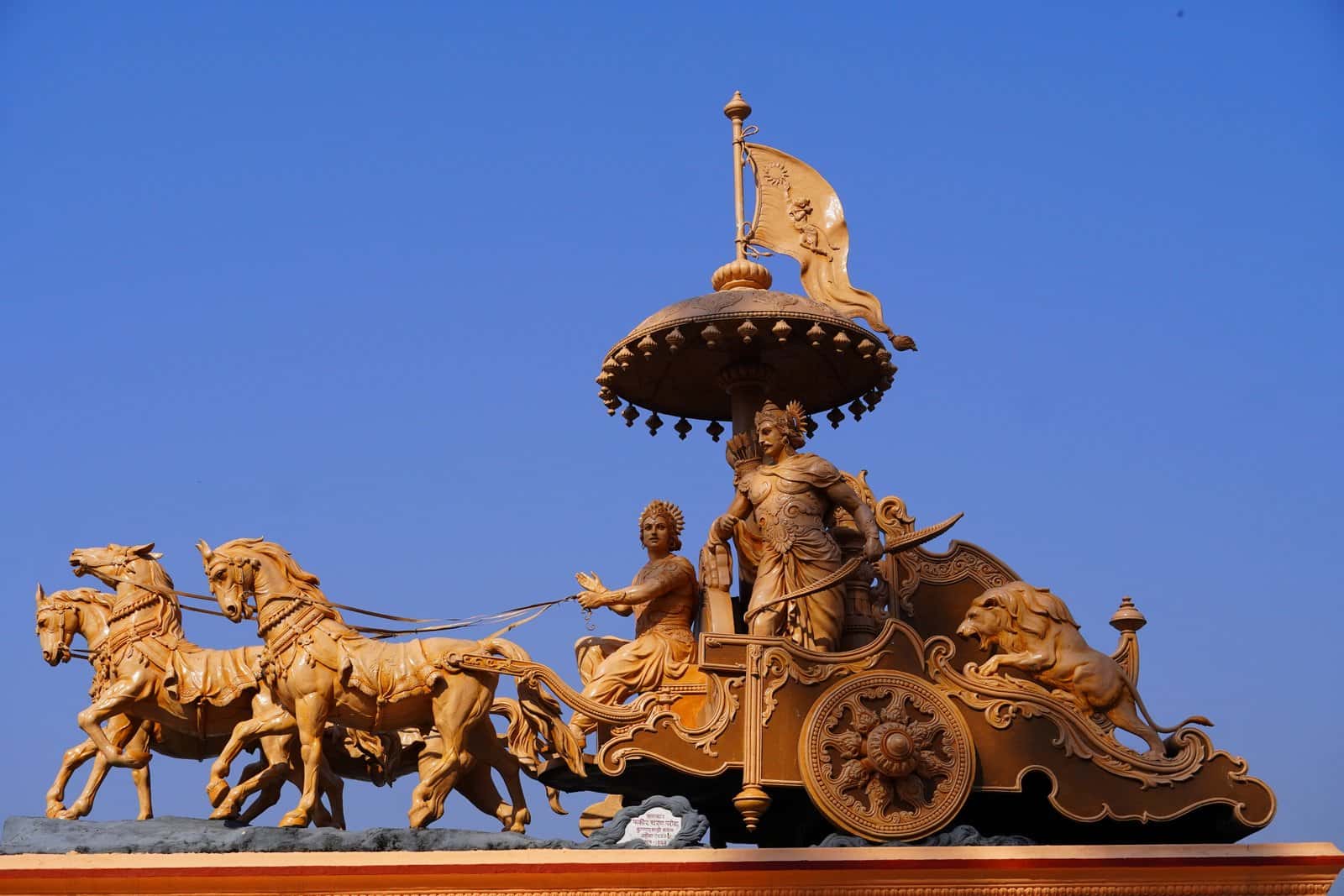
Kurukshetra is, by tradition, the Dharmakshetra, the field of righteousness on which the great Mahabharata war was fought between the Pandavas and the Kauravas. Its enduring fame, though, rests not on the battle but on a conversation. On the eve of the war, by the tradition marked at Jyotisar, Arjuna stood between the armies, his bow Gandiva slipping from his hand, unwilling to fight his own kin. There his charioteer, Krishna, spoke to him the words that became the Bhagavad Gita: on duty and detachment, action and the soul, and the steadiness that outlasts fear. An ancient banyan at Jyotisar is held to have witnessed that discourse, and pilgrims still come to stand beneath it. Around the field lie the great sacred tanks, Brahma Sarovar and Sannihit Sarovar, where the faithful bathe, most of all on the day of a solar eclipse, and the wider land is bound together by the 48-kos parikrama linking its many tirthas. Come knowing that you are standing where, in the telling of millions, a moment of doubt on a battlefield turned into one of the world's enduring scriptures, told here as the living tradition and faith of this place rather than as a single dated record, and the quiet field gathers a weight that no museum label can give it.
Planning a Kurukshetra trip?
Our Haryana travel experts plan your full journey for you: route, hotels, darshan timings and transport. You get a free day-by-day plan and an exact quote on WhatsApp, usually within a few hours. No payment is needed to get your plan.