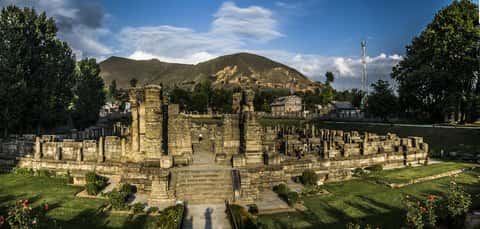
Avantipur Travel Guide
The comfortable window is broadly March to October . Spring and autumn frame the roofless stone beautifully, while deep winter brings snow that changes access and comfort at an...
When to visit Avantipur and the Kashmir Valley
The comfortable window is broadly March to October. Spring and autumn frame the roofless stone beautifully, while deep winter brings snow that changes access and comfort at an open-air site.
- Spring, about March to MayMild days around 12 to 18 degrees Celsius, blossom across the valley and the tulips of Srinagar make this many travellers' favourite window. The light is soft on the grey stone, and an open-air ruin is a pleasure rather than an endurance test in these temperatures.
- Summer, about June to AugustWarm and pleasant, the main sightseeing season, though the odd shower passes through. The ruins have almost no shade, so carry water and a hat, and do your walk of the site in the morning or the later afternoon rather than the middle of a bright day.
- Autumn, about September to NovemberThe Chinar trees turn gold and the valley is at its most photogenic. Days cool steadily through the season, so a layer helps, and the low autumn sun rakes across the carvings in a way that rewards anyone who lingers over the stone.
- Winter, about December to FebruaryCold, often below freezing, with snow that can dust or blanket the ruins. It is atmospheric for a photographer but demanding for a casual visit, and access along the valley can be affected by weather. Come prepared, or save Avantipur for a warmer month.
Avantipur is a roofless site, so the time of day matters as much as the season. Early morning and the last hours before sunset throw long shadows across the trefoil arches and the carved panels, which is when the ruin photographs best and the detail is easiest to read. The flat glare of noon washes the stone out. If you can, build your Kashmir day so the Avantipur stop falls at either end of daylight rather than the middle.
How to reach Avantipur
Avantipur sits on NH44 about 28 to 30 km south of Srinagar, directly on the road to Pahalgam. Almost everyone arrives by road, though the valley railway now offers a novel alternative.
- By road from SrinagarThe usual way in. Avantipur, signed as Awantipora, is about 28 to 30 km south of Srinagar on National Highway 44, roughly 45 minutes to an hour by car depending on traffic through Pampore. It sits right on the highway, so it slots naturally into a Pahalgam or Anantnag day trip rather than needing a special journey.
- On the way to PahalgamThis is the smart way to do it. Avantipur is between Srinagar and Pahalgam, so stopping here on the outbound leg costs you almost no extra time. Add the Pampore saffron fields just before it and the Martand Sun Temple further on, and you have a natural heritage circuit that avoids doubling back.
- By train to AwantiporaAvantipur has its own station, Awantipora, on the Banihal to Baramulla valley line, and the full Jammu to Srinagar link became operational in early May 2026 with Vande Bharat services now running through the valley. Arriving by train is scenic and cheap, and the mainstream travel pages overlook it. Check current stops and timings on IRCTC before you rely on it, as valley services change.
- Nearest airportSrinagar International Airport, also called Sheikh ul-Alam International Airport, code SXR, is about 29 km away and is the only practical airport. There is nothing closer, so an overseas or out-of-state visitor flies into Srinagar and reaches Avantipur by road from there.
Read the safety section first, as several governments currently advise against travel to the valley. If you do go, fly into Delhi and connect to Srinagar (SXR), then reach Avantipur by road. There are no international flights to Kashmir.
Connect through Delhi to Srinagar, then drive the 28 to 30 km south on NH44. Avantipur pairs easily with a wider Srinagar, Pahalgam and Gulmarg loop by road.
Fly or take the train to Srinagar, or use the new through valley rail line to Awantipora station. From Srinagar the ruins are a short drive south, and most Indian travellers see them as a stop on a Pahalgam day.
The two temples of Avantivarman, and the rules
Avantipur is two 9th-century temples, not one: the Avantiswami temple to Vishnu and the more ruined Avantishwara temple to Shiva. Both are roofless ruins, so you visit them as a site, not a shrine.
- Avantiswami temple, the main siteThe better-preserved of the two, dedicated to Vishnu and the reason most people come. A rectangular colonnaded courtyard, or peristyle, surrounds a central shrine on a raised base, with corner shrines and a grand gateway. This is where the surviving carvings are, and where you spend most of your visit.
- Avantishwara temple, the second stopAbout 1 km away in the Jawbrari area, dedicated to Shiva and much more ruined, with mainly the great gateway and base left. Most tour groups skip it. Take the ten extra minutes only if you are a keen ruins or history enthusiast, otherwise the main site tells the story on its own.
- It is a ruin, not a living templeBoth temples are open-air archaeological ruins, protected by the Archaeological Survey of India. There is no idol and no darshan, you keep your shoes on, and photography is allowed. Pages that tell you to remove footwear or that ban cameras are simply wrong for a site like this.
- What the carvings showThe stone is unusually rich for a Kashmiri ruin. Look for the trefoil arches and fluted columns that carry a Gandhara and Greco-Roman flavour, panels of a six-armed Vishnu with his consorts, a group read as Kamadeva with Rati and Priti, and a portrait panel traditionally taken to be King Avantivarman himself.
Avantiswami is a ticketed ASI monument. The Indian entry fee is small, in the region of about 15 to 25 rupees, and the foreigner fee in the region of about 200 to 250 rupees, but sources genuinely disagree on the exact figure and ASI can revise it, so treat it as a small charge and reconfirm the current ASI ticket before you go. Children up to 15 enter free. Hand-held still photography is free; video filming carries a small ASI fee of about 25 rupees, and a tripod or a professional shoot needs ASI permission in advance. The site is open roughly sunrise to sunset, in practice about 9 am to 5:30 pm for a comfortable look.
Reading the ruins: what to do at Avantipur
Beyond the quick photo, Avantipur rewards anyone who slows down to read the stone. Here is how to turn a rubble stop into a genuinely interesting half hour, and how to fit it into a Kashmir day.
- Walk the colonnade slowlyStart at the gateway and walk the rectangular peristyle, the row of columns that ringed the courtyard. This is the layout that makes Kashmiri temples distinctive, and seeing it whole, even ruined, is the point. Give it a few unhurried minutes rather than a single photo from the gate.
- Hunt the carvingsLook for the six-armed Vishnu panels, the trefoil-arched niches, the fluted Greek-looking columns and the figures read as Kamadeva with Rati and Priti. There is a portrait panel long taken to be King Avantivarman himself. Treat it as a treasure hunt and the site opens up in a way a quick stop never allows.
- Take the on-site guideA nominal government guide is usually available for about 100 rupees and is worth it for the history, since almost none of it is signposted. Agree that you are happy to tip beforehand; a few guides decline anyway. Even fifteen minutes of context changes how you see the stone.
- Decide on the second templeIf you have caught the history bug, walk or drive the 1 km to the Avantishwara Shiva temple for the gateway and base. If you have seen enough, the main Avantiswami site is a complete visit on its own, and there is no shame in moving on to Pahalgam.
- Photograph the light, not just the wallsThe ruin is at its best in early morning or late-afternoon light, when shadows pick out the carving. The Jhelum and the mountains behind make a natural backdrop. Ask before photographing local people, and be mindful of the security presence along the highway.
- Pair it with MartandThe other great Kashmiri ruin, the Martand Sun Temple near Anantnag, sits further along the same road. Doing both in a day is the classic ruins circuit and lets you compare the Vishnu temple here with the grander sun temple there. It is also the real location of the famous Aandhi film song, often wrongly attributed to Avantipur.
Most people arrive expecting a five-minute rubble stop and leave in five minutes, having missed everything. The reward here is in the detail of the stone, not the scale of the ruin. Give Avantiswami about 45 minutes, take the guide, and actually look at the carvings, and it becomes one of the more memorable stops on a Kashmir trip rather than a name you ticked off from the car.
Where to stay near Avantipur
You do not stay at Avantipur, you stay in Srinagar or Pahalgam and stop here on the way. Choosing the right base is what makes the ruins an easy addition rather than a detour.
- Srinagar, the natural baseAlmost everyone bases in Srinagar, on a houseboat on Dal Lake or in a hotel, and takes Avantipur as a stop on the drive out to Pahalgam. It is about 28 to 30 km and under an hour away, so no special planning is needed; the ruins simply fall on the route south.
- Pahalgam, if you are heading upIf your next night is in Pahalgam, see Avantipur on the outbound drive and you lose no time at all. Pahalgam itself has resorts and guesthouses along the Lidder, and the ruins are roughly an hour and a bit back down the valley.
- There is nothing to stay at in AvantipurAvantipur is a roadside heritage stop in a small town, not an overnight destination. There is a J and K Tourism restaurant opposite the site for a meal or a tea break, but you will not, and need not, stay the night in Awantipora itself.
- How the stop fits your nightsA typical valley trip is a few nights in Srinagar plus a night or two in Pahalgam and Gulmarg. Avantipur costs you only the 15 to 90 minutes you choose to spend, so it fits any of these without adding a night. Plan your beds around Srinagar and Pahalgam, not around the ruins.
Avantipur costs: entry, guide and getting there
The site itself is cheap. The real cost of visiting Avantipur is the taxi or tour time to get here, since you fold it into a wider Kashmir day rather than paying for a separate trip.
- The entry ticketA small ASI charge, in the region of about 15 to 25 rupees for Indian visitors and about 200 to 250 rupees for foreign visitors, with children up to 15 free. Sources disagree on the exact figure and ASI can revise it, so carry small cash and treat the amount as minor. Hand-held photos are free; video costs a small extra fee of about 25 rupees.
- The guideThe nominal on-site guide is usually about 100 rupees and is the best-value spend here, since the site is unsignposted and the history is the whole point. It is optional, but for the price it turns a confusing pile of stone into a story.
- The real cost is transportBecause Avantipur is a stop rather than a destination, its true cost is the taxi or tour that carries you along the Srinagar to Pahalgam road. Folding it into a day you are already doing means the ruins add almost nothing to your bill beyond the ticket and the guide.
- Carry cash, no cardsThe ticket counter, the guide and the roadside stalls all run on cash, and small notes are easiest. There is no card or reliable digital-payment culture at a roadside ruin, so draw what you need in Srinagar before you set off.
You will see this fee quoted as 5, 10, 15, 20 and 25 rupees for Indians across different pages, and around 200 to 250 rupees for foreigners, because operators and blogs copy old figures and ASI revises them. We deliberately do not print a single hard number as fact. It is a small charge either way, so carry a little cash and pay whatever the counter asks on the day, and if you want certainty, check the current ASI ticket before you travel.
Practical logistics: food, toilets, guides and getting around
The small things that make an Avantipur stop smooth: where to eat and use a toilet, how the on-site help works, and how you actually move between the two temples.
- Food and toiletsThere is a J and K Tourism restaurant opposite the Avantiswami site with Jhelum-view seating, and clean toilets and parking within the premises. A few food stalls sit outside the gate. It is a comfortable place to break a Srinagar to Pahalgam drive for lunch or tea.
- Getting between the two templesAvantiswami is right on the highway. The second temple, Avantishwara, is about 1 km away in Jawbrari and is easiest reached by having your taxi run you across, since it is off the obvious tourist path. Ask your driver, as many know it, and it is a short hop rather than a journey.
- Guides and informationThe site is almost entirely unsignposted, so the roughly 100 rupee on-site guide does real work. There is no visitor centre and no audio guide, so a little reading before you arrive, or the guide on the day, is what turns the stones into sense.
- Connectivity and IDMobile coverage along the highway is generally workable but can be patchy, so download your maps in Srinagar. Carry a photo ID, as security checks along the NH44 corridor are routine, and a foreign visitor should keep a passport copy handy.
Safety, travel advisories and the honest access reality
This is the section to read before you book. Several governments currently advise against travel to the Kashmir Valley, and the ruins sit on a highway with a real security presence. Here is the honest picture.
- Read the official advisories firstAs of 2026 the UK Foreign Office advises against all travel to Jammu and Kashmir including Srinagar and the Jammu to Srinagar highway, and the United States and Australia both place the territory at their highest Do Not Travel level. These are official positions, they change, and you should read the current wording yourself before deciding.
- What that means in practiceMany Indian and some foreign tourists do visit the valley and complete trips without incident, and Srinagar tourism operates. But a do-not-travel rating usually voids ordinary travel insurance, and consular help is limited, so weigh the official advice against your own risk tolerance rather than dismissing it.
- The highway and vehicle-access quirkThe ruins sit on NH44 in Pulwama, a corridor with a routine security presence. On some days, non-local vehicles, for example a Jammu-registered cab, have been refused at checkpoints or the site. Using a Srinagar-based taxi, carrying photo ID, and following your driver's read of the day avoids almost all of this.
- Ordinary health and comfortThe site itself is a safe, well-touristed open-air ruin. The everyday risks are the ordinary ones: uneven stone underfoot, no shade in summer, and cold that can bite in the shoulder seasons. Wear proper footwear, carry water and sun protection in summer, and a warm layer outside high summer.
We will not tell you the valley is either perfectly safe or off limits, because neither is honest. The facts are that official UK, US and Australian advisories currently rank Jammu and Kashmir at their most severe travel-warning levels and name Srinagar and the NH44 highway specifically, that many travellers nonetheless visit without incident, and that insurance is usually void in such a zone. Read the current advisories at the source, factor them into your cover and your plans, and decide for yourself rather than on a travel page's reassurance.
Avantipur for every kind of traveller, and on access
A ruin suits some visitors far more than others. Here is what Avantipur offers you and the one tip that matters for each, including an honest read on the stone steps for seniors.
- History and heritage loversThis is your stop. The layout, the Gandhara-flavoured columns and the carved panels reward reading, and with the guide or a little background it is one of the most rewarding heritage sites in the valley. Allow the full 45 minutes and consider the second temple too.
- PhotographersCome at early or late light for the shadows in the carving, use the Jhelum and mountains as a backdrop, and remember photography is free and permitted. Ask before photographing people, and be discreet about the security presence along the highway.
- Families with childrenA ruin holds a child's attention for about the 20 to 30 minutes a stop takes, especially if you turn the carvings into a hunt for animals and figures. It is open ground with uneven stone, so keep little ones from climbing the fragile masonry, which is also asked of every visitor.
- Senior travellers and on accessibilityDoable with care. The ground is uneven stone with some steps up to the raised shrine base and no ramps, so wear firm shoes and take it slowly. You can appreciate a great deal from the courtyard level without climbing, and the flat approach from the gate is manageable. Skip the summer midday heat, as there is no shade.
- CouplesA quiet, atmospheric half hour among old stone on the way to Pahalgam, best at golden hour. It is a gentle, unhurried counterpoint to the meadows and gondolas of the rest of a Kashmir trip, and pairs well with a Jhelum-view tea across the road.
- Budget and independent travellersReachable by the valley train to Awantipora or by shared road transport, with a tiny entry fee, this is one of the cheapest heritage stops in Kashmir. It suits anyone travelling light who wants substance over a packaged sight.
How long to spend, and where Avantipur fits your day
The honest, tiered answer to the question everyone asks. Avantipur is a stop, not a day, and how you sequence it decides whether you sail through or backtrack.
- The 15 to 20 minute versionA quick photo stop at Avantiswami: walk in, take in the courtyard and the gateway, photograph the carvings and move on. This is what most tour groups do, and it is fine if the ruins are a bonus rather than your reason for the trip.
- The 45 minute versionDone properly, with time to walk the colonnade, read the carvings and take the guide. This is the sweet spot for most travellers who care at all about heritage, and it still fits a Pahalgam day comfortably.
- The 90 minute versionFor the enthusiast: the full Avantiswami visit plus the 1 km hop to the Avantishwara Shiva temple. Budget about 90 minutes in total. Only worth it if you genuinely love ruins, since the second temple is far more broken down.
- The ruins circuitThe elegant way to do it on a Pahalgam day is Srinagar, then the Pampore saffron fields, then Avantipur, then the Martand Sun Temple, then Pahalgam, all on the outbound leg so you never double back. Reverse none of it and the whole heritage run costs you an hour or two of a day you are already driving.
The single planning mistake is leaving Avantipur and Martand for the return from Pahalgam, when everyone is tired and the light has gone. Do the ruins on the way up, in the morning, when you are fresh and the sun is low and kind to the stone, and keep the drive home for driving. Slotted this way, a rich pair of 9th-century ruins costs you almost nothing on a day you were spending on the road anyway.
The real questions travellers ask about Avantipur
Straight answers to the questions that come up again and again on traveller forums and review pages, so you arrive already knowing the score.
- Is it worth it or just rubble?It divides people. If you want scale and grandeur you may find it modest; if you slow down and read the carvings, or take the guide, it is one of the more rewarding heritage stops in the valley. Treat it as a rich 45 minutes, not a monument to be wowed by from the gate.
- How long do I need?About 15 to 20 minutes for a photo stop, about 45 minutes to do it properly with the carvings and a guide, and about 90 minutes if you add the second Avantishwara temple 1 km away. Most travellers find 45 minutes the right amount.
- Is it safe to stop on the highway?The site itself is a safe, well-touristed ruin, but it sits on NH44 in Pulwama, and official UK, US and Australian advisories currently warn against travel to the valley. Read the safety section, weigh the advisories, and if you go, use a Srinagar taxi and carry ID.
- Can a Jammu taxi take me, or only Kashmir vehicles?Travellers have occasionally been turned back at the highway or the site when arriving in a non-local, for example Jammu-registered, vehicle on a tense day. A Srinagar-based taxi avoids this in almost every case, so hire your car in Srinagar rather than bringing one up from Jammu.
- Is it a temple I can pray at?No. Both temples are open-air archaeological ruins with no idol and no worship. You keep your shoes on, photography is allowed, and you visit as you would any ancient site, not as a pilgrim. Anyone expecting a living shrine will be surprised.
- Should I do Martand as well, and was the Aandhi song shot here?If you like ruins, yes, pair Avantipur with the grander Martand Sun Temple further along the road. And to settle a common mix-up, the famous Aandhi film song was shot at Martand, not at Avantipur, so do not go looking for that spot among these stones.
Planning Avantipur from abroad
For an overseas or NRI visitor the two things that matter most are the current travel advisories and the reality that this is a protected ruin, not a living temple. Get those right and the visit is straightforward.
- Check your government's advisory firstThe UK advises against all travel to Jammu and Kashmir, and the US and Australia rate it Do Not Travel. This affects your insurance and your consular support. Read the current advisory for your own country, understand that it usually voids ordinary cover, and make an informed choice before you book anything.
- Know it is a ruin, not a shrineYou are visiting a 9th-century archaeological site protected by the Archaeological Survey of India, not a working temple. There is no darshan, you keep your shoes on, and photography is free. Come for the history and the carving, not for worship, and the site makes sense.
- The foreigner ticket and photographyAs a foreign visitor expect a small ASI ticket in the region of about 200 to 250 rupees, cash only, with hand-held photography free and video carrying a small extra fee of about 25 rupees. Carry small notes and a passport copy, since ID checks along the highway are routine.
- How it fits a Srinagar tripIf you do travel, Avantipur is an easy 28 to 30 km stop south of Srinagar on the Pahalgam road, best combined with Pampore and the Martand Sun Temple. Fly into Srinagar via Delhi, use a Srinagar-based car and guide, and give the ruins about 45 minutes.
Money, connectivity and timing for foreign visitors
The practical basics for an overseas traveller at a small roadside ruin: cash, a SIM, ID, and how much of your Kashmir time this stop really deserves.
- Carry cash, expect no cardsThe ASI ticket, the guide and the roadside stalls are all cash, and there is no card culture at a roadside ruin. Draw rupees in Srinagar before you set off and keep small notes for the ticket and the guide, since change can be scarce.
- SIM and connectivity for foreignersNote that prepaid SIM activation for foreign visitors in Jammu and Kashmir can be slow and is best arranged on arrival in Srinagar with your passport and photo. Coverage along the highway is workable but patchy, so download offline maps before you drive out to the ruins.
- Keep ID to handSecurity checks along the NH44 corridor are routine. A foreign visitor should carry a passport or a clear copy, and travel in a Srinagar-registered vehicle with a local driver who knows the checkpoints, which keeps the whole day smooth.
- How much time to give itOn a wider Kashmir trip, Avantipur deserves about 45 minutes as part of a Pahalgam day, or up to 90 minutes if you love ruins and add the second temple. It is a stop that enriches a day, not one that needs a day of its own.
For an overseas traveller who has weighed the advisories and chosen to visit the valley, Avantipur is a quiet, uncrowded window into a 9th-century Kashmir that predates the more famous Mughal gardens and shrines. It asks little of you, a short stop, a small fee, a bit of reading, and gives back a sense of the old Hindu Kashmir that most itineraries skip entirely. Slot it into a Srinagar and Pahalgam few days and it becomes the thoughtful chapter between the lakes and the meadows.
The king who built a city, and the silt that saved it
Avantipur is named for King Avantivarman, who reigned in Kashmir from about 855 to 883 AD and founded the Utpala dynasty. He built a new capital here on the Jhelum and raised two great temples, the Avantiswami to Vishnu and the Avantishwara to Shiva, in the distinctive Kashmiri style with its colonnaded courtyards, trefoil arches and columns that carry a memory of Greece and Gandhara. The temples were later reduced to ruins, and popular accounts blame the 14th-century iconoclast Sikandar Butshikan. Yet the archaeological record tells a gentler and stranger story: the shifting Jhelum had already buried the Avantiswami courtyard in silt, two-thirds of the way up its columns, before Sikandar's time, so the fine carving survived underground for centuries and was only brought back to light by excavation from the 19th century onward, notably the definitive dig by D.R. Sahni recorded in the Archaeological Survey of India annual report of 1913 to 1914. It was the river, not the king or the iconoclast, that kept these stones.
Planning a Avantipur trip?
Our Jammu And Kashmir travel experts plan your full journey for you: route, hotels, darshan timings and transport. You get a free day-by-day plan and an exact quote on WhatsApp, usually within a few hours. No payment is needed to get your plan.