Deoghar Travel Guide
The best months are September or October to March . The one thing to plan around is not the weather: it is the Shravani Mela, when through the month of Shravan lakhs of pilgrims...
When to visit Deoghar, and the Shravani Mela rule
The best months are September or October to March. The one thing to plan around is not the weather: it is the Shravani Mela, when through the month of Shravan lakhs of pilgrims fill Deoghar and a darshan can take many hours.
- October to March: pleasant for darshanThe most comfortable window, cool and clear with daytime temperatures roughly 10 to 25 degrees Celsius, good for the queue and for the side trips to Trikut, Tapovan and Basukinath. The early mornings are crisp, which suits an early-morning darshan before the day warms up, and a winter evening can be the quietest darshan of all.
- September shoulder and the late monsoonSeptember is a fair shoulder month as the monsoon eases, still green and not yet crowded once the Mela is over. Carry light rain protection early in the month, and check the local forecast, since eastern India can see a late shower.
- Summer is hot, monsoon brings the MelaHigh summer, about April to June, gets hot, so keep to an early-morning or evening darshan then. The peak monsoon, about late July to August, brings the Shravani Mela crowds along with humidity, so plan very carefully if you come in that window.
- Mahashivratri and other festival daysMahashivratri, about February or March, is another major day at Baidyanath with big crowds, as are Basant Panchami in winter and other Shiva festivals. Come for the atmosphere if you wish, but never expect a quick darshan on those days.
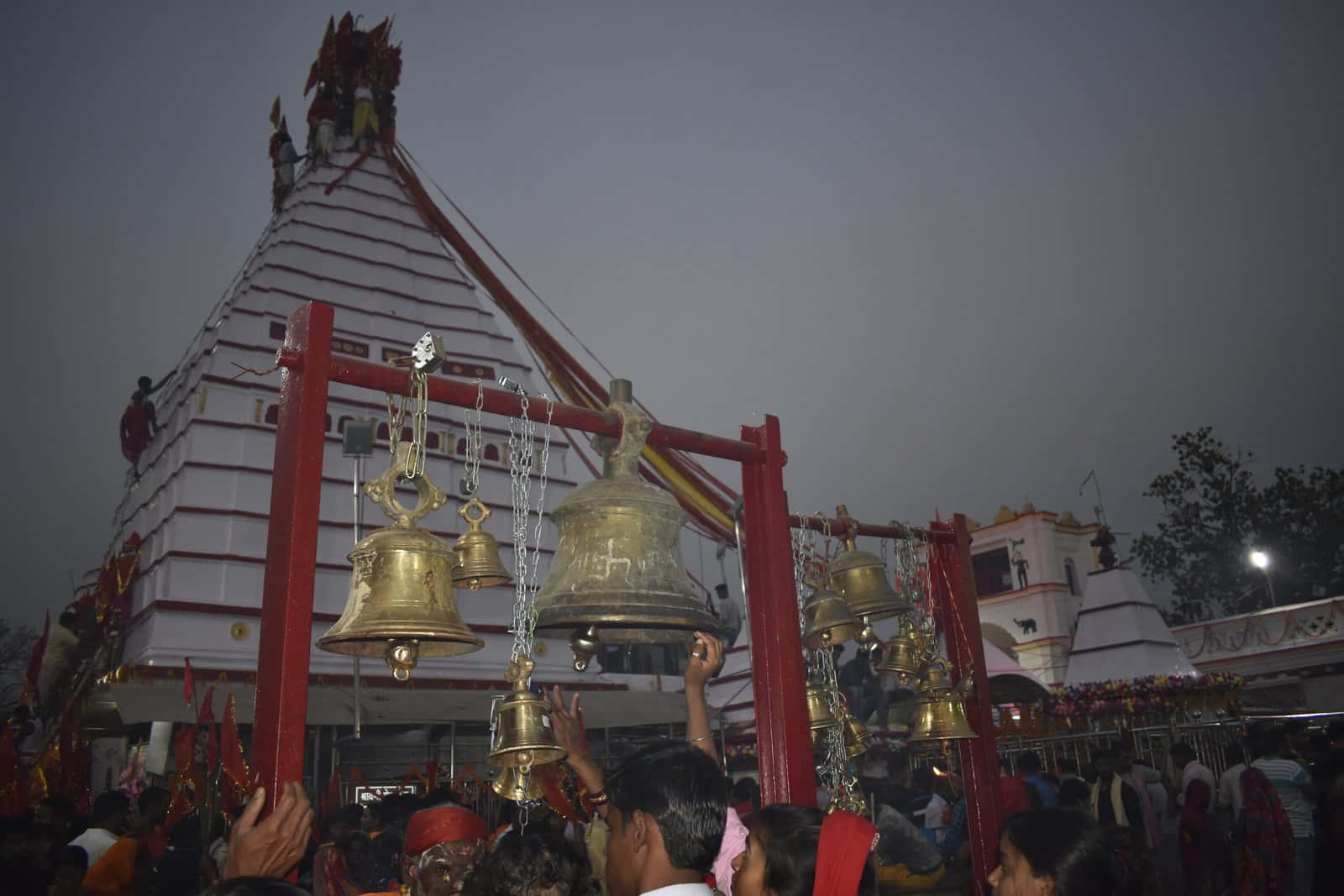
Through the Hindu month of Shravan, which begins about 30 July in 2026 and runs into late August, Deoghar hosts the Shravani Mela, often called the longest religious fair in the world. An estimated 50 to 55 lakh pilgrims arrive over the month, and a vast number of kanwariyas walk about 105 to 109 km from Sultanganj carrying Ganga water. It is an extraordinary sight, but darshan then can take many hours. Come in Shravan only for the experience of the Mela, and choose September to March for a calmer darshan. Confirm the exact Mela dates on the Deoghar district site before you book.
How to reach Deoghar
Deoghar is now easier to reach than it used to be: it has its own airport (DGH) since 2022, and Jasidih Junction is the main railhead just a few kilometres from the temple.
- By air to Deoghar (DGH)Deoghar's own airport (DGH, ICAO VEDO) opened in 2022. As of 2026 IndiGo is the operating carrier, with a direct Kolkata flight of about 1 hour 5 to 10 minutes (roughly one a day) and a Delhi link of about 2 hours where a non-stop runs, with other routes seasonal and often connecting via Kolkata. It is a young airport, so reconfirm the current schedule when you book. We arrange your airport transfer to the temple, about 12 km away.
- By train via Jasidih JunctionJasidih Junction is the main railhead, only about 6 to 7 km from the Baidyanath temple, and well connected by long-distance trains from Kolkata, Delhi, Patna and beyond. A short branch line also runs to the small Baidyanathdham (Deoghar) station, but most rail pilgrims simply arrive at Jasidih and drive the last few kilometres by auto or taxi.
- By road and the Basukinath pairingDeoghar is well linked by road across Jharkhand and Bihar. Most itineraries pair Baidyanath with Basukinath Dham, about 43 to 45 km away and roughly an hour by road, since by tradition the pilgrimage is incomplete without Basukinath. We arrange a car with an experienced local driver.
Fly into Kolkata, the nearest major international gateway, then take a short IndiGo hop to Deoghar (DGH) in about an hour, or come by train via Jasidih. Deoghar's own airport makes the last leg far easier than it once was.
Fly into Kolkata, with good direct links from the Gulf and Southeast Asia, and continue to Deoghar by the short flight or by train. Baidyanath pairs naturally with a wider eastern-India temple trip.
Fly direct to Deoghar (DGH) from Kolkata, or via Kolkata from Delhi and other metros on IndiGo, or take a long-distance train to Jasidih Junction and drive the last few kilometres to the temple.
Baidyanath, the Shakti Peetha, and what you actually pay
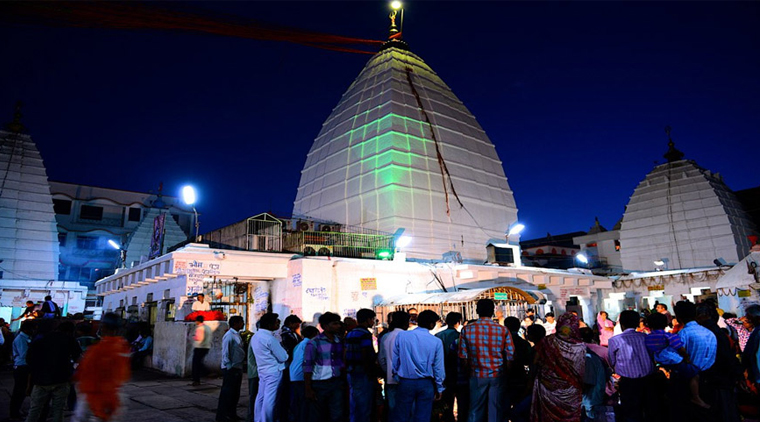
Deoghar is the Baidyanath Jyotirlinga and the Jai Durga Shakti Peetha in one complex, plus Naulakha Mandir, Tapovan and Trikut nearby. Knowing the darshan options before you arrive saves you a long wait.
- Baba Baidyanath JyotirlingaThe only Shiva Jyotirlinga in eastern India, where Shiva is worshipped as Vaidyanath, the divine physician. Per the temple administration the doors open about 4:00 am for the Kancha Jal offering, close for a midday break in the early afternoon, reopen in the evening for the Shringar Puja, and close for the night about 9:00 pm. The free general queue can run for hours on a busy day, which is why the darshan options below matter.
- The Shighra Darshan pass and the free queueThe free general queue runs roughly 1 to 2 hours on a normal day but 3 to 4 hours or more on a special day. For a much shorter wait there is a paid Shighra Darshan (quick darshan) pass from the temple and district administration, generally about 250 rupees per person on a normal day, rising to about 500 rupees on special occasions and through the Shravani Mela. It routes you through the administrative building and lets you finish darshan and jalabhishek in roughly 15 to 30 minutes. At present these are sold offline only, so reconfirm the current price and counter before you travel.
- The Jai Durga Shakti PeethaWithin the same complex is the Jai Durga Shakti Peetha, where the heart of Goddess Sati is believed to have fallen. Baidyanath is one of the rare sites that is both a Jyotirlinga and a Shakti Peetha, so give time to both the Shiva and the Shakti shrines; the jalarpan ritual links the two.
- Naulakha Mandir, Nandan Pahar, Tapovan and TrikutNaulakha Mandir, about 1.5 km away, is a tall white shrine in the Belur Math style; Nandan Pahar is a small hill on the town edge with a Nandi shrine and family rides; Tapovan, about 10 km out, has caves and a hilltop Shiva shrine; and Trikut (Trikoot) Pahar, about 10 km away, gives wide views. Note that the Trikut ropeway has stayed closed since 2022, so the summit is now reached on foot.
Dress modestly, covering shoulders and knees. Leather items and electronic gadgets, including phones in the inner temple, are generally not allowed, and footwear is removed before the main premises, so carry as little as possible and use the cloakroom. Many pilgrims take a dip in the Shivaganga tank before the darshan, so carry a change of clothes if you plan to. The Shighra Darshan pass details are in this section; the jalarpan ritual is explained next.
Jalarpan at Baidyanath, and the Shravani Mela kanwar yatra
The heart of a Deoghar pilgrimage is the jalarpan, pouring holy water on the Jyotirlinga. In Shravan this becomes the Shravani Mela, when a vast number of kanwariyas walk from Sultanganj to do exactly that. Here is how both work.
- The jalarpan (jalabhishek) ritualThe signature offering is jalarpan, also called jalabhishek: you pour holy water, ideally Ganga water, onto the Baidyanath Jyotirlinga. Many pilgrims first take a purifying dip in the Shivaganga tank near the temple. The water offering is then symbolically carried to the Jai Durga Shakti Peetha, marking the union of Shiva and Shakti. Bilva (bel) leaves, flowers and sweets are the usual offerings.
- The Shravani Mela windowThrough the Hindu month of Shravan, which begins about 30 July in 2026 and runs into late August, Deoghar hosts the Shravani Mela, an estimated 50 to 55 lakh pilgrims over the month. It is called the longest religious fair in the world. The temple keeps its doors open far longer than usual, sometimes nearly around the clock, during these weeks to clear the crowds.
- The kanwar yatra from SultanganjThe defining sight is the kanwar yatra: a vast number of kanwariyas, clad in saffron, walk about 105 to 109 km, often barefoot, from Sultanganj in Bihar (where the Ganga uniquely flows north) carrying Ganga water in decorated kanwars, chanting Bol Bam, to offer it at Baidyanath. The road becomes one long human chain of devotees.
- Come for the spectacle, or come for calmThe Mela is an unforgettable display of faith, but darshan then can take many hours and the town is stretched to its limits, so book accommodation far ahead. If you want a calm, quick darshan instead, come between September and March and use the Shighra Darshan pass or simply pick a quiet weekday evening.
During the Shravani Mela, accommodation fills early, basic amenities are stretched by the sheer numbers, and the queue can run for many hours even with a pass. If you come for the Mela, treat it as an experience of the crowd and the devotion, not a quiet temple visit, and tell us early so we can secure rooms and a Shighra Darshan pass where it is available. Carry water, wear footwear you can leave at a cloakroom, and keep elderly travellers out of the densest crush.
The Shakti Peetha, Tapovan, Trikut and Basukinath
Beyond the main darshan, Deoghar offers a Shakti Peetha, hill shrines and caves, and the paired pilgrimage to Basukinath. Here is how to do them.
- Pair Baidyanath with BasukinathBasukinath Dham, about 43 to 45 km away and roughly an hour by road, is traditionally paired with Baidyanath; by local belief the pilgrimage is incomplete without it. Most itineraries do both in a day, and we arrange the car and the timing so you reach Basukinath in good light.
- Tapovan caves and hill shrineTapovan, about 10 km from town, has meditation caves and the Tapo Nath Mahadev hilltop shrine, with a quiet, contemplative air away from the temple crowds. Wear sturdy shoes for the short climb, and start early to beat the midday warmth.
- Trikut Pahar, now on footTrikut (Trikoot) Pahar, about 10 km from town, gives wide views over the country. The passenger ropeway has stayed closed since the 2022 accident, so the summit is reached on foot now; treat it as a hill walk rather than a quick cable-car ride, carry water, and check locally before you go.
- Naulakha Mandir and the ashramsNaulakha Mandir, about 1.5 km from the temple, is a striking tall white shrine in the Belur Math style dedicated to Radha and Krishna. Deoghar also has several calm spiritual centres, including the Ramakrishna Mission Vidyapith and the Satsang Ashram, that are pleasant to visit between darshans.
- A dip at Shivaganga, and Harila JoriThe Shivaganga tank beside the temple is where many pilgrims bathe to purify themselves before the jalarpan; carry a change of clothes and keep to the marked bathing area. Harila Jori, about 8 km out, is the spot tied to the Ravana legend, a quiet stream worth a short stop for those who want the full story.
Where to stay in Deoghar, and how many nights
Stay close to the temple to walk to the early darshan, or a little out for a quieter, more comfortable room. One to two nights is the right length outside the Mela.
- Near the temple and Tower ChowkThe lanes around the Baidyanath temple and the Tower Chowk market are the most convenient base, a short walk to the queue and to the Shivaganga tank. They are busy and basic but let you reach an early-morning or late-evening darshan on foot, which is the single best way to skip the worst crowds.
- A little out, near Jasidih or the bypassNewer, quieter hotels sit out towards Jasidih and along the bypass, with more comfortable rooms and easier parking, a short auto or car ride from the temple. Better for families, older travellers and anyone who wants a calm night after a crowded darshan.
- Room budgetsOutside the Mela, simple guesthouses and dharamshalas run from a few hundred rupees, and comfortable mid-range hotel rooms are commonly about 1,500 to 3,500 rupees a night. During the Shravani Mela rooms are scarce and several times dearer, so book months ahead or stay further out and commute in.
- How many nightsOne full day covers the Baidyanath darshan, the Shivaganga dip and a paired Basukinath visit if you keep moving. A second night lets you add Tapovan, Trikut, Naulakha Mandir and a gentler pace, and is the kinder plan for seniors who want an unhurried early darshan.
During the Shravani Mela, hotels, dharamshalas and tented arrangements fill months in advance at several times the normal rate, and the whole town is stretched. If your dates fall in Shravan, book very early, consider staying out towards Jasidih or beyond, and tell us as soon as you can so we can hold a room and a darshan slot.
Deoghar costs and a realistic daily budget
A Deoghar darshan can cost almost nothing or a little more for comfort. Here is what the main things cost, so you can plan and avoid being overcharged.
- A rough daily budgetExcluding your flights or trains and your room, plan on about 1,000 to 1,500 rupees a day for a simple pilgrim day with the free darshan, local food and short auto hops, and about 2,500 to 4,000 rupees for a comfortable day that adds the Shighra pass and a car for Basukinath and Tapovan.
- The darshan choicesThe free general queue costs nothing but time, roughly 1 to 2 hours on a normal day. The paid Shighra Darshan pass is generally about 250 rupees per person on a normal day, rising to about 500 rupees on special occasions and during the Shravani Mela, sold offline at the temple counters. Decide whether the time saved is worth it for your day and your group.
- Puja, pandas and offeringsA formal puja or Rudrabhishek with a panda is extra and negotiable, so agree the amount before it begins rather than after. Flowers, bel leaves and prasad are inexpensive from the stalls outside. Keep small notes handy and do not feel pressured into a large donation on the spot.
- Cash, cards and ATMsCarry cash for the temple lanes, the stalls, autos and small eateries, as not everyone takes cards or UPI. There are bank ATMs around Tower Chowk and the main market. Bigger hotels and restaurants take cards or UPI.
Almost everything negotiable in Deoghar, a panda's puja, an auto fare, a hotel rate in the off-season, comes down when you agree it in advance and politely. The fixed things are the official Shighra Darshan pass at its counter and your train or flight. Settle every other price before the service begins and the town's only real friction, the on-the-spot donation push, simply disappears.
Practical logistics: food, money, dress and getting around
The small things that make a Deoghar day smooth, from the temple dress code and the cloakroom to ATMs, food and local transport.
- Temple dress and what to leave behindCover shoulders and knees, and remove footwear before the main premises. Leather items and electronic gadgets, including phones in the inner temple, are generally not allowed, so carry as little as possible and use the cloakroom for the rest. Keep your wallet slim and your hands free for the queue.
- Food and the satvik normDeoghar is a devotional town and most food near the temple is vegetarian and satvik, simple and clean. Eat at busy, well-used places, drink bottled or filtered water, and take the usual care with street food, especially in the warm and humid months.
- Getting around townAutos and cycle-rickshaws cover the short hops between Jasidih, Tower Chowk, the temple and the nearby sights, and they are cheap once you agree the fare. A hired car is easiest for the Basukinath, Tapovan and Trikut loop, and we arrange one with a local driver.
- Money, SIM and languageCarry cash for the lanes and stalls, with ATMs around the main market. Mobile coverage in town is generally fine for calls and data. Hindi is the working language; English is understood at hotels and by guides, so communicating is straightforward.
Safety, the panda pressure, and staying well
Deoghar is a deeply devotional and generally safe town, but it is crowded and runs on its own customs, so a little awareness keeps the day smooth and the donation pressure manageable.
- The panda donation pressure, and how to handle itSome pandas (hereditary priests) and touts can be insistent about pujas and donations, quoting large sums and offering to break the queue for a fee. A panda can genuinely help with a proper puja, but agree the service and the amount clearly before it begins, keep small notes ready, and do not feel pressured into a big donation on the spot. A polite, firm no is enough.
- Buy the Shighra Darshan pass at the official counterThe paid quick-darshan pass is run by the temple and district administration and, at present, is sold offline. Beware touts selling fake VIP or quick-darshan passes; ask your operator or hotel for the official counter and reconfirm the current price rather than paying a middleman in the lane.
- Crowds, footing and the Mela crushOn busy days and through the Shravani Mela the crush is real. Keep children and elderly travellers close, hold valuables tight, wear footwear you can leave at the cloakroom, and never assume a quick darshan on a special day. The marble and the wet steps near Shivaganga can be slippery, so step carefully.
- Heat, water and healthDrink bottled or filtered water, carry sun protection in the warmer months, and pace the hill walks at Trikut and Tapovan. Carry any regular medicines, especially for older pilgrims, and keep a small first-aid kit, as the lanes can be dusty and the days long.
Deoghar is a busy pilgrimage town where most visitors find the crowds devotional rather than threatening, and women travellers generally manage well with standard precautions. Dress modestly, keep to the busier lanes after dark, be firm with the panda and donation pressure, and prefer an early-morning or evening darshan when the crowd is thinner. As anywhere, keep an eye on your bag in the densest crush.
Deoghar for every kind of traveller, and on access
Deoghar rewards very different pilgrims. Here is what it offers you, and the one tip that matters for each, including how a senior visits comfortably.
- Senior travellers and on accessibilityVery doable with planning. Use the Shighra Darshan pass, about 500 rupees, to skip the long free queue, fly in to Deoghar airport rather than enduring a long road journey, avoid the Shravani Mela crush, stay near the temple or out by Jasidih for a calm room, and take an early-morning or evening darshan when the crowd is thinnest. The temple lanes are uneven and the steps near Shivaganga can be slippery, so go slowly and lean on a companion.
- Families with childrenThe darshan, the Shivaganga dip and a side trip to Tapovan, Nandan Pahar or Basukinath fill an easy day or two. Keep small children close in the temple crowds, carry water, and use the Shighra pass so little ones are not stuck for hours in the free queue. Nandan Pahar's simple rides are a welcome break for them.
- First-time pilgrimsUnderstand the jalarpan ritual and the darshan choices first: the free queue, and the paid Shighra Darshan pass for a much shorter wait. Knowing the system, and that Baidyanath is both a Jyotirlinga and a Shakti Peetha, makes the visit far richer than just standing in line.
- Spiritually inclinedThis is the only eastern Jyotirlinga and a rare Jyotirlinga-and-Shakti-Peetha double, so give time to both the Baidyanath and the Jai Durga shrines, take the Shivaganga dip, and consider the paired Basukinath visit and the calm Ramakrishna Mission and Satsang ashrams to complete the pilgrimage.
- Nature and quiet seekersBeyond the temple, Trikut Pahar (now a hill walk, with the ropeway closed), Tapovan's caves and the green country around Deoghar give a gentler, quieter side to the trip. Start early, carry water, and treat the hills as a walk rather than a quick photo stop.
- Budget pilgrimsThe free general queue costs nothing but time, and trains to Jasidih are cheap and frequent. Come outside the Shravani Mela for lower room rates, eat at the simple satvik places near the temple, and decide whether the Shighra pass is worth it for your day.
A suggested Deoghar itinerary
How to shape one or two days so you catch an unhurried darshan and still see the Shakti Peetha, Basukinath and the hill shrines.
- Day one, early morningStart at the Baidyanath temple soon after the doors open about 4:00 am, or take an early slot, when the queue is shortest. Take the Shivaganga dip first if you wish, then the jalarpan, and give time to the Jai Durga Shakti Peetha. Decide in advance whether to use the Shighra pass.
- Day one, afternoonAfter the midday temple break, drive out to Basukinath Dham, about an hour each way, to complete the paired pilgrimage. On the way back, stop at Naulakha Mandir, close to town, before the evening sets in.
- Day two, if you have itGive the morning to Tapovan's caves and hill shrine and, if you are up for the walk, the climb at Trikut Pahar (the ropeway is closed). Keep the afternoon for the calm of the Ramakrishna Mission or Satsang ashram, or a quieter second darshan in the evening when the crowd thins.
- The one-evening versionIf you only have an evening, aim for a late, quiet darshan when the crowd is thinnest, take the Shivaganga look, and see Naulakha Mandir nearby. You will miss Basukinath and the hills, but you will get the heart of the visit without the worst of the queue.
The thing that breaks a tight Deoghar plan is arriving when the sanctum doors are shut for the midday break or after the night closing about 9:00 pm. Build your darshan into the early morning or the evening reopening, keep the closed hours for Basukinath, the hills or a meal, and you will not find yourself at a shut gate with the day running out. Confirm the day's exact hours locally, as they shift with festivals and the Mela.
The real questions travellers ask about Deoghar
Straight answers to the questions that come up again and again on traveller forums and reviews, so you arrive already knowing the score.
- How long is the darshan queue, and how do I skip it?The free queue runs roughly 1 to 2 hours on a normal day, 3 to 4 hours or more on a special day, and can be almost empty on a quiet weekday evening. To shorten it, buy the paid Shighra Darshan pass, generally about 500 rupees, or simply time your visit to a quiet evening rather than a festival morning.
- Can I book the Shighra or VIP pass online?At present the quick-darshan pass is sold offline at the temple administration counters, not reliably online, so reconfirm the current price and counter before you travel, or let us arrange it. Treat any site claiming online VIP passes with caution and avoid touts in the lane.
- Do I really need a panda?You do not need a panda for a simple darshan and jalarpan. A panda is useful if you want a formal puja or Rudrabhishek, but agree the amount first; reviewers report some pandas pressure donations or break the queue for a fee, so be polite and firm and pay only what you agreed.
- Is Baidyanath really both a Jyotirlinga and a Shakti Peetha?Yes. It is the only Shiva Jyotirlinga in eastern India and, by tradition, also the Jai Durga Shakti Peetha where the heart of Sati fell, which makes it one of very few sites that hold both. Give time to both the Shiva sanctum and the Shakti shrine.
- Is the Trikut ropeway open?No. The Trikut Pahar passenger ropeway has stayed closed since the April 2022 accident, the operator was blacklisted and penalised, and it had not reopened as of 2026. The summit is reached on foot now, so treat Trikut as a hill walk and check locally before you go.
- How far is Basukinath and must I visit it?Basukinath Dham is about 43 to 45 km away, roughly an hour by road. It is not compulsory, but by tradition the Baidyanath pilgrimage is considered incomplete without it, so most pilgrims do both in a day.
Planning Deoghar from abroad
For a diaspora pilgrim, Deoghar is a special draw: the only Shiva Jyotirlinga in eastern India, and a rare Jyotirlinga-and-Shakti-Peetha double. The new airport and a little planning make it smooth.
- Arrive through Kolkata, then fly to DGHFly into Kolkata, the nearest major international gateway, then take a short IndiGo hop to Deoghar airport (DGH), about an hour, opened in 2022. You can also come by train via Jasidih Junction. The new airport makes the last leg far easier than it once was, especially for older parents.
- The only eastern Jyotirlinga and a Shakti PeethaBaidyanath is the only Shiva Jyotirlinga in eastern India and one of the few sites that is also a Maha Shakti Peetha. For a diaspora family making a once-in-a-trip pilgrimage, that double makes the journey well worth it, and it pairs naturally with a wider eastern-India temple route.
- Use the Shighra Darshan pass and carry your passportBook the paid Shighra Darshan pass, generally about 500 rupees per person, to finish darshan and jalabhishek in roughly 15 to 30 minutes rather than waiting hours. It is sold offline, so we help you arrange it. Carry your passport or OCI card for identification at the counters.
- Avoid the Shravani Mela for a calm visitUnless you specifically want the spectacle of the Mela, avoid the Shravan month (about late July to August), when lakhs of kanwariyas fill the town and darshan takes many hours. Come between September and March for a gentle, senior-friendly pilgrimage.
Money, connectivity and timing for foreign visitors
The practical basics an overseas pilgrim needs for a small temple town: cash, cards, a SIM, and how many days to give Deoghar on a wider India trip.
- Carry cash, expect to bargain politelyCards and UPI work in bigger hotels and restaurants, but the temple lanes, the stalls, the autos and the pandas run on cash, and many small prices are negotiable. Draw cash at the main-market ATMs, keep small notes for offerings and tips, and agree any puja or auto fare before it begins.
- Get a SIM or eSIM at the gatewayPick up an Indian tourist SIM or an eSIM when you land in Kolkata or Delhi rather than hunting for one in a small temple town. Coverage in Deoghar is generally fine for maps, calls and arranging your car or transfer.
- How long to give it on a bigger tripOn a wider eastern-India or Jyotirlinga trip, one to two days in Deoghar is the right weight: enough for the Baidyanath darshan, the Shakti Peetha, a paired Basukinath visit and a hill shrine, without slowing the whole itinerary. Add a night if you want an unhurried early darshan.
- Time your visit to your comfortSeptember to March is the comfortable window. If you want the extraordinary spectacle of the Shravani Mela, plan around the Shravan month and book far ahead; if you want a calm, senior-friendly darshan, come in the cooler months and pick an early morning or quiet evening.
For an overseas family, Baidyanath is an unusually meaningful stop: the only Shiva Jyotirlinga in eastern India and, by tradition, a Shakti Peetha as well, reachable now by a short flight rather than a long road slog. Give it a night or two, use the Shighra pass for the older travellers, avoid the Mela crush unless you want it, and let it be the spiritual heart of an eastern-India journey rather than a rushed stop.
Why Ravana could not carry Shiva home, and Deoghar got its Jyotirlinga
Tradition holds that Ravana, the demon king and great devotee of Shiva, performed fierce penance in the Himalayas and won from Shiva the boon of carrying his lingam to Lanka, on the one condition that he never set it down on the way. The gods, fearing an invincible Lanka, asked Vishnu to intervene. As Ravana neared this spot, an urgent call of nature forced him to hand the lingam, just for a moment, to a cowherd boy who was Vishnu in disguise. The boy set it on the earth, where it took root and could not be lifted again. Ravana pressed his thumb into it in frustration, and Shiva stayed here as Vaidyanath, the divine physician, the place known ever after as Baidyanath Dham. The names around Deoghar, including Harila Jori where the lingam is said to have changed hands, still carry the story. It is a puranic legend retold in many regional versions, not a single fixed scriptural verse, so we give it as the living tradition it is.
Planning a Deoghar trip?
Our Jharkhand travel experts plan your full journey for you: route, hotels, darshan timings and transport. You get a free day-by-day plan and an exact quote on WhatsApp, usually within a few hours. No payment is needed to get your plan.
Tour packages that visit Deoghar
Every journey below is private, hand-crafted and fully customizable. Tell us your dates and we tailor the itinerary, the pace and the priests or guides around you.