Gokarna Travel Guide
The best months are October to March , cool and dry for both the beaches and the temple. The monsoon is heavy and the cliff trek turns slippery, though the Konkan train ride is...
When to visit Gokarna, and the festival to plan around
The best months are October to March, cool and dry for both the beaches and the temple. The monsoon is heavy and the cliff trek turns slippery, though the Konkan train ride is at its most beautiful then.
- October to March: the comfortable windowCool, dry and pleasant, with calm-enough seas, clear cliff paths and warm days that are not yet harsh. This is when the beach trek, the temple and the day trips all work best, and it is the season we steer most visitors towards.
- April to June: hot and humidHigh summer on the coast is hot and sticky, with maximum temperatures often around 36 degrees Celsius. The beaches still work early and late in the day, but the midday heat is tiring for the cliff walk and the open temple streets.
- June to September: heavy monsoonThe southwest monsoon brings very heavy rain. The sea turns rough and unsafe, the cliff paths between the beaches get slippery and risky, and many beach huts close. Come only if you want the green, washed, almost empty version of the coast.
- The one exception: the monsoon trainIf you love a journey, the Konkan Railway through the monsoon is spectacular, with waterfalls down every hillside and mist in the tunnels. Just know the trains run a slower monsoon timetable and the beaches themselves are not at their best.
The great festival at the Mahabaleshwar Temple is Maha Shivaratri, which in 2026 falls on about 15 February. The signature spectacle is the Shivaratri Rathotsava, when a huge wooden chariot is drawn through Car Street by crowds of devotees. It is unforgettable, but the town fills up and rooms go fast, so book well ahead if your dates fall on it, and reconfirm the exact festival date against a reliable panchang or the temple before you travel.
How to reach Gokarna, and getting around
Gokarna has no airport. Most travellers arrive by train on the Konkan Railway at Gokarna Road station, about 10 km out, or drive down from Goa or across from Bangalore and Hubli.
- By train on the Konkan RailwayGokarna Road station, on the scenic Konkan line between Mangaluru and Mumbai, is the nearest railhead at about 10 km from town. Trains halt here through the day; take an auto-rickshaw or taxi for the last 10 km into Gokarna. Nearby Kumta and Ankola stations are alternatives if your train does not stop at Gokarna Road.
- Nearest airportsThere is no airport at Gokarna. Goa Dabolim is roughly 140 to 160 km north and is the usual air gateway, with the newer Goa Mopa airport a little further. Hubli, about 140 km inland, has domestic flights, and Mangaluru International is about 230 km south. From any of them it is a taxi or a train-and-taxi combination.
- By road from Goa or BangaloreFrom South Goa it is a scenic few hours down the coast, which is why so many travellers pair the two. Bangalore is an overnight bus or a long drive, and KSRTC and private buses run from Bangalore, Mangalore and Hubli.
- Getting around once you arriveThe town itself is small and walkable. Auto-rickshaws cover the short hops to Kudle and Om beaches and the railway station; agree the fare first. Half Moon and Paradise beaches are not on the road, so you reach those on foot or by boat, covered in the beaches section below.
Fly into a major Indian hub, then onward to Goa (Dabolim or Mopa), the nearest practical airport, and drive down the coast. Many overseas visitors fold Gokarna into a Goa trip as the calmer, more spiritual half.
Fly into Goa or Mangaluru, then drive or take a Konkan Railway train to Gokarna Road station. The coastal rail journey is part of the experience.
Take a Konkan Railway train to Gokarna Road, about 10 km from town, or an overnight bus from Bangalore, Mangalore or Hubli. From Goa it is an easy road trip down the coast.
The Mahabaleshwar Temple, the Atmalinga, and the access rules
The Mahabaleshwar Temple and its Atmalinga are the reason Gokarna is a holy town. A few rules - the timings, the dress code, and the limits on who enters the inner sanctum - are worth knowing before you go.
- Timings and entryThe temple is open roughly 6 am to 12:30 pm and again about 5 pm to 8 pm daily, and entry is free. It shuts through the middle of the day, so plan darshan for the morning or the evening rather than turning up at a closed gate at lunchtime.
- The dress code, taken seriouslyThe temple enforces a strict traditional dress code. Men are expected in a dhoti, and women in a saree or salwar kameez; shirts, trousers, jeans, shorts, hats and caps have been barred from the premises since the rule was tightened. Dress traditionally, or expect to hire or buy a dhoti near the gate before you can go in.
- Who enters the inner sanctumForeigners, including practising Hindus of non-Indian origin, are not permitted into the inner sanctum to see the Atmalinga; non-Hindus may enter the outer complex but are stopped at the sanctum. This is a firmly applied rule, reported consistently and experienced by foreign visitors, so come respectfully and without expecting sanctum darshan.
- Koti Tirtha and the town templesA short walk away is Koti Tirtha, the large temple tank where pilgrims bathe, and Car Street with the Maha Ganapati temple from where the Shivaratri chariot sets out. The whole temple core is compact and best explored slowly on foot, barefoot where asked.
Gokarna town is a deeply traditional Shaiva pilgrimage centre, not a beach resort. Dress modestly in the temple streets, leave swimwear and alcohol for the beach, remove your shoes where asked, and ask before photographing people at prayer. The relaxed beach scene and the conservative temple core sit only a short walk apart, and respecting the difference is part of travelling here well.
The Gokarna beach trek: Kudle, Om, Half Moon and Paradise
Gokarna's beaches run south from the town in a chain linked by cliff paths. Knowing the order, the walking times and how to reach the harder beaches turns a confusing afternoon into a clean plan.
- The order, north to southThe chain runs Gokarna Town Beach, then Kudle Beach, then Om Beach (named for its twin-bay shape like the Om symbol), then Half Moon Beach, then Paradise Beach. Walking the whole line takes most people about 5 to 6 hours and is rated easy to moderate, best done in the cool of the morning.
- The road-accessible beachesKudle and Om are reachable by road and auto-rickshaw, so even if you do not want to trek you can still spend a day on these two. They have the most huts, cafes and people, and are the easiest base for a first visit.
- Reaching Half Moon and ParadiseHalf Moon and Paradise are not on the road. You reach them on foot over the headlands from Om Beach, or by boat. A shared boat seat to Paradise Beach is commonly about 200 to 300 rupees a person, while a private boat is commonly quoted from about 1,000 rupees onwards, so agree the fare and your return pickup before you set off, and do not get stranded at a beach with no road out after dark.
- Pace it to your fitnessYou do not have to do the whole chain in one push. Many people do Kudle and Om one day and walk on to Half Moon and Paradise the next, carrying water, sun cover and shoes with grip for the rocky stretches. There are no shops on the far beaches, so take what you need.
Gokarna's beaches have real rip currents, and the sea is not always safe. Lifeguards have made rescues at Kudle Beach, and the authorities run a red and yellow flag system along the shore. Swim only between the flags, only in daylight, never alone and never after drinking, and stay out of the water altogether when it is rough or the red flag is up. This is the single most important safety point on the whole coast.
Signature experiences and day trips from Gokarna
Beyond the trek and the temple, these are the experiences people remember, and the easy day trips that round out a stay.
- Sunset and a slow beach dayThe loveliest free thing in Gokarna is a sunset over the Arabian Sea from a hut on Kudle or Om, with the cliffs going gold and the cafes lighting up. Gokarna is a place to slow right down, with plenty of yoga and quiet rather than a loud party scene.
- A boat ride and a swim between the flagsA short boat ride from Om Beach to Paradise or Half Moon, or out to spot dolphins in season, is a classic. Pair it with a daylight swim between the flags on a calm beach, and you have the heart of a Gokarna day.
- Yana caves day tripAbout 50 km inland, Yana is a pair of dramatic black limestone monoliths in the forest, reached by a short walk, with a Shiva shrine in a cave at the base. It pairs well with the nearby Vibhooti Falls and makes a good half-day to full-day excursion by hired car.
- Mirjan FortAbout 22 km away, Mirjan is an atmospheric old laterite fort with mossy walls and stepped tanks, free to enter. Casual phone and camera photos are usually fine, though professional or drone photography may need permission. It is an easy stop on the way in or out.
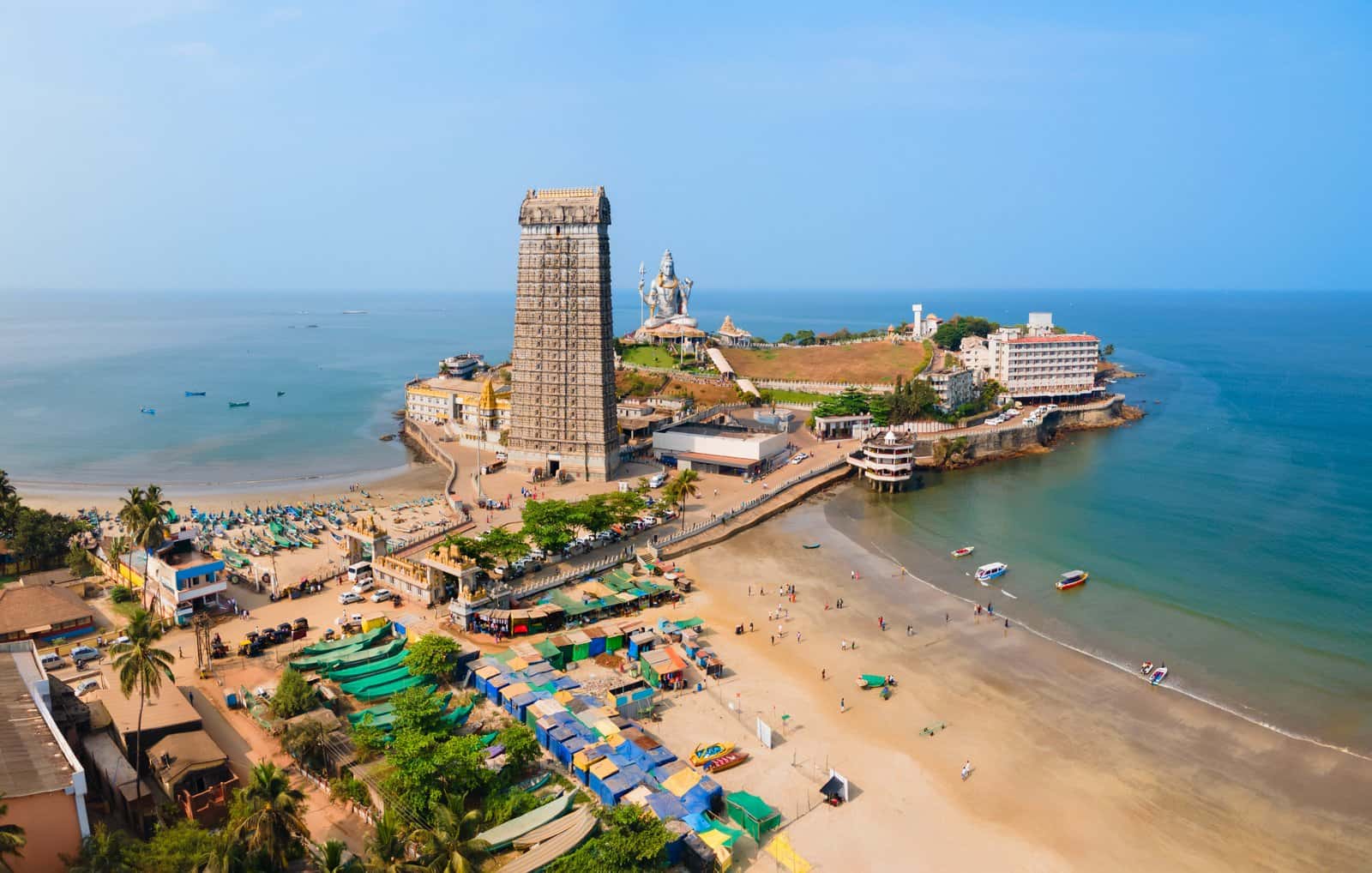
- MurudeshwarAbout 78 km south stands the towering Murudeshwar Shiva statue on a headland over the sea, one of the tallest in the world, with a temple and a lift up the gopura. It is a long day trip but a memorable one, often combined with a coastal drive.
- The temple and Car StreetEven if the sanctum is off limits to some, the Mahabaleshwar Temple, Koti Tirtha and the old Car Street are worth a slow morning. The lanes are full of pilgrims, flower stalls and traditional eateries, a complete contrast to the beach a few minutes away.
If you do only one thing slowly, make it a full sunset on Kudle or Om with nowhere to be afterwards. Gokarna rewards stillness more than ticking off beaches, and an unhurried evening with the sea, a chai and the cliffs going dark is what most people remember long after the day trips fade. Give yourself at least one evening with no plan at all.
Where to stay in Gokarna: beach huts or temple town
Stay in a beach hut on Kudle or Om for the laid-back scene, or in Gokarna town near the temple for comfort and pilgrim convenience. Two to three nights is the sweet spot.
- Beach huts on Kudle and OmThe classic Gokarna stay: simple bamboo and concrete huts and shacks right on the sand, with cafes and the sunset on your doorstep. Basic huts can run from about 500 to 800 rupees a night off-season and rise sharply at peak times and on the nicer beaches. Best for backpackers, couples and anyone who wants the beach scene.
- Gokarna town and guesthousesGuesthouses and a few small hotels in the town near the temple suit pilgrims, families and anyone who would rather not do the cliff walk to a hut. You trade the beach-on-your-doorstep feeling for comfort, easier access by road and a short walk to the temple.
- Resorts on the outskirtsA handful of resorts sit on or above Om and the quieter coves, with pools and sea-view rooms at higher prices. Better for couples and families who want comfort and space, and the natural choice if you are not chasing the budget-hut experience.
- How many nightsTwo to three nights is the sweet spot: one day for the temple and the road-accessible beaches, one for the cliff trek or a boat day, and a spare for a day trip to Yana, Mirjan or Murudeshwar or simply to slow down. A single night only scratches the surface.
Rooms and huts are easy to find off-season but get scarce and dearer over the December to January peak and around Maha Shivaratri in February, when pilgrims fill the town. If your dates fall on the festival or the holiday peak, book well ahead, and remember many beach huts simply close during the monsoon.
Gokarna costs and a realistic daily budget
Gokarna is one of the cheaper coastal stops in India, especially for backpackers. Here is what the main things cost so you can plan and avoid being overcharged.
- A rough daily budgetExcluding your room and long-distance transport, a backpacker can do Gokarna comfortably, with beach-cafe meals and the odd auto, while a mid-range traveller who adds boat rides, day trips and nicer cafes spends more. It is gentle on the wallet by Indian beach-town standards, well below Goa in season.
- The free and cheap thingsThe temple is free to enter, the beaches are free, and the cliff trek costs nothing but effort. Auto-rickshaw hops within town are short and cheap if you agree the fare first. This is a place where the best experiences cost little or nothing.
- The things to agree in advanceA boat to Paradise Beach is commonly about 200 to 300 rupees a person on a shared seat or from about 1,000 rupees onwards for a private boat, a hired car for a Yana or Murudeshwar day trip is a fixed negotiation, and beach-hut rates swing with the season. Settle the price before you commit and the only common friction disappears.
- Cash is kingATMs in Gokarna town can be limited or out of cash, and many huts and cafes prefer cash, though UPI is increasingly accepted. Draw enough cash before you arrive or in the town, and do not rely on finding a working ATM on a beach.
Almost everything negotiable in Gokarna - the boat to Paradise Beach at about 200 to 300 rupees a person shared or from about 1,000 rupees onwards private, the day-trip car, the hut rate in peak season - is quoted high to visitors and comes down without drama once you ask and agree it first. Settle the number before anything begins, carry enough cash because the ATMs are unreliable, and the town stays as cheap and easy as its reputation.
Practical logistics: money, SIM, food and etiquette
The small things that make a Gokarna day smooth, from unreliable ATMs to the etiquette that keeps the temple town and the beach scene in balance.
- Money and ATMsATMs are in Gokarna town but can run dry, especially at weekends and peak times. Carry enough cash for huts, cafes and autos, treat UPI as a bonus not a guarantee, and do not expect to find a cash machine out on the beaches.
- SIM, signal and connectivityMobile coverage in the town and on Kudle and Om is generally fine for calls, maps and UPI, though it thins out on the far beaches and the cliff paths. Buy a tourist SIM or eSIM at your arrival airport rather than hunting for one in a small coastal town.
- Food and the dry-versus-relaxed splitBeach cafes serve the usual traveller mix and seafood, while the temple town leans traditional and vegetarian. Alcohol is around on the beaches but is not for the temple streets, so keep the two worlds separate and you will not put a foot wrong.
- Dress and etiquetteBeachwear is fine on the sand but not in town or at the temple, where you should cover up and dress modestly. The temple has its own strict dress code covered above. Reading the room between the relaxed beach and the conservative temple core is the key to travelling here respectfully.
Safety in Gokarna: the sea, the cliffs and solo travel
Gokarna is welcoming and low on crime, but the sea and the cliff paths are the real risks. A little awareness keeps the visit happy.
- The sea is the main dangerRip currents are real and there have been rescues, including at Kudle Beach. Swim only between the red and yellow flags, only in daylight, never alone and never after drinking, and stay out of the water when it is rough or the red flag is flying. Most serious incidents here involve the sea, not other people.
- The cliff pathsThe headland trails between the beaches are easy in dry weather but get slippery and dangerous in the monsoon and after dark. Wear shoes with grip, carry water, and do not attempt the far-beach paths at night or in heavy rain. Turn back rather than push on in bad conditions.
- Petty theft and your valuablesViolent crime is rare, but petty theft of bags and phones does happen, especially if you leave things unattended on the beach or sleep alone on an isolated stretch. Keep valuables secure, use your hut's locker, and do not leave belongings on the sand while you swim.
- Health and the sunDrink bottled or filtered water, take the usual care with street and beach food, and carry strong sun protection for the open beaches and the cliff walk. There is basic medical care in the town but the nearest full hospitals are some distance away, so travel insurance is wise.
Many solo women travel Gokarna comfortably and find it relaxed, but the sensible precautions matter. Avoid the secluded far beaches, especially Paradise, alone after dark, keep valuables close, prefer the busier Kudle and Om for a first stay, and dress modestly in the temple town. The friction reported is petty rather than violent, and being aware of the sea and your surroundings goes a long way.
Gokarna for every kind of traveller, and on access
Gokarna suits very different visitors in different ways. Here is what it offers each, including how a senior or a pilgrim enjoys it without the cliff trek.
- Backpackers and budget travellersGokarna's natural crowd: cheap beach huts, sociable cafes, the cliff trek and a slow, low-key vibe. Easy to reach by Konkan train and a great place to settle in for several days.
- CouplesQuiet, scenic and romantic, with sunset huts on Kudle and Om and the option of a calmer resort. An overnight or two lets you catch both the beach and the temple town without rushing.
- Families with childrenDoable with care: base on Kudle or Om or in a town resort, stick to the road-accessible beaches, and swim only between the flags in daylight. Skip the long cliff trek with small children and consider a boat instead.
- Senior travellers and on accessibilityVery enjoyable without the trek. Base in Gokarna town or a resort near Om, use autos and boats rather than the cliff paths, visit the temple in the cool of morning or evening, and take the road-accessible beaches at your own pace. The far beaches and steep trails are optional, not essential.
- PilgrimsFor those who come for the Atmalinga, base in town near the temple, plan darshan for the morning or evening around the midday closing, observe the dress code, and pair the temple with Koti Tirtha and the other town shrines. The beaches are a gentle bonus, not the point.
- Solo female travellersGenerally relaxed and well used to independent travellers. Prefer the busier Kudle and Om, avoid the secluded far beaches alone after dark, keep valuables secure, and dress modestly in town. One of the calmer coastal stops for solo women, with the sea the main thing to respect.
A suggested Gokarna itinerary
How to shape two or three unhurried days so you catch the temple at the right hours, walk the beaches safely, and fit in a day trip.
- Day one: temple and the near beachesStart early at the Mahabaleshwar Temple before the midday closing, dressed for the code, then walk Koti Tirtha and Car Street. Spend the afternoon and sunset on Kudle or Om, swimming only between the flags. A gentle, complete first day.
- Day two: the cliff trek or a boat dayWalk the chain from Kudle through Om to Half Moon and Paradise in the cool of the morning, about 5 to 6 hours at an easy pace, or take a boat to Paradise and back if you would rather not trek. Carry water and sun cover, and agree your boat return in advance.
- Day three: a day tripHire a car for Yana caves about 50 km away, Mirjan Fort about 22 km away, or Murudeshwar about 78 km south, or simply slow down for another beach day. A third day turns a quick stop into the calm pause Gokarna does best.
- The Goa-and-Gokarna versionMany travellers fold Gokarna into a Goa trip, driving down from South Goa for two or three nights of quieter beaches and the temple before heading back. It is the easiest way to pair the party coast with the calm one.
The thing that breaks a tight Gokarna plan is arriving at the Mahabaleshwar Temple when it is shut through the middle of the day, roughly after 12:30 pm until about 5 pm. Build your day so the temple falls in the morning or the evening, keep the hot midday for a cafe or a rest, dress for the code before you go, and you will never find yourself at a closed gate in the heat.
The real questions travellers ask about Gokarna
Straight answers to the questions that come up again and again on traveller forums, so you arrive already knowing the score.
- Can foreigners enter the temple and see the Atmalinga?Foreigners, including non-Indian Hindus, are not allowed into the inner sanctum to see the Atmalinga, though non-Hindus can enter the outer complex. It is firmly enforced, so come respectfully and enjoy the temple town and the festival without expecting sanctum darshan.
- Is Gokarna better than Goa?It depends on what you want. Gokarna is quieter, cheaper, more spiritual and less developed, with no big party scene; Goa is livelier and more built up. Many travellers do both, using Gokarna as the calm counterpoint to Goa rather than choosing one.
- How many days do I need?Two to three nights is ideal: the temple and near beaches, the cliff trek or a boat day, and a day trip or a slow beach day. One night only scratches the surface; a week suits those who want to settle in and unwind.
- How do I reach Paradise Beach?On foot over the headlands from Om Beach via Half Moon, or by boat: a shared seat is commonly about 200 to 300 rupees a person, a private boat from about 1,000 rupees onwards. Agree the fare and a return pickup first, and do not get stranded there after dark, as there is no road out.
- Is there a full-moon party scene?Not really. Gokarna is a calm, spiritual, backpacker town, not a party destination like some Goa beaches. There is the odd beach gathering and plenty of music and yoga, but if a big party scene is what you want, this is not it.
- Is it safe to swim?Only with care. Rip currents are real and there have been rescues, so swim only between the red and yellow flags, in daylight, never alone or after drinking, and stay out when the sea is rough. The beaches are beautiful but the water demands respect.
Planning Gokarna from abroad
Gokarna is the calm, spiritual half of a Goa trip, but two things catch overseas visitors out: the temple sanctum rule and the rip currents. A little preparation makes both easy to handle.
- Know the temple access rule in advanceForeigners, including non-Indian Hindus, are not allowed into the inner sanctum of the Mahabaleshwar Temple to see the Atmalinga, and the dress code is strict. Knowing this before you arrive means you experience the temple town and the festival respectfully, without a disappointing turn-back at the sanctum.
- Respect the seaThe beaches look gentle but have real rip currents and have needed rescues. Swim only between the red and yellow flags, in daylight, never alone, and you will be fine. This is the one safety point worth fixing in your mind before you go in the water.
- Pair it with GoaFly into Goa (Dabolim or Mopa), then drive down the coast a few hours to Gokarna for two or three nights of quieter beaches and the temple, before heading back. It is the natural calm counterpoint to Goa on a first South India coast trip.
- Gentle and senior-friendly with planningYou do not need to do the cliff trek. Base in town or near Om, use autos and boats, and take the road-accessible beaches and the temple at your own pace. Gokarna is one of the easier, gentler coastal stops in India for parents and grandparents.
Money, connectivity and timing for foreign visitors
The practical basics an overseas traveller needs for a small coastal town: cash, a SIM, and how many days to give it on a wider India trip.
- Carry cash, do not rely on ATMsGokarna town has ATMs but they can be limited or empty, and the beaches have none. Draw cash before you arrive or in town, keep small notes for huts, cafes and autos, and treat UPI and cards as a bonus rather than a guarantee.
- Get a SIM at the airportPick up an Indian tourist SIM or an eSIM when you land in Goa or Mangaluru rather than hunting for one in a small town. Coverage in Gokarna and on Kudle and Om is fine for maps and calls, though it thins on the far beaches.
- How long to give it on a bigger tripOn a Goa-and-coast trip, two to three nights in Gokarna is the right weight: enough for the temple, the beaches and a day trip, without slowing the whole itinerary. Stay a week only if you want to truly settle in and unwind.
- Time your visit to your comfortOctober to March is the comfortable window. Avoid the June to September monsoon for the beaches, when the sea is rough and the cliff trek slippery, though the Konkan train ride through the rains is spectacular if a journey is what you are after.
Gokarna is an unusually gentle introduction to coastal India: small, walkable, cheap and calm, with a holy town at one end and quiet beaches at the other. Slot it after Goa, give it two or three nights, respect the temple rules and the sea, and let it be the slow, soulful chapter of your coast trip. Many overseas visitors say it ends up being the part they remember most warmly.
How Ravana, Ganesha and a cow's ear gave the town its name
In the old story, the demon king Ravana won from Shiva the Atmalinga, the soul-lingam, on one strict condition: wherever it was first set on the ground, there it would root forever. The gods, fearing Ravana would become invincible, asked Ganesha to intervene. As Ravana neared the western coast at dusk and had to perform his evening prayers, he could not put the Lingam down, so a boy cowherd, Ganesha in disguise, offered to hold it, on the promise he would call out before setting it down. The boy called out, and before Ravana could return, set the Atmalinga on the earth, where it took root. Enraged, Ravana tried to wrench it free; he could not move the base, and the force is said to have twisted the Lingam into the shape of a cow's ear, giving the town its name Gokarna, from the Sanskrit for cow (go) and ear (karna). The Lingam stayed, and the temple of Mahabaleshwar, the all-powerful, rose around it. The tale is carried in the Skanda Purana and the Ananda Ramayana traditions and retold across regional temple histories; the details vary between versions, and no single verse is reliably the only source.
Planning a Gokarna trip?
Our Karnataka travel experts plan your full journey for you: route, hotels, darshan timings and transport. You get a free day-by-day plan and an exact quote on WhatsApp, usually within a few hours. No payment is needed to get your plan.
Tour packages that visit Gokarna
Every journey below is private, hand-crafted and fully customizable. Tell us your dates and we tailor the itinerary, the pace and the priests or guides around you.
