Netrani Island Travel Guide
The diving season runs roughly October or November to May , with the calmest, clearest water in December to February . Diving is normally closed in the monsoon, and even in...
When to dive at Netrani, and the monsoon closure to plan around
The diving season runs roughly October or November to May, with the calmest, clearest water in December to February. Diving is normally closed in the monsoon, and even in season a rough-sea or naval-firing day can cancel a trip.
- December to February: the clear-water peakThe settled winter months bring the calmest sea and the best visibility, commonly about 15 to 20 metres, which is why operators advise booking ahead in this window. If the underwater trip is the whole point of your visit, aim for these weeks and reconfirm the season with the operator before you commit.
- October or November and March to May: the shouldersThe season broadly opens around October or November and can run into May. These shoulder weeks are usually fine for diving, with fewer crowds, though the sea and visibility are a little more variable, so keep your plan flexible and be ready for the odd cancelled day.
- June to September: monsoon, and diving closedThe southwest monsoon brings heavy rain and a rough, dangerous sea, and Netrani diving is normally closed through these months. Come to Murudeshwar in the monsoon for the temple and the green coast if you like, but do not plan the trip around the dive.
- Weekends fill fast in seasonIn-season weekends and holidays see the dive slots and the Murudeshwar hotels fill quickly. Book your dive a week or two ahead in peak season, and a weekday trip is calmer both on the boat and in town.
If your visit is built around diving or snorkelling at Netrani, do not come in the monsoon, roughly June to September, when the activity is normally closed because the sea is too rough. The clear-water season runs about October or November to May, best around December to February. Treat the exact opening and closing as weather-dependent and reconfirm the current season directly with a permitted Netrani operator before you book flights or rooms, because rough-sea days, and occasionally naval firing activity, can cancel even a confirmed booking in season. Build a spare day into a diving-focused trip.
How to reach Netrani Island
There is no way to reach Netrani except by boat from Murudeshwar, roughly 19 km offshore. You reach Murudeshwar first by the Konkan Railway or from Mangaluru airport, then join a permitted dive boat.
- The boat from MurudeshwarNetrani lies about 10 nautical miles or roughly 19 km off Murudeshwar, and the only way there is a dive-operator boat from Murudeshwar. Departures are typically in the morning, commonly around 8 am to 9 am, and the crossing takes time each way, so the whole outing runs as a half-day. You cannot land on the island: you dive or snorkel from the boat anchored just off it.
- Reach Murudeshwar by the Konkan RailwayMurudeshwar has its own Konkan Railway station about 2 km east of the temple, a short auto-rickshaw hop, with trains linking Mangaluru, Madgaon in Goa, Karwar, Mumbai and beyond. Rail is the simplest and most scenic way to reach the launch town for Netrani.
- Nearest airportsThere is no airport at Murudeshwar or Netrani. Mangaluru airport is about 135 to 165 km south, roughly 2 to 3 hours by road, and Hubballi about 170 to 230 km inland, roughly 4 to 5 hours. Most divers fly to Mangaluru and take a Konkan Railway train or drive up the coast to Murudeshwar.
- By road and on a coastal loopMurudeshwar sits on National Highway 66, the coastal Mumbai to Kochi route, so buses and taxis run frequently. Gokarna is about 1.5 to 2 hours north and Udupi about 2 to 2.5 hours south, so the natural plan threads Gokarna, Murudeshwar with the Netrani dive, and Udupi rather than treating Netrani as a standalone trip.
Fly into a major Indian hub such as Mumbai or Bengaluru, then connect to Mangaluru by air and drive up the coast, or join the Konkan Railway to Murudeshwar. The Netrani dive itself is a boat trip from Murudeshwar; there are no flights or landings on the island.
Fly into Mangaluru directly where routes allow, or via Mumbai or Bengaluru, then drive about 2 to 3 hours north along NH-66 or take a Konkan Railway train to Murudeshwar, and join a permitted dive boat from there.
Take a Konkan Railway train straight to Murudeshwar station, the easiest option, or fly to Mangaluru or Hubballi and drive. From Goa it is an easy coastal drive or train down NH-66 to Murudeshwar for the Netrani boat.
The reef, the marine life and the heart-shaped island
Netrani's draw is underwater: a coral reef alive with reef fish, occasional big visitors, and the striking heart shape of the uninhabited island you dive beneath but never land on.
- The coral reef and reef fishNetrani is a coral island whose reefs are the reason to come. A study recorded eighty-nine varieties of coral fish, and on a good dive you can expect butterfly fish, triggerfish, parrotfish, snappers, barracuda and moray eels around the coral, with visibility commonly about 15 to 20 metres in the clear season.
- The rare big visitorsDivers and snorkellers occasionally report whale sharks and other large marine life, but these are rare and never guaranteed. Come for the reef and its fish, and treat any big-animal sighting as a bonus rather than the expectation the photos might suggest.
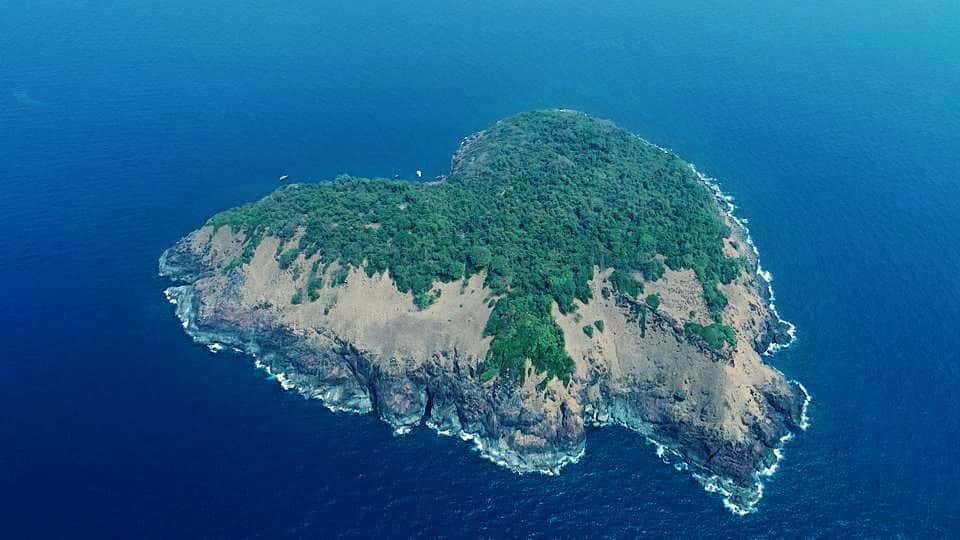
- The heart-shaped, uninhabited islandSeen from above, Netrani appears heart-shaped, which is why it is billed as the only heart-shaped island in India; it is also called Pigeon Island for its birds and is uninhabited apart from wildlife. You admire it from the boat, as landing is not allowed.
- A small clifftop shrine you view from the waterThe island carries a small Hanuman shrine tied to local tradition and pilgrimage lore, but with landing banned it is something you see from the boat rather than visit. The real experience of Netrani is beneath the surface, not on the rock.
Netrani is not a beach or a picnic island you step onto. It is a naval firing and target-practice range with steep cliffs and sharp rocks, and landing is not allowed, so every dive and snorkel happens from a boat anchored just off the island. Set your expectations for a half-day at sea over a reef, admiring a heart-shaped rock from the water, and the day makes sense.
Scuba diving at Netrani, the honest guide
Netrani is India's premier reef dive. Here is how the boat day works, the no-certification beginner option, the season and a hedged price, so you plan it right and book a proper operator.
- How the day worksA dive boat leaves Murudeshwar in the morning, commonly around 8 am to 9 am, crosses about 19 km of open sea, and anchors off Netrani. You dive or snorkel from the boat, then cross back, so the whole outing is a half-day. Underwater time on a beginner dive is short, often around 20 to 40 minutes, with the rest of the day the crossing and the surface interval.
- Beginners and non-swimmersA Discover Scuba Dive needs no certification and no swimming skill: a PADI or SSI instructor holds you one-on-one and takes you down to a shallow depth after a short medical self-check. If you flag any condition you may need a doctor's clearance. Snorkelling is the gentler alternative if you would rather stay at the surface.
- Certified diversIf you are certified, you can do deeper reef and wall dives around the island and often a second dive, usually at a higher price than the beginner dive. Bring your certification card and logbook, and ask the operator about the deeper sites and the day's dive plan when you book.
- What it costs, roughlyOperators commonly price the full Netrani beginner dive from around 3,500 rupees per person, with a shorter intro or try-dive nearer shore sometimes advertised from about 1,999 rupees; some operators quote 4,000 to 5,000 rupees. Confirm the current price, exactly what it includes, the boat timing and the cancellation policy directly with the operator when you book, as offers and conditions change.
Scuba diving at Netrani is regulated: after years of restrictions the state ran a bidding process, permitting about three operators around October 2023 and about six more by around November 2024. Choose a currently permitted operator running proper PADI or SSI dives with a medical check, not whoever is cheapest at the jetty. Book a week or two ahead in the December to February peak, and outside the obvious months confirm with the operator that the season is open before you travel. A rough-sea or naval-firing day can cancel even a confirmed booking, so never treat the dive as guaranteed.
The boat crossing, seasickness and what to bring
The open-sea crossing is the part first-timers underestimate. Seasickness is the most common complaint in real reviews, and there are no facilities at the island, so a little preparation makes the whole day.
- Expect a choppy crossingThe run out to Netrani crosses open sea and can be choppy, and seasickness is the single most common complaint in real diver reviews. It is easy to prepare for and nothing to be embarrassed about, but do not assume a calm harbour ride, especially in the shoulder months.
- How to handle seasicknessTake a motion-sickness tablet about 30 to 45 minutes before departure, eat a light meal rather than travelling on an empty or heavy stomach, stay on deck watching the horizon rather than looking down, and tell the crew in advance if you are prone to it so they can look after you.
- There are no facilities at the islandNetrani is uninhabited, with no shops, toilets, drinking water, food stalls or shade, and no landing. Everything you need for the half-day, water, snacks, sun protection, a hat, any medication and a dry bag for valuables, must come with you from Murudeshwar. The operator supplies the dive gear.
- Dress and pack for a wet, sunny dayWear swimwear under quick-dry clothes, bring a towel and a change of clothes for the boat back, and pack strong sun protection, since there is no shade at sea. A waterproof phone case or a dry bag keeps your valuables safe on a boat that will be wet and moving.
The mistake first-timers make is treating Netrani as a quick swim rather than a half-day at sea. Between the morning departure, the crossing each way, the surface interval and the dive, you are committed for several hours on a boat with no facilities and no way ashore. Come rested, fed and prepared, keep the afternoon for the Murudeshwar temple and the Raja Gopura, and the day is one of the best on the coast rather than a queasy ordeal.
Where to stay for a Netrani trip, and for how long
You do not stay on Netrani. Base yourself in Murudeshwar for the dive, or in Gokarna or Bhatkal nearby, and give the trip a morning plus a spare day for weather.
- Murudeshwar: the natural baseNetrani is uninhabited, so you stay on the mainland and Murudeshwar is the natural base, with hotels near the temple and the seafront within reach of the dive jetty and an easy early start for the morning boat. This is the simplest choice for a diving trip.
- Gokarna and Bhatkal nearbyIf you want a beachier base, Gokarna, about 1.5 to 2 hours north, has the coast's laid-back beach scene, and Bhatkal, just south, has simpler lodgings close to Murudeshwar. Either works if you do not mind an earlier start to reach the boat, and Gokarna pairs the dive with proper beach time.
- How many daysThe Netrani trip itself is a morning. Give it one full day based in Murudeshwar, keeping the afternoon for the temple and the Gopura, and build in a spare day so a rough-sea or naval cancellation does not cost you the dive. For the wider coast, plan two to four days.
- Book ahead in seasonSeafront rooms near Murudeshwar temple are limited and fill on weekends and through the October to February season when pilgrims and divers overlap. Book ahead if your dates fall on a weekend or a festival, and consider a weekday for a calmer town and boat.
Because Netrani diving is weather-dependent and occasionally interrupted by naval activity, the smart plan is to base in Murudeshwar with a spare day, rather than pinning the dive to a single fixed morning on a tight schedule. If the first morning is cancelled, the second gives you another shot, and either way you have the temple, the Raja Gopura and the coastal loop to fall back on. Divers who allow this slack rarely go home disappointed.
Netrani diving costs and a realistic budget
The dive is the one real cost of a Netrani day. Here is what to expect so you can plan and avoid paying a jetty premium, with the price hedged across the permitted operators.
- The dive itselfThe full Netrani beginner dive is commonly priced from around 3,500 rupees per person, with a shorter intro or try-dive nearer shore sometimes advertised from about 1,999 rupees, and some operators quoting 4,000 to 5,000 rupees. Certified deeper dives usually cost more. Confirm the exact price and inclusions with the operator when you book.
- What the price usually includesA beginner package commonly bundles the boat transfer, the dive gear, instructor support and often underwater photos or video. Check whether photos, a second dive, snorkelling gear or transfers from your hotel are included or extra, so you are not surprised at the jetty.
- Getting there and small costsAdd the cost of reaching Murudeshwar, the train or the drive from Mangaluru, and a short auto-rickshaw from the station to the hotel or jetty, agreed before you set off. Meals at local eateries in Murudeshwar are inexpensive, and you bring your own food and water for the boat.
- Cash and cardsBigger hotels and some operators take cards or UPI, but autos, small eateries and some dive operators may prefer cash, and ATMs are limited in a small town. Carry enough cash for the day, especially the dive and the transfers, and draw it before a busy weekend.
Almost everything else on a Netrani day is cheap, so build your budget around the dive, commonly from around 3,500 rupees per person for the full Netrani beginner dive, and reconfirm it directly with a permitted operator, since prices vary and some quote 4,000 to 5,000 rupees. Book directly or through us rather than paying a walk-up premium, carry cash for the autos and transfers, and remember card and UPI acceptance is patchy in a small coastal town.
Practical logistics: booking, gear, food and signal
The small things that make a Netrani day smooth, from booking a permitted operator to what gear is provided, food, money and the patchy signal at sea.
- Book a permitted operator aheadDiving is run by permitted PADI or SSI operators from Murudeshwar, so book a week or two ahead in season rather than turning up at the jetty. Confirm you are dealing with a currently permitted operator, ask about the medical form, and reconfirm the boat timing the day before.
- What is provided and what you bringThe operator supplies the dive gear, wetsuit and instructor. You bring water, snacks, sun protection, a towel, a change of clothes, any medication and a dry bag, since there are no facilities at the island. Certified divers bring their card and logbook.
- Food, money and languageEat a light breakfast in Murudeshwar before the boat and carry food and water for the day. Carry cash, as ATMs and card or UPI acceptance are limited outside bigger hotels. Kannada is the local language, with Konkani and Tulu on the coast, and Hindi and English get you by in the tourist trade.
- Signal and staying reachableMobile coverage in Murudeshwar town is generally fine for calls, maps and booking, but expect little or no signal for much of the open-sea crossing and at the island. Tell someone your plan and expected return time, and do not rely on being reachable while you are out at Netrani.
Safety and health: the dive, the sea and the naval range
Netrani is a rewarding but real open-water expedition. The dive, the crossing and the naval-range status are where care matters most, and a little awareness keeps the day safe and happy.
- Dive with a proper operator and be honest on the medical formChoose a permitted operator running PADI or SSI dives with a medical self-check and one-on-one instruction for beginners, not the cheapest boat. Be honest on the medical form, do not dive with a cold, congestion or after drinking, and never fly within the recommended window after diving, usually about 18 to 24 hours.
- The naval firing range and cancellationsNetrani is used by the Indian Navy as a firing and target-practice range, landing is banned, and access is by permitted boat trips only. Dives can be cancelled at short notice during naval activity as well as in rough seas, so keep your plan flexible and follow the operator's decision to cancel without argument, as it is a safety call.
- Seasickness and the crossingThe open-sea crossing can be rough and seasickness is common. Take a tablet before departure, eat lightly, and stay on deck. If you feel unwell, tell the crew early rather than pushing on, and remember there are no facilities and no quick way back until the boat returns.
- Sun, water and non-swimmersThere is no shade at sea, so sun protection and enough drinking water matter. Non-swimmers and anxious first-timers should stick to the guided beginner dive or snorkelling with an instructor, stay within arm's reach of the guide, and never enter the water alone off the boat.
Netrani is a naval firing range you cannot land on, reached by a boat across open sea with no facilities, so it is a proper expedition, not a casual swim. Dive only with a permitted PADI or SSI operator, be honest about your health, prepare for seasickness, and accept that rough seas or naval activity can cancel the day for your safety. Handled this way, it is one of the finest and safest reef dives in India; treated casually, it is where people come unstuck.
Netrani for every kind of traveller, and on access
Netrani suits very different visitors. Here is what it offers each, and the one tip that matters, including how a nervous non-swimmer safely tries a dive.
- Beginner divers and non-swimmersThe guided Discover Scuba Dive needs no certification and no swimming skill: an instructor holds you one-on-one down to a shallow depth after a medical check. If you are nervous, say so, keep within arm's reach of the guide, and remember snorkelling is the gentler option. This is the friendliest first dive on the coast.
- Certified diversThe reef, the deeper wall dives and the chance of a second dive make Netrani worth a certified diver's time, especially in the December to February clear-water peak. Bring your card and logbook, ask about the deeper sites, and treat visibility as good but variable rather than tropical-guaranteed.
- FamiliesOlder children who can follow instructions can try a guided beginner dive or snorkel, while others watch from the boat. Weigh the choppy crossing and the seasickness risk for young or anxious children, and be clear that there is no landing, no beach and no facilities at the island.
- Seniors and on accessibilityA fit senior can do the guided beginner dive or snorkel, but the boat boarding, the crossing and the open sea need reasonable mobility and a stomach for motion. Discuss any heart, lung or ear condition and current medication with the operator and a doctor first, and consider snorkelling or watching from the boat if the dive is too much.
- Solo and budget travellersNetrani is easy to reach solo on the Konkan Railway and join a shared boat, and the beginner dive is affordable for what it is. Book ahead in season, and pair it with Gokarna and Udupi to make a full coastal trip rather than a single dash for the dive.
- PhotographersThe reef, the fish and the light through clear water are the shots, best in the December to February peak visibility. Use a proper underwater housing, ask the operator about camera rules on the dive, and treat any whale-shark sighting as a rare bonus, not the plan.
A suggested Netrani and Murudeshwar itinerary
How to shape a diving morning, a full day based in Murudeshwar, or a coastal loop with Gokarna and Udupi, so weather and the naval range do not sink the whole trip.
- The diving morningJoin the morning boat from Murudeshwar, around 8 am to 9 am, for the crossing, the dive or snorkel, and the crossing back, a half-day in all. Come rested, fed and prepared for seasickness, with your own water and sun protection, since there are no facilities at the island.
- One full day based in MurudeshwarDive in the morning, then spend the afternoon on the Murudeshwar temple, the Raja Gopura lift with its sea view, the statue complex and the beach viewpoint. An overnight lets you catch the temple in soft morning or evening light and keeps a spare morning if the dive is weather-cancelled.
- Build in a spare dayBecause rough seas and occasional naval activity can cancel the dive, plan a spare day rather than pinning it to one fixed morning. If the first attempt is off, the second gives you another shot, and either way Murudeshwar and the coast fill the time well.
- The coastal loop, two to four daysThread Gokarna, about 1.5 to 2 hours north, Murudeshwar with the Netrani dive, and Udupi, about 2 to 2.5 hours south, often adding Jog Falls inland. Two to four days gives each place a proper morning and evening and makes the whole trip resilient to a single cancelled dive.
The thing that ruins a Netrani plan is treating the dive as a fixed appointment on a tight schedule. It is weather-dependent and occasionally interrupted by naval activity, so a single locked morning can leave you with a cancelled dive and no second chance. Base in Murudeshwar, keep a spare day, and let the temple, the Raja Gopura and the Gokarna to Udupi coast absorb any slack, and you will almost always get your dive in.
The real questions travellers ask about Netrani
Straight answers to the questions that come up again and again on traveller forums and review sites, so you arrive already knowing the score.
- When can I dive, and is it closed in the monsoon?The season runs roughly October or November to May, best around December to February, and diving is normally closed in the southwest monsoon, June to September, when the sea is rough. Reconfirm the current season with a permitted operator, and keep a spare day for weather even in season.
- Can a beginner or non-swimmer dive?Yes. A guided Discover Scuba Dive needs no certification and no swimming skill: an instructor takes you down one-on-one after a short medical check. Snorkelling is gentler still. If you are anxious, say so and stay within arm's reach of the guide.
- How much does it cost?The full Netrani beginner dive is commonly from around 3,500 rupees per person, a shorter intro from about 1,999 rupees, and some operators quote 4,000 to 5,000 rupees. Confirm the current price and what it includes with the operator, since prices vary across the permitted operators.
- Can I land on the island?No. Netrani is a naval firing and target-practice range and landing is banned, so you dive or snorkel from a boat anchored just off it. There are no facilities, food, toilets or shade, so bring everything you need for a half-day at sea.
- How rough is the boat, and will I be seasick?The open-sea crossing can be choppy and seasickness is the most common complaint in reviews. Take a tablet 30 to 45 minutes before departure, eat lightly, stay on deck watching the horizon, and tell the crew if you are prone to it. Most people are fine with a little preparation.
- Is it worth it, and how does it fit a trip?For a reef dive it is among the best in India, with clear water and abundant reef fish, though big-animal sightings are rare. Base in Murudeshwar, keep a spare day for weather, and thread it onto a Gokarna, Murudeshwar and Udupi coastal loop rather than a one-day dash.
Planning a Netrani dive from abroad
Netrani is India's premier reef dive off the Konkan coast and pairs naturally with a Goa to Mangalore run through Murudeshwar. A little preparation makes the season, the navy and the crossing easy to handle.
- Time your trip to the diving seasonCome about October or November to May, best around December to February, and avoid the monsoon, June to September, when diving is closed and the sea is rough. Confirm the season with a permitted operator before you book international flights, and keep a spare day for weather.
- Understand the naval range and the no-landing ruleNetrani is a naval firing and target-practice range, so you cannot land, you dive from an anchored boat, and naval activity can cancel a trip at short notice. This is normal here and not a red flag; it just means keeping your plan flexible and trusting the operator's call.
- Prepare for a facility-free crossingThe island is uninhabited with no shops, toilets, water, food or shade, and the crossing can be rough. Bring water, snacks, sun protection, any medication and a dry bag, and treat seasickness as likely rather than possible, with a tablet before departure.
- Slot it on a coastal routeFly into Mangaluru, or come down the coast from Goa, and thread Gokarna, Murudeshwar with the Netrani dive, and Udupi by car or the scenic Konkan Railway. Netrani is a striking half-day highlight on that route rather than a destination you stay at, since it is uninhabited.
Money, connectivity and certification for foreign visitors
The practical basics an overseas diver needs for a remote reef off a small coastal town: cash, a SIM, your certification, and how many days to give it on a wider South India trip.
- Carry cash, expect patchy cardsBigger hotels and some operators take cards or UPI, but autos, small eateries and some dive operators want cash, and ATMs in a small town are limited and can run dry on busy weekends. Draw cash in Mangaluru or Goa before you arrive and keep small notes for transfers.
- Get a SIM at the airportPick up an Indian tourist SIM or an eSIM when you land at Mangaluru or your arrival hub rather than hunting for one in a small town. Coverage in Murudeshwar is fine for maps, calls and booking, but expect little or no signal on the open-sea crossing to Netrani.
- Bring your certification and be honest on the medicalCertified divers should bring the certification card and logbook for the deeper dives. Beginners need no certification for the guided dive but must complete a medical self-check, so declare any heart, lung, ear or sinus condition honestly and carry a doctor's note if you already know you will need clearance.
- How long to give it on a bigger tripOn a coastal South India trip, the Netrani dive is a half-day highlight best based in Murudeshwar over a full day, with a spare day for weather, and slotted between Gokarna and Udupi on a two to four day loop. It does not need a long stay of its own, since you sleep on the mainland.
Netrani is an easy, rewarding introduction to Indian diving: a coral reef off a heart-shaped island, reached by a morning boat from Murudeshwar, with a beginner option that needs no certification. Slot it between Goa or Gokarna and Udupi or Mangaluru, base in Murudeshwar for a day with a spare morning for weather, and let the Konkan Railway do the scenic legs. Respect the navy's call to cancel and prepare for the crossing, and the rest of the visit is relaxed and memorable.
Why they call Netrani the heart of the Arabian Sea
Seen from the air, Netrani draws itself as a heart, which is why it is billed as the only heart-shaped island in India, a shape that shows only from above and not from the deck of a boat below. Its older names hold its other lives: Pigeon Island, for the birds that wheel around its cliffs, and Bajrangi Island, for a small clifftop Hanuman shrine tied to local pilgrimage lore, with a tradition that Hanuman paused here on his flight to fashion and worship a figure of Rama. Uninhabited but for wild goats, pigeons and the fish that crowd its coral, the island wears a quieter modern history too: a rock long used by the navy for target practice, until in 2012 the Karnataka High Court stayed the shelling out of concern for the reef, and diving grew into the island's new calling. So Netrani is a heart you never set foot on, admired from the water and known best from beneath it, where the coral and the reef fish make the real case for the trip.
Planning a Netrani Island trip?
Our Karnataka travel experts plan your full journey for you: route, hotels, darshan timings and transport. You get a free day-by-day plan and an exact quote on WhatsApp, usually within a few hours. No payment is needed to get your plan.