Srirangapatna Travel Guide
The comfortable months are October to February , and if birds are your reason to come, the Ranganathittu season stretches wider. The town is a day trip, so plan it around Mysore...
When to visit Srirangapatna, and the birding window
The comfortable months are October to February, and if birds are your reason to come, the Ranganathittu season stretches wider. The town is a day trip, so plan it around Mysore weather.
- October to February: cool and easyThe most comfortable window, pleasant by day and cool in the evening, which matters because the sites are open-air and spread across the island in the sun. This is the best stretch for the fort, the palace and a relaxed walk by the Cauvery.
- March to May: warm, so start earlyThe plain around Mysore heats up through the pre-monsoon months. You can still do Srirangapatna comfortably if you start at the temple and Ranganathittu early in the morning and keep the middle of the day for a shaded lunch or the palace museum.
- June to September: green and full riverThe monsoon fills the Cauvery and turns the island lush, which is atmospheric, though the odd heavy shower can interrupt the boat ride at Ranganathittu. Carry a light rain layer and keep the day flexible.
- Birdwatchers: aim widerThe birding at Ranganathittu is richest from roughly November to June, when migratory visitors and nesting colonies are in. For the best of it, be at the sanctuary soon after it opens, when the light is soft and the birds are most active.
Srirangapatna has almost no hotels of its own, so almost everyone visits from Mysore, about 30 to 40 minutes away, or on a longer day out from Bengaluru. Plan the weather and the timing around your Mysore stay rather than around staying on the island itself, and you will get the sites at their best hours without the worry of finding a room in the town.
How to reach Srirangapatna
Srirangapatna sits on the Bengaluru-Mysuru highway and has its own small railway station. Most visitors come by road or rail from Mysore or Bengaluru; there are no flights into the town.
- From Mysore, the nearest baseMysore is only about 15 to 19 km away, roughly 30 to 40 minutes by road, and our own Karnataka day tours run it as a short hop of about 22 km each way. A taxi, an auto or a local bus all do the trip easily, and most people combine it with a Mysore day.
- From Bengaluru by roadBengaluru is about 120 to 130 km away, roughly 2.5 to 3 hours on the Bengaluru-Mysuru highway, which runs straight through the island. A private car with a driver is the comfortable way to do it as a full day, often paired with Mysore or Somnathpur.
- By trainSrirangapatna has its own small station on the busy Bengaluru-Mysuru line, and many express trains stop here, so the train is a genuine option. From the station it is a short auto ride to the fort and temple. Book on IRCTC a little ahead in season.
- By KSRTC busFrequent Karnataka state buses on the Bengaluru-Mysuru route pass through Srirangapatna. Note that some fast Volvo services do not enter the town bus stand, so ask the conductor in advance to set you down on the highway near the fort rather than carrying you on to Mysore.
Fly into Bengaluru (Kempegowda International), the reliable gateway about 150 to 170 km away, then drive to Srirangapatna, usually via Mysore. There are no international flights closer, and none into Srirangapatna itself.
Fly into Bengaluru, then drive about 2.5 to 3 hours down the Mysuru highway. Srirangapatna sits neatly on the Bengaluru, Srirangapatna, Mysore and Somnathpur heritage circuit.
Take a train or bus to Srirangapatna or Mysore on the Bengaluru-Mysuru line, or drive from Bengaluru. Many express trains stop right at Srirangapatna, which is the simplest way in by rail.
The temple, the palace, the tomb and the fort
Srirangapatna is a great Vishnu temple, Tipu Sultan's summer palace and tomb, and a river fort with a dark dungeon. A few sites are ASI-ticketed and several are free, so it helps to know which is which.
- Sri Ranganathaswamy TempleThe great reclining-Vishnu temple that gives the town its name, traditionally dated to the late tenth century. General entry is free, a paid special darshan of about 250 rupees is usually available, and the temple closes for a few hours in the middle of the day. The inner sanctum is effectively for Hindus, while the outer complex, with its carved pillars, is open to all.
- Daria Daulat Bagh, Tipu's summer palaceTipu Sultan's 1784 summer palace, an ASI monument set in a garden, famous for the teak walls painted with battle and court frescoes. Entry is about 25 rupees for Indian visitors and about 300 for foreign nationals, open roughly 9 am to 5 pm. It houses a small museum of Hyder Ali and Tipu-era arms, coins and paintings.
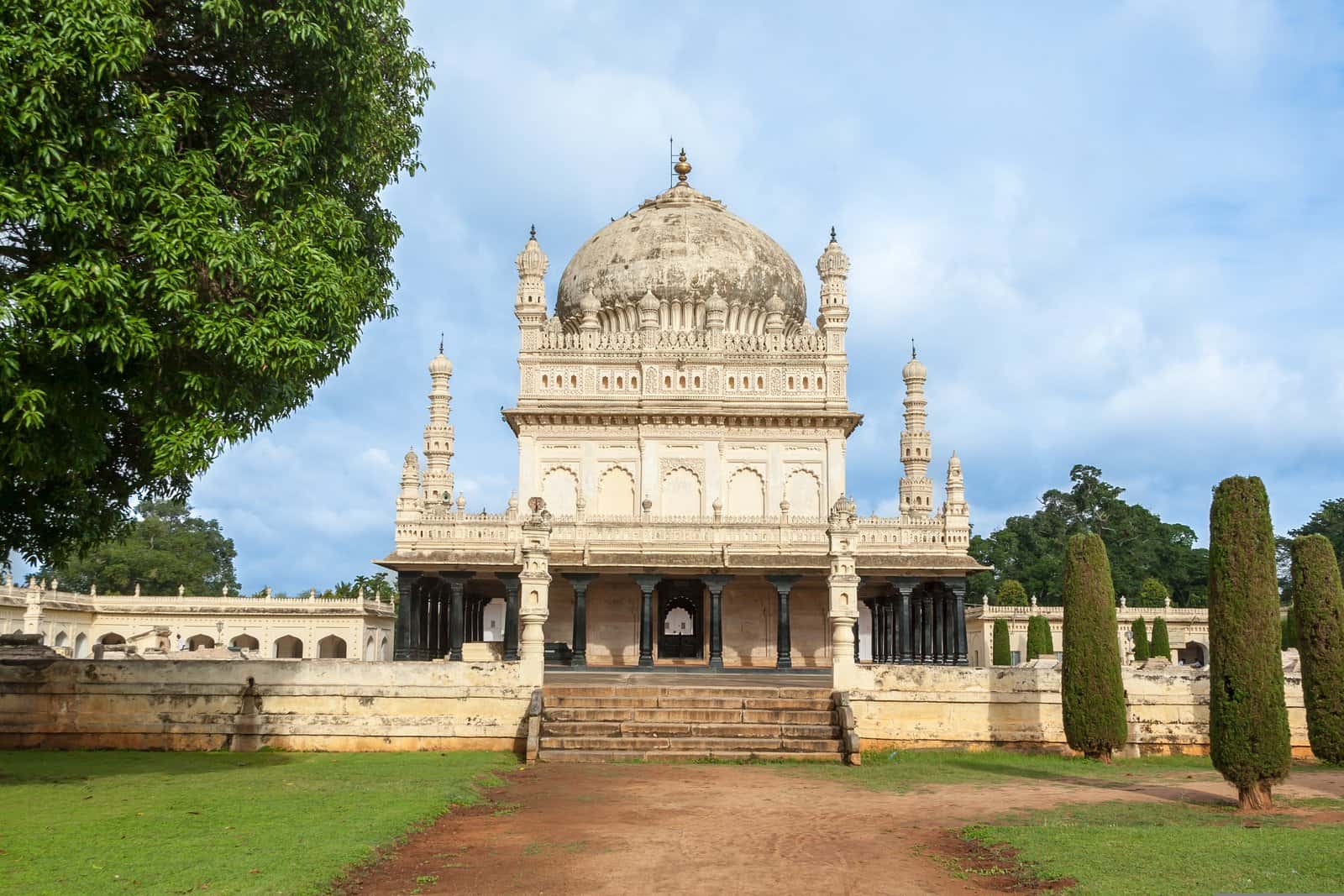
- The GumbazThe domed mausoleum where Tipu Sultan, his father Hyder Ali and his mother lie buried, an ASI monument in a quiet cypress garden about 2 km east of the fort. Entry to the Gumbaz itself is free. Remove your shoes and cover your head at the tomb, as it is an active place of respect.
- The fort and Colonel Bailey's DungeonThe river fort, its gates and ramparts, and the dungeon where the British were held in Tipu's time, are free to walk. The dungeon is reached down a short flight of steps near the water and still holds a cannon that once pierced its own ceiling; the ruined walls carry the whole battle story of 1799.
The two ASI-ticketed sites are Daria Daulat Bagh and, in its precinct, the Gumbaz garden, though entry to the Gumbaz tomb itself is free. The fort, Colonel Bailey's Dungeon and general temple entry cost nothing; the only temple charge is the optional special darshan. Reconfirm the ASI rates on the day, as they are revised from time to time, and remember cash is often not taken at the palace counter, which sells tickets online.
Signature experiences in Srirangapatna
Beyond ticking off monuments, these are the experiences people remember, from the Ranganathittu boat ride to reading a lost battle in the fort ruins.
- The Ranganathittu boat ride at first lightThe guided boat ride on the Cauvery at Ranganathittu Bird Sanctuary is the town's standout experience: painted storks, spoonbills, darters, kingfishers and basking mugger crocodiles at close range. Entry is around 80 rupees for Indian adults and about 600 for foreigners, with the common boat ride charged separately from roughly 120 rupees per person. Go soon after it opens, at about 8:30 am, for the best birds and light, and reconfirm the current Forest Department fees on site.
- The frescoes inside Daria Daulat BaghDo not rush the summer palace. The teak walls are covered with fine frescoes, including Tipu's forces at the Battle of Pollilur, and the small museum holds arms, coins and rare sketches. Give it about an hour and read the panels; it is the richest single site in town.
- Reading the fort and the dungeon as one storyWalk the fort walls, find the breach where the British stormed in on 4 May 1799, then descend into Colonel Bailey's Dungeon. Taken together, the ruins tell the fall of Tipu's Srirangapatna better than any plaque, and it is all free to explore at your own pace.
- A quiet moment at the GumbazThe domed tomb of Tipu and Hyder Ali, set among cypress and lawns, is the calmest corner of a busy day. Slip off your shoes, keep your voice down, and take in the ivory-inlaid doors and the tiger-stripe motifs that were Tipu's signature.
- The Cauvery at the Sangama and the bathing ghatsThe river braids around the island and rejoins downstream, and the ghats below the temple are a gentle place to watch daily life and, on a clear evening, a soft sunset. It is a good pause between the monuments, especially in the cooler months.
- Pair it with a Hoysala masterpieceIf you have a full day, add the Hoysala temple at Somnathpur, about an hour away, or continue into Mysore for the palace. Srirangapatna slots naturally into a Mysore heritage day rather than filling one on its own.
If you do only one thing slowly, make it the early boat ride at Ranganathittu. The birds are at their busiest and the crocodiles most visible in the first hour after opening, and the light on the Cauvery is at its softest. Rushing in at midday, when the boating pauses and the sun is high, is the single most common way visitors come away underwhelmed. Give it the morning and it becomes the memory of the trip.
Where to stay for Srirangapatna, and how long to give it
Srirangapatna itself has few beds, so base in Mysore and treat the island as a day out. Half a day covers the monuments; a full day adds Ranganathittu comfortably.
- Stay in MysoreMysore, about 30 to 40 minutes away, has the full range from backpacker guesthouses to grand heritage hotels, and it is the natural base for the whole region. Do Srirangapatna as a morning or a day out and return to Mysore for the night.
- A day out from BengaluruMany visitors, especially families and first-timers, do Srirangapatna and Mysore together as a long day trip from Bengaluru with a private car. It makes a full but rewarding day, and you sleep in the city at both ends.
- How many hoursThe temple, fort, dungeon, Daria Daulat Bagh and Gumbaz take about three to four hours together. Add Ranganathittu and you have a comfortable full day. Half a day, on the drive between Bengaluru and Mysore, is enough for the temple, the palace and a look at the fort.
- The few beds on the islandThere are a handful of simple lodges and a riverside resort or two around Srirangapatna and Ranganathittu if you specifically want to wake for the dawn birds, but the choice is thin and the standard basic. For comfort and range, Mysore wins.
Because the sites are scattered across the island rather than clustered, the order matters. Start at the temple and Ranganathittu early while it is cool and the birds are active, take the palace museum and a shaded lunch through the hot middle of the day, then walk the fort, the dungeon and the Gumbaz in the softer afternoon light. Done this way, a day in Srirangapatna never feels rushed or baking, which is the complaint of visitors who arrive at noon and try to do it all at once.
Srirangapatna costs and a realistic day budget
Srirangapatna is cheap to see: several sites are free and the ticketed ones are modest. The real cost is the car or the tour that carries you between the scattered monuments.
- The ticketed sitesDaria Daulat Bagh is about 25 rupees for Indian visitors and about 300 for foreign nationals. Ranganathittu entry is around 80 rupees for Indian adults and about 600 for foreigners, with the common boat ride charged separately from roughly 120 rupees per person. These are the main fixed costs, and they are still modest.
- The free sitesGeneral entry to the Ranganathaswamy Temple, the fort, Colonel Bailey's Dungeon and the Gumbaz tomb costs nothing. The only optional temple charge is the special darshan of about 250 rupees, which you do not need for a normal visit.
- The real expense: getting aroundThe sites are spread out, so a hired car with a driver or an auto for the round is the main outlay, and it is money well spent in the heat. A private day tour from Bengaluru or Mysore folds transport, and often a guide, into one price; ask what is included before you book.
- Cash and cardsCarry small cash for entry tickets, autos, the boat ride and tea, as the town runs largely on cash and the palace counter sells tickets online rather than for cash. There are ATMs in the town and plenty in nearby Mysore.
Entry to everything you actually need in Srirangapatna comes to only a small sum, because the temple, fort, dungeon and Gumbaz are free and the two ticketed sites are modest. Budget instead for the transport that links them, whether that is a car with a driver for the day or a packaged tour from Mysore or Bengaluru. Spend on the wheels, not the tickets, and the day is both cheap and comfortable.
Practical logistics: temple rules, tickets, food and getting around
The small things that make a Srirangapatna day smooth, from the temple sanctum rule and the online ASI ticket to eating on a town with few restaurants.
- The temple sanctum rule and dressGeneral entry to the Ranganathaswamy Temple is free and open to all, but the inner sanctum is effectively reserved for Hindus. Dress modestly, cover shoulders and knees, and remove your shoes before entering. Photography inside the sanctum is usually not allowed; ask before pointing a camera at anyone at prayer.
- ASI tickets are often online onlyDaria Daulat Bagh sells its tickets through the ASI online system and the counter frequently does not take cash, so keep a phone with a working payment app and a little data. Video cameras may carry a small extra fee even where still photos are free.
- Getting around the islandThe monuments are not walkable one to the next in the heat, so hire a car with a driver for the day, take autos between sites, or come on a tour. Autos are easy to find near the fort and the temple; agree the round-trip fare before you set off.
- Food and facilitiesSrirangapatna has simple South Indian eateries and tea stalls rather than a restaurant scene, so plan a proper lunch in Mysore or keep it to a light thali in town. Carry water, especially in the warmer months, as the sites are open and shade is patchy.
Safety, sun, water and small scams
Srirangapatna is an easy, low-hassle town. The real risks are the sun, the river and the odd pushy guide or priest rather than crime; a little awareness keeps the day happy.
- Sun, heat and hydrationThe sites are open-air and the island can be hot for much of the year. Carry water, wear a hat and sunscreen, and keep the harder walking, the fort and the dungeon, for the cooler morning or late afternoon. This is the most common thing that spoils a Srirangapatna day.
- Guides, priests and small donationsAt the temple and the monuments, freelance guides and priests may offer their services or a blessing and then press for a tip or donation. This is sales pressure, not a threat. Agree a fee before accepting any guide, keep any temple donation to what you choose, and a polite, firm no is always enough.
- The river and the boat rideThe Cauvery runs fast in places and there are mugger crocodiles at Ranganathittu, so keep to the marked areas, wear the life jacket on the boat, and keep children close at the ghats and the sanctuary. Do not wade or swim in the river.
- Health basicsDrink bottled or filtered water and take the usual care with street food. Mysore, half an hour away, has the nearest full hospitals and pharmacies, so carry any regular medicines with you for the day rather than relying on the small town.
Srirangapatna is a busy, well-visited day-trip town and generally relaxed for solo and women travellers with standard precautions. The sites see a steady flow of families and tour groups through the day, so you are rarely alone at any monument. Dress modestly at the temple, be firm with freelance guides, and time your visit to daylight hours, since the town quiets down in the evening once the day-trippers head back to Mysore.
Srirangapatna for every kind of traveller, and on access
Srirangapatna suits history lovers, birdwatchers and families in different ways. Here is what it offers you, and the one tip that matters for each, including how a senior does it comfortably.
- History loversThis is the richest Tipu Sultan site in the country: the summer palace frescoes, the tomb, the fort breach and the dungeon tell the fall of Mysore in 1799. Read a little history before you come and the ruins come alive. Give the palace museum a full hour.
- Families with childrenThe Ranganathittu boat ride, with its crocodiles and storks, is the easy win for kids, and the fort and dungeon are good for young explorers. Keep little ones close by the river, do the boat early, and break the day with a Mysore lunch.
- Senior travellers and on accessibilityVery doable by car with a driver, which spares the walking between scattered sites in the sun. The dungeon involves a short flight of steps and the fort ground is uneven, so take those slowly or admire them from the top. Stay in Mysore, start early, and rest through the midday heat.
- Birdwatchers and photographersRanganathittu at dawn is the draw: nesting colonies, waders and kingfishers at close range from the boat, best from about November to June. The palace frescoes and the fort ruins reward a patient camera too; ask before photographing worshippers at the temple.
- Solo travellersAn easy, low-hassle stop well used to day-trippers, and simple to reach by train or bus from Mysore or Bengaluru. Be firm with freelance guides, carry water, and you can see the town comfortably in a morning on your own.
- Faith and heritage travellersThe Ranganathaswamy Temple is one of the great Vaishnavite shrines on the Cauvery, and the Gumbaz is a place of quiet respect. Both reward an unhurried, mindful visit; observe the sanctum rule and the shoes-off, heads-covered etiquette at each.
A suggested Srirangapatna itinerary
How to shape a half day or a full day so you catch Ranganathittu at its best and never stand at a shut temple gate.
- Early morningStart at Ranganathittu soon after it opens, at about 8:30 am, for the best birds and light, then reach the Ranganathaswamy Temple in its morning hours before the midday closing. Both are at their calmest and coolest first thing.
- Late morning and lunchMove to Daria Daulat Bagh for the frescoes and the museum, giving it a full hour, then take a shaded lunch in town or drive the short hop to Mysore through the hot middle of the day.
- AfternoonReturn for the fort walls, the breach where the British stormed in, and Colonel Bailey's Dungeon, all free, then finish at the Gumbaz as the light softens. This keeps the walking for the cooler end of the day.
- The full-day version with Somnathpur or MysoreWith a whole day from Bengaluru, pair Srirangapatna with the Hoysala temple at Somnathpur, about an hour on, or continue into Mysore for the palace and Chamundi Hills. A private car makes this loop comfortable and unhurried.
The single thing that breaks a tight Srirangapatna plan is arriving at the Ranganathaswamy Temple during its midday closing, when it shuts for a few hours between roughly 1 pm and 4 pm. Build your day so the temple falls in the morning or the later afternoon, keep the hot middle of the day for the palace museum or a Mysore lunch, and you will never find yourself at a locked door with the clock running. The same early start also lands you at Ranganathittu when the birds are busiest.
The real questions travellers ask about Srirangapatna
Straight answers to the questions that come up again and again on traveller forums, so you arrive already knowing the score.
- How long do I need?About three to four hours covers the temple, fort, dungeon, palace and Gumbaz. Add Ranganathittu and it becomes a comfortable full day. Half a day, on the Bengaluru to Mysore drive, is enough for the temple, the palace and a look at the fort.
- Can foreigners and non-Hindus enter the temple?The outer temple complex is open to all, and everyone can walk it and admire the carving. The inner sanctum is effectively reserved for Hindus. There is no ticket for general entry, only an optional paid special darshan.
- Is it worth it beyond Mysore?Yes, as part of a Mysore day. On its own it is a compact half day rather than a destination, but the Tipu history, the palace frescoes and the Ranganathittu birds make it one of the best add-ons to a Mysore or Bengaluru trip.
- How much is the Ranganathittu boat ride?Entry is around 80 rupees for Indian adults and about 600 for foreigners, and the common boat ride is charged separately from roughly 120 rupees per person. Boating runs from about 8:30 am with a lunch break in the early afternoon, and early morning is best. Reconfirm the current Karnataka Forest Department fees on site, as they change.
- Where exactly did Tipu Sultan die?There are two plaques in the town, a couple of hundred metres apart, each claiming the spot where Tipu fell on 4 May 1799, and historians still dispute which is right. You can see both near the fort; treat any guide who states one as certain with a little friendly scepticism.
- Should I combine it with Somnathpur?If you have a full day, yes. The Hoysala temple at Somnathpur is about an hour away and its carving is extraordinary, so Srirangapatna, Somnathpur and Mysore make a strong one-day heritage loop by car from Bengaluru.
Planning Srirangapatna from abroad
Srirangapatna is the Tipu Sultan history lesson and the birdwatching pause on a Karnataka trip, and it pairs naturally with Mysore and Somnathpur. A little preparation makes the tickets and the temple rule easy.
- Know the foreigner ticket bandsAt Daria Daulat Bagh, foreign nationals pay about 300 rupees against about 25 for Indian visitors, and Ranganathittu also charges foreigners more, with the boat ride extra. These are small sums; carry a little cash and a phone with a payment app, since the palace ticket counter often sells online rather than for cash.
- The temple is open, the sanctum is notYou can walk the outer Ranganathaswamy Temple complex and admire the carving, but the inner sanctum is effectively for Hindus. This is normal for a living South Indian temple and nothing to worry about. Dress modestly, remove your shoes, and enjoy the outer courts.
- Pair it with Mysore and SomnathpurFly into Bengaluru, then loop Bengaluru, Srirangapatna, Somnathpur and Mysore. Srirangapatna is the Tipu Sultan chapter of a Karnataka heritage trip, an easy day out from Mysore or a long day from Bengaluru with a car and driver.
- Easy and senior-friendly by carBecause the sites are scattered, a private car with a driver is the comfortable way to do it, especially for older travellers. It keeps the walking short, spares you the heat between sites, and lets you fold in Ranganathittu and a Mysore lunch without any hassle.
The Tipu Sultan story, money and timing for foreign visitors
The context that makes Srirangapatna come alive for an overseas traveller: who Tipu Sultan was, the 1799 siege the British called Seringapatam, and the practical basics of money and timing.
- Why this town mattersSrirangapatna was the island capital of Hyder Ali and his son Tipu Sultan, who fought four wars against the British East India Company. The town the British called Seringapatam fell on 4 May 1799 when Tipu died defending it, a turning point in the British conquest of southern India. The palace, the tomb and the fort are that story in stone.
- Read the frescoes and the fort togetherDaria Daulat Bagh's walls show Tipu's victory at Pollilur, while the fort shows where his capital finally fell. Seeing the summer palace, the Gumbaz tomb and the fort breach in one visit turns a list of monuments into a single, moving arc of history.
- Carry cash, expect online ticketsThe town runs largely on cash for autos, tea and the boat ride, but the ASI palace counter sells tickets online and may not take cash. Keep small notes and a working payment app, and draw money in Mysore, where ATMs are plentiful, rather than relying on the small town.
- When to come and how long to give itOctober to February is the comfortable window, and the Ranganathittu birding runs wider still. On a first Karnataka trip, give Srirangapatna a half day to a full day between Mysore and Bengaluru, enough for the history, the temple and the birds without slowing the itinerary.
Srirangapatna is an unusually rewarding introduction to the region's layered history: a great living Hindu temple, an Indo-Islamic palace and tomb, and a colonial-era battlefield, all on one small river island. Slot it beside Mysore, give it a half day to a full day, and let a driver carry you between the scattered sites. Many overseas visitors find it the chapter of a Karnataka trip that stays with them, because it is where the sweep of eighteenth-century Indian history becomes something you can walk through.
Where an empire changed hands, and the spot no one can quite agree on
On 4 May 1799 the island capital the British called Seringapatam fell, and Tipu Sultan, the Tiger of Mysore, died sword in hand defending it against the storming columns of the East India Company. His death ended the Fourth Anglo-Mysore War and cleared the British path to dominance in southern India. Yet for all its weight, the exact place he fell is uncertain: to this day two plaques stand in the town, a couple of hundred metres apart, each claiming the spot, and historians have never settled which is right. That small, honest ambiguity is worth carrying as you walk the fort breach, the summer palace and the Gumbaz where he lies beside his father Hyder Ali. Beware any guide who points to one plaque as the certain place; the truth is that the ground swallowed the detail, and the two markers are the argument in stone.
Planning a Srirangapatna trip?
Our Karnataka travel experts plan your full journey for you: route, hotels, darshan timings and transport. You get a free day-by-day plan and an exact quote on WhatsApp, usually within a few hours. No payment is needed to get your plan.