Kannur Travel Guide
The comfortable window is October to March , and it happens to overlap the Theyyam ritual season , roughly October to May. Decide early whether catching Theyyam matters, because...
When to visit Kannur, and the Theyyam season to plan around
The comfortable window is October to March, and it happens to overlap the Theyyam ritual season, roughly October to May. Decide early whether catching Theyyam matters, because it shapes when you come.
- October to February: cool, dry and the Theyyam windowThe pleasant months on the Malabar coast, warm by day, easy by evening, and the heart of the Theyyam season in the village shrines. This is the time to come if the rituals matter to you, and the beaches and forts are at their best too.
- March to May: hot, but Theyyam still runsIt turns hot and humid, and afternoons on the open beaches are tiring, but the Theyyam season carries on into Edavam, around May, in many kavus. Do the beaches and forts early, rest through midday, and you can still pair heat with culture.
- June to September: the monsoonThe southwest monsoon brings heavy rain and lush green, good for Ayurveda and quiet, but most village Theyyam is paused and the drive-in beach is off limits. Rates are lowest then, and Parassinikadavu still has its daily ritual whatever the weather.
- Theyyam or not, decide firstIf seeing Theyyam in a village kavu is the point of your trip, come between about October and May and check the Kerala Tourism Theyyam calendar for dates, since each shrine follows its own festival schedule. If you only want the daily ritual at Parassinikadavu, any month works.
Theyyam is seasonal, not a year-round show you can simply turn up and watch. Across Kannur and Kasaragod the season runs roughly from Thulam (mid October) through Edavam (May or early June), and even within that window performances happen on each shrine's own festival days, often starting before dawn or late at night in rural kavus you will need private transport to reach. Use the Kerala Tourism Theyyam calendar to fix a date and a place before you build your trip around it, and treat any page that implies Theyyam is daily everywhere as wrong. The one reliable daily exception is Parassinikadavu, covered below.
How to reach Kannur
Kannur now has its own international airport at Mattannur, sits on the coastal railway, and is an easy drive up or down NH 66. Most travellers come by air or train.
- By air into Kannur (CNN)Kannur International Airport at Mattannur, about 25 to 28 km east of town, opened in December 2018 and is served by carriers including Air India Express and IndiGo, with domestic flights to cities such as Bengaluru, Mumbai, Delhi, Hyderabad and Chennai and direct Gulf links. Routes change, so check the airport schedule before booking.
- By train, on the coastal lineKannur is on the Mangalore to Shoranur coastal railway in the Southern Railway zone, with frequent expresses. Kozhikode is about 90 km, roughly 1.5 to 2 hours; Mangaluru about 130 km, roughly 2 to 3 hours; Kochi lies beyond Shoranur at about 280 to 290 km, roughly 5 to 6 hours. Confirm current trains on IRCTC.
- By road on NH 66The coastal highway makes road travel easy: Kozhikode is about 90 km and roughly 2 hours, Kasaragod and Bekal about 70 to 90 km, Wayanad about 90 to 100 km, Mangaluru about 110 to 140 km, and Kochi about 285 km and roughly 6 hours. KSRTC and private buses run the corridor frequently.
- Which gateway for a wider Kerala tripIf you are touring Kerala, Kannur slots between Mangaluru and Bekal to the north and Kozhikode, Wayanad and Kochi to the south. Fly into Kannur for the Malabar north, or into Kochi if you are starting from the backwaters and working up the coast.
Fly direct into Kannur (CNN) from points such as Dubai, Abu Dhabi, Sharjah or Doha. The airport was built largely for the region's NRI workforce, so for many Malabar families it is the simplest way home, with no need to route through Kozhikode or Kochi.
Fly into Kochi or a Gulf hub, then connect on to Kannur by a short flight, or come up the coast by train. There are no direct long-haul flights into Kannur itself.
Fly into Kannur from Bengaluru, Mumbai, Delhi, Hyderabad or Chennai, or take the coastal train. From Karnataka and Mangaluru it is an easy drive down NH 66.
The forts, the museum and the beaches
Kannur is a sea fort, a one-of-a-kind royal museum, a string of beaches and the temples of the Theyyam country. A few facts and rules are worth knowing before you go.
- St Angelo FortThe triangular laterite sea fort built by the Portuguese in 1505 and now protected by the Archaeological Survey of India. It changed hands through the Dutch, the Arakkal rulers and the British, and today it is an easy, breezy walk along the ramparts with cannon and a view over the fishing harbour. Go in the cooler morning or late afternoon.
- Arakkal Museum (Arakkal Kettu)The palace museum of the Arakkal family, the only Muslim royal house of Kerala, who ruled Kannur and the Lakshadweep islands under a matrilineal succession in which the eldest member, man or woman, became ruler. It is typically closed on Mondays, so plan around that, and it is a quiet, unusual half hour.
- Payyambalam and the town beachesPayyambalam is the free, landscaped city beach with lawns and the Mother and Child sculpture, with the still active Kannur Lighthouse (the present tower near here dates from about 1976) and the Sea View Park walkway nearby. It is the easy in-town evening. The bigger draws, Muzhappilangad and the Thalassery beaches, are a short drive south.
- Parassinikadavu and the Theyyam templesParassinikadavu Muthappan Temple, about 16 to 18 km out, is where you see Theyyam daily, and the area has a snake park nearby. The village kavus across the district hold the seasonal Theyyam during the festival months. The experiences and safety sections cover how to do both well.
Theyyam is worship, not a folk show staged for tourists. At a kavu or at Parassinikadavu, dress modestly, ask before photographing the performer or people at prayer, do not block the ritual space, and follow the stewards. Traditional dress, a mundu and shirt for men and a saree or half saree for women, is appreciated at the temple though not strictly enforced. Treat the forts and beaches as you would any heritage site, and the whole coast opens up warmly.
Theyyam: how to see it, honestly
Theyyam is the reason many travellers come to Kannur, and the single most misunderstood thing about the place. Here is how to time it, where to be sure of it, and how to behave.
- The season, told straightAcross Kannur and Kasaragod the Theyyam season runs roughly from Thulam, mid October, through Edavam, May or early June. Outside that window the village kavus are largely quiet. Within it, each shrine performs on its own festival days, so there is no single date, and a calendar check is essential.
- The daily guarantee at ParassinikadavuIf your dates or your stay are short, go to Parassinikadavu Muthappan Temple, about 16 to 18 km from town, where the Muthappan Thira is performed almost every day of the year, roughly in the early morning around 5:45 am to 8 am and again in the evening around 6:30 pm. Entry is free. This is the one place you can count on whatever the season, with a single exception: the temple holds an annual pause of roughly a month from about mid October (Thulam 1) to about mid November (mid Vrischikam), when the ritual is not held, so reconfirm if you visit then.
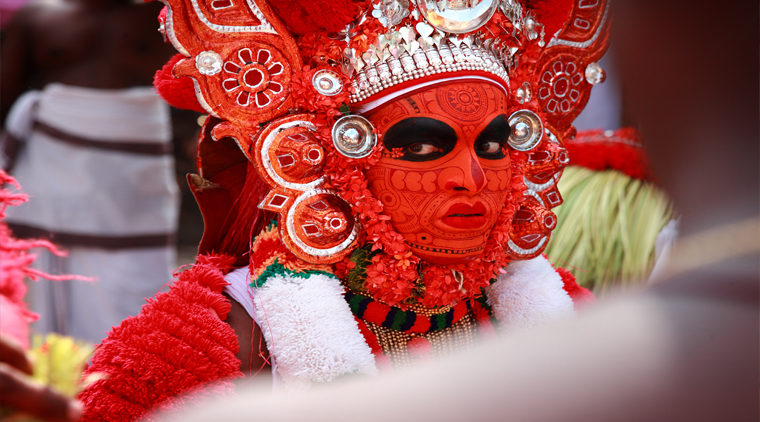
- Seeing a village kavu TheyyamA Theyyam in a rural sacred grove, with its towering headdress, painted face and fire, is the deeper experience, but it takes planning. Fix the date and shrine from the Kerala Tourism Theyyam calendar, arrange private transport because performances often start before dawn, and a local guide or your homestay host helps you find the right kavu and the right hour.
- Dress and conductDress modestly, and at the temple traditional dress is appreciated. Ask before photographing the performer, who is regarded as embodying the deity during the ritual. Stay outside the ritual space, follow the stewards, and do not treat it as a photo opportunity above all else. The respect is repaid with an unforgettable few hours.
Many Theyyam performances, including the morning session at Parassinikadavu around 5:45 am, begin before the first local buses run. Travellers on IndiaMike and TripAdvisor repeatedly get caught out planning to bus there at dawn. Arrange a taxi the night before and leave at roughly 5 am, or stay close by, so you are not stranded waiting for transport while the ritual you came for is already underway. A pre-booked car is the difference between seeing the best of Theyyam and missing it.
The drive-in beach, and the rest of the experiences
Beyond Theyyam, Kannur is the drive-in beach, the handloom looms, and the Thalassery food-and-history day. Here is how to do each one without the tourist-trap version.
- Muzhappilangad, the drive-in beachKerala Tourism calls this roughly 4 km strip near Thalassery the longest drive-in beach in Asia, and you really can drive a car, bike or even a bicycle along the hard packed sand. A line of black rocks calms part of the water for a safer swim, but read the safety section before you drive, because firm sand, low speed and the tide all matter.
- The handloom countryKannur is the Land of Looms. At the Kanhirode Weavers Cooperative, founded in 1952 about 13 km east of town and owned by its mostly women members, you can watch the pit looms at work. It is a genuine, unhurried look at the craft that underpins much of Kerala's handloom, and a quiet antidote to the beaches.
- A Thalassery food-and-history dayDrive about 20 km south to Thalassery for the famous Malabar biryani made with short jeerakasala or kaima rice, the ASI-protected Thalassery Fort, the French colonial pocket of Mahe nearby, and the town that was the birthplace of cricket in Kerala. It is the best single day trip from Kannur, food and heritage in one loop.
- Sunset, slow, by the seaEnd a day at Payyambalam Beach or the Sea View Park walkway as the light goes over the Arabian Sea, or watch the evening Theyyam at Parassinikadavu. Kannur is not a place to rush. Its pleasures are a ritual at dawn, a loom in the afternoon and a quiet beach at dusk.
If you do only one thing in Kannur, make it a Theyyam, the daily one at Parassinikadavu if your dates are tight, or a village kavu if you can time it. Nothing else on the coast compares to the moment a painted, fire-lit figure becomes, for the believers around you, the deity itself. The drive-in beach and the biryani are wonderful, but the Theyyam is why Kannur is worth the journey when the rest of Kerala pulls travellers south.
Where to stay in Kannur, and how many nights
Stay in town for the beaches and easy logistics, or in a coastal homestay for the slow Malabar pace. Two to three nights is the sweet spot, and Kannur makes a good north Kerala base.
- Kannur town and Payyambalam: convenientClose to the railway station, the fort, the city beach and the restaurants, and easiest for catching trains or the airport taxi. Best for first-timers and short stays who want everything in reach without much driving.
- Coastal homestays and heritage stays: the Malabar paceKannur has a strong homestay and small heritage-stay scene along the coast and the backwater edges, often family run and warm. Better for couples and anyone who wants to slow down, though you will rely on a car or autos to get about.
- How many nightsTwo to three nights is right. That covers a Theyyam, St Angelo Fort and the Arakkal museum, a drive-in beach afternoon, the handloom and a Thalassery food day, without rushing. One night only really suits a Theyyam-and-fort stopover; longer lets you fold in Bekal or Wayanad.
- Room budgetsOutside the peak Gulf-holiday weeks, plan on about 800 to 1,700 rupees a night for a budget room, about 1,700 to 2,700 for mid range, about 2,000 to 3,000 for a homestay and about 3,500 to 5,000 and up for a heritage or four star stay. These are estimates that rise around festivals and the Onam and Eid travel peaks.
Kannur works well as the hub for the Malabar north. Bekal fort and the Kasaragod backwaters are about 70 to 90 km north, and Wayanad's hills are about 90 to 100 km east, both comfortable day trips or one-night side trips. If your trip is mostly about Theyyam and beaches, base in Kannur; if it is mostly hills, base in Wayanad and dip down to the coast. Many travellers split their nights between Kannur and Bekal to get both the culture and the quieter fort coast.
Kannur costs and a realistic daily budget
Kannur is gentle on the wallet and less touristy than south Kerala. Here is what the main things cost, hedged honestly, so you can plan and avoid being overcharged.
- Rooms and a rough daily budgetBudget rooms run about 800 to 1,700 rupees, mid range about 1,700 to 2,700, homestays about 2,000 to 3,000, and heritage stays about 3,500 to 5,000 and up. A local meal is cheap, often around 100 to 300 rupees, and a sit-down restaurant meal around 400 to 700 rupees a head. These are estimates that move with season and demand.
- The free and near-free thingsA great deal of Kannur is free. Theyyam at Parassinikadavu has free entry, Payyambalam and the town beaches are free, and St Angelo Fort and the small museums are inexpensive. The biggest cost on a culture-focused trip is usually the car you hire to reach the dawn Theyyam and the out-of-town sights.
- Getting around and auto faresAutos run on the Kerala meter, from a minimum around 30 rupees for the first short stretch, with a night surcharge and higher rates outside the corporation limits, so confirm the fare or insist on the meter. A half-day or full-day taxi for the spread-out sights is the practical way to see Kannur, agreed as a package in advance.
- Cash, cards and the airport taxiCards and UPI work in hotels and bigger restaurants, but autos, small eateries and beach shacks run on cash, so carry some. At Kannur airport, prepaid taxi counters outside arrivals give a fixed fare into town, the simplest option after a flight rather than haggling outside.
Kannur's sights are spread out and the best Theyyam starts before dawn, so the single expense that shapes a culture trip is transport. Agree a half-day or full-day car as a package the night before, including the early Parassinikadavu run or a village kavu, and you turn the trip's only real friction, getting to the right place at the right hour, into a fixed, predictable cost. Everything else here is cheap by Kerala standards.
Practical logistics: food, money, SIM and getting around
The small things that make a Kannur day smooth, from the Malabar food to ATMs, autos and the spread-out geography that means you will want a car.
- Eat the Malabar foodThis is some of Kerala's best food: the Thalassery biryani with its short jeerakasala rice, fish and prawn curries, pathiri and the snacks of the coast. Unlike the holy towns of the north, Kannur has no dietary restriction, so eat freely, and fresh seafood at a beach shack is a highlight.
- Getting aroundThe sights are spread out, so a hired car or a daily taxi is the practical choice; autos handle short town hops. App cabs work in the town core but thin out in the outlying areas, where call-taxis and pre-booked cars are the norm, especially for the dawn Theyyam run.
- Money and ATMsBank ATMs are easy to find in Kannur town and Thalassery. Carry cash for autos, beach shacks, small eateries and temple offerings, while hotels and bigger restaurants take cards and UPI.
- SIM, signal and languageMobile coverage is good across the town and the coast. Malayalam is the local language, but English is widely understood in the tourist and hotel trade, so communicating is easy, and a homestay host is the best source for local Theyyam dates and directions.
Safety, the drive-in beach, and staying well
Kannur is calm and welcoming, but the drive-in beach and the sea need respect, and the dawn Theyyam logistics catch people out. A little care keeps the visit happy.
- Driving the beach safelyDrive only on the firm, hard packed sand, keep your speed low, and watch the tide, because soft or wet sand traps cars. It is riskiest in and after the monsoon, when the sand softens and driving is effectively off. Wash the underside of the car afterwards to clear the salt, and check with your hire firm first, as self-drive and rental cars are sometimes restricted on the beach.
- Swimming and the seaThe black rocks at Muzhappilangad calm part of the shore, but this is still the open Arabian Sea with currents, so swim only where it is shallow and calm, never alone, and never after driving has churned the water. Heed any local warning, and keep children close. The town beaches are for strolling more than swimming.
- The dawn Theyyam logisticsThe biggest practical risk to your plans is being stranded at roughly 5 am with no transport to a pre-dawn Theyyam. Book a car the night before. Carry water, and in the warmer months sun protection, for the open beaches and forts, and a mosquito repellent for the forests and after the monsoon.
- Everyday safetyKannur is a low-key, family-oriented town and generally very safe, including for solo and women travellers, with normal precautions. There is little of the tout pressure of the big tourist towns. Take usual care with belongings on the busy beaches, and the usual food and water caution, and you will find the coast easygoing.
Kannur is one of the gentler, less touristy parts of Kerala to travel, and solo and women travellers generally find it relaxed and safe with standard precautions. The main thing to plan rather than worry about is transport for the early-morning Theyyam and the spread-out sights: a pre-booked car or a trusted call-taxi removes the only real logistical friction. Dress modestly at the temples and kavus, which is good practice anywhere on this devout coast.
Kannur for every kind of traveller, and on access
Kannur suits very different visitors in different ways. Here is what it offers you, and the one tip that matters for each, including how a senior sees Theyyam comfortably.
- CouplesSlow, uncrowded and authentic: coastal homestays, quiet beaches at sunset, and the drama of a shared Theyyam. Kannur is the unpackaged Kerala, romantic precisely because it is not a resort strip.
- Families with childrenEasy and varied, with the drive-in beach, the snake park at Parassinikadavu, the forts and the lighthouse. Pick the calm, shallow water for swimming, keep children close on the beach and away from the driving lane, and a Theyyam is a vivid, if loud and late, spectacle for older kids.
- Senior travellers and on accessibilityVery doable with planning. For Theyyam, choose the daily Parassinikadavu over a pre-dawn village kavu, and consider the more comfortable evening session around 6:30 pm rather than the early morning. Stay in town near the flat Payyambalam beach and the Sea View Park walkway, hire a car for the spread-out sights, and take the forts in the cool of the day.
- Solo and women travellersRelaxed, safe and free of the big-town tout pressure, with standard precautions. The thing to organise is transport for the early sights and the dawn Theyyam, with a pre-booked car or call-taxi. One of the easier corners of Kerala to travel independently.
- Culture and Theyyam loversThis is your place. Build the trip around the Kerala Tourism Theyyam calendar, line up a village kavu performance, add the handloom cooperative and the Arakkal museum, and let Parassinikadavu be the dependable daily anchor. Few places in India reward a patient cultural traveller like the Theyyam country.
- PhotographersThe painted faces and fire of Theyyam, the laterite forts against the sea, the looms and the drive-in beach at golden hour. Ask before photographing a performer or worshippers, respect the ritual space, and the images you take home are unlike anywhere else in Kerala.
A suggested Kannur itinerary
How to shape two or three unhurried days so you catch a Theyyam, the forts and the drive-in beach without backtracking, and fit in a Thalassery food day.
- Day one: arrive and the in-town sightsSettle in, then see St Angelo Fort and the Arakkal museum in the cooler hours, with the museum's Monday closing in mind. End at Payyambalam Beach and the Sea View Park walkway for sunset over the Arabian Sea, and book a car for an early start the next day.
- Day two: Theyyam and the drive-in beachStart before dawn for the morning Theyyam at Parassinikadavu, around 5:45 am, or a village kavu if your dates match the calendar. Rest through midday, then spend the late afternoon at Muzhappilangad, driving the firm sand and swimming where it is calm, before the light goes.
- Day three: Thalassery food and heritageDrive about 20 km south to Thalassery for the Malabar biryani, the ASI fort, French Mahe and the cricket heritage, and fold in the Kanhirode handloom cooperative on the way back. A third night turns a tick-the-box visit into a proper Malabar immersion.
- The one-night versionIf you only have a night, do the evening Theyyam at Parassinikadavu around 6:30 pm and St Angelo Fort, and you will have caught the soul of Kannur. The drive-in beach and Thalassery then become a reason to come back.
The single thing that breaks a Kannur plan is treating Theyyam as something to slot in casually. Fix your Theyyam first, the daily Parassinikadavu session or a dated village kavu from the Kerala Tourism calendar, arrange the pre-dawn car for it, and build the forts, the beach and the Thalassery day around that anchor. Do it that way and you will never find yourself in Kannur having missed the one thing it is famous for because the timing or the transport let you down.
The real questions travellers ask about Kannur
Straight answers to the questions that come up again and again on traveller forums, so you arrive already knowing the score.
- Where and when can I see Theyyam?In the village kavus, roughly between October and May, on each shrine's own festival days, which you fix from the Kerala Tourism Theyyam calendar. It is not daily across the district. For a guaranteed sighting any day of the year, go to Parassinikadavu Muthappan Temple, morning or evening.
- Is Kannur worth visiting, and how long?Yes, if you want the real, unpackaged Kerala and especially Theyyam. Two to three days covers the Theyyam, the forts, the drive-in beach, the handloom and a Thalassery food day. One night suits only a Theyyam-and-fort stopover.
- Can I really drive on Muzhappilangad beach?Yes, on the firm, hard packed sand, at low speed, watching the tide. It is risky in and after the monsoon, and you must wash the salt off the car afterwards. Check with your hire firm first, as rental and self-drive cars are sometimes not allowed on the beach.
- Kannur, Bekal or Wayanad as a base?Base in Kannur for Theyyam, beaches and the forts; it is central to the Malabar north. Add Bekal, about 70 to 90 km north, for the great fort and the quieter coast, and Wayanad, about 90 to 100 km east, for the hills. Many travellers split nights between Kannur and Bekal.
- How do I reach the early-morning Theyyam?By pre-booked taxi, leaving at roughly 5 am, because the first local buses run later than the ritual starts. This is the most common planning mistake travellers report. Arrange the car the night before, or stay near Parassinikadavu.
- Is the new airport convenient?Yes. Kannur International Airport at Mattannur, about 25 to 28 km east of town, has domestic and Gulf flights, and a prepaid taxi counter outside arrivals gives a fixed fare into town. For Gulf NRIs it is often the simplest way home to Malabar.
Planning Kannur from abroad
Kannur is the Gulf NRI's home gateway and the most authentic corner of Kerala for foreign visitors. A little preparation makes the Theyyam season and the holy-shrine etiquette easy to handle.
- Fly straight in from the GulfKannur International Airport was built largely for the region's large Gulf workforce, with direct flights to points such as Dubai, Abu Dhabi, Sharjah and Doha. For a Malabar family returning home, that often means no more routing through Kozhikode or Kochi, and a prepaid taxi waits outside arrivals.
- Time your trip to Theyyam, honestlyIf Theyyam is part of why you are coming, plan for roughly October to May and check the Kerala Tourism Theyyam calendar, because it is seasonal and tied to each shrine's festival days. Outside that window, Parassinikadavu still performs daily, so you are never entirely without it.
- It is the unpackaged KeralaKannur has none of the resort gloss of the south. That is the appeal: real villages, real rituals, real food, and warm, low-key hospitality. Foreign visitors who want the Kerala behind the brochure find it here, paired easily with Bekal, Wayanad and the road south to Kochi.
- Respect the living ritualTheyyam is worship. Dress modestly, ask before photographing the performer, who embodies the deity during the rite, and follow the stewards. The respect is welcomed and repaid. The forts and beaches need only normal heritage-site courtesy.
Money, connectivity and timing for foreign visitors
The practical basics an overseas traveller needs for the Malabar coast: cash, cards, a SIM, the airport taxi, and how many days to give Kannur on a wider Kerala trip.
- Carry cash, but cards work tooHotels and bigger restaurants take cards and UPI, but autos, beach shacks, small eateries and temple offerings are cash. Draw cash at the easy-to-find town ATMs and keep small notes for autos and the dawn Theyyam taxi.
- Get a SIM at the airportPick up an Indian tourist SIM or an eSIM when you land at Kannur, Kochi or a Gulf-transit hub rather than hunting for one in town. Coverage across Kannur and the coast is good for maps, calls and ride-booking to the out-of-town sights.
- Use the airport prepaid taxiFrom Kannur airport at Mattannur, about 25 to 28 km east of town, the prepaid taxi counters outside arrivals give a fixed fare into the city, the simplest option after a flight. Ask your hotel whether a pickup is easier if you arrive late.
- How long to give it on a bigger tripOn a Kerala trip, two to three nights in Kannur is the right weight for the Theyyam, the forts and the beaches, before you continue to Bekal and Mangaluru north, or Wayanad and Kochi south. Come between about October and May for the comfortable weather and the rituals together.
Kannur is an unusually rewarding introduction to the Kerala most visitors never reach: a coast of forts and looms where an ancient trance ritual is still living worship rather than a staged show. Fly in from the Gulf or connect from Kochi, give it two or three nights, fix your Theyyam first from the official calendar, and let the beaches, the biryani and the handloom fill the days around it. Many travellers say the Malabar north ends up being the part of Kerala they found most real.
Theyyam: when a man becomes a god
Theyyam is north Malabar's great gift to the world, a ritual far older than the temples around it, in which a performer of a particular community, after days of fasting and preparation, dons a towering headdress, a painted face and a costume of fire and red, and through drumming and trance is believed to become the deity himself. For the hours of the ritual the villagers do not watch a dancer, they receive their god, who blesses them, hears their troubles and gives counsel. There are said to be more than four hundred Theyyam forms, each tied to a deity, a legend and a particular sacred grove, and the season runs roughly from Thulam in mid October through Edavam in May. No single text fixes its origin, which is honestly part of its power: Theyyam is an oral, lived tradition older than the written record, kept alive in the kavus of Kannur and Kasaragod. To see one, well timed and respectfully, is to witness something India has very nearly nowhere else.
Planning a Kannur trip?
Our Kerala travel experts plan your full journey for you: route, hotels, darshan timings and transport. You get a free day-by-day plan and an exact quote on WhatsApp, usually within a few hours. No payment is needed to get your plan.
Tour packages that visit Kannur
Every journey below is private, hand-crafted and fully customizable. Tell us your dates and we tailor the itinerary, the pace and the priests or guides around you.