Thrissur Travel Guide
The comfortable months are October to March , but the great set-piece is Thrissur Pooram in late April, in the hot season. Decide early whether you are coming for the festival or...
When to visit Thrissur, and the festival to plan around
The comfortable months are October to March, but the great set-piece is Thrissur Pooram in late April, in the hot season. Decide early whether you are coming for the festival or for the calmer town.
- October to March: cool, dry and easyThis is the pleasant window across Kerala, drier and cooler, and the most comfortable time for temple visits, town walks and a day at Athirappilly. Mornings are fresh and the humidity is bearable, so it suits families and older travellers best.
- June to September: the monsoonThe southwest monsoon brings heavy, dramatic rain. It is the time Athirappilly thunders at its fullest and the countryside is greenest, but the town is humid and downpours can disrupt plans, so pack a rain layer and keep the itinerary flexible.
- April to May: hot, and Pooram seasonHigh summer on the plains is genuinely hot and sticky. This is also when Thrissur Pooram falls, so if you come for the festival, plan around the heat with water, shade and rest, and do not expect a cool visit.
- Festival or calm, decide firstPooram is one of India's great spectacles, but the town is packed and rooms vanish months ahead. A quiet visit in winter is gentler and lets you take the temples and Athirappilly at your own pace. Choose the experience you want before you book.
Thrissur Pooram is held at the Vadakkunnathan Temple in the Malayalam month of Medam, on the day the moon sits in the Pooram asterism, so the date moves every year. For 2026 the main Pooram day is reported as about 26 April 2026, with the 36 hour celebration spilling into the early hours and midday of 27 April and a formal announcement on 25 April. Treat 26 April as the reported date, not a date to bet flights on, and reconfirm it on the official Kerala Tourism site before you book, since the festival calendar follows the Malayalam calendar and dates should be confirmed with local authorities.
How to reach Thrissur
Most visitors fly into Cochin and come up by road or train. Thrissur sits on the main rail line and the Cochin to Munnar road circuit.
- By air, via CochinCochin International Airport at Nedumbassery is the nearest major airport, about 50 km from Thrissur by the official district figure, roughly 1.5 hours by road. It has wide domestic and international connections, so it is the gateway for almost all overseas and long-haul travellers.
- Calicut airport as an alternativeCalicut, or Kozhikode, airport at Karipur is the other option, roughly 100 km by road to the north. It is useful if your fares or routes work better there, but Cochin is closer and busier, so most people use it.
- By train, the easy way inThrissur railway station, station code TCR, is a major stop on the Shoranur to Ernakulam main line with a heavy daily train count and direct connections to Ernakulam and Kochi, Thiruvananthapuram and Chennai. Book on IRCTC a little ahead in season. A smaller station, Poonkunnam, lies just north of the centre.
- By roadThrissur is an easy drive from Cochin, about 1.5 hours, and sits on the route up to Munnar and across to the backwaters, so it slots neatly into a wider Kerala loop. We can arrange a car with an experienced driver for the whole circuit.
Fly into Cochin, the nearest international gateway, then reach Thrissur by road in about 1.5 hours or by a short train hop. Cochin connects through the Gulf and major Indian hubs.
Fly directly into Cochin, which has strong Gulf connections, then drive or train up to Thrissur. It pairs easily with Munnar, the backwaters and Fort Kochi.
Take a train to Thrissur on the main Shoranur to Ernakulam line, well served from Ernakulam, Thiruvananthapuram and Chennai, or fly to Cochin and drive the short hop.
Vadakkunnathan, Guruvayur, and the entry rules to know
Thrissur is its great Shiva temple on the hill, the nearby Krishna temple at Guruvayur, and the colonial-era churches and museums around town. A few entry rules matter before you go.
- Vadakkunnathan TempleThe classical Shiva temple on the wooded hill at the centre of town is a monument of national importance protected by the Archaeological Survey of India, famous for its murals and its koothambalam, the wooden temple theatre. It admits Hindus only, so non-Hindu visitors admire the architecture and the surrounding Thekkinkadu Maidan from outside.
- Guruvayur Sri Krishna TempleAbout 29 to 30 km away, Guruvayur is one of Kerala's most revered Krishna shrines and draws huge crowds. Like Vadakkunnathan, it admits Hindus only and enforces a strict traditional dress code. Read the logistics section on the darshan queue and the special darshan before you go.
- Churches, museums and the Swaraj RoundThrissur has grand churches, including the Our Lady of Lourdes and Puttanpalli basilicas, and museums around the Vadakkunnathan hill. The Swaraj Round, the broad road circling the temple, is the heart of town and an easy orientation point on foot.
- Kerala Kalamandalam at CheruthuruthyAbout 30 km north, the Kerala Kalamandalam is the state's famous academy for Kathakali, Mohiniyattam and other classical arts, where you can watch students train. It is a rewarding half-day for anyone interested in Kerala's performing traditions.
Both the Vadakkunnathan Temple in town and the Guruvayur Sri Krishna Temple admit Hindus only and bar non-Hindus and foreigners from the inner complex, so overseas visitors should expect to see the exterior rather than the sanctum. Guruvayur in particular enforces a strict dress code: men remove the upper garment and wear a mundu or dhoti, with no shirts, trousers or jeans inside, and women wear a saree, set-mundu or salwar kameez, not jeans or western dresses. People in the wrong clothes are turned back at the gate, so dress traditionally and reconfirm current rules with the temple board.
Signature experiences in Thrissur
Beyond the temples, these are the experiences people remember, from the percussion of Pooram to the thunder of Athirappilly, and how to arrange them well.
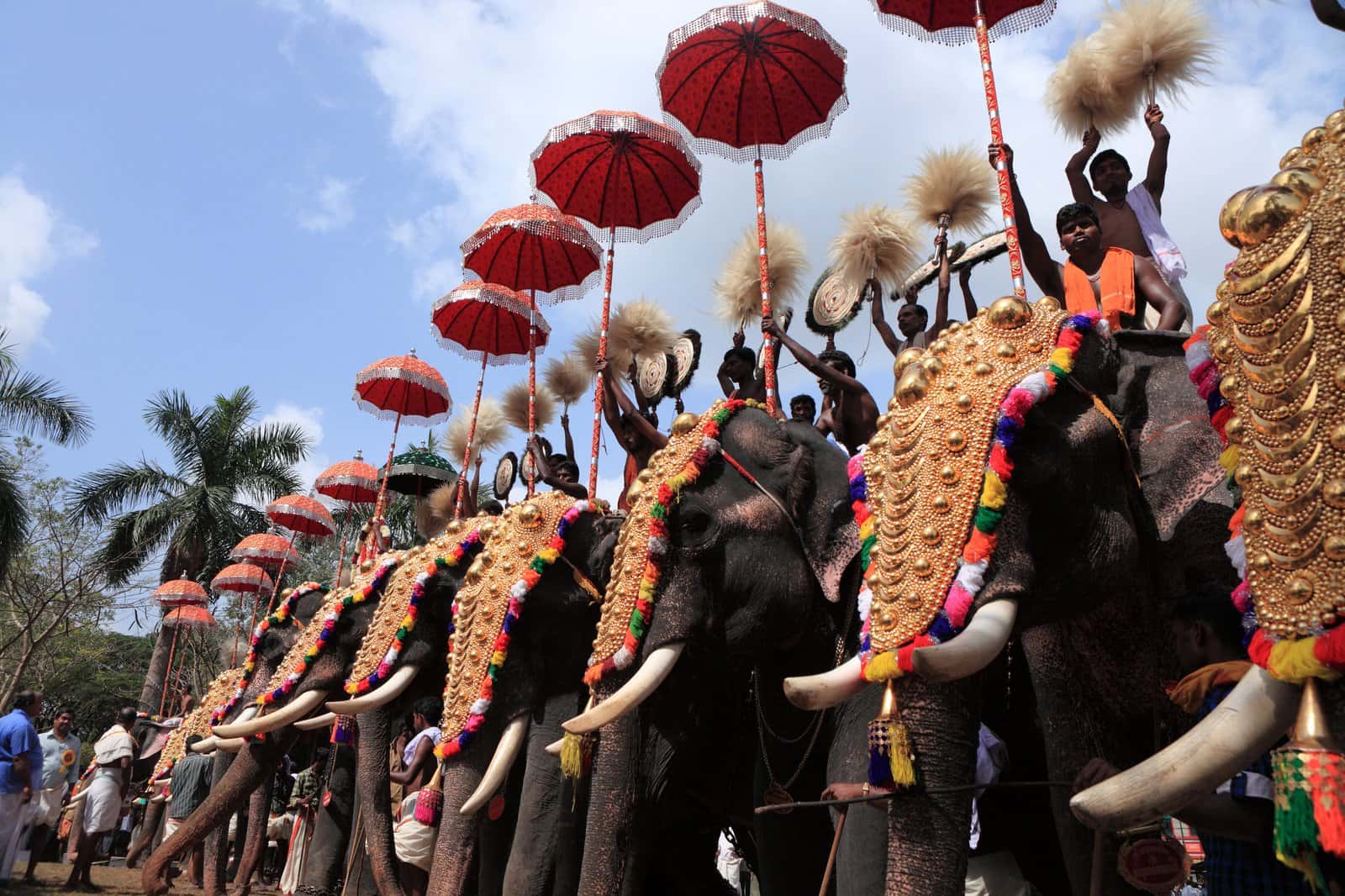
- Thrissur Pooram, if your dates matchIf you visit in late April, Pooram is the experience of a lifetime: the Ilanjithara Melam percussion, the Kudamattam parasol display in the early evening, caparisoned elephants and the fireworks in the small hours. It is hot, loud and crowded, so plan rest, water and ear protection, and read the safety section on the crowds.
- Watching the Ilanjithara MelamThe afternoon Ilanjithara Melam, a huge ensemble of drums and horns building in waves, is for many the soul of Pooram even more than the fireworks. Find a spot in the shade near the Vadakkunnathan grounds, settle in, and let it build; it rewards patience over a quick look.
- Athirappilly waterfallsKerala's largest waterfall, often called the Niagara of India, is about 55 to 63 km south, roughly 1.5 hours by road, and thunders most in and after the monsoon. There is a short forest trek down to the base, so wear grippy shoes and allow a couple of hours, plus an early start if you are travelling by bus.
- A Kathakali or Koodiyattam performanceThrissur and nearby Cheruthuruthy are the heartland of Kerala's classical arts. Catch a Kathakali or Koodiyattam performance, or watch students train at the Kerala Kalamandalam, for a window into the traditions the town is built around.
- The town on foot around Swaraj RoundThe compact centre around the Swaraj Round and the Thekkinkadu Maidan, with its markets, churches and old shops, is a pleasant slow wander. It is also the best way to feel the rhythm of a working Kerala town that is not just a tourist stop.
- A Guruvayur darshan, done rightFor Hindu travellers, a darshan at Guruvayur is the spiritual centre of a Thrissur trip. Time it around the queue, consider the ghee-lamp special darshan to shorten the wait, and dress traditionally. The logistics section explains exactly how the queue and the booking work.
If you do only one thing slowly, make it the Ilanjithara Melam at Pooram or, outside festival time, an unhurried half-day at Athirappilly. Both reward patience over a quick photo stop: the melam builds over hours into something overwhelming, and the falls deserve the short trek to the base and time to simply sit by the water. Give either an unrushed window and Thrissur opens up in a way a tick-the-box visit never allows.
Where to stay in Thrissur, and how many nights
Stay near the Swaraj Round to be in the thick of the town, or out towards Guruvayur or Athirappilly if those are your focus. Two to three nights is the sweet spot.
- Town centre, around Swaraj RoundStaying near the Swaraj Round and the Vadakkunnathan hill puts you walking distance from the temple grounds, the markets and the churches, and central for trips out to Guruvayur and Athirappilly. Best for first-timers who want to be in the heart of things.
- Towards GuruvayurIf a Guruvayur darshan is your main reason to come, there are many pilgrim hotels and Devaswom guesthouses near the temple, which lets you join the early-morning queue without a long pre-dawn drive. Book ahead on festival and Ekadasi days when the town fills up.
- How many nightsTwo to three nights is the right length: one day for Vadakkunnathan, the town and the museums, one for Guruvayur, and one for Athirappilly. A single night only lets you skim the town. During Pooram, give yourself extra time to absorb the long festival and recover from the late nights.
- Room budgetsOutside festival season, budget and mid-range hotels run from about 1,200 to 3,000 rupees, and higher-end and heritage stays about 4,000 to 9,000 rupees. All of these rise sharply around Pooram, so book well ahead if your dates fall on the festival.
During Thrissur Pooram, hotel rooms across town are scarce and sold months in advance at several times the normal price, and many places ask for minimum stays. If your dates fall on the festival, book very early, or base yourself a little outside town and commute in for the day. Leaving it late around Pooram usually means no room at all rather than just an expensive one.
Thrissur costs and a realistic daily budget
Thrissur is gentle on the wallet outside festival season. Here is what the main things cost, so you can plan and avoid being overcharged.
- A rough daily budgetExcluding your room and long-distance transport, plan on about 1,200 to 2,000 rupees a day as a budget traveller, about 3,000 to 5,000 rupees mid-range, and about 6,000 rupees and up for a comfortable day with taxis, meals out and entry fees. Kerala food is excellent value, so eating well costs little.
- Temples and the special darshanEntering the temples is free, but the ghee-lamp special darshan at Guruvayur, the Neyvilakku, is widely reported at about 1,000 rupees per person and is the main paid choice if you want to shorten the queue. Reconfirm the price on the official Devaswom portal, since it can change.
- Athirappilly and day tripsThe Athirappilly entry fee is reported at about 50 rupees for an Indian adult, about 15 to 20 rupees for a child and about 200 to 250 rupees for a foreign visitor, usually covering Vazhachal the same day. A taxi for the round trip from Thrissur is the comfortable option; the bus route is far cheaper but eats most of a day.
- Cash and cardsHotels, bigger restaurants and shops take cards and UPI, but local buses, small eateries, temple offerings and the falls run on cash. There are plenty of bank ATMs around the Swaraj Round, so carry enough cash for the day to keep things smooth.
In Thrissur the big swings are the room and the transport rather than daily spending: food, local buses and temple entry are cheap, while a Pooram-week hotel or a private taxi to Athirappilly is where the cost climbs. Decide early whether you want the convenience of a car for the day trips and the comfort of a central hotel, budget those two lines honestly, and the rest of a Thrissur day stays inexpensive.
Practical logistics: the Guruvayur queue, dress, money and getting around
The small things that make a Thrissur trip smooth, from how the Guruvayur darshan queue and special darshan work to dress, ATMs and local transport.
- The Guruvayur darshan queue, and the special darshanThe general free darshan queue at Guruvayur can run for several hours and is far longer on Ekadasi and festival days. To shorten it, the ghee-lamp special darshan, the Neyvilakku, is reported at about 1,000 rupees per person and is bookable online on the official Guruvayur Devaswom portal. Slots for weekends and festival days fill about a week or more ahead, so book early and carry photo ID.
- Dress for the templesGuruvayur enforces a strict dress code: men remove the upper garment and wear a mundu or dhoti, women wear a saree, set-mundu or salwar kameez, and jeans, trousers and western dresses are not allowed inside. Vadakkunnathan is similar. Both admit Hindus only, so plan visits accordingly and reconfirm rules with the boards.
- Getting around town and out of itThe centre around the Swaraj Round is compact and walkable. Auto-rickshaws, app cabs and the excellent Kerala state buses cover the trips to Guruvayur and out towards Chalakudy for Athirappilly. For the day trips, a hired car with a driver is the easy, time-saving choice.
- Money, SIM and languageBank ATMs are easy to find around the Swaraj Round, and cards and UPI work in hotels and bigger shops, but carry cash for buses, small eateries and temple offerings. Malayalam is the local language, but English is widely understood. Pick up an Indian or eSIM tourist plan at Cochin airport rather than hunting for one in town.
Safety, the Pooram crowds, and the elephant question
Thrissur is a safe, easy town, but Pooram is a serious crowd event and the elephant-welfare debate is worth knowing. A little awareness keeps the visit happy and responsible.
- Surviving the Pooram crowdsPooram draws huge crowds, and during the Kudamattam and the fireworks you may not be able to move freely. Carry only the minimum, use a cross-body bag, keep children close, and agree a meeting point in case you are separated. Pick your viewing spot well ahead and accept that you will be holding it for hours.
- Heat, noise and the small hoursPooram is in the late-April heat, so carry water, sun protection and a hat, and pace yourself for the long day and night. The fireworks, the Vedikettu, run around the small hours and are extremely loud, so bring ear protection, especially for children and anyone sensitive to noise.
- The elephant-welfare debateCaparisoned elephants are central to Pooram, but their welfare is now an active public debate, with a case before the Kerala High Court over loud fireworks near elephants, crowding and heat, and authorities citing monitoring and animal-welfare rules. Keep a respectful distance, never crowd or provoke an elephant, and make your own ethical choice about how closely to engage.
- Everyday health and safetyThrissur is generally safe and relaxed. Drink bottled or filtered water, take the usual care with street food, and watch the surf and slippery rocks at Athirappilly, where the trek can be slick in the monsoon. Standard small-town caution is enough the rest of the time.
Kerala is among the easier Indian states for women travelling alone, and Thrissur is a calm, family town where solo women generally feel comfortable with standard precautions. Dress modestly near the temples, where it is also required, prefer busy areas after dark, and be aware that Pooram is an intense crowd event best navigated with a plan and, ideally, company. The everyday friction is minimal compared with busier tourist hubs.
Thrissur for every kind of traveller, and on access
Thrissur suits very different visitors in different ways. Here is what it offers you and the one tip that matters for each, including how a senior visits comfortably.
- Families with childrenEasy and rewarding, with the falls, the elephants and the colour of the festivals, plus good food. During Pooram keep little ones close in the crowds and protect their ears from the fireworks, and at Athirappilly hold hands near the slippery edges.
- Senior travellers and on accessibilityVery doable with planning. At Guruvayur, the ghee-lamp special darshan spares the long queue, so consider booking it. At Athirappilly the trek to the base is steep and uneven, so the upper viewpoints are a gentler alternative, and a hired car for the day trips saves the bus changes. Skip the crush of peak Pooram days if calm matters.
- CouplesThrissur is more cultural than romantic, but it pairs well with the wider Kerala loop. A Kathakali performance, the falls and a slow evening around the Swaraj Round make a good cultural pause between the backwaters and the hills.
- First-time Kerala visitorsThrissur is the cultural anchor of a first Kerala trip, the temple and festival heart between Cochin, Munnar and the backwaters. Give it two to three days and you will understand the state far better than a beaches-and-houseboats-only route.
- Solo female travellersGenerally relaxed and easy, in one of India's gentler states for solo women. Dress modestly near the temples, prefer busy areas after dark, and treat Pooram as the one time to plan carefully for the crowds.
- PhotographersPooram is one of India's great photographic events, from the caparisoned elephants to the night fireworks, and Athirappilly is dramatic in the monsoon. Ask before photographing people at prayer, respect the no-photography rules inside the temples, and never crowd the elephants for a shot.
A suggested Thrissur itinerary
How to shape two or three unhurried days so you cover the town, Guruvayur and Athirappilly without rushing, and catch Pooram well if your dates match.
- Day one, the townStart with the Vadakkunnathan hill and the Swaraj Round in the cooler morning, take in the churches and a museum, then catch a Kathakali or Koodiyattam performance in the evening. An easy day to find your feet in the cultural capital.
- Day two, GuruvayurGo early to Guruvayur for the darshan, ideally with a ghee-lamp special darshan booked ahead to shorten the queue, and dress traditionally. Add the elephant sanctuary at Punnathur Kotta nearby, then return to Thrissur in the afternoon.
- Day three, AthirappillyTake a day trip south to Athirappilly, best by hired car for an early start, or by bus to Chalakudy and a connecting bus on. Allow a couple of hours for the falls and the short trek, and pair it with Vazhachal on the same ticket.
- If you are here for PooramGive the festival its own day and night around about 26 April 2026, with rest built in for the late fireworks. Arrive a day early to settle in and scout your viewing spot, and keep the following day gentle to recover.
The two things that break a tight Thrissur plan are the multi-hour Guruvayur darshan queue and the late-April heat at Pooram. Book the ghee-lamp special darshan ahead if you want to protect your day at Guruvayur, start the temple and the falls early before the heat builds, and keep the hot middle of the day for a meal and a rest. Plan the day around those two realities and you will not find yourself stuck in a queue with the clock running or wilting in the afternoon sun.
The real questions travellers ask about Thrissur
Straight answers to the questions that come up again and again on traveller forums, so you arrive already knowing the score.
- Can non-Hindus or foreigners enter the temples?No. Both Guruvayur and the Vadakkunnathan Temple admit Hindus only and bar non-Hindus and foreigners from the inner complex. You can admire the architecture and the grounds from outside, but plan for the exterior view so it is not a disappointment, and build your day around other sights.
- How do I shorten the Guruvayur queue?The general free queue can run for hours and is far longer on Ekadasi and festival days. The fix is the ghee-lamp special darshan, the Neyvilakku, reported at about 1,000 rupees per person and bookable online on the official Devaswom portal. Festival and weekend slots fill about a week or more ahead, so book early and carry photo ID.
- When is Pooram and how early should I arrive?For 2026 the main Pooram day is reported as about 26 April, running into 27 April, but reconfirm officially. Arrive at least a day ahead to settle in and scout a viewing spot, and accept that you will hold your place for hours during the Kudamattam and the fireworks.
- How do I reach Athirappilly without a car?Take a bus from Thrissur to Chalakudy, about an hour, then a connecting local bus from Chalakudy towards Athirappilly and Vazhachal, about 35 to 45 minutes and running roughly every half hour. Start early, since the round trip by bus eats most of a day.
- Is Athirappilly doable with elderly parents or at night?The upper viewpoints are gentle and suit seniors, but the trek down to the base is steep, uneven and slippery in the monsoon, so judge it carefully. The falls close in the early evening and are not a night visit, so plan to be there in daylight and out before closing.
- Is Thrissur worth visiting and how long do I need?Yes, if you want the cultural heart of Kerala rather than only beaches and backwaters. Two to three days covers the town, Guruvayur and Athirappilly comfortably; come for Pooram and it becomes a once-in-a-lifetime spectacle, with all the crowds that brings.
Planning Thrissur from abroad
Thrissur is the cultural heart of a Kerala trip and pairs naturally with Cochin and Munnar. A little preparation makes the temple rules and the Pooram crowds easy to handle.
- Know the Hindus-only temple ruleBoth Guruvayur and Vadakkunnathan admit Hindus only and bar foreigners from the inner complex, so as an overseas visitor you will see the architecture from outside rather than the sanctum. This catches many first-timers, so plan around it and lean into the festivals, the arts and the falls instead.
- The foreigner viewing slot for PooramFor Pooram, a viewing point near the southern entrance of Vadakkunnathan is reported to be bookable in advance for foreign visitors through the Kerala Tourism website once the link is activated. Check the official site as the dates approach, since this is the comfortable way to watch the spectacle.
- Pair it with Cochin and MunnarFly into Cochin, the nearest international gateway, then loop Cochin, Thrissur, Munnar and the backwaters. Thrissur is the cultural pause between the hills and the water, an easy 1.5 hour drive from the airport.
- Dress traditionally and plan the queueIf you are a Hindu traveller visiting Guruvayur, dress in a mundu or saree as required and consider the ghee-lamp special darshan to shorten the queue. If you cannot enter, the temple town and the elephant sanctuary nearby are still worth the trip out.
Money, connectivity and timing for foreign visitors
The practical basics an overseas traveller needs for Thrissur: cash, cards, a SIM, and how many days to give it on a wider Kerala trip.
- Carry cash, but cards work tooHotels, bigger restaurants and shops take cards and UPI, but local buses, small eateries, temple offerings and the falls run on cash. Draw cash at the ATMs around the Swaraj Round and keep small notes for buses, tips and entry fees.
- Get a SIM at the airportPick up an Indian tourist SIM or an eSIM when you land at Cochin rather than hunting for one in town. Coverage in Thrissur and on the day trips is generally fine for maps, calls and ride-hailing.
- How long to give it on a bigger tripOn a first Kerala trip, two to three days in Thrissur is the right weight between Cochin, Munnar and the backwaters: enough for the town, Guruvayur and Athirappilly without slowing the whole itinerary. Add time only if you are here for Pooram.
- Time your visit to your comfortOctober to March is the comfortable window. If you want the spectacle of Pooram, plan around late April and book far ahead, but expect heat and crowds; if you want the falls at their most dramatic, come in or just after the monsoon and accept the rain.
Thrissur is the cultural ballast of a first Kerala trip: where Munnar gives you hills and the backwaters give you water, Thrissur gives you the temples, the classical arts and, if your timing is lucky, the overwhelming spectacle of Pooram. Slot it after Cochin, give it two or three days, and treat the Hindus-only temple rule as a reason to lean into the festivals and the falls rather than a setback. Many overseas visitors say it is the part of Kerala that finally made the state make sense to them.
Why two temples turned a festival into a friendly contest
Thrissur Pooram is built around the great Shiva temple of Vadakkunnathan, but the festival itself is a celebrated rivalry between two other temple groups, Paramekkavu Bhagavathy and Thiruvambadi Sri Krishna. By tradition the modern Pooram took shape in the late eighteenth century under the Cochin ruler Sakthan Thampuran, who is widely credited with reorganising the scattered local poorams into one grand gathering at Vadakkunnathan, with the two groups bringing their deities, their caparisoned elephants and their percussion teams to face each other across the Thekkinkadu Maidan. Out of that grew the set pieces that define Pooram today: the Ilanjithara Melam, the parasol-changing Kudamattam where each side tries to outdo the other overhead, and the duelling fireworks in the small hours. The contest is friendly, the artistry is fierce, and the whole town turns out to judge who did it better, which is why Thrissur wears the title of the cultural capital of Kerala.
Planning a Thrissur trip?
Our Kerala travel experts plan your full journey for you: route, hotels, darshan timings and transport. You get a free day-by-day plan and an exact quote on WhatsApp, usually within a few hours. No payment is needed to get your plan.