Khardung La Travel Guide
The road over Khardung La is open mainly May to October , when the passes are clear. But the date that matters most is not on the calendar: you must rest about 48 hours in Leh...
When to cross Khardung La, and why you acclimatise first
The road over Khardung La is open mainly May to October, when the passes are clear. But the date that matters most is not on the calendar: you must rest about 48 hours in Leh before you attempt the pass.
- May to October: the open windowThis is the reliable season, when Khardung La and the road into Nubra are generally clear. June to September is the surest stretch; the shoulder weeks of May and October can be glorious but colder, and the pass can shut at short notice in snow, so we reconfirm the road status with the Border Roads Organisation and local sources close to your travel dates.
- Acclimatise in Leh firstRest about 48 hours in Leh (about 3,500 metres) before going up to Khardung La. This is not optional padding: the permit portal will not even let you generate the Ladakh permit until that rest is done, and your body genuinely needs it. The single best thing you can do for a safe crossing happens in Leh, before you ever see the pass.
- Winter is unreliableThrough deep winter the pass is often closed or unreliable with snow and ice, and even when the army clears it the crossing can be perilous. If you are travelling outside the main season, treat the Khardung La crossing as something to confirm rather than assume, and have a plan B around Leh that does not depend on the pass being open.
- Pick your light, then your monthSummer brings the longest days and the warmest valley nights in Nubra, which matters because you want to sleep low after the pass. If photography is your aim, the clear, dry air of September gives some of the sharpest mountain light of the year, with fewer crowds than peak July.
Khardung La sits high enough that the standard advice is to spend only a short time at the top, around 15 to 25 minutes, then descend. Plan your day so the pass is a crossing on the way to Nubra, not somewhere you linger. See the acclimatisation and safety sections for how to do it without inviting altitude sickness.
How to reach Khardung La, with Leh as your base
Everyone reaches Khardung La from Leh, about 39 km away. You get to Leh by a short flight from Delhi or by the great Himalayan highways, then cross the pass after your rest days.
- Leh is the baseKhardung La is about 39 km from Leh on the road to the Nubra Valley. You climb through two checkpoints, South Pullu on the Leh side and North Pullu on the Nubra side, where your permit is checked, so keep it handy. There is no town or stay at the pass itself, only the army post, a tea point and the famous sign.
- Fly into Leh from DelhiKushok Bakula Rimpochee airport (IXL) has nonstop flights from Delhi on IndiGo, Air India and SpiceJet, more or less year-round. It is the quick way to the base, but it lands you at about 3,500 metres, so the first day in Leh must be a rest day before you think about the pass. Book a morning flight, as Leh weather and winds can disrupt afternoon departures.
- Or drive in from Srinagar or ManaliThe Srinagar-Leh and Manali-Leh highways are open in the warmer months and bring you to Leh overland. The Srinagar route gives a gentler, more gradual climb that helps acclimatisation, while the Manali route crosses several high passes and is harder on the body. From Leh, the Khardung La crossing is a separate day once you have acclimatised.
- On to Nubra over the passFrom Leh, the Nubra villages of Diskit and Hunder are about 120 to 130 km and roughly 5 to 6 hours away over Khardung La. Most people make this the day they cross the pass, descending to sleep low in Nubra rather than returning to Leh the same day.
Fly into Delhi, then take a short morning flight to Leh. Rest in Leh, sort the Protected Area Permit through a registered local agent, and cross Khardung La on a later day. There are no direct international flights to Ladakh.
Fly into Delhi and connect to Leh by air, or route via Srinagar for a gentler overland climb. Either way the first day in Leh is a rest day before the high pass, never the day you cross it.
Leh is a short flight from Delhi or a multi-day road trip from Srinagar or Manali. Khardung La itself is a roughly 39 km drive from Leh once you are acclimatised and your Environment Fee receipt is ready.
At the pass and on to Nubra: what there is to see
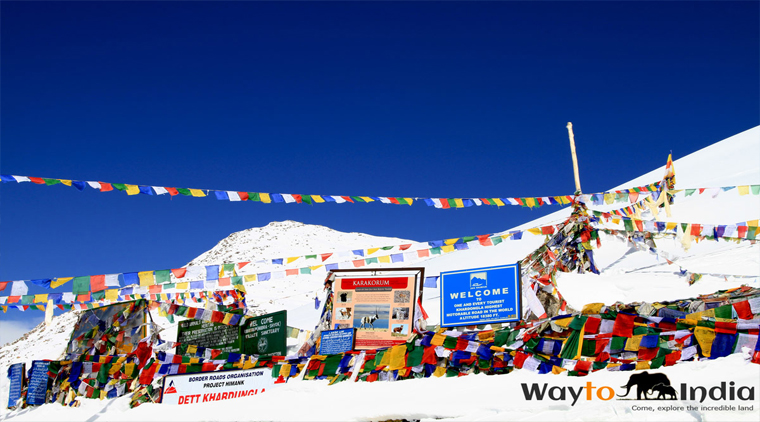
Khardung La is the crossing itself, the photo at the top, and the descent into the Nubra Valley with its dunes, camels and the great Diskit Buddha. Here is what is actually there.
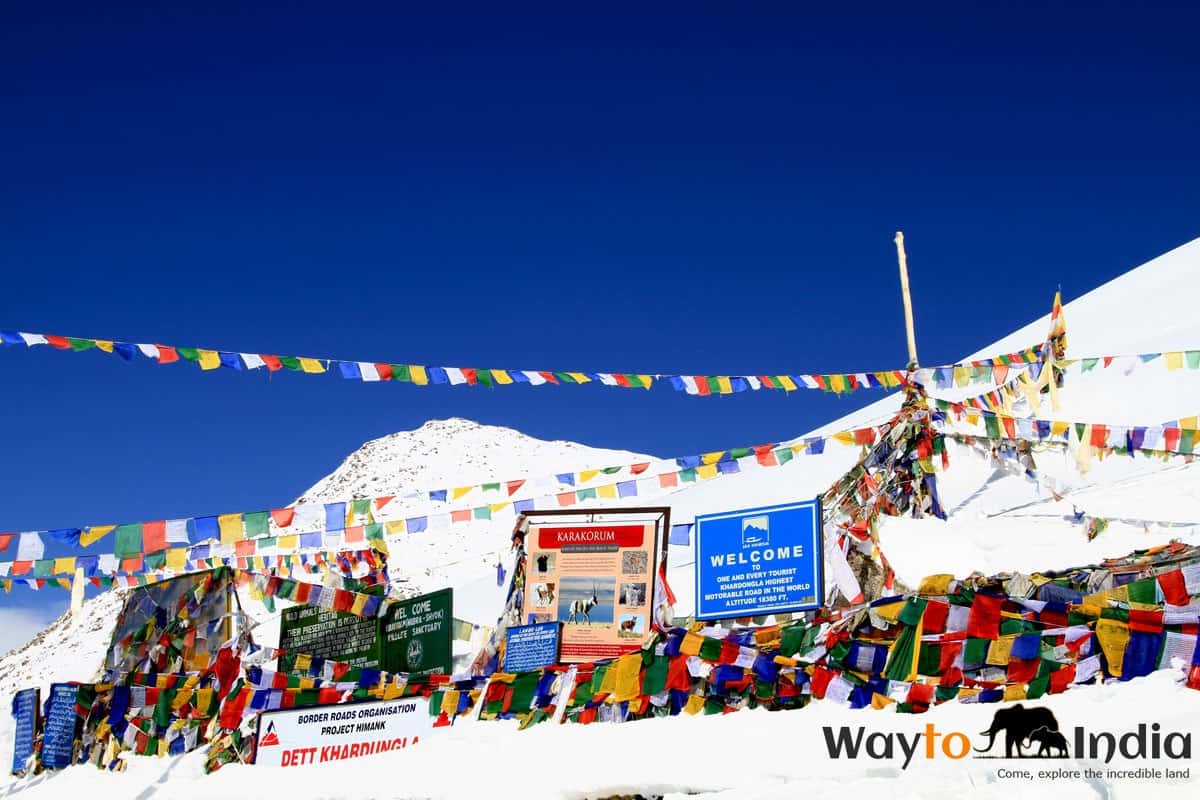
- The top of the passAt the summit there is the famous sign, a small army-run tea point, a tiny shrine and prayer flags, with big mountain views on a clear day. Take your photos, have a quick tea if you like, and keep your time short, around 15 to 25 minutes, because the air is thin and there is genuinely nothing to gain by lingering.
- Down into the Nubra ValleyMost people cross Khardung La on the way to Nubra, descending past North Pullu to the confluence of the Shyok and Nubra rivers. It is a different world below the pass, greener and warmer, and far better to sleep here than at altitude.
- The Hunder dunes and Bactrian camelsAt Hunder, cold-desert sand dunes sit against snow peaks, home to the rare double-humped Bactrian camels left over from the old Silk Road. A short, gentle ride here is the signature Nubra experience, and a strange, lovely contrast to the high pass you have just crossed.
- Diskit monastery and the giant MaitreyaDiskit, the oldest and largest monastery in Nubra, with its towering Maitreya Buddha statue looking out over the valley toward the Pakistan border, makes a calm, moving stop after the high drama of the pass. It is also the main village with shops, a fuel pump and basic medical help.
It is worth being clear-eyed: Khardung La itself is a sign, a viewpoint and a tea stall at a great height, and the photo is the point. The real reward is the valley beyond, the dunes, the camels, the monastery and the river country of Nubra. Treat the pass as the dramatic gateway it is, cross it well, and spend your real time lower down where the air is kinder.
Crossing Khardung La: the altitude, the permit and the drive
Khardung La is one of the highest points a road traveller will ever reach, and it is a real medical and logistical matter, not a formality. Get the acclimatisation, the permit, the fuel and the time-at-top right, and the crossing is a joy. Here is how.
- The honest altitudeThe summit sign claims about 18,380 feet (about 5,602 metres) and one of the world's highest motorable roads. Independent GPS and satellite surveys put it lower, at about 5,359 metres (about 17,582 feet), and higher motorable passes exist: Umling La at about 5,799 metres held the highest-road title until 2025, when the Border Roads Organisation opened a still higher road over Mig La at about 19,400 feet. So the famous Khardung La claim is contested. Either way it is extremely high, which is what matters for your body.
- Acclimatise in Leh first, no shortcutsRest about 48 hours in Leh before the pass. The permit portal enforces this, and your body needs it. Heading straight up on arrival is the commonest and most dangerous mistake people make here, and being young or fit does not protect you. Drink water, move slowly, and let the first two days in Leh be genuinely easy.
- Keep your time at the top shortSpend only around 15 to 25 minutes at the summit, take your photos, then descend. Lingering in the thin air raises the risk of acute mountain sickness (AMS), with headache, nausea, dizziness or breathlessness. If anyone feels seriously unwell, do not wait it out at altitude, descend, because going down is the one reliable cure.
- Fill the tank in LehThere is no reliable fuel between Leh and Nubra. The pump in Nubra is at Diskit and can be closed or run dry, so do not count on refuelling at or beyond Khardung La. Fill up in Leh before you set off, and if you are on a motorcycle carry a little spare fuel within the rules.
- Carry the permit and a few copiesIndians carry the Ladakh Environment Fee receipt, foreigners the Protected Area Permit. Bring several printed copies, as they are checked at the South Pullu and North Pullu checkpoints, and carry your photo ID or passport. A dead phone in the cold is not an excuse the checkpoint will accept, so paper is your friend here.
Khardung La is high enough to be a genuine medical consideration, not a thrill to shrug off. Older travellers, anyone with a heart or lung condition, high blood pressure or a recent illness, and very young children should speak to a doctor before the trip, and may be better staying lower around Leh rather than attempting the pass at all. We are happy to advise honestly on whether the crossing is right for you, and to pace the trip gently. There is no shame in skipping a height.
Permits and fees: the 2021 change explained
The single most-muddled fact about Khardung La is the permit. It changed in 2021, and it works differently for Indians and for foreign nationals. Here is the current, honest version.
- Indians: the Ladakh Environment FeeIndian tourists no longer need an Inner Line Permit for Khardung La and Nubra. Since 2021 it is the Ladakh Environment Fee, paid online through the official LAHDC Leh permit portal at lahdclehpermit.in. The fee is about 400 rupees as a one-time environment charge, plus a wildlife fee of about 20 rupees per day, plus an optional Red Cross contribution of about 50 rupees, so a typical trip comes to about 590 to 700 rupees per person.
- Foreigners: the Protected Area PermitForeign nationals still need a Protected Area Permit (PAP) for Khardung La and Nubra. You cannot apply individually online; you must be in a group of two or more, and the permit is arranged through a registered Leh travel agent and carried with the passport, typically valid about 7 days per restricted zone. Tell us your nationality early so we set it up before you go up.
- The portal enforces acclimatisationA quietly important detail: the permit portal will not let you generate the permit until your Leh acclimatisation period is done. This is the system nudging you to rest first, and it is the right instinct, so do not try to game it. Sort the fee online once you are settled in Leh.
- Carry copies, and skip the toutsWhichever permit applies, print several copies, as they are checked at the South Pullu and North Pullu checkpoints. Indians can do the Environment Fee themselves online in minutes, so be wary of anyone charging a heavy markup to arrange a simple permit, and use the official channels.
Indians: pay the Ladakh Environment Fee online at lahdclehpermit.in, about 590 to 700 rupees per person for a typical trip, and carry printouts. Foreigners: get a Protected Area Permit through a registered Leh agent, in a group of two or more, carried with your passport. Both are checked at the Pullu checkpoints, and neither will issue until your Leh rest days are done.
How to do the Khardung La and Nubra experience
Beyond the photo at the sign, this is how to make the crossing a real experience, sequenced around the altitude and the road rather than against them.
- Cross early, sleep low in NubraStart from Leh in the morning, cross Khardung La, and descend to sleep in the lower, warmer Nubra Valley rather than returning the same day. The overnight at lower altitude is gentler on the body and gives you the dunes and camels at Hunder in the soft evening light, which a there-and-back day trip misses entirely.
- The photo and a quick tea at the topThe summit sign is the classic photo, and there is a small army-run tea point. Have your moment, keep it short at around 15 to 25 minutes, and move on before the thin air catches up with you. Walk slowly at the top; even a brisk few steps can leave you breathless at this height.
- The double-humped camels at HunderBeyond the pass, the cold-desert dunes of Hunder are home to the rare double-humped Bactrian camels, a leftover of the old Silk Road caravans. A short, gentle ride here at sunset is the highlight of the Nubra side, and far calmer than the crowded camel scenes elsewhere in India.
- Diskit monastery and the giant MaitreyaDiskit, the oldest monastery in Nubra, with its towering Maitreya Buddha statue looking out over the valley, makes a calm, moving stop after the high drama of the pass. Visit in the morning for the light and the quiet before the day-trippers arrive.
- For bikers, ride within the light and weatherKhardung La is a dream ride, but even the fittest need the Leh rest days first. Carry warm layers and spares, fill up in Leh, and ride within the daylight and the weather. The cold, the altitude and the broken stretches near the top demand respect, so pace the route with sensible stops rather than racing the pass.
If you do only one thing right, make it the order: two easy days in Leh, then cross Khardung La in the morning and sleep low in Nubra. Many travellers also ask whether to do Nubra or Pangong first. The common steer is Nubra first, because the Khardung La crossing is best tackled fresh and the descent into warmer Nubra is kind after the pass. Either way, never make the pass the day you arrive in Ladakh.
Where to stay around Khardung La and Nubra, and how long
You do not stay at Khardung La. You base in Leh, cross the pass, and sleep low in Nubra. Where you put your nights is itself a safety decision at this altitude.
- Base in Leh for the rest daysLeh, at about 3,500 metres, is where you acclimatise and sort the permit. It has the full range of guesthouses, homestays and hotels, and is comfortable enough that the mandatory two rest days pass easily, with the old town, the palace and the monasteries nearby to fill them gently.
- Sleep in Nubra, not at the passThere is no accommodation at Khardung La and you should not try to sleep at altitude anyway. Cross the pass and stay the night in the Nubra Valley at Diskit, Hunder or Sumur, which are lower and warmer, with everything from simple homestays and camps to comfortable hotels.
- How many nights for the pass and NubraPlan on at least two nights in Leh first, then one or two nights in Nubra. That gives you a safe, unhurried Khardung La crossing, a full day among the dunes and the monastery, and an easy return over the pass, rather than a punishing single-day dash to the sign and back.
- Book Nubra ahead in peak seasonIn July and August the better Nubra stays and the desert camps fill up, and the valley is small, so reserve ahead rather than arriving and hoping. Power can be limited to a few evening hours in parts of Nubra, so do not expect city comforts; that is part of its charm.
The golden rule of high mountains is to climb high and sleep low. Crossing Khardung La by day and sleeping in lower Nubra is exactly that rule in action. Do not be tempted to compress the trip by sleeping higher to save time; the body recovers overnight at lower altitude, and that single choice does more for your safety than any pill or oxygen can.
Khardung La and Nubra costs: a realistic budget
The pass itself costs little; the trip around it is where the money goes. Here are the real numbers, so you can plan and avoid being overcharged at altitude.
- The permit is cheapFor Indians, the Ladakh Environment Fee for a typical trip is only about 590 to 700 rupees per person, covering Khardung La, Nubra and the other restricted zones. For foreigners, the Protected Area Permit is arranged through an agent and the cost is modest compared with the trip overall. The permit is not where your budget goes.
- The taxi over the passA private taxi from Leh for the Nubra trip over Khardung La runs roughly 7,000 to 13,000 rupees for a two-day round trip, at official Leh taxi-union rates, depending on the vehicle and season. Shared jeeps and the local bus are far cheaper if you are travelling light and flexible, and split between four the private taxi is reasonable too.
- Stays, food and the camel rideNubra stays range from simple homestays to comfortable hotels and desert camps, and food in the valley is basic and honest. The Hunder camel ride is a short paid experience; agree the price before you climb on, as with any ride sold to visitors at a tourist spot.
- Oxygen and odds and endsIf you choose to carry oxygen as a backup, cylinders rent in Leh for roughly 500 to 1,000 rupees a day. Carry enough cash for the whole Nubra leg, as ATMs and card machines are unreliable beyond Leh, and small purchases run on cash.
The honest budget headline for Khardung La is that the pass and its permit are cheap; the cost is the transport, the stay and the days you give it. Sharing a jeep keeps it light, a private taxi split between four is fair, and the only place people overpay is the rushed solo taxi or the unagreed camel ride. Settle prices in Leh in advance and carry cash, and there are no nasty surprises at altitude.
Practical logistics: fuel, signal, cash and the cold
The small things that make a Khardung La and Nubra day smooth, from the fill-up rule to the patchy signal, the cash habit and the cold at the top.
- Fuel, the cardinal ruleFill up in Leh. There is no reliable fuel between Leh and Nubra, and the Diskit pump can be closed or dry, so the tank you leave Leh with is the tank that gets you over the pass and back. This is the single logistics rule that ruins trips when ignored.
- Signal, power and SIMsMobile coverage fades beyond Leh, and only postpaid Indian SIMs work well in Ladakh; prepaid tourist SIMs often do not. Power in parts of Nubra can be limited to a few evening hours. Download offline maps, carry a power bank, and tell people you will be off-grid for a day or two.
- Cash, because cards fail up hereDraw cash in Leh for the whole Nubra leg. ATMs are scarce and card or UPI payments unreliable beyond town, and the camel ride, small eateries and homestays run on cash. Carry small notes for tips and the tea point at the pass.
- Dress for the top, even in summerIt can be warm in Leh and freezing at the pass on the same morning. Carry a windproof layer, gloves and a hat even in July, and sunglasses and strong sunblock, as the high-altitude sun is fierce. The cold at the top is a bigger shock to most visitors than the height.
Safety and health: AMS, oxygen and knowing when to descend
Khardung La is gentle and well-policed, so the real risk here is not crime or scams, it is altitude. Treating AMS seriously is the whole of safety on this pass.
- Know the signs of AMSAcute mountain sickness can hit anyone at this height, regardless of age or fitness. Watch for headache, nausea, loss of appetite, dizziness, poor sleep and breathlessness at rest. Mild symptoms mean rest and do not go higher; worsening or severe symptoms, confusion or a cough mean descend at once. Descending is the one reliable cure, and there is no prize for pushing through.
- Acclimatise, hydrate, go slowThe 48 hours of rest in Leh is the foundation. Drink plenty of water, avoid alcohol and heavy exertion on the first days, eat light, and move slowly at the top of the pass. Acclimatising properly does more than any drug or oxygen can.
- Diamox is a doctor's call, not travel adviceMany travellers use the altitude drug acetazolamide (sold as Diamox), often starting a day before going high, but it is a prescription medicine with side effects, so whether to take it is a decision for your doctor before the trip, not something to pick up casually in Leh. It is a backstop, not a substitute for resting first.
- Oxygen and where help isOxygen cylinders rent in Leh for roughly 500 to 1,000 rupees a day as a backup. There is a small army medical aid point near the top of the pass, and Diskit in Nubra is the next place with medical help, but the plan if anyone is unwell is always to descend toward Leh, not to rely on these.
If in doubt, go down. Altitude sickness is the only serious risk at Khardung La, and it answers to one thing reliably: losing height. Do not let a permit, a paid taxi, a tight itinerary or pride keep you high when your body is telling you to descend. A turned-around day is a small price; a serious AMS case at 5,000 metres in a remote valley is not. Build your trip so descending is always an easy choice.
Khardung La for every kind of traveller, and on access
The pass rewards very different visitors, but the altitude shapes what suits whom. Here is what it offers you, and the one tip that matters for each, including a frank steer for seniors.
- Couples and honeymoonersCrossing one of the highest passes in the world together, then descending to a Nubra night under the stars, is wonderfully memorable. Take the rest days in Leh first and the slow pace becomes part of the romance rather than a chore.
- Families with childrenOlder children love the idea of standing at the top of the world and the camels at Hunder, but very young children feel the altitude and cannot always tell you how they feel, so take medical advice, keep the time at the top short, and sleep low in Nubra. Watch them closely for AMS signs.
- Senior travellers, and on accessibilityPossible with care, but be honest with yourself. Speak to a doctor first if you have any heart, lung or blood-pressure condition, do the full Leh acclimatisation, keep the summit stop brief, and seriously consider whether staying lower around Leh and skipping the pass suits you better. There is no walking required at the top, but the altitude itself is the barrier. We will advise honestly and never push a height.
- Bikers and adventurersThe classic Khardung La ride, but even the fittest must acclimatise in Leh first. Carry spares and warm layers, fill up in Leh, and ride within the daylight and the weather. The broken stretches near the top reward a steady hand, not a fast one.
- Backpackers and budget travellersShared taxis, group jeeps and the local bus from Leh make the crossing affordable, and you still pay only the small Environment Fee. Carry cash, keep the time at the top short, and respect the rest days; altitude does not care about your budget or your youth.
- PhotographersThe sign, the prayer flags, the layered mountains and the descent into Nubra are extraordinary, with September air the sharpest. Shoot quickly in the thin cold at the top, then take your time lower down. Carry spare batteries, as the cold drains them fast.
A safe Khardung La and Nubra itinerary
How to shape the days so the altitude works for you, not against you: rest first, cross fresh, sleep low, return easy.
- Days one and two: rest in LehFly or drive into Leh and do almost nothing strenuous for about 48 hours. Wander the old town and a nearby monastery, drink water, eat light, and let your body adjust to 3,500 metres. Sort the Environment Fee online once you are settled. This is the foundation of a safe crossing.
- Day three: cross Khardung La to NubraLeave Leh in the morning with a full tank, cross Khardung La with a short 15-to-25-minute stop at the top, and descend the roughly 120 to 130 km, about 5 to 6 hours, into Nubra. Sleep low at Diskit, Hunder or Sumur, not at altitude.
- Day four: the dunes, the monastery, then back or onwardSpend the morning at the Hunder dunes and the Bactrian camels and the Diskit monastery, then either return over Khardung La to Leh or, if your trip is longer, continue the wider Ladakh circuit. The return crossing is easier now that you are acclimatised.
- If you have only one day, reconsiderA there-and-back day trip from Leh to the pass and back is possible but punishing, gives you no real Nubra, and keeps you high for longer in one go. If your time is that tight, you may be better seeing Khardung La as part of a proper Nubra overnight on a future, less rushed trip.
The thing that breaks a Khardung La plan is treating the pass as the destination and trying to do it on arrival or in a single hard day. Build in the two Leh rest days, cross fresh, and always have a lower place to sleep within reach. An itinerary that lets you turn around and lose height at any point is a safe itinerary; one that locks you high to hit a schedule is not.
The real questions travellers ask about Khardung La
Straight answers to the questions that come up again and again on traveller forums, so you arrive already knowing the score.
- Is it safe straight after flying into Leh?No, and this is the most important answer on the page. Flying into Leh lands you at about 3,500 metres with no overland adjustment, so going up to Khardung La on day one is risky. Rest about 48 hours in Leh first; the permit portal enforces it, and your body needs it more than any keen traveller wants to admit.
- Nubra or Pangong first?The common steer on the forums is Nubra (via Khardung La) first, because the high pass is best crossed fresh and the descent into warmer, lower Nubra is gentle on the body afterwards. But both work if you have acclimatised properly in Leh; the order matters less than the rest days do.
- Do I really need oxygen?Most acclimatised travellers cross Khardung La without bottled oxygen, because the time at the top is short and you descend straight after. Renting a cylinder in Leh for roughly 500 to 1,000 rupees a day is a reasonable backup, especially with seniors in the group, but it is no substitute for resting first and descending if anyone is unwell.
- Can my elderly parents or someone with a heart condition do it?Take a doctor's advice before the trip. The altitude is a real medical consideration for older travellers and anyone with a heart, lung or blood-pressure condition, and for some the honest answer is to enjoy Leh and skip the pass. We would rather tell you that than sell you a risk.
- How long does it take and how far is Nubra?Khardung La is about 39 km from Leh; Leh to the Nubra villages is about 120 to 130 km and roughly 5 to 6 hours over the pass. Plan the crossing as a morning drive with a short stop at the top, sleeping in Nubra rather than rushing back to Leh the same day.
- Is it still an Inner Line Permit?Not for Indians. Since 2021 Indian tourists pay the Ladakh Environment Fee online at lahdclehpermit.in, about 590 to 700 rupees for a typical trip, not an Inner Line Permit. Foreign nationals still need a Protected Area Permit through a registered Leh agent, in a group of two or more.
Planning Khardung La from abroad: permits and altitude
Khardung La is a bucket-list Himalayan high pass, and very doable from overseas with the right planning around the foreign permit and the altitude.
- Sort the Protected Area PermitForeign nationals need a Protected Area Permit for Khardung La and Nubra. You cannot apply individually online; you must be in a group of two or more, and the permit is arranged through a registered Leh travel agent and carried with the passport, typically valid about 7 days per zone. Tell us your nationality early so we set it up before you go up.
- Fly via Delhi, and rest in Leh firstReach Leh on a short morning flight from Delhi, then rest about 48 hours before the pass. The altitude is real and the gradual approach is kindest. Cross Khardung La only after your acclimatisation days, never on the day you arrive in Ladakh.
- Plan for fuel, cash and the checkpointsFill up in Leh, as there is no reliable fuel until Nubra. Draw cash in Leh, since cards and ATMs fail beyond town, and carry several printed copies of your permit for the South Pullu and North Pullu checkpoints, where it is checked along with your passport.
- Take the altitude seriouslySpeak to your doctor before the trip, especially for older travellers or anyone with a heart or lung condition. Keep the time at the top short, around 15 to 25 minutes, descend if anyone feels unwell, and we will advise honestly on whether the crossing suits your group and pace it safely.
Khardung La and Nubra are an extraordinary introduction to the Himalaya, but they are high, remote and weather-dependent in a way no amount of fitness overrides. Give Ladakh time: two settled days in Leh, the pass crossed fresh, a night low in Nubra. Many overseas visitors say the slow, careful version is the one they remember, while the rushed dash to the sign and back is the one that makes people ill. Plan for the careful version.
Money, connectivity and timing for foreign visitors
The practical basics an overseas traveller needs for a remote high-altitude leg: cash, a working SIM, the off-grid reality of Nubra, and how many days to give it on a wider India trip.
- Carry cash, because cards fail beyond LehDraw cash in Leh for the whole Khardung La and Nubra leg. ATMs are scarce and card or UPI payments unreliable beyond town, and the tea point at the pass, the camel ride and homestays run on cash. Keep small notes, and do not assume any card works once you leave Leh.
- Get a postpaid Indian SIM, not a tourist prepaidOnly postpaid Indian SIMs work reliably in Ladakh, and prepaid tourist SIMs often do not, so an eSIM or roaming plan may serve you better than a local prepaid. Coverage fades beyond Leh and parts of Nubra have power for only a few evening hours, so download offline maps and carry a power bank.
- How long to give it on a bigger tripOn a first India trip, do not bolt Ladakh onto a hot-plains itinerary lightly. Give Leh and the Khardung La and Nubra leg at least four to five days end to end: two settled days in Leh, the pass crossed fresh, and a night or two low in Nubra. The altitude sets the pace, not your schedule.
- Time your visit to the open season and your comfortMay to October is the road-open window, with June to September the surest. Come in summer for the warmest Nubra nights, which matter when you want to sleep low after the pass, or in September for the clearest mountain air. Avoid trying to force the crossing outside the season.
Khardung La is unlike anywhere a road traveller has been: remote, very high, and dependent on weather and the army keeping the pass open. The overseas visitors who love it are the ones who slow down for it, rest properly in Leh, carry cash and an offline map, and accept a day or two off-grid in Nubra as part of the adventure rather than a failure of comfort. Plan for that version and Ladakh becomes the highlight of the whole India trip.
Khardung La, the gate to the valley of flowers
Khardung La takes its name from the village of Khardung on the Nubra side of the pass, with la being the Tibetan and Ladakhi word for a mountain pass. For centuries this was a link on the caravan branch of the old Silk Road, the high gate between Leh and the Nubra Valley and the routes north toward Central Asia, crossed by traders, pilgrims and pack animals long before any motor road. The double-humped Bactrian camels that still graze the Hunder dunes are the living memory of those caravans. The Border Roads Organisation, who keep the pass open today, carry the motto Shramena Sarvam Sadhyam, roughly all things are achievable through hard work, which is a fair description of holding a road open across a pass this high. We give the popular highest-motorable-road claim honestly: the sign says about 18,380 feet, surveys say lower, and higher passes have taken the title (Umling La, and the Border Roads Organisation's even higher Mig La road opened in 2025), but none of that diminishes the human achievement of the crossing itself.
Planning a Khardung La trip?
Our Ladakh travel experts plan your full journey for you: route, hotels, darshan timings and transport. You get a free day-by-day plan and an exact quote on WhatsApp, usually within a few hours. No payment is needed to get your plan.
Tour packages that visit Khardung La
Every journey below is private, hand-crafted and fully customizable. Tell us your dates and we tailor the itinerary, the pace and the priests or guides around you.
 7D / 6N
Incredible Ladakh Holiday
- Visit Gurudwara Pathar Sahib
- Visit Pangola Lake
 10D / 9N
Kashmir Ladakh Tour Package
- Shikara Ride
- River Indus and River Zanskar
 10D / 9N
Srinagar Leh Ladakh Tour Package
- Pangong Lake
- Nubra Valley
 6D / 5N
Leh Ladakh Tour Package for Couples
- Visit Leh Palace
- Visit Pangong Lake
 9D / 8N
Leh Ladakh Road Trip
- Tiger Hill
- The Tololing Peak
 8D / 7N
Manali Leh Tour
- Visit of Spituk and Phyang Monastery
- Visit old Pagoda Temple of Hadimba Devi
 8D / 7N
Srinagar To Leh Tour Package
- Visit Dal lake & Nigeen lake
- Visit Shalimar Bagh