Nubra Valley Travel Guide
The valley is reachable only while the road over Khardung La is clear, broadly May or June to September or October . Pick your weeks for the road and the weather, not just the...
When to visit Nubra Valley, and when the road is open
The valley is reachable only while the road over Khardung La is clear, broadly May or June to September or October. Pick your weeks for the road and the weather, not just the calendar.
- June to September: the reliable windowThis is the heart of the season, when Khardung La and the valley roads are most dependably open, the dunes are warm in the day and the camel rides run. It is also the busiest stretch, so book a night ahead in Diskit or Hunder.
- Late May and October: shoulder, with a caveatThe road usually opens in May or early June and stays passable into October, with thinner crowds and crisp light, but nights turn very cold and an early or late snow can shut the pass at short notice. Keep a buffer day and reconfirm road status before you go.
- Winter: largely closedThrough deep winter Khardung La is unreliable or shut and most of Nubra's tourist infrastructure winds down. A few hardy travellers go for the cold and the quiet, but treat it as a serious expedition, not a casual trip, and never assume the road is open.
- Nubra is lower, so it sleeps easierWhatever the month, remember the valley floor at Diskit and Hunder is lower and warmer than Leh. That makes Nubra one of the more comfortable places to spend a night in Ladakh once you are acclimatised, which is worth building into your plan.
Nubra is reachable only over Khardung La, and that pass can close at short notice for snow even in summer. Treat May or June to September or October as the broad season, but always reconfirm the current road status with the Border Roads Organisation or your Leh agent before you set out, and keep a buffer day in your plan. Pages that promise a fixed open date are copying old information; the mountain decides each year.
How to reach Nubra Valley from Leh
Everyone reaches Nubra the same way: up and over Khardung La from Leh. There is no airport and no shortcut, so the gateway is always Leh.
- Over Khardung La from LehThe only road in climbs from Leh over Khardung La, the high pass about 39 to 40 km from town, then descends to the valley. Leh to the villages of Diskit and Hunder is about 120 to 130 km and roughly 5 to 6 hours of driving, with your permit checked at the South Pullu and North Pullu checkpoints either side of the pass.
- By taxi, shared jeep or busMost visitors take a private taxi from Leh, but shared jeeps and a limited local bus also cross. An official Leh Taxi Union two-day Nubra round trip runs roughly about 12,988 rupees for a standard vehicle at published seasonal rates; a private two-day Nubra trip overall sits in roughly the 7,000 to 13,000 rupees band depending on vehicle and season.
- Fly into Leh firstThere is no airport in Nubra. The gateway is Leh, whose Kushok Bakula Rimpochee airport (IXL) has nonstop flights from Delhi on IndiGo, Air India and others, mostly early-morning departures. Because the flight lands you at about 3,500 metres, rest in Leh first before tackling the pass.
- On a longer overland loopMany travellers reach Leh overland from Srinagar or Manali, acclimatising as they climb, then add Nubra from Leh. Our Srinagar and Manali to Leh itineraries build in the gradual gain and the Khardung La crossing to Nubra, and we can arrange a car with an experienced high-altitude driver.
Fly into Delhi, the main international gateway, then take a domestic flight to Leh, rest to acclimatise, and cross Khardung La to Nubra. Foreign nationals need a Protected Area Permit arranged through a Leh agent, covered in the overseas section below.
Fly into Delhi, connect to Leh, and follow the same Leh-first, acclimatise-then-cross sequence. There are no flights into Nubra itself, and the pass is the only way in.
Fly to Leh from Delhi, or come overland from Srinagar or Manali to acclimatise, then drive over Khardung La. Indian travellers no longer need an Inner Line Permit, only the Ladakh Environment Fee paid online.
Permits for Nubra Valley, for Indians and foreigners
The permit rule changed in 2021 and most pages still get it wrong. Indians pay an environment fee online; foreigners need a Protected Area Permit through an agent.
- Indian travellers: no ILP, just the environment feeSince 2021 Indian tourists no longer need an Inner Line Permit for Nubra. Instead you pay the Ladakh Environment and Development Fee online at the LAHDC Leh permit portal: about 400 rupees as a one-time environment fee, plus a wildlife fee of about 20 rupees per day, and an optional Red Cross contribution of about 50 rupees, so roughly 590 rupees per person covers a typical 7 day trip. Carry a printout and your ID.
- Foreign nationals: the Protected Area PermitForeigners still need a Protected Area Permit (PAP) for Nubra. You cannot apply individually; you must travel in a group of two or more, and the permit is arranged through a registered Leh travel agent, carried with your passport, and usually valid about 7 days. Nationals of Pakistan, China, Afghanistan, Bangladesh and Myanmar face extra restrictions, so confirm with an agent well ahead.
- Where the permit is checkedYour permit is checked at the South Pullu checkpoint on the Leh side of Khardung La and North Pullu on the Nubra side, and again at points deeper in the valley toward Turtuk. Keep several photocopies, as checkpoints often keep one. The portal will not even issue the permit until your acclimatisation rest in Leh is logged.
- Acclimatise before you can crossThe Ladakh administration requires about 24 to 48 hours of rest in Leh, at about 3,500 metres, before going higher over Khardung La. This is both a health rule and a permit rule, so plan a clear day or two in Leh first rather than racing to Nubra the day you fly in.
The single most copied error on Nubra pages is telling Indian travellers they need an Inner Line Permit. That changed in 2021; Indians now pay the Ladakh Environment Fee online instead, while foreigners need the Protected Area Permit. Apply on the official LAHDC Leh portal, reconfirm the current fee before you travel because it is reviewed periodically, and ignore any blog still quoting the old ILP for domestic visitors.
Diskit Monastery, the Maitreya Buddha and the dunes
Nubra is the giant hilltop Buddha at Diskit, the cold-desert dunes at Hunder, and the Balti border village of Turtuk. Each rewards the right timing.
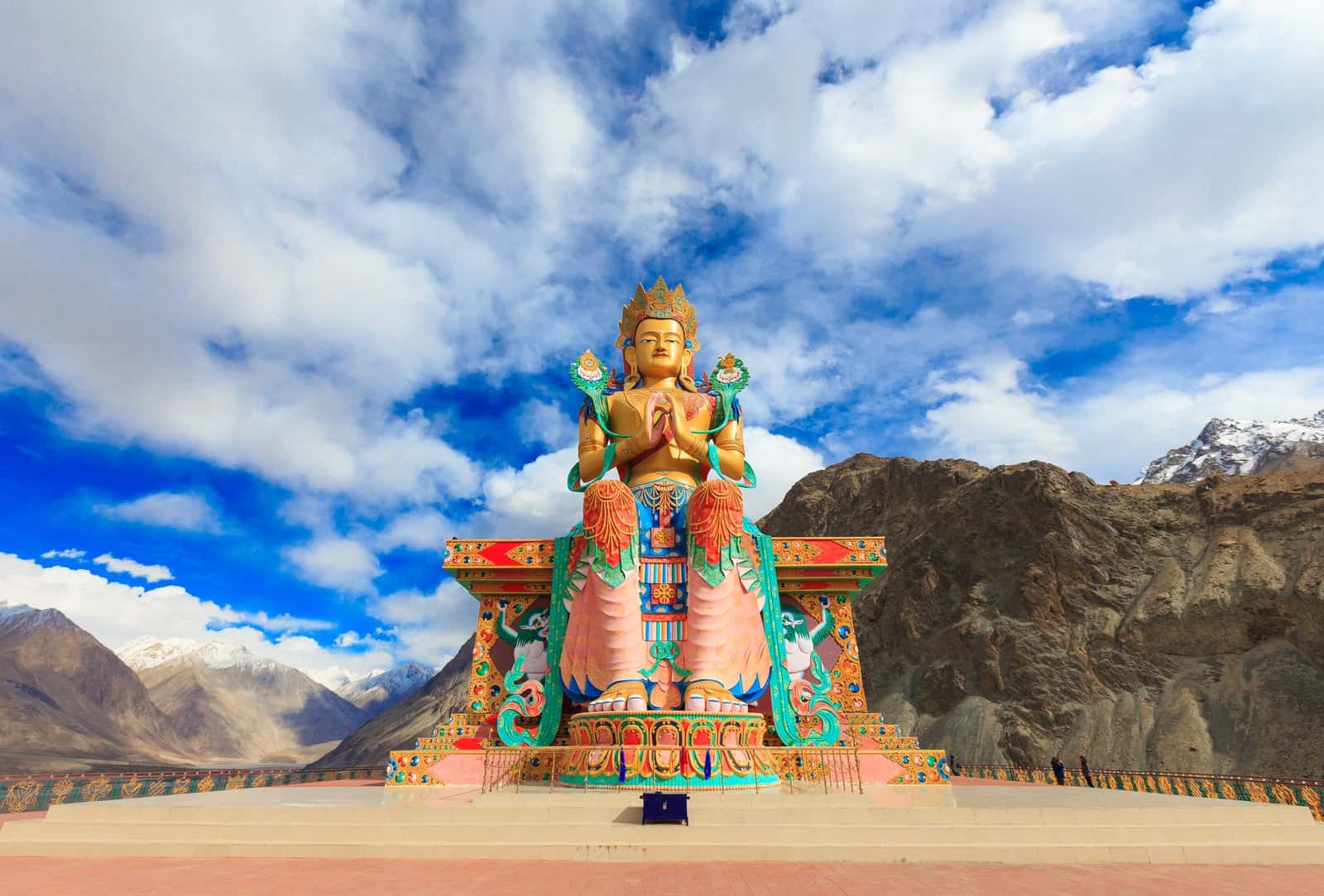
- Diskit Monastery and the Maitreya BuddhaDiskit Monastery is the oldest and largest gompa in Nubra, founded in the 14th century in the Gelugpa school. Below it stands the giant Maitreya (Future) Buddha statue, about 32 metres or 106 feet tall, consecrated by the Dalai Lama in 2010, facing down the Shyok river toward the border. Come in the morning for the light on the statue and the valley view from the monastery.
- Hunder sand dunesThe cold-desert dunes between Hunder and Diskit are Nubra's signature surprise, a pocket of sand at over 3,000 metres ringed by snow peaks. They are at their best in the soft light of late afternoon and sunset, when the midday crowds and the heat off the sand have eased.
- Turtuk, the Balti border villageTurtuk is the Balti-speaking village near the Line of Control that opened to tourists only in 2010. It is about 85 to 90 km beyond Diskit, around 2.5 to 3 hours further on, and rewards an overnight: apricot orchards, stone-and-timber houses, and a culture distinct from the rest of Ladakh.
- Panamik and the Yarab Tso lakeOn the Nubra-river arm of the valley, Panamik is known for its hot springs and the small, sacred Yarab Tso lake reached by a short walk. It is a quieter alternative to the Turtuk drive if you want the other side of the valley without the long border road.
Diskit is a working monastery, so dress modestly, remove shoes where asked, and keep quiet during prayers. Toward Turtuk you are in a sensitive border area, so photograph people only with permission, never photograph military positions or checkpoints, and keep your permit and ID handy. A little courtesy goes a long way in these small, close communities.
Signature experiences in Nubra Valley
Beyond the sights, these are the things people remember, and how to arrange them without overpaying or missing the best light.
- Ride a double-hump Bactrian camel at HunderThe two-humped Bactrian camels of Hunder are descendants of the old Silk Road caravans and are Nubra's classic experience. Short rides are typically about 200 to 500 rupees per person, roughly 200 rupees for about 15 minutes and about 350 rupees for about 30 minutes. Agree the length and price before you start, and ride in the late afternoon light rather than the midday rush.
- Sunset on the dunesOnce the day-trippers thin out, the dunes go quiet and gold. Find a spot away from the camel rank, sit, and watch the light move across the sand and the peaks. It is the free experience most travellers say they remember, and it costs nothing but patience.
- The drive to TurtukIf you have a second night, the drive on to Turtuk is itself the experience: the Shyok river, the changing geology, and the arrival into a green Balti village near the border. Walk its lanes, accept the apricots in season, and stay over rather than turning straight back.
- Camp or homestay in the valleySleeping in Nubra, in a riverside camp at Hunder or a family homestay in Diskit or Turtuk, is part of the reward, and because the valley is lower than Leh you usually sleep better here. Camps run from simple to comfortable, so match it to your budget and the cold.
- Hot springs and the quiet arm at PanamikIf the Turtuk drive is too far, the Panamik side gives you hot springs and the short walk to Yarab Tso lake, a calmer half-day that still shows you the other half of the valley.
- Stargazing once the village sleepsWith almost no light pollution and thin, dry air, Nubra's night sky is extraordinary. Step out after dinner, let your eyes adjust, and the Milky Way is often plainly visible. Bring a warm layer, because the temperature drops fast after dark.
If you do only one thing slowly, make it the dunes at sunset. The camel ride is fun, but the memory people carry home is sitting on the warm sand as the light fades on the snow peaks and the valley goes silent. Give yourself an unhurried late afternoon at Hunder rather than ticking it off at midday, and Nubra opens up in a way a quick stop never allows.
Where to stay in Nubra, and how many nights
Stay in Hunder for the dunes, Diskit for the monastery and services, or Turtuk for the border village. One night is the minimum, two if you add Turtuk.
- Hunder: by the dunesHunder has the riverside camps and guesthouses closest to the sand dunes and the camels, the natural choice for sunset on the dunes and the most popular base. It is small and quiet, so book ahead in peak season.
- Diskit: the valley hubDiskit is the administrative centre with the monastery, the giant Buddha, the valley's most reliable services, an ATM and the fuel pump. A good base if you want amenities close and a short hop to the dunes.
- Turtuk: the border village overnightIf you go all the way to Turtuk, staying overnight in a Balti homestay is far better than the long round-trip in a day. It is basic and remote, with little signal, but it is the most distinctive sleep in the valley.
- How many nightsOne night in Diskit or Hunder is the minimum to do the monastery and the dunes properly and to acclimatise. Add a second night if you want Turtuk or the Panamik side, because each is several hours away. A there-and-back day trip from Leh is possible but punishing and wastes the valley's calm.
Nubra's villages are small and rooms are limited, so in July and August the better camps and guesthouses fill well ahead. Comfort is simpler than in Leh, with patchy power and hot water, and Turtuk especially is basic. Book your night before you cross the pass rather than arriving and hoping, and carry a warm layer because nights are cold even in summer.
Nubra Valley costs and a realistic budget
The big costs are the taxi over the pass, the permit and your stay. Here is what the main things cost so you can plan and avoid being overcharged.
- The transport over the passThe largest single cost is usually the taxi. An official Leh Taxi Union two-day Nubra round trip runs roughly about 12,988 rupees for a standard vehicle at published seasonal rates; a private two-day Nubra trip overall sits in roughly the 7,000 to 13,000 rupees band depending on vehicle and season. A shared jeep or the local bus is far cheaper if you have time.
- The permitFor Indians the Ladakh Environment Fee is about 400 rupees one-time plus about 20 rupees a day, so roughly 590 rupees per person for a 7 day trip. Foreigners pay the Protected Area Permit charges through their Leh agent, which vary, so ask for the all-in figure before you book.
- The fixed-fun thingsA double-hump camel ride at Hunder is typically about 200 to 500 rupees per person depending on length. Monastery entry is a small donation. The dunes themselves and the stargazing are free, which makes them the best value in the valley.
- Stay, food and cashCamps and guesthouses range from simple budget rooms to comfortable tented camps, generally dearer than Leh for the same comfort because everything is trucked in. Carry enough cash from Leh, as Diskit's ATM is unreliable and most small places do not take cards.
The two figures that shape a Nubra budget are the official Leh Taxi Union two-day rate, about 12,988 rupees for a standard vehicle, and the camel ride, about 200 to 500 rupees a person. Settle the taxi at the union rate before you leave Leh, agree the camel ride length and price before you mount, and carry cash because the valley runs on it. Get those right and Nubra has almost no hidden costs.
Practical logistics: fuel, cash, SIM and getting around
The small things that make a Nubra trip smooth, from filling up in Leh to the postpaid-only SIM rule and the cash-only reality of the valley.
- Fill the fuel tank in LehThere is no reliable fuel at or beyond Khardung La. The only pump in Nubra is at Diskit and it can be closed or dry, so fill up in Leh before you cross and carry a small reserve if you are self-driving or biking. This is the logistics mistake that strands people on the pass.
- Carry cash from LehThere are a few ATMs in Diskit but they are unreliable, and most camps, homestays, camel handlers and small eateries are cash only. Draw what you need in Leh before you go, and keep small notes for rides and tips.
- Connectivity is thin, and postpaid onlyOnly postpaid SIMs work anywhere in Ladakh, and in Nubra it is effectively BSNL with a little Jio or Airtel postpaid in the main villages. Much of the valley has no signal, and Turtuk has little or none, so download offline maps and tell people at home you will be off-grid.
- Getting around the valleyMost people use the same taxi that brought them over the pass to move between Diskit, Hunder and Turtuk; there is little public transport within Nubra. If you have hired a car and driver, agree the in-valley stops as part of the deal so there is no haggling later.
Altitude sickness, the pass, and staying well
The real risk in Nubra is altitude, not crime. The Khardung La crossing is the test, and honest preparation keeps the trip happy.
- Acute mountain sickness is the main riskAcute mountain sickness (AMS) is the genuine danger on this leg, brought on by the thin air, with headache, nausea, breathlessness and poor sleep. Acclimatise in Leh for about 24 to 48 hours before crossing Khardung La, climb gradually, drink plenty of water, and do not push on if you feel unwell. The reassuring part is that Nubra itself is lower than Leh, so descending into the valley usually eases symptoms.
- The descend-not-medicate ruleIf symptoms get worse, the safest response is to go down, not to medicate and continue. The nearest medical help in the valley is at Diskit, and there is a small army medical aid point near the top of Khardung La, but treat these as backup; the real cure for altitude sickness is losing height. Some travellers use acetazolamide (sold as Diamox) under a doctor's advice, but that is a medical decision, not travel advice.
- Time at the top of the passAt Khardung La the air is very thin, so the standard advice is to spend only about 15 to 25 minutes at the summit for photos and then move on. Lingering for a long picnic at the top raises the AMS risk for no reward, and the warmer valley below is where you want to be.
- Cold, sun and the road itselfCarry warm layers, gloves and a windproof even in summer, and strong sun protection because the high-altitude sun is fierce. The mountain road is long and exposed, so use an experienced driver, do not rush the schedule, and keep a buffer day in case the pass closes for weather.
Altitude affects everyone differently and children cannot always describe how they feel, so watch them closely for tiredness, headache or loss of appetite and never explain symptoms away. The same goes for older travellers and anyone with heart or lung conditions, who should take medical advice before the trip. The good news is that Nubra is lower than Leh, so a night in the valley is often more comfortable than a night in town, but the crossing still demands a slow, well-acclimatised, descend-if-in-doubt approach.
Nubra for every kind of traveller, and on access
Nubra suits very different visitors in different ways. Here is what it offers you, and the one tip that matters for each, including how a senior crosses comfortably.
- CouplesQuiet, remote and beautiful: sunset on the dunes, a riverside camp and a sky full of stars. An overnight rather than a day trip lets you have the dunes after the crowds and the night sky to yourselves.
- Families with childrenThe camel ride and the dunes are a hit with children, and the valley is lower and warmer than Leh, which helps. But altitude affects children unpredictably, so acclimatise well in Leh, watch them on the pass, and keep the schedule gentle.
- Senior travellers and on accessibilityVery doable with planning. Spend a clear two days acclimatising in Leh first, cross the pass slowly, limit time at the Khardung La summit, and sleep low in Nubra, which is more comfortable than Leh. Anyone with heart or lung conditions should take medical advice before the trip, and the monastery has steps, so take them slowly.
- Bikers and self-driversThe Khardung La to Nubra ride is a bucket-list leg, but fuel discipline is everything: fill up in Leh, carry a reserve, and do not rely on the Diskit pump. Ride within your limits at altitude and keep the day short enough to handle weather and AMS.
- Solo female travellersLadakh is generally one of the safer regions in India to travel alone, and Nubra is calm and friendly. The real cautions here are altitude, the remoteness and the thin connectivity rather than crime, so share your plan, carry cash, and join a shared jeep if you would rather not cross alone.
- PhotographersThe Maitreya Buddha in morning light, the dunes and camels at sunset, and the Balti faces and orchards of Turtuk. Ask before photographing people, and never point a lens at military positions or checkpoints in the border zone.
A suggested Nubra Valley itinerary
How to shape one or two nights so you cross the pass safely, do the monastery and dunes at the right hours, and add Turtuk only if you have the time.
- Day one: cross and settleLeave Leh after breakfast, cross Khardung La with only a short stop at the top, and descend into the valley by early afternoon. Check into Hunder or Diskit, rest, then take in the dunes and camels in the late-afternoon light. Sleep low and well in the valley.
- Day two: monastery, then chooseStart at Diskit Monastery and the Maitreya Buddha in the morning light. From here, either turn back toward Leh over the pass in the afternoon for a one-night trip, or, if you have a second night, drive on toward Turtuk or the Panamik side.
- The Turtuk extensionWith two nights, give the second day to Turtuk: the long, scenic drive in, an afternoon in the Balti village, an overnight homestay, and the return on day three. It is several hours each way, so do not try to fold it into a single Nubra day.
- Where Nubra sits in a Ladakh loopMost circuits do Leh, then Nubra, then Pangong, or the reverse. Doing Nubra first works well because the valley floor is lower, giving you a gentler second night before you climb again toward Pangong. Our Ladakh itineraries sequence the passes and rest days for safe acclimatisation.
The single thing that breaks a Nubra plan is trying to cross Khardung La, see the valley and return to Leh in one day. It is about 120 to 130 km and 5 to 6 hours each way over a high pass, so a day trip means two hard crossings, no time at the dunes in good light, and more altitude stress. Give the valley at least one night; it is lower than Leh and a far better place to sleep.
The real questions travellers ask about Nubra Valley
Straight answers to the questions that come up again and again on traveller forums, so you arrive already knowing the score.
- Nubra first or Pangong first?Either works, but doing Nubra first has a quiet advantage: the valley floor at Diskit and Hunder is lower than Leh, so it is a gentler second night for acclimatisation before you climb again toward Pangong. If you must choose only one, Nubra has more variety, the monastery, the dunes and the camels.
- Is one night enough?One night in Diskit or Hunder covers the monastery and the dunes well and lets you acclimatise. Add a second night only if you want Turtuk or the Panamik side, since each is several hours away. A there-and-back day from Leh is possible but hard and misses the calm.
- Is Turtuk worth the extra drive?If you have the time, yes. Turtuk is unlike anywhere else in Ladakh, a Balti border village opened only in 2010, with its own language, food and apricot orchards. But it is 2.5 to 3 hours beyond Diskit, so plan an overnight rather than rushing it in a day.
- Do I really need a permit, and which one?Yes. Indians pay the Ladakh Environment Fee online, about 590 rupees for a 7 day trip, with no Inner Line Permit since 2021. Foreigners need a Protected Area Permit arranged through a Leh agent, in a group of two or more. Carry copies, as checkpoints keep one.
- Will my phone work, and are there ATMs?Barely. Only postpaid SIMs work in Ladakh, and in Nubra it is mostly BSNL with patchy Jio or Airtel postpaid in the main villages and little or no signal toward Turtuk. ATMs in Diskit are unreliable, so carry cash from Leh and download offline maps.
- How much does the camel ride cost?A double-hump Bactrian camel ride at Hunder is typically about 200 to 500 rupees per person, roughly 200 rupees for about 15 minutes and about 350 rupees for about 30 minutes. Agree the length and price before you start, and ride in the softer late-afternoon light.
Planning Nubra from abroad
Nubra is the most rewarding leg of a Ladakh trip for an overseas visitor, but the Protected Area Permit and the altitude need preparation before you arrive.
- Arrange the Protected Area Permit through a Leh agentAs a foreign national you cannot get the permit yourself online. You need a Protected Area Permit arranged through a registered Leh travel agent, you must travel in a group of two or more, and you carry it with your passport. Nationals of a few neighbouring countries face extra restrictions, so start this with your agent well before you fly.
- Respect the altitude on arrivalYou will land in Leh at about 3,500 metres. Rest there for a day or two before crossing Khardung La to Nubra, drink plenty of water, and do not race the schedule. The reward is that Nubra itself is lower than Leh, so the valley is often the most comfortable night of the trip once you are acclimatised.
- Build it into a Ladakh loopFly Delhi to Leh, acclimatise, then loop Leh, Nubra and Pangong. Nubra is the leg most overseas visitors single out afterwards, for the monastery, the dunes, the camels and Turtuk. Give it at least one night, two if you want the border village.
- Expect remoteness, and plan for itThis is a high, remote border valley, not a resort region. Connectivity is thin, comfort is simple, and the nearest serious medical care is back in Leh. None of that is a problem if you expect it; it is precisely what makes Nubra feel like the edge of the map.
Money, connectivity and timing for foreign visitors
The practical basics an overseas traveller needs for a remote high valley: cash, the postpaid-SIM rule, and how many days to give it on a wider India trip.
- Carry cash from LehCards barely work in the valley and the ATMs in Diskit are unreliable, so draw enough cash in Leh for your whole Nubra leg, including the taxi, the permit charges through your agent, the camel ride and tips. Keep small notes for rides and homestays.
- Sort a postpaid SIM, and lower your expectationsForeign tourist SIMs are usually postpaid and best bought on arrival in Delhi; only postpaid works in Ladakh at all. Even then, much of Nubra has no signal and Turtuk has little or none. Download offline maps and let people at home know you will be off-grid for a day or two.
- How long to give it on a bigger tripOn a Ladakh trip, give Nubra one to two nights within a 6 to 8 day Leh circuit: enough for the monastery, the dunes and a safe, acclimatised crossing, with a second night if you add Turtuk. It is the leg most worth not rushing.
- Time it to the road, not just the weatherThe comfortable window is about June to September, and the road over Khardung La is the limiting factor at the edges of the season. Plan around the road opening and a buffer day, and confirm the current status before you travel rather than trusting a fixed date online.
Nubra is an unusually rewarding introduction to high Ladakh: a monastery, a giant Buddha, cold-desert dunes with camels, and a border village all in one valley that is gentler to sleep in than Leh. Slot it after a proper acclimatisation rest in Leh, give it a night or two, and let it be the leg you slow down for. Many overseas visitors say the descent into Nubra, lower and greener after the bare pass, is the moment Ladakh finally makes sense.
Why Nubra was the Silk Road's gentle reward
Nubra means something close to the green valley, and to the caravans of the old Silk Road it was exactly that: after the bare, breathless heights of Khardung La and the Saser passes, traders descending toward the Shyok and Nubra rivers found apricot orchards, barley fields and pasture, and a place where their two-humped Bactrian camels could rest. Those same camels still graze the cold-desert dunes at Hunder, the living descendants of the caravan animals that once carried pashmina, salt and silk between Ladakh and Central Asia. Today the giant Maitreya Buddha at Diskit, the Future Buddha, looks down the Shyok toward the border, a statue raised in part as a prayer for peace on a frontier that has seen too much war. It is a fitting symbol for a valley that has always been a meeting place: of rivers, of mountain ranges, of Buddhist Ladakh and Balti Turtuk, and of the road and the rest at the end of it. This retelling follows the regional history of the Nubra caravan route and Diskit Monastery rather than any single scriptural source.
Planning a Nubra Valley trip?
Our Ladakh travel experts plan your full journey for you: route, hotels, darshan timings and transport. You get a free day-by-day plan and an exact quote on WhatsApp, usually within a few hours. No payment is needed to get your plan.
Tour packages that visit Nubra Valley
Every journey below is private, hand-crafted and fully customizable. Tell us your dates and we tailor the itinerary, the pace and the priests or guides around you.
 8D / 7N
Manali to Leh Tour
- Visit Sarchu
- Visit Nubra Valley
 10D / 9N
Srinagar Leh Ladakh Tour Package
- Pangong Lake
- Nubra Valley
 9D / 8N
Leh Ladakh Road Trip
- Tiger Hill
- The Tololing Peak