Bhimbetka Travel Guide
The comfortable window is October to March . Beyond the season, the time of day matters more here than at most sites, because the trail is open rock with no shade.
When to visit Bhimbetka, and the time of day that matters
The comfortable window is October to March. Beyond the season, the time of day matters more here than at most sites, because the trail is open rock with no shade.
- October to March: cool and dryThe most comfortable months, pleasant by day and cool in the early morning, with clear light on the rock. This is when the Bhopal heritage circuit is at its best, so it is also the busiest, though Bhimbetka rarely feels crowded.
- April to June: very hot, plan around the heatHigh summer on the exposed sandstone is fierce, often 40 degrees Celsius or more, and there is almost no shade on the trail. If you must come then, go at opening time, carry plenty of water, and be off the rock before midday.
- July to September: green, vivid, but slipperyThe monsoon turns the forest lush and some travellers feel the paintings look more vivid against the damp rock, but the boulder trail gets genuinely slippery. Step carefully, wear grippy shoes, and check the weather, as heavy rain can make parts of the loop awkward.
- Go early in the dayWhatever the season, the early morning is best: the light is kinder on the faint paintings, the heat is bearable, and you beat the day-tripper buses. A first visit in the soft morning light is a completely different experience from the harsh midday glare.
Many of the paintings are faint, weathered ochre and white on grey-brown sandstone, and at the famous panels the low, raking light of early morning or late afternoon lifts them out of the rock in a way the flat overhead sun of midday flattens. One reason regular visitors say the same site rewards a dawn arrival is simply this: you can see more. Pair the morning light with a guide who knows where to look and Bhimbetka opens up.
How to reach Bhimbetka
Bhimbetka is about 45 km southeast of Bhopal off NH-46, near Obaidullaganj. Almost everyone comes on a half-day or day trip from Bhopal, and a hired car is far easier than the bus.
- By car from Bhopal, the easy wayA taxi or self-drive from Bhopal takes about 1 to 1.5 hours each way along NH-46, the old Bhopal to Hoshangabad road. This is by far the most practical option, because it drops you at the gate and waits while you walk the trail and visit Bhojpur on the way back. We can arrange a car with an experienced driver.
- By bus, with a catchHoshangabad-bound buses from Bhopal's Nadra or ISBT stand pass the site, but they set you down at the Highway Treat stop on the main road, from where it is about a 3 km uphill walk to the entrance with no local transport. Doable for hardy budget travellers, but slow and tiring, especially in the heat.
- By trainThe nearest railhead is the small Obaidullaganj station, about 7 km from the site, but services are limited; most travellers use Bhopal Junction, a major railhead well connected across India, and pick up a taxi there.
- Nearest airportRaja Bhoj Airport at Bhopal, about 45 to 50 km from Bhimbetka, is the nearest airport, with flights to Delhi, Mumbai and other cities. There are no flights anywhere near the site itself, so you fly into Bhopal and drive out.
Fly into Delhi or Mumbai, then connect to Bhopal by a short domestic flight or an overnight train, and drive about 1 to 1.5 hours to Bhimbetka. It pairs naturally with Sanchi and Bhojpur on a central India heritage trip.
Fly into Delhi or Mumbai, connect to Bhopal, and base yourself in the city. Bhimbetka, Bhojpur and Sanchi are all easy half-day or day excursions from Bhopal.
Take a train or flight to Bhopal, then hire a car for the day. From Indore it is roughly a half-day drive, so Bhimbetka also works as a weekend from across Madhya Pradesh.
The rock shelters, the painted panels, and what the trail covers
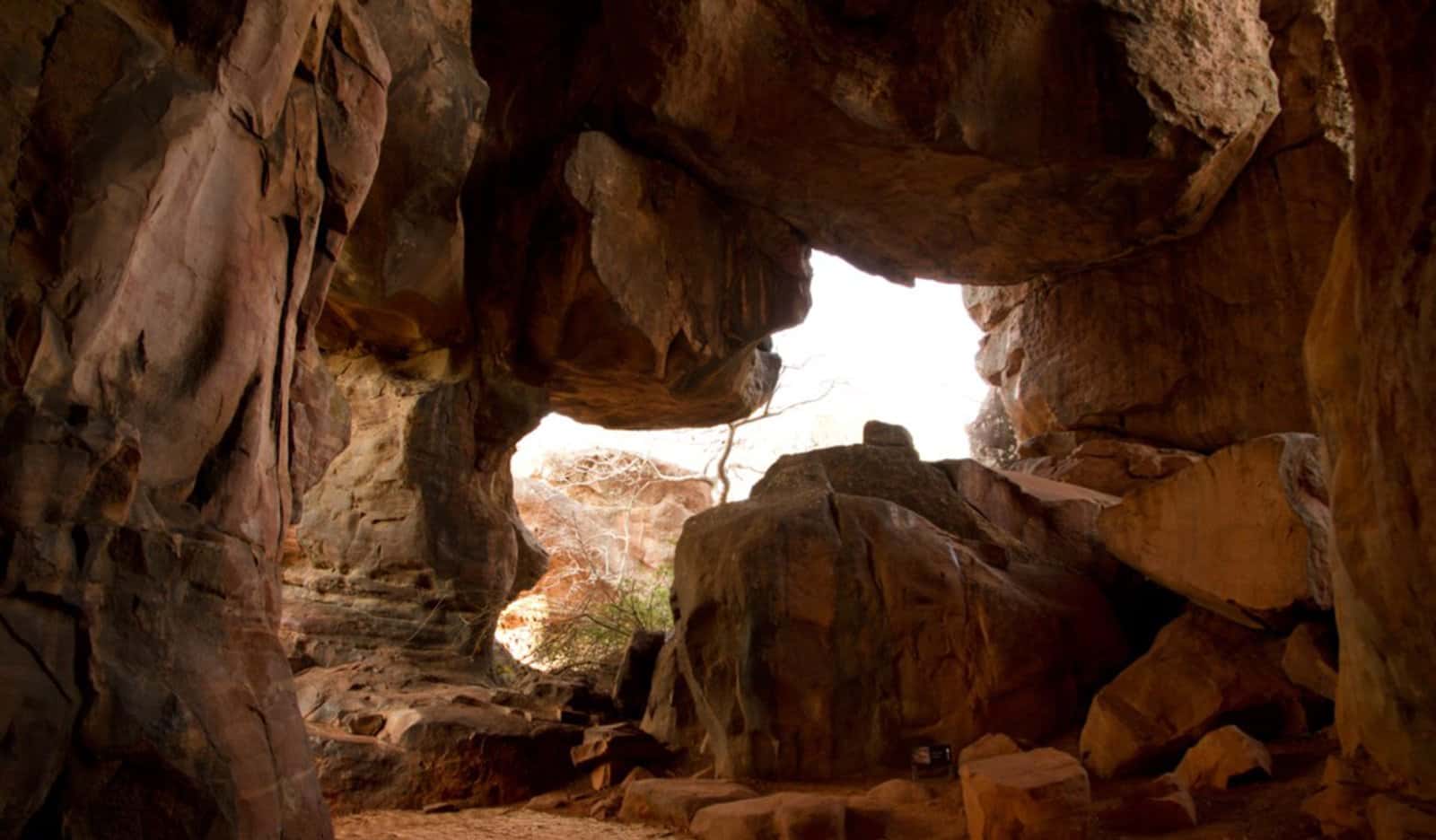
Bhimbetka is a marked loop through massive sandstone shelters carrying prehistoric paintings. Only about 15 of the hundreds of shelters are open, so it helps to know the signature ones.
- The Auditorium CaveThe largest shelter, a soaring natural cathedral of rock at the heart of the site, with a commanding feel and ancient cup-like depressions on the rock that are thought to be extremely old. It anchors the trail and is one of the first big shelters most guides show you.
- Zoo RockThe most densely painted shelter, named for its crowd of animals: deer, bison, elephants and more, layered across periods from the Mesolithic to much later. It is the single best place to grasp how many hands painted here over thousands of years.
- The bison and boar panelsThe famous scene of a great red bison looming over a small human figure is among the most reproduced images from Indian prehistory, and a separate panel shows a giant horned boar dwarfing the people around it. These are exactly the paintings a guide helps you find and read.
- The marked loop itselfThe trail threads about 15 of the most important shelters over roughly 1.5 to 3 km of easy but uneven walking among the boulders. You are not meant to roam all 750-plus shelters; the open ones are chosen to show the range of the art without damaging the rest.
Bhimbetka is a protected ASI monument and a World Heritage Site. The single most important rule is to keep your hands off the art: do not touch, wet, chalk or trace the paintings, do not scratch or write on the rock, and stay on the marked path. Skin oils and graffiti permanently damage paint that has survived for thousands of years, and some panels already show the scars of careless visitors. Photograph freely, but with respect.
How old are the Bhimbetka paintings, really?
You will read that Bhimbetka holds the oldest art in the world. The honest, sourced picture is more careful, and frankly more interesting: among the oldest known in India, on a site humans used for a very long time.
- What UNESCO actually saysThe UNESCO listing describes the paintings as appearing to date from the Mesolithic Period right through to the historical period, a continuous tradition rather than a single ancient moment. The earliest paintings are commonly dated to around 10,000 BCE, corresponding to the Indian Mesolithic.
- What the habitation evidence showsThe Archaeological Survey of India records continuous human use from the Stone Age through the late Acheulian to the late Mesolithic, and some shelters were occupied more than 100,000 years ago. So people lived here far longer ago than the paintings, even if the surviving art is younger.
- The honest headlineBhimbetka holds some of the oldest known rock art in India, and among the oldest in the world, which is remarkable enough. Treat any flat claim that it is provably the single oldest art on earth with caution, because the dating of prehistoric pigment is genuinely hard and still debated.
- Why that still makes it extraordinaryWhat sets Bhimbetka apart is not winning a single record but the sheer span: layer upon layer of painting across many thousands of years, from hunting scenes to later riders and battles, on a site humans returned to again and again. You are looking at one of the longest continuous records of human imagination anywhere.
Different reliable sources give different shelter and painting counts and slightly different dates, which is normal for a site this large and this old. UNESCO and the ASI cite over 750 shelters with roughly 400 painted; Madhya Pradesh Tourism quotes its own figures. We have used the UNESCO and ASI numbers and flagged the dating honestly rather than picking the most dramatic claim. When a page tells you a precise single oldest date with total confidence, be a little sceptical.
Making the most of the visit: the guide, the light, and Bhojpur
Bhimbetka rewards a little planning. A guide, the morning light, and a Bhojpur stop on the way back turn a quick tick-the-box stop into a genuinely memorable half day.
- Take a guide for the paintingsThis is the single best decision you can make here. Many paintings are faint and easy to walk past, and a local guide, charging around 150 to a few hundred rupees by negotiation, points out the bison, the riders, the layered animals and the stories in them. Without one, first-timers often miss half of what they came for.
- Walk the loop slowlyGive the marked trail its 1.5 to 3 hours rather than rushing it. The shelters reveal more the longer you look, and the silence of the forest and the scale of the rock are part of the experience. Wear comfortable shoes for the uneven ground.
- Add Bhojpur on the way backThe unfinished Bhojeshwar Shiva temple at Bhojpur, about 25 to 28 km away, makes a natural second stop, with one of the largest single Shiva lingams in India and 11th century architecture frozen mid-construction. Most day trips from Bhopal combine the two comfortably.
- Photograph with respectPhotography is generally allowed on the trail, so bring a camera and use the morning light. Just keep your distance from the paintings, never use anything to wet or highlight them for a shot, and avoid flash close to the pigment.
If you do only one thing right at Bhimbetka, hire a guide at the gate. The site does not explain itself: the paintings are subtle, the chronology is layered, and the difference between a guided and an unguided visit is the difference between seeing scattered marks on rock and reading thousands of years of human storytelling. It is a small spend for a site this important, and it transforms the half day.
Where to stay for Bhimbetka, and how long to give it
There are no hotels at the site, so you stay in Bhopal and visit on a half-day or day trip. One full day covers Bhimbetka with Bhojpur; two to three days adds Sanchi and the city.
- Stay in BhopalBhopal, about 45 km away, is the practical base, with everything from budget rooms to mid-range hotels and MP Tourism properties, plus the city's lakes, museums and food. There is a single MP Tourism Highway Treat stop near the site for a meal, but no real accommodation at Bhimbetka itself.
- Half a day, the quick versionBhimbetka alone is a comfortable half-day trip from Bhopal: drive out in the morning, walk the loop with a guide, and be back by lunch. This suits travellers short on time or adding it to a wider central India itinerary.
- One full day, with BhojpurThe most popular shape is a full day from Bhopal taking in Bhimbetka in the morning and the Bhojeshwar temple at Bhojpur on the way back, with time for both unhurried. This is the version most operators sell, and it works well.
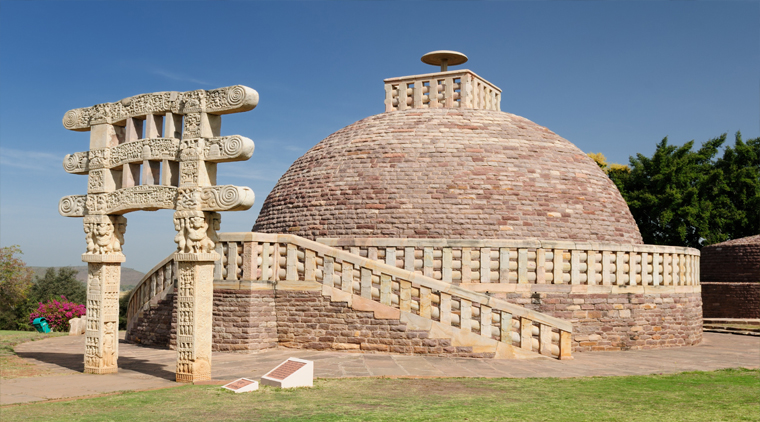
- Two to three days, the full circuitTo do the area justice, give it two to three days from Bhopal: the city itself one day, Bhimbetka with Bhojpur another, and Sanchi, the great Buddhist stupa complex about 46 to 48 km north, on a third. That is the classic Bhopal heritage circuit.
Bhimbetka costs and a realistic budget
The site itself is cheap; the main cost is getting there. Here is what the pieces cost so you can plan and avoid being overcharged for the car or the guide.
- The ASI entry ticketThe entry fee is modest, but the exact figure varies by source and appears to have been revised, so budget on roughly 25 rupees for Indian and SAARC visitors and somewhere between about 100 and 500 rupees for foreign nationals, plus separate parking, and reconfirm at the counter. It is the rare fixed price of the day.
- The guideA local guide at the gate is the spend that most improves the visit, typically around 150 to a few hundred rupees, agreed before you start walking. Settle the amount up front to avoid any friction at the end.
- The car, the real costThe biggest line item is the taxi from Bhopal. A half-day or full-day car for Bhimbetka, often with Bhojpur added, is negotiable and depends on the vehicle and the season, so get a clear all-in quote in advance that includes waiting time. This is where most of your budget goes.
- Food and waterCarry your own water and snacks, because there is no cafe at the shelters and only the Highway Treat stop nearby. Budget for a meal in Bhopal or at the highway stop rather than expecting anything on the trail.
The ticket and the guide together are small, often under a few hundred rupees for an Indian visitor. The transport is the real expense, because Bhimbetka has no convenient public option to the gate, so a hired car is effectively part of the cost of seeing it. Agree the car fare, including waiting and any Bhojpur detour, before you set off, and the only common source of overcharging disappears.
Practical logistics: tickets, timings, water and the trail
The small things that make a Bhimbetka visit smooth, from the opening hours to the lack of facilities and what to carry on the open-rock loop.
- Opening hoursThe site is open daily, roughly sunrise to sunset, commonly listed as about 7 am to 6 pm. There is no midday closure, but the cooler morning is far more pleasant and gives better light, so aim to arrive near opening.
- No food, water or shadeThere is no cafe, no reliable drinking water and very little shade on the trail. Carry water, a hat, sunscreen and any snacks you want, and use the Highway Treat stop on the main road for a proper meal before or after.
- Footwear and the trailThe loop is easy in distance but the ground is uneven rock and earth, with a few steps and slopes. Wear closed, grippy shoes rather than sandals, especially in the monsoon when the rock is slippery.
- Money and connectivityCarry cash for the ticket, parking and the guide, as card and UPI are not reliable at a remote heritage gate. Mobile coverage is patchy in the forest, so download your map and any notes before you leave Bhopal.
Safety, the heat, and the tiger-reserve forest
Bhimbetka is a gentle, safe visit, but the open rock, the heat and the new tiger-reserve setting are worth understanding before you go.
- Heat and hydrationThe biggest real risk is the sun and heat on the exposed sandstone, especially from April to June. Go early, carry more water than you think you need, wear a hat and sunscreen, and rest in the shade of the larger shelters. The ASI trail itself is well-marked and safe to walk.
- The monsoon trailIn the rains the boulders get slippery and a few sections become awkward. Take the loop slowly, watch your footing on the steps, and keep children close on the wet rock.
- It is now a tiger reserveBhimbetka sits inside the Ratapani Tiger Reserve, notified in December 2024. The rock-art trail is a controlled, ticketed monument and ordinary safari rules do not apply to it, but you are in a forest with wildlife, so do not wander off the marked path into the surrounding reserve, and keep noise down.
- General safetyPetty crime is not a notable problem at the site, and solo travellers, including women, generally find a daytime visit straightforward. As anywhere, keep valuables close, agree fares and guide charges in advance, and avoid lingering on the empty trail near closing time.
Bhimbetka for every kind of traveller, and on access
Bhimbetka suits very different visitors in different ways. Here is what it offers you, and the one tip that matters for each, including how an older traveller does the trail comfortably.
- History and culture loversThis is the heart of the matter: one of the longest continuous records of human art anywhere, and a guide unlocks the layers. If prehistory or archaeology moves you, give it the full half day and read up on the dating beforehand.
- Families with childrenChildren engage best with a guide who turns the paintings into a story: spot the elephant, find the dancers, count the deer. Keep them on the path and off the rock, carry water and snacks, and go early before the heat tires everyone out.
- Senior travellers and on accessibilityVery doable with planning, but be realistic: the trail is uneven rock with a few steps and slopes, and there is no shade or seating to speak of. Go in the cool morning, take it slowly, carry water, and consider focusing on the nearer signature shelters rather than the full loop. A steady companion and a guide help a great deal.
- PhotographersCome for the morning or late light, when the faint ochre and white paintings lift off the grey rock. Photography is allowed on the trail; respect the no-touch rule, skip flash near the pigment, and bring a lens that handles the contrast between bright rock and shaded shelters.
- Solo travellersAn easy, rewarding solo day from Bhopal. Hire a car or join a small group tour for the transport, take a guide at the gate, and you have a calm, low-pressure heritage visit with none of the tout hassle of busier sites.
- School and college groupsA superb teaching site, but plan for the lack of facilities: arrange transport to the gate, brief the group firmly on not touching the art, and split a large group across guides so everyone can actually see and hear the explanations.
A suggested Bhimbetka itinerary
How to shape a half day, a full day, or a two to three day heritage circuit from Bhopal so you see Bhimbetka in good light and pair it sensibly with Bhojpur and Sanchi.
- The half-day planLeave Bhopal early, reach Bhimbetka near opening at about 7 am, take a guide and walk the loop over 1.5 to 3 hours in the cool morning light, then drive back to Bhopal for lunch. Tight but satisfying if Bhimbetka is your only target.
- The full-day plan with BhojpurDo Bhimbetka in the morning as above, then stop at the Bhojeshwar temple at Bhojpur on the way back to see the great unfinished Shiva temple and its giant lingam, returning to Bhopal by evening. This is the classic, comfortable day trip.
- The two to three day circuitAdd Sanchi, the UNESCO Buddhist stupa complex about 46 to 48 km north of Bhopal, on a separate day, and give Bhopal itself a day for its lakes, the tribal art museum and its food. Bhimbetka with Bhojpur becomes one chapter of a richer central India trip.
- Where it fits on a bigger tripOn a wider Madhya Pradesh route, Bhopal with Bhimbetka slots neatly between Indore and the Khajuraho or Kanha legs, or as a heritage pause on a Delhi to central India journey. Two nights in Bhopal is the sweet spot.
The single thing that weakens a Bhimbetka day is arriving in the harsh, hot early afternoon. Build the day so the rock-art trail falls in the cool morning light, keep Bhojpur or a meal for later, and you get better photographs, a more comfortable walk and a guide who is not rushing you off the rock in the midday glare. The site is the same; the morning version is simply better.
The real questions travellers ask about Bhimbetka
Straight answers to the questions that come up again and again on traveller forums, so you arrive already knowing the score.
- How long do I need, and is it worth it?Plan 1.5 to 3 hours on the marked loop, more if prehistory fascinates you. For history and culture lovers it is genuinely worth the trip; if rock art holds no interest for you, it is a pleasant but short stop best combined with Bhojpur.
- Do I need a guide?You can walk the trail on your own, and it is not forbidden, but most first-timers miss the faint paintings without one. A guide at the gate, for around 150 to a few hundred rupees, is the difference between seeing marks on rock and reading the art, so we strongly recommend it.
- Can I do it by public bus?Only just. Hoshangabad-bound buses from Bhopal drop you at the Highway Treat stop about 3 km below the gate, with no onward transport, so you walk the last stretch uphill. For most visitors a hired taxi from Bhopal is far more practical.
- Can I photograph the paintings?Yes, photography is generally permitted on the trail. Just keep your distance from the art, do not touch or wet it for a shot, and avoid flash close to the pigment. Morning light gives the best results.
- Can I combine Bhimbetka with Bhojpur and Sanchi?Bhimbetka and Bhojpur sit close together, about 25 to 28 km apart, and are easily done in one day from Bhopal. Sanchi is on the other side of Bhopal, about 46 to 48 km north, so it is usually a separate day rather than the same trip.
- Is there anywhere to eat or rest?Not at the shelters. There is the MP Tourism Highway Treat stop on the main road for a meal, but no cafe, water or shade on the trail itself, so carry water and snacks and plan your meal around the visit.
Planning Bhimbetka from abroad
Bhimbetka is one of the most moving prehistoric art sites on earth and an easy day from Bhopal. A little preparation on the ticket, the guide and the heat makes it effortless.
- Budget the foreign ticket and a guideForeign nationals pay more than locals at ASI sites, somewhere between about 100 and 500 rupees against about 25, which is still very modest, and you should reconfirm the current figure at the gate. Add a guide for around a few hundred rupees, because the paintings are faint and a guide is what makes the visit make sense.
- Fit it into a Bhopal heritage circuitFly into Delhi or Mumbai, connect to Bhopal, and use the city as a base for Bhimbetka, Bhojpur and Sanchi, three very different layers of Indian history within easy reach. It is one of the most rewarding and least crowded heritage clusters in the country.
- Come prepared for the trailThere is no food, water or shade at the shelters, so carry water, sun protection and snacks, and go in the cool morning. The walk is short but the ground is uneven rock, so wear proper shoes rather than sandals.
- Respect the heritageThis is fragile, world-significant art. Do not touch, wet or trace the paintings, stay on the marked path, and photograph from a respectful distance without flash. You are a guest of one of humanity's oldest galleries.
Understanding what you are seeing, and when to come
For an overseas visitor, a little context turns Bhimbetka from a few faint marks into one of the great prehistoric sites in the world. Here is how to read it and when to come.
- How it compares to sites you may knowMadhya Pradesh Tourism itself draws the comparison: Bhimbetka's art sits alongside the rock paintings of Kakadu in Australia, the Bushmen paintings of the Kalahari and the Upper Palaeolithic caves of Lascaux in France as one of the world's great prehistoric galleries. If those mean something to you, this belongs on the list.
- Read the dating honestlyThe earliest paintings are commonly dated to around 10,000 BCE, with the human use of the shelters going back far further, more than 100,000 years in places. Treat any claim that it is provably the oldest art on earth with care; the truth, among the oldest known anywhere, is impressive enough.
- Best months for an overseas tripTime a central India trip for October to March, when the weather is comfortable for the open-rock trail and the wider Bhopal circuit. Avoid the April to June heat, which is punishing on the exposed sandstone.
- Give yourself the morningPlan to be at the gate near opening at about 7 am. The light is kinder on the paintings, the heat is bearable, and you walk the loop before the day-trip buses arrive. An unhurried morning here is one of the quiet highlights of a Madhya Pradesh trip.
Bhimbetka is an unusually rewarding stop for a thoughtful traveller: uncrowded, deeply ancient, and free of the tout pressure of bigger sites. Base in Bhopal, give Bhimbetka a guided morning, add Bhojpur and Sanchi on either side, and you have a heritage trio, prehistoric, Hindu and Buddhist, that few overseas itineraries reach. Many visitors say it ends up being the most surprising part of their central India trip.
Why it is called Bhimbetka, and what the rock remembers
The name Bhimbetka is usually traced to Bhimbaithka, the sitting place of Bhima, the mighty Pandava of the Mahabharata, who legend says rested among these great boulders. It is a folk etymology rather than a documented history, and the rock itself tells a far older story than any epic. Across more than 750 sandstone shelters in the Vindhyan foothills, layer upon layer of painting records the human imagination from the Mesolithic, around 10,000 BCE by common dating, right through to the historical period: red and white bison, deer and elephants, dancers and hunters, and later riders and battle scenes, painted by people who returned to this place over thousands of years. UNESCO inscribed it in 2003 for exactly that long interaction between people and landscape. Stand in the Auditorium Cave at first light and you are not looking at the oldest art on earth, a claim no one can prove, but at one of the longest continuous galleries our species has left anywhere.
Planning a Bhimbetka trip?
Our Madhya Pradesh travel experts plan your full journey for you: route, hotels, darshan timings and transport. You get a free day-by-day plan and an exact quote on WhatsApp, usually within a few hours. No payment is needed to get your plan.
Tour packages that visit Bhimbetka
Every journey below is private, hand-crafted and fully customizable. Tell us your dates and we tailor the itinerary, the pace and the priests or guides around you.