Chitrakoot Travel Guide
The comfortable months are October to March . The other half of the planning is the pilgrimage calendar: ordinary days are quiet, but every Amavasya and the big festivals turn...
When to visit Chitrakoot, and the crowd calendar to plan around
The comfortable months are October to March. The other half of the planning is the pilgrimage calendar: ordinary days are quiet, but every Amavasya and the big festivals turn the ghats into a sea of people.
- October to March: cool and clearThe most comfortable window by far, dry and pleasant by day and cool at night, so carry a light layer for winter mornings and the dawn parikrama. This is the right time for the barefoot Kamadgiri loop and the outlying temples, and the skies are clear for the Ram Ghat aarti.
- April to June: fierce heat, best avoidedHigh summer on the Vindhya plateau is brutal, reported around 45 to 47 degrees Celsius. Barefoot parikrama in that heat is a genuine dehydration and heat-exhaustion risk, especially for the elderly and children, so if you must come then, do the walking at first light and rest through the middle of the day.
- July to August: monsoon caveatsThe forested hills are green and beautiful, but the Mandakini can rise and some approach roads to the outlying sites can waterlog. It is doable with a flexible plan, though not the season for a tight one-day darshan.
- Quiet day or festival, decide firstOn an ordinary weekday Chitrakoot is calm and unhurried. On the big occasions it is the opposite, so choose the experience you want before you fix dates: the calm reflective town, or the roar of a festival crowd.
Chitrakoot fills up on the new moon. Every Amavasya draws large crowds for the Kamadgiri parikrama, and the biggest gatherings fall on Somvati Amavasya, Diwali, Sharad Purnima, Makar Sankranti and Ram Navami. The Diwali Deepdan at Ram Ghat, when the ghats are lit with countless lamps, draws crowds reported in the many lakhs. These are unforgettable if you want the spectacle, but rooms, roads and the parikrama path are packed and moving is slow, so families and older pilgrims who prefer calm should deliberately avoid the new-moon dates and come on an ordinary weekday. Reconfirm the exact festival dates against the panchang for your travel year before you book.
How to reach Chitrakoot
Most people arrive by train at Chitrakoot Dham Karwi or by road from Prayagraj. Chitrakoot's own small airport has no scheduled commercial flights, and the station is a short drive from the temple core, not in it.
- By train, via Chitrakoot Dham KarwiThe nearest railhead is Chitrakoot Dham Karwi, station code CKTD, on the Jhansi division of North Central Railway, served by trains such as the Bundelkhand Express and the Chitrakoot Express and connected to Delhi, Jhansi, Prayagraj, Kanpur and beyond. The station is about 8 to 12 km from Ram Ghat, roughly 20 to 30 minutes by auto or taxi, so do not confuse Karwi the station town with the temple core.
- By road from PrayagrajPrayagraj is the usual road gateway, roughly 3 to 4 hours away, and Chitrakoot sits naturally on an Ayodhya to Prayagraj to Chitrakoot Ramayana-trail loop. The town is well connected to the national highways, and hiring a car with a driver is the easiest way to handle the spread-out sites once you arrive.
- Nearest airportsThe closest airport is Prayagraj (Bamrauli), reported at about 106 to 145 km depending on the source and route; Khajuraho airport in Madhya Pradesh is about 165 to 185 km (the Chitrakoot district site cites 167 km). Chitrakoot does have its own small airport at Devangana about 12 km out, but it has had no scheduled commercial flights since late 2024, so overseas visitors usually fly to Prayagraj, Varanasi or Khajuraho and drive in.
- Getting around once you are thereThe sites are spread over roughly 20 km on both banks of the Mandakini, so the sensible move is to hire a car or an auto for the day. Ram Ghat, Kamadgiri and Bharat Milap are close together in the core, while Gupt Godavari, Sati Anusuya and Bharat Koop are a half-day drive out.
Fly into Delhi or Varanasi, then reach Chitrakoot by train to Karwi or by road via Prayagraj. Many overseas visitors pair it with Khajuraho or with the Ayodhya and Prayagraj Ramayana trail. Chitrakoot's own small Devangana airport has had no scheduled commercial flights since late 2024.
Fly into Delhi or Varanasi, continue to Prayagraj, then drive about 3 to 4 hours. Chitrakoot slots easily onto a wider Uttar Pradesh temple circuit.
Take a train to Chitrakoot Dham Karwi and drive the short hop into the temple core, or drive from Prayagraj, Kanpur, Jhansi or Khajuraho. The Karwi railhead, on the Jhansi to Prayagraj line, is the simplest way in by rail.
Ram Ghat, Kamadgiri and the two-state circuit
Chitrakoot is Ram Ghat on the Mandakini, the sacred Kamadgiri hill you walk around, and a ring of Ramayana sites spread across two states. Knowing which side of the river each one is on saves confusion.
- Ram Ghat and the MandakiniThe riverside heart of the town on the Uttar Pradesh side, lined with temples and boats, and the setting for the evening aarti. Free, open through the day, and the place most people return to at dusk. Go barefoot near the water, dress modestly, and let the aarti be the still point of the day.
- Kamadgiri and the parikramaThe forested hill held to be the true Chitrakoot, where the deity Kamtanath is the presiding god of the whole region. Pilgrims walk the roughly 5 km loop around its base, the Kamadgiri parikrama, barefoot and clockwise, past a string of shrines. This is the central act of a Chitrakoot visit, not an optional sight.
- Bharat Milap TempleIn the town core, marking the spot where Bharata is said to have met Rama and pleaded with him to return to Ayodhya. The temple keeps the memory of the charan paduka, the wooden sandals Bharata carried back to rule in Rama's name.
- Across the river in Madhya PradeshSeveral key sites sit on the Satna side of the Mandakini: Janki Kund, the pool linked to Sita's bathing, Sphatik Shila, the crystal boulder said to bear Rama's footprint, and the Sati Anusuya Ashram in the quiet forest. They are an easy drive from the core, and the crossing between states is seamless in practice.
Chitrakoot is not one town in one state. The Mandakini river is the border: the district of Chitrakoot, the town core, Karwi, Ram Ghat, Kamadgiri and Bharat Milap are in Uttar Pradesh, while Janki Kund, Sphatik Shila and the Sati Anusuya Ashram sit across the river in Satna district of Madhya Pradesh. Nothing changes spiritually, and you cross back and forth without any formality, but it explains why some pages call Chitrakoot a UP town and others an MP one. Both are right, and a full darshan touches both states.
Signature experiences in Chitrakoot
Beyond ticking off temples, these are the moments people remember, and how to arrange them so you get the unhurried, genuine version.
- The Kamadgiri parikrama at dawnThe defining experience: a roughly 5 km barefoot loop around the sacred hill, done clockwise past its shrines. Start early, ideally around 6 am and finishing before about 9:30 am, both for the merit and to beat the heat. Unhurried, it takes about 1.5 to 3 hours. Wear clothes you can walk in and carry your footwear.
- The evening aarti at Ram GhatAs the light goes, priests and pilgrims gather on Ram Ghat for the Mandakini aarti, lamps swung to conch and bell over the river. It is the emotional high point of a day here. Arrive a little early, find a spot on the steps, and sit quietly with it.
- A boat on the MandakiniShort shared or private boat rides on the river from Ram Ghat are the classic thing to do, loveliest at sunrise and around the aarti. Agree the price and length before you set off, as with any boatman, and enjoy the town from the water.
- Wading through Gupt GodavariAbout 18 km out, a pair of natural caves with a shallow stream running along the floor, so you wade barefoot through knee-high water inside the rock. It is one of the most memorable stops. Carry footwear you can hold and wear clothes you do not mind getting wet to the knee.
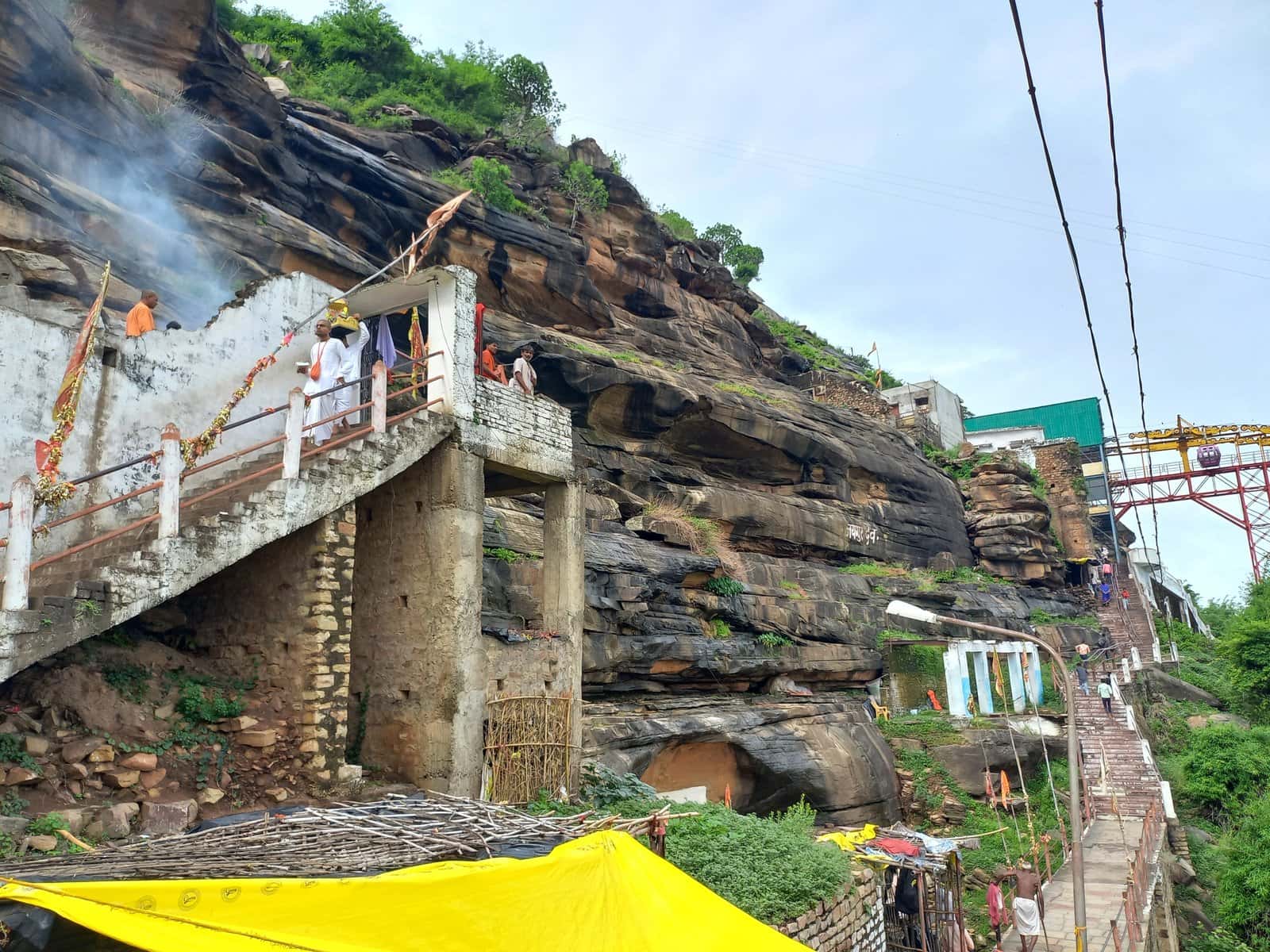
- Hanuman Dhara by steps or ropewayA hillside Hanuman shrine reached by a climb of around 650 steps or by the cable-car ropeway. The view over the town is the reward. Reported round-trip ropeway fares vary, commonly around 130 rupees and sometimes up to about 160 rupees, so confirm the current fare at the counter.
- The Diwali Deepdan, if your dates matchAt Diwali, Ram Ghat is lit with countless lamps for the Deepdan and draws crowds reported in the many lakhs. It is a spectacle like few others, dense and slow-moving, so go with patience, keep your group close, and treat it as an event rather than a quiet darshan.
If you do only one thing slowly, make it the dawn parikrama followed by a boat on the Mandakini before the day heats up. That quiet early hour, barefoot on the cool path with the hill on one side and the river waking on the other, is what stays with people long after the outlying temples blur together. Give yourself an unhurried morning and Chitrakoot opens up in a way a rushed one-day darshan never allows.
Where to stay in Chitrakoot, and how many nights
Stay near Ram Ghat to be in the heart of it, or in a quieter resort for calm and space. One to two nights is the sweet spot, and the official MP Tourism properties set a reliable price floor.
- Near Ram Ghat and the coreWalking distance to the ghat, the aarti and the Kamadgiri approach, with dharamshalas, ashram guest houses and simple hotels. Atmospheric and convenient for early parikrama, though busier and plainer. Best for pilgrims who want to step straight into the devotional rhythm.
- Quieter resorts and bungalowsA little out from the crush, with more space, gardens and calm, but you will want transport into the core for the aarti and the dawn walk. Better for families and older travellers who value a quiet night and a proper breakfast.
- The official MP Tourism anchorMadhya Pradesh Tourism runs the MPT Tourist Bungalow, listed at about 250 to 2,890 rupees, and the MPT Mandakini Resort at about 200 to 2,290 rupees. These are clean, bookable and English-friendly, and useful as a trustworthy price floor when private rates around festivals get inflated.
- How many nightsOne night is the practical minimum and one to two nights is the sweet spot. A planned day and a half covers Kamadgiri, Ram Ghat and the aarti, Bharat Milap, Sati Anusuya, Gupt Godavari, Sphatik Shila and Hanuman Dhara. A second night lets you do the parikrama unhurried at dawn rather than racing it.
On the big new-moon and festival occasions, rooms near Ram Ghat are scarce and priced high, and the town is at its most crowded. If your dates fall on Somvati Amavasya, Diwali, Sharad Purnima, Makar Sankranti or Ram Navami, book well ahead or plan to arrive and leave outside the peak hours. On an ordinary weekday you can usually find a room on the day, but the official MP Tourism properties are worth reserving for peace of mind.
Chitrakoot costs and a realistic budget
Chitrakoot is cheap to visit because the pilgrimage itself is free. The real costs are a car for the day and a night's room, so here is what to plan for.
- The circuit is essentially freeKamadgiri parikrama, Ram Ghat, Bharat Milap, Sphatik Shila, Janki Kund, Sati Anusuya Ashram, Hanuman Dhara and Bharat Koop carry no entry fee. So the pilgrimage costs nothing to enter, and any package price you are quoted is for the car, the driver, the room and meals, not for tickets.
- The few things that do costA boat ride on the Mandakini, the Hanuman Dhara ropeway (reported around 130 to 160 rupees round trip, so confirm at the counter), a car or auto for the day to reach the outlying sites, and any donation you choose to give at a temple. Agree the boat and car rates before you commit.
- Room budgetsThe official MP Tourism properties run at about 250 to 2,890 rupees for the Tourist Bungalow and about 200 to 2,290 rupees for the Mandakini Resort, and dharamshalas and simple hotels sit around and below that band. Private rates rise sharply around the festivals, which is when the official anchor prices are most useful.
- A rough daily budgetExcluding your room and the train or long-distance transport, a comfortable day with a hired car for the outlying temples, meals and a boat ride is modest by Indian pilgrimage standards, since the sites themselves are free. Carry cash for boats, autos, small eateries and donations, as not everyone takes cards or UPI.
The single most useful budgeting fact about Chitrakoot is that entry is free almost everywhere, so a package or a quote is really pricing a car and a night, not a temple ticket. Once you see that, you can compare operator prices sensibly and decide whether to hire your own car and auto for the day instead. Settle the car and boat rates in advance and the town holds no unpleasant surprises on cost.
Practical logistics: food, money, walking and the two banks
The small things that make a Chitrakoot day smooth, from the simple vegetarian food to cash, footwear for the barefoot circuit, and hopping between the two banks of the Mandakini.
- Simple, vegetarian foodAs a working pilgrimage town, Chitrakoot's food is largely simple, fresh and vegetarian, with dharamshala thalis, sweet shops and the official MP Tourism restaurants at the bungalow and resort. Alcohol and public drinking are not welcome in this devotional setting, so treat it as a dry, satvik trip and save any indulgence for your next stop.
- Footwear for the barefoot circuitThe Kamadgiri parikrama is walked barefoot, and Gupt Godavari means wading through knee-high water. Carry a small bag or a sling for your shoes, wear clothes that dry, and if your feet are tender, do the parikrama in the cool of the morning rather than on a hot afternoon path.
- Money and ATMsKarwi town has bank ATMs and the usual services, and the core has small vendors, boatmen and autos who run on cash. Carry enough cash for the day, keep small notes for boats, rickshaws and donations, and do not rely on cards at the ghats or on the parikrama path.
- Crossing between the two banksBecause the sites split across Uttar Pradesh and Madhya Pradesh with the river as the border, plan your day as a loop rather than back-and-forth trips. A hired car or auto handles the crossings without any formality, and a good driver will sequence the outlying MP-side sites efficiently with the UP-side core.
Safety, heat, crowds and staying well
Chitrakoot is a calm, welcoming devotional town with low crime, but the real risks are heat on the barefoot circuit and the density of festival crowds. A little planning keeps the visit happy.
- Heat and the barefoot walkThe biggest health risk is the sun. Barefoot on a hot parikrama path in the April to June heat, reported around 45 to 47 degrees Celsius, is a real dehydration and heat-exhaustion danger, especially for older pilgrims and children. Do the walking at dawn, carry water, and rest through the middle of the day.
- Festival crowdsOn Amavasya, at the Diwali Deepdan and on the big festival days, crowds run into the lakhs and the ghats and parikrama path get very dense. Keep your group together, mind children and elders closely, agree a meeting point, and avoid the tightest crush hours if anyone in your party is frail.
- Water, food and the riverDrink bottled or filtered water, take the usual care with street food, and treat the Mandakini as a place for a respectful dip rather than swimming, particularly when it runs high after rain. Carry any personal medicines, as this is a small town without big-city hospitals.
- General safety and toutsChitrakoot is generally safe and low on the aggressive touting you meet at bigger tourist sites, precisely because it is a working pilgrimage town rather than a foreigner circuit. The usual sense applies: agree boat and car prices first, be polite but firm with priests seeking large donations, and mind your belongings in the festival press.
Chitrakoot is a devout, family-oriented town and generally comfortable for solo and female travellers, with far less hustle than the big tourist centres. Dress modestly in keeping with the pilgrimage setting, do the parikrama and the aarti in company where you can, and be firm about agreeing prices before boats and rides. The main thing to manage is the density of festival crowds rather than any particular threat, so a calm weekday visit is the easiest way to travel here alone.
Chitrakoot for every kind of traveller, and on access
Chitrakoot suits pilgrims, families and quiet-minded travellers more than resort-seekers. Here is what it offers you, and the one tip that matters for each, including how an older pilgrim does it comfortably.
- Pilgrims and the devoutThis is the heart of the audience: the Ramayana associations are living and unbroken here, and the parikrama, the aarti and the ashrams are the point. Give it a full day and a night to do the circuit without rushing, and start the parikrama at dawn.
- Families with childrenEasy and rewarding on ordinary days, with the boat ride, the caves at Gupt Godavari and the open ghats. On festival days keep little ones close in the crowds and skip the tightest hours, and remember the barefoot walk and the heat when planning the day.
- Senior travellers and on accessibilityVery doable with planning. Do the Kamadgiri parikrama at first light when the path is cool, take it slowly with rests, and consider the ropeway rather than the roughly 650 steps at Hanuman Dhara. Stay near Ram Ghat to limit walking, keep the outlying temples to a hired car, and avoid peak festival crowds if calm matters.
- Couples and quiet-minded travellersNot a resort break, but a soulful, unhurried one: the dawn river, the forested hills, the aarti at dusk. Come off-festival, stay a night, and let the slow rhythm of a devotional town be the appeal rather than sightseeing volume.
- Solo and female travellersGenerally comfortable and low-hustle for a holy town of this scale. Dress modestly, keep to company on the parikrama and at the aarti, agree prices before boats and rides, and prefer an ordinary weekday over the festival crush.
- PhotographersThe Ram Ghat aarti, the dawn mist on the Mandakini, the barefoot parikrama and the Deepdan lamps are the frames. Ask before photographing people at prayer, be discreet inside shrines, and respect any request not to shoot in the sanctum.
A suggested Chitrakoot itinerary
How to shape one or two unhurried days so you catch the parikrama at dawn, the aarti at dusk, and the outlying temples without a scramble.
- Day one, dawnStart at first light with the Kamadgiri parikrama, roughly 5 km barefoot and clockwise, aiming to finish before about 9:30 am and the heat. Follow it with a boat on the Mandakini and breakfast near Ram Ghat while the town is still cool and quiet.
- Day one, afternoonRest through the midday heat, then take a hired car to the outlying sites across the river: Sati Anusuya Ashram in the forest, then Gupt Godavari to wade the caves, timing your return to the core for late afternoon.
- Day one, eveningVisit Bharat Milap and the core temples, then settle on the steps at Ram Ghat for the Mandakini aarti at dusk, which is the emotional close of the day. Keep it unhurried; this is the moment people remember.
- Day two, if you have itA second morning lets you do Hanuman Dhara by steps or ropeway for the view, see Sphatik Shila and Janki Kund at a gentle pace, and pick up anything you skipped. A second night turns a rushed darshan into the calm, reflective trip Chitrakoot does best.
The single thing that breaks a Chitrakoot plan is trying to walk the barefoot Kamadgiri parikrama in the heat of the day. Build the day so the roughly 5 km loop falls at first light, ideally begun around 6 am and finished before about 9:30 am, keep the hot middle of the day for rest and the shaded caves, and save the aarti for dusk. Do it in that order and the day flows; do it backwards and you will be footsore on a scorching path with the best light already gone.
The real questions travellers ask about Chitrakoot
Straight answers to the questions that come up again and again on traveller forums, so you arrive already knowing the score.
- Is Chitrakoot in UP or MP?Both. The Mandakini river is the border: the town core, Karwi, Ram Ghat, Kamadgiri and Bharat Milap are in Uttar Pradesh, while Sphatik Shila, Janki Kund and the Sati Anusuya Ashram are across the river in Satna district of Madhya Pradesh. You cross freely, and a full darshan touches both states.
- Is one night enough?One night is the practical minimum and covers the essentials if you plan well. Two nights is better, letting you do the dawn parikrama unhurried, take in the outlying temples without racing, and sit with the aarti more than once. Half a day only scratches the surface.
- Is Karwi station the same as the town?No. Chitrakoot Dham Karwi station, code CKTD, is about 8 to 12 km from Ram Ghat, roughly 20 to 30 minutes by auto or taxi. Karwi is the railhead town; the temple core is a short drive away, so book onward transport rather than expecting to walk from the platform.
- Are the temples ticketed, what does it cost?Almost the entire circuit is free: Kamadgiri, Ram Ghat, Bharat Milap, Sphatik Shila, Janki Kund, Sati Anusuya, Hanuman Dhara and Bharat Koop have no entry fee. The costs are a car for the day, a boat, the Hanuman Dhara ropeway if you take it, a room and meals, so a visit is cheap by pilgrimage standards.
- Do I really have to walk the parikrama barefoot?The Kamadgiri parikrama is traditionally walked barefoot and clockwise, about 5 km, and most pilgrims do it that way. If your feet are tender or the day is hot, walk it at dawn when the path is cool, take it slowly, and carry water. It is the central act of a Chitrakoot visit, so most people make the effort.
- Can I combine it with Ayodhya, Prayagraj or Khajuraho?Yes, and many do. Chitrakoot sits on the Ram Van Gaman Ramayana trail with Ayodhya and Prayagraj, roughly 3 to 4 hours from Prayagraj by road, and Khajuraho in Madhya Pradesh is about 165 to 185 km, so it pairs naturally with a wider Uttar Pradesh or heritage circuit.
Planning Chitrakoot from abroad
Chitrakoot is the quiet, deeply authentic chapter of the Ramayana trail, with very few foreign faces. A little preparation makes the barefoot circuit, the two-state geography and the working-town feel easy to embrace.
- Expect a working pilgrimage town, not a tourist resortChitrakoot is devotional, simple and largely unvisited by foreigners, which is exactly its appeal. Food is fresh vegetarian, the mood is respectful and dry, and the experience is genuine rather than packaged. Come for the atmosphere and the Ramayana story, not for tourist infrastructure.
- Understand the two-state geographyThe Mandakini river is the border between Uttar Pradesh and Madhya Pradesh, so a full day of darshan crosses between the two states repeatedly with no formality. It explains why some sources call Chitrakoot a UP town and others an MP one; both are right, and a hired car handles the crossings.
- Fit it into the Ramayana trailFly into Delhi or Varanasi, then loop Ayodhya, Prayagraj and Chitrakoot for the Ram Van Gaman trail, or pair Chitrakoot with Khajuraho, about 165 to 185 km away. Prayagraj, roughly 3 to 4 hours by road, is the practical gateway, and Chitrakoot is the reflective pause on the wider circuit.
- Doable for older NRI parents with planningStay near Ram Ghat to keep walking short, do the parikrama at first light, use the Hanuman Dhara ropeway rather than the roughly 650 steps, and avoid the biggest festival crowds if comfort matters. For a returning-roots trip it is one of the most moving stops on the Ramayana trail.
Money, connectivity and timing for foreign visitors
The practical basics an overseas traveller needs for a small devotional town: cash, cards, a SIM, and how many days to give it on a wider India trip.
- Carry cash, expect a cash townCards and UPI work at the bigger hotels and the MP Tourism restaurants, but the boats, autos, small eateries and donations run on cash. Draw money at the ATMs in Karwi town and keep small notes for rides, the boat and temple offerings, as the ghats and parikrama path are not card places.
- Get a SIM before you arrivePick up an Indian tourist SIM or an eSIM when you land in Delhi or Varanasi rather than hunting for one in a small town. Coverage in Chitrakoot itself is generally fine for maps, calls and arranging a car, though it can thin out at the outlying forest sites.
- How long to give it on a bigger tripOn a Ramayana-trail or wider Uttar Pradesh itinerary, one to two nights in Chitrakoot is the right weight between Prayagraj and Khajuraho or Ayodhya: enough for the parikrama, the aarti and the outlying temples, without slowing the whole trip. One night is the minimum for anything meaningful.
- Time your visit to your comfortOctober to March is the comfortable window. If you want the spectacle of the Diwali Deepdan or an Amavasya gathering, plan for it deliberately and expect large crowds; if you want calm and the town almost to yourself, come on an ordinary weekday in the cool season.
Chitrakoot is an unusually authentic introduction to devotional India: small, forested, deeply tied to the Ramayana, and refreshingly free of the tourist hustle you meet at bigger sites. Slot it into the Ayodhya and Prayagraj Ramayana trail, give it a night or two, and let it be the quiet, story-rich chapter of the journey. Many overseas and NRI visitors find the dawn parikrama and the Ram Ghat aarti the parts of the trip they remember most warmly.
Where Bharata begged Rama to come home, and left with his sandals
Chitrakoot belongs to the Ayodhya Kanda of the Ramayana, the early chapters of the fourteen-year exile. In the tradition, Lord Rama, Sita and Lakshmana crossed into these forested hills on the Mandakini and made their first long home here, drawn by the sages and the beauty of the place. When word reached Ayodhya that his father Dasharatha had died, Bharata came to Chitrakoot with the army and the people of the capital, not to take the throne but to beg his elder brother to return and rule. Rama, bound by his vow, refused to come back before the fourteen years were done. In the meeting remembered as the Bharat Milap, Bharata at last asked for Rama's wooden sandals, the charan paduka, and carried them home on his head to place upon the throne, ruling as regent in his brother's name until the exile ended. The Bharat Milap Temple in the town marks the spot the tradition assigns to that meeting. The core of the story is told in Valmiki's Ramayana (Ayodhya Kanda), though the precise identification of each site with a scene is temple and regional tradition rather than a single fixed scriptural verse, and it is honest to hold it that way.
Planning a Chitrakoot trip?
Our Madhya Pradesh travel experts plan your full journey for you: route, hotels, darshan timings and transport. You get a free day-by-day plan and an exact quote on WhatsApp, usually within a few hours. No payment is needed to get your plan.