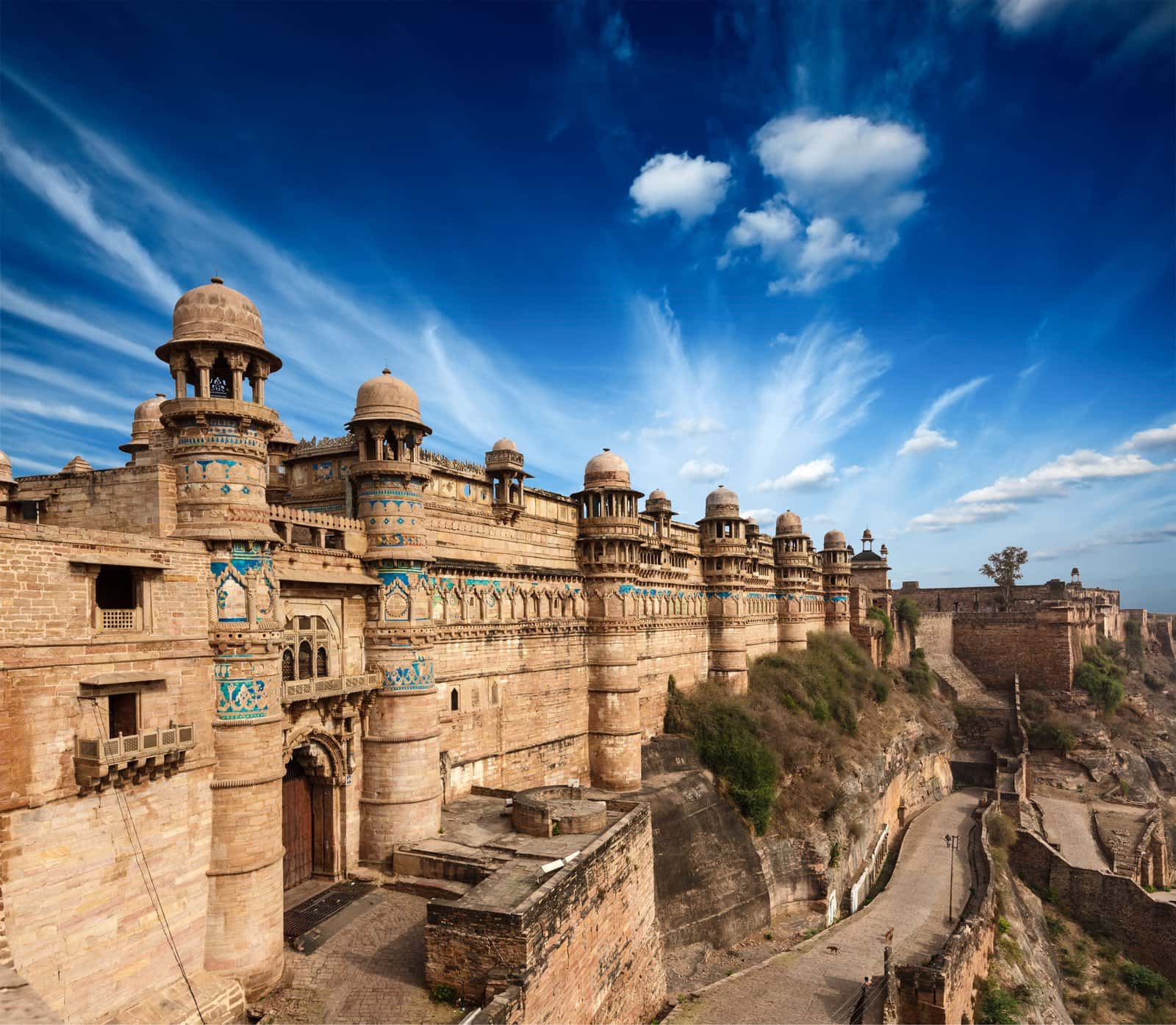
Gwalior Travel Guide
The comfortable window is October to March . The fort and palaces are mostly open-air, so the fierce April to June heat is the thing to plan around, and the music-lovers'...
When to visit Gwalior, and the heat to plan around
The comfortable window is October to March. The fort and palaces are mostly open-air, so the fierce April to June heat is the thing to plan around, and the music-lovers' set-piece is the Tansen Festival in December.
- October to March: cool and clearThe pleasant season, with winter days roughly 8 to 25 degrees Celsius and cold nights, so carry a layer. This is the right time for the open fort, the rock-cut sculptures and the palaces, and December also brings the Tansen Music Festival.
- April to June: fierce heat, plan carefullyHigh summer on the plain is severe, with highs that have reached about 45 to 47 degrees Celsius, and the fort gives almost no shade. If you must come then, do the fort at opening and keep the middle of the day for an indoor palace or your hotel.
- July to September: monsoon, moderate rainThe monsoon cools things down with moderate rainfall and greener surroundings. Stone steps can be slick, so take the fort stairs slowly, but the crowds thin and the light is good for photographs between showers.
- Time it to the Tansen Festival, if music draws youIf you love Indian classical music, plan around the December Tansen Samaroh near Tansen's tomb, when leading musicians perform over several days. Confirm the year's exact dates on the official festival or Gwalior district site before you book.
Gwalior's headline sights, the fort with Man Mandir, Teli ka Mandir, the Sas Bahu temples and the Gopachal Jain sculptures, are largely in the open with uneven stone underfoot and little shade. In the April to June heat, with highs around 45 to 47 degrees Celsius, that turns a wonderful morning into a hard slog by noon. Whatever the month, start the fort early, carry water and sun cover, and keep an indoor palace or a long lunch for the hot middle of the day. The cool October to March window is genuinely the difference between enjoying Gwalior and enduring it.
How to reach Gwalior
Gwalior is unusually easy: it has its own airport and sits on the main Delhi to Bhopal trunk line, so the fast trains from Delhi and Agra are the natural way in.
- By fast train, the easy defaultGwalior is on the busy Delhi to Bhopal and Chennai line. The Gatimaan Express runs New Delhi to Gwalior in about 2 hours 57 minutes, the Bhopal Shatabdi in about 3 hours 20 minutes, and Agra Cantt to Gwalior is only about 1 hour 15 minutes to 2 hours, which is why the Agra day trip works so well.
- By air, into Gwalior's own airportThe Rajmata Vijaya Raje Scindia Air Terminal is about 8 to 10 km from the city and has carried flights to Delhi, Indore and Bhopal with seasonal links to Mumbai, Bengaluru, Ahmedabad and Hyderabad. Routes change often, so check current schedules on the AAI site before relying on a flight.
- By road from Agra and the heritage circuitAgra is about 120 km, roughly 2 to 2.5 hours by road, and Gwalior slots neatly between Agra and Orchha, with Orchha about 120 km and roughly 2 hours south. We can arrange a car with an experienced driver for the heritage loop.
- From Delhi by roadDelhi is about 320 to 350 km, a long day by car on the expressway and highway. Most travellers take a fast train instead, since the Gatimaan and Shatabdi are quicker and far less tiring than the drive.
Fly into Delhi, then take the Gatimaan or Shatabdi train to Gwalior in about 3 hours, or combine it with Agra and the Taj Mahal on the same fast line. Gwalior has no international flights of its own.
Fly into Delhi, then train down to Gwalior, or connect onward to Gwalior's own airport on a domestic flight. The Delhi rail link is the simplest and most reliable option.
Take a fast train from Delhi or Agra, or a domestic flight from a metro. Gwalior's position on the main north-south trunk line makes the train the obvious choice for most Indian travellers.
The fort, Jai Vilas Palace, and the temple cluster
Gwalior is its hilltop fort with the painted Man Mandir Palace, the towering Teli ka Mandir and Sas Bahu temples, the giant Gopachal Jain sculptures, and the opulent Jai Vilas Palace down in the city. A few entry rules are worth knowing first.
- Gwalior Fort and Man Mandir PalaceThe great hilltop fort is the reason most people come, crowned by the tile-painted Man Mandir Palace of Raja Man Singh Tomar. The inner ASI monuments are ticketed at about 25 rupees for Indian visitors and roughly 250 to 300 rupees for foreign visitors, the same ticket covering Man Mandir, Teli ka Mandir and the Sas Bahu temples. Budget 3 to 5 hours for the whole hilltop.
- Teli ka Mandir and the Sas Bahu templesInside the fort, Teli ka Mandir is the tallest structure at about 30 metres, an unusual blend of north and south Indian style, while the two carved Sas Bahu temples (a worn form of Sahasrabahu, a name of Vishnu, not literally mother-in-law and daughter-in-law) are small but exquisite. Both are covered by the same fort-monument ticket.
- The Gopachal Jain rock-cut sculpturesOn the cliff faces along the Urwai approach are dozens of monumental Jain figures cut straight into the rock, some standing many metres tall, defaced once and later restored. They are free to view from the road and are among the most striking and least-hyped sights in Gwalior.
- Jai Vilas Palace and the Scindia MuseumDown in the city, the still-royal Jai Vilas Palace houses the Scindia Museum, with its 3.5-tonne Durbar Hall chandeliers and the famous silver drinks train. It is open about 10 am to 6 pm, closed Mondays, ticketed at about 300 rupees per person per Madhya Pradesh Tourism. Reconfirm the rate and any Darbar Hall supplement at the counter.
Gwalior catches the unwary with three separate tickets, not one: the ASI fort-monument ticket (about 25 rupees Indian, roughly 250 to 300 rupees foreign) for Man Mandir, Teli ka Mandir and the Sas Bahu temples; the Jai Vilas Palace ticket (about 300 rupees per person, MP Tourism); and the Sound and Light show ticket in the evening. The single biggest trap is that Jai Vilas Palace is closed on Mondays, which quietly ruins a Monday day trip from Agra. Reconfirm all three at the counter, and do not buy a fort palace from a tout at the gate.
Signature experiences in Gwalior
Beyond ticking off monuments, these are the experiences people remember: the evening Sound and Light show, the music heritage, the Jain colossi and a quiet temple at dusk.
- The fort Sound and Light showHeld in the Man Mandir amphitheatre, the show tells the fort's story across about 45 minutes. Timings split by season: roughly 7:30 pm Hindi and 8:30 pm English from about March to October, and roughly 6:30 pm Hindi and 7:30 pm English from about November to February. Tickets are commonly around 100 to 250 rupees, so confirm the day's time at the counter.
- Tansen's tomb and the music heritageGwalior is the cradle of the Gwalior gharana and the home of Mian Tansen, the Mughal-era maestro. His tomb sits in a quiet garden beside the tomb of his teacher Mohammad Ghaus, and tradition holds that chewing a leaf from the old tamarind tree there sweetens the voice. The December Tansen Samaroh fills the place with classical music.
- Stand beneath the Gopachal Jain colossiWalking or driving the Urwai approach, stop at the rock-cut Jain figures carved into the cliff, some many metres tall. They are quieter and more astonishing in person than any photo suggests, and cost nothing to see. Go in soft morning or late light for the best of the carvings.
- A calm dusk at the Sun TempleThe modern Konark-style Sun Temple at Morar, built by the Birla family and dedicated in 1988, is free, peaceful and a good antidote to a busy fort day, open roughly 6:30 am to 12 noon and about 1 pm to 6 pm. It suits travellers who want a gentle, uncrowded sight to end on.
- Wander the old bazaars of LashkarThe Lashkar and Sarafa areas in the city are good for a slow afternoon browse, with local sweets, brassware and everyday bustle. It is not a tourist bazaar, which is exactly its charm, and a fair place to feel Gwalior as a living city rather than a monument.
If you do only one thing beyond the fort by day, make it the Sound and Light show in the Man Mandir amphitheatre at dusk. Sitting under the floodlit palace as the fort's thousand-year story unfolds is the moment most visitors remember, and it ties together everything you walked past in daylight. Just get the timing right: the show starts earlier in winter, around 6:30 pm Hindi, and later in summer, around 7:30 pm Hindi, with the English show after it, so check the day's slot when you buy your monument ticket.
Where to stay in Gwalior, and how many nights
Stay in the city and Lashkar core for the railway station and the fort, or splurge on the heritage Usha Kiran Palace. One to two nights is the sweet spot, or a single long day from Agra.
- City and Lashkar core: handy for everythingMost hotels cluster in the city and Lashkar area near the railway station, within easy reach of the fort and Jai Vilas Palace. This is the practical base for train arrivals and day-trippers, with budget rooms roughly 1,200 to 2,500 rupees and reliable mid-range stays a notch above.
- MPSTDC Tansen Residency: the safe mid-rangeThe state-run Tansen Residency is a dependable three-star near the station and the sights, commonly around 2,500 to 5,000 rupees a night. It is the easy, no-surprises choice for travellers who want a clean, central, fairly priced room without hunting reviews.
- Usha Kiran Palace: the heritage splurgeThe Taj-run Usha Kiran Palace, a former royal guesthouse set in landscaped grounds, is the standout luxury stay, often upward of about 18,000 to 30,000 rupees a night. It is a genuine heritage experience for a special occasion rather than an everyday booking.
- How many nightsOne full day covers the fort and Jai Vilas Palace at a brisk pace; two nights let you add the Sound and Light show, Tansen's tomb, the Sun Temple and a slower fort morning. From Agra, many do Gwalior as a single long day by fast train and return the same evening.
Because Gwalior is so well connected by fast train and most visitors arrive by rail, staying in the city and Lashkar core near the railway station saves time and taxi fuss. You can drop bags, taxi straight up the Urwai road to the fort, and be back for the evening Sound and Light show without crossing town twice. If you are coming only for the day from Agra, you may not need a room at all, just a half-day car and guide on arrival.
Gwalior costs and a realistic daily budget
Gwalior is gentle on the wallet, but the three separate tickets and the car-and-guide for the fort are the costs to plan. Here is what the main things run, so you can budget the day.
- A rough daily budgetExcluding your room and long-distance transport, plan about 1,200 to 2,000 rupees a day as a budget traveller, about 3,000 to 5,000 rupees mid-range, and about 6,000 rupees and up for a comfortable day with a car, a guide and lunch out.
- The ticketed sightsThe ASI fort monuments are about 25 rupees for Indian visitors and roughly 250 to 300 rupees for foreign visitors, covering Man Mandir, Teli ka Mandir and the Sas Bahu temples on one ticket. Jai Vilas Palace is about 300 rupees per person. The Sound and Light show is commonly around 100 to 250 rupees. The Sun Temple is free.
- Car and guide for the fortA half-day car with driver plus a fort guide is commonly around 1,500 to 2,500 rupees in total, with guide fees themselves often quoted around 800 to 1,200 rupees and negotiable. For seniors and families this is money well spent, since the car takes the Urwai road to the top and saves the steep climb.
- Cash and cardsHotels, bigger restaurants and the palace counter take cards or UPI, but autos, guides, small eateries and the bazaar run on cash. There are plenty of bank ATMs in the city, so carry enough cash for tickets, autos and tips to keep the day smooth.
The number that trips people up in Gwalior is not the size of any fee, all of them are modest, but the fact that there are three of them: the ASI fort monuments, Jai Vilas Palace and the Sound and Light show are separate tickets, and the palace and the show are not inside the fort gate. Add the half-day car and guide and you have the real cost of a full Gwalior day. None of it is expensive, but knowing the stack in advance means no scramble at the counter and no tout selling you a pass you do not need.
Practical logistics: the two fort approaches, autos and getting around
The small things that make a Gwalior day smooth: which fort approach to take, how to get around, autos, money and dust.
- Pick your fort approach deliberatelyThere are two ways up. The Gwalior Gate or Urwai side on the west is the steep walk-up, passing the Gopachal Jain sculptures, the Archaeological Museum and Gujari Mahal. The Urwai road lets a car drive right up to the Man Mandir cluster, which is the sensible choice for seniors, families and anyone short on time or energy.
- Getting around the cityThe fort, Jai Vilas Palace and the bazaars are spread across the city, so a car or autos for the day beats hopping rides. Autos are cheap for short hops, for example the station to the Urwai gate is only about 50 to 70 rupees, but agree the fare first as meters are rare.
- Money and ATMsBank ATMs are easy to find in the city and Lashkar. Carry cash for autos, guides, tickets and the bazaar, since not every small vendor takes cards or UPI, and the fort ticket counters prefer cash or the ASI online portal.
- Dust, water and shoesGwalior is dusty and the fort circuit is long and stony, so wear closed comfortable shoes, carry water, and consider a light scarf for the dust if you are sensitive. Hindi is the main language, with English understood at hotels and by guides.
Safety, touts, and the steep fort stairs
Gwalior is a generally easy, low-hassle city, but the fort stairs and the guide and tout pricing are the things to handle. A little awareness keeps the day happy.
- Mind the steep, uneven fort stairsInside the fort the paths are uneven stone with steep and sometimes dark stairs in the Man Mandir lower chambers, and there are no lifts or ramps. Wear proper shoes, use a torch on your phone for the dark passages, take the steps slowly, and let the car take you up the Urwai road if knees or heat are a concern.
- Agree guide and auto prices firstGuide charges at the fort are quoted high and are negotiable, often settling around 800 to 1,200 rupees for a couple of hours after bargaining. Agree the fee, the route and the time before you start, and fix every auto fare in advance, and the only common friction in Gwalior disappears.
- Skip the fake fort pass and ticket toutsBuy your monument ticket only at the official ASI counter or the ASI online portal, never from someone offering a fort pass at the gate. The outer fort road and viewpoints are free, so anyone selling general fort entry is best ignored.
- Heat, water and street foodThe fort is open and hot for much of the year, so carry water and sun cover and do it early. Take the usual care with street food and drink bottled or filtered water. Gwalior is generally a comfortable city for travellers, including solo, with standard precautions.
Gwalior is a fairly relaxed heritage city and most solo travellers, including women, find it straightforward with the usual precautions. The fort can feel quiet in spots away from the main monuments, so visit in daylight, prefer the busier areas late in the day, and keep to a car or known auto after dark. The main friction reported by travellers is guide and auto pricing rather than safety, so being firm on fares and choosing daytime for the quieter corners goes a long way.
Gwalior for every kind of traveller, and on access
Gwalior suits very different visitors in different ways. Here is what it offers you and the one tip that matters for each, including exactly how a senior does the fort comfortably.
- History and architecture loversThis is Gwalior's core audience: a thousand years of forts, palaces and temple-carving in one compact city. Take a guide for the fort to unlock the layers, and give Jai Vilas Palace unhurried time for the Scindia collection.
- Families with childrenThe fort is a great adventure for older children, with ramparts, painted palaces and giant rock sculptures. Drive up the Urwai road rather than the steep walk, keep little ones away from unguarded edges and the dark stairs, and break the day with the silver toy train story at Jai Vilas.
- Senior travellers and on accessibilityVery doable with the car-up approach. Take the Urwai road by car straight to the Man Mandir cluster rather than the steep walk-up, do the fort early before the heat, and skip the darker lower chambers if stairs are hard. Jai Vilas Palace is largely level inside. With a car and guide, a senior can enjoy Gwalior fully and comfortably.
- Couples and culture seekersAn easy, soulful heritage break: the fort by day, the Sound and Light show at dusk, and the music of the Gwalior gharana if your dates catch the Tansen Festival. A heritage night at Usha Kiran Palace makes it special.
- PhotographersThe tile-work of Man Mandir, the Gopachal Jain colossi in soft light, and the Durbar Hall chandeliers at Jai Vilas are the standout frames. Go early for the carvings, ask before photographing people, and check the palace photography rules at the counter.
- Day-trippers from AgraGwalior works beautifully as a day trip by fast train from Agra. Take an early Gatimaan or Shatabdi, hire a half-day car and guide on arrival, do the fort and Jai Vilas, and train back, just not on a Monday when the palace is shut.
A suggested Gwalior itinerary
How to shape one or two days so you catch the fort before the heat, fit Jai Vilas Palace around its Monday closure, and end on the Sound and Light show.
- Day one, morning: the fort earlyStart at the fort soon after opening, before the heat. Drive up the Urwai road to Man Mandir, then take in Teli ka Mandir and the Sas Bahu temples on the one ASI ticket, and stop at the Gopachal Jain sculptures on the way. Carry water and good shoes.
- Day one, afternoon: Jai Vilas PalaceAfter lunch and a rest through the hottest hours, head to Jai Vilas Palace and the Scindia Museum for the Durbar Hall chandeliers and the silver drinks train. Remember it is closed on Mondays, so swap the order or pick another day if your visit lands on one.
- Day one, evening: the Sound and Light showEnd at the fort's Sound and Light show in the Man Mandir amphitheatre. Check the day's start time when you buy your monument ticket, since it is earlier in winter, around 6:30 pm, and later in summer, around 7:30 pm, with the English show after the Hindi one.
- Day two, if you have itAdd a slower fort morning, Tansen's tomb and the gharana heritage, the calm Sun Temple at Morar, and a wander through the Lashkar bazaars. With more time, day-trip onward to Datia and Orchha, both an easy drive south.
The single thing that breaks a tight Gwalior plan is arriving at Jai Vilas Palace on a Monday, when it is closed. This catches a lot of day-trippers from Agra who pick a Monday for the trains. If your visit must fall on a Monday, do the fort, the Gopachal sculptures, Tansen's tomb and the Sun Temple instead, and save the palace for another day. Build the rest of the day around the early fort and the evening Sound and Light show, and the plan holds together.
The real questions travellers ask about Gwalior
Straight answers to the questions that come up again and again on traveller forums, so you arrive already knowing the score.
- Is Gwalior worth visiting?Yes, especially for anyone who likes history, forts and architecture. The hilltop fort alone, with Man Mandir, Teli ka Mandir, the Sas Bahu temples and the Gopachal Jain colossi, justifies the trip, and Jai Vilas Palace adds royal grandeur. It is one of the most rewarding and least crowded heritage cities in north-central India.
- Can I do it as a day trip from Agra by train?Yes, this is a classic. Agra Cantt to Gwalior is only about 1 hour 15 minutes to 2 hours by fast train. Take an early Gatimaan or Shatabdi, hire a half-day car and guide on arrival, cover the fort and Jai Vilas, and train back the same evening, just not on a Monday.
- Is one day enough?One full day covers the fort and Jai Vilas Palace at a brisk pace. Two days are better if you also want the Sound and Light show, Tansen's tomb, the Sun Temple and a slower fort morning, or to day-trip onward to Datia and Orchha.
- Do I need a guide and a car?A car is worth it because the sights are spread out and the Urwai road takes you to the top of the fort. A guide is optional but rewarding for the fort's deep history; agree the fee, often around 800 to 1,200 rupees for a couple of hours, before you start.
- Is the Jai Vilas Palace really closed on Mondays?Yes. Madhya Pradesh Tourism lists Jai Vilas Palace open about 10 am to 6 pm with Monday as the weekly off, ticketed at about 300 rupees per person. Plan the palace for any day except Monday, and reconfirm the rate and any Darbar Hall supplement at the counter.
- When is the Sound and Light show?It runs in the Man Mandir amphitheatre with a seasonal split: roughly 7:30 pm Hindi and 8:30 pm English from about March to October, and roughly 6:30 pm Hindi and 7:30 pm English from about November to February, about 45 minutes long, commonly around 100 to 250 rupees. Confirm the day's time at the ticket counter.
Planning Gwalior from abroad
Gwalior is the easy, underrated heritage extension east of Agra and pairs naturally with the Golden Triangle. A little preparation makes the trains, the ASI foreigner fees and the temple etiquette simple.
- Reach it by fast train from Delhi or AgraThe simplest plan is the Gatimaan or Shatabdi from Delhi, about 3 hours, or the short hop from Agra, about 1 hour 15 minutes to 2 hours. Book a few days ahead in season. The trains are comfortable, punctual and far easier than driving, and they put Gwalior on the same line as the Taj Mahal.
- Expect the ASI foreigner fee, and carry your passportLike all major Indian monuments, the fort charges foreign visitors more, roughly 250 to 300 rupees against about 25 rupees for Indians, on one ticket that covers Man Mandir, Teli ka Mandir and the Sas Bahu temples. It is still inexpensive. Carry your passport, as ID is sometimes asked at counters.
- Pair it with the Golden Triangle and OrchhaGwalior slots neatly east of Agra and north of Orchha and Khajuraho. A natural route is Delhi, Agra, Gwalior, Orchha, Khajuraho, taking in the Taj, this fort, and the temples in one cultural loop. Gwalior is the quiet, deeply rewarding link in that chain.
- Mind the Monday closure and the heatJai Vilas Palace is closed Mondays, so plan the palace for another day. The fort is open-air and hot from April to June, so come October to March if you can, and do the fort early. Dress modestly at the temples and remove shoes where asked.
Money, connectivity and timing for foreign visitors
The practical basics an overseas traveller needs for a heritage city: cash, cards, a SIM, and how many days to give Gwalior on a wider India trip.
- Carry cash, cards work in bigger placesHotels, the palace counter and bigger restaurants take cards or UPI, but autos, guides, small eateries and the bazaar are cash places. Draw cash at the city ATMs, keep small notes for autos and tips, and have cash ready for the fort ticket counter.
- Get a SIM at the airportPick up an Indian tourist SIM or an eSIM when you land in Delhi rather than hunting for one in Gwalior. Coverage in the city is fine for maps, calls and ride-hailing, which makes getting around and confirming train times easy.
- How long to give it on a bigger tripOne full day covers the headline fort and palace; one to two days is the right weight on a Golden Triangle extension toward Orchha and Khajuraho. From Agra, a single long day by fast train works well if you are tight on time.
- Time your visit to your comfortOctober to March is the comfortable window for the open-air fort. If you can only come in the April to June heat, do the fort at opening and keep an indoor palace for midday. December adds the Tansen Music Festival if classical music draws you.
Many overseas visitors stop at Agra and turn back to Delhi, missing what lies just down the line. Gwalior is an easy, uncrowded next step: a fast train from Agra, a magnificent fort, a still-royal palace, and a gateway onward to Orchha and Khajuraho. Give it a long day or an overnight, slot it between Agra and Orchha, and you turn a there-and-back Taj trip into a proper heritage circuit that very few foreign itineraries include.
The chandeliers eight elephants were sent to test
When Maharaja Jayajirao Scindia built the Jai Vilas Palace in the 1870s, he crowned its Durbar Hall with two of the largest chandeliers in the world, each about 12.5 metres tall and weighing about 3.5 tonnes, carrying 250 bulbs apiece, beneath a ceiling gilded with around 560 kg of gold. The hall's keepers tell that before the chandeliers were hung, eight elephants were hauled up and walked across the roof above the ceiling to prove it could bear the weight. In the banquet hall nearby runs a small silver railway, a toy train of cut-glass wagons made for the Maharaja in the early 1900s to carry cigars and drinks around the dining table to his guests. Gwalior wears its grandeur lightly, in a fort painted with blue and yellow tiles and a palace where a silver train once served the wine, and the Durbar Hall is the moment that grandeur takes your breath.
Planning a Gwalior trip?
Our Madhya Pradesh travel experts plan your full journey for you: route, hotels, darshan timings and transport. You get a free day-by-day plan and an exact quote on WhatsApp, usually within a few hours. No payment is needed to get your plan.
Tour packages that visit Gwalior
Every journey below is private, hand-crafted and fully customizable. Tell us your dates and we tailor the itinerary, the pace and the priests or guides around you.