Jabalpur Travel Guide
The best months are October to March , cool and clear for the Marble Rocks boat ride. The monsoon makes Dhuandhar Falls spectacular but usually suspends the gorge boating, so the...
When to visit Jabalpur and Bhedaghat, and the season that changes the boat
The best months are October to March, cool and clear for the Marble Rocks boat ride. The monsoon makes Dhuandhar Falls spectacular but usually suspends the gorge boating, so the season decides what you can actually do.
- October to March: cool, clear and idealThe comfortable window, pleasant by day and cool at night, and the right time for the marble-rocks boat ride, the gorge viewpoints and the climb to the Chausath Yogini Temple. This is also when the tiger reserves are open, so it is the season for a full central-India trip.
- April to June: fiercely hotHigh summer on the central plain is punishing, often 40 degrees Celsius and above, tiring for the open ghats and the falls. If you must come then, keep the middle of the day for rest and do the boat ride early or late.
- July to September: the monsoon trade-offThe rains make Dhuandhar Falls thunder at its most dramatic and the gorge lush, but the Marble Rocks boating is usually suspended when the Narmada is in spate, and the core-zone tiger safaris are closed. Come for the falls, not for the boat or the safari.
- Plan around the full moon for the moonlit rideIf the silver moonlit boat ride is your dream, you must time your visit to a full-moon night, principally around Sharad Purnima in autumn or Buddha Purnima in early summer, as that ride does not run every evening. Decide this before you book.
Bhedaghat is really two different places depending on when you come. From about mid-October to mid-June the Narmada is calm and the shared rowing boat runs the marble gorge and back in about an hour, which is the classic experience most travellers picture. In the monsoon, roughly July to September, the boating is usually suspended for safety when the river is high, and the local Nagar Panchayat sets and can change the dates with the water level. If the boat ride is the reason you are going, come in the cool season and reconfirm the boating status before you travel.
How to reach Jabalpur
Jabalpur is the air-and-rail hub of central India: Dumna Airport connects the metros, and Jabalpur Junction is a major railway station, which is why most tiger-safari travellers pass through here.
- By air, Dumna Airport (JLR)Jabalpur's Dumna Airport, about 25 km east of the city, has domestic flights, currently led by IndiGo, to metros such as Delhi, Hyderabad and Bengaluru, with the Mumbai region served through Navi Mumbai. Delhi is usually the most frequent route, roughly an hour and a half in the air. The airline mix and routes change from season to season, so check current schedules before you rely on a connection.
- By train, Jabalpur Junction (JBP)Jabalpur Junction is an A-1 station and the headquarters of West Central Railway, on the main Mumbai to Howrah line with wide connections. Delhi is roughly 16 hours by train and Mumbai roughly 18 hours; it is also well linked to Bhopal, Nagpur, Indore and Kolkata. Trains such as the Mahakoshal Express originate here.
- By roadGood highways link Jabalpur to Bhopal, Nagpur and the tiger reserves. Most travellers arrive by air or train and then take a car for the drive out to Kanha, Bandhavgarh or Pench, which we can arrange with an experienced driver.
- It is a gateway, not just a destinationPlan Jabalpur as the hinge of a central-India trip: fly or take the train in, see Bhedaghat, then drive on to the parks. Very few travellers come only for the city itself, and that shapes how long you give it.
Fly into Delhi or Mumbai, then take a domestic flight to Jabalpur (JLR). From there it is a scenic drive to Kanha or Bandhavgarh. This is the practical way for an overseas traveller to reach central India's tiger country.
Fly into Delhi, Mumbai or Hyderabad, then connect onward to Jabalpur by air, or take a train if you have time. Jabalpur sits on the main Mumbai to Kolkata rail line.
Fly or take a train to Jabalpur from Delhi, Mumbai, Bhopal or Nagpur. The junction is well served, and a car handles the last leg to Bhedaghat and the parks.
Bhedaghat, the falls, the temple and the city sights
Jabalpur's headline is Bhedaghat, the Marble Rocks and Dhuandhar Falls, with the 10th-century Chausath Yogini Temple above the river. The city itself adds a hilltop fort, a balancing rock and the Narmada aarti.
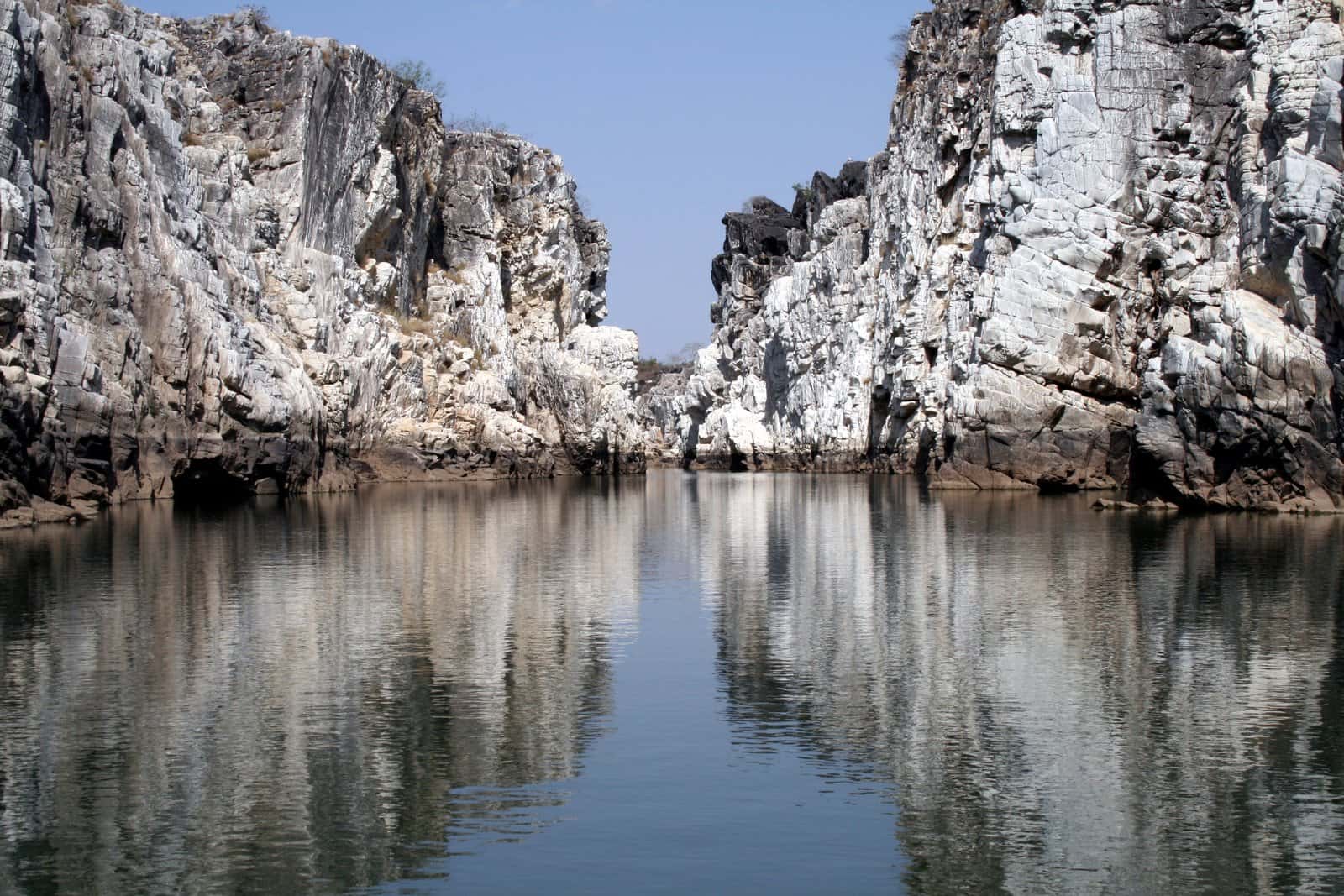
- The Marble Rocks at BhedaghatThe signature sight: a gorge of soft white and grey dolomite cliffs rising sheer from the Narmada, about 25 to 27 km from the city. The classic way to see it is the shared rowing boat that runs the gorge and back in about an hour, with the boatman pointing out the shapes in the marble. Boating is seasonal, covered in the best-time section.
- Dhuandhar FallsA short walk from the marble gorge, the Narmada plunges through a narrow gap in a roaring cloud of spray, which is what dhuan, smoke, means. Entry is free. The falls are most powerful in the monsoon; a cable car crosses the gorge for the best aerial view, covered in the experiences section.
- Chausath Yogini Temple (Golki Math)A circular 10th-century Kalachuri-era shrine on a hilltop above the river, one of India's largest yogini temples and on UNESCO's tentative World Heritage list. Reaching it means a climb of about 150 steps, so it rewards those who can manage stairs and offers a fine view over the gorge from the top.
- The city sightsIn Jabalpur itself, the 12th-century Gond-era Madan Mahal Fort sits on a hill with sweeping views, the nearby Balancing Rock is a natural curiosity, and the Rani Durgavati Museum holds tribal sculpture and heritage. These are quick stops that round out a city half-day.
For most travellers Bhedaghat is the whole reason to be here, so give it the better part of a day and treat the city sights as a light add-on. The marble gorge by boat, the falls, the ropeway and the temple sit within a few kilometres of each other, so you can see them comfortably in a half to full day. The city fort, museum and balancing rock are worth an hour or two if you have a spare morning, but they are not why you came.
Signature experiences in and around Jabalpur
Beyond ticking off sights, these are the experiences people remember, and how to arrange them honestly, with the real fares and the seasonal catches.
- The Marble Rocks boat rideThe shared rowing boat through the marble gorge and back takes about an hour, with the boatman weaving stories about the shapes in the cliffs. It is genuinely worth it in the cool season. Fares are a small per-person seat charge on the shared boat, more for a private boat; agree the price and the length before you set off, and remember boating is suspended in the monsoon.
- The moonlit boat ride, if your dates matchOn a full-moon night the marble glows silver and the ride becomes the most magical thing in central India. But it runs only on a handful of nights a year, principally around Sharad Purnima in autumn and Buddha Purnima in early summer, so you must plan your visit around the full moon. Do not assume it is available any evening.
- The Dhuandhar ropewayThe cable car across the gorge gives the best view of the falls in full roar, running roughly 10:30 am to 6:30 pm depending on season and weather, with tickets commonly around 100 to 150 rupees per person and revised year to year. It also saves the walk down to the viewpoint, which helps in the heat or for tired legs.
- The Narmada aarti at GwarighatIn the city, the daily evening aarti at Gwarighat on the Narmada, around 7 pm for about 30 minutes, is the most atmospheric thing to do in Jabalpur itself: lamps, chants and floating diyas on the river. It is free to watch; arrive 15 to 20 minutes early for a good spot on the ghat.
- A tiger safari from the gatewayThe biggest experience the region offers is a jeep safari in Kanha, Bandhavgarh or Pench, all within a few hours' drive. Book the permit through the forest portal or your resort well ahead, and remember the core zones are closed in the monsoon, covered in the logistics section.
- Bargi Dam boatingAbout 40 km out, the reservoir behind Bargi Dam offers boating and a relaxed cruise, open roughly 10 am to 6 pm. It is a gentle water outing for families or a spare half-day rather than a headline sight, and pairs well with the drive out toward the countryside.
If you do only one thing slowly, make it the marble gorge by boat in the cool season, ideally with the low light of early morning or late afternoon on the white cliffs. It is quiet, unhurried and unlike anywhere else in India, and the boatman's patter is part of the charm. If you can align your dates with a full moon, the moonlit version is unforgettable, but the ordinary daytime ride is already the highlight of a Jabalpur visit, so do not skip it waiting for a moon that may not fit your trip.
Where to stay in Jabalpur, and how many nights
Stay in the city for connections and food, or out at Bhedaghat for the riverside quiet. One night is usually enough before you drive on to the parks.
- Jabalpur city: convenient and connectedThe city has the widest choice of hotels, close to the station, the airport road and the restaurants, and is the practical base if you are arriving late or leaving early for the parks. Areas around the civil lines and the main road hold most of the reliable mid-range and business hotels.
- Bhedaghat: riverside and quietStaying at Bhedaghat, with MP Tourism's Marble Rocks property and a few homestays and resorts, puts you beside the gorge for a slow morning boat ride and a sunset over the marble. Quieter and more scenic, but you are 25 to 27 km from the city and its transport links.
- How many nightsOne night in Jabalpur or Bhedaghat is usually enough: a half to full day covers Bhedaghat and the city sights before you move on to Kanha or Bandhavgarh. Add a second night only if you want the moonlit ride, a slower pace, or a Bargi Dam outing.
- Room budgetsBudget rooms run from about 800 to 1,800 rupees, mid-range hotels about 2,000 to 4,500 rupees, and MP Tourism and boutique stays about 2,500 to 6,000 rupees. Prices rise in the winter peak and around festivals, so book ahead in season.
If Jabalpur is a springboard to the tiger reserves, stay in the city for the easy transport and an early start on the drive out. If Bhedaghat and the boat ride are the point of your trip, stay by the river to catch the gorge in the soft light of early morning or late afternoon, when the day-trip crowds from the city have gone. Either way, one night is the norm, since the region's real draw is the parks a few hours further on.
Jabalpur costs and a realistic budget
Jabalpur is gentle on the wallet. Here is what the main things cost, so you can plan and avoid being overcharged on taxis and boats.
- Rooms and foodBudget rooms from about 800 to 1,800 rupees, mid-range about 2,000 to 4,500 rupees, and MP Tourism or boutique stays about 2,500 to 6,000 rupees. Local vegetarian food is cheap and good; a proper meal at a mid-range restaurant is a small outlay.
- The Bhedaghat costsEntry to Dhuandhar Falls is free. The Marble Rocks boat ride is a small per-person seat charge on the shared boat, more for a private boat, and the ropeway is commonly around 100 to 150 rupees per person. Agree the boat fare before you board, as visitors are sometimes quoted high.
- Getting around and to the parksA full sightseeing taxi for a city-and-Bhedaghat day is commonly about 2,500 to 3,500 rupees, and a Jabalpur-to-Kanha one-way transfer is often about 3,500 to 5,000 rupees, depending on the vehicle and season. Settle the rate before you start, and expect higher prices in the winter peak.
- Cash and cardsHotels and bigger restaurants take cards and UPI, but the boat, the ropeway, small eateries and roadside stops run on cash. There are plenty of bank ATMs in the city, so carry enough cash for the day, especially for the Bhedaghat outing.
As with much of India, the taxi fare and the private-boat charge are negotiable and quoted high to visitors, so the single habit that keeps costs down is to agree the price before anything begins, whether that is a sightseeing taxi, a private boat, or a transfer out to the parks. Fixed things like the ropeway and the shared-boat seat leave little room to haggle, but the car hire and the private boat come down without drama once you settle the number in advance.
Practical logistics: safari booking, food, money and getting around
The practical machinery of a Jabalpur trip, from how the tiger-safari booking works to food, ATMs, SIM and local transport.
- How the tiger-safari booking worksJeep safaris for Kanha, Bandhavgarh and Pench are booked online through the Madhya Pradesh forest portal at forest.mponline.gov.in. Core-zone permits sell out in peak season, so book well ahead, and it is easiest to book through your resort or a reputable operator who handles the permit, the gate entry and the naturalist guide.
- Getting aroundThe city is spread out, so use auto-rickshaws and app cabs within town and hire a car for Bhedaghat and the parks. Bhedaghat is a 40-minute drive; a half-day taxi covers the boat, the falls and the temple comfortably.
- Food and moneyJabalpur's food is largely vegetarian and good value, with famous local sweets and street snacks. Bank ATMs are plentiful in the city; carry cash for the boat, the ropeway and small roadside stops, which do not always take cards.
- SIM, signal and languageMobile coverage in the city and at Bhedaghat is fine for maps, calls and data, though it thins out on the drives to the parks. Hindi is the everyday language; English is understood at hotels and in the tourist trade, so communicating is easy.
Safety, the water, and staying well
Jabalpur is a calm, welcoming city with few tourist scams. The real cautions are the fast Narmada water, the heat, and standard travel sense.
- Respect the riverThe Narmada is deceptively strong, especially near Dhuandhar Falls and in and after the monsoon. Do not clamber onto wet rocks near the falls, keep to marked viewpoints, wear the life jacket on the boat, and follow the boatman's instructions. Most Bhedaghat mishaps come from people getting too close to the water.
- Heat and hydrationIn the warmer months the open ghats and the climb to the Chausath Yogini Temple are tiring, so carry water and sun protection and do the outdoor bits early or late. Take the usual care with street food and drink bottled or filtered water.
- Minor overcharging, not much elseJabalpur has little of the aggressive touting of the bigger tourist towns. The main friction is being quoted a high taxi or private-boat fare as a visitor, which a firm, friendly agreement in advance settles. Petty theft precautions in crowds are sensible but the city is generally easy-going.
- On the safariIn the parks, stay in the vehicle, keep quiet near wildlife, and follow your guide and the forest rules. Carry any regular medication with you, as the reserves are rural and pharmacies are limited once you are out of Jabalpur.
Jabalpur is generally regarded as a calm, low-hassle city, and solo and female travellers usually find it manageable with standard precautions. The busiest tourist point is Bhedaghat, which is well populated by day; as anywhere, prefer daytime for the gorge and the temple climb, keep to populated areas after dark, and use registered taxis or app cabs for the drive out. The city itself is more workaday than touristy, which tends to make it easier, not harder, to travel.
Jabalpur for every kind of traveller, and on access
Jabalpur suits different visitors in different ways, from wildlife travellers using it as a gateway to families on the boat. Here is the one tip that matters for each, including how a senior sees Bhedaghat comfortably.
- Wildlife travellersThis is your gateway. Fly or train in, see Bhedaghat if time allows, then drive to Kanha, Bandhavgarh or Pench. Book your safari permits ahead through the forest portal and time the trip for the open season, October to June, since the core zones close in the monsoon.
- Families with childrenEasy and rewarding: the shared boat ride, the roar of the falls, the ropeway and Bargi Dam boating all appeal to children. Keep little ones close to the water and use the life jackets, and break the day so the heat does not wear them out.
- Senior travellers and on accessibilityVery doable with planning. The boat ride and the Dhuandhar ropeway let you see the best of Bhedaghat with little walking, but the Chausath Yogini Temple means a climb of about 150 steps, so skip it if stairs are hard. Visit in the cool season, do the outdoor parts early, and keep a driver for the day rather than walking between sights.
- CouplesThe moonlit boat ride, if your dates align with the full moon, is as romantic as central India gets, and a riverside stay at Bhedaghat makes a quiet escape. Even the ordinary sunset over the marble is lovely and unhurried.
- PhotographersThe white marble in low light, the falls in full monsoon roar, and the aarti lamps at Gwarighat are the standout frames. Ask before photographing people at prayer, and note the marble looks best in soft early or late light rather than harsh midday sun.
- Backpackers and budget travellersCheap rooms, cheap food and easy rail links make Jabalpur an easy budget stop, and shared boats and public transport keep costs low. It works well as a low-cost hinge between the tiger reserves on a longer central-India route.
A suggested Jabalpur and Bhedaghat itinerary
How to shape a half to full day so you catch the marble gorge at its best light, the falls, the temple and, if you have time, the city and the parks beyond.
- Morning: Bhedaghat firstDrive out to Bhedaghat early, about 40 minutes, and take the marble-rocks boat ride while the light is soft and the crowds are thin. Then walk over to Dhuandhar Falls and take the ropeway across the gorge for the best view of the water in full roar.
- Midday: the temple and lunchIf you can manage the climb of about 150 steps, go up to the Chausath Yogini Temple for the view over the gorge and the 10th-century carvings. Break for lunch at one of the riverside spots before the afternoon heat, or head back toward the city.
- Afternoon and evening: the cityBack in Jabalpur, fit in Madan Mahal Fort and the Balancing Rock, and end at the evening Narmada aarti at Gwarighat around 7 pm. This rounds out a full day without feeling rushed.
- If you have more time, drive to the parksMost travellers spend one night here, then drive on: about 3.5 to 4 hours to Kanha, a little more to Bandhavgarh or Pench. Add a Bargi Dam morning or a moonlit boat night only if your dates and interests call for it.
The single thing that breaks a Jabalpur plan is arriving in the monsoon expecting the gorge boat, which is usually suspended from about July to September when the Narmada is high. Build your trip for the cool season if the boat ride matters, and if you have set your heart on the moonlit ride, align your dates with a full moon, principally Sharad Purnima or Buddha Purnima, since that ride does not run every night. Get the season right and the rest of the day falls into place.
The real questions travellers ask about Jabalpur
Straight answers to the questions that come up again and again on traveller forums, so you arrive already knowing the score.
- Is Jabalpur worth a stop, or just a gateway?Both. Most travellers pass through on the way to the tiger reserves, but Bhedaghat, with the marble gorge, the falls and the 10th-century temple, is genuinely worth a half to full day in its own right. Give it the time and it is more than a stopover.
- How many days do I need?One night is the norm: a half to full day covers Bhedaghat and the main city sights before you drive on. Add a second night only for the moonlit ride, a slower pace, or a Bargi Dam outing.
- Is the boat ride worth it, and can I do it in the monsoon?The marble-rocks boat ride is the highlight and well worth it in the cool season. But it is usually suspended from about July to September when the Narmada is in spate, so a monsoon visitor sees the falls at their most dramatic but generally cannot take the gorge boat.
- Can I do the moonlit ride any night?No. The famous moonlit boat ride runs only on a few full-moon nights a year, principally around Sharad Purnima in autumn and Buddha Purnima in early summer. Plan your dates around the full moon if that is what you want, and do the ordinary daytime ride otherwise.
- How do I get from Jabalpur to Kanha or Bandhavgarh?By road with a hired car. Kanha is about 160 to 172 km, roughly 3.5 to 4 hours via Mandla, and Bandhavgarh a little further. Book the safari permits ahead through the forest portal, and remember the core zones close for the monsoon, roughly July to September.
- When exactly is the Narmada aarti, and where?The evening aarti is at Gwarighat, on the river within the city, around 7 pm for about 30 minutes. Arrive 15 to 20 minutes early for a good spot on the ghat; it is free to watch and the most atmospheric thing to do in the city itself.
Planning Jabalpur and a central-India tiger trip from abroad
Jabalpur is the practical gateway to Kanha, Bandhavgarh and Pench. Get the season and the safari booking right from abroad and the rest is straightforward.
- Time it for the open seasonThe tiger reserves are open for safari from about October to June and closed in the monsoon, roughly July to September, when the core zones shut and the Bhedaghat boating pauses. Plan your India dates in the cool, dry season so you catch both the safari and the marble-rocks boat ride.
- Book the safari permits earlyCore-zone jeep permits for Kanha and Bandhavgarh sell out in peak season and are booked through the Madhya Pradesh forest portal. The simplest route from abroad is to book a reputable resort or operator who arranges the permit, the gate entry and the guide, so you are not wrestling with the portal from another time zone.
- Fly in, then driveFly into Delhi or Mumbai, connect to Jabalpur by domestic flight, see Bhedaghat, then drive about 3.5 to 4 hours to Kanha or a little more to Bandhavgarh. Jabalpur is the natural hinge of the trip, which is why almost every central-India safari runs through it.
- Easy and low-hassle on the groundJabalpur is a workaday city with little aggressive touting, so it is an easy landing for a first central-India trip. English is understood at hotels and in the tourist trade, food is largely vegetarian and safe, and a hired car with a driver removes most of the friction.
Money, connectivity and timing for foreign visitors
The practical basics an overseas traveller needs for Jabalpur and the drive out to the parks: cash, cards, a SIM, and how many days to give it on a wider India trip.
- Carry cash for the boat and the roadCards and UPI work in city hotels and bigger restaurants, but the boat, the ropeway, small eateries and roadside stops on the drive to the parks are cash places. Draw cash at a city ATM before you head out to Bhedaghat or the reserves, where machines are scarce.
- Get a SIM in the metroPick up an Indian tourist SIM or an eSIM when you land in Delhi or Mumbai rather than hunting for one in Jabalpur. Coverage in the city and at Bhedaghat is fine, though it thins out on the forest drives, so download offline maps before you leave town.
- How long to give it on a bigger tripOn a central-India trip, one night in Jabalpur or Bhedaghat plus two to three nights at a tiger reserve is a good balance: enough for the marble gorge and a couple of safaris without rushing. Jabalpur is the transit hinge, not the place you linger.
- Time your visit to your priorityCome October to March for the best all-round weather, the boat ride and the safari. If the moonlit ride is the priority, align with a full moon; if the thundering monsoon falls are the draw, come in the rains and accept that the boat and the core-zone safari will be off.
Jabalpur is an unusually smooth introduction to the heart of India: a real working city rather than a tourist bubble, with a genuine natural wonder at Bhedaghat and the country's finest tiger reserves within a half-day's drive. Fly in, give Bhedaghat a morning, then let the trip open out into the forests of Kanha or Bandhavgarh. Many overseas visitors find the mix of the marble gorge and the tiger country is the part of the journey they remember most.
Why the Narmada carved a canyon of white stone at Bhedaghat
At Bhedaghat the Narmada, one of India's most sacred rivers, has spent an immense span of time cutting a gorge through a band of soft dolomitic marble, leaving cliffs of white and grey stone that rise sheer from the water and glow when the light is low. Local tradition holds the Narmada as a goddess, older and holier than the Ganges in the belief of many who live along her, and the marble reach at Bhedaghat is among her most revered stretches. It is also a place where geology and legend meet: fossil-bearing rocks and, at some ghats, fragments identified as dinosaur eggshell have been found in the region, a reminder of how old this river valley is. On a full-moon night, when the boat glides between the pale cliffs and the marble turns to silver, it is easy to see why the gorge has drawn pilgrims, poets and travellers for centuries. No single scriptural verse fixes the story of the stone; what is reliable is the river's sanctity in living tradition and the plain wonder of the marble itself.
Planning a Jabalpur trip?
Our Madhya Pradesh travel experts plan your full journey for you: route, hotels, darshan timings and transport. You get a free day-by-day plan and an exact quote on WhatsApp, usually within a few hours. No payment is needed to get your plan.