Sanchi Travel Guide
The comfortable months are November to March , and the single most useful choice you make is the time of day. The hilltop is open and shadeless, so come early or late, not at noon.
When to visit Sanchi, and the hour that matters
The comfortable months are November to March, and the single most useful choice you make is the time of day. The hilltop is open and shadeless, so come early or late, not at noon.
- November to March: cool and clearThe pleasant season on the Malwa plateau, comfortable by day and cold at dawn, so carry a layer for an early start on the hill. This is also when the late-November relic festival fills the town with pilgrims, so the place feels alive.
- April to June: hot, and hard on the open hillCentral India gets fierce in summer, with average highs near 40 degrees, and Sanchi's hilltop has almost no shade. If you must come then, be on the hill at sunrise and off it before mid-morning, and carry water.
- July to September: green but humidThe monsoon brings heavy rain and a green, atmospheric hill, but slippery steps and grey light for the carving. The ASI site lists the best season as November to April, which is the honest steer for most travellers.
- Go early or late in the dayThe monuments open sunrise to sunset every day. The soft light of early morning and late afternoon is best for the gateway carvings and the kindest on the open hill, so build your day so the climb is not at midday.
Sanchi is a single open hill with the monuments spread across the top, and there is very little tree cover up there. In the cool months this is a joy; from April to June the middle of the day is genuinely tiring. Whatever the season, aim for the first or last couple of hours of daylight: the light rakes across the toranas and shows the carving at its best, and you are not standing in full sun while a guide walks you through 2,000 years of history.
How to reach Sanchi, and the Bhopal day trip
Almost everyone reaches Sanchi from Bhopal, about 46 to 48 km away, either by a short train ride to Sanchi's own station or by car. The nearest airport is Bhopal.
- By train from BhopalSanchi has its own small station, code SCI, about 1 km from the monuments. Roughly five direct trains a day run from Bhopal Junction, taking about 28 to 49 minutes, with second-class fares from about 150 rupees. The train is the cheapest and often the fastest way in, though the timings tie you to the schedule for the return.
- By car from BhopalBy road it is about 46 to 48 km from Bhopal city, roughly 1 hour to 1 hour 30 minutes, and a car gives you the freedom to add Udayagiri and Vidisha on the same day. We can arrange a car with an experienced driver for the full heritage day.
- Nearest airportBhopal's Raja Bhoj Airport is the nearest, about 55 to 57 km from Sanchi, roughly 1 hour 30 minutes by road, with domestic connections to Delhi, Mumbai and other cities. There are no flights into Sanchi itself.
- Train or car, the honest callIf Sanchi is your only stop, the train is simple and cheap. If you want to pair it with Udayagiri caves and the Heliodorus pillar at Vidisha in one day, take a car or a guided day tour, because juggling the three by train and auto eats the day.
Fly into Delhi or Mumbai, then take a domestic flight or train to Bhopal, and visit Sanchi as a half-day or day trip about 46 to 48 km away. Sanchi has no airport of its own.
Fly into Delhi or Mumbai and connect onward to Bhopal. From Bhopal the monuments are an easy day trip by car or the short train hop to Sanchi station.
Reach Bhopal by air or train, then take the short train to Sanchi station or drive about an hour. Vidisha, on the main line, is also close, so many trains stop there too.
The Great Stupa, the four gateways and the Ashoka pillar
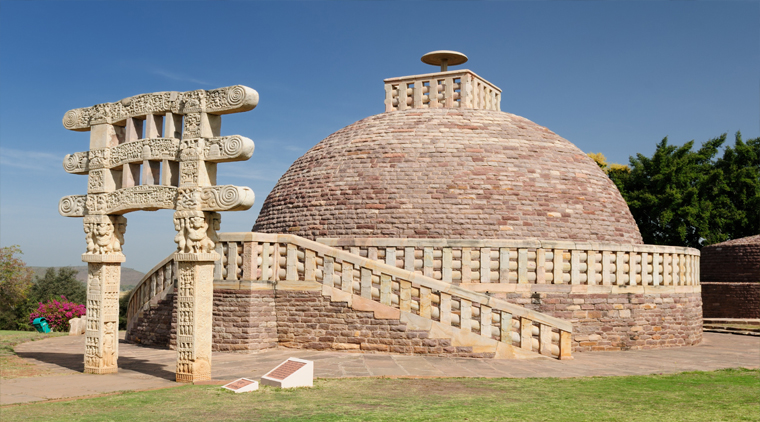
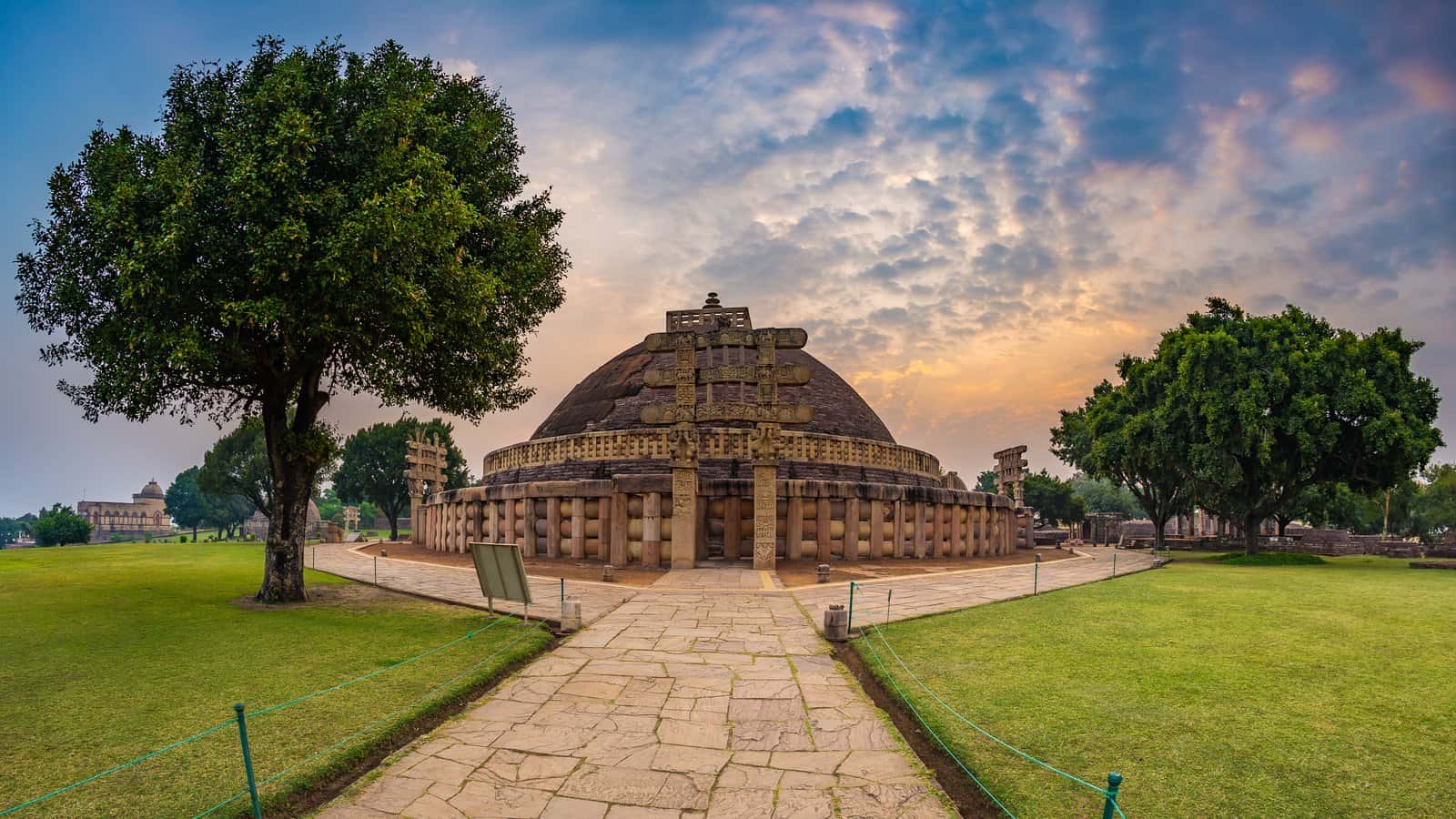
Sanchi is the Great Stupa with its four carved gateways, the Ashoka pillar, the smaller stupas and the monastery ruins. A little context turns a pile of old stone into one of the great sights of India.
- The Great Stupa, Stupa Number 1The centrepiece: a solid hemispherical dome about 36 metres across and roughly 16 metres high, begun under Ashoka in the 3rd century BCE and enlarged later. The dome is solid and cannot be entered; what you walk is the railed path around it, and what you study is the carving on the four gateways and the railing.
- The four toranas, the gatewaysAdded in the 1st century BCE, the four gateways at north, south, east and west are the reason to come. Every post and crossbar is dense with relief carving of the Buddha's past lives, the Jataka tales, and scenes from his life. This is the high point of early Buddhist art in India.
- The Ashoka pillar and Stupas 2 and 3Near the south gateway stand the remains of Ashoka's polished sandstone pillar, once topped by a lion capital. Stupa 3 nearby once held the relics of two of the Buddha's chief disciples, and Stupa 2, lower down the hill, has its own finely carved railing worth the short walk.
- The monasteries, temples and the hill itselfAcross the top of the hill lie the ruins of monasteries and temples spanning many centuries, including the apsidal Temple 18 and the Gupta-era Temple 17. Allow time to wander; the views over the plain and the spread of monuments are part of the experience.
The carving at Sanchi is from the aniconic phase of Buddhist art, which means the Buddha himself is never shown as a human figure. Instead he is present as a symbol: a wheel for his teaching, a tree for his enlightenment, a footprint, a riderless horse, an empty throne. Once you know this, the gateways come alive, because you start spotting the Buddha hidden in plain sight in scene after scene. This single idea, which most pages skip, is the most rewarding thing to carry up the hill.
Signature experiences at Sanchi
Beyond walking the hill, these are the things that make a Sanchi visit memorable: a guide on the gateways, the museum, the relics at the vihara, and the evening show.
- Walk the four gateways with a guideThe single best thing you can do here. A licensed guide at the gate, around 850 rupees for roughly 60 to 90 minutes, walks you panel by panel through the Jataka stories on each torana. The carving makes far more sense narrated, and an hour with a good guide is worth more than a day wandering alone.
- The Archaeological Museum at the foot of the hillThe ASI museum holds the lion capital from the Ashoka pillar and sculptures recovered from the site. It is open about 9 am to 5 pm but closed every Friday, so check your day. Allow about 45 minutes, and do it before or after the hill, not instead of it.
- The relics at Chetiyagiri ViharaJust outside the monument compound, the modern Chetiyagiri Vihara, built in 1952, enshrines the relics of Sariputta and Mahamoggallana, two of the Buddha's chief disciples. The relics are brought out for public viewing around the late-November festival, which draws thousands of pilgrims; outside that, the vihara itself is a calm stop.
- The evening Light and Sound showAn evening Light and Sound show near the monuments tells Sanchi's story; the counter typically opens about 6.30 pm with entry from about 7 pm, tickets commonly about 100 rupees for Indians and about 300 rupees for foreign visitors, with narration in Hindi. Reconfirm days and timing locally, as it is weather and season dependent.
- Sunrise or sunset on the hillIf you stay near Sanchi rather than day-tripping, the hill at first or last light, with the plain spread below and the dome catching the sun, is the quiet reward that a midday day-tripper never sees.
- Pair it with Udayagiri and VidishaWith a car you can add the Udayagiri rock-cut caves, about 8 to 13 km away, with their famous Varaha (boar) panel, and the Heliodorus pillar near Besnagar in Vidisha, a 2nd-century-BCE Greek ambassador's column. Together they make a deep one-day heritage circuit.
If you do only one thing properly at Sanchi, make it the gateways with someone who can read them, whether a hired guide or a good book in hand. The toranas are not background; they are the reason this hill is a World Heritage Site. Give them an unhurried hour, learn the symbol language so you can find the Buddha hidden in each scene, and a place that some visitors dismiss as one old dome becomes one of the most absorbing stops in central India.
Where to stay for Sanchi, and how long to give it
Most travellers base in Bhopal and day-trip; a few stay at Sanchi itself for the hill at dawn. Half a day covers Sanchi alone, a full day with Udayagiri and Vidisha.
- Bhopal: the practical baseBhopal, about 46 to 48 km away, has the full range of hotels, restaurants and connections, and most visitors day-trip from there by car or train. It also lets you combine Sanchi with Bhimbetka's rock shelters and Bhopal's own lakes and museums over a couple of days.
- Stay at Sanchi for the hill at dawnThe town itself is tiny with limited stays. The MP Tourism MPT Gateway Retreat sits about 500 metres from the stupa, with rooms broadly about 1,500 to 3,600 rupees depending on season and category, and is the natural choice if you want the monuments at sunrise without an early drive. Book MP Tourism stays ahead in peak winter.
- How long to give itHalf a day, about 2 to 3 hours on the hill plus the museum, is enough for Sanchi alone. A full day of about 8 hours lets you pair it with Udayagiri caves and the Heliodorus pillar at Vidisha without rushing. Rushing the hill in under an hour wastes the trip.
- Combine with BhimbetkaMany travellers pair Sanchi with the Bhimbetka rock shelters, another UNESCO site, on the other side of Bhopal, over a two-day heritage break based in the city. The two together make a strong central-India heritage trip.
Sanchi rewards a half day, not a long stay, so unless you specifically want sunrise on the hill, Bhopal is the sensible base. You get comfortable hotels, a choice of food that the small town cannot match, and the flexibility to fold in Bhimbetka, the Bhopal lakes and the state museum. The one good reason to sleep at Sanchi is the MPT Gateway Retreat a few hundred metres from the stupa, for travellers who want the monuments to themselves at first light.
Sanchi costs: tickets, guide and a day budget
Sanchi is inexpensive. Here is what the entry tickets, the guide, the museum and the show actually cost, with the official ASI rates, so you can plan and avoid being overcharged.
- The ASI entry ticketFor the monuments the ASI ticket is about 40 rupees cash or about 35 rupees online for Indian visitors and citizens of SAARC and BIMSTEC countries, and about 600 rupees cash or about 550 rupees online for other foreign visitors. Children up to 15 are free. A higher ticket with extra facilities is about 850 rupees cash or about 800 rupees online.
- The museum and the showThe Archaeological Museum is separate and modest, roughly 30 rupees for Indians and about 250 to 500 rupees for foreign visitors, closed Fridays. The evening Light and Sound show is commonly about 100 rupees for Indians and about 300 rupees for foreign visitors. Reconfirm all of these on arrival, as the museum fee in particular has been revised.
- The guideA licensed guide at the gate is around 850 rupees for roughly 60 to 90 minutes, the single best money you spend here. Agree the rate and the duration before you start, and it is fair to share a guide between a small group to split the cost.
- A rough day budgetExcluding your Bhopal hotel, a comfortable Sanchi day, entry, a guide, the museum, lunch and transport, runs roughly 1,500 to 3,000 rupees per person by shared car, less by train, and naturally more for a private full-day car tour that adds Udayagiri and Vidisha.
The single money tip at Sanchi that almost no page mentions: the official ASI ticket is cheaper booked online than paid in cash at the gate, about 35 rupees instead of 40 for Indian visitors and about 550 instead of 600 for foreign visitors. Book on the ASI portal before you arrive, both to save a little and to skip the queue, and treat any third-party site charging a large markup with suspicion. Always reconfirm the current rate on the official portal, as fees are revised from time to time.
Practical logistics: tickets, food, water and the Friday closure
The small things that make a Sanchi day smooth: the sunrise-to-sunset window, the Friday museum closure, carrying water and food, and how to get around the hill.
- Timings and the Friday museum closureThe monuments are open sunrise to sunset every day. The Archaeological Museum, though, is closed every Friday and open about 9 am to 5 pm otherwise, so if the museum matters to you, do not come on a Friday. Plan the museum before or after the hill.
- Carry water and a snackThe hilltop has very little shade and the town is small, with food mostly down at the base and at the Gateway Retreat. Carry water and a snack up the hill, wear a hat and sunscreen in the warmer months, and shoes you can walk and climb gentle steps in.
- Getting around the siteThe monuments are spread across the hilltop and you cover them on foot over uneven ground and a few flights of steps. From Sanchi station it is about 1 km to the foot of the hill; an auto or a short walk handles that last stretch.
- Cash, cards and the basicsKeep some cash for tickets at the gate, the guide and small eateries, as not everything takes cards or UPI in a town this size. Hindi is the local language; English is understood by guides and at the tourism hotel.
The most common avoidable mistake at Sanchi is arriving on a Friday expecting the Archaeological Museum, which is closed every Friday, while the monuments stay open sunrise to sunset. If your only free day is a Friday, you can still walk the hill and the gateways, just plan to skip the museum, where the Ashoka lion capital lives. If the museum is a must-see for you, choose any other day of the week.
Safety, the heat and respectful behaviour
Sanchi is calm and very safe by Indian standards. The real risks are the sun on the open hill and the uneven ground, not crime. A little care and respect keeps the visit easy.
- Heat and sun are the main riskThe open, shadeless hilltop in the warmer months is the genuine hazard here. Visit early or late, carry and drink water, wear a hat and sunscreen, and take the steps slowly. The ropeway-style shortcuts of bigger sites do not exist, so pace the climb in the heat.
- Watch your footingThe ground across the hill is uneven and some steps are worn and without rails. Wear proper shoes, mind the edges around the stupas and railings, and keep a hand on children near the drops. This is the kind of injury risk that matters more here than any crime.
- It is a low-hassle, safe siteSanchi is a quiet heritage town with very little of the tout pressure of busier destinations, and is widely reported as safe and relaxed, including for solo and women travellers, with standard sensible precautions. Most friction is no more than the odd insistent souvenir or guide approach, handled with a polite no.
- Respect a living sacred siteSanchi is sacred to Buddhists and a place of pilgrimage. Walk clockwise around the stupas as pilgrims do, keep your voice down, dress modestly, remove shoes where asked at the vihara, and ask before photographing people at prayer, especially around the late-November relic festival.
Sanchi is one of the gentler, lower-hassle stops in central India and is generally reported as safe and relaxed for solo travellers and women, with the usual sensible precautions: visit in daylight, keep to the open site, and arrange your return from Bhopal before dark, since the last convenient trains and the day-tour cars run to a schedule. The town empties in the evening, so plan your transport rather than relying on finding a ride late.
Sanchi for every kind of traveller, and on access
Sanchi suits very different visitors. Here is what it offers you and the one tip that matters for each, including how a senior visits the hill comfortably.
- History and art loversThis is your place. The four gateways are a master class in early Indian sculpture, and the site spans 1,300 years of Buddhist history. Take a guide or a good guidebook, give it half a day, and read the gateways panel by panel.
- Buddhist pilgrimsSanchi is among the oldest sanctuaries in the Buddhist world, with the relics of Sariputta and Mahamoggallana at the Chetiyagiri Vihara. Time your visit to the late-November festival to see the relics shown to the public, or come any time for quiet circumambulation of the stupas.
- Senior travellers and on accessibilityVery doable with planning, but be honest about the hill: there is a climb to the monuments, uneven ground on top and few rails. Visit in the cool of morning, take it slowly, carry water, and consider a car to the base rather than the train-and-walk. The hilltop is not wheelchair-friendly, so set expectations for anyone with limited mobility.
- Families with childrenEasy and open, with space to roam and stories in the carving to keep older children engaged. Mind the unguarded edges around the stupas with little ones, bring water and snacks, and plan the day around the train or car times rather than a long stay.
- PhotographersEarly and late light on the gateways is superb, and the dome against the plain is a classic frame. The museum bans photography of some exhibits, so check inside, and ask before photographing pilgrims, especially at the festival.
- First-time central India travellersSanchi pairs naturally with Bhopal, Bhimbetka and Udayagiri for a compact, deeply historic introduction to central India that most foreign itineraries miss. It is calm, cheap and genuinely world-class.
A suggested Sanchi itinerary
How to shape a half day for Sanchi alone, or a full day that pairs it with Udayagiri and Vidisha, so you read the gateways in good light and never hit a shut museum.
- The half-day version: Sanchi onlyLeave Bhopal early by car or the morning train, reach the hill while it is cool, take a guide for the gateways, walk the stupas and monasteries over about 2 to 3 hours, then drop down to the museum for about 45 minutes, avoiding Friday. Back in Bhopal by lunch or early afternoon.
- The full-day heritage circuitBy car, do Sanchi in the cool morning, then drive about 8 to 13 km to the Udayagiri rock-cut caves for the Varaha panel, about 1.5 hours, then the Heliodorus pillar near Besnagar in Vidisha and, if time allows, the Vidisha museum. A full day of roughly 8 hours, back in Bhopal by evening.
- Stay-over version for the hill at dawnSleep at the MPT Gateway Retreat near the stupa, walk up for sunrise with the monuments almost to yourself, do the museum when it opens at about 9 am, and add Udayagiri and Vidisha at a relaxed pace through the day.
- Two-day central-India heritage breakBase in Bhopal: day one Sanchi with Udayagiri and Vidisha, day two the Bhimbetka rock shelters and Bhopal's lakes and museums. Two UNESCO sites and a handsome city in a comfortable weekend.
The one thing that breaks a tight Sanchi plan is the museum. The monuments are open sunrise to sunset every day, but the Archaeological Museum is closed every Friday and runs about 9 am to 5 pm otherwise. If you want the Ashoka lion capital and the sculptures, do not come on a Friday, and on the stay-over plan do the hill at dawn and the museum after it opens at about 9 am, not before.
The real questions travellers ask about Sanchi
Straight answers to the questions that come up again and again on traveller forums, so you arrive already knowing the score.
- How long do you really need?About 2 to 3 hours on the hill plus 45 minutes for the museum is the sweet spot for Sanchi alone, a comfortable half day. A full 8-hour day lets you add Udayagiri and Vidisha. Under an hour and you have walked past the carving that makes the place worth the trip.
- Is it worth a guide?Yes, for most people. A licensed guide at around 850 rupees for 60 to 90 minutes turns the gateways from pretty stone into readable stories, which is the difference between a tick-box stop and a memorable one. If you would rather go solo, at least read the aniconic symbol rule first.
- Train or car from Bhopal?Train if Sanchi is your only target: cheap, about 28 to 49 minutes, five a day, and Sanchi has its own station about 1 km from the hill. Car if you want to add Udayagiri and Vidisha or travel on your own schedule, since chaining the three sites by public transport eats the day.
- Is the museum really closed on Fridays?Yes. The ASI Archaeological Museum at the foot of the hill is closed every Friday and open about 9 am to 5 pm the rest of the week. The monuments on the hill stay open sunrise to sunset daily, so a Friday visitor can still see the stupas and gateways, just not the museum.
- When are the relics shown to the public?The relics of Sariputta and Mahamoggallana, kept at the Chetiyagiri Vihara, are brought out for public viewing around the late-November festival, traditionally on the last Sunday of November, drawing thousands of pilgrims. Outside that window you can still visit the calm vihara itself.
- Is Sanchi just one stupa, or worth the journey?It is far more than one dome: four masterpiece gateways, the Ashoka pillar, several stupas, monasteries and temples across 1,300 years, plus a fine museum, and the easy add-ons of Udayagiri and Vidisha. For anyone who likes history or art it is one of the most rewarding half-days in India.
Planning Sanchi from abroad
Sanchi is the oldest stone Buddhist sanctuary in India and one of the most rewarding half-days in the country, easily reached from Bhopal. A little preparation on tickets, heat and a guide makes it effortless.
- Know the foreigner ticket and book onlineThe ASI monument ticket for foreign visitors is about 600 rupees cash or about 550 rupees online, with the museum about 250 to 500 rupees and the evening show about 300 rupees. Book the monument ticket on the ASI portal to save a little and skip the queue, and reconfirm current rates before you go.
- Take a guide for the gatewaysThe carving is the whole point, and it is from the aniconic phase where the Buddha appears only as a symbol, a tree, a wheel, a footprint. A licensed guide at around 850 rupees for an hour or so unlocks all of it. This is the best money you will spend at Sanchi.
- Base in Bhopal, fold in BhimbetkaFly into Delhi or Mumbai, connect to Bhopal, and use the city as a comfortable base. Sanchi is a half-day trip; the Bhimbetka rock shelters, another UNESCO site, fill a second day, making a compact world-class central-India break that most foreign itineraries miss.
- Mind the heat and the open hillThe hilltop has almost no shade and central India is hot from April to June. Come November to March, visit early or late, carry water and sun cover, and wear shoes for uneven ground and a few steps. Sanchi is calm and low-hassle, so the heat, not crime, is the thing to plan around.
Sanchi on a wider India trip, and how long to give it
Where Sanchi fits on a Buddhist-heritage or central-India itinerary, how it pairs with Udayagiri and Bhimbetka, and how many days to budget for the Bhopal base.
- Where it sits on a Buddhist circuitSanchi is the great early-Buddhist art site, complementing the pilgrimage sites of Bodhgaya, Sarnath and Kushinagar in the east. It is the place to see how Buddhist architecture and storytelling matured in stone, and pairs well with a wider India trip rather than standing alone.
- Two days from a Bhopal baseGive central India about two days based in Bhopal: one for Sanchi with Udayagiri caves and the Heliodorus pillar at Vidisha, one for the Bhimbetka rock shelters and Bhopal itself. That covers two UNESCO World Heritage Sites at an unhurried pace.
- Connecting onwardBhopal sits on main rail and air routes, so Sanchi slots between Delhi or Agra to the north and the temples of Khajuraho or the forts of central India. Plan Sanchi as a half-day within a Bhopal stop rather than a special detour, and it costs you almost no extra time.
- Best window for an overseas tripNovember to March is the comfortable season and also when the late-November relic festival animates the town. Avoid April to June, when the open hill is punishing, and the monsoon months, when the steps are slick and the light is flat for the carving.
Sanchi is one of those rare places that delivers far more than its modest reputation abroad suggests. It is the oldest standing stone Buddhist sanctuary in India, its gateways are a high point of early Indian art, and it is cheap, calm and easy to reach from a comfortable city base. Slot it into a Bhopal stop, give it a guided half day, and many overseas visitors find it one of the quiet highlights of a central-India trip.
The empty throne: how Sanchi shows the Buddha without showing him
Walk up to the four gateways of the Great Stupa and you will see crowds, kings, elephants, trees, wheels and thrones carved in dense, joyful detail, and yet you will never once see the Buddha as a person. This is the aniconic phase of Buddhist art, from about the 1st century BCE, when the Master was felt too sacred to depict as a human figure. So the sculptors showed him only by symbol: a wheel for the first sermon, a bodhi tree for the enlightenment, a pair of footprints, a riderless horse leaving the palace, an empty throne where a king or god bows to nothing the eye can see. Once a traveller learns this, the gateways change before them, because every scene becomes a puzzle solved, the Buddha present in the reverence of everyone around an empty space. That single idea, carved into stone here more than 2,000 years ago, is the keepsake of Sanchi, and the reason an hour with the gateways outlasts the memory of any photograph.
Planning a Sanchi trip?
Our Madhya Pradesh travel experts plan your full journey for you: route, hotels, darshan timings and transport. You get a free day-by-day plan and an exact quote on WhatsApp, usually within a few hours. No payment is needed to get your plan.
Tour packages that visit Sanchi
Every journey below is private, hand-crafted and fully customizable. Tell us your dates and we tailor the itinerary, the pace and the priests or guides around you.