Dapoli Travel Guide
The comfortable window is October to March , when the seas are calm and the boats run. The monsoon is lush but rough, and the dolphin and Suvarnadurg boats stop. Decide what you...
When to visit Dapoli, and the monsoon question
The comfortable window is October to March, when the seas are calm and the boats run. The monsoon is lush but rough, and the dolphin and Suvarnadurg boats stop. Decide what you want before you book.
- November to February: the sweet spotCool, dry and calm, with the best chance of clear morning dolphin boats and easy crossings to Suvarnadurg. This is when the Harnai fish auction is in full swing and the beaches are at their gentlest. It is also the busiest, so weekends and the Diwali and Christmas holidays fill up early.
- October and March: warm but fineStill good for the beaches and the boats, with fewer crowds than the peak weeks. By late March the Konkan afternoons turn humid, so do the boats and the forts early and keep the middle of the day for shade and a long lunch.
- April to May: hot, and mango seasonHot and sticky on the coast, but this is when the Ratnagiri Alphonso mangoes are at their peak, a real draw for those who come as much for the food as the sea. The boats still run in calm seas; just plan around the heat.
- June to September: green, wet, and boats offThe monsoon turns the Konkan brilliantly green with waterfalls and mist, and it is a beloved nature escape from Mumbai and Pune. But it rains most days, the sea is rough, swimming is dangerous, and the dolphin and Suvarnadurg boats are suspended, so come for the green and not for the water.
Dapoli in the monsoon, roughly June to September, is wonderful for greenery, waterfalls and atmosphere, and inland sights like the Unhavare hot springs and the Panhalekaji caves stay open and even improve in the mist. But the sea-dependent highlights, the dolphin boats and the boat crossing to Suvarnadurg, stop running in the rough seas, the Harnai fish auction is disrupted when boats stay in, and swimming is genuinely dangerous. If those experiences are why you are coming, plan for October to May instead and reconfirm conditions locally before you set out on any boat.
How to reach Dapoli
Dapoli has no airport or railway of its own. Almost everyone drives from Mumbai or Pune, or takes the Konkan Railway to Khed and transfers by road over the last stretch.
- By Konkan Railway via KhedThe nearest railhead is Khed on the Konkan Railway, reportedly about 30 to 40 km from Dapoli, roughly an hour by road. There is no train to Dapoli itself, so a rail arrival always ends with a taxi or bus transfer. One important catch: there is also a Khed near Pune, so book the Khed station in Ratnagiri district on the Konkan Railway line.
- From Mumbai by roadDapoli is reportedly about 225 to 230 km from Mumbai, roughly 5 to 6 hours via the NH-66 Mumbai to Goa highway and state roads. The highway is good, but the last stretch in towards Dapoli and the beaches can be narrow and potholed, more so after the monsoon, so allow extra time. We can arrange a car with a driver who knows the Konkan roads.
- From Pune by roadPune is reportedly about 180 to 195 km away, roughly 5 hours, most scenically via the Tamhini Ghat and Khed. The ghat is beautiful but winding and slippery in and after the rains, and road condition is the single most-asked question on the Dapoli traveller forums, so check current conditions before a monsoon-season drive.
- Nearest airportsThere is no airport at Dapoli. Pune, about 180 km away, and Mumbai, about 225 km away, are the practical full-service airports, both followed by a long road transfer. Ratnagiri has a small airport with limited service that you should treat as changeable and verify before relying on; for most travellers it is fly to Mumbai or Pune, then drive.
Fly into Mumbai, the nearest major international gateway, then drive about 5 to 6 hours down the NH-66 coast road to Dapoli. There are no international flights anywhere near Dapoli, and the journey is part of the Konkan experience.
Fly into Mumbai or Pune, then drive to Dapoli, about 5 to 6 hours from either. Dapoli pairs naturally with a wider Konkan coast loop down towards Ganpatipule and Ratnagiri.
Drive from Mumbai or Pune, or take the Konkan Railway to Khed and transfer by road for the last hour. Remember to book Khed in Ratnagiri district, not the same-named Khed near Pune.
The beaches, the UNESCO sea fort, and the heritage sights
Dapoli is a string of distinct beaches, a UNESCO-listed sea fort off Harnai, ASI-protected rock-cut caves, hot springs and clifftop temples. Here is how they fit together.
- The beaches: Murud, Karde, Ladghar, AnjarleMurud-Dapoli, reportedly about 11 km from town, has dark sand and water sports; Karde alongside it is the calmer family beach and a dolphin-boat launch; Ladghar, called Tamas Teerth, is known for reddish sand and sunsets; and Anjarle, reportedly about 20 km away, has clean pale sand, coconut groves and turtle conservation. Murud and Anjarle have official Maharashtra Tourism pages.
- Suvarnadurg, the UNESCO sea fortThe island fort off Harnai was inscribed in July 2025 as one of the twelve forts of the Maratha Military Landscapes of India, the country's 44th UNESCO World Heritage Site, and is protected by the Archaeological Survey of India. Reportedly built by Bijapur in the 16th century and reinforced under Shivaji around 1660, it is reached only by a short boat crossing from Harnai in the calmer months.
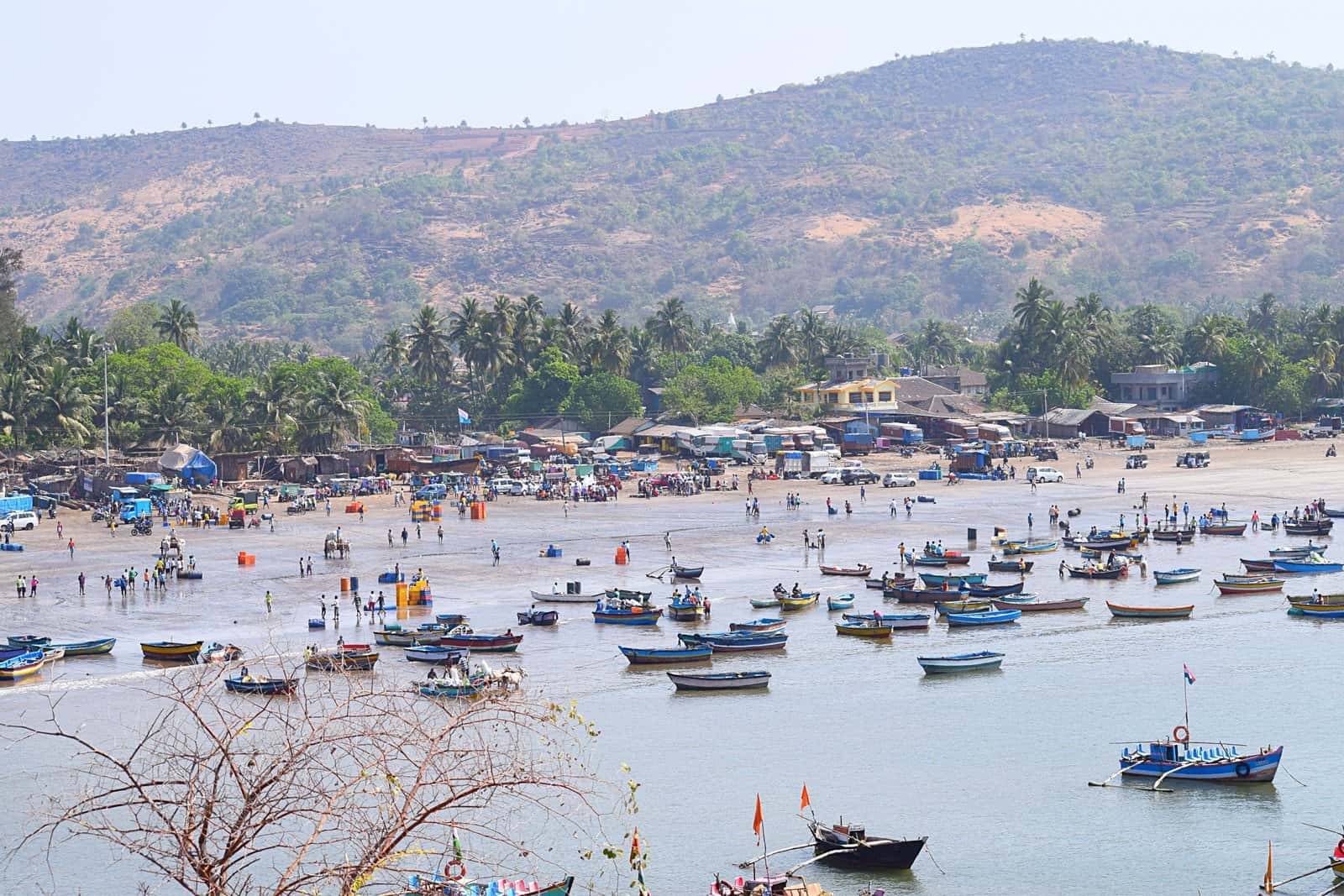
- Harnai port and the fish auctionHarnai is a busy fishing port and the setting for the famous evening fish auction, where the day's catch is sold off the boats. It is also the gateway to Suvarnadurg and its satellite land forts, Kanakdurg and Fattegad, on the headland above the port.
- Panhalekaji caves, Unhavare springs and the templesInland, the Panhalekaji caves are an ASI-protected complex of rock-cut Buddhist and Hindu shrines, reportedly about 30 km from town; the Unhavare hot springs offer a soak in natural sulphur water; and the small clifftop Kadyavarcha Ganpati at Anjarle and the spring-fed Keshavraj temple near Asud are gentle, atmospheric outings.
Think of Dapoli in three clusters. The coast, Murud, Karde and Ladghar, is the beach base and the dolphin-boat launch. Harnai, a little north, is the fish auction and the boat to UNESCO-listed Suvarnadurg. And the inland loop, Panhalekaji caves, Unhavare hot springs, Keshavraj and Anjarle, is the green, heritage and turtle side. Two days lets you do the coast and Harnai on one and the inland loop on the other, which is how most travellers shape a visit.
Signature experiences in Dapoli
Beyond lying on the sand, these are the experiences people remember, and how to arrange them honestly without the overpriced version.
- The Harnai fish auction at duskWatch the trawlers come in and the catch, pomfret, kingfish, mackerel, prawns and squid, auctioned right at the port, reportedly roughly between about 4 pm and 7 pm and busiest around 5 to 6 pm. It is loud, wet underfoot and strong-smelling, and that is exactly the point. Go in the cooler season from about October to April; in the monsoon the boats stay in and the auction is disrupted.
- A dawn dolphin boat off Murud or KardeLocal fishermen run dolphin-spotting boats, usually around 7 am, from Murud, Karde and Anjarle in the calm season from about October or November to May. Life jackets are provided and sightings are likely but not guaranteed. Go on a light stomach as it can be choppy, and agree the fare on the beach before you board, as prices are negotiated and not fixed.
- The boat to Suvarnadurg fortFrom Harnai, a short boat crossing arranged with local fishermen takes you to the UNESCO-listed island fort of Suvarnadurg, usually only in the calmer months from about October to May. The sea decides whether it runs, so be ready to flex your plan, and settle the fare before you set off.
- A soak at the Unhavare hot springsThe natural sulphur springs at Unhavare have bathing kunds with separate shelters for men and women, reportedly free to use. It is a low-key, local experience rather than a polished spa, rarely crowded, and one of the few highlights that stays open and atmospheric in the monsoon mist.
- The Panhalekaji caves and the inland templesFor a quiet half-day, the ASI-protected Panhalekaji caves reward anyone who likes history away from the crowds, and the short walk to the spring-fed Keshavraj temple through betel-nut groves is a gentle, green outing that families enjoy.
- Konkan food, the real reason many returnLean into the local kitchen: fresh fish curry, kokam sol kadhi, kombdi vade, prawns and, in April and May, Ratnagiri Alphonso mangoes. The agritourism homestays often cook the best of it, and some offer cooking sessions, which is a highlight in its own right.
If you do only one thing slowly, make it the Harnai evening, the fish auction as the boats come in, then the light going down over the headland and the silhouette of Suvarnadurg out at sea. Pair it with a homestay dinner of fresh Konkan fish, and you have the heart of Dapoli in a single evening, the working coast and the heritage and the food all in one place, long after a beach photo has faded.
Where to stay in Dapoli, and how many nights
Choose a sea-facing resort at Murud, Karde or Ladghar to be on the beach, or a Konkan agritourism homestay for food and character. Two nights is the sweet spot.
- Beach resorts at Murud, Karde and LadgharSea-facing resorts with pools and views, walkable to the sand, best if you want to wake up to the beach and have an easy base for the dolphin boats. Karde and Ladghar are the calmer stretches, which suits families and those who want a quiet sea, while Murud is livelier with water sports.
- Agritourism homestays inlandDapoli is well known for its agritourism and homestays among orchards and paddy, often the better choice for home-cooked Konkan food, value and a slower pace, and a real favourite with families. You will need a vehicle for the short hops to the beaches and sights, which most people have anyway.
- How many nightsTwo nights is the common length: one day for the coast and the Harnai fish auction, the second for Suvarnadurg, a dolphin boat, and the inland loop of caves, hot springs or Velas. Add a third night if you want to fold in the turtle festival at Velas or simply slow right down.
- When rates riseRooms and rates climb on weekends, in the Diwali and Christmas to New Year holidays, in the May summer break and in mango season, when this becomes a popular escape from Mumbai and Pune. Book ahead for those windows, and you will find midweek and shoulder-season stays much gentler on the wallet.
If food, value and a genuine sense of the Konkan matter most, the agritourism homestays usually win, with home-cooked fish thalis, orchard walks and warm hosts, at the cost of a short drive to the beach. If a pool, a sea view and stepping straight onto the sand matter more, a beach resort at Karde or Ladghar is the call. Many travellers split the difference and book a homestay but drive out for sunrise and the boats.
Dapoli costs and a realistic budget
Dapoli is gentle on the wallet outside peak weekends. The trick is that the boats and rides are priced on the spot, so here is how to plan and avoid being overcharged.
- The negotiated things: boats and ridesThe dolphin boats, the Suvarnadurg crossing and any short joyride are arranged on the spot with local fishermen and are not officially fixed. Rates vary by beach, season and how the boat is shared or chartered, so always agree the price and the length of the ride before you board, and prefer a shared boat to bring the per-person cost down.
- The free and near-free thingsThe beaches, the Harnai fish auction, the Unhavare hot springs and walking up to the Anjarle and Keshavraj temples cost nothing or next to nothing. Much of what makes Dapoli special is free, which is part of its appeal as a low-key getaway.
- Where the money goesYour main costs are the room, the long road transfer from Mumbai or Pune, fuel and tolls if you drive, and meals. Konkan food in homestays and small eateries is very good value; resorts cost more for the sea view and pool. Build in the boat fares as a negotiated extra rather than a fixed line.
- Cash and cardsCards and UPI work at resorts and bigger places in Dapoli town, but the boats, small eateries and roadside stalls run on cash. ATMs and petrol pumps cluster in Dapoli town and thin out once you reach the beaches and forts, so withdraw cash and fuel up in town before heading out.
Because every boat and ride in Dapoli is priced on the spot rather than fixed, the single habit that keeps costs sensible is to agree the fare and what it includes before anything starts, and to share a boat where you can. Quotes to visitors start high and come down without drama, and a price settled in advance turns the coast's only real friction into a non-event. Carry enough cash from a Dapoli-town ATM, as the boatmen do not take cards.
Practical logistics: getting around, network, fuel and cash
The small things that make a Dapoli trip smooth, from needing your own vehicle to the patchy mobile coverage and where to find an ATM.
- You really want your own wheelsThe beaches, Harnai, the caves and the springs are spread over many kilometres of country road, and public transport between them is thin. A self-drive car, a hired car with driver, or at least a scooter makes all the difference, and it is how almost every visitor gets around.
- Mobile network and internetCoverage is best on Jio and can be patchy or absent on other networks once you leave Dapoli town and head out to the beaches and forts. Resort and homestay wifi can be unreliable, so download your maps offline and do not count on a strong signal at every beach.
- Cash, ATMs and fuelATMs and petrol pumps are concentrated in Dapoli town and become sparse out at the coast and the inland sights. Withdraw cash and fill up before you set out for the day, since the boats and small eateries are cash-only and a pump can be a long way off.
- Language and the local rhythmMarathi is the local language, with Hindi widely understood and English fine at resorts and with younger people. The Konkan runs on an unhurried rhythm, so build slack into your day, especially around the tide and the boats, which the sea times rather than the clock.
Sea safety, boat safety, and staying well
Dapoli is friendly and low-hassle, but the sea is the real risk here. A little awareness about swimming, the boats and the monsoon keeps the trip happy.
- Which beaches are safe to swimKarde and Ladghar are generally the gentlest for families and weak swimmers, and Murud has a lifeguard post, but Konkan currents can pull suddenly even on a calm-looking day. Stay in the shallows, keep children within arm's reach, follow any local or lifeguard guidance, and never swim alone or after drinking. Drowning incidents do happen along this coast, so treat the sea with respect.
- Never swim in the monsoonFrom June to September the sea is rough and the currents are strong, and swimming is genuinely dangerous regardless of how inviting the green coast looks. The dolphin and Suvarnadurg boats are suspended for the same reason. Enjoy the beaches with your feet on the sand, not in the water, during the rains.
- Boat safetyThe dolphin boats and the Suvarnadurg crossing are run by local fishermen, not regulated tour operators. Insist on a life jacket for everyone, do not overload a small boat, avoid going out if the sea looks rough or the weather is turning, and never pressure a boatman to go out in marginal conditions. If in doubt, do not get on the boat.
- Health, sun and foodCarry sun protection and water for the open beaches and the boats, drink bottled or filtered water, and take the usual care with where you eat, though the fresh Konkan seafood in busy homestays and eateries is generally excellent and safe. Keep any regular medicines with you, as pharmacies are limited outside Dapoli town.
The sea is the one thing in Dapoli that can genuinely harm you, so read the no-swim monsoon rule and the sudden-current warning as real, not boilerplate. And watch wildlife responsibly: do not chase or crowd dolphins, keep a respectful distance, do not touch turtle nests or hatchlings at Anjarle or Velas, and follow the conservation volunteers' instructions. Responsible behaviour keeps these experiences alive for the next traveller.
Dapoli for every kind of traveller, and on access
Dapoli suits very different visitors in different ways. Here is what it offers you, and the one tip that matters for each, including how a senior enjoys it comfortably.
- Families with childrenA relaxed, safe-feeling beach break with gentle Karde and Ladghar sands, the fish auction as a spectacle and an easy dolphin boat. Pick the calmer beaches for swimming, keep little ones close in the water, and a homestay with home cooking usually suits families better than a formal resort.
- CouplesQuiet, green and unhurried, with sunset at Ladghar, a dawn dolphin boat and slow seafood dinners. A two-night stay at a homestay or a small sea-facing resort, away from the crowds of Goa, is the romantic version of the Konkan.
- Senior travellers and on accessibilityVery doable if you build the trip around the beaches, the fish auction, the hot springs and a gentle temple or two, and skip the boats and the cave and clifftop climbs if mobility is a concern. Stay at a flat, sea-facing resort at Karde or Ladghar to keep walking short, and avoid the long monsoon drives.
- Nature lovers and birdwatchersThe Konkan coast, the orchards and the inland greenery reward slow mornings, and the monsoon turns it lush with waterfalls. Add Velas for the Olive Ridley turtles in season, and Anjarle for the turtle conservation beach and the clifftop temple.
- Mumbai and Pune weekendersAn easy two-night escape, but the road is the deciding factor: check current conditions, especially after the monsoon, and start early to beat the city traffic. A homestay base and a relaxed agenda beat trying to cram everything into a single rushed day.
- FoodiesCome hungry. Fresh fish curry, kokam sol kadhi, kombdi vade, prawns and, in April and May, the legendary Ratnagiri Alphonso mango. The homestays cook the best of it, and a cooking session is a memorable add-on.
A suggested Dapoli itinerary
How to shape two unhurried days so you catch the dawn boats, the dusk fish auction and the inland heritage without rushing the long drive.
- Day one: arrive, beaches, Harnai at duskDrive in from Mumbai or Pune in the morning, settle into your homestay or resort, and spend the afternoon on Karde or Ladghar beach. Time the late afternoon for Harnai so you catch the fish auction as the boats come in, then watch the light fade over Suvarnadurg from the headland.
- Day two: dawn dolphin boat and the inland loopStart early with a dolphin boat off Murud or Karde, then take the Harnai boat across to Suvarnadurg if the sea is calm. In the afternoon, head inland to the Panhalekaji caves and the Unhavare hot springs, or to the Keshavraj temple walk, depending on your energy and the heat.
- Day three, if you have itAdd Velas for the Olive Ridley turtles if you are visiting in season, or simply slow down with a long homestay lunch, an orchard walk and a final sunset on the beach before the drive home. A third night turns a packed weekend into a genuine rest.
- The compressed weekendOn a tight two-day weekend, prioritise the beaches, the Harnai fish auction and one boat, the dolphins or Suvarnadurg, and leave the caves and hot springs for a return trip. Trying to do everything in two days, with the long drives at each end, leaves you tired rather than rested.
The two highlights that break a tight Dapoli plan are the dawn dolphin boat and the Harnai fish auction, and both are timed by the sea and the fishing day, not by your schedule. Put the dolphin boat first thing in the morning and the auction in the late afternoon, keep the hot middle of the day for the beach or a long lunch, and be ready to swap the Suvarnadurg crossing for an inland sight if the sea turns rough. Flexibility is what makes a Konkan trip work.
The real questions travellers ask about Dapoli
Straight answers to the questions that come up again and again on traveller forums, so you arrive already knowing the score.
- How is the road from Pune or Mumbai, especially after the monsoon?The highways are good, but the Tamhini Ghat from Pune is winding and the last stretches into Dapoli and the beaches can be narrow and potholed, more so just after the rains. Road condition is the most-asked question on the Dapoli forums, so check current reports and start early; the drive is about 5 to 6 hours either way.
- Is Dapoli worth it in the monsoon?Yes for greenery, waterfalls and atmosphere, and for inland sights like the hot springs and caves. No if you want the sea: swimming is dangerous and the dolphin and Suvarnadurg boats are suspended in the rough seas. Come in the monsoon for the green, and from October to May for the water.
- Where is best for a dolphin boat, and when?Murud, Karde and Anjarle all launch boats, usually around 7 am, in the calm season from about October or November to May. Sightings are likely but never guaranteed. Go on a light stomach, insist on life jackets, and agree the fare on the beach before you board.
- Which beach is safe to swim, and is it good for kids?Karde and Ladghar are the gentlest and most family-friendly, and Murud has a lifeguard post. Konkan currents can pull suddenly, so stay shallow, keep children close and never swim in the monsoon. Dapoli is generally a calmer, safer family beach trip than busier coasts.
- Homestay or resort, and how many days?Homestays win on food, value and character and suit families; resorts win on pools and sea views. Two days and nights is the common length, three if you add Velas or want to slow down. A toddler does fine here, with the calm beaches and the easy pace.
- How do I reach Suvarnadurg and the fish auction at Harnai?Both are at Harnai, a short drive from the beaches. The fish auction runs at the port in the late afternoon, reportedly roughly 4 pm to 7 pm; the Suvarnadurg boat is a short crossing arranged with local fishermen in the calm season, weather permitting, with the fare negotiated on the spot.
Planning Dapoli from abroad
Dapoli is the unhurried, home-cooked, green counterpoint to Goa on the Konkan coast. A little preparation around access, the season and responsible wildlife watching makes it easy.
- Know it is road-only from Mumbai or PuneFly into Mumbai, the nearest major gateway, then drive about 5 to 6 hours down the coast, or take the Konkan Railway to Khed and transfer by road. There is no airport or station at Dapoli, so build the long road transfer into your plan and consider a car with a driver who knows the Konkan roads.
- Time it to the seasonCome from October to May for the beaches and the boats; the dolphin rides and the Suvarnadurg crossing stop in the monsoon. November to February is the most comfortable, and April and May bring the famous Ratnagiri Alphonso mangoes if you come for the food.
- Watch dolphins and turtles responsiblyThe dolphin boats and the turtle conservation beaches at Anjarle and nearby Velas are special, so treat them with care: keep a respectful distance from dolphins, do not touch nests or hatchlings, and follow the local conservation volunteers. Responsible behaviour is what keeps these experiences alive.
- Lean into the food and the homestaysDapoli's agritourism homestays are the highlight for many overseas visitors: home-cooked Konkan seafood, orchards and warm hosts, often better value and more memorable than a resort. It is a gentle, authentic slice of coastal Maharashtra that most foreign itineraries miss.
Money, connectivity and timing for foreign visitors
The practical basics an overseas traveller needs for a rural coast: cash, a SIM that works, and how to slot Dapoli into a wider India trip.
- Carry cash, and draw it in townResorts and bigger places in Dapoli town take cards and UPI, but the boats, small eateries and stalls are cash-only, and ATMs are concentrated in Dapoli town and sparse out at the coast. Withdraw enough cash in town for the day, and keep small notes for the boats and roadside food.
- Get a SIM at the airport, and expect Jio to work bestPick up an Indian tourist SIM or an eSIM when you land in Mumbai rather than hunting for one in a small town. In the Dapoli area, Jio tends to have the best coverage, and other networks can be patchy once you leave town, so download offline maps before you set out.
- How long to give it on a bigger tripTwo to three nights is the right weight for Dapoli on a wider trip. It pairs well with a Konkan coast loop down to Ganpatipule and Ratnagiri, or as a quiet rural pause before or after Mumbai or Pune, and rewards a slow pace rather than a tick-list dash.
- Set your expectations for rural KonkanThis is a working coast of fishing villages, orchards and small homestays, not a polished resort strip. The roads are long, the boats are run by fishermen, and the wifi is patchy, but the food, the green and the unhurried welcome are the reward. Come for the authenticity, not the gloss.
Dapoli is an unusually gentle introduction to the Konkan coast: calm family beaches, a genuine fish auction, a UNESCO sea fort, hot springs and turtle beaches, all at an unhurried pace and a fraction of Goa's bustle. Give it two or three nights, base yourself in an agritourism homestay for the food, and let it be the slow, green chapter of a wider Maharashtra trip. Many overseas visitors find this quiet stretch of coast is what they remember most warmly.
Suvarnadurg, the golden sea fort off Harnai
Out beyond the fishing boats of Harnai, low and dark on the water, sits Suvarnadurg, the golden fort. Its name means fortress of gold, and it has guarded this stretch of the Konkan for centuries: reportedly raised by the rulers of Bijapur in the 16th century and reinforced under Shivaji around 1660, it became a key naval base of the Maratha fleet, with its satellite land forts, Kanakdurg and Fattegad, watching the headland above the port. For generations it was simply a local landmark, the silhouette the fishermen rowed past at dawn. Then in July 2025 it was inscribed as one of the twelve forts of the Maratha Military Landscapes of India, the country's 44th UNESCO World Heritage Site, and protected by the Archaeological Survey of India. A short boat ride from Harnai, sea permitting, carries you across to walls that once held off empires, and back to a port where the day's catch is still auctioned at dusk, the old coast and its new crown side by side.
Planning a Dapoli trip?
Our Maharashtra travel experts plan your full journey for you: route, hotels, darshan timings and transport. You get a free day-by-day plan and an exact quote on WhatsApp, usually within a few hours. No payment is needed to get your plan.
Tour packages that visit Dapoli
Every journey below is private, hand-crafted and fully customizable. Tell us your dates and we tailor the itinerary, the pace and the priests or guides around you.