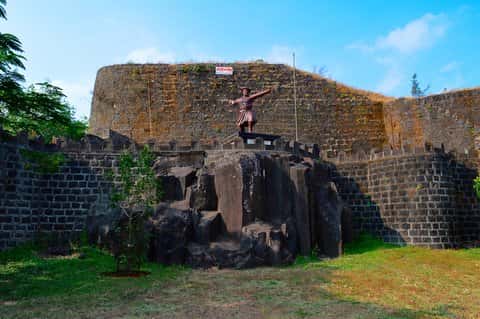
Panhala Travel Guide
Panhala sits high enough to stay pleasant most of the year. October to February gives you the long views the fort was built for; the monsoon gives you mist and green instead...
When to visit Panhala, and the monsoon question
Panhala sits high enough to stay pleasant most of the year. October to February gives you the long views the fort was built for; the monsoon gives you mist and green instead. Decide which Panhala you want.
- October to February: the clear windowThis is the season we recommend for a first visit. The air is washed clean after the rains, the mornings are cool, and from the ramparts you can see the plains fall away for many kilometres. Evenings get genuinely chilly on the hilltop, so carry a light warm layer.
- June to September: the misty, green PanhalaThe monsoon is heavy here. The fort turns emerald, clouds drift through the gates, and the drive up is beautiful. But be honest with yourself: on many days the mist hides the very views you came for, and the stone ramparts turn slippery. Come in this season for mood, not for panoramas.
- March to May: warm but workableThe hilltop stays several degrees cooler than Kolhapur below, so summer visits are quite possible. Walk the monuments in the morning, rest through the early afternoon, and come out again for sunset. Carry water, a cap and sun protection for the open stretches.
- September to October bonus: Masai Pathar in bloomIf you visit just after the rains, the huge Masai Pathar plateau about 5 km from Panhala flowers like a smaller cousin of the famous Kaas plateau. It is a lovely add-on that most visitors never hear about.
Shivaji Maharaj Jayanti in February fills the fort with flags, lezim drums and school groups, and it is a moving day to be here. The 13 July anniversary of the Pavan Khind battle draws trekkers and history lovers in the middle of the monsoon. And if you are pairing Panhala with Mahalaxmi darshan in Kolhapur, the Kirnotsav windows, typically around 31 January to 2 February and 9 to 11 November, are special; reconfirm each year on the temple's official site before you plan around them.
How to reach Panhala
Everything runs through Kolhapur, about 18 to 22 km below the fort. The overnight train from Mumbai is the classic way in; flights exist but are few and changeable.
- From Kolhapur, the short hop upPanhala is about 18 to 22 km northwest of Kolhapur, roughly 45 minutes by road on a good ghat stretch. Taxis and autos are easy to arrange from the city, and state transport buses run up from Kolhapur's central bus stand through the day. The road passes right through the fort gates, so you arrive inside the walls.
- By train, the sensible wayKolhapur's station, Chhatrapati Shahu Maharaj Terminus, is well connected to Mumbai and Pune. From Mumbai, the overnight Mahalaxmi Express (17411/17412) is the classic choice, and the Koyna Express (11029/11030) runs daily through the day via Pune. Two cautions our checks turned up: the old Sahyadri Express is currently cancelled, and the Rani Chennamma Express from Bengaluru no longer reaches Kolhapur, it now ends at Sangli via Miraj Junction, about 50 km away, so from Bengaluru you change at Miraj for the last short hop or simply fly. Book on IRCTC a little ahead in season and reconfirm current timings there.
- By air, with realistic expectationsKolhapur's Chhatrapati Rajaram Maharaj Airport (KLH) has limited flights by Star Air and IndiGo only, on routes such as Mumbai, the new Navi Mumbai airport, Bengaluru and Hyderabad as of mid-2026; older lists still mention Nagpur, Ahmedabad or Tirupati, but those were not in the schedule when we last checked. Schedules on small routes change often, so check before you rely on one. Pune, about 230 km away, is the nearest big airport with wide connections.
- By roadKolhapur sits on NH48, the Mumbai to Bengaluru highway. From Pune it is about 230 km, roughly 4 to 5 hours; from Mumbai roughly 390 to 400 km, a long 7 to 8 hour day. From Goa, the ghat drive takes roughly 5 to 6 hours, which makes Panhala a natural heritage pause on a coast-to-Deccan route.
Fly into Mumbai, then take the overnight Mahalaxmi Express to Kolhapur or connect by air via Bengaluru or Hyderabad to Kolhapur's small airport. The train saves a hotel night and lands you in Kolhapur at breakfast time.
Fly into Mumbai, Pune or Bengaluru. From Pune it is an easy half-day drive down NH48; from Bengaluru take a short Star Air or IndiGo flight when the schedule suits, or the overnight Rani Chennamma Express to Miraj Junction and finish with the one-hour road or rail hop to Kolhapur.
Take a train to Kolhapur from Mumbai or Pune and drive the last 45 minutes up the hill; from Bengaluru, fly to Kolhapur or take the Rani Chennamma Express to Miraj Junction and finish by road. Self-drivers from Pune or Goa will find the roads good; fuel up in Kolhapur before the climb.
The story of Panhala, told straight
Panhala is where Chhatrapati Shivaji Maharaj spent more days than almost anywhere else, where a barber gave his life as a decoy, and where a queen ruled a state. The dates below are checked against the district gazetteer record.
- A fort older than most empiresPanhala was built between 1178 and 1209 CE by the Shilahara king Bhoja II, one of about 15 forts he raised in this hill country. A copper plate found in Satara records Raja Bhoja holding court here in 1191 to 1192 CE. The fort later passed to the Yadavas, then the Bahmani sultans, and from 1489 to the Adil Shahi dynasty of Bijapur, whose engineers built the mighty walls and gateways you walk through today.
- The siege and the great escape, 13 July 1660Shivaji Maharaj took Panhala in 1659. In May 1660 Siddi Jauhar's Bijapur army sealed the fort, and for months the garrison lived off the Amberkhana granaries. On the stormy night of 13 July 1660, Shivaji Maharaj slipped out through the hidden Rajdindi bastion and rode for Vishalgad. The barber Shiva Kashid, who resembled him, let himself be captured as a decoy, and paid with his life when the trick was discovered.
- Baji Prabhu at the passAt the narrow pass of Ghod Khind, Baji Prabhu Deshpande and a small rear guard turned to face the pursuing army so that their king could get through. They held the pass through repeated assaults until the cannon of Vishalgad boomed the signal that Shivaji Maharaj was safe. Baji Prabhu, mortally wounded, is said to have let go only after hearing that sound. The pass was renamed Pavan Khind, the sacred pass. Panhala itself returned to Shivaji Maharaj permanently in 1673.
- A queen's capital, then the BritishMaharani Tarabai, one of the great figures of Maratha history, spent her formative years here during the Mughal wars of the 1690s, when even Aurangzeb, who took the fort in person in 1701, could not hold it long. In the first decade of the 1700s she made Panhala the seat of the new Kolhapur state, and it remained the capital until 1782. On 1 December 1844 a British force stormed the fort and dismantled parts of its defences, including the Char Darwaza gate.
You will read on many pages, including some very official ones, that Shivaji Maharaj escaped Panhala hidden in a basket of sweets. That famous basket story belongs to his escape from Aurangzeb's custody at Agra in 1666. The Panhala escape of 13 July 1660 was a night ride through the Rajdindi postern behind a brave decoy. Both stories are true and thrilling; they are simply two different escapes, six years and a thousand kilometres apart.
The monuments of Panhala fort, and a UNESCO milestone
In July 2025 Panhala became part of a UNESCO World Heritage property, the Maratha Military Landscapes of India. Here is what to see inside the walls, and the order that makes sense on the ground.
- Teen Darwaza, the great gateThe fort's main surviving double gateway is a beauty: an outer gate, a courtyard, and an inner gate with a finely carved lintel that carries a Ganesh motif added by the Marathas. Persian inscriptions date the gate to the reign of Ibrahim Adil Shah I of Bijapur. Start your circuit here; guides usually wait nearby.
- Andhar Bav, the hidden wellA besieging army's first move was to poison a fort's water. The Adil Shahi answer was this three-storey hidden well, with winding stairs, recesses where soldiers stood guard, and concealed escape passages. It is a fort within a fort, and children love it.
- Amberkhana, the granaries that won a siegeIn the centre of the fort stand three enormous Bijapuri-style granaries named Ganga, Yamuna and Saraswati. The largest is recorded as holding about 25,000 khandis of rice, nachni and warai, which is why Siddi Jauhar's five-month blockade could not starve the fort out. Climb the side stairs for the scale of it.
- Sajja Kothi and Sunset PointThe Sajja Kothi, a domed viewing pavilion of about 1500 CE hanging over the ramparts, is where tradition says the young Sambhaji Maharaj was kept under watch. Its balconies give the classic valley view. Nearby, the fort's high ground that locals call Sunset Point is the place to end your day.
- Rajdindi, the escape gateThe small hidden bastion through which Shivaji Maharaj rode out on the night of 13 July 1660 is still intact. Standing at that modest opening, knowing what began there, is for many visitors the most moving moment on the fort.
- Temples and memorialsThe old Ambabai temple, where Shivaji Maharaj is said to have made offerings before campaigns, the Someshwar and Mahakali temples, the samadhi of statesman Ramchandra Pant Amatya, and memorials linked to the poet Moropant near the Parashar caves reward an unhurried second loop. Maharani Tarabai's palace still stands, today housing a school and offices.
In July 2025, at its 47th session in Paris, the World Heritage Committee inscribed the Maratha Military Landscapes of India, twelve forts including Panhala, Raigad, Rajgad, Pratapgad and Gingee, as India's 44th World Heritage property. For you as a visitor it means rising footfall, slowly improving signage and conservation, and a fort that now sits on the world map. Treat the walls accordingly: no climbing on fragile sections, no litter, no names scratched into 800-year-old stone.
Signature experiences in and around Panhala
Beyond the monument circuit, Panhala rewards slow walking, a plateau in bloom, a pink hill of devotion, and one of India's great food cities waiting at the bottom of the hill.
- Walk the ramparts in the golden hourThe fort's walls run for kilometres along the cliff edge, and the hour before sunset is when the Deccan light turns the stone amber. Walk from Sajja Kothi towards Sunset Point, unhurried. In the clear months you can trace the plains and hill ranges far below.
- Drive or trek to Pavan KhindThe pass where Baji Prabhu Deshpande made his stand is about 50 to 55 km from Panhala, roughly a 2 hour drive on winding roads, just below Vishalgad fort. A memorial marks the spot in a green, steep-sided defile. Organised groups also walk the full escape route as a two-day monsoon trek, busiest around the 13 July anniversary; go with a group, as the trail crosses open country.
- Masai Pathar, the flowering plateauAbout 5 km from Panhala spreads one of the region's largest laterite plateaus, with the Masai Devi temple and small rock-cut caves. Just after the rains, roughly September to October, it blooms with carpets of wildflowers, and film crews have used it, including for Padmaavat. Mornings are best for light and birdlife.
- Jyotiba on a Sunday, if you can take the crowdThe Jyotiba temple stands on a neighbouring hill of the same range, 18 km northwest of Kolhapur, rebuilt in 1730 by Ranoji Shinde. Sunday is the deity's day and the hill fills with devotees; at the Chaitra Purnima yatra the gulal flies so thick that the whole hilltop turns pink. Visit on a weekday morning for calm darshan, or on Sunday for the spectacle.
- Mahalaxmi darshan and the Kolhapur food crawlPair the fort with darshan of Ambabai at the Mahalaxmi temple in Kolhapur, one of the revered Shakti Peethas. Then eat like a local: misal for breakfast, tambda rassa and pandhra rassa with bhakri for lunch, and a pair of hand-made Kolhapuri chappals to carry home.
Give the ramparts one unhurried golden hour. Most day-trippers see Panhala from a car window between monuments and leave by late afternoon. The fort's real gift is the walk along the wall as the light lengthens, with the plains below and the wind that has blown over this stone since Bhoja II's masons set it. That hour costs nothing and is the thing you will remember.
Where to stay: on the fort or in Kolhapur
Sleep on the hilltop for the quiet and the morning mist, or base in Kolhapur city for the temple, the food and the wider choice. One night on the hill is the sweet spot for most travellers.
- On the fort: quiet and coolPanhala town, inside the walls, has a modest spread of hotels and resorts, many with valley views. Staying up here means misty mornings, empty ramparts before the day-trippers arrive, and cool evenings. Budget and MTDC-listed rooms start from about 900 to 1,500 rupees, mid-range hotels run about 1,500 to 3,500 rupees, and the bigger view resorts about 3,500 to 6,000 rupees; reconfirm current rates when you book.
- In Kolhapur: temple, food and choiceKolhapur city has the full range of hotels, the Mahalaxmi temple a short ride away, and the best eating in this part of Maharashtra. If your trip is built around darshan, or you want restaurants open late, base here and do Panhala as an easy 45 minute excursion.
- How many nightsOne night on the fort is the sweet spot: an afternoon and sunset circuit, then a quiet morning walk before you descend. Two nights suit trekkers heading for Pavan Khind or anyone adding Masai Pathar and Jyotiba at leisure. A pure day trip from Kolhapur works too, but you lose the golden hours that make the hill special.
- Book ahead for the peak momentsRooms on the hilltop are limited, so book early for weekends in the October to February season, for Shivaji Maharaj Jayanti in February, and for the monsoon trek weekends around 13 July. On ordinary weekdays you will usually find space without trouble.
Panhala is a small taluka town, not a polished resort hill station. Even the better hotels are simple by metro standards, kitchens close early, and room heaters are rare though winter nights get cold. Carry a warm layer, order dinner before about 9 pm, and treat the simplicity as part of the charm rather than a shortcoming.
Panhala costs and a realistic daily budget
This is one of the cheapest great heritage trips in India: the fort is free, the food is inexpensive, and the only real spends are your room and the car.
- The fort costs nothingThere is no entry ticket for Panhala fort; it is a lived-in town and you walk or drive in free. The government's Incredible India page lists monument visiting hours of about 9 am to 6 pm, and daylight hours are anyway when you want to be out on the walls. Parking near the monuments is easy on weekdays.
- A rough daily budgetAs a planning estimate, a lean day, bus up from Kolhapur, simple thali meals and a budget room, runs about 1,200 to 1,800 rupees per person. A comfortable day, mid-range room, hired car for the loop and good meals, runs about 2,500 to 4,000 rupees per person. Treat both as estimates and reconfirm locally, since fuel and room rates move.
- The car is the main spendA full-day cab from Kolhapur covering Panhala, Jyotiba and the city sights is commonly quoted around 2,500 to 3,500 rupees depending on the season and vehicle. Agree the price, the route and the waiting time before you set off, and it is money well spent, because the loop does not work smoothly by bus.
- Guides, food and small spendsLocal guides at the fort work informally; agree the fee before you start and expect to pay a modest few hundred rupees for a good circuit of the main monuments. Food is famously cheap: a filling misal or thali costs less than a metro coffee. Temples take no entry fee; general darshan at Mahalaxmi is free.
A couple travelling from Mumbai by overnight sleeper train, spending one night on the fort in a mid-range room, hiring a car for one full day and eating well, can do the whole Panhala and Kolhapur trip comfortably on a few thousand rupees a head. Very few UNESCO-listed destinations anywhere give you this much history for this little money, which is exactly why we tell travellers to go now, before the listing changes the economics.
Practical logistics: cash, connectivity and moving around
The small-town basics that keep a Panhala day smooth: where to draw cash, how the buses work, what the phone signal does, and the etiquette of a fort people live in.
- Money and paymentsUPI works at most hotels and many small shops, but carry some cash for autos, guides, chappal stalls and temple offerings. ATMs on the hilltop are few, so it is wiser to withdraw in Kolhapur city before you climb. Card acceptance outside the bigger hotels is patchy.
- Phone, network and languageMobile coverage on the fort is generally fine for calls and data on the major networks, though it can dip on the trek routes and at Pavan Khind. Marathi is the language of the hill; Hindi is understood everywhere, and English works at hotels and with guides. A few words of Marathi, a warm namaskar, open every door.
- Getting around the fortThe fort zone is large, so the standard pattern is to drive between monument clusters and walk each one. Autos wait near the bus stand and Teen Darwaza for point-to-point hops. State buses from Kolhapur drop you inside the walls; the last buses down leave by evening, so check the return time when you arrive.
- Respect the living townFamilies live, farm and run schools inside these walls, including in Tarabai's old palace. Dress modestly at the temples, remove footwear where asked, ask before photographing people, and keep drones grounded unless you have explicit permission, since rules around protected monuments are strict.
Safety, health and the monsoon edge
Panhala is a gentle, low-hassle destination with none of the tourist-trap pressure of the big circuits. The real risks are physical: wet stone, unfenced drops and the midday sun.
- Unfenced ramparts and old wellsLong stretches of the walls have sheer drops with no railing, and structures like Andhar Bav have steep, worn stairs. Keep children within arm's reach on the ramparts, wear shoes with grip, and do not pose for photos on wall edges. In the monsoon the stone is genuinely slippery; walk the middle of paths, not the parapet.
- Monsoon and trek precautionsIf you walk any part of the Pavan Khind route in the rains, go with an organised group, expect leeches, and carry rain protection and a charged phone. Mist can drop visibility fast on the plateau and the passes. Solo wandering off marked paths in the monsoon is the one genuinely unwise thing to do here.
- Sun, water and medical helpThe fort is open and shadeless for long stretches, so carry water and sun protection from March onwards. Pharmacies and clinics exist in Panhala town for small needs, but the serious hospitals, including the district's big government hospital, are in Kolhapur, about 45 minutes away, which is worth knowing if you travel with elderly parents.
- A refreshingly low-hassle placeUnlike the famous tourist circuits, Panhala has little tout culture: no forced guiding, no donation traps, no aggressive selling. Standard care with valuables in crowds at Jyotiba on Sundays and at the Mahalaxmi temple is all the street-smarts you need. Solo women travellers generally report an easy, respectful experience here.
The road between Kolhapur and Panhala is good, but it is still a hill road with curves, two-wheelers and the occasional unlit bullock cart, and in the monsoon it carries mist after dark. If your plan ends with sunset on the ramparts, drive down promptly afterwards or simply stay the night on the fort rather than descending late and tired.
Panhala for every kind of traveller, and on access
A rare fort that serves the historian, the grandparent, the trekker and the child equally well. Here is the one steer that matters for each of you.
- Senior travellers and on accessibilityThis is Panhala's quiet superpower: a public road runs through the fort and a car reaches close to most monuments, so grandparents who could never climb Raigad's steps can stand at Teen Darwaza and Sajja Kothi with ease. Paths are mostly flat but uneven; a walking stick helps, and the cool months are kindest. Keep the Kolhapur hospitals in mind for peace of mind.
- Families with childrenChildren take to Panhala instantly: a hidden well with secret passages, a giant granary, an escape gate with a real adventure story. Tell them about Shiva Kashid and Baji Prabhu before you come; the fort turns into the story's stage. Watch them closely on the unfenced walls.
- History lovers and fort collectorsWith the 2025 UNESCO listing, Panhala anchors a superb Maratha circuit: pair it with Vishalgad and Pavan Khind on this range, and Raigad, Rajgad and Pratapgad further north. Give it a full day and walk with a guide; the layers, Shilahara, Bijapuri, Maratha, British, reveal themselves only slowly.
- Trekkers and the monsoon crowdThe Panhala to Pavan Khind route is one of Maharashtra's most loved monsoon treks, a two-day walk in the footsteps of the 1660 escape, at its busiest around the 13 July anniversary. Go with an organised group, break in your shoes, and make peace with leeches.
- Couples and slow travellersMisty mornings, rampart sunsets and very few crowds on weekdays make Panhala a quietly romantic base. Take a valley-view room, walk the walls at both ends of the day, and drive out to Masai Pathar for a picnic morning.
- PhotographersCome in October to February for the long views, or in the monsoon for mist and moss if you accept blind days. Golden hour on the western ramparts, the geometry of the Amberkhana, and the pink riot of Jyotiba on a Sunday are the signature frames.
How many days, and a Panhala itinerary that flows
The fort's core needs about 2 to 3 hours. The right trip is half a day, one full day with the temples, or two days with Pavan Khind, depending on what you came for.
- The half-day circuitWith about 2 to 3 hours on the fort you can do the classic loop: Teen Darwaza, Andhar Bav, the Amberkhana granaries, Sajja Kothi and Rajdindi, with a guide filling in the stories. This is the day-tripper's Panhala, and it is genuinely satisfying if time is short.
- The one-day darshan and fort loopStart early with Mahalaxmi darshan in Kolhapur before the queues build, drive up to Jyotiba on its neighbouring hill by late morning, avoiding Sunday unless you want the crowds and colour, then reach Panhala for lunch, walk the monuments through the afternoon and end at Sunset Point. Descend after dark or stay the night. This loop is the single best day this region offers.
- Two days for the full storyDay one, the loop above with a night on the fort. Day two, drive out to Pavan Khind and Vishalgad, about 2 hours each way through beautiful hill country, stand in the pass where Baji Prabhu fought, and return via Masai Pathar if it is bloom season. History lovers should not skip day two; the escape route is the point of Panhala.
- The trekker's weekendMonsoon weekends, especially around 13 July, are for the organised two-day Panhala to Pavan Khind trek. You walk the escape route itself, sleep in village halls or camps arranged by the group, and finish at the memorial in the pass. Book with an established trekking group and travel light.
Two timing rules make this region work. Temples first: Mahalaxmi and Jyotiba are calmest soon after opening, and Jyotiba's Sunday crowds are a different order of magnitude. Fort last: Panhala faces its best light in the late afternoon, and Sunset Point is the natural full stop. Reverse the order and you will queue at noon and reach the ramparts in flat midday glare.
The real questions travellers ask about Panhala
Straight answers to the questions that come up again and again on the TripAdvisor Kolhapur forum and in trek groups, so you arrive already knowing the score.
- Is it worth visiting, and how long does it need?Yes, emphatically, and more so since the UNESCO listing. The core monuments need about 2 to 3 hours; a full day with the temples, or two days with Pavan Khind, is better. It is a place of stories rather than spectacle, so a guide or a little reading beforehand multiplies what you see.
- Can I do Mahalaxmi, Jyotiba and Panhala in one day?Comfortably, with a car and an early start: temple, hill, fort, in that order. Forum regulars suggest exactly this loop, and it works because the three sites sit within roughly an hour of each other. On Sundays, budget extra time for Jyotiba's crowds or drop it to a weekday.
- Fort entry, timings and carsEntry is free with no ticket; the government page lists monument hours of about 9 am to 6 pm, and the public road through the fort means your car takes you close to most monuments. Guides wait near Teen Darwaza; agree the fee before you start.
- Panhala or Kolhapur for the night?Stay on the fort if you want sunset, sunrise and quiet; stay in Kolhapur if you want restaurants, wider hotel choice and the temple at your doorstep. Many travellers do one night on the hill and one in the city, which captures both.
- What about the monsoon mist?June to September is beautiful and green, but on many days cloud sits on the hill and the long views vanish. If views are your reason, come October to February. If mood, mist and the trek are your reason, the monsoon is exactly when to come.
- How do I get to Pavan Khind?By road it is about 50 to 55 km from Panhala, roughly 2 hours each way, best done as a half-day taxi round trip combined with Vishalgad. On foot it is the organised two-day monsoon trek. There is no useful public transport on this stretch, so plan the car in advance.
Planning Panhala from abroad
For an overseas visitor, Panhala is the easiest way to touch the Maratha story at a real UNESCO fort, without treks, permits or crowds. Here is how to slot it into an India trip.
- Why this fort, of all the fortsRaigad and Rajgad demand steep climbs; Panhala you can drive through. Yet it carries as much history as any of them: a 12th-century Shilahara foundation, Bijapuri gates, Shivaji Maharaj's longest residences, a queen's capital, and the most famous escape in Maratha memory. If your India trip has room for one Maratha fort, especially with parents along, make it this one.
- The route that worksLand in Mumbai, spend your city days, then take the overnight Mahalaxmi Express to Kolhapur; you wake up at the doorstep of the region. Do the temple, Jyotiba and the fort over a day or two, then continue by road to Goa, roughly 5 to 6 hours away, or back via Pune. The rail-in, road-out shape gives you both the Deccan and the coast in one sweep.
- For NRI families especiallyIf your parents or grandparents grew up on powadas of Baji Prabhu and stories of Tarabai, walking them through Rajdindi and Pavan Khind is a gift no mall of a trip can match. Combine it with Ambabai darshan at the Mahalaxmi Shakti Peetha, book the e-darshan pass on the official mahalaxmikolhapur.com portal for busy days, and keep the pace gentle; the fort allows it.
- Set expectations honestlyThis is small-town India at its warmest, not a resort destination. Hotels are simple, English is functional rather than fluent, and evenings are quiet. In exchange you get a UNESCO site with a fraction of the visitors of Agra or Jaipur, real prices, and people genuinely glad you came.
Panhala works beautifully as the calm, authentic chapter between Mumbai's intensity and Goa's beaches. You will likely be the only foreign visitors on the ramparts that morning, which is increasingly rare at any World Heritage site anywhere. Learn the escape story before you come, and the stones will do the rest.
Money, connectivity and timing for foreign visitors
The practical basics an overseas traveller needs for a small Deccan hill town: cash strategy, SIM cards, seasons, and how many days to give it on a wider route.
- Sort money and SIM in the big cityGet your Indian SIM or eSIM and a cash reserve in Mumbai, Pune or Bengaluru before you travel; the hilltop has few ATMs and no currency exchange. If you have UPI working through an Indian account or a tourist wallet, most of the trip is cashless; otherwise carry small notes for autos, guides and temple offerings.
- How many days on a wider routeGive the Kolhapur and Panhala region one to two nights. One night covers the temple, Jyotiba and the fort loop; the second adds Pavan Khind and Vishalgad, which history-minded visitors rate as the highlight. It slots naturally between Mumbai and Goa or Hampi legs.
- Pick your season deliberatelyOctober to February is the reliable window for views and comfortable walking. The monsoon, June to September, is atmospheric but frequently mist-blind and wet underfoot; choose it only if green landscapes and the trek are your goal. March to May is hot at midday but workable with an early-and-late pattern.
- Trains, and booking them from abroadBook the overnight Mahalaxmi Express on IRCTC well ahead for the cool season; an AC 2-tier berth is the comfortable choice, and Kolhapur station is a short drive from both the temple and the Panhala road. If rail feels daunting, a car from Pune down NH48 takes about 4 to 5 hours and the highway is good.
Do not build a tight international connection around Kolhapur's little airport. Its handful of Star Air and IndiGo routes are genuinely useful when they fit, but small-route schedules in India change with little notice. Treat any KLH flight as a bonus, keep the train or the Pune road as your backbone, and recheck the current schedule shortly before you fly.
The pass that earned a holy name
On the stormy night of 13 July 1660, Chhatrapati Shivaji Maharaj slipped out of besieged Panhala through the hidden Rajdindi gate and rode for Vishalgad. Behind him, the barber Shiva Kashid wore the king's dress and let the enemy take him, buying hours with his life. And in the narrow defile of Ghod Khind, the horse pass, Baji Prabhu Deshpande turned with a small rear guard to face an army. The ballads say he fought on though mortally wounded, refusing to fall until the cannon of Vishalgad thundered the signal that his king was safe. Only then did he let go. The pass has been called Pavan Khind, the sacred pass, ever since, and trekkers still walk the escape route each monsoon in his memory. The core events and the date are recorded history; the detail of the dying man waiting for the cannon comes to us through the powada ballad tradition, and we tell you so honestly, because that is how Maharashtra itself remembers it.
Planning a Panhala trip?
Our Maharashtra travel experts plan your full journey for you: route, hotels, darshan timings and transport. You get a free day-by-day plan and an exact quote on WhatsApp, usually within a few hours. No payment is needed to get your plan.