Alwar Travel Guide
The comfortable season is October to March , when both the safari and the forts are at their best. The monsoon shuts Sariska's core tiger zones, so it matters more here than at...
When to visit Alwar and Sariska
The comfortable season is October to March, when both the safari and the forts are at their best. The monsoon shuts Sariska's core tiger zones, so it matters more here than at most Rajasthan towns.
- October to March: the proper seasonCool, pleasant days and cold mornings make this the right window for everything Alwar offers, the Sariska safari, the hill forts and Siliserh Lake. Carry a layer for the early-morning jeep, which is genuinely cold in December and January with the wind on an open vehicle.
- April to June: hot, but waterholes draw animalsHigh summer on the Aravalli plain is fierce and tiring for the open ghats of ruins and the climb to Bala Quila. The one upside is wildlife: in the heat, animals gather at the waterholes, so dedicated photographers sometimes prefer late summer despite the discomfort.
- July to September: the monsoon, and the core closesThis is the weakest window for a wildlife trip. Sariska's core tiger zones close every monsoon, so a full core safari is not possible and only buffer routes may run. The forts and lake are still visitable, but if tigers are the point, come in the cool season instead.
- Plan the safari around the closure firstUnlike most Rajasthan towns, the season really shapes the trip here because of the closure. Decide your dates around the safari you want, confirm the core is open on the official portal, and build the forts and lake around it rather than the other way round.
Sariska's core tiger zones close to tourism every monsoon, from about 1 July to 30 September, under the standard National Tiger Conservation Authority rule for the breeding season and trail safety. In those months only buffer-zone routes may run, so a proper core safari is off. Treat these dates as the usual rule rather than a fixed promise, and reconfirm the exact open dates on the official Rajasthan Forest Department portal before you book travel.
How to reach Alwar
Alwar has no airport but sits on the Delhi to Jaipur railway line, so most people arrive by train or drive in from either city. Sariska is a short hop on from the town.
- By train from Delhi or JaipurAlwar Junction sits on the busy Delhi to Jaipur line. From Delhi it is roughly 150 to 160 km and about 2 to 4 hours by train depending on the service, with the Ajmer Shatabdi among the faster options at roughly 2.5 hours. From Jaipur it is a similar distance and a comparable ride. Confirm trains and times on IRCTC, as schedules change.
- By road from DelhiAlwar is about 150 to 170 km from Delhi, roughly 3 to 4 hours by car, just off the main Delhi to Jaipur highway corridor rather than directly on it. It makes an easy long-weekend drive, and we can arrange a car with an experienced driver for the whole loop including Sariska and Bhangarh.
- By road from JaipurFrom Jaipur it is about 110 to 160 km and roughly 2.5 to 4 hours by road, which makes Alwar a natural detour at the start or end of a Jaipur trip. The Jaipur airport is the practical air gateway for travellers coming from further afield.
- Nearest airportsAlwar has no airport of its own. Jaipur airport and Delhi airport are at comparable distances of about 110 to 160 km by road, so either works as your entry point. Most overseas visitors fly into Delhi or Jaipur and reach Alwar by train or car.
Fly into Delhi, the main international gateway, then take a train or drive about 3 to 4 hours to Alwar, or pick up Alwar as a detour on a Delhi to Jaipur road trip. There are no international flights to Alwar.
Fly into Delhi or Jaipur, both at comparable road distance from Alwar, then continue by train or car. Alwar sits neatly between the two on the classic Delhi, Alwar and Jaipur route.
Take a train to Alwar Junction on the Delhi to Jaipur line, or drive in from either city for a weekend. The rail option is the simplest and most comfortable way in for most domestic travellers.
Sariska, the forts and the lake
Alwar pairs a tiger reserve with a cluster of fine forts, cenotaphs and a quiet lake. A few of them carry rules and permits worth knowing before you set out.
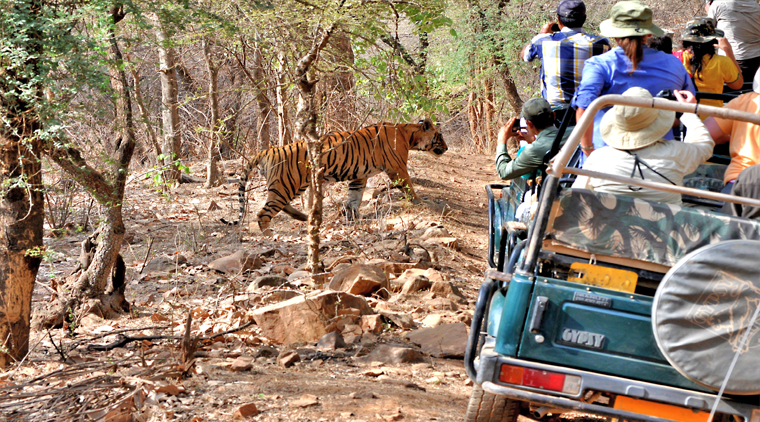
- Sariska Tiger ReserveThe wildlife heart of the trip, about 35 to 40 km from town in dry Aravalli hill forest. Officials put the population at about 50 tigers as of late 2025 across roughly 880 square kilometres, so this is a low-density reserve. Come for the landscape, the ruins inside, the birds and the quiet, and treat a tiger as a lucky bonus rather than an expectation.
- Bala Quila, the Alwar hill fortThe great fort on the hill above town, reached by a steep road, with sweeping views over Alwar. It sits in a restricted forest area with a police wireless station at the top, so you typically need prior permission from the office of the Superintendent of Police, Alwar, near the City Palace, to drive up. Entry to the fort itself is free.
- City Palace, museum and Moosi Maharani ki ChhatriIn the centre of town, the City Palace (Vinay Vilas Mahal) holds a Government Museum of miniatures, manuscripts and arms, usually closed on Fridays. Right beside it, the red-sandstone and marble Moosi Maharani ki Chhatri, a cenotaph of 1815 with painted ceilings, is one of the loveliest free corners in Alwar.
- Siliserh Lake and Bhangarh FortSiliserh Lake, about 13 to 15 km from town, has an RTDC heritage hotel on its bank, boating and a calm Aravalli setting. Bhangarh, the famous so-called haunted fort, sits about an hour and a half on, an evocative ruin best visited well before sunset for the reasons in the safety section.
Two of Alwar's sights carry rules the listicles skip. Bala Quila usually needs prior permission from the Superintendent of Police, Alwar, because of the restricted forest area and the police station on top, so arrange it in the morning before you drive up. And Bhangarh is officially closed between sunset and sunrise by an Archaeological Survey of India notice, for safety reasons covered below, so it is strictly a daytime visit.
Booking and doing the Sariska safari
The Sariska safari is the centrepiece, but it runs on rules: official-only booking, fixed shifts, allotted vehicles and a monsoon closure. Here is how to do it without the common mistakes.
- Book on the official portal onlySafaris are booked through the Rajasthan government OBMS portal or the Forest Department safari page, not the many lookalike private sites that crowd the search results. Bookings are prepaid, non-refundable and non-transferable, and the vehicle, driver, guide and zone are allotted by the system on the day, so you cannot pick your own gypsy.
- Two shifts, jeep or canterThere are morning and evening shifts, each running about 3 to 3.5 hours, in an open jeep, called a gypsy, of about six seats, or a larger canter of about twenty seats. A certified naturalist or guide is mandatory in every vehicle, and you cannot walk inside the reserve. The reserve is widely reported to be closed to safari on Wednesdays, so plan around that and reconfirm.
- What it costs, roughlyConfirm current rates on the official portal, but as a guide, park entry is about 80 rupees for an Indian and about 470 rupees for a foreigner, a gypsy seat is roughly about 1,150 to 1,600 rupees for Indians and about 2,700 rupees for foreigners, and a canter seat is roughly about 1,200 rupees for Indians and about 2,200 rupees for foreigners. Foreign nationals must enter passport details when booking.
- Set your expectations honestlySariska is a low-density reserve, so a tiger is a stroke of luck, not a given. What you are very likely to see is sambar, chital, nilgai, wild boar, peafowl and a rich bird life against a beautiful dry-forest backdrop, with old ruins and the Kankwari fort inside. Go in with that in mind and the safari rarely disappoints.
Deep inside the reserve, the Pandupol Hanuman temple draws pilgrims, and on Tuesdays and Saturdays you can usually drive in by private vehicle for a small fee, typically from about 8 am to mid-afternoon, separate from a safari. These are busy temple days. On other days the area is reached only by safari. The access days can change, so reconfirm locally before planning a temple visit around them.
Signature experiences around Alwar
Beyond the safari, these are the experiences people remember, and how to arrange them without the tourist-trap version.
- A dawn safari into SariskaThe morning shift, leaving in the cold before sunrise, is the classic Alwar experience: the dry hills waking up, deer at the edge of the track and the chance, never a promise, of a tiger. Dress warm in winter, book the official slot ahead, and let the landscape rather than the tiger count be the reward.
- Bhangarh by daylightThe most atmospheric ruin in the area, a whole abandoned town below a hillside fort, is worth a couple of unhurried hours. Go in the morning or early afternoon, well before the sunset closing, keep food out of sight from the bold monkeys, and read the safety section so the parking and guide touts do not catch you out.
- The view from Bala QuilaWith your permit arranged, the drive up the hill fort gives the best panorama over Alwar. It is a steep road and the fort is largely in ruins, so it suits those who enjoy a rugged, atmospheric viewpoint over a polished monument.
- A slow hour at Siliserh LakeAbout 13 to 15 km from town, the lake with its hilltop heritage hotel is the calm counterpoint to the safari and the forts. A short boat ride and a tea on the terrace as the light goes soft over the water is a gentle way to end a day.
- Neemrana Fort and the ziplineOn the Delhi side, the restored Neemrana Fort Palace makes a fine day visit even if you are not staying: a fort tour and lunch for roughly about 1,600 to 2,000 rupees, and the Flying Fox zipline circuit over the fort for roughly about 2,600 rupees. Reconfirm both with the operator, as offerings and prices change.
- Central Alwar on footThe City Palace, the museum and the Moosi Maharani ki Chhatri sit close together in the centre and reward a slow morning walk, with the cenotaph's painted ceilings and the museum's miniatures the quiet highlights between the bigger wildlife and fort days.
If you do only one thing slowly, make it the dawn safari. The light on the dry Aravalli hills, the stillness, and the slow reveal of deer and birds is the real Sariska, whether or not a tiger crosses your path. Book the morning slot, dress for the cold, and let it unfold rather than chasing a sighting, and you will come away with the best of what Alwar does.
Where to stay in Alwar and Sariska
Base in Alwar town for the forts and the museum, or out at a Sariska jungle resort to be on the doorstep of the dawn safari. Two nights is the sweet spot for the whole loop.
- Alwar town: convenient for the fortsStaying in town keeps you close to the City Palace, the museum, the cenotaph and Bala Quila, with the widest choice of budget and mid-range hotels. It is the practical base if the heritage and the town matter as much as the safari, and you can still drive out to the reserve at dawn.
- Sariska resorts: on the safari's doorstepJungle resorts near the reserve, including the RTDC Tiger Den and private camps such as Sariska Tiger Camp, put you minutes from the gate for the cold morning shift and give the immersive forest-edge feel. Better for a wildlife-led trip, though you will drive back into town for the forts.
- Heritage stays for atmosphereFor a memorable night, the Siliserh Lake Palace on its lake and Neemrana-run heritage forts in the district turn the stay itself into part of the trip. These sit in the upper band and swing with the season, so book ahead and confirm the current rate.
- How many nightsTwo nights is the sweet spot: a fort-and-town day, a dawn safari and Bhangarh on the second, and time for Siliserh without rushing. One night is enough for a focused safari-and-Bhangarh dash from Delhi, while three nights lets you slow down and add Neemrana or a second safari shift.
As a rough guide, plan on about 600 to 1,500 rupees a night for budget rooms in Alwar town, about 2,000 to 4,500 rupees for comfortable mid-range hotels, and about 4,000 to 9,000 rupees and up for heritage stays and the better Sariska jungle resorts. These are estimates from current listings rather than fixed prices, and they rise in the cool peak season and on weekends, so book ahead and reconfirm.
Alwar costs and a realistic daily budget
Alwar is gentle on the wallet apart from the safari, which is the one real expense. Here is what the main things cost so you can plan and avoid being overcharged.
- A rough daily budgetExcluding your room, the safari and long-distance transport, plan on about 800 to 1,500 rupees a day as a budget traveller and about 2,500 to 4,000 rupees for a comfortable day with sit-down meals and a part-day taxi. Alwar runs cheaper than the big Rajasthan cities, so the safari is usually the single biggest line in the day.
- The safari, your main costA Sariska gypsy seat is roughly about 1,150 to 1,600 rupees for Indians and about 2,700 rupees for foreigners, plus park entry of about 80 rupees for Indians and about 470 rupees for foreigners. Confirm the live rates on the official portal, since these change every year and operators add small service fees.
- The cheap fixed-price sightsMost of the forts and monuments are inexpensive: Bhangarh is about 25 rupees for Indians and about 200 rupees for foreigners, the Government Museum is a few rupees, and Bala Quila and the Moosi Maharani ki Chhatri are free. The sights are not where the money goes here, which makes the safari budget the one to plan carefully.
- Cash, cards and the carHotels and bigger restaurants take cards or UPI, but small eateries, entry kiosks and the bazaar run on cash, so carry enough for the day. The other real cost is a hired car with driver to link Sariska, Bhangarh and Siliserh, since public transport on those routes is sparse; agree the day rate before you set off.
The ASI site at Bhangarh has no parking charge, but villagers sometimes collect an unofficial sum of about 100 rupees per car, and self-styled guides charge several hundred rupees for what is essentially a free walk. Park only at the official area, decline unsolicited guides politely, and pay only the printed ASI entry fee. Knowing this in advance turns the one common friction at Bhangarh into a non-event.
Practical logistics: getting around, money and timing
The small things that make an Alwar trip smooth, from why you want a car to ATMs, language and how the sights are spread out.
- You will want a car and driverAlwar town is walkable in its centre, but the big draws are spread out: Sariska is about 35 to 40 km away, Siliserh about 13 to 15 km, and Bhangarh well beyond. Public transport on these routes is sparse and slow, so a hired car with driver for the day is the practical way to link them comfortably.
- Getting around townInside Alwar, auto-rickshaws and local taxis cover the City Palace, the museum, the cenotaph and the station easily and cheaply. For Bala Quila you need both the permit and a vehicle for the steep hill road, so fold it into a car day rather than an auto hop.
- Money, ATMs and timingsBank ATMs are easy to find in Alwar town, but carry cash for entry kiosks, small eateries and the safari area. Plan the safari shift first, since it is fixed, then build the forts around it, keeping the hot middle of the day for the museum or a meal.
- Language and connectivityHindi is the everyday language and English is understood in hotels and the tourist trade. Mobile coverage is generally fine in town and patchy inside the reserve and at remote ruins like Bhangarh, where there is little or no signal, so do not rely on your phone once you are deep in the forest.
Safety, the Bhangarh truth, and staying well
Alwar is a safe, easygoing destination. The things to manage are the small scams at Bhangarh, the responsible way to treat the ghost story, and the usual care on a wildlife trip.
- The Bhangarh ghost story, told honestlyBhangarh is sold as the most haunted place in India, but the Archaeological Survey of India has never declared it haunted, and there is no credible evidence of anything supernatural. The famous rule against entry between sunset and sunrise is a standard safety closure: unstable ruins, resident wildlife such as leopards and wild boar, no lighting and no mobile signal after dark. Enjoy the legend as folklore, and respect the daytime-only rule for the real reasons.
- The Bhangarh scams to expectVillagers sometimes collect an unofficial parking charge of about 100 rupees per car although the ASI site has none, and fake guides offer their services for several hundred rupees for what is a free walk. A polite no is enough. Park at the official area, pay only the printed entry fee, and keep snacks out of sight from the bold monkeys, which will snatch food and bags.
- On the safari and at the fortsInside Sariska, stay in the vehicle, do not get out, and keep noise down. At Bala Quila and Bhangarh the ground is uneven and the ruins are open, so wear proper shoes, watch your footing, and do not climb crumbling walls. Carry water and sun protection in the warmer months for the open sites and the hill climb.
- Health and general careDrink bottled or filtered water, take the usual care with street food, and carry any personal medication, as a small town has limited pharmacies after hours. There is little phone signal inside the reserve and at Bhangarh, so tell your driver or hotel your plan for the day before you head out.
Alwar is generally an easy, low-key place with little of the hard-sell tout pressure of the bigger tourist towns. Standard precautions apply: keep to daylight for the remote ruins, since Bhangarh closes at sunset anyway and the forts are isolated, travel with a known driver for the out-of-town sights, and avoid lonely spots after dark. With those simple habits it is one of the more relaxed corners of Rajasthan to travel in.
Alwar for every kind of traveller, and on access
Alwar suits different visitors in different ways. Here is what it offers you and the one tip that matters for each, including how a senior does it comfortably.
- Families with childrenThe safari, the open jeep and the dramatic ruins are a hit with children, and Siliserh Lake adds a gentle break. Keep little ones close at Bhangarh because of the bold monkeys and the open ruins, and book the canter rather than the gypsy if your group is large.
- CouplesA two-night escape works well: a dawn safari, the atmospheric ruins of Bhangarh, and a quiet evening at Siliserh or a heritage fort stay. It is a low-key, unshowy break rather than a romantic-resort one, which is part of its charm for those who like the offbeat.
- Senior travellers and on accessibilityDoable with planning, but be realistic: the safari jeep is bumpy, Bala Quila is a steep hill climb, and Bhangarh involves a walk from the parking over uneven ground. Choose the canter over the gypsy for a smoother ride, stay in comfortable town hotels, skip Bala Quila if the climb is too much, and keep to the cool morning hours.
- Wildlife photographersSet expectations honestly: Sariska is a low-density reserve, so plan for landscape, birds, deer and the dry-forest light rather than guaranteed tiger frames. The early morning shift gives the best light, and the Kankwari fort and ruins inside the reserve add strong compositions even on a tiger-less drive.
- Solo travellersAlwar is relaxed and largely tout-free, which makes it an easy solo stop. Hire a known driver for the out-of-town sights so you are not stranded on sparse routes, keep to daylight at the remote ruins, and you will find it one of the gentler places in Rajasthan to explore alone.
- Delhi weekendersAlwar is one of the best wildlife-and-heritage weekend escapes from Delhi, close enough for a Friday-evening start. A clean two-night plan covers the forts, a dawn safari and Bhangarh, with Neemrana an easy stop on the way back.
A suggested Alwar itinerary
How to shape one to three days so you catch the dawn safari at its best and fit the forts and lake around the fixed safari shift and the daytime-only Bhangarh rule.
- Day one, town and fortsArrive and spend the day in central Alwar: the City Palace and Government Museum, the Moosi Maharani ki Chhatri beside it, and, with the permit arranged in the morning, the drive up to Bala Quila for the view. End with a quiet evening at Siliserh Lake if you have the time.
- Day two, dawn safari and BhangarhTake the cold morning safari into Sariska, booked ahead on the official portal, then return for breakfast. In the afternoon drive out to Bhangarh while there is plenty of daylight, since it closes at sunset, and explore the ruined town and fort at an unhurried pace.
- Day three, if you have itAdd a second safari shift for another shot at the wildlife, or break the return to Delhi at Neemrana Fort for a day visit, a lunch and, if you fancy it, the zipline. A third day turns a brisk loop into a relaxed one.
- The one-night dashFrom Delhi you can do a focused overnight: drive down, an evening at the lake or town, a dawn safari, Bhangarh in the late morning, and back. It is tight but rewarding if the safari and the ruins are all you are after.
Two things are fixed and everything else bends around them. The safari runs on set morning and evening shifts that you must book ahead on the official portal, and Bhangarh closes between sunset and sunrise, so it has to be a daytime visit. Build the safari shift and a well-before-dark Bhangarh into your plan first, then slot the forts, the museum and the lake into the gaps, and the days flow without a shut gate or a missed slot.
The real questions travellers ask about Alwar and Sariska
Straight answers to the questions that come up again and again on traveller forums, so you arrive already knowing the score.
- Is Sariska worth it, or is Ranthambore better?For a near-certain tiger photo, Ranthambore is the better choice, with a denser population and more open terrain. Sariska, with about 50 tigers over a large hill-forest area, is quieter and far less crowded, and rewards you with landscape, ruins and birds rather than reliable tiger frames. Many travellers do both for the contrast.
- Will I actually see a tiger?Honestly, maybe not. Sariska is a low-density reserve, so a tiger is a lucky bonus rather than an expectation. Plan the trip around the experience of the dawn safari and the dry-forest wildlife, and a sighting becomes a wonderful surprise rather than the thing that makes or breaks the day.
- Can I really visit Bhangarh at night?No. The Archaeological Survey of India prohibits entry between sunset and sunrise, with a notice at the gate, so a night visit is not allowed. The reason is safety, not ghosts: unstable ruins, wildlife and no light or signal after dark. Go in daylight and leave well before the gate closes.
- Can I do it as a day trip from Delhi?You can do a long day or, better, a one-night dash from Delhi for the safari and Bhangarh, but two nights is far more comfortable and lets you add the forts and the lake. A single rushed day trip means a lot of driving for a thin slice of what Alwar offers.
- Should I base in Alwar town or a Sariska resort?Stay in town if the forts, the museum and convenience matter, and drive out for the dawn safari. Stay at a Sariska jungle resort if the wildlife is the priority and you want to be minutes from the gate for the cold morning shift. Two nights lets you sample both sides.
- Do foreigners need a passport for the safari?Yes, foreign nationals must enter passport details when booking the Sariska safari, and foreigner fees are higher, roughly about 2,700 rupees for a gypsy seat plus the higher park entry. Book on the official portal in good time and carry your passport on the day.
Planning Alwar from abroad
Alwar is the wildlife-and-ruins detour on the Delhi to Jaipur road, an easy add-on to a first Rajasthan trip. A little preparation makes the safari rules and the forts straightforward.
- Carry your passport for the safariForeign nationals must enter passport details to book the Sariska safari, and the foreigner fees are higher, so book on the official Rajasthan portal in good time and carry your passport on the day of the drive. This is the one rule that catches overseas visitors out.
- Set realistic tiger expectationsSariska is a low-density reserve, so unlike the marketing, a tiger is far from guaranteed. Come for the Aravalli landscape, the birds, the deer and the ruined forts inside, and treat any big cat as a bonus. If a guaranteed tiger photo is essential, build Ranthambore into your wider Rajasthan plan instead.
- Slot it between Delhi and JaipurAlwar sits neatly on the Delhi to Jaipur route, about 3 to 4 hours from Delhi and roughly 2.5 to 4 hours from Jaipur, so it works as the wildlife-and-heritage chapter at the start or end of a Rajasthan loop. A car with a driver for the cluster of out-of-town sights is the easy way to do it.
- Know what the forts ask of youThese are working ruins, not polished monuments. Bala Quila is a steep hill climb and needs a police permit, Bhangarh is a walk over uneven ground and closes at sunset, and the safari jeep is bumpy. None of it is hard with decent shoes and a sensible pace, but it helps to know before you arrive.
Money, connectivity and timing for foreign visitors
The practical basics an overseas traveller needs for a small wildlife town: cash, cards, a SIM, and how many days to give it on a wider India trip.
- Carry cash, cards work in partHotels and bigger restaurants take cards and UPI, but entry kiosks, small eateries and the safari area run on cash, and the unofficial charges at Bhangarh are cash too. Draw cash at the town ATMs and keep small notes for the day, since you cannot always tap a card at a fort gate.
- Get a SIM at the airportPick up an Indian tourist SIM or an eSIM when you land in Delhi or Jaipur rather than hunting for one in a small town. Coverage is fine in Alwar itself for maps and calls, but expect little or no signal inside the reserve and at remote ruins like Bhangarh, so download maps offline.
- How long to give it on a bigger tripOn a first Rajasthan trip, two nights in Alwar is the right weight between Delhi and Jaipur: enough for a dawn safari, the forts, Bhangarh and the lake without slowing the whole itinerary. Add a third night only if you want a second safari shift or a Neemrana stop.
- Time it to the season and the closureOctober to March is the comfortable window and the proper safari season. Avoid July to September if wildlife is the point, since the core zones close in the monsoon, and avoid the fierce April to June heat unless you are a photographer chasing the waterhole gatherings.
Alwar is an unusually easy slice of wild and historic India to fold into a first trip: close to Delhi, low on crowds and hard-sell, and a genuine tiger reserve paired with dramatic ruins. Slot it between Delhi and Jaipur, give it a night or two, book the safari officially and carry your passport, and it becomes the offbeat chapter many overseas visitors say they remember as warmly as the famous stops.
Why India's most haunted fort closes at sunset
Bhangarh is sold as the most haunted place in India, and the stories are wonderful: a tantrik who loved the princess Ratnavati and tried to enchant her with a charmed perfume, the spell turned back on him, his dying curse on the town, and a settlement abandoned overnight. They are folklore, told and retold, and worth hearing for the colour they give the ruins. The honest part is this: the Archaeological Survey of India has never declared Bhangarh haunted, and the famous rule against entering between sunset and sunrise is a standard safety closure. The ruins are unstable, leopards and wild boar move through after dark, there is no lighting and almost no mobile signal, and a lost or injured visitor at night would be in real trouble. So enjoy the legend in daylight, respect the gate that shuts at dusk for the practical reasons it does, and let Bhangarh be the rare place where the true story is as good as the ghost story.
Planning a Alwar trip?
Our Rajasthan travel experts plan your full journey for you: route, hotels, darshan timings and transport. You get a free day-by-day plan and an exact quote on WhatsApp, usually within a few hours. No payment is needed to get your plan.
Tour packages that visit Alwar
Every journey below is private, hand-crafted and fully customizable. Tell us your dates and we tailor the itinerary, the pace and the priests or guides around you.