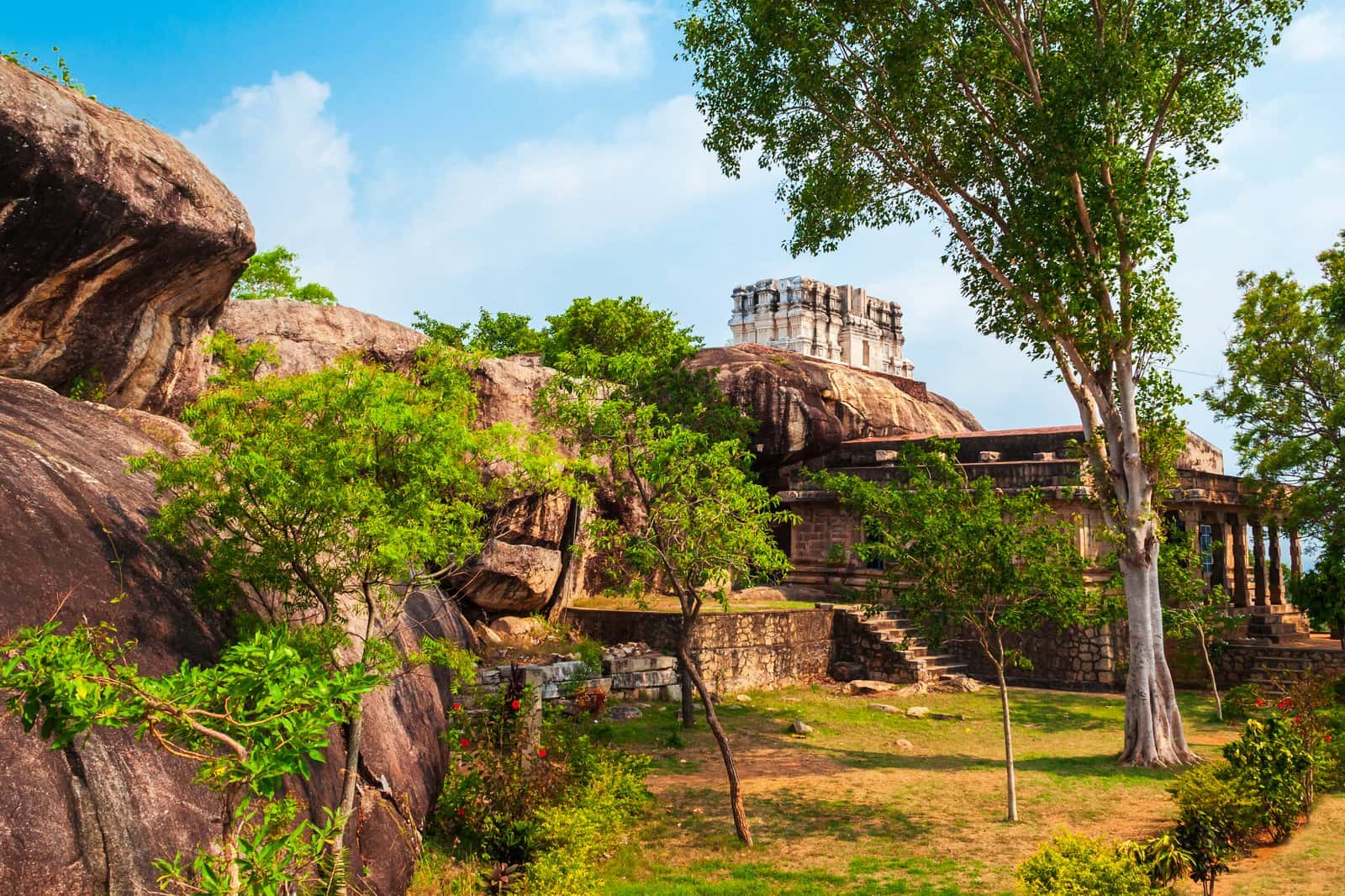
Chitharal Travel Guide
Tamil Nadu Tourism gives the season as October to March . The honest refinement is that December to March is the safest window, because this district takes rain from both...
When to visit Chitharal, and the rain nobody warns you about
Tamil Nadu Tourism gives the season as October to March. The honest refinement is that December to March is the safest window, because this district takes rain from both monsoons and November is usually its wettest month.
- December to March: the sweet spotThis is when you want to be on the hill. The air is drier, the mornings are cool and the cement steps and bare rock are not slippery. The valley below is green from the rains that have just finished, so you get the best of both, a dry path underfoot and a lush view from the top. If you have a free choice of dates, choose these months.
- October and November: green, but wetThe official season begins in October, and the district is beautiful then, but this is also the heart of the northeast monsoon here. November is usually the wettest month of the year in Kanyakumari district. Rain does not close the site, but it makes the climb slippery and the view flat and grey. If you must come now, go early in the morning and watch your footing on the rock.
- April to June: hot and heavy goingThe far south is humid rather than dry, and the walk up is exposed in places. Travellers who come in the afternoon in these months regularly say the same thing: it is hot, it is tiring and you will finish your water. If your dates fall here, be at the foot of the hill for about 8 am, when the gate is reported to open, and be back down before the sun gets high.
- July to September: the other monsoonUnlike most of Tamil Nadu, this district also gets the southwest monsoon, so these months bring their own rain. The countryside is at its most beautiful, and if you do not mind a wet day, the hill is quiet and green. Just do not plan a tight itinerary around it.
Padmanabhapuram Palace, the natural second stop of a Chitharal day, is closed on Mondays and on national holidays. If you build your day trip on a Monday you will climb the hill happily and then find the palace gate shut. Fix your Chitharal day for any day except Monday, and you keep the whole plan alive.
How to reach Chitharal, and the last mile that catches people out
Chitharal is a village, not a town. You reach it from Marthandam, Kuzhithurai, Nagercoil or Thiruvananthapuram, and the last two or three kilometres are where most day trips go wrong.
- The official distancesTamil Nadu Tourism gives Marthandam bus stand at about 6 km, Kuzhithurai railway station at about 9 km and Thiruvananthapuram international airport at about 52.8 km. The Kanyakumari district administration puts Chitharal at about 42 to 45 km from Kanyakumari and about 64 km from Thiruvananthapuram by road. In plain terms, Chitharal is closer to Trivandrum than it is to Kanyakumari.
- By car, which is what we recommendA car with a driver is the sane way to do this. Cars and vans can drive right up to the foot of the hill, where there is parking. Keep the car with you while you climb. This single decision solves the return problem that spoils the day for travellers who come by bus.
- By trainKuzhithurai is the nearest railway station, on the Thiruvananthapuram to Nagercoil line, and Nagercoil Junction is the bigger railhead. Check current trains and timings on IRCTC before you plan, because services on this stretch change. From either station take an auto or a taxi, and ask the driver to wait.
- By bus, and the last-mile catchTown buses from Marthandam towards Arumanai or Kulasekharam set you down at Chitharal on the main road. From that bus stop it is another 2 to 3 km to the foot of the hill, and there are usually no autos waiting. Buses back are infrequent. If you come by bus, allow about 3 hours for the round trip from Marthandam and be ready to walk or to wait.
Fly into Chennai, Bengaluru or Kochi, then take a connecting flight to Thiruvananthapuram, which is the nearest international airport at about 52.8 km. From there a car reaches Chitharal in roughly an hour and a half. Pair the trip with Kovalam, Kanyakumari and the temple towns of the far south.
There are direct flights into Thiruvananthapuram from several Gulf cities and from Southeast Asia, which makes this the easiest heritage day trip in the far south for an NRI family. Land, rest a night in Kovalam or Trivandrum, and give Chitharal your first clear morning.
Take a train to Nagercoil Junction or Kuzhithurai, or fly into Thiruvananthapuram or Madurai. Chitharal fits neatly into a Kanyakumari, Nagercoil and Padmanabhapuram loop, and it is an easy add-on to a Madurai, Rameshwaram and Kanyakumari pilgrimage circuit.
The cave temple, the bas-reliefs and the Bhagavati shrine
Three things share this rock: beds cut for Jain ascetics, a 9th century rock-cut Jain cave temple, and a Bhagavati temple beside it. They have shared it peacefully for more than a thousand years.
- The bas-reliefs on the outer rockThis is the first thing you see as you come up. A natural overhanging rock carries rows of Tirthankaras in bas-relief, most seated in half lotus under three-tiered parasols, with standing figures of Parshvanatha and the goddess Padmavati under a many-hooded cobra. Look for Ambika with her lion, and the flying Vidyadharas above the niches. Under each figure is a short donor inscription in Tamil, in the old Vatteluttu script.
- The rock-cut Jain cave templeYou reach it through a narrow passage between two boulders. Inside is a pillared mandapa and three sanctums, carved out of the living rock in the 9th century: Parshvanatha on the left, Lord Mahavira in the centre and Padmavati. Because they were cut from the rock itself and never installed as loose images, they could never be carried away, which is why they are still here for you to see.
- The Bhagavati templeBeside the Jain temple, reached by a climb over the rocks, stands a temple to the goddess Bhagavati, with a mandapam, a verandah, a balipeetham and a kitchen cut into an overhanging rock. Its inscriptions record gifts from the 13th and 14th centuries. Be clear about what it is today, because no other page will tell you: this is a protected monument, not a working temple. Tamil Nadu Tourism itself says the Bhagavati shrine used to be an active place of worship, and visitors consistently report finding it closed, with no pooja performed. Look at it, respect it, but do not come expecting darshan.
- The rock beds, the pond and the viewScattered among the boulders are the plain stone beds with drip ledges that Jain ascetics used, dated by the Archaeological Survey of India to the long period from about the first century BCE to the sixth century CE. Below the temple lies a small natural pond, heart-shaped in the old descriptions, and from the top the whole green valley of paddy fields, rubber and coconut opens up below you.
Those unremarkable stone beds are the reason this hill matters. The Archaeological Survey of India dates them to the centuries between about 100 BCE and 600 CE, which makes them the earliest surviving Jain monument in the southernmost part of India. Long before the cave temple was cut, Jain ascetics were already climbing this rock to meditate. When you sit on the bench near the top and look out at the valley, you are looking at the same view they came here for.
The things worth doing at Chitharal, and how to time them
This is a small site and a short climb. What makes it memorable is doing it at the right hour, in the right order, and understanding what you are looking at.
- Climb at first lightBe at the foot of the hill for about 8 am, which is when visitors consistently report the gate opening. The air is still cool, the path is shaded for much of the way, and the low sun throws the carvings into relief so you can actually read them. Travellers who come at this hour regularly find they have the entire hill to themselves. By late morning the heat has arrived and so have the few other visitors.
- Read the carvings slowly, not quicklyGive the outer bas-reliefs a good twenty minutes. Once you know that the standing figure under the cobra hood is Parshvanatha, that the seated central figure with the tree above him is Lord Mahavira, and that each small line of script under a niche names the person who paid for that carving, the rock stops being decoration and becomes a record of real people.
- Sit at the top for ten quiet minutesThere is no ritual to perform here and nothing to buy. The best thing this hill offers is silence and a long green view over the valley. Sit on the rock, let the breeze come up, and give it ten minutes before you start back down. Almost every traveller who takes this hill slowly says the same thing afterwards: the quiet is the point.
- Pair it with Padmanabhapuram PalaceThe great wooden palace of the Travancore rulers, roughly 15 to 20 km away, is the natural second half of the day. Reach it after it reopens in the afternoon, at about 2 pm, and you have a full and satisfying day of heritage without rushing anything.
- Add water, if you have the timeThe Thirparappu falls and the Mathur aqueduct, the long trough bridge that carries water across the valley, are both in this district and both make an easy late-afternoon stop. Both charge only a small nominal ticket, so carry a little change. We have not been able to confirm their current rates against an official rate card, so treat any figure you read online with caution.
- Photograph with respectThe light on the carvings is best early. Photography is generally allowed at the monument, and the hill is popular for wedding and film shoots, but drones and professional shoots need permission, so do not simply turn up with one. Ask before you photograph any person, and do not photograph inside a sanctum if you are asked not to.
If you only do one thing properly at Chitharal, make it the walk up. It is about a kilometre of cement steps with benches every hundred metres or so, shaded by rubber and cashew trees in stretches and open to the sun in others, with the valley opening a little more at every turn. Rushing it turns the site into a fifteen-minute photograph. Taking it slowly, resting on the benches, and arriving at the rock without being out of breath is what makes the carvings land.
Where to stay for Chitharal, and how long to give it
Nobody stays in Chitharal. You stay in Nagercoil, Kanyakumari, Marthandam or Trivandrum and Kovalam, and drive out for the morning.
- Nagercoil: the practical baseThe district headquarters, about an hour away, with the widest choice of ordinary, clean, good-value hotels, a big railway junction and plenty of places to eat. If you want to see Chitharal, Padmanabhapuram, Thiruvattar and Kanyakumari over two or three days without changing hotels, this is the sensible place to sleep.
- Kanyakumari: the tourist baseAbout 42 to 45 km away, so a comfortable morning drive. Stay here if the point of your trip is the sunrise, the Vivekananda Rock Memorial and the Thiruvalluvar statue, and Chitharal is your half-day excursion. Rooms here range from simple to comfortable and fill up around holidays and long weekends.
- Trivandrum and Kovalam: the comfortable baseThe best hotels and resorts in this region are across the border in Kerala, and Chitharal is only about 64 km from Thiruvananthapuram by road. For an overseas or NRI family arriving at Trivandrum airport, this is the easiest and most comfortable choice: sleep in Kovalam, drive out after breakfast, be back by the afternoon.
- Marthandam: only if you want to be closeThe nearest town, about 6 km away, with basic lodges rather than hotels. It is genuinely useful only if you are travelling by bus and want to be at the hill at first light. Most travellers will be more comfortable elsewhere.
Chitharal itself is a half day, and that is being generous: about an hour on the hill, plus the drive in each direction. It is not a destination you stay in, it is a morning you build a day around. Two nights in Nagercoil or Kovalam gives you Chitharal and Padmanabhapuram on one day, and Kanyakumari, Nagercoil and Thiruvattar on the next, without hurrying anything.
What a Chitharal day actually costs
The monument itself is free. Almost everything you will spend goes on the car that gets you there and back, which is why we would rather help you get an honest quote than print a made-up number.
- Entry: freeThere is no entry ticket at Chitharal. It is not one of the ticketed monuments of the Archaeological Survey of India in Tamil Nadu, and travellers report free entry consistently. Be wary of any page that quotes you an entry fee for this site, because none is published.
- Parking: a small charge, unofficiallyVisitors report a small parking charge at the foot of the hill, quoted at around 40 rupees for a car. This is not published on any official rate card and we could not confirm it against one, so carry small change, expect it to change, and do not be surprised either way.
- Padmanabhapuram Palace: the real ticket of the dayIf you add the palace, budget about 50 rupees for an Indian adult and about 500 rupees for a foreign national, with about 10 rupees for an Indian child and about 100 rupees for a foreign child. A still and video camera ticket is about 250 rupees, and a mobile phone camera is about 10 rupees. These are the palace's own published rates.
- The car, which is the real costEverything else on this trip is the vehicle. Rates for a car with a driver move with fuel prices, the season and the operator, so we will not print a figure you can hold us to. Ask your hotel or ask us for a written quote for the day, agree it before you set out, and you will not be surprised at the end.
- Food, water and small changeStalls at the foot of the hill sell water and snacks, and there is nothing on the climb. Meals are cheap and excellent in Marthandam, Thuckalay and Nagercoil. Carry cash in small notes, because the stalls, the parking attendant and the small temples will not be taking cards.
Every travel page on Chitharal that quotes you a car rate is copying a number from another page, and most of those numbers are years old. Fuel prices move, seasons move, and operators differ. The honest thing, and the thing that actually saves you money, is to get a written quote before you travel and to agree the waiting time as part of it, because the driver waiting at the foot of the hill while you climb is what makes this trip work.
Practical logistics: timings, footwear, food, water and language
The small things that decide whether a Chitharal morning is a pleasure or a slog. Start with the timings, because the official sources are quieter on this than you would expect.
- Timings: the honest answerNo official gate timing for Chitharal is published by the Archaeological Survey of India or by Tamil Nadu Tourism. We opened both and neither carries one, so treat any page that gives you confident hours with suspicion. What we can give you is what visitors report, consistently and in numbers: a gate that opens at about 8 am and closes at about 5 pm or 6 pm, with staff at the base desk from mid-morning. Be there for about 8 am, climb between about 8 am and 10 am, and you will not be caught out.
- Footwear and the pathWear real walking shoes or good sandals with grip. The path is paved with cement steps for most of the way, but there is bare rock near the top and it is slick after rain. You will be asked to remove your footwear at the temple itself, so slip-on shoes are easier than laces.
- Water, food and toiletsCarry at least a litre of water per person. Small stalls at the base sell water and snacks, and there is nothing at all on the climb or at the top. Facilities at the site are basic, so use the toilet at your hotel or at a restaurant in Marthandam before you set out. Do not carry food up to the temple.
- Language and cashThis is a bilingual belt: Tamil is the state language and Malayalam is widely spoken because Kerala is only a few kilometres away. Basic English works with drivers and hotel staff. ATMs are in Marthandam and Kuzhithurai, not in Chitharal village, so draw your cash before you drive out.
Chitharal is a protected monument, and neither the Jain cave temple nor the Bhagavati shrine beside it is in daily worship today. That does not make the hill any less sacred. Dress modestly, cover your shoulders and knees, remove your footwear where you are asked to, and speak softly near the sanctums. The cave still holds the images of Lord Mahavira, Parshvanatha and Padmavati exactly where they were carved, so give them the respect you would give any deity. Do not touch the carvings, do not climb on the rock beds, and do not leave anything behind on the hill.
Safety, the climb, and looking after yourself on the hill
There are no touts and no scams to speak of at Chitharal. The real risks here are heat, a slippery rock and being stranded without a ride home.
- Heat and dehydration are the main riskThe far south is humid, and travellers who climb in the middle of the day regularly describe it as hot, tiring and short of water. Climb early, carry more water than you think you need, wear a hat, and rest on the benches. There is no shop and no water source on the way up.
- Wet rock is genuinely slipperyDuring the monsoon months, especially October and November, the cement steps and the open rock near the top hold water and moss. Go slowly, use the handrails and the benches, and if you are carrying a small child, do not carry a camera in the other hand.
- Do not get strandedThis is the practical safety point at Chitharal. Buses back to Marthandam are infrequent, autos are usually not waiting at the hill, and mobile signal in the village is not something to depend on. Keep your car, or agree a firm pick-up time and place with your auto driver, and do not begin the climb late in the afternoon.
- Health basicsDrink bottled or filtered water, take the usual care with street food, and carry a small first aid kit if you have children with you, because the nearest pharmacy is in Marthandam. There is no medical facility at the site.
This is a rural, quiet, low-crime corner of Tamil Nadu, and we have found no reports of crime against visitors on this hill. But we will not pretend it is a busy, watched site, because it is not. There is no guard beyond one person at the base desk, there is no camera, and the hill can be completely empty on a weekday morning. Local reviewers say plainly that women should not climb here alone, and we would rather pass that on than flatter the place. Take it seriously: climb with company, tell someone where you are going, keep your phone charged, and do not climb late in the day, after dark or in heavy rain. The other risk is simply a slip on wet rock with nobody around to help you.
Chitharal for every kind of traveller, and the truth about access
This is a hill with steps and no lift. Here is what it offers you, and the one honest thing you need to know before you bring your parents.
- Jain pilgrims and devoteesFor a Jain traveller this hill is important, not just pretty. The rock beds here are dated by the Archaeological Survey of India to the centuries between about 100 BCE and 600 CE, the earliest Jain footprint in the far south of India, and the cave temple still holds Lord Mahavira, Parshvanatha and Padmavati exactly where they were carved. Give it a full morning.
- History and archaeology loversCome for the inscriptions. Each bas-relief carries a short donor line in Tamil in Vatteluttu script, added over several centuries, and the Bhagavati side of the site carries longer records of gifts. Read the section below on the conversion myth before you go, and the hill will tell you a much better story than the signboards do.
- Senior travellers, and the honest word on accessBe clear-eyed. Your car can reach the foot of the hill, but from there it is about a kilometre of steps with no lift, no ramp and no palanquin. There are benches roughly every hundred metres, and parts of the path are shaded while other stretches are open to the sun, so a fit senior who walks regularly will manage it slowly in about thirty to forty minutes. If your parents cannot manage a long staircase, this is not the site for them, and it is kinder to say so than to have them turn back halfway.
- Families with childrenChildren over about six will enjoy the climb, the boulders and the narrow passage into the cave. Younger ones will need to be carried for parts of it. Go early, carry water and snacks, and do not attempt it in the middle of a hot afternoon with small children.
- Solo travellers and backpackersVery doable and genuinely rewarding. The catch is transport, not safety: come by bus and you will walk 2 to 3 km from the stop and may struggle to get back. Hire a two-wheeler or an auto for the half day from Marthandam and the problem disappears.
- PhotographersEarly morning light on the outer bas-reliefs, and the valley view from the top, are the two shots. The site is quiet enough that you can work slowly. Be respectful at the Bhagavati shrine and ask before photographing anyone at prayer.
There is no version of Chitharal that avoids the steps. If someone in your group cannot climb, plan for them honestly: leave them comfortably at the base with the driver, where there are stalls and shade, and keep your own visit to about an hour. Or choose a different heritage stop for that day. Padmanabhapuram Palace, Vattakottai fort and the Nagaraja temple at Nagercoil are all largely flat and much kinder on the knees.
A Chitharal day, hour by hour
Chitharal is a morning. The trick is to build the rest of the day around the two fixed points: the heat, and the hours of Padmanabhapuram Palace.
- Early morning: the hillLeave your hotel early enough to be at the foot of the hill for about 8 am, which is when visitors report the gate opening. Climb slowly, spend about an hour at the top with the carvings and the view, and be walking back down before the heat builds. Keep your car waiting at the base.
- Late morning: breakfast and the temple townCome down and eat properly in Marthandam or Thuckalay. If you have time, add the Adikesava Perumal temple at Thiruvattar, one of the 108 Divya Desams, but check the darshan hours locally, because this temple follows the usual pattern of an early morning opening, a midday closing and an evening reopening.
- Afternoon: Padmanabhapuram PalaceThe palace reopens at about 2 pm after its midday break, and the last entry is well before it shuts at about 4:30 pm. Reach it soon after two and give it a good ninety minutes. Remember that it is closed on Mondays and on national holidays.
- Late afternoon: water or the coastFinish at the Thirparappu falls or the Mathur aqueduct if you want green and water, or drive on to Kanyakumari for the sunset at the southern tip. Either way you will be back at your hotel by evening, having done a full day without rushing a single stop.
Only two mistakes can ruin a Chitharal day. The first is doing it on a Monday, when Padmanabhapuram Palace is closed and half your day disappears. The second is arriving at the palace between about 12:30 pm and 2 pm, during its midday break, and standing at a shut gate. Plan the hill for the cool early morning, the palace for the afternoon, and both problems solve themselves.
The real questions travellers ask about Chitharal
Straight answers to the questions that keep coming up on traveller forums, so you arrive already knowing what to expect.
- How long is the climb, really?From the foot of the hill it is roughly one kilometre uphill on cement steps and a paved path, with benches about every hundred metres. Most people take about 20 to 30 minutes at an easy pace. The district administration's own note says about a 10 minute walk, which is optimistic unless you are moving fast.
- Is there an entry fee, and what are the timings?There is no entry ticket. Chitharal is not one of the ticketed monuments of the Archaeological Survey of India in Tamil Nadu. No official gate timing is published either, so treat any confident hours you read online with suspicion. What visitors report, consistently, is a gate open from about 8 am to about 5 pm or 6 pm. The safe plan is to be at the foot of the hill for about 8 am.
- Can I get there and back by public transport?Yes, but plan the return. Town buses from Marthandam towards Arumanai or Kulasekharam drop you at Chitharal on the main road, from where it is another 2 to 3 km to the foot of the hill. Coming back is the hard part, because buses are infrequent and autos are usually not waiting. Allow about 3 hours for the round trip from Marthandam.
- Is it worth it, or is it just another hill temple?It is worth it if you want quiet, an old and honest piece of history and a beautiful view. It is not worth it if you want a grand temple, facilities and a crowd. Travellers who go for the silence and the carvings come back delighted; those who expect a Kanyakumari-style attraction do not.
- Is the Jain temple still in worship?No, and neither is the Bhagavati shrine beside it. Both are protected monuments today. Tamil Nadu Tourism writes that the Bhagavati temple used to be an active place of worship, and visitors report finding the shrine closed with no pooja performed, although the Kanyakumari Devaswom Board still lists it on its register as a minor temple. So do not travel here expecting darshan. You may of course pay your respects quietly to Lord Mahavira, Parshvanatha and Padmavati where they are carved, and you should keep the etiquette of any temple while you are on the rock.
- Can I do it as a day trip from Trivandrum or Kovalam?Easily. Chitharal is about 64 km from Thiruvananthapuram by road, and it is closer to Trivandrum than it is to Kanyakumari. Leave Kovalam by about 6 am, climb the hill in the cool, add Padmanabhapuram Palace in the afternoon, and you will be back for dinner.
- Is there food, water or a toilet at the site?There are small stalls at the foot of the hill selling water and snacks, and nothing on the climb or at the top. There is no restaurant. Facilities are basic. Carry water, and eat in Marthandam, Thuckalay or Nagercoil.
The Jain heritage trail of Nanjil Nadu, and the myth to unlearn
Chitharal is not a curiosity. It is one surviving piece of a Jain world that once covered this whole corner of the south. Understanding that is what turns the hill into an experience.
- The conversion story that everybody repeatsRead almost any page about Chitharal and you will find the same line: that the Jain temple was converted into a Bhagavati temple in the 13th century. It sounds definite, and it is repeated on tourism sites and travel blogs alike. It is also, on the evidence, wrong.
- What the archaeologist actually concludedT. A. Gopinatha Rao, who first published the site in the Travancore Archaeological Series, did originally suggest a conversion. Then more inscriptions were found on the Bhagavati side, including one recording an endowment for temple services in a year corresponding to about 1373. Rao then wrote, in print, that he now thought his conversion theory was a mistake. He had, in his own words, been misled by a Hindu donor's name.
- What really happened on this rockThe Jain images were never erased or destroyed. They were carved from the rock itself and they are still in their sanctums. Hindus of the region already honoured Padmavati as a goddess of their own, so they revered the southern side of the hill, made their gifts there, built their mandapam and their kitchen, and left the Jain carvings entirely alone. This is a hill of coexistence, not of conquest, and that is a far more interesting story.
- The trail: Chitharal to NagercoilThen go and see the proof. The Nagaraja temple at Nagercoil, the temple that gives the town its name, began as a Jain shrine. Images of Lord Mahavira, Parshvanatha and Padmavati are still carved on the pillars of its mandapam, and a stone record of 1521 shows it was still in use as a Jain temple then. Seeing Chitharal in the morning and those pillars in the evening is the best history lesson this district can give you.
- The rest of the protected circuitThe same district holds several more monuments under the same Archaeological Survey circle: the rock-cut cave temple at Thirunanthikarai, the sea-facing Vattakottai fort near Kanyakumari, the Parthasarathi and Krishna temples at Parthivapuram, and the rock in the sea at Kanyakumari where Swami Vivekananda meditated. If you have two or three days here, they make a quiet, uncrowded heritage circuit that almost no visitor to Kanyakumari ever does.
It changes what you see. If you arrive believing that Jains were driven off this hill, you will read the Bhagavati temple as an intruder. If you arrive knowing that the archaeologist himself withdrew that claim, you will notice something much better: that a Jain sanctum and a Hindu shrine have sat on the same rock, a few steps apart, for the best part of a thousand years, and that both were cared for by the same villagers. Very few places in India let you see that quite so plainly.
Planning Chitharal from abroad
For a family flying in from the Gulf, Singapore, the UK or the United States, Chitharal is the easiest and most rewarding heritage morning in the far south. A little planning makes it effortless.
- Fly into ThiruvananthapuramTrivandrum is the nearest international airport, about 52.8 km from Chitharal, with direct flights from several Gulf cities and from Southeast Asia. It is closer to the hill than Kanyakumari is. Land, rest a night in Kovalam or Trivandrum, and give Chitharal your first clear morning while you are still fresh.
- Take a car with a driver, not a busThis is the one decision that makes the day work. A car can reach the foot of the hill, and the driver waits while you climb. Coming by public bus means walking 2 to 3 km from the bus stop and struggling to find a ride back. Ask us or your hotel for a written quote for the day, including waiting time.
- Build the day properlyHill in the early morning, breakfast in Marthandam, Padmanabhapuram Palace after it reopens at about 2 pm, and Kanyakumari or the Thirparappu falls in the late afternoon. That is a complete, unhurried day of heritage in a part of India most overseas visitors never see.
- Know what you are walking intoThis is a village hill, not a managed tourist attraction. There is no ticket counter, no cafe, no gift shop, no lift and no guide waiting for you. What there is, is silence, a thousand-year-old rock, and a green valley. Arrive expecting that and you will love it.
Chitharal is a protected monument, and neither shrine on the rock is in daily worship now, so there is no darshan to queue for and no priest to meet. That does not make the hill any less sacred, and it deserves the same manners. Dress modestly, with shoulders and knees covered. Remove your footwear where you are asked to. Keep your voice down near the sanctums, do not touch the carvings, and ask before photographing any person. If you wish to pay your respects quietly to Lord Mahavira, Parshvanatha and Padmavati where they are carved, you are most welcome to.
Money, connectivity and timing for foreign visitors
The practical basics for a village monument with no counter, no card machine and patchy signal. Get these four things right before you leave your hotel.
- Carry cash in small notesThere is nothing to pay for at the monument itself, but the parking attendant, the water stall and the small temples all run on cash. There are no ATMs in Chitharal village; draw your cash in Marthandam, Kuzhithurai, Nagercoil or Trivandrum before you drive out, and keep small notes.
- Get an Indian SIM or eSIM at the airportPick one up when you land at Trivandrum rather than hunting for one in a small town. Signal in the village is workable but not something to rely on, and you will want maps and a working phone if you need to call your driver from the foot of the hill.
- Give it a morning, not a dayOn a wider south India trip, Chitharal is a half day, not a destination. One morning is exactly right: the climb, the carvings, the view, and back down. Build the rest of the day around Padmanabhapuram Palace and Kanyakumari and you will have used your time well.
- Time your visit to the weather, not the calendarDecember to March is the comfortable window. October and November are officially in season but this is the wettest stretch of the year in this district, and wet rock is no fun to climb. If you are coming in the monsoon months, simply start earlier in the day and take the steps slowly.
The scholar who took back the conversion story
The old name of this hillock is Tiruchcharanattu Malai, the hill holy to the Charanas, the wandering Jain ascetics who first climbed it and cut plain stone beds among the boulders. Centuries later a cave was carved into a temple, and Parshvanatha, Lord Mahavira and Padmavati were cut from the living rock. Later still, a Bhagavati shrine grew beside them. When T. A. Gopinatha Rao published the site in the Travancore Archaeological Series, he read a Hindu donor's name in an inscription and suggested that the Jains had been displaced and their temple converted. It is the line the whole internet still repeats. But Rao kept digging, more inscriptions came to light, and he wrote something rare for a scholar of his time: that he now thought his own conjecture was a mistake. The Jain images were never touched. The people of this valley had long counted Padmavati among their own goddesses, so they honoured one side of the rock and left the other in peace. Stand between the two shrines, a few steps apart on the same hill, and you are standing in the proof.
Planning a Chitharal trip?
Our Tamil Nadu travel experts plan your full journey for you: route, hotels, darshan timings and transport. You get a free day-by-day plan and an exact quote on WhatsApp, usually within a few hours. No payment is needed to get your plan.