Kumbakonam Travel Guide
The best months are November to March , pleasant in the Cauvery delta. The thing that really shapes your day, though, is not the weather but the temples: almost all of them close...
When to visit Kumbakonam, and the midday rule
The best months are November to March, pleasant in the Cauvery delta. The thing that really shapes your day, though, is not the weather but the temples: almost all of them close for a long midday break.
- November to March: cool in the deltaThe comfortable season for a day of temple stops and open courtyards, with mild mornings made for an early start. This is the peak window for the Navagraha and Chola circuits, and the months most pilgrims choose, so book rooms and a car a little ahead.
- October to December: the rain monthsThe northeast monsoon brings most of the delta's rain in these weeks, usually short heavy spells rather than all-day washouts. It keeps the paddy country green and the air cooler, but carry an umbrella and allow extra time on the village roads between temples.
- April to June: hot and humidHigh summer in the delta is sticky and tiring across a day of temples and the sixty steps at Swamimalai. If you must come then, do the temples and the bronze workshops at dawn, keep the afternoon for a meal and rest, and drink plenty of water.
- The twelve-year MahamahamThe great Mahamaham bathing festival comes once every twelve years; the last was on about 22 February 2016 and the next is due in 2028, when millions descend on the town. Plan well around it, whether you mean to be there for it or to avoid the crush entirely.
Almost every temple in and around Kumbakonam shuts for a long midday break, commonly about 12:30 pm to 4 pm, with some shrines reopening nearer 4:30 pm. Build your day around a morning session and an evening session, and keep the hot afternoon for a meal and a rest. A circuit planned around this flows; one that ignores it stalls at locked doors. Always reconfirm the day's hours locally, as festival days and special poojas shift them.
How to reach Kumbakonam, and getting around the circuit
Kumbakonam sits in the heart of the temple delta, easiest reached through Trichy or by train, and is a well-connected railway junction. For the scattered Navagraha temples you will want a car or the government bus.
- By air via TrichyThe nearest airport is Tiruchirappalli (Trichy), about 90 km away, roughly two hours by road, with domestic flights and some Gulf connections. Chennai, about 280 km north, is the larger national and international gateway. From either airport a pre-arranged car brings you straight to the temple base.
- By trainKumbakonam is a railway junction on the delta line, with regular express trains from Chennai, Trichy, Thanjavur, Madurai and Coimbatore. The train is a comfortable, scenic way to arrive into the heart of the temple country, and the station sits close to the town centre.
- By road, and a car for the circuitGood roads link Kumbakonam to Thanjavur, Trichy and Chennai. For the Navagraha and birth-star temples, a car with an experienced local driver is the practical choice, as they are scattered villages with thin signage; we can arrange one, and your driver will know the timings and the back lanes.
- The government Navagraha busOn a budget, Tamil Nadu's state transport runs a packaged Navagraha bus from Kumbakonam, mainly at weekends, covering all nine temples in a day with breakfast and lunch for around 750 rupees per passenger. It is excellent value, but seats sell out weeks ahead online, so book early or fall back on a shared car.
Fly into Chennai, then drive or take a train down to Kumbakonam, or fly Chennai to Trichy and drive the last 90 km. From here you have the Navagraha, birth-star and Chola-UNESCO circuits at your doorstep.
Fly into Chennai or Trichy (Trichy has several Gulf routes) and continue by road or rail. Kumbakonam pairs naturally with Thanjavur and Trichy for a temple-and-heritage trip.
Trains and good roads from Chennai, Trichy, Thanjavur and Madurai reach Kumbakonam easily; the Trichy airport is the quickest air route, and the delta rail line is the most relaxing way in.
The great temples of Kumbakonam town
Kumbakonam town alone holds several of Tamil Nadu's important temples, all within a short ride of each other, all to be timed around the midday break.
- Adi Kumbeswarar templeThe central Shiva temple that gives the town its name, with its goddess Mangalambigai, in the heart of the bazaar beside the Mahamaham tank. Open about 5:30 am to 12:30 pm and about 4 pm to 9 pm, with the usual long midday break. The early morning is the calmest time for darshan.
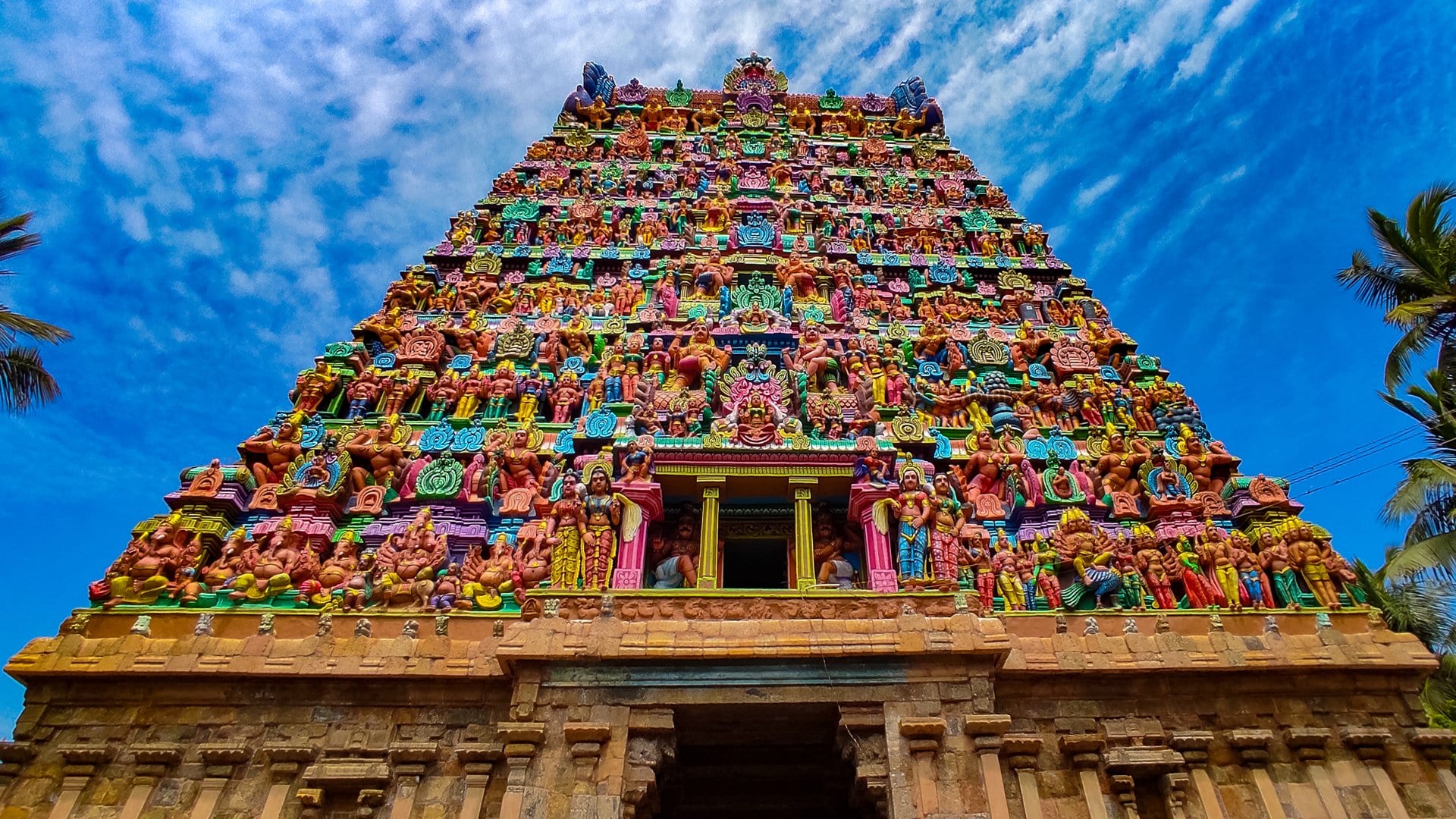
- Sarangapani templeA grand Vishnu temple and the sixth of the 108 Divya Desams, its eleven-tier rajagopuram rising about 173 feet, the tallest temple tower in Kumbakonam and the third tallest among the Divya Desams. A Chola and later masterpiece, with its own midday close, so pair it with Adi Kumbeswarar in one morning.
- Nageswaran, Ramaswamy and ChakrapaniThe Chola-era Nageswaran temple, built so that sunlight falls on the deity on certain days of the Tamil month of Chithirai, the Ramaswamy temple with its Ramayana mural and sculpture panels, and the Chakrapani temple on the river complete the town's great set, each a short ride apart.
- The Mahamaham tankThe large sacred tank in the town centre, ringed by twenty-one wells named for sages, is the focus of the twelve-yearly Mahamaham festival. Quiet and atmospheric between festivals, it is worth a slow walk at dawn or dusk when the gopurams reflect in the water.
These are living temples, so dress modestly and traditionally (avoid shorts and sleeveless tops; men remove the shirt at some inner shrines), leave footwear and leather outside, keep your voice low in the shrines, and walk clockwise. General darshan is free, and a named archanai or abhishekam in your name is arranged and paid for at the temple office. Carry only packaged water. The next sections show how this one town becomes the base for the great circuits.
Kumbakonam, the base for the Navagraha, birth-star and Chola circuits
Kumbakonam's real magic is its position. From one base you can do the Navagraha nine, your birth-star temple, the three UNESCO Chola temples and Swamimalai, most within an hour, if you respect the midday rhythm.
- The Navagraha nineThe nine planetary temples cluster around Kumbakonam and Mayiladuthurai: Suryanar Kovil for the Sun, Thingalur for the Moon, Vaitheeswaran Koil for Mars, Thiruvenkadu for Mercury, Alangudi for Jupiter, Kanjanur for Venus, Thirunageswaram for Rahu and Keezhaperumpallam for Ketu, with only Thirunallar for Saturn further off near Karaikal. Eight sit within roughly 60 km; the full circuit is a comfortable two to three days from here, timed around the midday breaks.
- One long day or a gentler two to threeDetermined pilgrims, and the government bus, do all nine in a single early-to-late day. We usually suggest two to three days so the driving is humane, the darshan unhurried, and the midday rest real. Seniors and families should always take the longer version.
- Your birth-star (Nakshatra) templeMany of the twenty-seven birth-star temples lie in this same delta. If you wish only to visit your own star's temple, carry your nakshatra details and we route you to the convenient one and arrange the archanai; the full twenty-seven is a longer guided circuit for the committed.
- The Great Living Chola TemplesAiravatesvara at Darasuram, about 5 km away and open roughly 8 am to 12 pm and 4 pm to 8 pm, is the UNESCO jewel on your doorstep, with Brihadeeswarar at Thanjavur and the temple at Gangaikonda Cholapuram completing the trio. Slot a heritage day into the pilgrimage.
- Swamimalai, the Murugan abodeAbout 8 to 9 km away, the fourth Arupadai Veedu abode of Murugan, reached by sixty steps named for the sixty Tamil years, open about 6 am to 12 pm and 4 pm to 9 pm. The hilltop shrine and the bronze workshops below make a lovely half-day.
The temptation is to move hotels as you tick off temples. Resist it. Kumbakonam sits at the centre of the whole web, so a single base means you unpack once, your driver knows every back lane and timing, and you come home each evening to the same bed and the same degree coffee. It is calmer, cheaper and far less tiring than chasing rooms across the delta.
The bronzes, the Chola art and the degree coffee
Around the temples, Kumbakonam offers a living craft, the finest Chola carving, and the south's most famous filter coffee. These are the experiences people remember as much as the darshan.
- Watch Swamimalai bronze-castingIn and around Swamimalai, families still cast bronze temple icons by the ancient lost-wax method, the very craft of the Chola sculptors. A workshop visit, watching a wax model become a bronze god, is genuine and memorable, and you can buy a small icon directly from the artisans rather than a showroom.
- Read the Chola art at DarasuramAiravatesvara at Darasuram rewards a slow look: the chariot-shaped mandapam with stone wheels and horses, the friezes of dancers and musicians, and the famous musical stone steps. A good guide turns the carvings into stories, so take one or read up before you go.
- Drink the degree coffeeKumbakonam gives its name to degree coffee, the strong first-decoction filter coffee made with pure cows' milk and served in a brass tumbler. A tumbler of it, with a delta breakfast of idli, pongal and vadai, is a small daily joy between temples.
- Nearby temple gemsThiruvidaimarudur with its great Mahalingaswamy temple, Oppiliappan, and the river town of Thiruvaiyaru with its Carnatic-music heritage are all close, if you have an extra morning among the circuits. Ask your driver to slot one in on a lighter day.
Skip the mass-produced trinkets. Kumbakonam's real keepsakes are a hand-cast Swamimalai bronze bought from the artisan family who made it, a brass coffee filter and tumbler from the town's metal bazaar, and a pack of the local filter-coffee powder. They are heavier than fridge magnets but they carry the place with them, and the bronze, if blessed at a temple, becomes a small shrine of its own at home.
Where to stay in Kumbakonam, and how long to spend
Stay in the town for the temples and the coffee, or on the quiet delta outskirts for a heritage retreat. Two to three nights is the sweet spot for the full circuit.
- In town: simple and centralThe town centre near the big temples and the railway station is where most pilgrims stay: clean budget hotels and lodges, walkable to Adi Kumbeswarar, Sarangapani and the bazaar, and handy for an early start and a late return from the circuit. Practical rather than pretty, and excellent value.
- On the delta edge: heritage and calmA handful of heritage and resort stays sit in the paddy country just outside town, converted homes and riverside properties with gardens and quiet. You need the car into town, but they are lovely for couples and for travellers who want the delta to slow them down between temples.
- Room budgetsClean budget rooms and pilgrim lodges run roughly 1,000 to 2,000 rupees a night, comfortable mid-range hotels roughly 2,500 to 5,000 rupees, and the heritage and resort stays well above that. All of these tighten and climb sharply in a Mahamaham year and on big festival days, so book ahead in season.
- How many nightsTwo nights covers the town temples, Darasuram, Swamimalai and a good slice of the Navagraha circuit. Three nights does the full Navagraha nine plus the Chola heritage at a humane pace. One night only suits the town temples and a single birth-star visit on the way through.
In a Mahamaham year (next 2028) and on major festival days, rooms across Kumbakonam are booked out months ahead and prices multiply. If your dates fall on a festival, reserve very early, or base yourself in Thanjavur or Trichy and drive in. In a normal month outside festivals you can usually find a good room without much notice.
Kumbakonam costs and a realistic budget
Kumbakonam is one of the gentler temple towns on the wallet. Here is what the main things cost, so you can plan and keep the touts off.
- The fixed and free thingsGeneral darshan at all the temples is free. Airavatesvara at Darasuram is free for Indian visitors, with a small ASI ticket, often quoted around 50 rupees, for foreign visitors. The TNSTC Navagraha day-bus is around 750 rupees per person including breakfast and lunch. These are the rare set prices in a town that otherwise runs on cash and negotiation.
- The car and the circuitThe real cost of a Kumbakonam trip is the car and driver for the scattered temples, charged by distance and by day. Share it and the per-head cost drops sharply, which is why families and small groups travel cheaply here. We can quote a fixed circuit rate so there are no surprises on the road.
- Archanai and offeringsA named archanai is inexpensive and bought at the temple office; an abhishekam costs more and is arranged in advance. Agree the amount at the counter before it is done, never with a tout, and you avoid the one common friction of a temple day.
- Food, coffee and staysFood is cheap and superb: a full meals plate, idli and a degree coffee cost very little, and the eating is part of the joy. With budget rooms from roughly 1,000 rupees, a simple pilgrim's day here is genuinely inexpensive once the car is shared.
Settle two things in advance and a Kumbakonam trip stays cheap and smooth: agree the car-and-driver circuit rate before you set off, and agree any archanai or abhishekam amount at the temple office before the ritual begins. Both are quoted high to the unprepared visitor and come down without drama once you ask the price first. Carry cash in small notes, as the temple towns and villages run on it.
Practical logistics: food, money, language and dress
The small things that make a Kumbakonam temple day smooth, from the dress code to ATMs, language and getting around town.
- Dress for living templesAvoid shorts and sleeveless tops; a dhoti or trousers and a simple shirt for men, and a salwar or sari or a long skirt and top for women, see you welcome everywhere. Men are asked to remove the shirt at some inner shrines, so wear something easy. Footwear and leather come off outside; carry a cloth bag for shoes on the circuit.
- Food and waterThe vegetarian delta food is a highlight: meals plates, idli, pongal, vadai and the famous degree coffee. Drink packaged or filtered water, especially in the monsoon months when town water can be unreliable, and take the usual care with cut fruit and very oily street snacks.
- Money and ATMsThere are bank ATMs in Kumbakonam town, and cards or UPI work in hotels and bigger shops, but the temples, villages, archanai counters and small eateries run on cash. Carry enough small notes for the day's circuit, as the scattered temple villages have few machines.
- Language and getting around townTamil is the language, and Hindi is little spoken here, though English gets you by in hotels and with drivers. The town core is compact, with autos for the short hops; for the temple villages beyond, the car or the government bus is the way, as local transport between them is sparse.
Safety, touts, heat and temple etiquette
Kumbakonam is a calm, devout and welcoming town with little of the hassle of bigger tourist centres. A few sensible habits keep a temple trip happy and well.
- Touts and priced ritualsThe main friction at busy temples is people offering special darshan, a quick pooja or a guided shortcut for cash. Arrange any archanai or abhishekam at the temple office, agree the amount first, and a polite, firm no handles the rest. Book through your operator if you are unsure who is official.
- Heat, steps and waterThe delta is hot for much of the year, and a temple day is a lot of walking on stone, barefoot in the shrines, plus the sixty steps at Swamimalai. Carry water and sun cover, do the temples in the cool morning, and use the midday closure for a proper rest rather than pushing through it.
- Feet, floors and footwearStone courtyards can be scorching by late morning and slippery near the tanks. Have socks ready for hot floors, watch your step around wet ghats and tank edges, and keep an eye on left-outside footwear at the busier shrines, where a small minder fee or a cloth bag saves a barefoot walk back to the car.
- General safetyKumbakonam is generally safe and low-crime, and solo and women travellers usually find it easy with standard precautions. Keep valuables close in festival crowds, agree fares and circuit rates in advance, and you will find the town gentle and helpful.
The one time to be extra careful is a major festival, above all a Mahamaham year, when enormous crowds gather at the tank. If you travel then, go early, keep your group together, mind children and elders in the press near the water, follow the crowd-control marshals, and do not attempt the bathing steps when they are densely packed. Outside festivals the same tank is quiet and entirely manageable.
Kumbakonam for every kind of traveller, and on access
Kumbakonam draws very different visitors. Here is what it offers you, and the one tip that matters for each, including how an older pilgrim does the circuit comfortably.
- Circuit pilgrims and devoteesThe one base for the Navagraha, the birth-star and the Chola temples. Plan around the midday break, take a car and driver or the government bus, and let us arrange the named archanai at each temple so the darshan is unhurried and the touts kept off.
- Senior travellers and on accessibilityVery doable with gentle pacing. The circuits are many short stops, so spread them over two or three days, do the temples in the cool morning, and rest through the midday closure. At Swamimalai there are sixty steps; rest on the way or skip the climb if needed. A car between every temple does the hard part, and the flat town temples are easy on the feet.
- Families with childrenThe bronze-casting workshop, the giant gopurams and the Darasuram musical steps and stone chariot keep children interested. Keep them close in the crowded bazaar temples, plan around the heat and the closures, and break the circuit with the coffee and the food they will remember.
- Heritage and art loversDarasuram, the Thanjavur Brihadeeswarar and the Gangaikonda Cholapuram temples are a feast of Chola architecture and the heart of the UNESCO Great Living Chola Temples. A good guide and an unhurried pace make it unforgettable; give the art at least a full day.
- Overseas and NRI pilgrimsIdeal for a Navagraha or birth-star vow. If you only want your own star's temple, carry your nakshatra and gotra details and we route you to the convenient one and arrange the ritual; the full circuit is a guided few days, paced for jet lag and older parents.
- Budget travellersKumbakonam has simple, cheap lodges and superb cheap food, and the temples cost nothing to enter. The TNSTC Navagraha day-bus at around 750 rupees, or a shared car, keeps the circuit affordable; this is one of the easiest pilgrimages in the south to do well on little.
A suggested Kumbakonam itinerary
How to shape two or three unhurried days so you cover the town temples, the Chola heritage and the Navagraha circuit without ever hitting a locked sanctum.
- Day one, the town and DarasuramStart early at Adi Kumbeswarar and Sarangapani before the midday close, walk the Mahamaham tank, then rest through the heat. In the late afternoon take in Airavatesvara at Darasuram when it reopens around 4 pm, ending with a degree coffee in town.
- Day two, Swamimalai and the first Navagraha templesClimb Swamimalai in the cool morning and visit a bronze workshop below, then begin the Navagraha circuit with the temples closest to town, such as Thirunageswaram and Suryanar Kovil, working around their midday breaks with your driver.
- Day three, the rest of the Navagraha nineComplete the planetary temples, including the further ones near Mayiladuthurai and, if you wish, Thirunallar for Saturn over near Karaikal. A pre-dawn start and a packed lunch make this a full but rewarding day.
- The short versionOn a single day, do the town temples and Darasuram, or take the government Navagraha bus for the nine planetary temples. You will miss the unhurried pace and the heritage, but you will still touch the heart of the delta.
The single thing that breaks a Kumbakonam plan is arriving at a temple during its midday closure, roughly 12:30 pm to 4 pm. Build each day so the temples fall in the morning and the late afternoon to evening, and keep the hot middle of the day for a meal and a rest. Do that and you will never stand at a shut gate with the clock running and the driver waiting.
The real questions travellers ask about Kumbakonam
Straight answers to the questions that come up again and again on traveller forums, so you arrive already knowing the score.
- Can I do all nine Navagraha temples in one day?You can, and the government bus and many private packages do exactly that, but it is a long pre-dawn-to-late-night day with quick darshans. Two to three days is far more comfortable and lets you actually sit with each temple. Seniors and families should always take the longer version.
- Is Kumbakonam the right base?Yes. It sits at the centre of the whole web of temples, so eight of the nine Navagraha shrines, the Chola heritage and Swamimalai are within about an hour, and you can unpack once. Only Thirunallar for Saturn, near Karaikal, is a longer drive out and back.
- Is it really true everything shuts at midday?Yes, almost every temple closes roughly 12:30 pm to 4 pm, some reopening nearer 4:30 pm. This is the single most important planning fact: build mornings and late afternoons of temples, and keep the middle of the day for food and rest.
- Can non-Hindus and foreigners go inside?Most temples here welcome respectful foreign and non-Hindu visitors into the outer precincts and to view the deity, though a few inner sanctums are reserved for Hindus and some have separate rules. Dress traditionally, follow the queue and the priests' directions, ask before photographing inside, and you will be made welcome; reconfirm at any shrine that seems to restrict the sanctum.
- Is there a cheap government bus?Yes. Tamil Nadu state transport runs a packaged Navagraha bus from Kumbakonam, mainly at weekends, covering all nine temples in a day with breakfast and lunch for around 750 rupees a head. It is great value, but books out weeks ahead online, so reserve early.
- How do I do just my birth-star temple?Carry your nakshatra (and ideally gotra) details, and we route you to the convenient birth-star temple in the delta and arrange the archanai in your name. It is an easy half-day add-on rather than the full twenty-seven-temple circuit, ideal if you are short on time.
Planning Kumbakonam from abroad
Kumbakonam is the base for South India's great temple circuits and the heart of Chola heritage, a rewarding and meaningful trip for overseas and NRI pilgrims. A little preparation makes the rituals and the temple rules easy.
- Base yourself here for the circuitFly into Chennai (or on to Trichy), then base in Kumbakonam for the Navagraha, birth-star and Chola-UNESCO temples, most within an hour. A car and driver and a coordinator who calls ahead and knows the timings make the whole circuit smooth, especially through the midday closures.
- Do your birth-star or Navagraha vow properlyFor a specific birth-star or Navagraha parihara, carry your nakshatra and gotra details. We route you to the right temple and arrange the archanai or abhishekam in your name at the temple office, avoiding the touts who target visitors who do not know the system.
- See the Chola masterpiecesAiravatesvara at Darasuram, Brihadeeswarar at Thanjavur and the temple at Gangaikonda Cholapuram are the Great Living Chola Temples, a UNESCO trio worth a full heritage day amid the pilgrimage. Foreign visitors pay a small ASI ticket at these monuments; carry cash for it.
- Gentle and senior-friendly with planningFor older parents, spread the circuit over two or three days, do the temples in the cool morning, use the car between every stop, and rest through the midday close. Mind the universal closure and the sixty steps at Swamimalai, where the climb can be rested or skipped.
Respectful foreign and non-Hindu visitors are welcome at almost all of these temples to view the deity and the art, and the Chola monuments at Darasuram and Thanjavur are open ASI heritage sites for everyone. A small number of inner sanctums are reserved for Hindus. Dress traditionally, remove footwear and leather, follow the queue and the priests, and ask before photographing inside, and you will be received warmly across the delta.
Money, connectivity and timing for foreign visitors
The practical basics an overseas traveller needs for a temple-town circuit: cash for the villages, a SIM that works on the road, the ASI tickets, and how many days to give it on a wider South India trip.
- Carry cash for the temple villagesCards and UPI work in town hotels and bigger shops, but the temples, the archanai counters, the small eateries and the scattered Navagraha villages run on cash, and ATMs thin out beyond town. Draw enough in Kumbakonam each morning and keep small notes for offerings, footwear minders and the foreign-visitor ASI tickets at the Chola monuments.
- Get a SIM at the airportPick up an Indian tourist SIM or an eSIM when you land in Chennai or Trichy rather than hunting for one in a temple town. Coverage across the delta is generally fine for maps, calls and reaching your driver, which matters on the village roads between the planetary temples.
- How long to give it on a bigger tripOn a wider Tamil Nadu trip, two to three nights in Kumbakonam is the right weight: enough for the town temples, Darasuram, Swamimalai and a good slice of the Navagraha circuit, and it pairs naturally onward with Thanjavur, Trichy, Chidambaram and Madurai.
- Time your visit to your comfortNovember to March is the comfortable window for a circuit of barefoot temple floors and open courtyards. If a Mahamaham year (next 2028) tempts you, plan far ahead for the crowds; if you want calm darshan, come in a quiet month and you will have the cool mornings almost to yourself.
Kumbakonam is an unusually rewarding introduction to the living temple culture of the south: compact, devout and welcoming, with the greatest Chola art and a working pilgrimage circuit on its doorstep. Give it two or three unhurried nights, let a good driver handle the timings and the back lanes, and respect the midday rest the temples themselves keep, and you will come away with the heart of Tamil Nadu's sacred geography in a single, calm base.
Kumbakonam, the corner where the pot came to rest
Kumbakonam means roughly the pot's corner, from kumbha, a pot. In the old story, as a great deluge gathered to dissolve the world at the end of an age, Lord Brahma gathered the seeds of all living things, along with the Vedas, into a sacred pot of nectar, the amrita kalasam, and set it adrift on the rising waters to ride out the flood. The pot floated for ages and finally came to rest at this spot. Lord Shiva, as a hunter, loosed an arrow and broke the pot; the nectar spilled, the world was made anew, and where the pot broke open a sacred tank was formed, the Mahamaham tank with its twenty-one wells. To this day the town keeps the name of the pot, and once every twelve years the Mahamaham festival draws millions to bathe where the nectar is said to have spilled. The tale is woven through the regional sthala-purana tradition and retold in local temple histories; no single scriptural verse is reliably attributed to it, so we tell it as the living legend it is.
Planning a Kumbakonam trip?
Our Tamil Nadu travel experts plan your full journey for you: route, hotels, darshan timings and transport. You get a free day-by-day plan and an exact quote on WhatsApp, usually within a few hours. No payment is needed to get your plan.
Tour packages that visit Kumbakonam
Every journey below is private, hand-crafted and fully customizable. Tell us your dates and we tailor the itinerary, the pace and the priests or guides around you.