Thanjavur Travel Guide
The best months are October to March , and the best hour is early morning, when the granite is cool underfoot and the light is soft on the great tower. The Big Temple also closes...
When to visit Thanjavur, and the morning rule
The best months are October to March, and the best hour is early morning, when the granite is cool underfoot and the light is soft on the great tower. The Big Temple also closes for a long midday break, so the morning matters twice over.
- October to March: the pleasant seasonThe comfortable Tamil cool months are the time for the open temple courtyard and the palace, with cool mornings ideal for the Big Temple and easy days for the gallery and library. This is the peak window for heritage visitors, and it overlaps with Pongal in January and the Natyanjali dance festival, so the city has a festive air.
- Come early in the dayFootwear is left outside the temple, and the granite courtyard grows hot by late morning, so arrive close to opening. The early light on the vimana is the most beautiful of the day, the courtyard is cool on bare feet, and the crowds are thinnest before the tour buses arrive.
- April to June: hot and humid, best avoidedHigh summer on the Cauvery delta is hot and sticky. If you must come then, do the temple at dawn, keep the air-conditioned indoors of the palace, gallery and library for the heat of the day, and rest through the afternoon when the temple is shut anyway.
- Maha Shivaratri and festival daysMaha Shivaratri, around February or March, is the Big Temple's biggest festival, with long queues and a charged atmosphere; wonderful if you want the living temple at full devotion, slower if you only want the architecture. Reconfirm timings before any festival visit, as the schedule changes.
Entry to the Brihadeeswarar temple is free for everyone. It is open about 6 am to 12:30 pm and 4 pm to 8:30 pm, with a long break of roughly three and a half hours in the middle of the day, so plan the temple for the morning and the palace complex for later. The signature section below shows how to read the masterpiece once you are inside.
How to reach Thanjavur
Thanjavur is easiest reached through Trichy, an hour or so to the west, and is itself a railway junction barely 2 km from its great temple. Chennai is the bigger gateway up north.
- By air via TrichyThe nearest airport is Tiruchirappalli (Trichy), about 55 to 60 km away by road, roughly an hour and a quarter in a taxi, with domestic flights and some Gulf and Southeast Asia connections. Chennai is the larger international gateway further north.
- By trainThanjavur is a railway junction, about 2 km from the Big Temple, well connected to Chennai, Trichy (only about 49 to 50 km by rail), Madurai and Kumbakonam. Arriving by train drops you right in the heart of Chola country.
- By road from ChennaiFrom Chennai it is about 340 to 350 km, roughly 7 to 8 hours, via Villupuram and Kumbakonam, a long but easy drive on good highway. Many travellers break it at Pondicherry or Chidambaram, or fly to Trichy to skip the haul.
- Pair it with Trichy, Kumbakonam and MaduraiThanjavur sits naturally on the Tamil Nadu temple circuit: Trichy and its Rockfort an hour west, Kumbakonam and the Chola trio about 40 km north-east, and Madurai a few hours south. We can arrange a car with an experienced driver to link them.
Fly into Chennai, then take a short domestic hop or onward train to Trichy and drive about an hour to Thanjavur. It is the centrepiece of the Great Living Chola Temples heritage trail.
Fly into Chennai or directly to Trichy, which has some regional international flights, then continue by road or rail. Thanjavur pairs with Kumbakonam and the Chola trio for a heritage trip.
Take a train to Thanjavur Junction from Chennai, Trichy or Madurai, or fly to Trichy and drive the short hop. Good roads link it to Kumbakonam and the wider temple circuit.
The Big Temple, the palace, the library and the bronzes
Thanjavur's great sights cluster within about a kilometre: the thousand-year Brihadeeswarar temple, and the royal palace with the most remarkable old library in India and the finest Chola bronzes. Know the tickets and closing days before you go.
- The Brihadeeswarar templeThe foremost Great Living Chola Temple, over a thousand years old, free to enter, open about 6 am to 12:30 pm and 4 pm to 8:30 pm. Allow an hour and a half to two hours for the vimana, the giant Nandi, the long colonnades and the courtyard, and come in the morning before the heat and the closure.
- The Thanjavur Maratha PalaceAbout 1 km from the temple, the Nayak and Maratha palace complex inside the old fort walls, with its Durbar Hall, the bell tower and the royal museum. A small entry ticket covers the palace, with extra for cameras; give it a couple of hours alongside the library and gallery within.
- The Saraswathi Mahal LibraryWithin the palace, the library the Encyclopaedia Britannica called the most remarkable in India, with rare palm-leaf and paper manuscripts and a small museum. It is open about 10 am to 1 pm and 1:30 pm to 5:30 pm and is closed on Wednesdays and government holidays, so do not plan a Wednesday visit.
- The Thanjavur Art GalleryAlso in the palace, a superb collection of Chola, Nayak and Maratha bronze and stone sculpture, including some of the loveliest Chola bronzes anywhere. It is open about 9 am to 1 pm and 3 pm to 6 pm, closed on national holidays, with a nominal entry of only a few rupees (about 5 rupees for Indians and about 20 rupees for foreign visitors, reconfirm on site) and a separate camera fee of about 30 rupees for a still camera. The highlight for art lovers.
Footwear is left outside the temple, and the granite courtyard gets hot by midday, so the morning is far kinder on bare feet. Dress modestly, and note photography is usually fine in the courtyard but restricted inside the sanctum. If you want the Saraswathi Mahal Library, avoid Wednesday, when it is closed. The next section reads the masterpiece itself.
Reading the Brihadeeswarar temple
The Big Temple is not just to be seen but to be read. Built by Raja Raja Chola I a thousand years ago, it is a feat of art and engineering that still astonishes, and a little knowledge turns the granite into history.
- The vimana and the capstoneThe granite tower rises about 216 feet (66 metres), among the tallest temple towers in India, capped by a single stone of about 80 tons. How the Cholas raised that capstone a thousand years ago, probably up a long earthen ramp, is still wondered at, and the proportions of the whole tower are mathematically exact in a way that rewards a slow look from the far end of the courtyard.
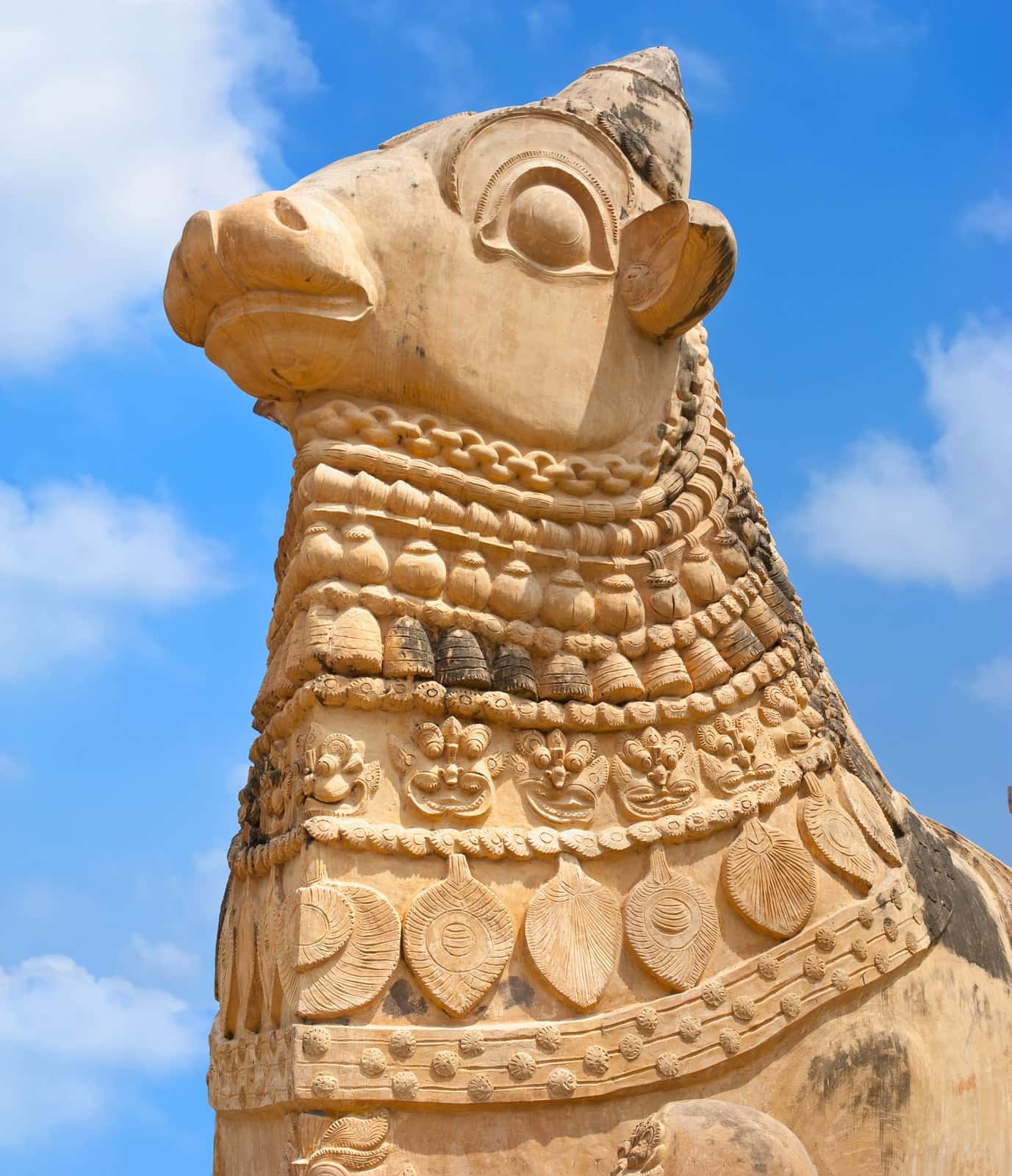
- The giant monolithic NandiIn the courtyard sits one of India's largest single-stone Nandi bulls, about 12 to 16 feet long, carved from one block and facing the sanctum from its own 16th-century pavilion. A favourite photograph, and a real sense of the scale the Cholas worked at.
- The frescoes and the inscriptionsLook for the Chola frescoes in the passage around the sanctum and the long Tamil inscriptions that record the temple's endowments in detail, a thousand-year-old account book in stone listing gifts of gold, land and dancers. A licensed guide turns the walls into a living history.
- Come at dawn, and take a licensed guideArrive for opening, when the light is soft and golden on the granite and the courtyard is cool underfoot. Official guides licensed by the Archaeological Survey of India wait at the entrance; agree the fee first, and you will read far more in the stone than you would alone.
You will hear that the vimana's shadow never falls on the ground at midday. It is a lovely story, but it is not literally true. The tower does cast a shadow; at noon it falls close to the temple's own base and towards the periphery, where the broad plinth and the trees hide it from an easy view, and the precise effect depends on the season and the sun's angle. Enjoy the legend for what it is, a tribute to Chola genius, rather than repeating it as a proven mystery.
Bronzes, Tanjore paintings and the Chola trio
Thanjavur is a city of art as much as worship: the Chola bronzes, the gold-leaf paintings, the veena and the nodding-head dolls, and the wider trail of the three UNESCO Chola temples around Kumbakonam.
- The Chola bronzesSpend time with the bronzes in the Thanjavur Art Gallery, the dancing Shivas and graceful goddesses that are a high point of Indian sculpture, cast by the lost-wax method a thousand years ago. Unhurried, and ideally with a guide, they reward a long look, and the entry ticket is only a few rupees (about 5 rupees for Indians, about 20 rupees for foreign visitors, with a separate about 30 rupees fee if you carry a still camera).
- Buy a genuine Tanjore paintingThe gold-leaf Tanjore painting is the city's signature craft and carries a Geographical Indication (GI) tag from 2007. A real one uses actual 22-karat gold foil laid over raised gesso work and sometimes semi-precious stones. The market is full of brass-foil and gold-paint fakes, so buy from a reputable studio, ask to see the gold leaf, and watch an artist at work if you can.
- The veena and the dollsThanjavur is also famous for the handmade Saraswati veena, the classical instrument made here for generations, and the charming nodding-head dolls (thalaiyatti bommai). Both make lovely, characterful souvenirs from a genuine maker rather than a mass-market stall.
- Do the Chola UNESCO trioPair the Big Temple with the Airavatesvara temple at Darasuram (near Kumbakonam, about 40 km away, added to the UNESCO list in 2004) and the temple at Gangaikonda Cholapuram to complete the three Great Living Chola Temples. Darasuram in particular, smaller and exquisitely carved, is the connoisseur's favourite, and the loop makes a wonderful heritage day or two.
- Eat the deltaThe Cauvery delta serves superb vegetarian meals on a banana leaf and the south's best filter coffee. Eat at busy, clean places and drink bottled or filtered water, and try the local Thanjavur sweets if you have a sweet tooth.
If you do only one thing slowly, give the Chola bronzes in the Art Gallery a proper hour rather than a quick walk-through. They are the very finest of their kind in the world, the same artistry that made the Big Temple, in a quiet room for an entry ticket of only a few rupees that most hurried visitors skip entirely. Combined with a real Tanjore painting from a genuine studio, they are what you will remember of Thanjavur's art long after the crowds fade.
Where to stay in Thanjavur, and how many nights
Stay near the temple and the old town to walk to everything, or pick a comfortable hotel on the edge of town for space and quiet. One full day with an overnight is the sweet spot, two if you add the Chola trail.
- Near the temple and old townStaying close to the Big Temple and the palace keeps everything within a short auto hop or a walk, which matters in the heat. The area has plenty of budget and mid-range hotels, busier and plainer but convenient, and best for first-timers who want to step straight into the heritage.
- Edge-of-town and riverside hotelsQuieter, more comfortable hotels and the odd resort sit on the outskirts and towards the river, with more space, gardens and pools but a short drive into the centre. Better for families, seniors and anyone who wants to slow down after a hot day of temples.
- How many nightsOne full day with an overnight covers the Big Temple at dawn, the palace, the library and the bronze gallery comfortably. Add a second night to do the Chola trio at Darasuram and Gangaikonda Cholapuram, or to slow the pace. A half-day stop on a longer drive lets you see only the temple and a quick palace look.
- Or base in TrichySome travellers base in Trichy for its wider choice of hotels and the airport, and day-trip to Thanjavur and Kumbakonam, about an hour and a half each way. That works well if you are flying in and out, though staying in Thanjavur itself gives you the temple at dawn, which a day trip rarely manages.
Thanjavur costs and a realistic daily budget
Thanjavur is gentle on the wallet: the great temple is free, the bronze gallery costs only a few rupees to enter, and most of your spend is meals, autos and a guide. Here is what the main things cost so you can plan.
- A rough daily budgetExcluding your room and long-distance transport, plan on about 800 to 1,500 rupees a day as a budget traveller, about 2,000 to 4,000 rupees mid-range, and about 5,000 rupees and up for a comfortable day with a car, a guide and a good meal out. Thanjavur is one of the cheaper heritage cities to spend a day in.
- The fixed-price thingsThe Brihadeeswarar temple is free to enter. The Thanjavur Art Gallery charges only a nominal entry, commonly reported about 5 rupees for Indians and about 20 rupees for foreign visitors, with a separate camera fee of about 30 rupees for a still camera and about 300 rupees for video (small museum fees are revised from time to time, so reconfirm on site). The Saraswathi Mahal Library is inexpensive too. These small, fixed tickets are a useful anchor in a city where most things are cheap.
- Getting around and a guideAn auto-rickshaw hop across town is typically about 50 to 150 rupees, agreed before you set off, and a half-day auto to cover the temple, palace and gallery runs roughly 500 to 800 rupees. A licensed temple guide is usually a few hundred rupees for the Big Temple; agree the fee first.
- Cash, cards and mealsBigger hotels and shops take cards and UPI, but autos, small messes and craft stalls run on cash, so carry enough for the day from a main-market ATM. A banana-leaf vegetarian meal is very cheap, often around 100 to 200 rupees, and the filter coffee a few rupees more.
The single best-value ticket in Thanjavur, and one most hurried visitors skip, is the Thanjavur Art Gallery in the palace, whose entry is only a few rupees (about 5 rupees for Indians and about 20 rupees for foreign visitors, with about 30 rupees more if you carry a still camera) for some of the finest Chola bronzes in the world. Set against a temple that is free and meals under 200 rupees, Thanjavur gives you a thousand years of the greatest Indian art for almost nothing, so the only real spend to plan for is a car, a guide and somewhere comfortable to sleep.
Practical logistics: getting around, food, money and language
The small things that make a Thanjavur day smooth, from autos and the compact core to ATMs, water and the language.
- Getting aroundThe temple, the palace, the library and the gallery sit within about a kilometre, so a single auto-rickshaw or a short walk links them. Auto-rickshaws are widely available; agree the fare before you set off or ask for the meter, and a half-day hire is the easiest way to cover the sights and a craft studio.
- Food and waterThanjavur is firmly vegetarian-leaning delta cooking at its best, with banana-leaf meals, dosas and filter coffee. Eat at busy, clean places, and drink bottled or filtered water rather than tap, which is the usual sensible precaution in this climate.
- Money and ATMsBank ATMs are in the main market and near the bus stand. Cards and UPI work in bigger hotels and shops, but autos, small eateries and craft stalls are cash, so carry enough small notes for the day.
- Language and signalTamil is the local language and Hindi is little spoken, but English is widely understood in the tourist, hotel and craft trade, so communicating is easy. Mobile coverage in town is generally fine for maps, calls and ride apps.
Safety, the heat, and temple etiquette
Thanjavur is calm, friendly and low-hassle. The real things to manage are the heat and the bare-feet granite, plus a little temple etiquette, rather than any serious safety worry.
- The heat and the bare feetThe biggest practical hazard is the sun and the hot stone. Footwear comes off at the temple, and the granite courtyard is scorching by late morning, so go at dawn, carry water, and wear socks for the hot stone where they are allowed. Hats and shade help in the open courtyard.
- Temple etiquetteDress modestly, cover shoulders and knees, remove footwear where asked, and walk clockwise around the sanctum in the Hindu custom. Keep your voice low inside the shrines, do not photograph inside the sanctum where it is restricted, and ask before photographing people at prayer.
- Low-hassle, but the usual careThanjavur is a relaxed temple town with little of the tout pressure of busier tourist towns. Use the normal precautions: agree auto fares first, watch your belongings in crowds on festival days, and be polite but firm with anyone steering you to a particular craft shop for a commission.
- Solo and senior travellersSolo travellers, including women, generally find Thanjavur an easy, gentle stop with standard precautions. For seniors, the sights are fairly flat and close together, but the heat and the bare-feet stone are the things to plan around, so go early and use a car between the temple and the palace.
The single thing that breaks a tight Thanjavur plan is arriving at the Big Temple during its midday closure, about 12:30 pm to 4 pm, on a courtyard that is also at its hottest then. Build your day so the temple falls at dawn, keep the hot, shut middle of the day for the air-conditioned palace, gallery and a long lunch, and remember the Saraswathi Mahal Library is closed on Wednesdays. Get those three timings right and nothing else about Thanjavur is hard.
Thanjavur for every kind of traveller, and on access
Thanjavur rewards very different visitors in different ways. Here is what it offers you and the one tip that matters for each, including how an older traveller sees the Big Temple comfortably.
- Heritage and history loversThe thousand-year Chola capital, best read with a licensed guide for the temple, the bronzes and the inscriptions. Allow a full day, two with the Chola trio at Darasuram and Gangaikonda Cholapuram.
- Devotees and pilgrimsA living, free temple of immense sanctity. Come at dawn for a calm darshan before the heat and the visitors, walk clockwise around the sanctum, and observe the dress and the bare-feet custom.
- Senior travellers and on accessibilityVery doable with care. The temple and palace are fairly flat and close together, but footwear comes off and the granite is hot by midday, so go early, carry water, wear socks for the hot stone if allowed, and use a car or auto between the temple and the palace rather than walking in the sun.
- Families with childrenThe giant Nandi, the towering vimana and the nodding-head dolls delight children. Plan around the midday closure and the heat, keep little feet off the hot stone at noon, and the bronze gallery is a short, manageable indoor stop when it is hot outside.
- Art loversThe Chola bronzes in the Art Gallery and the gold-leaf Tanjore paintings are the real draw. Give the gallery a slow hour, watch a painter at work, and buy a genuine GI-tagged piece from a reputable studio rather than a roadside copy.
- PhotographersThe vimana at dawn, the monolithic Nandi, the long colonnades and the frescoes where permitted. Early light is everything in the open courtyard, and remember photography is restricted inside the sanctum.
A suggested Thanjavur itinerary
How to shape one or two days so you catch the temple at dawn, the palace through the hot midday, and the Chola trio if you have a second day.
- Day one, early morningStart at the Big Temple for opening, while the granite is cool and the light is golden on the vimana. Take a licensed guide for the inscriptions and the Nandi, and give it an unhurried hour and a half to two hours before the heat builds and the midday closure begins.
- Day one, midday and afternoonThrough the hot, shut middle of the day, do the palace complex about a kilometre away: the Durbar Hall and bell tower, the Saraswathi Mahal Library (not on a Wednesday) and a slow hour with the Chola bronzes in the Art Gallery. Break for a banana-leaf lunch and filter coffee, then visit a Tanjore-painting studio in the late afternoon.
- Day two, the Chola trailWith a second day, drive the Chola UNESCO trio: Airavatesvara at Darasuram near Kumbakonam, about 40 km away and exquisitely carved, and the great temple at Gangaikonda Cholapuram. A wonderful, quieter heritage day that completes the three Great Living Chola Temples.
- The half-day versionOn a longer drive through Tamil Nadu you can stop in Thanjavur for the Big Temple and a quick look at the palace in three or four hours, though you will miss the dawn light and the unhurried hour with the bronzes that make the city sing.
Thanjavur runs on one simple rhythm: the temple is best and coolest at dawn and then shuts at midday, while the palace, library and gallery are indoors and open through the hot afternoon. Do the temple first and the palace second and the day flows; do it the other way round and you will be standing at a shut temple gate in the worst of the heat. The Chola trio is a separate, quieter day, best with your own car.
The real questions travellers ask about Thanjavur
Straight answers to the questions that come up again and again on traveller forums, so you arrive already knowing the score.
- Is one day enough?One full day with an overnight covers the Big Temple at dawn, the palace, the library and the bronze gallery comfortably. Add a second day only if you want the Chola trio at Darasuram and Gangaikonda Cholapuram, which is well worth it for heritage lovers but not essential.
- Thanjavur or Trichy as a base?Stay in Thanjavur itself if you want the temple at dawn and the unhurried heritage day. Base in Trichy only if you are flying in and out and prefer its wider hotel choice, then day-trip the hour and a half each way to Thanjavur and Kumbakonam.
- Can I do Thanjavur and Kumbakonam in one day?Yes, a single long day of about 8 to 12 hours from Trichy or Thanjavur can take in the Big Temple and the Airavatesvara temple at Darasuram, and a Kumbakonam temple or two, though it is a full day. With your own car and an early start it is a rewarding Chola sweep.
- Is the Big Temple free, and what are the timings?Yes, entry to the Brihadeeswarar temple is free for everyone. It is open about 6 am to 12:30 pm and 4 pm to 8:30 pm, with a long midday break, so come in the morning. Reconfirm on festival days, when the schedule changes.
- Is the no-shadow story true?Not literally. The tower does cast a shadow; at midday it falls close to its own base and towards the periphery, where the broad plinth and the trees hide it from an easy view. It is a lovely legend that honours Chola skill, rather than a proven mystery, so enjoy it as a story.
- Which day should I avoid for the library?Avoid Wednesday for the Saraswathi Mahal Library, which is closed on Wednesdays and government holidays. The Art Gallery has no weekly holiday but closes on national holidays, and both shut for a lunch break, so a late-morning or mid-afternoon visit on a non-Wednesday is safest.
Planning Thanjavur from abroad
Thanjavur is the thousand-year Chola capital and the centrepiece of the Great Living Chola Temples, a rewarding heritage stop for overseas and NRI travellers. A little preparation on timing and the crafts makes it easy.
- Come through Chennai or TrichyFly into Chennai, then take a short domestic hop or train to Trichy, about 55 to 60 km from Thanjavur, and drive the last hour. Thanjavur pairs with Kumbakonam, about 40 km away, for the Chola heritage loop, and slots onto a wider Tamil Nadu temple trip with Madurai and Trichy.
- Free entry, but plan the timingThe Big Temple is free and open about 6 am to 12:30 pm and 4 pm to 8:30 pm. Come at dawn for the light and the cool stone, do the palace, library and bronze gallery through the hot midday, and avoid Wednesday if you want the Saraswathi Mahal Library, which is closed that day.
- See the bronzes and buy a real Tanjore paintingDo not miss the Chola bronzes in the palace Art Gallery, the finest of their kind, for an entry of only a few rupees (about 20 rupees for foreign visitors, plus about 30 rupees if you carry a still camera). Buy a genuine gold-leaf Tanjore painting, GI-tagged since 2007, from a reputable studio with real 22-karat foil, not a brass-foil copy, as a lasting souvenir of the trip.
- Gentle and senior-friendly with planningMostly flat and walkable, with short drives, Thanjavur suits parents and grandparents on a heritage trip. Go early for the cool morning, carry water, wear socks for the hot temple stone if allowed, and use a car between the temple and the palace. It is one of the easier, calmer heritage stops in South India.
Thanjavur on a wider South India heritage trip
For a diaspora or culture traveller, Thanjavur is the heart of a Chola and Tamil Nadu heritage trip. Here is how it fits the wider circuit, how long to give it, and the practicalities of a small temple city.
- Where it fits the circuitThanjavur is the centrepiece of the Great Living Chola Temples and sits naturally between Trichy and Kumbakonam, a few hours from Madurai with its great Meenakshi temple, and on the way to Chidambaram and Pondicherry. A classic Tamil Nadu heritage loop links Chennai, Mahabalipuram, Pondicherry, Thanjavur, Trichy and Madurai.
- How long to give itOn a wider trip, one to two nights in Thanjavur is the right weight: one night and a morning for the Big Temple, the palace, the library and the bronzes, and a second day if you want the full Chola trio at Darasuram and Gangaikonda Cholapuram. It is a focused heritage stop, not a multi-day base.
- Cash, cards and a SIMPick up an Indian tourist SIM or eSIM when you land in Chennai rather than in a small city. Cards and UPI work in bigger hotels, but autos, small messes and craft stalls are cash, so draw enough at a main-market ATM and keep small notes for autos and tips.
- A licensed guide is worth itFor overseas visitors especially, a licensed guide at the Big Temple turns a beautiful but silent monument into a thousand years of Chola history, reading the inscriptions and the bronzes. Arrange one through your operator or hotel, or take an Archaeological Survey of India licensed guide at the gate, agreeing the fee first.
Thanjavur is an unusually rewarding introduction to South India's temple heritage: a single thousand-year masterpiece you can read in a morning, the world's finest Chola bronzes in a quiet gallery for a few rupees, and a living craft you can buy genuine. Give it a night or two, take a guide, and let it be the heritage heart of a Tamil Nadu trip between the seaside of Mahabalipuram and the devotion of Madurai. Many overseas visitors say the Big Temple at dawn is the image of the whole trip they keep.
The thousand-year temple, the capstone, and the shadow that does fall
When Raja Raja Chola I raised the Brihadeeswarar temple at his capital a thousand years ago, finished around 1010 CE, he built the tallest temple tower in the land: a granite vimana of about 216 feet crowned by a single stone said to weigh some 80 tons, probably hauled into place up a long earthen ramp. The temple is the foremost of the three Great Living Chola Temples on the UNESCO World Heritage List, and the most-told story about it is that its tower casts no shadow on the ground at noon. It is a beautiful tribute to Chola genius, and it is worth telling honestly: the tower does cast a shadow, but at midday it falls close to its own broad base and towards the periphery, where the plinth and the trees hide it from an easy view, and the exact effect shifts with the season and the sun. The real marvel needs no myth. That a granite mountain of a temple, mathematically exact in its proportions, with the finest bronzes and inscriptions in stone, has stood a living place of worship for a thousand years is wonder enough.
Planning a Thanjavur trip?
Our Tamil Nadu travel experts plan your full journey for you: route, hotels, darshan timings and transport. You get a free day-by-day plan and an exact quote on WhatsApp, usually within a few hours. No payment is needed to get your plan.