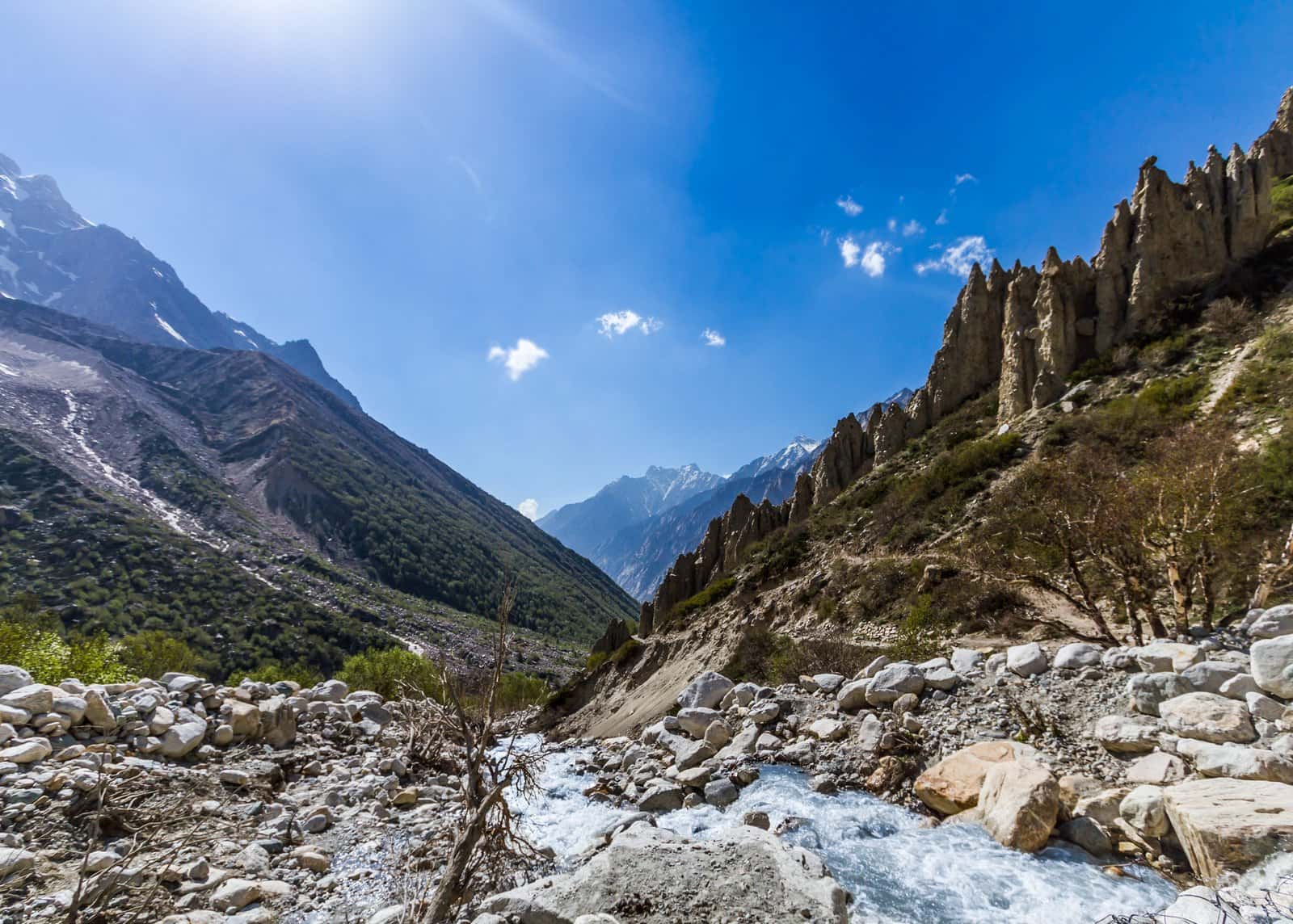
Harsil Travel Guide
The kind months are May to mid-June and September to October . The monsoon, roughly late June to August, is the season this valley has learned to fear, and you should plan around...
When to visit Harsil, and the months to avoid
The kind months are May to mid-June and September to October. The monsoon, roughly late June to August, is the season this valley has learned to fear, and you should plan around it.
- May to mid-June: the clean, easy windowThis is when the valley is at its kindest. The Gangotri road is open, the deodar forest is bright, the snow is still lying on the ridges above and the days are warm enough to walk in a light fleece. If you are bringing parents or children, this is the window to choose. Book early, because the Char Dham season fills the same rooms.
- September to October: apples, clear light and fewer peopleOur favourite time. The pilgrim rush has thinned, the air is washed clean after the rains, and the orchards around Harsil, Dharali and Mukhba are heavy with fruit. The valley celebrates its apples with a festival in this season. Nights get cold quickly, so carry a proper jacket even if the afternoon feels gentle.
- Late June to August: the monsoon, and the honest advicePlease do not plan a leisure trip to this valley in the monsoon. The road from Bhatwari up through Sukhi Top is landslide country, and the debris flow that destroyed much of Dharali came down on 5 August 2025. In the second week of July 2026, the district administration was evacuating buildings at Harsil itself because the Bhagirathi was eating into the village, and the Gangotri highway was opening and closing with landslides. That is what this season does here. If you must travel in these months, keep your plans loose, keep spare days, and follow the district advisories.
- Winter: snow, silence and Maa Ganga at MukhbaFrom about December the valley goes white and very quiet. Gangotri is shut, but the idol of Goddess Ganga is brought down and worshipped at Mukhba village all winter, so devotees can still have darshan. Some stays remain open and the snow is beautiful, but the road can close for days at a time, so keep spare days in hand.
We have to be blunt with you, because this is a safety matter. The valley is not closed. Vehicular movement to Gangotri was restored on about 30 August 2025, roughly 24 days after the Dharali debris flow, and Gangotri National Park reopened for the season on 1 April 2026. But right now, in the middle of the 2026 monsoon, Harsil itself is in an emergency. Reports of 7 July 2026 (ETV Bharat, quoting the Bhatwari tehsildar and the Irrigation Department) said the district administration had evacuated eight buildings at Harsil as the swollen Bhagirathi cut into the village, that notices to vacate more were being issued, that the wire-crate wall being built to protect Harsil had been washed away, and that large cracks had opened in the foundation under the GMVN guest house. The Gangotri highway was blocked again and again by landslides at Nalupani, Nagun and Dharasu Ghat, and was reported reopened only on 10 July 2026 after debris clearance, with the state on high alert under an IMD heavy-rain warning. Our honest advice on the day we last checked this page: do not come for a holiday until after the monsoon. Read the safety section below, and confirm the position with the Uttarkashi district administration and Uttarakhand Tourism in the week you plan to travel rather than trusting any page, including this one, that you read months earlier.
How to reach Harsil
There is no railway and no airport in this valley. Everyone comes up the Bhagirathi by road from Rishikesh or Dehradun through Uttarkashi, or by the seasonal helicopter from Dehradun.
- The drive, and what it really takesHarsil sits on National Highway 34, the Char Dham highway, roughly 75 to 78 km above Uttarkashi town. From Dehradun it is about 200 km and 6 to 7 hours, from Haridwar about 244 km and 7 to 8 hours, and from Delhi about 450 km and a long 12 to 13 hours. Nobody should attempt Delhi to Harsil in one day. Break the journey at Uttarkashi. Your body will thank you and so will your driver.
- The section that decides your dayThe stretch from Bhatwari up over Sukhi Top to Harsil is the one that travellers on IndiaMike and TripAdvisor keep asking about. It is a mix of good tar and rough, broken, occasionally water-crossed road, and it is the first to suffer after rain. Start early, aim to be off this section well before dark, and never let a driver push it at night.
- Air and railThe nearest airport is Jolly Grant at Dehradun, roughly 200 to 220 km below, and the nearest railheads are Rishikesh and Dehradun. From either, take a taxi or a state bus to Uttarkashi and change there. There is no station and no commercial airstrip anywhere close to Harsil, whatever a booking site tells you.
- The helicopter, and a WayToIndia route worth knowingA seasonal helicopter service runs from Sahastradhara in Dehradun to Harsil. Separately, on some Char Dham helicopter itineraries from Dehradun, the day-one halt is at Kharsali or Harsil itself. For an older pilgrim who cannot face twelve hours of mountain road, that halt is the gentlest way into this valley, and it is worth asking us about when you plan.
Fly into Delhi, then take a train or short flight to Dehradun. From Dehradun it is a full day by road through Uttarkashi. Give yourself a night at Rishikesh or Uttarkashi on the way up. Do not try to do it from Delhi in a single push.
Fly to Delhi or Dehradun, then drive. This valley pairs naturally with Rishikesh and Haridwar at the bottom of the road, so build a loop rather than a there-and-back run.
Train or bus to Rishikesh or Dehradun, then a shared jeep or a hired car up through Uttarkashi. Shared jeeps run the valley daily and are the cheapest way up, though they will not wait while you photograph the river.
The villages, the orchards and the winter seat of Ganga
Harsil is not a place of monuments. It is a cluster of about eight small villages under deodar and apple trees, and the things worth seeing here are all lived in.
- Harsil village and the BhagirathiThe village itself is small, green and framed by the river. Walk the riverbank in the early morning when the mist is coming off the water and the peaks are catching the first light. Remember that this is an army and ITBP area and a Garhwal Scouts base, so keep your camera away from the camps, the helipad and any installation, and carry a photo ID.
- Mukhba, where Maa Ganga spends the winterA short drive from Harsil, Mukhba is the winter seat of Goddess Ganga. After Diwali the idol is carried down from Gangotri and worshipped here through the snow months, and the Semwal priests of this village are the hereditary custodians at both shrines. Even in summer it is a place to walk quietly, do pranam and let the village be a village.
- Bagori and the Jadh Bhotiya storyTen or fifteen minutes on foot from Harsil, Bagori is home to the Jadh Bhotiya families who were moved down from Nelong and Jadung after the 1962 war. Their carved wooden houses, the stupa and the Hindu and Buddhist shrines standing side by side tell you more about this border than any museum could. Ask before you photograph anyone.
- Dharali, and how to be a decent guest thereDharali, just above Harsil, is the village that the debris flow of 5 August 2025 came through. Much of its market, its hotels and its homes were destroyed and lives were lost. It is on the road and you will pass it. Please do not treat it as a photo stop. If you go, go to buy something from a family rebuilding a shop, not to take a picture of their grief.
The apple trees you will walk under were not always here. They were introduced in the mid-nineteenth century by Frederick Wilson, an Englishman who deserted the East India Company's army in 1842 and reached this valley at twenty-five. He grew rich felling deodar for railway sleepers, was called the Raja of Harsil, minted his own coins, and is widely believed to have inspired Rudyard Kipling's The Man Who Would Be King. His wooden mansion, Wilson Cottage, burned down in 1997. The Chipko leader Sunderlal Bahuguna held him responsible for the ruin of the Garhwal forests. Both things are true, and you are standing in the middle of them.
Walks, orchards and the lakes above Dharali
This is a valley for walking slowly, not for ticking off sights. Give it two unhurried days and it will give you more than a week of driving would.
- The Sattal walk from DharaliThe classic hike of the valley. A forest trail of about 5 km one way climbs from Dharali to Sattal, a scatter of small high lakes in the pines, and most walkers do it out and back in about 4 to 5 hours. It is not technical, but it is a real climb at altitude, so start early and carry water. The trailhead is at Dharali, so please ask locally about its current condition before you set off.
- An apple orchard, in seasonIf you come between about late August and October, the orchards around Harsil, Dharali and Mukhba are the whole point. Ask your host, not a stranger, and you will usually be walked through a family orchard and given fruit off the tree. Buy a crate. The money goes straight to the family, and it is the single most useful thing a tourist can do here right now.
- Simply sitting by the BhagirathiDo not underestimate this. Find a rock, sit down, and give the river an hour without a phone in your hand. The Bhagirathi at Harsil runs clear and cold and loud, and this is the sound that pilgrims have walked towards for centuries. If you do only one thing here slowly, make it this.
- Bagori, on foot, in the eveningWalk over to Bagori as the light goes. Prayer flags, deodar, wood smoke and the small sounds of a village settling for the night. It is ten minutes from Harsil and it is the best free hour in the valley.
- Stargazing, because there is no light hereThere is almost no light pollution above Uttarkashi. On a clear night the sky over Harsil is extraordinary. Step outside, let your eyes adjust for ten minutes, and look up. Bring a warm layer, because it will be much colder than you expect.
- A day up to GangotriGangotri Dham is roughly an hour and a half further up the road. Many travellers use Harsil as their night halt and go up to the temple for the morning, which is far kinder on the body than sleeping at Gangotri's altitude. Remember your Char Dham registration.
Every guide will tell you to do Gartang Gali and the Sattal lakes, and you should. But the memory people carry away from Harsil is almost never a sight. It is an ordinary morning: cold air, wood smoke, an old woman carrying fodder, the river, and the sun coming over a ridge onto an orchard. Give this valley one whole day in which you plan nothing at all. After what these villages have been through in the last year, the most respectful thing a visitor can do is stay a little longer and spend a little more.
Gartang Gali and Nelong: the permits, the fees and the rules
Above Harsil the road runs into border country. The cliff staircase at Gartang Gali is open to everyone who registers and pays. Nelong and Jadung are not, and the rule surprises people at the barrier.
- What Gartang Gali isA wooden staircase about 136 m long, bolted into a sheer cliff above the Jadh Ganga, built around 150 years ago by Pathan traders from Peshawar as part of the old India to Tibet trade route. It was closed after the 1962 war, left to rot, then restored at a cost of about 64 lakh rupees and reopened to visitors in 2021 after 59 years. Walking it is one of the most extraordinary hours in Uttarakhand.
- How to walk it, and what it costsDrive up past Gangotri turnoff to the forest check post near the Lanka bridge at Bhairon Ghati, about 90 km above Uttarkashi. Register there and pay the entry fee, about 200 rupees for Indian citizens and about 800 rupees for foreign nationals, with children free. You may also be asked for a refundable deposit of about 100 rupees if you carry plastic bottles or packets, which you get back when you bring them out.
- The rules on the staircase, and why they existOnly about 10 people are allowed on the track at a time. There is no jumping, no dancing, no crowding together for photographs and no leaning out over the railing. These rules sound fussy when you read them and completely reasonable when you are standing on old timber with a very long drop under your boots. The walk itself is a moderate 2 km from the check post and takes roughly two hours there and back.
- Nelong and Jadung: the rule that catches people outThe trans-Himalayan valleys above, which people call Little Ladakh, are inner-line areas on the China border. The permit is issued by the SDM office at Uttarkashi and it goes to Indian citizens only. Foreign nationals and foreign-passport holders, including many NRIs, are not given it. It is a day visit, no overnight stay is permitted, and you are expected back at the check post by about 5 pm. Apply a few days ahead and carry your Aadhaar, licence and vehicle papers.
If anyone in your car holds a foreign passport, including an OCI card holder, do not build your itinerary around Nelong or Jadung. Every permit operator and permit guide we checked says the same thing: the inner-line permit for those valleys is issued by the SDM at Uttarkashi to Indian citizens only, and the valley was opened to visitors in 2015 on the condition that foreign nationals would not be allowed in. We must be straight with you, though. We were not able to open a public order of the SDM saying this in writing, so we are giving you the rule as it is consistently reported and applied on the ground, not as a document we have read. Please confirm it with the SDM office at Uttarkashi before you plan a whole day around it, because if the rule holds, you will be turned back at the barrier after driving all the way up. Gartang Gali is a different matter: the forest department charges a separate entry fee of about 800 rupees for foreign nationals, so overseas visitors can and do walk it.
Where to stay in Harsil, and how many nights
Choose between the government rest house, a village homestay and a handful of resorts. Two nights is the right length. One night is a waste of a very long drive.
- GMVN, the state tourist rest house, and an important warningGarhwal Mandal Vikas Nigam, the state tourism corporation, runs a tourist rest house at Harsil with a small number of deluxe rooms, hot water, a restaurant and a view of the Bhagirathi from the windows. It is plain, it is reliable, and you book it directly on gmvnonline.com. But you must know this before you book: on 7 July 2026 it was reported that the Bhagirathi had swept away a tin shed belonging to this guest house and that large cracks had appeared in the foundation beneath the building, which stands close to the eroding bank. Please telephone GMVN and ask about the condition of the property before you pay for a room there this year. We could not open the GMVN tariff page ourselves, so ask them for the current rate as well.
- Homestays, and why we push themThe village homestays of Harsil, Bagori and Mukhba are simple: a clean room, a hot bucket, rajma and rice and rotis made in front of you. They are also the most direct way to put your money into the hands of families who lost income when this valley shut in 2025. If you can be comfortable without a lift and a lobby, stay in a home.
- Resorts and campsA few resorts and orchard-side properties run in the valley with heaters and better beds. Rooms across the valley are commonly listed from roughly 1,500 rupees for a simple guesthouse to about 8,000 rupees and upwards for the better resorts, and prices climb in the Char Dham season. Please treat that as an estimate taken from booking listings and not as an official tariff, and reconfirm the rate directly with the property when you book, because prices in this valley move about a great deal.
- How many nightsTwo nights at Harsil is the sweet spot: one full day for Gartang Gali and the top of the valley, one for the Sattal walk, the orchards and Bagori, with Gangotri as a morning run from here. Three nights if you want to do nothing on one of them, which is the correct way to use this place. One night, after a seven-hour drive, is barely a night at all.
This is the single best planning decision you can make on this road. Gangotri sits at about 3,100 m and the accommodation there is basic. Harsil, near 2,700 m, is lower, warmer, greener and far better supplied, and it is only about an hour and a half from the temple. Sleeping here and driving up for a morning darshan gives your body a gentler altitude profile, gives you a proper dinner and a proper bed, and gives the valley your custom. Pilgrims have been doing exactly this for a very long time.
Harsil costs, permits and a realistic daily budget
The valley is not expensive. What catches people out is arriving with no cash for the permits, because there is very little card acceptance and no reliable ATM up here.
- A realistic daily budgetExcluding your car and your long-distance travel, plan on roughly 1,500 to 2,500 rupees a day for a simple homestay trip with local food, and about 3,000 to 5,000 rupees a day for a comfortable one with a better room and a hired vehicle for the top of the valley. There is very little here to spend money on beyond your bed, your meals and your permits, which is part of its charm.
- The permit and fee list, so you carry the right cashGartang Gali entry is about 200 rupees for Indian citizens and about 800 rupees for foreign nationals, with a refundable plastic deposit of about 100 rupees. Gangotri National Park charges a forest entry fee of about 150 rupees per person for Indians; the foreign-national fee is higher and is commonly given as about 600 rupees, but we could not confirm that figure on an official forest department page, so please ask at the forest office and carry a little extra. Char Dham Yatra registration itself is free. Carry all of this in cash.
- Rooms and foodRooms run from roughly 1,500 rupees at a simple guesthouse or homestay to about 8,000 rupees and up at the better resorts, higher in the Char Dham peak. Food is simple, vegetarian and honest: dal, rajma, rice, roti, aloo, and in season, apples. A day's meals at a homestay will cost you very little and taste better than the road-side dhabas below.
- The negotiable thingsYour car is the big variable. Agree the fare, the days, the halts and who pays the driver's food and stay before you leave Dehradun or Uttarkashi, and get it in writing. Shared jeeps up the valley are a fraction of the price if you can work to their timing rather than yours.
There is no reliable ATM above Uttarkashi, and connectivity is too patchy for UPI to be trusted up here. Draw what you need at Uttarkashi, or at Rishikesh if you want to be certain, and carry small notes. The forest check post at Bhairon Ghati wants cash for the Gartang Gali fee, homestays want cash, the orchard family selling you a crate of apples wants cash. Travellers who assume they can tap a card at 2,700 m have a miserable, borrowing sort of day.
Practical logistics: registration, signal, food and what to carry
A handful of practical things separate a smooth trip up this valley from a frustrating one. None of them are difficult if you know them before you leave Rishikesh.
- Char Dham registration is mandatory and freeIf you are going up this road towards Gangotri, register for the Char Dham Yatra. It is compulsory and it is free. Use the official Uttarakhand portal registrationandtouristcare.uk.gov.in, the Tourist Care Uttarakhand app, or the counters at Haridwar and Rishikesh. Carry the QR pass on your phone and a printout. Any website asking you to pay for this registration is not the government.
- Signal, and how to live without itCoverage thins out badly as you climb. BSNL and Jio tend to work best in this valley and even they come and go. Download your offline maps, tell your family you will be out of touch, and save the numbers of your homestay and your driver on paper. On the treks above, assume there is no signal at all.
- Food, and the yatra ruleFood up here is simple and vegetarian, and on the Char Dham route you should not expect or ask for meat or alcohol. Rajma from this valley is famous and worth every rupee. Eat where your host cooks, drink boiled or bottled water, and carry dry fruit and glucose for the walking days.
- What to carry, honestlyLayers, always, even in June: it is cold after sunset at this height. A windproof, a rain shell, a warm cap, good grippy shoes, sunscreen, a torch, a power bank and any regular medication in your hand baggage rather than the car boot. Add a photo ID for the check posts and cash. Leave the drone at home.
Harsil is an army and ITBP area and a base of the Garhwal Scouts, and the China border is not far above. Do not photograph camps, convoys, the helipad or any installation. Carry a government photo ID and expect to show it. Do not fly a drone anywhere in this valley without written permission. And when a soldier or a forest guard asks you to turn back or to wait, do it without argument. They are not being difficult with you. They are the reason the road is open at all.
Altitude, landslides and the honest risk in this valley
We are not going to soften this. Harsil is beautiful and it is worth going to, and it is also a fragile, disaster-prone valley that lost lives in 2025. Go informed, and go carefully.
- Altitude: real, but manageableHarsil is near 2,700 m. Most healthy people feel nothing worse than a little breathlessness, but a night halt at Uttarkashi on the way up makes a genuine difference, and it is essential if you are going higher to Gangotri or on to Gaumukh. Drink plenty of water, skip the alcohol, walk slowly on the first day, and if a headache turns into nausea or breathlessness, go down. Anyone with a heart or breathing condition should ask their doctor first.
- Landslides and the monsoon roadThe Bhatwari to Sukhi Top to Harsil stretch is landslide and rockfall country, worst after heavy rain. Travel in daylight, never let a driver run this road at night, and keep at least one spare day in the plan so that a blocked road is an inconvenience and not a crisis. If the road closes behind you, sit tight in a village and wait. People will look after you.
- What happened at Dharali, and what it means for youOn 5 August 2025 a massive debris flow tore through Dharali and destroyed much of the village. Seven people were confirmed dead, sixty-eight more were missing and were later declared dead, and nine soldiers went missing at the Harsil army camp. A study by ISRO scientists, published in the Nature portfolio journal npj Natural Hazards in March 2026, has since reconstructed the event from satellite images and terrain models. It concluded that this was neither a cloudburst nor a glacial lake burst: the rain those days was only light to moderate and there was no glacial lake above. What actually happened was that an exposed patch of ice on the Srikanta glacier, at about 5,220 m, weighing roughly 69 million kg, suddenly broke away and came down the steep slope into the Kheer Gad stream that runs through Dharali. This is a newly recognised kind of Himalayan hazard, it is linked to glaciers melting, and it is very hard to predict.
- The rule that keeps you safe hereDo not camp, park or linger on a river bank, a dry stream bed or an alluvial fan, and especially not where a side stream meets the Bhagirathi. That is exactly the ground that gets buried. Follow the district advisories and the IMD warnings, and if there is heavy rain forecast in the catchment above, move down the valley rather than up it.
We are dating this carefully so that you can judge how old it is when you read it. On 7 July 2026 ETV Bharat reported from Harsil that the rising Bhagirathi and the erosion of its bank were threatening the GMVN guest house, the Harsil police station, hotels, homestays, houses and apple orchards; that the district administration had already evacuated eight buildings and was identifying more; that the river had washed away the debris mound and the wire-crate wall being built to protect the village; and that large cracks had appeared in the foundation under the GMVN guest house. The Irrigation Department said a protection scheme worth about 10.24 crore rupees, with a 500 m concrete wall, had been held up in tendering. On 10 July 2026 news agencies reported that the Gangotri highway, which had been blocked again and again by landslides at Nalupani, Nagun and Dharasu Ghat, had been reopened after debris clearance, that the Uttarkashi district magistrate had stationed an excavator permanently at Nalupani, and that the state was on high alert under an IMD heavy-rain warning. Reports also say a lake could form again at Harsil or Dharali if debris blocks the river. We could not open a district order confirming all of this ourselves, so please treat it as what it is, careful reporting, and check the current position with the district administration before you travel.
Harsil for every kind of traveller, and on accessibility
This valley suits some travellers wonderfully and others not at all. Here is an honest note for each, including the ones the adventure blogs never write for.
- Senior travellers, and on accessibilityVery doable with planning, and lovely for the right person. Break the drive at Uttarkashi, stay at Harsil rather than Gangotri, and do Gangotri as a morning trip. The village is flat enough to walk, but the paths are uneven, there are no lifts and no ramps, and medical facilities are basic and far away. If mobility or the long drive is a worry, ask us about the helicopter yatra with a Harsil halt, which removes the hardest part entirely.
- Families with childrenOlder children will love the orchards, the river and the Gartang Gali staircase. With small children, think carefully: the drive is long, the altitude is real, and this valley remains under watch during the monsoon. Come in May or in September or October, keep the days short, and do not attempt the whole Char Dham circuit with a toddler in the car.
- Couples and slow travellersThis is the valley's natural audience. Quiet, green, wildly beautiful, no nightlife and nothing to do but walk and look. Take three nights, take a homestay with a view of the Bhagirathi and take no plans at all for one of the days.
- PilgrimsHarsil is the sensible night halt on the Gangotri leg of the Char Dham, and Mukhba, the winter seat of Maa Ganga, is right here. Register for the yatra, sleep here, and go up to Gangotri for the morning aarti with a rested body.
- TrekkersSattal from Dharali is the easy one. Above you are Gaumukh and Tapovan out of Gangotri, on a paid forest permit with a cap of about 150 trekkers a day, and the high, hard Kedartal at roughly 4,750 m. Take a registered guide, take insurance, and do not treat any of these as a casual walk.
- Solo travellers and photographersThe valley is safe and welcoming for solo travellers, and the light here in September and October is exceptional. The usual sense applies: tell someone your plan, do not walk trails alone at dusk, and keep the camera pointed away from anything in uniform.
A suggested Harsil itinerary
Here is how the days actually work, including the drive up and the drive down, which is where most itineraries you will read online quietly cheat.
- Day one: Rishikesh or Dehradun to UttarkashiStart early, drive up the Bhagirathi and stop at Uttarkashi for the night. It is a long enough day on its own. Walk to the Vishwanath temple in the evening, eat well, sleep low, and let your body get used to the hills before you climb further.
- Day two: Uttarkashi to Harsil, and nothing elseThe road over Sukhi Top is slow. Reach Harsil in the afternoon, check in, and then do nothing but walk to the river and over to Bagori. Resist the urge to push on to Gangotri the same day. This is the day that makes the rest of the trip comfortable.
- Day three: Gangotri in the morning, Gartang Gali afterGo up early to Gangotri for the darshan and the Bhagirathi at the temple, then come back down towards Bhairon Ghati, register at the forest check post near Lanka bridge, and walk the Gartang Gali staircase. Back at Harsil for dinner. It is a full, glorious day.
- Day four: Sattal, or the orchards, or neitherWalk up to the Sattal lakes from Dharali, roughly 4 to 5 hours out and back, or spend the day in the orchards and the villages if the apples are on the trees. Or genuinely do nothing. This is the day you will remember.
- Day five: downDrive back down to Uttarkashi and on to Rishikesh or Dehradun. It is a long day, so leave early and do not schedule a same-night flight out of Jolly Grant. Give yourself a night in the plains.
If you have only four days, drop Sattal and keep everything else. If you have only three, you will spend two of them driving and one of them at Harsil, and you should probably choose a different trip. And if a package promises you Harsil, Gangotri, Gartang Gali and Gaumukh in five days from Delhi, read it again: it is asking your body to gain 2,000 m and lose it in less than a week, and it is planning to run the mountain road in the dark to make the timings work. Slow itineraries are not a luxury on this road. They are the safety margin.
The real questions travellers ask about Harsil
Straight answers to the questions that come up again and again on TripAdvisor, IndiaMike and the travel forums, so you arrive already knowing the score.
- Is Harsil open, and is it safe?Open and safe are two different words, and you should hold them apart. Open, yes: the Gangotri highway was restored on about 30 August 2025 and Gangotri National Park reopened on 1 April 2026. Safe depends entirely on when you go. In the good seasons, with a daylight drive and a sensible plan, this is as safe as any high Himalayan valley. In the monsoon it is not, and as we write this in July 2026 it is genuinely not: the district administration has evacuated eight buildings at Harsil because the Bhagirathi is cutting into the village, and the highway keeps closing with landslides. Come in May, or in September and October, and you have chosen most of your safety already.
- Do I need a permit just to visit Harsil?No permit is needed for the village itself. But Char Dham Yatra registration is mandatory and free if you are on the Gangotri route, and you will need it at the check posts. Gartang Gali needs an entry fee paid at the forest check post, and Nelong and Jadung need an inner-line permit from the SDM at Uttarkashi, issued only to Indian citizens.
- Harsil or Gangotri for the night?Harsil, almost always. It is lower, warmer, greener and better supplied, the food is better and it is only about an hour and a half from the temple. Sleep here, drive up for a morning darshan, come back. Stay at Gangotri only if you are starting the Gaumukh trek at dawn.
- Will my parents manage the altitude?Usually yes, at Harsil's height, provided you break the drive at Uttarkashi and do not rush them up to Gangotri on the same day they leave the plains. Anyone with a heart or lung condition should get a doctor's clearance. The helicopter yatra with a Harsil halt exists precisely for the pilgrim who cannot take the road.
- Can my cousin from London come to Nelong with us?Almost certainly not, and this catches families out every season. As the rule is consistently reported and applied, the Nelong and Jadung inner-line permit is issued to Indian citizens only, and a foreign passport, including an OCI holder's, will not get one. We could not open an official SDM order stating it, so ring the SDM office at Uttarkashi and ask before you build a day around it. Gartang Gali is open to foreign nationals on a higher entry fee of about 800 rupees, so plan that instead.
- Is it wrong to go? Am I disaster tourism?Not if you go for the right reason. This valley lives on tourism and on apples, and it lost most of one year of both. Stay in a homestay, eat in the village, buy the fruit, hire a local guide, and give Dharali the dignity of not being photographed. That is not disaster tourism. That is the help these villages have actually asked for.
Planning Harsil from abroad
Harsil is one of the most rewarding places an overseas visitor can reach in North India, and there are exactly three things you must know before you book anything.
- The permit rule that will change your itineraryNelong and Jadung, the Little Ladakh valleys above Harsil, are inner-line border areas, and the rule as it is consistently reported and applied is that the permit is issued to Indian citizens only. A foreign passport, including an OCI card holder's, will not be given one. We could not open an official SDM order confirming this, so please ask the SDM office at Uttarkashi directly, but do not plan on the assumption that you will get in. Gartang Gali is different and is open to you on payment of an entry fee of about 800 rupees for foreign nationals. Build your plan around Gartang Gali, Harsil and Gangotri, and treat Nelong as closed to you.
- The drive is the tripFly into Delhi, get to Dehradun, and give yourself two days to reach Harsil with a night at Rishikesh or Uttarkashi. Overseas visitors consistently underestimate this road. It is roughly 200 km from Dehradun and it takes 6 to 7 hours on a good day. Nobody enjoys it done in one push, and nobody should attempt it at night.
- Register for the Char Dham YatraEven if you are not a pilgrim, if you are going up the Gangotri road you must carry the free, mandatory Char Dham registration. Do it on the official portal registrationandtouristcare.uk.gov.in or the Tourist Care Uttarakhand app before you leave your city. Carry a printout, because your phone may have no signal at the check post.
- Altitude, insurance and the honest riskHarsil is near 2,700 m and Gangotri near 3,100 m, and the nearest real hospital is a very long drive away. Take travel insurance that covers high-altitude travel and evacuation, carry your medication with you rather than in the car boot, and read the safety section on this page properly. This is a remote border valley that suffered a major disaster in 2025, not a European mountain resort.
Because there is nowhere else like it. A deodar and apple valley on the old Tibet trade road, with a Bhotiya village of carved wooden houses and prayer flags next to a Hindu village whose priests are the hereditary custodians of the Ganga, a hundred-and-fifty-year-old wooden staircase hanging off a cliff, a river that people have walked towards for a thousand years, and almost no crowd. If your India trip is Delhi, Agra and Jaipur, this is the chapter that will surprise you, and it is the one you will talk about at home.
Money, connectivity and etiquette for foreign visitors
The practical basics for a remote village with no ATM, patchy signal, an army camp and a great deal of quiet dignity. None of it is hard once you know it.
- Cash, because cards will not save youThere is no reliable ATM above Uttarkashi and the signal is too patchy for UPI to be dependable. Draw your cash in Rishikesh or Dehradun, carry small notes, and budget for the permits: about 200 rupees for Gartang Gali if you are an Indian citizen and about 800 rupees if you are a foreign national, plus a refundable deposit of about 100 rupees for plastic you carry in.
- Get your SIM before you leave the cityBuy an Indian tourist SIM or activate an eSIM in Delhi or Dehradun. BSNL and Jio work best in this valley, and even they will disappear for stretches. Download your maps offline, tell people at home you will be uncontactable for a day or two, and enjoy it.
- Timing your visitMay to mid-June and September to October are the two windows. Late June to August is the monsoon and this is not a valley to be casual about in the rain. Winter is beautiful but the road can close for days, so only come then if you can afford to be stuck.
- Etiquette, which matters more here than anywhereDress modestly, remove your shoes at the shrines, ask before you photograph a person, and never photograph the army camps, the helipad or a convoy. Do not fly a drone. Do not treat Dharali as a photo opportunity. And if you are offered tea in a village house, sit down and drink it. That, more than any sight, is the valley.
Do not book a package that puts Harsil, Gangotri and a Nelong day into a five-day trip out of Delhi. It is asking your body to gain and lose 2,000 m of altitude in under a week, it will almost certainly involve driving mountain roads after dark to make the timings work, and if there is a foreign passport in the car, the Nelong day was never going to happen anyway. Any operator selling you that itinerary has not checked the permit rules. Ask them directly, in writing, whether foreign nationals are issued the Nelong inner-line permit. Their answer will tell you a great deal about them.
Hari-shila: the stone that settled the quarrel of two rivers
The name of this place is a story. In the old telling, the Bhagirathi and the Jalandhari, the two rivers that meet here, fell into an argument about which of them was the greater. Neither would yield. The quarrel grew so fierce that Lord Vishnu, who is Hari, was asked to come and settle it. He came, and he did not take a side. He turned himself into a great stone, a shila, and stood between them and absorbed all their anger into himself. Hari, and shila: Hari-shila, and in time Harsil. The people of this valley will tell you that this is why, below the meeting place, the waters run a little quieter than they did above it. Stand on the bank at Harsil in the early morning, before the road wakes up, and you can hear it for yourself. After what this valley went through in August 2025, it is a story worth carrying: that the river's anger is real, and that it can be borne, and that what stands between the anger and the village is something that chose to take it.
Planning a Harsil trip?
Our Uttarakhand travel experts plan your full journey for you: route, hotels, darshan timings and transport. You get a free day-by-day plan and an exact quote on WhatsApp, usually within a few hours. No payment is needed to get your plan.