Munsiyari Travel Guide
Come between March and June or between September and November . The monsoon closes roads and hides the mountains, and deep winter is beautiful but hard.
The best time to visit Munsiyari, month by month
Come between March and June or between September and November. The monsoon closes roads and hides the mountains, and deep winter is beautiful but hard.
- March and April: rhododendron and clean snow viewsThis is when the forest on the way up turns scarlet with rhododendron flowers and the Panchachuli peaks stand out sharp and white against a clear sky. Nights are still cold, so carry a proper jacket. If you want to see snow lying on Khaliya Top without walking in deep winter, this is your window, though how much snow is left depends entirely on the year and nobody can promise it to you.
- May and June: green, pleasant and the trekking seasonThe days are warm and the evenings are kind. This is the main season for the long treks up the Johar valley, and the town is at its busiest and most cheerful. Rooms fill up because Munsiyari is a small place, so book ahead rather than arriving and hoping.
- July to early September: the monsoon, and we would ask you to waitHeavy rain sits on this whole belt. The Thal to Munsiyari road is landslide country in the monsoon, and a block can hold you for hours or for a day. The mountains stay hidden behind cloud for days together. If you must travel then, keep spare days in your plan, check the road with your hotel or the local police before you set out, and never push a hill drive after dark in rain.
- September to November: the sharpest air of the yearAfter the rain washes the sky, the Panchachuli view is at its finest and the crowds have gone home. Mornings are cold and brilliant. For a first visit, if you have a free choice, October is close to perfect.
- December to February: snow, silence and real coldMunsiyari under snow is unforgettable, and the town keeps working through it, but nights fall well below freezing and a heavy snowfall can shut the road for a day or two. Go only if you are prepared to be flexible about the dates you come back, and carry proper winter clothing rather than a smart city coat.
The Thal to Munsiyari road has been blocked by landslides during heavy monsoon rain in past years, and news reports of the road being cut are a regular monsoon event in Pithoragarh district. We are not saying this to frighten you. We are saying it because a Munsiyari plan with no spare day in it is a plan that can go wrong. Between about July and early September, either choose a different destination or build in a buffer day, and always confirm the road position locally on the morning you travel.
How to reach Munsiyari, and the two roads in
There is no railway and no airport at Munsiyari. Everyone arrives by road, and it is a long, beautiful mountain day that you should not try to squeeze.
- The railhead: Kathgodam, and how long the drive really takesKathgodam is the practical railway station, and the Pithoragarh district administration puts Munsiyari at about 300 km from it. Travellers on the Munsiyari forum who have done it by public transport say the drive from Haldwani or Kathgodam takes roughly 8 to 9 hours with two short halts. Taxis leave the stand early, around 6 am. This is a full day, not a morning.
- The usual road: Thal, Birthi and the Kalamuni passThe common route runs Kathgodam to Almora or Bageshwar, then Berinag, Chaukori, Udiyari Bend and Thal, and then climbs over Birthi and the Kalamuni pass into Munsiyari. Thal to Munsiyari is about 70 km of steady hill road. This is the route almost every taxi takes and the one we would put an unfamiliar driver on.
- The other road: Pithoragarh, Jauljibi and MadkotFrom Pithoragarh you can come along the river through Jauljibi and Madkot. It is lower and it can be shorter, but it is a rougher road and its condition changes from year to year. Travellers ask on the Munsiyari forum every season which of the two is safer. Our honest answer is that the Thal and Kalamuni route is the standard for a reason, and unless a local driver actively recommends the river road on the day, take the standard one.
- By air, and why you should not count on itPantnagar is the airport people actually use, roughly 336 km away by road. The Naini Saini airstrip at Pithoragarh is much closer, and the district site gives Munsiyari as about 94 km from it, though the road distance is commonly quoted nearer 125 km depending on the route you take. Small aircraft services to Naini Saini have started, stopped and changed operators more than once, so treat any schedule you find as unconfirmed and check it directly before building a trip around it.
- Break the journey, and enjoy it moreThe single best piece of advice on this page: do not drive Kathgodam to Munsiyari in one push if you have children, elderly parents, or a driver who will be tired. Stop the first night at Chaukori or at Birthi, both of which sit on the route and both of which have a Kumaon Mandal Vikas Nigam rest house. You will arrive in Munsiyari fresh, and you will have seen the mountains from two more places on the way.
Fly into Delhi, then take an overnight or day train to Kathgodam, and drive from there. Give the road two days if you can. Please read the permit section below before you plan any trek beyond Munsiyari, because the rules for a foreign passport are not the same as the rules for an Indian one.
Fly into Delhi, or into Pantnagar on a connecting flight, and drive up through the Kumaon. Pantnagar cuts several hours off the plains section of the journey and is the sensible choice for an NRI family with older parents.
Take a train to Kathgodam and pick up a shared or reserved taxi, or drive your own car from Delhi over two days. Direct buses are scarce and slow. Almost everyone who reaches Munsiyari does the last long stretch by taxi.
The regulars on the Munsiyari forum are blunt about this: bus service on this route is thin and unreliable, and a shared taxi is both faster and easier. Taxis for Munsiyari leave Haldwani and Kathgodam early in the morning, around 6 am. Coming back, they start even earlier, around 6:30 am from Munsiyari, and the seats are very limited, so book your return seat the day before rather than turning up at the stand and hoping.
The Panchachuli peaks, the Nanda Devi temple and the sights around town
Munsiyari is really one great view and a handful of quiet, human places around it. Give it time and it gives you a great deal back.
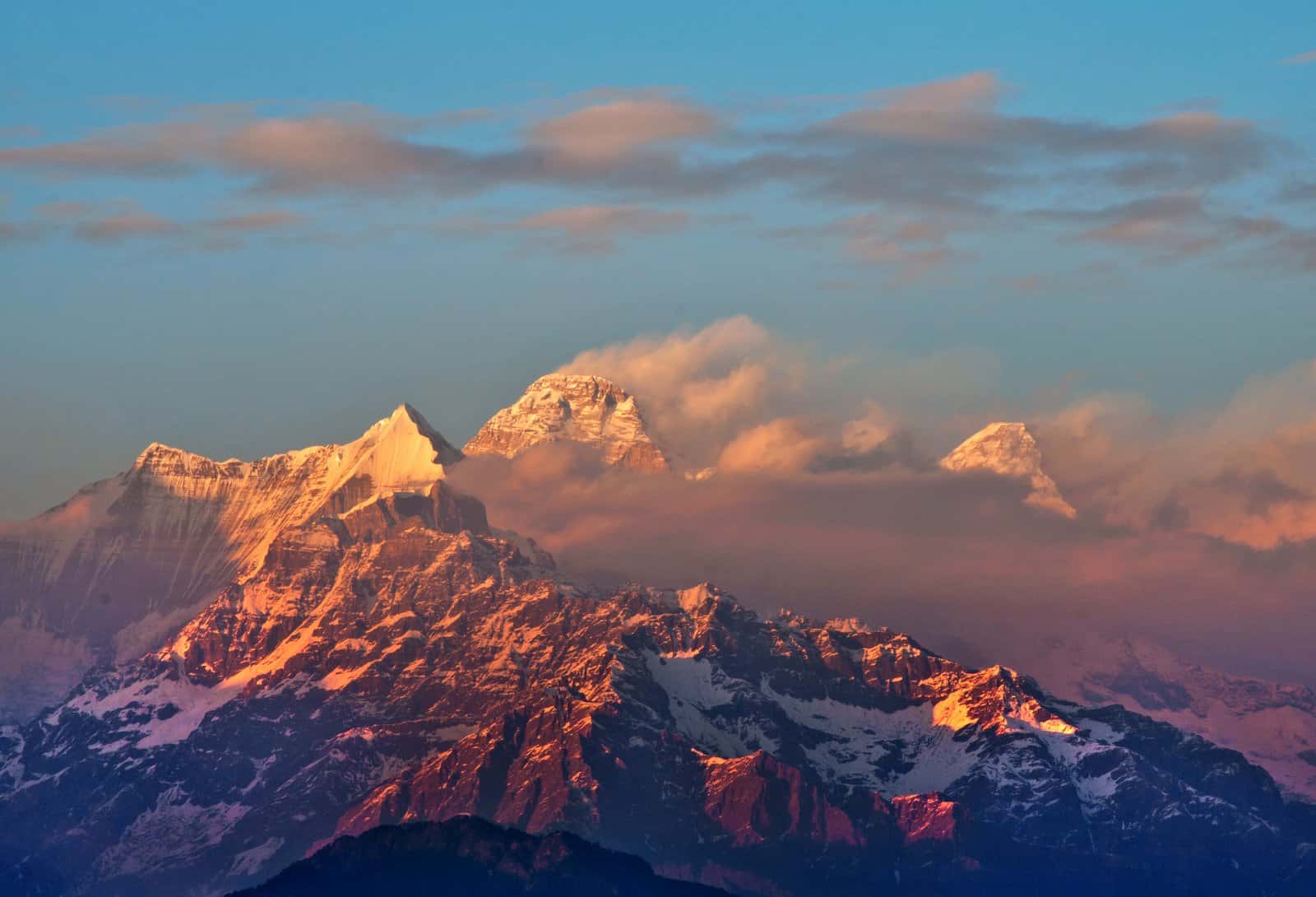
- The Panchachuli peaks at first lightFive peaks, ranging from about 6,334 m to about 6,904 m, standing in a line across the head of the valley. In the old story they are the five chulhas, the five hearths, on which Draupadi cooked the last meal for the Pandavas before their final journey. Be outside with a cup of tea before sunrise and watch the first light touch them one after another. This is why you came, and it costs nothing.
- The Nanda Devi temple ridgeAbove the town stands the temple of Nanda Devi, the presiding goddess of the whole Kumaon. It is a short, steady walk up. Take your darshan quietly, sit on the ridge for a while, and you will find you are also standing at one of the best free viewpoints for the Panchachuli sunrise anywhere in Munsiyari. Around Nandashtami, in September, the Nanda Devi Mela is celebrated across the Kumaon, including in the far reaches of Johar.
- The Tribal Heritage Museum, Masterji's life's workIn 2000, Dr Sher Singh Pangtey, a local history teacher whom everybody still calls Masterji, opened a small private museum of Shauka and Bhotiya life. He walked on foot to the high migratory villages of the Johar valley to collect the vessels, the wool, the trading weights and the everyday objects of families who once carried goods over the passes to Tibet. Masterji himself is no longer with us, and his family now keeps the museum going, so please do not arrive expecting to meet him. It sits in Nanasen village, about 2 km from the main market. Entry is free. Give it an hour, look slowly, and leave a donation. It is the best hour you will spend in this town.
- Thamri Kund, Maheshwari Kund and the forest walksTwo quiet high lakes sit in the forest above the town, and the walks to them through oak and rhododendron are lovely and easy. Go early and quietly with a local guide and you may see musk deer, and you will certainly hear far more birds than you can name.
- Birthi Falls and the Kalamuni passBoth are on the road in, so you see them without spending a day. Birthi Falls drops in a long white ribbon just off the highway, and at Kalamuni, on the pass, there is a small Kali temple where drivers stop. If the weather is kind, the first big view of the Panchachuli range opens for you right here.
- Darkot and the weaving villagesDarkot, a short drive away, is where the woollen weaving of this valley is still a working trade rather than a souvenir stall. Shawls, caps, blankets and carpets are made in the houses. Buy directly from the weaver if you can, pay a fair price without hard bargaining, and you are keeping a two-hundred-year-old skill alive.
There is no single grand monument here, and if you arrive with a checklist you will be disappointed. The pleasure of Munsiyari is slow. It is the tea at dawn while the peaks turn gold, the walk through the forest to a still lake, the hour among Masterji's collected pots and looms in his museum, and the evening when the clouds lift and the whole Panchachuli line appears as if a curtain had been drawn. Give it two full days and it will give you a memory. Give it three hours and it will give you a photograph.
Things to do in Munsiyari, from a day walk to a glacier trek
The one-day walk to Khaliya Top, a village morning with a birding guide, and, for the serious, the long walk up the Johar valley to Milam.
- Khaliya Top, the day trek that everybody can tryThe meadow at Khaliya Top sits at about 3,500 m, and the walk up is an easy gradient of about 6 km from Balati Bend on the Munsiyari to Thal road. From the top you look at the Panchachuli, Rajrambha, Hardeol and Nanda Kot peaks all at once. An entry fee of about 50 rupees per person is collected at the gate by the Munsiyari Nature Education and Eco Park Centre of the Pithoragarh Forest Division. There are no shops on the trail, so carry your own water and food.
- A village morning with a local birding guideExperts quoted by Mongabay India estimate more than 300 bird species around Munsiyari. The women of Sarmoli village have trained as culture and nature guides, and a morning walk with one of them, through fields and forest and past their own homes, tells you more about the Kumaon than any museum. If you do one paid experience here, make it this one.
- The Milam glacier trek, if you have the days and the legsThis is a serious multi-day walk up the Johar valley, and the Kumaon Division of the Government of Uttarakhand gives the stages plainly: about 12 km from Munsiyari to Lilam, about 13 km more to Bagudyar at about 2,509 m, about 12 km to Railkot, about 17 km to Milam village and about 5 km further to the glacier at about 4,242 m. Read the permits section before you commit, take a registered local guide, and give the altitude the respect it is owed.
- The Ralam glacier and Nanda Devi East, for the very experiencedFrom Bagudyar it is about another 12 km to the Ralam glacier, and the Nanda Devi East base camp route also starts from this valley. These are proper expeditions. They need a guide, real fitness, honest acclimatisation and time in hand for bad weather. Note that Ralam, even more clearly than Milam, is still described in current permit guidance as needing a permit from the SDM office at Munsiyari along with an ITBP clearance, so build the paperwork into your plan. Do not treat these as an extension of a holiday.
- The Balati farm and the road-end walksIf you do not want to trek but do want to walk, the meadows and the potato farm around Balati, on the way to the Khaliya trailhead, give you a gentle couple of hours with big views and no exertion. This is what to do with an older parent who wants the mountains without the climb.
- Buying the wool, and eating what grows hereTake home a hand-woven shawl or a woollen cap, and buy the local rajma and potatoes, which are famous in the Kumaon for good reason. In the homestays you will be given madua roti, pahadi rajma and bhang ki chutney. Eat what the family eats. It is simple, warming food and it is the true taste of this valley.
Every page calls the Khaliya walk easy, and on paper it is: about 6 km on a good gradient. But you are climbing from a town at roughly 2,100 to 2,300 m to a meadow at about 3,500 m, and that is a gain of well over 1,000 m in a single day. Plenty of first-time trekkers get a headache, nausea or breathlessness on that meadow. Spend a full day in Munsiyari first, walk slowly, drink far more water than you think you need, and if you feel worse as you go higher, turn around and come down. There is no prize for pushing on.
Permits for Milam, Ralam and Khaliya: what applies to you
The permit position for an Indian trekker and for a foreign passport holder are not the same, and almost every page online confuses the two. Here is the difference.
- Munsiyari town and the day walks: no special permitFor Munsiyari itself, the Nanda Devi temple, the museum, the lakes, Darkot, Birthi and the Khaliya Top day trek, an Indian traveller needs no special permit. At the Khaliya gate you pay the forest entry fee of about 50 rupees per person and that is all.
- Milam, for Indian nationals: the position is genuinely mixed, so read this twiceFor decades an inner-line pass was demanded before anyone could go beyond Lilam, about 12 km from Munsiyari. In October 2023, PTI reported that the ITBP had instructed its personnel to let tourists, trekkers and mountaineers go up to the Milam glacier without an inner-line pass, and the Munsiyari Sub-Divisional Magistrate confirmed it at the time. That relaxation is real and it is on the record. But we must be straight with you: as of July 2026 we can find no government notification confirming that it still stands, and current trekking permit guides and Munsiyari operators still describe a permit and registration at the SDM office at Munsiyari together with an ITBP clearance for the Milam and Ralam routes. So do not walk in assuming you need nothing. Treat registration at the SDM office as required until that office itself tells you otherwise, allow a day for it, carry your photo identity and several photocopies, and expect to sign in and out at the ITBP check posts along the way.
- Milam, for foreign passport holders: this is the part nobody tells youThe Ministry of Home Affairs is clear. Under the Foreigners (Protected Areas) Order, 1958, the part of Uttarakhand between the inner line and the international border is a Protected Area. The MHA document lists the adjoining areas of Milam Glacier among the places a foreign tourist may visit only in a group of four or more persons, sponsored by a recognised travel agency in India, with a pre-drawn itinerary, after obtaining a Protected Area Permit from the MHA or from the DM or SDM where the state has delegated that power. If you hold a foreign passport, do not assume the relaxation for Indian trekkers covers you. Plan the permit through a registered operator, well ahead.
- OCI card holders: the rule is clearer than most people think, and it is not in your favourMany NRI families assume an OCI card makes them Indian for this purpose. It does not. The Ministry of Home Affairs gazette notification of 4 March 2021, which sets out what an OCI cardholder is entitled to, states plainly that an OCI cardholder is a foreign national holding the passport of a foreign country and is not a citizen of India. The same notification says an OCI cardholder must obtain a special permission or a special permit to visit any place which falls within a Protected, Restricted or prohibited area, and separately to undertake mountaineering. Munsiyari town and the Khaliya Top day walk are not that. The protected belt beyond, towards the border, is. So if you travel on a foreign passport with an OCI card, plan the Johar valley on the same footing as any other foreign visitor, and confirm your own position with the SDM office at Munsiyari or the District Magistrate at Pithoragarh before you set out.
- Take a registered local guide, whatever your passportBeyond the practicalities of paper, the Johar valley is high, remote and prone to landslides, and there is no casual help up there. A guide from Munsiyari knows the check posts, the shelters, the river crossings and the weather. Hire one through your homestay or hotel, and let the money stay in the valley.
Border-belt rules are exactly the kind of rule that changes without a press release. Everything in this section is sourced, and it is what we could verify as of July 2026 from the Ministry of Home Affairs documents and from the news report of the ITBP relaxation. Note honestly that the sources disagree about Milam for Indian trekkers: a 2023 news report says the inner-line pass was dropped, while permit guides and operators in 2025 and 2026 still describe an SDM permit and an ITBP clearance. Where sources disagree, assume the stricter one and ask. The SDM office at Munsiyari and the District Magistrate's office at Pithoragarh are the authorities that decide this on the day, and no website, including this one, can overrule them. Be suspicious of any blog, including a confident one, that gives you a single breezy answer for both Indian and foreign travellers.
Where to stay in Munsiyari, and why the homestay changes the trip
A hotel room with a Panchachuli view is lovely. A homestay in Sarmoli is something else, and where you sleep here is also an ethical choice.
- The Sarmoli homestays, run by the women of the villageSarmoli sits just outside town, facing the peaks. The Himalayan Ark homestay programme there was started in 2004 by Malika Virdi and is run entirely by the women of the village. Speaking to Mongabay India, Virdi said that about 95 percent of the earnings go to the villagers, about 2 percent is spent on conserving forests, lakes and rivers, and the rest on training and running the programme. That is the programme's own account of itself rather than an audited figure, and we pass it on as such, but the direction of the money is not in doubt. You sleep in a family home, you eat what the family eats, and the money stays in the valley. For most travellers this is the right answer.
- Hotels and guesthouses with the viewMunsiyari has a modest set of hotels and lodges, several of them positioned so that the Panchachuli line fills your window at dawn. When you book, ask one direct question: does the room itself face the peaks, or only the terrace. That single question is the difference between waking to the mountains and walking outside in the cold to look for them.
- The KMVN rest house, the government optionThe Kumaon Mandal Vikas Nigam runs a tourist rest house at Munsiyari and another at Birthi on the road in, with a dormitory as well as rooms. It is plain, well placed and reliable, and it is a sensible choice if you want to be sure of a bed. Book on the KMVN portal at kmvn.in and reconfirm the current tariff there rather than trusting a price you read on a blog.
- What a room costs, as an estimateTreat these as our indicative estimate and reconfirm on the day. A simple homestay or budget room often runs about 800 to 1,500 rupees a night. A comfortable hotel room with a Panchachuli view is often about 2,000 to 4,000 rupees. The better boutique properties start around 5,000 rupees and go up. Rates rise in the peak season and around long weekends.
- Book ahead, because the town is smallThis is not a hill station with a hundred hotels. In season, and on any long weekend, the good rooms go. If you are arriving late after a nine hour drive, having a confirmed bed is worth far more than the small saving you might make by bargaining on arrival in the dark.
If you are coming from Kathgodam, the smartest single change you can make to your plan is to spend the first night on the way rather than driving straight through. Chaukori, with its old tea gardens and its own long view of the snows, is roughly halfway. Birthi, closer in and next to the waterfall, is the other good choice. Both have a KMVN rest house. You arrive in Munsiyari the next morning, rested and in daylight, with the whole day still ahead of you.
Munsiyari costs, and the cash problem nobody warns you about
Munsiyari is cheap to be in and expensive to reach. And you must bring your cash with you, because the ATMs here run dry.
- Carry cash from the plains, and we mean this seriouslyMunsiyari has only a couple of ATMs and they frequently run out of cash. Draw what you need for the whole stay at Haldwani, Almora or Bageshwar on the way up. Homestays, guides, taxis, the wool weavers and the small eateries all run on cash. Being stuck in a beautiful mountain town with a working card and an empty ATM is a miserable way to spend a holiday.
- The one petrol pumpIf you are driving your own car, understand that Munsiyari has a single petrol pump and it sometimes runs out of fuel. Fill up at Almora, Bageshwar or Thal on the way in, and do not plan to arrive on fumes and refuel in town. This is the most common self-drive mistake on this route.
- A rough daily budget, as an estimateExcluding your room and the long drive up, plan on roughly 1,500 to 2,500 rupees a day if you are travelling simply, about 3,000 to 5,000 rupees for a comfortable day with a good room and meals out, and about 6,000 rupees and up if you are hiring a car and a guide. These are our estimates from current on-ground rates, not quoted prices, so please reconfirm locally.
- The fixed costsThe Khaliya Top forest entry fee is about 50 rupees per person, collected at the gate by the Munsiyari Nature Education and Eco Park Centre of the Pithoragarh Forest Division. We could not find an official published tariff for it online, so treat that figure as close but not guaranteed and carry small change. The Nanda Devi temple and the viewpoints cost nothing. Entry to the Tribal Heritage Museum is free, and a donation is the right thing to leave. The real money in a Munsiyari trip goes on the road, the room and, if you trek, the guide.
- The transport is the big line itemA reserved taxi from Kathgodam is a long-distance hill fare and it is the single biggest cost of most Munsiyari trips. A shared seat costs a fraction of it. If you are two or three people and you are not in a hurry, ask about the shared taxis at the stand rather than assuming you must reserve the whole vehicle.
Fill the fuel tank before Thal. Fill your wallet before Almora. Every other problem in Munsiyari can be solved on the spot with a smile and a little patience, but an empty tank and an empty ATM at the end of a nine hour drive cannot. Locals live with this and plan around it. Visitors who do not read this line find out the hard way.
Practical logistics: network, food, power and getting around
A small mountain town works differently from a city. Here is what actually functions in Munsiyari, and what does not.
- Mobile network and internetSignal in Munsiyari is workable but not city-grade, and it thins out fast as you leave town. Wi-fi in hotels and homestays is often slow. Travellers on the forums suggest calling your stay in advance rather than relying on messages getting through. Download your maps offline before you leave Haldwani, and tell your family at home that you may go quiet for a day. That is not a fault. It is part of why you are going.
- Food, and what to expectThis is not a restaurant town. You will find local dhabas and small eateries serving good North Indian food, momos and noodles, and the homestays serve simple Kumaoni cooking: madua roti, pahadi rajma, local potatoes, bhang ki chutney. Eat there. It is fresh, it is warming, and it is the real food of the Johar valley. Pure vegetarian food is easy to find everywhere.
- Getting around townMunsiyari town is small and walkable, though it is all slope, so nothing is quite as close as it looks. For Balati Bend, Darkot, Madkot or the lakes, hire a local taxi for the half day. Agree the fare and the route before you set off, as you would anywhere in the hills.
- Power, water and warm clothesPower cuts happen. Carry a power bank and a torch. Hot water may be by geyser or by bucket depending on where you stay, and it may not be available at every hour. Even in summer the nights are cold at this height, so pack a warm layer whatever the month, and in winter pack seriously.
- Medical helpThere is a Community Health Centre at Munsiyari for basic needs, but this is a remote sub-division and serious cases are moved down the hill. If you take regular medication, bring more than enough of it. If you are trekking, carry a proper first aid kit and know that evacuation from the Johar valley is slow and difficult.
The list that matters: warm layers and a windproof jacket in any season, a torch and a power bank, cash, your own water bottle, sun protection because the high sun is fierce even when the air is cold, good shoes with grip, and any medicine you take regularly with a few days spare. Leave the smart clothes at home. Munsiyari does not care what you are wearing and there is nowhere to wear it.
Safety and health in Munsiyari: the altitude and the road
The two real risks here are honest ones: the mountain road, and the altitude on the treks. Neither is a reason to stay away. Both are a reason to plan properly.
- Altitude: the town is gentle, the treks are notMunsiyari town, at roughly 2,100 to 2,300 m, is a height at which almost nobody has trouble. But Khaliya Top is about 3,500 m, and the Milam trek climbs past Bagudyar at about 2,509 m to a glacier at about 4,242 m. Acute mountain sickness begins with a headache, nausea, dizziness and breathlessness that do not settle with rest. The rule is simple and it is not negotiable: if you feel worse as you climb, stop climbing, and if it does not improve, go down. Sleep a night in Munsiyari before you attempt Khaliya, drink water constantly, and never leave a struggling member of your group behind to catch up.
- The road, and driving after darkThis is a narrow hill road with drops, blind bends and, in the wet, landslides. Do not drive it at night. Do not let a tired driver do the last two hours. If you have hired a car for the whole trip, make sure the driver has actually driven the Kumaon hills before, and give him a proper break at Chaukori or Thal. Most trouble on this route is caused by hurry, not by the road.
- Monsoon landslides and cloudburstsBetween about July and early September, landslides and cloudbursts are a genuine hazard across this belt, and the Thal to Munsiyari road has been blocked in past monsoons. Check the road position with your hotel or with the local police on the morning you travel, keep a spare day in your plan, and never try to cross a fresh slide on foot to reach a taxi on the other side.
- Cold, sun and waterThe mountain sun burns even when the air is freezing, so use sun cream and sunglasses on Khaliya Top and above. Drink plenty, but drink boiled, filtered or bottled water, and carry your own bottle rather than buying plastic in a place with no way to dispose of it. In winter, hypothermia is a real risk on the ridges if you get wet, so carry a windproof layer.
- Solo travellers and womenMunsiyari is a small, watchful mountain community and travellers, including solo women, generally report feeling comfortable and safe here. The sensible cautions are the same as anywhere remote: tell your hotel or homestay where you are walking and when you expect to be back, do not go up to the high lakes or the meadow alone without telling someone, and keep an eye on the light so you are not caught out on a forest path after dark.
There are leopards, Himalayan black bears and musk deer in the forests around Munsiyari. This is their home and you are the visitor. Do not walk forest paths alone after dark, keep children close on the walks to Thamri Kund and Maheshwari Kund, do not leave food out at a campsite, and never approach or feed any animal. Take a local guide on the forest walks. They will show you far more than you would ever see alone, and they know which paths to avoid at which hour.
Munsiyari for every kind of traveller, and a word on access
Munsiyari rewards the slow traveller. Here is what it offers you, whoever you are, and the one thing each of you should plan around.
- Families with childrenWonderful, provided you break the drive. Children do not enjoy nine hours of hairpin bends, and neither will you. Stop a night at Chaukori or Birthi. Once you are in Munsiyari, the gentle walks, the waterfall, the museum and the sight of five snow peaks from the breakfast table do all the work. Carry motion sickness medicine, and keep the first day light.
- Senior travellers, and on accessibilityMunsiyari is very doable for a fit older traveller, but be honest about two things. The journey is long and bumpy, so split it over two days in both directions. And the town is built on a slope, so choose a hotel or homestay where the room, the dining area and the view are on the same level and do not need a climb. Skip Khaliya Top and take the gentle Balati meadow walk instead. The Panchachuli view from Munsiyari itself is the same view, and it asks nothing of your knees.
- Couples and honeymoonersThis is a quiet, romantic place if what you want is silence, snow peaks and long mornings, and it is completely wrong if you want cafes and nightlife. Book a room that genuinely faces the peaks, give it three nights, and do not plan much. The best evening here is a shawl, a cup of tea and the light going pink on the mountains.
- Trekkers and first-timersKhaliya Top is one of the best first Himalayan treks in India: short, beautiful, and high enough to teach you what altitude feels like. Milam and Ralam are for people with real days in hand, a guide and honest fitness. Read the permits and altitude sections before you plan either.
- Solo travellersMunsiyari suits the solo traveller well, and the homestay network makes it easy to arrive alone and not be alone. Shared taxis put you next to people who live here, which is half the pleasure. Book your return seat in advance, tell your host where you are walking, and you will be looked after.
- Photographers and birdersFirst light on the Panchachuli line from the Nanda Devi temple ridge, and again from Khaliya Top. For birds, take a local guide from Sarmoli into the forest at dawn, in a region where experts count over 300 species. Be respectful with your camera in the villages. Ask before you photograph a person or a home, and you will usually be welcomed in.
How many days for Munsiyari, and a suggested itinerary
The honest answer is five days minimum from Delhi, because two of them are the road. Anything shorter and you are driving, not travelling.
- Day 1: Delhi or Kathgodam to Chaukori or BirthiTake the overnight train to Kathgodam, or drive from Delhi. Today you climb through Almora or Bageshwar and stop for the night at Chaukori or Birthi. You will get your first long view of the snows this evening. Do not push on to Munsiyari in the dark. This is the day that makes the rest of the trip pleasant.
- Day 2: to Munsiyari over the Kalamuni passA shorter drive today. Stop at Birthi Falls if you did not stay there, and again at the little Kali temple on the Kalamuni pass, where, if the sky is kind, the whole Panchachuli line suddenly appears. Reach Munsiyari by afternoon, settle into your homestay, and spend the evening doing nothing at all. This also lets your body get used to the height before you walk anywhere.
- Day 3: Khaliya Top, or the gentle versionStart early for Khaliya Top, about 6 km up from Balati Bend, and be back down by afternoon. If the family is not up to it, do the Balati meadow walk instead and spend the afternoon at the Tribal Heritage Museum with Masterji's collection. Either way, this is your big day.
- Day 4: the temple, the lakes and the villagesTake darshan at the Nanda Devi temple early, while the light is on the peaks. Then walk to Thamri Kund or Maheshwari Kund with a local guide, or drive out to Darkot to see the weaving. Keep the evening free. You will want to just sit and watch the mountains again.
- Day 5: back down the hillThe return taxis leave Munsiyari very early, around 6:30 am, and seats are limited, so book yours the previous day. Break the drive again if you can. If you must do it in one push, start at first light so you are off the hill roads before evening.
- If you have more daysWith seven to eight days you can add Chaukori, Patal Bhuvaneshwar and Kausani on the way back and make a proper Kumaon loop, which is exactly how our own Kumaon tours are built. With ten days or more and real fitness, you can commit to the long walk up the Johar valley to Milam.
People do try, and they regret it. Two days of driving to spend one day in the town means you arrive exhausted, see the peaks through cloud on your only morning, and leave. Munsiyari is roughly 300 km from the Kathgodam railhead and the drive alone is 8 to 9 hours each way. Give it five days from Delhi. If you only have a weekend, go to Nainital, Binsar or Kausani instead and save Munsiyari for when you can do it properly. It deserves that, and so do you.
The real questions travellers ask about Munsiyari
Straight answers to the questions that come up again and again on the Munsiyari forums, so you arrive already knowing the score.
- Which road is safer, Thal or the Jauljibi and Madkot route?Take the Thal, Birthi and Kalamuni route unless a local driver actively tells you otherwise on the day. It is the standard road, it is the one taxis run, and it is the one your driver is most likely to know. The Jauljibi and Madkot river road from Pithoragarh is lower and sometimes shorter, but rougher, and its condition changes from year to year.
- How long is the drive really, and can I do it in a day?From Kathgodam or Haldwani it is roughly 8 to 9 hours to Munsiyari with short halts, and Munsiyari is about 300 km from the Kathgodam railhead. You can do it in a day if you leave at first light. You will enjoy it far more if you do not.
- Do I need a permit for the Milam glacier?Do not trust a one-word answer to this, including ours. If you hold an Indian passport, the ITBP relaxed the inner-line pass requirement for Milam in October 2023 and that was widely reported, but permit guides and operators in 2025 and 2026 still describe a permit and registration at the SDM office at Munsiyari plus an ITBP clearance for Milam and Ralam. Plan on doing that registration, allow a day for it, and let the SDM office tell you if it is not needed. If you hold a foreign passport, including one with an OCI card, you are under a different rule entirely and you need a Protected Area Permit in a sponsored group of four or more. Read the permits section above carefully.
- Are there buses, or must I take a taxi?Buses on this route are thin and unreliable, and every regular on the Munsiyari forum says the same thing: take a shared taxi. They leave Haldwani early, around 6 am, and they are faster and more comfortable than waiting for a bus that may not come.
- Is one night in Munsiyari enough?No. One night gives you one morning, and if the cloud is in, you will have driven eighteen hours for nothing. Two full days in Munsiyari is the minimum that makes the journey worth it. Three is better.
- Will I see snow in April?Usually there is still snow on Khaliya Top in early April, and the rhododendron is in flower on the way up, which is a lovely combination. But nobody can promise you snow. It depends entirely on the winter that year, so treat snow as a bonus, not as the reason you came.
- Are there ATMs and a petrol pump?There is one petrol pump, which sometimes runs out of fuel, and only a couple of ATMs, which frequently run out of cash. Fill both your tank and your wallet before you leave the bigger towns down the hill. This is the single most useful sentence on this page.
- Is it worth going all that way?If you want a hill station with markets, cafes and things to do, go to Nainital and be happy. If you want to sit above a deep valley with five great snow peaks in front of you, walk in forests where almost nobody goes, and stay with a family whose grandparents traded across the passes to Tibet, then yes. Munsiyari is worth every hour of the road.
Planning Munsiyari from abroad
Munsiyari is the deep Himalaya, not a resort town. If you are flying in from abroad, plan around the road, the altitude and, if you hold a foreign passport, the permit rules.
- Give it enough days, and land in DelhiFly into Delhi, take the train up to Kathgodam, and give the road two days each way with a night at Chaukori or Birthi. From an international arrival, count on about seven days for a comfortable Munsiyari trip. If your India holiday is only ten days long and you also want to see Delhi or Agra, Munsiyari will not fit, and we would tell you so honestly rather than sell you a rushed trip.
- If you hold a foreign passport, read the permit rule firstUnder the Foreigners (Protected Areas) Order, 1958, the belt between the inner line and the international border in Uttarakhand is a Protected Area. The Ministry of Home Affairs lists the adjoining areas of Milam Glacier as open to foreign tourists only in groups of four or more, sponsored by a recognised travel agency in India, with a pre-drawn itinerary, on a Protected Area Permit. Munsiyari town and the Khaliya Top day walk are a different matter, but do not plan a Johar valley trek on a foreign passport without a registered operator and a permit.
- OCI holders: ask, do not assumeMany NRI families travel on a foreign passport with an OCI card and assume they are treated as Indians everywhere. In a border sub-division, that assumption can get you turned back at a check post. Ask the SDM office at Munsiyari or the District Magistrate at Pithoragarh what applies to your document, and get it in writing before you set out for the high valley.
- Altitude, jet lag and the first two daysDo not fly into Delhi and start climbing. Khaliya Top at about 3,500 m is a serious gain for a body that is still jet-lagged. Give yourself the night at Chaukori, a full day in Munsiyari doing nothing, and only then walk up. Drink far more water than you would at home, and go down at once if a headache gets worse rather than better.
- What Munsiyari is, and what it is notIt is a small, remote, working mountain town with modest hotels, simple food, patchy internet and one petrol pump. It is not a resort. If you come expecting a Swiss village you will be disappointed. If you come expecting the deep Himalaya, a valley that once traded with Tibet, and mornings that stop you in your tracks, you will not stop talking about it for years.
This is one of the most rewarding things you can do, and it needs one decision made properly: split the drive. Two easy half-days up and two easy half-days down, with a night at Chaukori each way, turns a punishing journey into a pleasure. Choose a room on one level with the view from the window. Skip the trek and take the gentle Balati meadow walk. Take darshan at the Nanda Devi temple in the morning light. Your parents will remember the Panchachuli sunrise long after they have forgotten every hotel they ever stayed in.
Money, SIM and connectivity for foreign visitors to Munsiyari
Get your cash and your SIM sorted in the plains. In Munsiyari the ATMs run dry and the signal comes and goes.
- Draw your cash in Delhi or HaldwaniMunsiyari has only a couple of ATMs and they frequently run out of cash, and international cards can be refused even when the machine has money. Draw plenty of Indian rupees before you leave the plains. Homestays, guides, taxis and weavers all deal in cash, and small notes are much appreciated.
- Buy an Indian SIM at the airportGet an Indian tourist SIM or an eSIM when you land in Delhi, and check that it works before you leave the city. Do not plan to buy one in the hills. Coverage in Munsiyari town is usable, but it thins out quickly on the roads and the trails.
- Download everything offlineOffline maps, your bookings, your photographs of your permit and your passport, and the phone numbers of your hotel and your driver. Assume that for parts of the journey you will have no data at all. Tell people at home that you may be out of contact for a day. That is normal here.
- How long to give Munsiyari on a bigger India tripIf you are also doing Delhi, Agra and Rajasthan, Munsiyari will not fit into two weeks without ruining the rest. Give Munsiyari its own trip, or build a proper Kumaon week around it with Nainital, Binsar, Chaukori and Kausani. That is a beautiful holiday in its own right and it is the honest way to see this region.
Why the peaks above Munsiyari are called Panchachuli
Ask anyone in Munsiyari why the five peaks are named Panchachuli and they will tell you the same story. When the Pandavas walked their last journey towards heaven, they came through this valley. Here Draupadi cooked their final meal, and the five great summits that close the head of the valley are her five chulhas, her five hearths, standing forever above the Johar. The peaks rise from about 6,334 m to about 6,904 m and they hold the watershed between the Gori and the Darma. Watch them at first light from the Nanda Devi temple ridge, when the highest snow catches the sun a full half hour before the town wakes, and the old name stops being a legend and becomes simply the obvious description of what you are looking at. This is a living local tradition of the Kumaon rather than a verse we can trace to a single scripture, and we tell it to you the way it is told here, honestly, as a story the valley keeps.
Planning a Munsiyari trip?
Our Uttarakhand travel experts plan your full journey for you: route, hotels, darshan timings and transport. You get a free day-by-day plan and an exact quote on WhatsApp, usually within a few hours. No payment is needed to get your plan.