Pithoragarh Travel Guide
For the high border routes to Adi Kailash and Om Parvat , your realistic windows are May to June and late September to October . The monsoon and the winter snow both shut this...
The best time to visit Pithoragarh, and the seasons that stop you
For the high border routes to Adi Kailash and Om Parvat, your realistic windows are May to June and late September to October. The monsoon and the winter snow both shut this district down in their own way.
- May and June: the main yatra seasonThis is when the Adi Kailash Yatra formally begins from Dharchula and when the high valleys are clear of snow. Days are pleasant, the Panchachuli peaks stand out sharply from Munsiyari, and the road parties have just finished their pre-season repairs. It is also the busiest time, so your permit and your rooms both need booking well in advance.
- Late September and October: the quiet, clean windowOnce the rains withdraw, the air is washed clean and the mountain views are at their very best. There are fewer pilgrims, the guest houses are easier, and the autumn Jauljibi fair falls in this stretch. You must move a little faster, because the cold and the first snow arrive by late October on the high line.
- July and August: the monsoon, and you must respect itThe rains bring landslides to this district every single year. Before the 2026 season the administration itself ordered repairs at Mangti Nala, Elagad, Koolagad, Najang and Pyalsiti, which tells you exactly where the road gives way. If you travel now, keep two spare days, start every drive early, and never argue with a driver who says the road is not safe today.
- November to April: the snow shuts the high lineThe Adi Kailash and Om Parvat route is effectively out of reach in deep winter. But Pithoragarh town, Chaukori, Berinag, Gangolihat and Patal Bhuvaneshwar stay reachable in a clear winter spell, and the snow view from Chaukori on a bright January morning is something few travellers ever see.
Whatever month you choose, the honest truth of eastern Kumaon is that the mountain decides. A single landslide can hold you for a few hours or for a whole day. Our own Kailash yatra desk tells every pilgrim the same thing, and we will tell you too: add two to three buffer days to any itinerary that goes beyond Dharchula. If you have a flight to catch from Delhi, keep a full clear day between coming down from the hills and your departure.
How to reach Pithoragarh, and why almost everyone drives
Pithoragarh has no railway. The district's own figures put Tanakpur railhead at about 138 km, Pantnagar airport at about 241 km and Delhi at about 457 km, so a long, beautiful mountain drive is part of the deal.
- By train to Tanakpur, then by roadTanakpur is the nearest railhead, about 138 km from Pithoragarh by the district administration's own reckoning, and taxis and buses wait outside the station. Many Indian travellers instead take the overnight train to Kathgodam and drive up from there, which is a longer road but a much better served station.
- By road from DelhiDelhi is about 457 km away and it is a full day of driving, so most travellers leave Delhi at night or very early. Uttarakhand Transport Corporation runs buses from Delhi towards the Kumaon hills, generally from the Anand Vihar bus terminal, and you should check the current services and timings on the corporation's own online timetable rather than trusting a blog, because these services change with the season.
- The Naini Saini airstrip, and the honest warningThere is a small airstrip at Naini Saini, only about 5 km from town, and small aircraft have flown here to Dehradun and to Delhi. But the service is thin, seasonal and cancels easily in cloud and rain. Treat a Naini Saini flight as a lucky bonus, never as the leg your whole trip depends on, and always keep a road plan behind it.
- Pantnagar, the practical airportPantnagar, about 241 km away in Nainital district, is the nearest airport with any dependability, and even that has limited flights. Most travellers, honestly, simply fly to Delhi and drive, and we can arrange a car with a driver who knows this road, which matters more here than anywhere else in Uttarakhand.
Fly into Delhi, rest one night, then drive or take the train to Kathgodam or Tanakpur and continue by road. Give the journey a full day in each direction and do not try to do it on the day you land.
Fly into Delhi and take the overnight train to Kathgodam, which is the gentlest way into Kumaon. From there the road to Pithoragarh climbs steadily and beautifully all day.
Take a train to Tanakpur or Kathgodam, then a shared or private taxi. If you are driving yourself from Delhi, break the run at Haldwani or Tanakpur rather than pushing through in one go.
The sights of Pithoragarh district, with the district's own distances
This district holds a Shakti Peeth, an underground Shiva cave, a Himalayan viewpoint town and two mountains that pilgrims travel across India to see. Here is where each one actually is.
- Patal Bhuvaneshwar, the cave of Lord ShivaAbout 91 km from Pithoragarh and about 14 km north of Gangolihat, this is the underground shrine that people remember for the rest of their lives. Be warned that the district's own page gives 91 km in its description and about 115 km by road elsewhere on the same page, so plan for most of a half day's drive rather than for a number. You go down through a tunnel and a narrow, wet, dark passage into a cave hall full of rock forms that the priest will name for you. Only a small group can be inside at a time, so a wait is normal in season. It is not for anyone who fears tight spaces.
- Gangolihat and the Mahakali Shakti PeethAbout 77 km from town, Gangolihat holds the Mahakali temple where, the district administration itself records, the Shakti Peeth was installed by Adi Shankaracharya. A fair is held here during Navratri. The Mankeshwar temple, the old Mankoti fort ruins and the Bharbhyo cave are all within a few kilometres.
- Om Parvat and Adi KailashOm Parvat is the mountain whose snow settles into the shape of the sacred syllable Om, seen from Nabhidhang on the Kalapani line. Adi Kailash, also called Chhota Kailash, stands above Jolingkong at about 4,572 m with Parvati Tal at its foot, the peak itself rising to about 6,191 m. Both need an Inner Line Permit, which has its own section below.
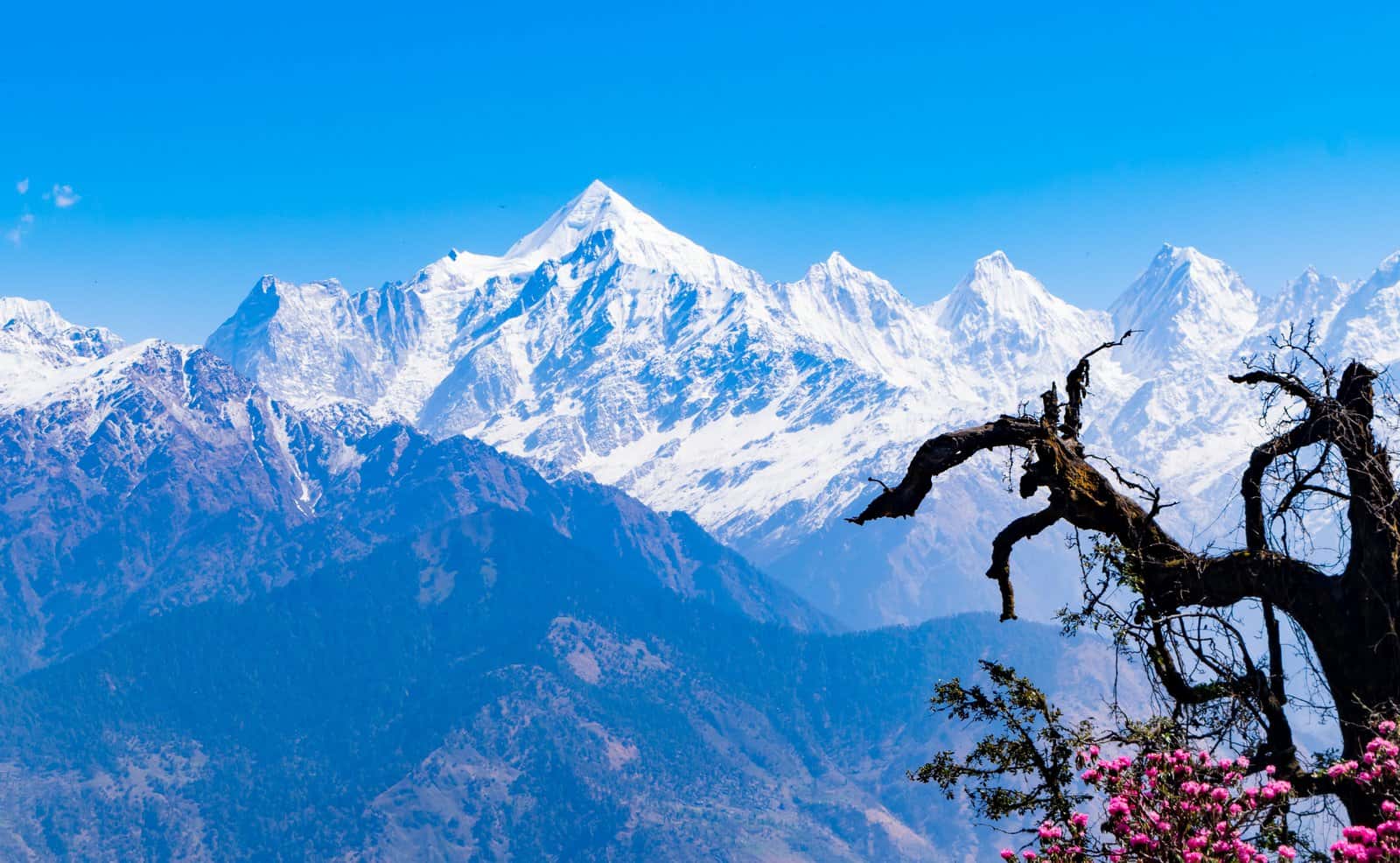
- Munsiyari and the PanchachuliAt about 2,298 m and about 154 km from Pithoragarh by the district's own figure, Munsiyari is the balcony seat of Kumaon. The five peaks of Panchachuli stand in a line in front of you, and on a clear morning you will not want to leave the terrace. It is also the gateway of the Johar valley and the old salt route to Tibet.
- The town's own hills and templesDo not rush past Pithoragarh town itself. Chandak, about 7 km above, gives the classic view over the green Soar valley to the snow line, with the Mostamanu temple of the local deity Mosta about 2 km further. Thal Kedar at about 16 km, the Dhwaj Jayanti temple at about 21 km via Totanaula, and the Kapileshwar Mahadev cave shrine are all short, quiet, deeply local outings.
- Chaukori, Berinag and the tea slopesBerinag is about 102 km from Pithoragarh at about 1,720 m, and Chaukori is about 11 km beyond it, sitting on a ridge above old tea gardens with a long open view of the Nanda Devi and Panchachuli line. It is the gentlest, most restful base in the district and it pairs perfectly with Patal Bhuvaneshwar.
Every distance on this page is taken from the Pithoragarh district administration's own excursion, trekking and Chota Kailash pages, not copied from other travel sites. You will find travel sites quoting Munsiyari as about 128 km and others quoting a good deal more. We give you the district's own figure of about 154 km and tell you plainly that the drive takes most of a day whatever the signboard says, because the road, not the distance, decides your time in these hills.
The signature experiences of eastern Kumaon
Darshan at a cave shrine, a sunrise over Panchachuli, a meadow you can walk up in a morning, and a border fair that still trades wool and copper. These are the days you will remember.
- Om Parvat darshan at NabhidhangFor most pilgrims this is the whole reason for the journey. You reach the Kalapani and Nabhidhang stretch high on the Vyas valley line, and if the sky is kind you will see the snow lying on the dark rock in the shape of Om. Weather here turns in minutes, so give yourself a spare morning. If cloud takes the mountain on your first day, wait. Many yatris have seen it only on the second attempt.
- Adi Kailash and Parvati TalFrom Jolingkong at about 4,572 m, the Chhota Kailash peak rises to about 6,191 m and its reflection sits in the little lake of Parvati Tal, with a small temple beside the water. Vehicles now go far up this line and most pilgrims drive most of the way and walk the last stretch, but you are still at great height, so move slowly and breathe.
- Darshan inside Patal BhuvaneshwarYou will bend, you will squeeze, and for a few minutes you will be in the dark under the earth. Then the cave opens and the priest walks you through the forms in the rock. Go early, wear clothes you do not mind getting wet and dirty, and leave your bag in the car. If you are claustrophobic, this is the one thing on this page you should skip without any guilt.
- Sunrise on Panchachuli from MunsiyariAsk your guest house for a room facing the peaks and set an alarm. When the first light touches the five summits of Panchachuli and they turn from grey to rose to gold, you understand why people drive all day to sit on this ridge. It costs nothing and it is the finest free thing in the district.
- The Khaliya Top day hikeFrom the Balati Farm road head near Munsiyari it is roughly a three hour walk up to a meadow at around 3,500 m, with Panchachuli, Rajrambha, Hardeol and Nanda Kot spread in front of you. No permit, no guide strictly needed, no camping. If you have one day and ordinary fitness, this is the high Himalaya on easy terms.
- The Jauljibi autumn fairAbout 77 km from town, where the Gori river meets the Kali, the autumn fair still brings Kumaoni, Bhotia and Nepali traders together with wool, spices and copperware. It is one of the last living pieces of the old Tibet trade route, and if your dates match, it is worth going far out of your way for.
If you can give this district only one slow day, spend it on the Munsiyari ridge. Watch the Panchachuli at sunrise, walk up Khaliya Top in the morning, come down and sit with tea while the peaks go pink again in the evening. It asks nothing of you, needs no permit and no paperwork, and it gives you the whole Himalaya in a single day. Travellers who race through Munsiyari in an afternoon always write afterwards that they wish they had stayed the night.
Permits for Adi Kailash, Om Parvat and the glacier treks
The Vyas valley is an Inner Line area. Without a permit you will be turned back at the check post, and no operator can talk his way past it. Here is exactly how it works.
- Who issues it, and whereThe Inner Line Permit for the Adi Kailash and Om Parvat route is issued through the SDM office at Dharchula tehsil, and applications can also be started on the state online portal. You submit identity documents and photographs for every person in your group. Give it time. Apply about a week to ten days before your travel date, because in peak season the office is working through hundreds of files at once.
- How busy it really getsThe Adi Kailash Yatra 2026 was flagged off from Dharchula on 1 May 2026. On that very day the administration said it had already received over 500 permit applications and had issued about 350 permits. That is the scale of the rush now, so do not arrive in Dharchula on a Sunday evening hoping to leave on Monday morning.
- Beware of fake permitsThe administration has publicly warned that unauthorised operators have been issuing fake permits and that legal action will follow. Get your permit through the SDM office or the official portal, or through a tour operator who shows you the actual permit document with your name on it. A photograph of somebody else's permit on a phone is worth nothing at the check post.
- Permits for the glacier treksThe Milam, Ralam and Namik glacier treks out of Munsiyari also run close to the border and need inner line permission, applied for through the SDM office before you start walking. Khaliya Top, Munsiyari town, Chaukori, Gangolihat and Patal Bhuvaneshwar need no permit at all. There is one interesting exception for foreign travellers, and we explain it in the next block, because the Milam glacier is the one high border area of this belt that the Ministry of Home Affairs has actually kept open to them.
The Inner Line Permit is for Indian citizens. If you travel on a foreign passport, including as an OCI cardholder, a completely different law applies to you and you must understand it before you book anything. Under the Foreigners (Protected Areas) Order, 1958, the whole belt of Uttarakhand between the Inner Line and the international border is a Protected Area, and the Ministry of Home Affairs says plainly that a foreigner is not normally allowed into a Protected Area unless the Government is satisfied that there are extraordinary reasons. You would need a Protected Area Permit, not an Inner Line Permit, and the Ministry's own schedule for Uttarakhand opens only four places to foreign tourists on such a permit: the Nanda Devi Sanctuary, Niti Ghati, Kalindi Khal, and the adjoining areas of the Milam glacier. Adi Kailash, Om Parvat, Gunji, Kalapani and Nabhidhang are not on that list. That, and not any officer's mood, is why foreign applications for this route are refused. We would rather tell you this now than let you fly across the world for a darshan you will be turned back from. Where a Protected Area Permit is possible in Uttarakhand it is given to a group of four or more foreign travellers sponsored by a recognised Indian travel agency with a pre-drawn itinerary, so the Milam glacier trek out of Munsiyari is the one high route in this district you may realistically be able to arrange. For everything else, build your Kumaon trip around Munsiyari, Chaukori, Gangolihat and Patal Bhuvaneshwar, which are open to everyone and are glorious in their own right. Please write to the SDM Dharchula office and confirm your own case in writing before you commit money.
Adi Kailash or Kailash Mansarovar: which yatra are you actually booking?
These are two completely different journeys and travellers mix them up every week. One is inside India and needs a permit. The other crosses into Tibet and needs a passport, a medical and a government application.
- Adi Kailash, inside IndiaAdi Kailash, also called Chhota Kailash, is in Pithoragarh district itself. You need only an Inner Line Permit. There is no passport, no visa and no government lottery. Most travellers now do it as a six to eight day road trip from Kathgodam or Pithoragarh with a short walk at the top, and this is the journey that ordinary families and elderly devotees are taking in large numbers.
- The Kailash Mansarovar Yatra, into TibetThis is the yatra to the real Mount Kailash and Lake Mansarovar across the Lipulekh pass. It is run by the Ministry of External Affairs. You apply only on the government portal, you must pass a medical at a designated hospital in Delhi, and you need a Chinese visa. Selection is by a computerised draw, not by paying more.
- Who the government will actually acceptThe Ministry sets out the eligibility in one short list, and it is worth reading before you dream. You must be a citizen of India. You must hold an ordinary Indian passport valid for at least six months as on 1 September of that year. You must be at least 18 and not more than 70 years of age as on 1 January of that year. Your Body Mass Index must be 25 or less. The Ministry then says, in the same list, that foreign nationals are not eligible to apply and that OCI cardholders are therefore not eligible either. Selected yatris are tested at the Delhi Heart and Lung Institute and then checked for high altitude endurance at the ITBP Base Hospital in New Delhi, and anyone found medically unfit at any stage is not allowed to continue.
- What the government actually charges for LipulekhThe Ministry of External Affairs publishes its own fee table. For the Lipulekh route it lists a non-refundable confirmation amount of about 5,000 rupees to Kumaon Mandal Vikas Nigam, a balance of about 60,000 rupees to the same corporation, medical tests of about 5,500 rupees, a stress echo of about 2,500 rupees if the doctors ask for it, a Chinese visa fee of about 1,800 rupees and a pool money contribution of about 4,000 rupees, plus about 1,400 US dollars payable inside Tibet. On the Chinese side the same table adds about 990 Chinese yuan for a porter both ways and about 2,370 Chinese yuan for a pony with its handler both ways.
- And how Nathu La comparesThe Nathu La route through Sikkim carries the same about 5,000 rupees confirmation amount, except that it is paid to the Sikkim Tourism Development Corporation. The table then lists about 39,000 rupees to that corporation, about 21,000 rupees for the Delhi to Bagdogra return airfare and about 2,700 US dollars inside Tibet. Every figure is marked subject to change, so treat all of this as a guide and reconfirm on the government portal before you pay anyone.
- Where the Lipulekh route endsOn the Lipulekh route you are allowed to choose Dharchula or Delhi as the end point of your return leg, which matters if you want to continue quietly through Kumaon afterwards instead of being bussed straight back to Delhi.
The government portal showed the last date to apply online for the 2026 Kailash Mansarovar Yatra as 19 May 2026. There are no spot registrations and no offline forms once it shuts. If you are reading this for 2027, watch the same government portal from early spring, keep your passport valid, and start walking now so that you can clear the medical. If any agent tells you he can still get you into a 2026 government batch, he is not telling you the truth.
Where to stay in Pithoragarh district, and which base suits you
You will not stay in one place here. Pithoragarh town is your road base, Chaukori is the restful one, Munsiyari is the view, and Dharchula is the gate to the yatra.
- Pithoragarh town: the working baseSimple hotels and guest houses, a market for anything you forgot, an ATM, a hospital and the road out to everywhere. It is not a pretty resort town and nobody comes here for the hotel. Stay one night at the start or the end of your loop, buy your warm layers here, and move on.
- Chaukori and Berinag: the restful baseA ridge above old tea slopes with a long Himalayan view, about 102 km from Pithoragarh to Berinag and about 11 km more to Chaukori. This is where you slow down, and it is the natural night before or after Patal Bhuvaneshwar. Families and older travellers usually love Chaukori more than anywhere else in the district.
- Munsiyari: the view you came forGuest houses, homestays and the state tourism rest house all sit on the ridge. Ask specifically for a room facing Panchachuli, in writing, because the difference between a front room and a back room here is the whole trip. Book ahead in May, June and October.
- Dharchula: the yatra gateAbout 94 km from Pithoragarh on the bank of the Kali river with Nepal on the far side. You stay here to collect your permit and to start early for the high valleys. Rooms are simple, and during yatra season they fill up completely, so book before you drive up.
- What rooms cost, roughlyA simple guest house room runs from about 800 to 1,500 rupees, a comfortable mid-range room about 2,000 to 4,000 rupees, and the better hotels and the state tourist rest houses about 3,000 to 8,000 rupees in season. Homestays in the villages above Munsiyari can be cheaper and warmer in every sense. Reconfirm all of this before you book, because season and yatra dates move these numbers.
Kumaon Mandal Vikas Nigam, the state tourism corporation, runs tourist rest houses right through this belt, and the district administration's own accommodation page lists them at Pithoragarh, Didihat, Thal, Chaukori, Birthi, Patal Bhuvaneshwar, Gangolihat, Munsyari, Dharchula and Narayan Ashram, with PWD inspection houses at several of the same places. You can check availability and book on the corporation's own site. They are plain rather than luxurious, but they are usually in the best position in town, they are safe, and they are honest with their pricing. For a first trip through this district with parents, they are a very sensible spine to build a route on, and the Birthi and Munsyari houses in particular save you hunting for a room after a long mountain day.
A realistic budget for Pithoragarh, Munsiyari and Adi Kailash
This is not an expensive district to travel in, until you add a permit route and a vehicle for the high valleys. Here is where the money actually goes, so nobody can inflate a quote on you.
- A rough daily budgetExcluding your room and your long drive in and out, plan on about 1,500 to 2,500 rupees a day as a simple traveller and about 3,500 to 6,000 rupees a day for a comfortable one with a private vehicle, good food and a guide where you want one. Food in this district is simple, filling and cheap, and you will not spend much unless you try to.
- What an Adi Kailash package really costsOperator packages for a six to eight day Adi Kailash and Om Parvat trip commonly quote from about 30,000 to 60,000 rupees per person, and the spread is real, not a trick. It depends on the vehicle, the group size, the standard of rooms, and above all whether a helicopter leg is included. Ask for the itinerary in writing with the vehicle type, the room category and what happens if weather stops you.
- The Kailash Mansarovar figures are publicFor the government yatra across Lipulekh, the Ministry of External Affairs prints its own fee table, and it is the single best defence against being overcharged. The confirmation amount of about 5,000 rupees and the balance of about 60,000 rupees both go to the state tourism corporation, not to an agent. If somebody quotes you a very different number for the Indian leg, ask him to show you the government table.
- The costs people forgetWarm clothing if you did not bring enough, because you will buy it in Pithoragarh market at short notice. Fuel and driver allowance if you hire a car for the high line. Buffer nights if the weather holds you. And the small, cheerful costs of a mountain trip, tea at every halt and prasadam at every temple, which you should never begrudge.
Get everything in writing before you leave the plains. The vehicle type, the exact rooms, who pays for the driver's food and stay, what happens to your money if a landslide costs you a day, and whether the permit fee and the paperwork are included. In this district the trouble is almost never dishonesty. It is the honest misunderstanding that follows a spoken quote, and a written itinerary removes it completely.
Practical logistics: signal, cash, fuel, food and paperwork
The small things that decide whether your days run smoothly in a border district where the mobile network stops long before the road does.
- Signal drops, and it drops earlyMobile coverage is fine in Pithoragarh town and reasonable in Munsiyari and Dharchula, but beyond Dharchula it becomes weak and unreliable. Download your offline maps before you leave town, tell your family at home that you will be out of contact for a few days, and do not plan any online work up there. A BSNL connection often works where others do not.
- Carry cash, and carry more than you thinkThere are ATMs in Pithoragarh town, in Munsiyari and in Dharchula, but they run dry and the network goes down. Draw your cash in Pithoragarh or Haldwani and carry it. Homestays, small dhabas, temple offerings, ponies and porters all run on cash, and a card is useless above Dharchula.
- Carry your documents, all of themTake your original photo identity, several photocopies and passport-size photographs for every person in your group. The permit office needs them, the check posts want to see identity, and there is no photocopy shop when you need one. Keep a photograph of every document on your phone as well.
- Fuel, food and the small habits of a mountain roadFill the tank in Pithoragarh and again in Dharchula. Carry water, dry fruit, energy bars and jaggery in the car, because halts can be long and unplanned. Eat the simple local food, which is hot, fresh and good, and be careful with anything cold or old at height. Start every drive early, because the mountain weather is kindest in the morning.
This is a live international border district. You will pass army and paramilitary posts, and you will be asked to show your permit and identity. Do it cheerfully. Do not photograph military installations, bridges or check posts, and put your camera away when you are asked to. The soldiers and the ITBP men on this line are the reason you can travel here safely at all, and a smile and a namaste go a long way with them.
Safety and health: altitude, landslides, and the honest risks
The danger in this district is not crime. It is altitude and it is the road. Both are manageable if you are honest with yourself and slow with your body.
- Altitude does not care how fit you areThis is the advice our own Kailash yatra desk gives every pilgrim, and it is the truth. Gym fitness will not protect you above 3,500 m. Go up slowly, sleep low where you can, and give yourself an extra night at Gunji or Dharchula before you push high. Learn the early signs of mountain sickness, which are headache, nausea, dizziness and broken sleep, and never dismiss them as tiredness.
- Water, medicines and DiamoxDrink three to four litres of water a day even when you do not feel thirsty, and carry ORS or electrolytes. Warm water is much kinder at height than cold, so a small thermos earns its place in your bag. Many yatris take Diamox for altitude, but you must ask your own doctor before your trip, not a fellow traveller on the road. Carry your regular prescription medicines with extra stock, because there is no pharmacy up there.
- The road is the real riskLandslides, rockfall and slush are ordinary events here, and the monsoon multiplies them. The district itself flagged Mangti Nala, Elagad, Koolagad, Najang and Pyalsiti for repair before the 2026 season. Drive only in daylight, use a driver who knows this road, and if he says today is not the day, believe him. No darshan is worth a night drive on a broken hill road.
- Cold, sun and the body at heightThe sun above 3,000 m burns even when the air is cold, so use a high sun cream, lip balm and sunglasses. Dress in layers, a thermal base, a fleece, then a windproof and waterproof outer shell, with gloves and a warm cap, because the wind on these passes takes the warmth out of you very fast. Nights are cold even in June.
If you or anyone in your group develops a headache that will not clear, breathlessness at rest, or confusion, the only treatment that works is to go down. Not tea, not rest, not one more day. Go down. Tell your driver and your guide immediately. Every experienced yatra leader in these mountains will tell you the same, and every year somebody ignores it. Lord Shiva is not counting your metres. A pilgrim who comes home safely and returns next year has done the yatra properly.
Pithoragarh for every kind of traveller, and on accessibility
This district asks different things of different people. Here is what it gives you, and the one honest note that matters for each of you.
- Senior pilgrims and elderly parentsThis is now the largest group on the Adi Kailash route, and it can be done. The vehicle goes far up the line and the walking at the top is short. But the altitude is real, so add an extra acclimatisation night, ask your cardiologist before you book, carry your medicines with spares, and accept in advance that if your body says no on the day, you turn back. A pony and a porter can be hired for the last stretches, and it is wise to arrange them in advance rather than on the morning.
- Families with childrenMunsiyari, Chaukori and Patal Bhuvaneshwar make a beautiful, gentle family week, and children love the cave, though a very small child may find the dark passage frightening. Think hard before taking a young child on the high Vyas valley line, because a child cannot always tell you what altitude is doing to them.
- Solo travellers and solo womenKumaon is one of the safer regions in India for a solo traveller, and the people of this district are famously decent. The practical difficulty is not safety, it is logistics: shared jeeps are infrequent, the days are long, and the network drops. Travel in daylight, tell your guest house where you are going, and consider joining a small group for the permit route.
- TrekkersThe Milam, Ralam and Namik glacier treks from Munsiyari are serious, multi-day, permit-bound Himalayan routes, and the district's own table puts Milam at about 59 km one way. Khaliya Top is the gentle day option with no permit. Do not try the glaciers without a local guide and proper permission.
- PhotographersThe Panchachuli at first light from Munsiyari, the Om formation on Om Parvat, the old wooden villages of Johar, and the faces of the Jauljibi fair. Ask before photographing people, especially at prayer, and remember the strict rule against photographing military positions and bridges.
- First-time Himalaya travellersIf you have never been in the high Himalaya before, do not make Adi Kailash your first trip. Do Chaukori, Patal Bhuvaneshwar and Munsiyari first, learn how your body behaves at 2,300 m, and come back for the Vyas valley next year with confidence. That is not a lesser trip. It is a very beautiful one.
How many days you need, and a suggested itinerary
A gentle Kumaon week, or a full Adi Kailash yatra. Both are built around the same truth: the roads here are long and you must not hurry them.
- The gentle Kumaon week, no permit neededKathgodam to Chaukori, a night. Chaukori to Patal Bhuvaneshwar and back, a full day. On to Pithoragarh for a night, with Chandak and Mostamanu in the evening. Then the long day to Munsiyari and two nights there for the sunrise and Khaliya Top. Back down to Kathgodam. About seven to eight days, no permit, and open to every passport in the world.
- The Adi Kailash and Om Parvat yatraMost travellers now do this in about six to eight days from Kathgodam or Pithoragarh: up to Dharchula, collect the permit, then up through the Vyas valley with a night at Gunji to acclimatise, out to Nabhidhang for Om Parvat darshan, then to Jolingkong for Adi Kailash and Parvati Tal, and back down. Add two to three buffer days on top of whatever the operator's brochure says.
- Doing both, the full districtIf you have twelve to fourteen days, you can do the yatra and then come down through Munsiyari and Chaukori instead of racing back to Delhi. This is the best version of a Pithoragarh trip, and it is the one very few people plan, because the tour brochures stop at the mountain and never bring you gently back down.
- The short version, honestlyCan you see Pithoragarh in three days? You can see the town, Chandak and one temple, and that is a pleasant thing. But the district's real gifts, the cave, the ridge at Munsiyari and the high valleys, all need long drives, so a three day trip will be mostly road. If that is all you have, choose Chaukori and Patal Bhuvaneshwar and do them well.
Every experienced traveller in eastern Kumaon plans for delay rather than praying against it. A landslide, a cloudy morning at Nabhidhang, a permit office that takes an extra day, or a cancelled flight from Naini Saini will each cost you a day, and one of them usually happens. If you keep two spare days in your plan you will spend them happily on a terrace looking at the mountains. If you do not, you will spend the whole trip anxious about a train you may miss.
The real questions travellers ask about Pithoragarh
Straight answers to the questions that keep coming up on traveller forums and in our own enquiries, so you arrive already knowing the score.
- Can my elderly parents do Adi Kailash?Very often yes, and thousands of older devotees now do. The vehicle goes far up and the walking is short. But get a cardiologist's clearance, add an acclimatisation night, hire a pony and porter in advance, and agree as a family before you leave that if the body says no, you turn back without argument.
- How bad is the road beyond Dharchula?It has improved a great deal and vehicles now run far up the Vyas valley, but stretches are still rough, and the Border Roads Organisation is still working on it. A normal car is not the right vehicle. Use a high-clearance vehicle with a driver who drives this road for a living, and travel only in daylight.
- Can a foreigner or an OCI cardholder go to Om Parvat?No, and here is the reason rather than a shrug. The Inner Line Permit is for Indian citizens. A foreign passport puts you under the Protected Area regime, and the Ministry of Home Affairs schedule for Uttarakhand opens only the Nanda Devi Sanctuary, Niti Ghati, Kalindi Khal and the adjoining areas of the Milam glacier to foreign tourists on a Protected Area Permit. Om Parvat and Adi Kailash are not on that list. Please check your own case with the SDM Dharchula office, and do not let an agent tell you otherwise. Munsiyari, Chaukori, Gangolihat and Patal Bhuvaneshwar are open to you and are wonderful, and the Milam trek may be arranged for a sponsored group of four or more.
- Is Munsiyari worth the long drive?Yes, if you stay the night. The drive is about 154 km by the district's own figure and takes most of a day on winding road with many hairpin bends. Travellers who come for an afternoon and leave feel cheated. Travellers who wake up to Panchachuli at sunrise never forget it.
- Should I fly to Naini Saini?Only if you enjoy uncertainty. The airstrip is only about 5 km from town and small aircraft do use it, but the service is thin and cancels in bad weather. If it works, you save a long day. If it does not, you lose one. Keep a road fallback and never book a same-day onward connection out of Delhi.
- Can I travel here in the monsoon?You can, and the valleys are green and beautiful, but you must accept landslide halts of hours or a day and you must not plan anything tight. If your dates are fixed and your flight home is not flexible, wait for late September instead.
- Why do Adi Kailash quotes differ so wildly?Because they are not the same trip. A shared vehicle with basic rooms and a helicopter package are both called Adi Kailash yatra. Quotes commonly run from about 30,000 to 60,000 rupees per person for six to eight days, and the difference is the vehicle, the group size, the room standard and the helicopter. Ask for the itinerary in writing and compare like with like.
Planning Pithoragarh from abroad: the permit truth, and the trip that is open to you
This is the one page on the internet that will tell you honestly what a foreign passport can and cannot do in this district, and then build you a beautiful trip out of what it can.
- The hard truth about the inner lineThe Inner Line Permit for Adi Kailash and Om Parvat is issued to Indian citizens. If you travel on a foreign passport, including as an OCI cardholder, you fall under the Protected Area regime instead. Under the Foreigners (Protected Areas) Order, 1958, the Uttarakhand belt between the Inner Line and the international border is a Protected Area, and the Ministry of Home Affairs states that a foreigner is not normally allowed to enter one unless the Government is satisfied that there are extraordinary reasons. You would need a Protected Area Permit, and the Ministry's Uttarakhand schedule opens only the Nanda Devi Sanctuary, Niti Ghati, Kalindi Khal and the adjoining areas of the Milam glacier to foreign tourists. Adi Kailash, Om Parvat, Gunji, Kalapani and Nabhidhang are simply not on that list. Please write to the SDM Dharchula office and get your own answer in writing long before you book a flight. We would rather lose your booking than let you fly from London or New Jersey for a darshan you will be turned back from at a check post.
- The one high route that may still be open to youThere is a door, and almost nobody tells you about it. The adjoining areas of the Milam glacier, reached from Munsiyari, are on the Ministry of Home Affairs list of Uttarakhand places open to foreign tourists on a Protected Area Permit. Such a permit is granted to a group of four or more foreign travellers, sponsored by a recognised Indian travel agency with a pre-drawn itinerary. So if you are set on a high Himalayan trek in this district and you carry a foreign passport, Milam, and not Adi Kailash, is the journey to ask us about. Start the paperwork months ahead, because it is a real permit with real checks.
- The government yatra needs an Indian passportThe Ministry of External Affairs Kailash Mansarovar Yatra across Lipulekh requires you to be a citizen of India, holding an ordinary Indian passport valid at least six months as on 1 September of that year. The Ministry says in its own eligibility list that foreign nationals are not eligible to apply and that OCI cardholders are therefore not eligible. An OCI card is not a substitute. The same list asks for an age between 18 and 70 as on 1 January and a Body Mass Index of 25 or less. If holding on to your Indian passport matters to you for this reason, that is a family decision worth taking with open eyes.
- What is completely open to you, and is gloriousMunsiyari and the Panchachuli sunrise. Khaliya Top, a three hour walk to a Himalayan meadow. Patal Bhuvaneshwar, the underground Shiva cave. Gangolihat and the Mahakali Shakti Peeth. Chaukori and its tea slopes. Chandak and the Soar valley. None of these need any permit, and together they make one of the finest weeks in the Indian Himalaya, with almost no other foreign visitors in sight.
- Bring your parents, not your suitcaseThis is a district for slow travel with family. Come in May, June or October, fly into Delhi, take the overnight train to Kathgodam, and drive up gently over a week. Pack warm layers, sturdy shoes and patience. Leave the heavy suitcase in Delhi, because these roads and these guest houses want a soft bag you can carry up a flight of stairs yourself.
Many of our NRI travellers come to Kumaon carrying a memory: a grandfather from Almora, a family that left the hills two generations ago, a name in a village register. This district rewards that kind of visit more than any brochure can explain. The people are warm, the temples are unhurried, the food is simple and good, and nobody will treat you like a tourist. Give it a week, take your children, and let them see the mountains their family came from.
Money, connectivity and timing for foreign visitors
The practical basics an overseas traveller needs for a remote border district where the network stops, the ATMs run dry, and the weather makes your schedule for you.
- Get your SIM in Delhi, on day oneBuy an Indian tourist SIM or activate an eSIM the moment you land in Delhi. Do not wait until the hills, where the paperwork is slower and the choice is smaller. Coverage is good in Pithoragarh town and reasonable in Munsiyari, and it fades away beyond Dharchula, so warn your family at home that you will be quiet for a few days.
- Cash is king above the townDraw your cash in Delhi or Haldwani and again in Pithoragarh town. Cards are of no use in the villages, ATMs run dry, and the network for a card machine simply is not there. Carry small notes for temple offerings, tea, ponies and porters, and keep your money in two separate places.
- How long to give this districtOn a wider India trip, give Kumaon a full week. Anything less and you will spend it all on the road. If you are combining it with Delhi, Agra and Rishikesh, place Kumaon last, when you have already found your rhythm in India and your body has settled.
- Time it for the mountain, not for your diaryMay and June, or late September and October. The monsoon of July and August is beautiful and green but it will hold you up, and deep winter closes the high routes altogether. If your flight home is fixed and expensive to change, keep two clear days in Delhi at the end of the trip. You will thank yourself.
Pithoragarh district is not a polished mountain resort and it does not pretend to be. There are no boutique lodges on every ridge and no cafes serving flat whites. What there is, is a green valley, an old fort town, a cave that goes under the earth, a ridge where five snow peaks stand up in front of you at dawn, and people who will invite you in for tea because you look tired. If that is the India you came for, this district will give it to you generously.
Why they call this land Byans
High above Gunji, on the old pilgrim line to Lipulekh, the road reaches Kalapani. The district's own record tells it simply. Although the river has been coming all the way down from the Lipulekh pass, it is the small pool formed under a huge rock at Kalapani that is honoured as the source of the Kali. Snow mountains stand all around it. On the mountain facing the pool is the cave of Rishi Vyas, the sage who gave us the Mahabharata, and it is because of him that this whole high valley is called Byans. There is a hot water spring here too. Pilgrims walking to Mount Kailash have stopped at this water for centuries, washed their faces, and gone on. Stand there for a moment before you drive on to Nabhidhang and Om Parvat, and you understand what this border district actually is: not a place at the end of India, but a place at the beginning of a river, and of a story we have all grown up hearing.
Planning a Pithoragarh trip?
Our Uttarakhand travel experts plan your full journey for you: route, hotels, darshan timings and transport. You get a free day-by-day plan and an exact quote on WhatsApp, usually within a few hours. No payment is needed to get your plan.