
Kalimpong Travel Guide
The clear windows are spring, about March to May , and autumn, about late September to November . The one season to avoid is the monsoon , when landslides close the hill road in.
When to visit Kalimpong, and the monsoon to plan around
The clear windows are spring, about March to May, and autumn, about late September to November. The one season to avoid is the monsoon, when landslides close the hill road in.
- March to May: spring, clear and greenThe most reliable window, pleasant by day and cool at night, with clear skies and the best chance of a sharp Kanchenjunga view, sharpest around March and April. The nurseries are at their best and the air is fresh, so carry a light layer for the evenings.
- Late September to November: crisp autumnAfter the rains clear, the views open up again, dry and crisp, and October to November is excellent for Kanchenjunga. The October flower season suits the nursery and orchid angle, and the haat is lively. This is the other prime window.
- Mid-June to September: the monsoon, best avoidedHeavy rain on the Teesta corridor triggers the NH10 landslides that can close the only road in for days at a time. The hills are lush but the views are clouded and the road risk is real, so this is the season to skip if you can, and to plan carefully around if you cannot.
- December to February: cold but clearWinter is cold, sometimes down near freezing at night, but often bright and quiet, with good views on clear mornings. Kalimpong is lower and milder than Darjeeling, so it stays a touch more comfortable than the higher hill stations in the cold months.
Kalimpong is reached almost entirely along NH10 beside the Teesta, and that road is chronically landslide-prone in the rains. In August 2025 it was closed for about six days by continuous landslides. If your only possible dates fall in the monsoon, roughly mid-June to September, build in a buffer day, travel in daylight, and check the road status before you set out. The town and its sights are not the risk, the access road is.
How to reach Kalimpong
Kalimpong has no airport or railway of its own. Everyone comes through Bagdogra airport or the New Jalpaiguri railhead, then drives up along the Teesta on NH10.
- Via Bagdogra airportBagdogra (IXB) near Siliguri is the nearest airport, about 75 km and roughly 2 hours 45 minutes by road, with flights from Kolkata, Delhi and other metros. Pre-paid taxis and shared cabs run up to Kalimpong from the airport, and we can arrange a car with an experienced hill driver.
- Via New Jalpaiguri railheadNew Jalpaiguri (NJP) is the nearest big railway station, about 73 km and roughly 2.5 hours away over NH10 and the Teesta bridge. It is well connected by train to Kolkata and Delhi, and is the usual rail gateway for the whole Darjeeling and Sikkim region.
- From Siliguri by shared jeepSiliguri, about 65 km and roughly 2.5 hours away, is the road hub; shared jeeps and Sumos run up to Kalimpong for around 250 to 300 rupees a seat, mostly between about 7 am and 3 pm from the city stands. A reserved small car is around 3,000 rupees. Treat these as indicative and reconfirm on the day.
- From Kolkata or DelhiThere is no direct way in: fly to Bagdogra or take a train to NJP, then drive the last 2.5 to 3 hours up the hill. Many travellers pair Kalimpong with Darjeeling or Gangtok, both an easy further drive, on one eastern-Himalaya loop.
Fly into Kolkata or Delhi, then take a domestic flight to Bagdogra, and drive about 2 hours 45 minutes up to Kalimpong. There are no international flights to the region, and no helicopter service to the town itself.
Fly into Kolkata, connect to Bagdogra, then drive up along the Teesta. Kalimpong slots neatly onto a Bagdogra, Darjeeling and Gangtok road circuit if you want the wider eastern Himalaya.
Train to New Jalpaiguri or fly to Bagdogra, then a shared jeep or taxi up the hill. NJP, on the main Kolkata and Delhi lines, is the simplest way in by rail.
Deolo, Durpin and the monasteries
Kalimpong is its hilltops, its monasteries and its school. Deolo and Durpin give the views, the gompas give the calm, and Dr Graham's Homes is the town's living history.
- Deolo Hill, the high pointAt about 1,704 metres, Deolo is the highest point in town, with a landscaped park and wide Himalayan views on a clear day. A small entry fee of about 20 rupees for Indians and about 50 rupees for foreign visitors is commonly quoted, with parking extra, though this comes from travel listings rather than an official notice, so reconfirm at the gate.
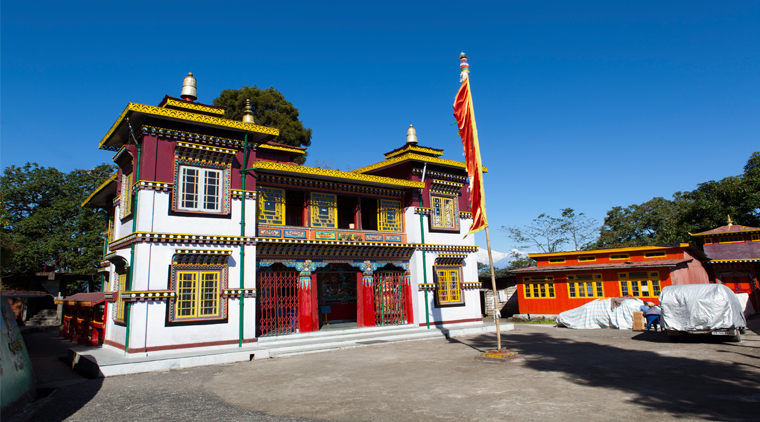
- Durpin Hill and the Durpin MonasteryOn the opposite ridge, Durpin Hill carries the Zang Dhok Palri Phodang, built around 1972 and consecrated by the Dalai Lama, which holds 108 volumes of the Kangyur scriptures. Entry is free. The hill also gives a fine panorama, and a quiet, working monastery atmosphere.
- Thongsa Gompa, the oldest monasteryThe Bhutanese monastery near 10th Mile, Thongsa Gompa, is the oldest in Kalimpong, founded about 1692. It is a calm, atmospheric stop close to the Mangal Dham temple, and a window onto the town's long Buddhist roots.
- Dr Graham's Homes, the living historyThis historic boarding school, founded about 1900 by the Reverend John Anderson Graham, spreads across the slopes below Deolo, with its stone chapel dedicated about 1925. It is a working campus of around 1,400 students, so there is no ticketed entry; view the grounds and the chapel quietly without disturbing school life.
- Hanuman Tok and Mangal DhamA large hilltop Hanuman statue at Hanuman Tok, listed on the Incredible India portal, looks out over the Himalaya, and Mangal Dham near 10th Mile is a spacious modern Hindu temple worth a quiet half-hour. Both are easy, gentle stops.
- The Lepcha MuseumA small museum dedicated to the culture of the Lepcha, the region's indigenous people, with entry free or by donation. It is a thoughtful, low-key stop for anyone curious about who the hills belonged to before the tea and the schools arrived.
Be honest with your plan: Kalimpong's set-piece sights, Deolo, Durpin, the gompas and Dr Graham's Homes, can be covered in a little more than half a day at a relaxed pace. The town rewards slowness rather than ticking off a long list, so leave room for the nurseries, the haat on a market day, and simply sitting with a view. That is where Kalimpong is at its best.
Nurseries, the haat and the Teesta
Beyond the viewpoints, Kalimpong is about its flower nurseries, its twice-weekly haat, and the river below. Here is how to enjoy each without the tourist-trap version.
- The flower and cactus nurseriesKalimpong is one of India's flower towns, known for orchids, gladioli, cacti and hybrid azaleas. The district names Shantikunj, Pine View, Orchid Retreat and the Horticultural Trading Company as visitable nurseries. Pine View on Atisha Road holds a huge cactus collection of around 1,500 species; a small entry fee of about 20 rupees a person is commonly quoted, from listings rather than an official page.
- The haat, on Wednesday and Saturday onlyKalimpong's open market, the haat, runs on Wednesday and Saturday, when traders bring Tibetan goods, woollens, the locally made handmade paper, cheese and pickles. On other days it is far quieter, so if the haat is a priority, time your visit to one of those two days.
- Teesta river raftingDown on the river near Teesta Bazaar and Melli, rafting runs on rapids graded about class 2 to 4, best from about November to March and to be avoided in the monsoon spate. A short run is commonly quoted at around 800 rupees a person for about 5 km and around 1,200 rupees for about 7 km, varying by operator and water level.
- Sunrise and the view pointsOn a clear morning, Deolo and Durpin give the big Himalayan panorama, with Kanchenjunga sharpest in spring and autumn. There is no toy train here as in Darjeeling, so the pleasure is quieter: a view, a monastery courtyard, a cup of tea, and time.
If you do only one thing slowly, make it the nurseries and the haat, the two experiences that are genuinely Kalimpong and not a generic hill-station tick. Wander a cactus and orchid nursery without a clock, then, if your day falls on a Wednesday or Saturday, lose an hour in the haat among the handmade paper, the cheese and the Tibetan stalls. That is the town being itself, and it is what people remember.
Where to stay in Kalimpong, and how many nights
Stay near the town and Deolo for the views and convenience, or out at a quiet homestay for calm. Two nights is the comfortable length for most travellers.
- Town and Deolo ridge: views and convenienceProperties around the town centre and up toward Deolo keep you close to the sights, the haat and the restaurants, with many rooms framing a Himalayan view. Best for first-timers and for anyone who wants to limit driving and walking between stops.
- Heritage and homestays: calm and characterMorgan House, the West Bengal Tourism heritage bungalow, and the many family homestays around the ridges give the quieter, more characterful stay, often with the best views and home cooking. These need a little transport into town but reward the slower traveller, couples and families.
- How many nightsTwo nights is the comfortable length: a full day for Deolo, Durpin, the gompas and Dr Graham's Homes plus a nursery, and a second for the haat, the Teesta or a day trip to Lava and Lolegaon. One night works if Kalimpong is a stop on a wider Darjeeling and Sikkim loop. A half-day in transit only scratches the surface.
- Room budgetsOff-season, budget rooms and homestays run from roughly 1,000 to 2,000 rupees, mid-range stays roughly 2,500 to 5,000 rupees, and heritage or boutique properties roughly 5,000 to 12,000 rupees and up. These are indicative bands from current listings; rates climb in the spring and autumn peaks, so book ahead in season.
Morgan House is a genuine West Bengal Tourism heritage property run by the state corporation WBTDCL, not a private hotel, and it should be booked only through the official portal at wbtdcl.wbtourismgov.in. The corporation states it is not responsible for bookings made on third-party sites, and original photo identity is required at check-in. If a reseller site quotes it, go to the official portal to book and confirm the current rate.
Kalimpong costs and a realistic daily budget
Kalimpong is gentle on the wallet outside the peaks. Here is what the main things cost, so you can plan and avoid being overcharged.
- A rough daily budgetExcluding your room and the long drive in, plan on roughly 1,200 to 2,000 rupees a day as a budget traveller, roughly 3,000 to 5,000 rupees mid-range, and roughly 6,000 rupees and up for a comfortable day with a hired car, entries and meals. The town is inexpensive once you are up the hill.
- Getting in and getting aroundA shared jeep seat from Siliguri, NJP or Bagdogra is around 250 to 300 rupees, a reserved small car around 3,000 rupees, and a full day's car hire for the sights and a day trip is commonly a few thousand rupees, negotiated in advance. Indicative figures, so reconfirm with your driver.
- Entries and activitiesDeolo is about 20 rupees for Indians and about 50 for foreign visitors, the Durpin Monastery is free, Pine View Nursery is around 20 rupees, and a short Teesta rafting run is around 800 to 1,200 rupees a person. The nursery and viewpoint fees are from listings rather than official notices, so treat them as a guide.
- Cash and cardsThere are ATMs in town and larger hotels and some restaurants take cards or UPI, but the haat, the shared jeeps and small eateries run on cash, so carry enough for the day. Connectivity can be patchy on the day trips, so do not rely on digital payment out in the hills.
The one figure that smooths a Kalimpong trip is the car. A reserved cab for the day, for the local sights or a Lava and Lolegaon run, is the main cost after your room, and rates are negotiable. Agree the vehicle, the route and the price before you set off, ideally a sturdy Sumo or Scorpio for the rough day-trip roads, and the trip's only real friction disappears.
Practical logistics: permits, road, money and getting around
The small things that make a Kalimpong trip smooth, from the no-permit truth to the NH10 road, ATMs and local transport.
- No permit for Kalimpong, by ruleKalimpong town and district need no permit at all, for Indian or foreign tourists, because this is West Bengal and not Sikkim. The permit worry travellers carry over from Sikkim simply does not apply here, so you can arrive and move freely without paperwork for the town and its sights.
- The NH10 road inAlmost everyone drives in along NH10 beside the Teesta. It is a scenic but landslide-prone road, fine in dry months and risky in the monsoon, so travel in daylight, keep a buffer day in the rains, and check the road status before you set out from Siliguri or NJP.
- Getting around town and outThe town core is walkable but hilly, and shared jeeps and taxis cover the stands; for the sights and the day trips, a reserved car is the practical choice. Use a sturdy Sumo or Scorpio for the rough Lava and Lolegaon roads rather than a small car.
- Money, SIM and languageATMs are in town; carry cash for the haat, jeeps and small eateries. Mobile coverage is generally fine in town but patchy on the day trips, so download maps in advance. Nepali, Hindi, Bengali and English are all widely understood in the tourist trade.
Safety, the NH10 landslides, and staying well
Kalimpong is calm and welcoming, and the main risk is not crime but the hill road and the weather. A little awareness keeps the trip happy.
- The NH10 landslide risk, and how to handle itThe road in along the Teesta is the real thing to plan around. It reopened on about 17 August 2025 after a six-day closure from continuous landslides, with damage around 9th Mile, Selfie Dara and Swetijhora; the cause is the raised riverbed after the 2023 South Lhonak glacial lake outburst flood. In the monsoon expect intermittent closures and single-lane delays, so travel by day, keep a buffer day, and check the road before you go.
- Altitude and healthKalimpong sits at about 1,250 metres, low enough that altitude is rarely a problem, which is one of its quiet advantages over higher hill stations. Take the usual care with drinking water, stick to bottled or boiled, and carry basic medicines for a cold or an upset stomach, as pharmacies in the hills are limited.
- Crossing into SikkimIf you plan to continue into Sikkim, foreigners need a Restricted Area Permit, and Tsomgo Lake needs a Protected Area Permit arranged through a registered agent in a group of two or more; Nathula Pass and Baba Mandir are open to Indian citizens only and foreigners are not allowed. A PAN card is not accepted as identity for these permits, so carry a passport, voter card or driving licence and spare photos.
- General safetyKalimpong is a quiet, low-crime hill town that is generally easy and safe, including for solo and women travellers, with the usual sensible care after dark. The friction here is weather and roads, not touts, so the planning that matters most is around the season and the journey, not personal safety.
The single habit that protects a Kalimpong trip in the wetter months is checking the NH10 status before you travel, not only the forecast. A landslide can close the road even when it is dry where you are standing, because the slip happens up the valley. Ask your hotel or driver for the current condition the night before, keep a spare day in the plan, and you turn the trip's one real risk into a manageable one.
Kalimpong or Darjeeling, and who Kalimpong suits
The question travellers ask most is which one to choose, or how to split the two. Here is the honest steer, plus what Kalimpong offers each kind of traveller.
- Kalimpong versus Darjeeling, honestlyKalimpong sits lower and warmer, about 1,250 metres against Darjeeling's roughly 2,000, which makes it the quieter, gentler base and easier on anyone who finds altitude or crowds tiring. Darjeeling has the toy train, the big tea estates and more set-piece sights; Kalimpong has monasteries, nurseries, calm and slowness. Neither is wrong; they suit different moods.
- How to split the twoThe common and sensible answer to the forum question is to do both: a night or two in Darjeeling for the train and the tea, then over to Kalimpong for the quiet, the two an easy drive apart on one loop. If you must choose one, pick Darjeeling for sights and buzz, Kalimpong for calm and views.
- Couples and honeymoonersKalimpong is the slow, romantic choice: a heritage stay or a ridge homestay with a Kanchenjunga view, the nurseries, and quiet evenings. Many couples find it the more restful half of a Darjeeling and Kalimpong honeymoon, away from the crowds.
- Senior travellers and on accessibilityThis is where the lower altitude pays off: Kalimpong is gentler on older travellers and on anyone who tires easily, with the main sights doable from a car and short, optional walks. Stay near town, use a reserved car, skip the rough day trips if walking is hard, and it is one of the easier eastern-Himalaya stops for parents and grandparents.
- Families with childrenEasy and uncrowded, with the nurseries, the viewpoints, Dr Graham's Homes and the Teesta. Keep the day trips short and the car sturdy, and it makes a calm family base, less hectic than the busier hill stations.
- Photographers and slow travellersMonastery courtyards, the orchid and cactus nurseries, the haat on a market day, and Kanchenjunga at dawn from Deolo or Durpin. The reward here is atmosphere and light rather than a long sight list, so give it time.
A suggested Kalimpong itinerary
How to shape one or two unhurried days so you catch the views, the monasteries and, if you have time, a day trip to Lava and Lolegaon.
- Day one, the townStart with Deolo for the morning view, then Durpin Monastery and Dr Graham's Homes, breaking for lunch in town. In the afternoon take in a nursery or two and, if it is a Wednesday or Saturday, the haat. End with the sunset from a ridge or your homestay terrace.
- Day two, the river or the day tripEither drop down to Teesta Bazaar for a rafting run in the dry season, or make the long, rewarding day trip to Lava, about 34 km and 1.5 hours, and Lolegaon, about 52 km and 2.5 hours, for the cryptomeria forest and, if it is open, the canopy walk. Start early and use a sturdy car for the rough roads.
- The one-night versionIf Kalimpong is a stop on a Darjeeling and Sikkim loop, one night covers Deolo, Durpin, a gompa and a nursery comfortably. Arrive by early afternoon, do the town sights, stay the night, and move on the next morning, having caught the calm that a half-day in transit misses.
- Pairing it on a wider tripKalimpong sits naturally between Darjeeling, about 55 km, and Gangtok, about 75 km, so the classic loop is Bagdogra or NJP, then Darjeeling, then Kalimpong, then on to Gangtok and Sikkim, or the reverse. Two nights here is plenty within such a loop.
The thing that breaks a Lava and Lolegaon day is underestimating the roads, which are rough and slow. Use a Sumo or Scorpio rather than a small car, leave early so you are back before dark, and treat it as a full day, not a quick hop. Done right it is one of the best things you can do from Kalimpong; done in a hurry in a small car it is a long, jarring slog.
The real questions travellers ask about Kalimpong
Straight answers to the questions that come up again and again on traveller forums, so you arrive already knowing the score.
- Is Kalimpong worth it, or just a transit stop?It is worth a night or two if you want calm, views, monasteries and nurseries rather than a long sight list. Travellers who arrive expecting Darjeeling's set-pieces can find it quiet; those who want a slower, gentler hill town tend to love it. Manage your expectations and it rewards you.
- How many days do I need?Two nights is the comfortable length, one full day for the town sights and a nursery, a second for the haat, the Teesta or a Lava and Lolegaon day trip. One night works on a wider loop. The set-piece sights alone take little more than half a day.
- Do I need a permit for Kalimpong?No. Kalimpong town and district need no permit for Indian or foreign tourists, as this is West Bengal, not Sikkim. You only need permits if you cross into Sikkim, where foreigners need a Restricted Area Permit and Tsomgo needs a Protected Area Permit through a registered agent, and where Nathula and Baba Mandir are open to Indians only and closed to foreigners.
- Is NH10 safe in the rains?NH10 along the Teesta is landslide-prone in the monsoon and was closed for about six days in August 2025. It is fine in the dry months. If you travel in the rains, go by daylight, keep a buffer day, and check the road status before you set out, as a slip up the valley can close the road even when it is dry where you are.
- Should I split a trip between Darjeeling and Kalimpong?Yes, this is the common and sensible answer. A night or two in Darjeeling for the toy train and the tea, then over to Kalimpong for the quiet, the two an easy drive apart. If you can only pick one, Darjeeling for sights, Kalimpong for calm.
- Can I do Lava and Lolegaon as a day trip?Yes, the two are commonly paired in one long day, Lava about 34 km and Lolegaon about 52 km, with the forest and, if it is open, the canopy walk the highlight. The roads are rough, so use a sturdy car, start early, and be back before dark.
Planning Kalimpong from abroad
Kalimpong is the calm, low-altitude heart of an eastern-Himalaya trip and pairs naturally with Darjeeling and Gangtok. A little preparation makes the permit and road questions easy to handle.
- No permit for Kalimpong, but know the Sikkim rulesKalimpong itself needs no permit for foreign visitors. The moment you cross into Sikkim it is different: foreigners need a Restricted Area Permit, Tsomgo Lake needs a Protected Area Permit arranged through a registered agent in a group of two or more, and Nathula Pass and Baba Mandir are closed to foreigners entirely. Plan any Sikkim leg with that in mind.
- Fly in via BagdograFly into Delhi or Kolkata, connect to Bagdogra, then drive about 2 hours 45 minutes up to Kalimpong. There are no international flights to the region and no helicopter to the town, so the road in along the Teesta is the way for everyone.
- Pair it with Darjeeling and GangtokThe natural loop is Bagdogra, then Darjeeling for the toy train and tea, then Kalimpong for the quiet, then Gangtok and Sikkim. Kalimpong is the gentle, low-altitude pause between the busier stops, an easy drive from each.
- Low altitude, gentle paceAt about 1,250 metres Kalimpong rarely troubles anyone with altitude, which makes it the easier eastern-Himalaya base for older travellers or a first hill trip. Stay near town, use a reserved car, and it is one of the calmer, more comfortable stops in the region.
Money, the road and timing for foreign visitors
The practical basics an overseas traveller needs for a small hill town: cash, a SIM, the road risk, and how many days to give it on a wider India trip.
- Carry cash, expect patchy signalCards and UPI work in hotels and bigger restaurants, but the haat, the shared jeeps and small eateries are cash places, and mobile coverage is patchy out on the day trips. Draw cash in town, pick up an Indian tourist SIM or eSIM when you land in Kolkata or Delhi, and download offline maps before the hills.
- Respect the road and the seasonBuild your dates around the dry windows, about March to May or late September to November, and treat the monsoon road risk seriously if you must travel then. The NH10 stretch beside the Teesta is the part to plan around, so keep a buffer day and travel in daylight.
- How long to give it on a bigger tripOn a first eastern-Himalaya trip, one to two nights in Kalimpong is the right weight between Darjeeling and Gangtok: enough for the views, a monastery and a nursery, without slowing the whole itinerary. Add a night if you want the Teesta or a Lava and Lolegaon day trip.
- Booking the heritage stayIf you want Morgan House, the West Bengal Tourism heritage bungalow, book it on the official WBTDCL portal at wbtdcl.wbtourismgov.in rather than a reseller, and carry original photo identity for check-in. The corporation states it is not responsible for third-party bookings.
Kalimpong is an unusually gentle introduction to the eastern Himalaya: low, warm, walkable and calm, with the views and the monasteries without the crowds. Slot it after Darjeeling, give it a night or two, and let it be the quiet, restful chapter before or after the busier Sikkim leg. Many overseas visitors find it the part of the trip they remember most fondly.
Why a small hill town became India's flower garden
Kalimpong's name is usually traced to the Lepcha, the hills' indigenous people, and is most often read as the place of the king's minister's stockade or, in another reading, the ridge where a wild grass once grew; the meaning is debated and no single origin is firmly settled, so it is honest to hold it lightly. What is not in doubt is what the town became. Scottish missionaries founded Dr Graham's Homes here in 1900, monasteries like the Bhutanese Thongsa Gompa had stood since the seventeenth century, and traders carried wool and goods down the old Tibet route. Out of that mingling of Lepcha, Bhutia, Nepali, Tibetan and British hands grew the thing Kalimpong is quietly famous for today: its nurseries. The cool, mild ridges turned out to suit orchids, gladioli, cacti and azaleas, and the town became one of India's flower centres, its blooms travelling far beyond the hills. To walk a Kalimpong nursery now is to stand in the living result of all that history, a small Himalayan town that the wider world helped to plant.
Planning a Kalimpong trip?
Our West Bengal travel experts plan your full journey for you: route, hotels, darshan timings and transport. You get a free day-by-day plan and an exact quote on WhatsApp, usually within a few hours. No payment is needed to get your plan.
Tour packages that visit Kalimpong
Every journey below is private, hand-crafted and fully customizable. Tell us your dates and we tailor the itinerary, the pace and the priests or guides around you.
 10D / 9N
Darjeeling Sikkim Tour Package
- Visit Darjeeling is one of most cool hill stations of India.
 6D / 5N
Eastern Triangle Tour
- Visit Rumtek Monastery & DroulChorthen
- Visit Durbin Dara Hills