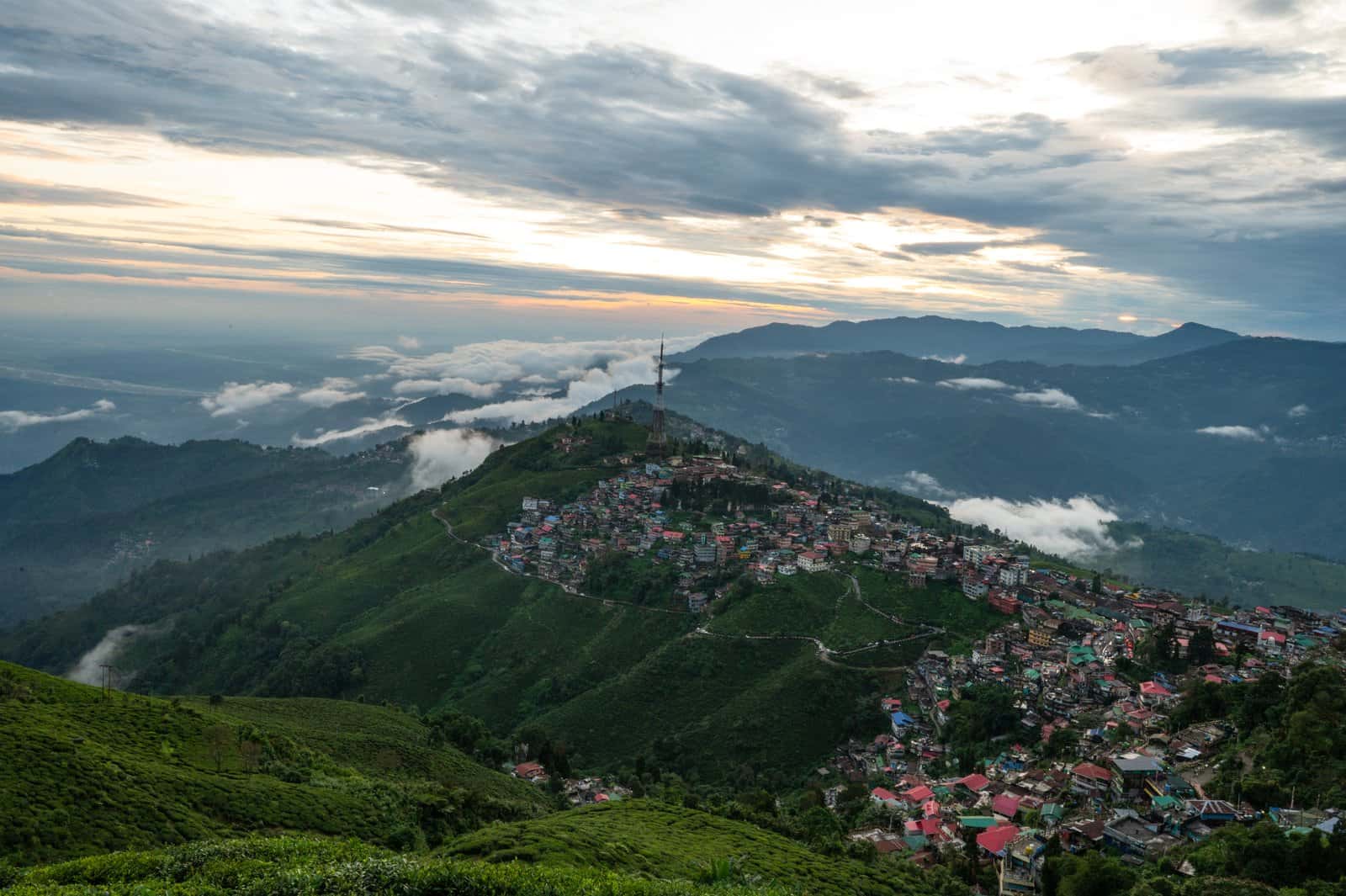
Kurseong Travel Guide
The kind months are March to mid June and October to December . The monsoon is the one season to avoid, because the hill roads here slide.
When to visit Kurseong, and when to stay away
The kind months are March to mid June and October to December. The monsoon is the one season to avoid, because the hill roads here slide.
- October to December: the clearest airAfter the rains stop, the sky opens and you get the sharpest view of Kanchenjunga from Eagle's Craig and Giddapahar. The tea slopes are still green, the days are pleasant and the nights are cool. If you can travel only once, come now. Late November to January is also when the oranges ripen in Sittong village, so you can add that easily.
- March to mid June: green and busy in the gardensThis is when the tea gardens are working hardest, so it is the best window for a real Makaibari factory visit. The first flush and then the second flush are being plucked and processed. Afternoons can turn hazy, so do your viewpoints early in the morning.
- Winter, December to February: quiet and coldKurseong is dry, calm and very peaceful in winter, with almost no crowd. It is genuinely cold at night, so carry heavy woollens for the evening and the early morning. This is a lovely time if you want to sit with a cup of tea and do nothing at all.
- Pack for a hill town, not a hot plainEven in summer you will want a light woollen for the evenings. In winter carry a proper jacket, a cap and gloves. Carry an umbrella at any time of year, because a sudden shower is normal in these hills and the local people never move without one.
From about June to September the rain is very heavy, July being the wettest month with an average of roughly 896 mm. You lose the mountain views to cloud, the forest paths get leeches, and, most seriously, the hill roads slide. In October 2025 the rains caused severe landslides across the Darjeeling and Mirik hills and badly damaged the Rohini road that links Kurseong with Siliguri. If you must travel in the rains, keep spare days, drive only in daylight, and never book a tight onward flight.
How to reach Kurseong
Kurseong sits on the Hill Cart Road, about halfway between Siliguri and Darjeeling. You come up from Bagdogra airport or NJP station, or you come down from Darjeeling.
- By air to Bagdogra (IXB)Bagdogra is the nearest airport, about 60 km away by the usual route through Matigara and Rohini, and the drive takes roughly 2 hours. A one way private sedan is quoted at roughly 2,000 to 3,000 rupees and an SUV at roughly 3,100 to 4,300 rupees, and rates go up in the season. Book the car in advance, especially if you are landing in the afternoon.
- By rail to New Jalpaiguri (NJP)NJP is the nearest big railway station, about 57 km away, and Siliguri town is about 51 km. From either, you take the same climb up the Hill Cart Road. Shared taxis run from outside NJP station and from the Tenzing Norgay bus stand area in Siliguri, and every Darjeeling bound vehicle passes through Kurseong.
- Shared taxi or private carA shared taxi seat is much cheaper but the vehicle is cramped and it leaves only when it fills. Remember that shared taxis to and from Siliguri and NJP generally run only in the daytime, roughly 7 am to 2:30 pm. If you are travelling with parents, with children or with luggage, take a private car with a good hill driver. We can arrange one for you.
- From Darjeeling, and by the toy trainDarjeeling is only about 33 km away, roughly 1 hour 15 minutes by road through Sonada and Ghum. You can also come or go by the Darjeeling Himalayan Railway itself, which is covered in the next section, and this is the loveliest way to link the two towns.
Fly into Kolkata or Delhi, then take a domestic flight to Bagdogra (IXB) and drive up for about 2 hours. Kurseong is a calm first stop before Darjeeling and Sikkim.
Fly into Kolkata, which is the nearest big international gateway, connect to Bagdogra, and drive up the hill. Many overseas Indian families break the climb at Kurseong instead of pushing straight to Darjeeling.
Fly or take a train to Bagdogra or NJP from Kolkata, Delhi and other cities. Every bus and shared taxi going up to Darjeeling stops at Kurseong, so you can get down here easily.
The landslides of 4 and 5 October 2025 washed away part of the Rohini road, also called Subash Ghising Marg, which is one of the three links between Kurseong and Siliguri. Recovery of a stretch of about 17 km from Kurseong to Simulbari was tendered under the national and state disaster response funds, and through 2026 this road was still being worked on, with its transfer to the state PWD discussed at a north Bengal infrastructure review in June 2026. Reports differ on how far it is now restored. The good news is that the other two roads, the Pankhabari road and the Hill Cart Road (NH-110) via Tindharia, stayed open, so you will get up the hill. But the drive may take longer than the usual 2 hours. Please ask your hotel or your driver which road they are using, a day before you travel.
The toy train from Kurseong, and the museum inside the station
Kurseong is the headquarters of the Darjeeling Himalayan Railway. You can board the real toy train here and ride uphill to Darjeeling, and there is a small DHR museum inside the station itself.
- Kurseong is the DHR headquartersThe Darjeeling Himalayan Railway, listed by UNESCO as a World Heritage site in 1999, has its headquarters right here. The line reached Kurseong in August 1880 and the station has been working ever since. Stand near the market and you will see the little train come straight down the middle of the road, with shopkeepers calmly moving their stools aside. There is no other sight quite like it in India.
- The DHR museum inside Kurseong stationInside the station there is a small one room museum with original rails and fittings from the 1880 line, old records, and framed photographs and sketches of the train working its way around the loops and the Z reverses. Most visitors do not know it is there, so you will often have it to yourself. It takes only about 20 minutes and it is a lovely thing to do while you wait for your train.
- The Kurseong to Darjeeling slip coachThis is the ride most pages never tell you about. A first class slip coach is attached at Kurseong to the New Jalpaiguri to Darjeeling passenger train, and it is booked separately as train number 02451, from station code KGN to DJ. It is reported to leave Kurseong at about 2:45 pm and reach Darjeeling at about 5:30 pm, a climb of about 30 km, and the first class fare is about 750 rupees. The down service, number 02540, is reported to leave Darjeeling at about 9 am and reach Kurseong at about 11:30 am.
- How this compares with the Darjeeling joy rideFrom Darjeeling, the short Ghum joy ride costs about 1,500 to 1,600 rupees per adult for the steam engine and about 1,000 rupees for the diesel. The long New Jalpaiguri to Darjeeling run takes about 7 and a half hours over about 84 km, with the first class fare about 1,400 rupees and the AC chair car about 1,500 rupees, and it halts at Kurseong for roughly 10 minutes. So if you are staying in Kurseong, the slip coach gives you the same heritage line, the same views, at a gentler price.
- How to book, and how far aheadBook online on IRCTC, where the window opens about 60 days before the journey. Seats on these coaches are very few, so book as soon as your dates are fixed. Different sources print slightly different timings for this coach, some showing a departure closer to 2:30 pm, so take the times here as a guide and let IRCTC be the final word. We are happy to book this for you.
This is the honest warning that the package pages will not give you. The hill section of this railway is suspended almost every monsoon. It was stopped in July 2024 after landslides between Sukna and Kurseong, and again in 2025 after a slide near Tindharia, and in some years it has stayed shut for weeks together. So if you are travelling between about June and September, please assume the train may not run, and be glad if it does. When the New Jalpaiguri line is shut, the short joy ride from Darjeeling up to Ghum often keeps running, so that remains your fallback. Check IRCTC and ask your hotel a day before. Also remember the coaches are small with very little space for luggage, so send big suitcases ahead by car, and carry your own water and snacks, because there is no food service on board.
Makaibari, and the tea gardens of Kurseong
Makaibari built the first tea factory in the Darjeeling hills in 1859. You can walk the garden, see the leaf being made into tea, and stay in a tea worker's home.
- Why Makaibari mattersMakaibari, about 3 km below Kurseong town, set up the first tea factory in the Darjeeling hills in 1859. It was the first garden in the world to be certified by Fairtrade and one of the earliest to go fully organic. The estate covers roughly 750 hectares, of which about 65 per cent has been left as natural forest and about 274 hectares is under tea. So when you walk here you are walking through a forest as much as a plantation.
- The factory tourA walk in tour of the processing factory is reported to cost only about 30 rupees and to take roughly 30 to 45 minutes. Go in the morning, before about 9 am, if you want to see the leaf actually being withered, rolled and dried. Come in the afternoon and you will see a quiet, empty factory, which is not the same thing at all. There is a small retail counter just inside the gate where you can buy the estate's tea.
- Stay in a tea village homeSince 2005, about 24 families of the tea garden have opened their homes to guests, coordinated by a local volunteer group. The rate has been reported at about 800 rupees per person per night, and it includes a home cooked breakfast and two full meals. The rooms are simple and clean with hot water. You will eat Nepali food with the family, you can learn to make momos, and you will understand the garden in a way no day visit allows.
- Buying tea honestlyIf you want the freshly plucked leaf rather than a packet, ask at the factory counter for the current flush. A few years ago the freshly plucked second flush was quoted at about 4,000 rupees a kilo, so please expect it to cost more today. Buy from the estate counter or a reputable shop, not from a stall on the roadside, and ask which flush and which year the leaf is from.
- The other gardensMargaret's Deck, the tea lounge of the Goodricke group beside the Margaret's Hope garden, is about 9 km from Kurseong station on the road to Darjeeling, and is a lovely place to sit with a pot of tea and look over the slopes, though it is a little costly. Ambootia Tea Estate, about 10 km below town, has a Shiva temple in the middle of the garden where the local villagers come to worship, and the factory can be seen with the manager's permission.
The tea gardens are working places and people's homes, not a photo studio. Ask before you photograph a woman plucking leaf, do not walk into the bushes without your host or a guide, and do not bargain hard with a village homestay family over a few rupees. The whole value of Makaibari is that the money reaches the family that cooks your dinner.
Netaji's house at Giddapahar, and the viewpoints
The house where Netaji was kept in British confinement is now a small, moving museum. Above it, Eagle's Craig gives you the whole valley and, on a clear day, Kanchenjunga.
- The Netaji Subhas Chandra Bose Museum, GiddapaharAbout 2 km from town, at Giddapahar, stands the house of Netaji's elder brother Sarat Chandra Bose. Netaji was kept here under British confinement in the mid 1930s, and the house is now a museum holding his furniture, his belongings and his writings. It is a quiet, thoughtful place and many Indian visitors find it the most moving hour of their trip.
- Timings, entry and the one ruleEntry is free. The museum is generally open about 9:30 am to 4:30 pm and it is closed on Mondays, so please do not plan your Giddapahar morning on a Monday. Photography inside is not allowed, so keep your phone in your pocket and simply look. The last stretch is a short uphill walk through a lane, which is worth knowing if you are bringing elderly parents.
- Eagle's CraigAbout 1 km above the station, Eagle's Craig is a small landscaped park with an observation tower and a little cafeteria. From here you look right down over the Siliguri plains, across the tea slopes, and on a clear morning you can see Kanchenjunga standing over everything. The entry is a nominal charge, reported at about 10 to 20 rupees, and it is usually open roughly 6 am to 6 pm. Come at sunrise or sunset.
- Hanuman Tok and Giddapahar viewpointHanuman Tok, with its large statue of Lord Hanuman, sits high above the town and gives you a wide view of Kurseong on its slope with the snow peaks behind. It is a peaceful place for a short darshan and a long look. The Giddapahar viewpoint nearby opens out over the valley and is a favourite of local families in the evening.
If you do only one thing in Kurseong with your family, make it the Netaji house at Giddapahar in the morning and Eagle's Craig at sunset. One gives your children a piece of our history that no textbook can, and the other gives you the mountain. Both are almost free, and both are best done slowly, without a driver waiting with the engine running.
Signature experiences in and around Kurseong
Beyond the train and the tea, Kurseong gives you forest walks, an old colonial hill, and some of the quietest villages in Bengal.
- Dow Hill and the Forest MuseumAbout 4 km above the town, Dow Hill is a cool forest of pine and cypress with a Deer Park and a Forest Museum run by the West Bengal forest department. The museum has old exhibits of the birds, animals and trees of these hills. Please note that it keeps irregular hours, is generally closed on Thursdays and on public holidays, and the small eco park charge is reported at about 20 rupees. The forest road itself is a beautiful, silent walk.
- Chimney village and the heritage parkA short drive from town, Chimney village is built around a single old chimney, the last remaining piece of a colonial house. A small heritage park and viewpoint has been made around it. It is a simple, pretty stop, and a good excuse to see the quiet slopes just outside Kurseong where local families live and grow their vegetables.
- Sittong, the orange villageAbout 24 km away, Sittong is a village of orange orchards and small homestays, and it is at its best when the fruit ripens from about late November to January. You can walk between the groves, sit in the sun, and eat an orange straight from the tree. Many Indian families now come here just to slow down for two days.
- Latpanchar and the salamander lakeLatpanchar, about 7 km from Sittong, is the highest point of the Mahananda Wildlife Sanctuary and one of the best places in Bengal to look for the rufous necked hornbill. Nearby is Namthing Pokhri, the salamander lake, a protected home of the Himalayan salamander. Go with a local guide, keep your voice low, and never touch or disturb the salamanders.
- Simply walk the Hill Cart RoadDo not underrate this. Walk from the station along the Hill Cart Road towards the Tourist Lodge, with the toy train line beside your feet and the shops opening around you. Stop for momos. Look into the old photo and gift shops. This half hour tells you more about Kurseong than any viewpoint.
You will read all over the internet that Dow Hill is the most haunted place in India, with a headless boy in the forest and a haunted school. Please understand what is actually there. Victoria Boys' School, founded in 1879, is a living, working boarding school with children studying inside it, not an abandoned ruin. The stories are local folklore and nothing more. Enjoy the forest, respect the quiet, and do not trespass on school property or wander the forest road alone after dark, for the same simple reasons you would not do that in any forest anywhere.
Where to stay in Kurseong, and how many nights
Stay near the Hill Cart Road to walk everywhere, in a tea garden for the view and the calm, or up on the Dow Hill slopes for silence. One to two nights is right.
- The Hill Cart Road and station areaThis is the heart of the town. You can walk to the station, the market, the taxi stand and up to Eagle's Craig. It is convenient and cheerful, though the road is busy and the town is a working town rather than a resort. Best for a short stay and for anyone who wants to be able to walk out for a plate of momos.
- The tea gardens around MakaibariThis is where Kurseong becomes special. You can take a simple village homestay with a tea garden family, or a luxury resort set inside the Makaibari garden. Either way you wake up to mist over the tea bushes. You will need a car for the town, but that is a small price for the calm.
- The state Tourist LodgeThe old Kurseong Tourist Lodge on Hill Cart Road, about 1 km from the market towards Darjeeling, is now branded Roudra Chhaya and is run by the West Bengal Tourism Development Corporation. It is the best known budget friendly address in town and its restaurant and momos bring people from far away. Please book only through the official WBTDCL portal, because the corporation does not take responsibility for third party bookings.
- How many nightsOne full day and night is enough for the town itself: the station and the DHR museum, Eagle's Craig, the Netaji house and Makaibari. Give it two nights if you want a proper tea garden morning, and three if you want to add Sittong, Latpanchar or Mirik. Kurseong also works beautifully as one calm night on the way up to Darjeeling.
- Room budgetsBudget rooms and homestays run roughly 800 to 1,500 rupees, mid range hotels roughly 2,000 to 5,000 rupees, and the premium tea garden resorts start from about 15,000 rupees and go well above that. The Makaibari village homestay, at a reported rate of about 800 rupees per person per night with all meals, is the best value in these hills.
Darjeeling town in the season is crowded, and the traffic on Hill Cart Road can take away the pleasure of the hills. Kurseong is quieter, cheaper and only about 33 km down the road, roughly 1 hour 15 minutes away. Many Indian families now base themselves here, take a day trip up to Darjeeling, and come back to a peaceful evening. If your parents are with you and you want calm, this is a sensible choice.
Kurseong costs and a realistic daily budget
Kurseong is one of the cheapest hill stations in Bengal. The two real costs are the car from the plains and, if you take it, the toy train.
- A rough daily budgetLeaving aside your room and the airport or station transfer, plan on about 1,200 to 2,000 rupees a day for a simple traveller and about 3,000 to 5,000 rupees for a comfortable day with a car for sightseeing, good meals and some tea shopping. The town itself is inexpensive and the sights cost almost nothing.
- The sights are nearly freeThe Netaji museum is free to enter. Eagle's Craig is a nominal charge reported at about 10 to 20 rupees. The Dow Hill eco park charge is reported at about 20 rupees. The Makaibari factory walk in is reported at about 30 rupees. In very few Indian hill stations can a family see everything for less than the cost of one meal.
- The transfer is the biggest costA one way private sedan from Bagdogra or NJP up to Kurseong is quoted at roughly 2,000 to 3,000 rupees, and an SUV at roughly 3,100 to 4,300 rupees. A shared taxi seat costs far less but runs only in the daytime and is cramped. If you are two people, weigh the comfort against the saving honestly.
- The toy train, if you take itThe Kurseong to Darjeeling first class slip coach fare is about 750 rupees. That is a real cost, but set it against the Darjeeling steam joy ride at about 1,500 to 1,600 rupees, and it is good value for a longer, more beautiful climb on the same heritage line.
- Cash, cards and UPIHotels and the bigger shops take cards and UPI. But the shared taxis, the small eateries, the homestays and the village stops run on cash, and the network can be slow. There are bank ATMs on Hill Cart Road near the market. Draw enough cash for two days, because the villages around Kurseong have no ATM at all.
In Kurseong your money goes almost entirely on the car and the room, not on the sightseeing. So decide those two things carefully and the rest of the trip stays gentle on the pocket. If you are a family, share one private car for the whole stay rather than hiring separately each day, and take a homestay meal plan instead of eating out three times a day.
Practical logistics: getting around, food, money and the small things
The small facts that make a Kurseong day run smoothly, starting with the one that surprises everybody: there are no totos here.
- There are no totos or e-rickshawsThis catches out almost every first time visitor. Kurseong has no toto and no e-rickshaw service. You walk, or you take a private taxi or a shared taxi from the stand near the railway station. So if your hotel is up the Dow Hill or Giddapahar slope, fix a car for the day rather than assuming you will find something at the gate.
- Fix a car for your sightseeing dayThe taxi drivers at the stand near the station offer standard half day and full day local tours, and your hotel can arrange a private car. This is the sensible way to cover the Netaji museum, Dow Hill, Makaibari and the viewpoints in one day. Agree the price and the exact list of stops before you start, as you would anywhere.
- Eat early, and eat momosKurseong is a working town, so the shops and small restaurants shut early in the evening. Do not plan a late dinner outside. The Tourist Lodge restaurant on Hill Cart Road is popular for lunch and its momos are famous, and there are good little cafes near the station. Thukpa, momos and simple Nepali food are what the hills do best, so please try them.
- Money, SIM and powerThere are bank ATMs on Hill Cart Road near the market, but carry cash for the villages. Mobile coverage in the town is generally fine for calls and maps, but it thins out at Latpanchar, Sittong and inside the tea gardens. Power cuts do happen in the off season, so carry a power bank and a small torch.
- Dress simply and warmlyThis is a modest hill town. Dress simply, especially when you visit Hanuman Tok or the Shiva temple at Ambootia, and remove your shoes where you are asked to. Carry an umbrella and a light woollen even in summer. Comfortable walking shoes matter, because the lanes are steep and uneven.
Safety, health and the hill roads
Kurseong is a calm and friendly town with almost no touting. The real cautions here are the roads, the rain and the cold, not the people.
- The altitude is easyAt about 1,480 m, Kurseong is a gentle height. Altitude sickness is not a worry for almost anyone, and this is one good reason to bring elderly parents or small children here rather than to the high passes of Sikkim. What will tire you is the steep walking, so go slowly and take your time.
- Landslides and the monsoon roadsThis is the one serious risk, and we will not soften it. From about June to September the hill roads can be blocked or damaged by landslides. The rains of 4 and 5 October 2025 were severe across the Darjeeling, Mirik and Kalimpong hills, lives were lost, and the Rohini road from Kurseong down to Siliguri was washed away in part, with recovery work continuing through 2026. The toy train on this hill section is also suspended in most monsoons. So if you travel in the rains, keep extra days in hand, travel only in daylight, and never book a tight connecting flight from Bagdogra.
- Crime and touting are not the problemKurseong is one of the gentler towns in India for a visitor. There is no aggressive touting, no fake guide culture and no priest donation trap. Take the normal care with your bags in the market, agree taxi fares before you start, and use licensed drivers. Women travellers generally find the town comfortable with the usual precautions.
- Health basics in the hillsDrink bottled or boiled water and avoid ice made from tap water. Carry your own medicines for cold, fever and stomach upset, because the pharmacies here stock the basics only. In the monsoon, leeches are common on the forest paths, so wear closed shoes and long socks. Keep a small first aid kit in the car.
- Respect the forest and the schoolDo not walk the Dow Hill forest road alone after dark, and do not go into the grounds of Victoria Boys' School, which is a working boarding school with children in it. Do not disturb the salamanders at Namthing Pokhri or feed any animal in the sanctuary. This is simple good manners, and it keeps these places open for the travellers who come after you.
From Kurseong you should start for Bagdogra airport by about 5:30 am to 6 am if you have a 9 am flight. The drive can take an hour and a half or more, fog is common in the mornings, and the airport gets crowded at check in. If a road is under repair, add more time. Missing a flight because you left an hour late is the most avoidable mistake in these hills.
Kurseong for every kind of traveller, and on access
Kurseong suits very different people in very different ways. Here is what it gives you, and the one tip that matters most for each.
- CouplesQuiet, misty and unhurried, without the crowds of Darjeeling. Take a tea garden stay, ride the toy train up to Darjeeling in the afternoon, and come back to a silent evening. Watch the sunset from Eagle's Craig with a cup of tea. This is a place for slowness, not for a long list of sights.
- Families with childrenChildren love the toy train coming down the middle of the road, the Deer Park at Dow Hill and the tea factory. The town is small and safe. Keep the days short, because the walking is steep, and please skip the ghost stories at bedtime.
- Senior travellers and on accessibilityKurseong is kinder to older travellers than Darjeeling. The altitude is gentle and the town is small. But the lanes are steep, and the Netaji museum needs a short uphill walk through a lane, so allow time and go slowly. Keep a private car for the whole day, stay near the Hill Cart Road or in a tea garden with level ground, and do your viewpoints in the morning before the legs get tired.
- Tea loversCome between about March and November when the leaf is being plucked, reach the Makaibari factory in the morning while the machines are running, and take the tea tasting. Then buy the current flush from the estate counter and ask which flush and which year it is. A day here will teach you more about Darjeeling tea than a shelf of books.
- Birdwatchers and nature loversLatpanchar, in the Mahananda Wildlife Sanctuary, is one of the best places in Bengal to look for the rufous necked hornbill, and the salamander lake at Namthing Pokhri holds the Himalayan salamander. Take a local guide, start at first light, and keep quiet. An early morning birding walk from a Makaibari homestay is reported at about 500 rupees for one or two people and about 200 rupees for each extra person.
- Solo travellers and photographersKurseong is safe, cheap and very easy to travel alone. For photographers, the toy train on the Hill Cart Road, the mist in the tea bushes and the sunrise from Eagle's Craig are the pictures worth waiting for. Carry a spare battery, because the cold and the early starts drain them faster than you expect.
A suggested Kurseong itinerary
How to shape one, two or three unhurried days so that you catch the tea in the morning, the museum on an open day, and the mountain in clear light.
- Day one, morningToday you drive up from Bagdogra or NJP and reach Kurseong in about 2 hours. Settle in, then walk down the Hill Cart Road to the station, see the small DHR museum inside it, and have a plate of momos. If you are not feeling tired, walk up to Eagle's Craig for the wide view over the plains.
- Day one, afternoon and eveningGo up to Giddapahar for the Netaji house, remembering that it is closed on Mondays and that photography inside is not allowed. From there, carry on to Hanuman Tok for the view. End the day back at Eagle's Craig for sunset, and eat early, because the town shuts by night.
- Day two: the tea morningToday you should be at Makaibari early, before about 9 am, so that you see the factory actually working. Take the tour and the tea tasting, walk into the garden, and if you have booked a village homestay, spend the day with the family. In the afternoon you can drive up to Dow Hill for the forest walk and the Deer Park, keeping in mind that the Forest Museum is generally shut on Thursdays.
- Day three, if you have itTake the toy train slip coach from Kurseong to Darjeeling in the afternoon and stay a night up there, or add a day for Sittong and Latpanchar, where the orange orchards and the birds are. Book the train the moment your dates are fixed, because the coach has very few seats. And keep the road option ready in your mind, because in the rains the train is often suspended and you will simply drive the same 33 km up instead.
- The half day versionIf you are only passing through on the way to Darjeeling, stop for two or three hours. See the station and its museum, take tea at Margaret's Deck about 9 km up the road, and look in at Makaibari. You will miss the calm that is the real gift of Kurseong, but you will understand why people stop here.
Two things break a tight Kurseong plan. The Netaji museum at Giddapahar is closed on Mondays, and the Dow Hill Forest Museum is generally closed on Thursdays and on public holidays and in any case keeps irregular hours. Put Giddapahar on a day that is not a Monday and Dow Hill on a day that is not a Thursday, and everything else falls into place. Also remember that the Makaibari factory only shows you something worth seeing on a working morning.
The real questions travellers ask about Kurseong
Straight answers to the questions that come up again and again on the traveller forums, so that you arrive already knowing the score.
- Is Kurseong worth a night, or only a lunch stop?Both answers are honest. On the forums you will find travellers who say Kurseong is only worth a lunch stop, and others who say it is better than Darjeeling because it is quiet and uncrowded. Our view is simple. If you want a long list of sights, Kurseong will disappoint you. If you want tea, a heritage railway, one very moving museum and a calm evening, give it one or two nights and you will be glad you did.
- Should I stay here instead of Darjeeling?Many Indian families now do exactly this. Kurseong is quieter, the rooms are cheaper, and Darjeeling is only about 33 km up the road, roughly 1 hour 15 minutes away, so you can go up for a day and come back to peace. If your trip is short and you want Tiger Hill at dawn every morning, stay in Darjeeling. If you want calm, stay here.
- Can I take the toy train from Kurseong?Yes, when it is running, and this is the best kept secret of the town. A first class slip coach, booked as train number 02451 from station code KGN to DJ on IRCTC, is reported to leave Kurseong at about 2:45 pm and reach Darjeeling at about 5:30 pm, with a fare of about 750 rupees. Book about 60 days ahead. But please be clear eyed about this: the hill section is suspended almost every monsoon after landslides, as it was in July 2024 and again in 2025, so between about June and September you should treat the train as a bonus and not as your plan.
- Are there totos in Kurseong?No. There is no toto and no e-rickshaw service in Kurseong. You walk, or you take a private taxi or a shared taxi from the stand near the station. Fix a car for your sightseeing day rather than hoping to find one on the road.
- Which days are the museums closed?The Netaji Subhas Chandra Bose Museum at Giddapahar is closed on Mondays. The Dow Hill Forest Museum is generally closed on Thursdays and on public holidays and does not keep regular hours in any case. Plan your two days around these and you will not find a shut gate.
- Is Dow Hill really haunted?No. The stories are folklore that the internet has grown fond of. Victoria Boys' School, founded in 1879, is a working boarding school with children inside it, and the forest is simply a beautiful, quiet forest. Walk it in daylight, enjoy the silence, and please do not trespass on the school grounds.
- How many days for Kurseong with the villages?One night for the town, two nights if you want a proper tea garden morning, and three nights if you want to add Sittong, Latpanchar or Mirik. Many travellers give Kurseong two nights on the way up and then two or three nights in Darjeeling, which is a very comfortable week.
Planning Kurseong from abroad
For an overseas Indian family or a first time visitor from abroad, Kurseong is the calm, affordable way into the Darjeeling hills, and it is kind to parents and children.
- Come through BagdograFly into Kolkata or Delhi, take a domestic flight to Bagdogra (IXB), and drive up for about 2 hours. If you are landing from a long flight, breaking your first night at Kurseong instead of pushing all the way to Darjeeling is a kind decision, especially if your parents are with you. The climb is shorter and the town is quiet.
- The altitude is gentle, which mattersAt about 1,480 m, Kurseong will not give anyone altitude trouble. If you are bringing elderly parents from abroad who are worried about the mountains, this is the reassurance they need. What will tire them is the steep walking, so keep a car, go slowly, and do not try to see everything in one day.
- The tea village stay is the real experienceYou can stay in the home of a tea garden family at Makaibari, reported at about 800 rupees per person per night with home cooked meals included. For an NRI family this is worth far more than a hotel. Your children will eat with the family, learn to make momos, and see how Darjeeling tea is really made. Please book it well ahead, because there are only about 24 homes.
- No permit is needed hereKurseong and the West Bengal hills need no special permit for any visitor, Indian or foreign. If you go on into Sikkim, foreign nationals do need permits, and your operator or hotel will arrange them. So keep Kurseong and Darjeeling as the easy part of your trip and let us handle the Sikkim paperwork if you add it.
Fly into Kolkata or Delhi, connect to Bagdogra (IXB), and drive up. Give Kurseong one or two nights, then go on to Darjeeling by toy train or by road.
Fly into Kolkata, connect to Bagdogra, then drive about 2 hours. Kurseong is an easy, calm start to an Eastern Himalaya trip.
Fly or take a train to Bagdogra or NJP, then drive up. Every vehicle going to Darjeeling passes through Kurseong.
Money, connectivity and timing for visitors coming from abroad
The practical basics for a small hill town: cash, a SIM, how many nights to give Kurseong on a bigger India trip, and how to keep an older traveller comfortable.
- Carry cash, and get your SIM in the cityHotels and larger shops take cards and UPI, but the shared taxis, the homestays, the village stops and the small eateries want cash. Draw cash at the ATMs on Hill Cart Road. Buy your Indian SIM or an eSIM at Kolkata or Delhi airport rather than hunting for one in a small hill town, and remember the signal thins out at Latpanchar and inside the tea gardens.
- How many nights to give itOn a bigger India trip, one or two nights in Kurseong is the right weight, followed by two or three nights in Darjeeling and, if you have time, Gangtok or Kalimpong. That gives you the tea, the railway and the mountain without rushing. Time it for about March to mid June or about October to December for the clear views.
- Book the train and the homestay earlyThe two things that need booking from abroad are the toy train, where the window opens about 60 days ahead on IRCTC and the coaches hold very few seats, and the Makaibari village homestay, where only about 24 families take guests. Everything else in Kurseong can be arranged on the ground. We are glad to book both for you.
- Keeping parents comfortableTake a private car for the whole stay, ask your hotel for a ground floor room, and choose a stay on the Hill Cart Road or in a tea garden rather than up a steep lane. Do the Netaji museum slowly, since the last stretch is an uphill walk. Carry warm clothes for the evening even in summer, and keep a simple medicine kit with you.
Kurseong is an unusually gentle introduction to the Indian Himalayas. The height is low, the town is small, the people are warm and the famous railway runs past your feet. If you have never been to the hills, or you are travelling with parents who worry about the mountains, begin here for a night or two, and let Darjeeling and Sikkim follow. You will find that the quiet start makes the whole trip better.
Why a small town on a railway line is worth your time
Kurseong takes its name from the Lepcha word Kharsang, the place of the white orchid, and the flower still grows quietly through these hills, mostly unnoticed, which is a fair description of the town itself. In August 1880 the Darjeeling Himalayan Railway climbed the last of its loops and reached Kurseong, and the little town became the headquarters of the line and the workshop of the men who kept it running. Everything that happened here afterwards happened beside that track. Rabindranath Tagore wrote in these hills. Sister Nivedita spent her days here. And in the mid 1930s, in a house at Giddapahar belonging to his elder brother Sarat Chandra Bose, the British kept Netaji Subhas Chandra Bose in confinement, a few hundred metres above the same railway. Today you can stand at Kurseong station where the line reached in 1880, look at the original rails kept in the little museum, walk up to the house where Netaji was held, and then take the train itself up the mountain to Darjeeling. Very few small towns in India let you touch their whole history in one afternoon. Kurseong does, and it does it without asking anything of you.
Planning a Kurseong trip?
Our West Bengal travel experts plan your full journey for you: route, hotels, darshan timings and transport. You get a free day-by-day plan and an exact quote on WhatsApp, usually within a few hours. No payment is needed to get your plan.