Mirik Travel Guide
The kind months are mid March to end May and mid September to December . Mirik is milder than Darjeeling all year, so the cold is never the problem. The monsoon is.
When to visit Mirik, and the season to avoid
The kind months are mid March to end May and mid September to December. Mirik is milder than Darjeeling all year, so the cold is never the problem. The monsoon is.
- October to December: the clearest and the busiestAfter the rain clears, the air washes clean and the Kanchenjunga peaks show themselves from the lake and from the ridge above town. October is the single busiest month of the year in Mirik, so rooms go early and the lakeside fills up with families. Come in late November or December and you get the same clear light with far fewer people, and the orange orchards are heavy with fruit.
- Mid March to May: green, warm and gentleSpring is the loveliest time for the tea gardens, when the first plucking is on and the slopes below Mirik turn a soft new green. Days are warm and you will not need a sweater in the sun. Afternoon haze can soften the snow peaks, so do your viewpoint mornings early and keep the afternoons for the lake and the bazaar.
- Winter, January and February: cold nights, easy daysMirik is kind in winter. Night temperatures fall to around 2 degrees C, but the daytime maximum stays around 13 degrees C, which is far gentler than Darjeeling. If you are travelling with elderly parents who find Darjeeling too cold, this is the reason to choose Mirik. Carry proper woollens for the evening and you will be comfortable all day.
- How warm does it actually getSummer highs are around 30 degrees C, which is warm for a hill town but never oppressive, and the evenings always cool down. One thing you will remember: cloud rolls into Mirik and quite literally comes in through an open window, so do not be surprised if your room fills with mist for ten minutes and then clears.
The rains bring low cloud, no mountain views, and, more seriously, landslides on the hill roads that connect Mirik with Siliguri, Bagdogra and Darjeeling. This is not a small warning here. On 4 and 5 October 2025 these hills took about 250 to 400 mm of rain in a single day, and Mirik was the worst hit town: a study in the journal Landslides counted 455 new landslides, five damaged bridges and 106 damaged buildings, and the bridge on the Siliguri to Mirik road came down. A blocked road here does not mean a delay of an hour, it can mean a lost day or a lost week. If you must travel in these months, keep your plans loose, ask your operator to confirm the road on the morning you travel, do the hill driving in daylight, and never book a tight onward flight or train on the day you come down from the hills.
How to reach Mirik, and the route decision that shapes your trip
Mirik has no airport and no railway. You come up from Bagdogra, NJP or Siliguri in about an hour and a half, or down from Darjeeling in about two and a half hours. The bigger question is which road you take.
- From Bagdogra airport (IXB)Bagdogra is about 52 to 55 km from Mirik and the drive takes roughly 1.5 hours. This is the fastest and simplest way in. The airport prepaid booth has quoted about 1,500 rupees for a small taxi, though prepaid cars are not always available; if the counter is empty, walk past the car park where private taxis wait and expect to pay about 2,500 to 2,800 rupees for a small car. Agree the fare before you load your bags.
- From New Jalpaiguri (NJP) and SiliguriNJP, the main railhead for the whole region, is about 57 km from Mirik and Siliguri is about 52 km, each roughly 1.5 hours away. A reserved small car is about 2,500 to 2,800 rupees. A shared jeep is far cheaper at about 150 to 200 rupees a seat, but it is cramped, your luggage rides on the roof, and it will only run from about 7 am to 3 pm, so an afternoon landing rules it out.
- From DarjeelingIt is about 49 km and takes about 2.5 hours, because the hill road is slow and you will want to stop. A shared jeep from the Chowk Bazaar motor stand is about 200 rupees a seat; a reserved small car is about 2,500 to 2,800 rupees one way, and a bigger Sumo or Bolero about 500 rupees more. For a full day round trip from Darjeeling that takes in Simana and Pashupati Market, a reserved car has been about 3,500 rupees.
- The route decision: the Mirik road or the direct roadThis is the choice that shapes your whole trip. From the plains you can reach Darjeeling directly on Hill Cart Road, or you can go up through Mirik on the alternative road. The Mirik road adds roughly an hour, but it is much less steep, it runs through tea gardens and orange orchards for most of the way, and it lets you break the climb with a night by the lake. If you have small children who get carsick, or parents who dislike hairpin bends, this gentler road is worth the extra hour.
- A note on the fares aboveThe taxi and jeep figures here come from the last publicly updated fare list for Mirik, which dates from around March 2022. Treat every one of them as a floor, not as today's rate, and expect peak season prices to run higher. Always confirm the fare when you book.
This is the one thing to check before you book, and no other Mirik page will tell you. The road from Siliguri up to Mirik crosses the Balason river at Dudhia, and that bridge has been broken twice. The original bridge collapsed in the floods of October 2025. A temporary bridge was built quickly, and heavy rain washed that away in June 2026, cutting the Siliguri to Mirik link again and forcing traffic on to long detours. The Indian Army's Trishakti Corps, the state PWD and the district administration then built a Bailey bridge in 20 days, and it was opened on 8 July 2026, so the normal Siliguri to Mirik road is working again. A permanent bridge is being built next to it. What this means for you is simple and practical: the route is open, but it is a young repair in the middle of a monsoon, so ask your hotel or your operator to confirm the road on the morning you travel, and keep a spare day in your plan if you are travelling between June and September.
Fly into Kolkata or Delhi, take a domestic flight to Bagdogra (IXB), and drive up in about 1.5 hours. Mirik pairs naturally with Darjeeling and Kalimpong for an Eastern Himalaya trip.
Fly into Kolkata, the closest major international gateway, connect to Bagdogra, then drive. Many overseas visitors use Mirik as the soft first night before the climb to Darjeeling.
Train to NJP or fly to Bagdogra from Kolkata, Delhi and other cities, then take a shared jeep or a reserved car. Mirik is an easy first or last stop on any Darjeeling trip.
Sumendu Lake, the Rainbow Bridge and the honest truth about charges
Everything in Mirik happens around the lake. It is free to walk, free to sit by, and the one thing you must be careful about is what you are told the boating and pony rides cost.
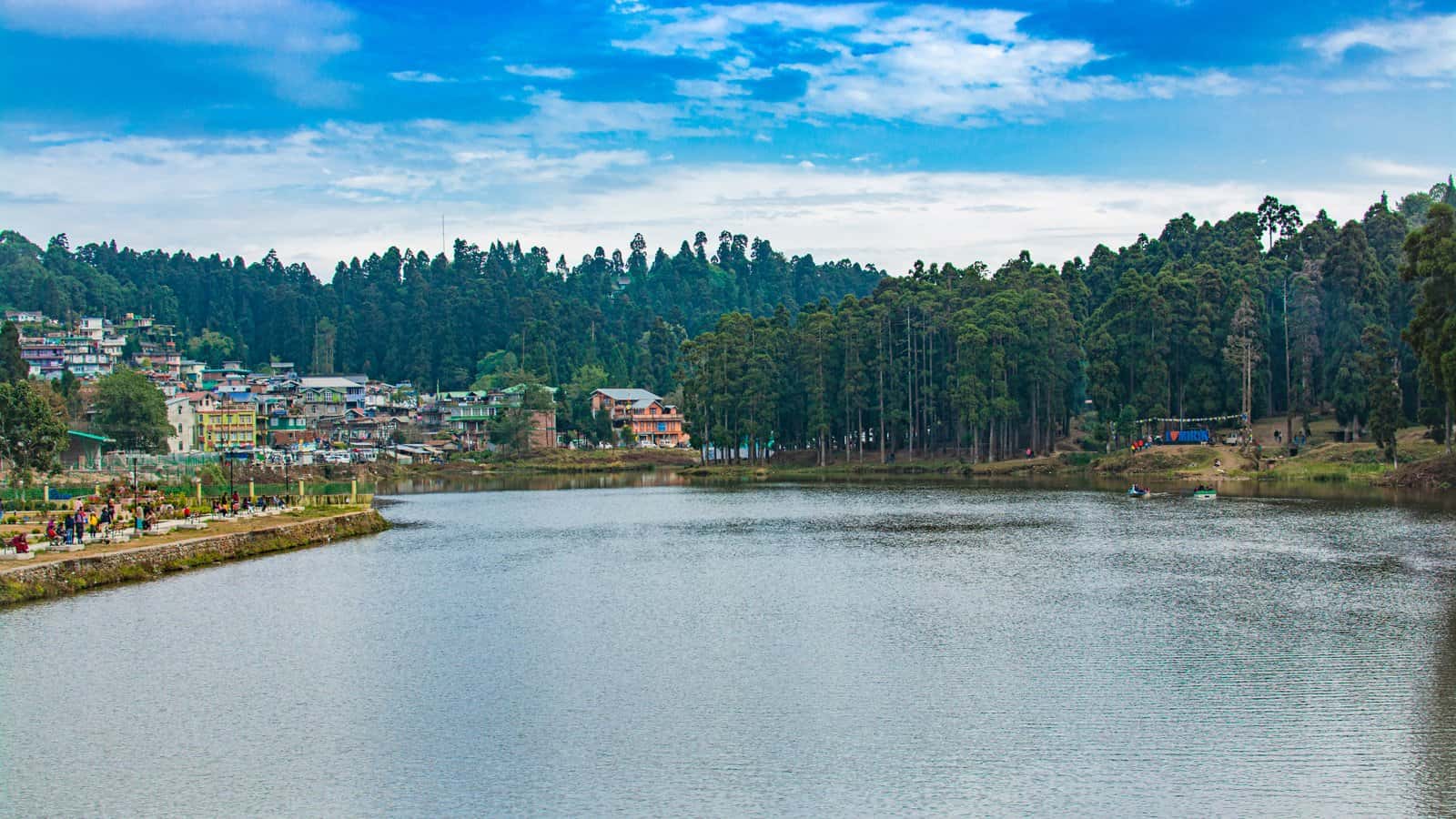
- The lake itselfSumendu Lake is about 1.25 km long, fed by rain and spring water so it stays full all year, and its depth ranges from about 3 ft to 25 ft. The eastern bank is a fenced flower garden where families spread out and children run about. The western bank is a forest of tall dhupi trees, which are cryptomeria, with a walking trail through them. There is no entry fee for either.
- The Indreni Pul, or Rainbow BridgeThe arch footbridge across the middle of the lake, about 80 ft long, is the picture everyone takes home. Walk over it slowly at first light, when the water is still and the far peaks sometimes show. Do not be startled if a pony walks across the bridge beside you, because they often do.
- The full circuit walkA path runs all the way round the lake, a circuit of about 3.5 km, and doing it early in the morning is the best free thing in Mirik. Your chance of a clear Kanchenjunga view is much higher at dawn. Be careful on the western forest side, where the trail is unpaved and uneven in places, and take it slowly if your knees are not what they were.
- Fish feeding at the bridgeJust outside the southern end of the lake, on the small bridge towards Krishnanagar, hundreds of fish gather below and every child in Mirik wants to feed them. A lady sells bread by the bridge for about 10 rupees a loaf. It costs nothing and it is the thing your children will talk about afterwards.
- The lakeside stalls and the floating marketThe entrance to the lake runs through a row of food stalls. Try chatpati, a local mix of hardened corn with onion, tomato, chilli and salt, which is about 10 to 20 rupees for a paper cone. A floating handicraft market sells woollens, cane baskets, Darjeeling tea and oranges out on the water, and it usually runs from about 10 am to 4 pm, while the lakeside stalls wind down by about 5 pm.
- The water is not as clean as the photographsYou should know this before you sit at the water's edge with a small child. When the state Municipal Affairs minister came to Mirik in June 2026, officials told her that roughly 1,050 of the town's approximately 2,800 households still send their sewage straight into the lake, and two more sewage treatment plants were announced to be built within three months to stop it. The lake is being desilted and rejuvenated for the same reason. None of this spoils the walk, the bridge or the boat ride. It simply means you do not swim here, you do not let children paddle or put their hands in the water and then in their mouths, and you wash your hands before you eat at the stalls.
There is no official published tariff for boating or pony rides at Sumendu Lake, and this is why the figures you find online contradict each other so badly. Travel pages commonly quote a pony ride at about 160 rupees per person and a 30 minute boat ride anywhere between about 200 and 800 rupees depending on the boat and how many of you there are, while other pages quote figures several times lower. Do not assume boating will even be running on the day you arrive. The lake is being desilted and rejuvenated under a state programme, which the Municipal Affairs minister was still reviewing on the ground in June 2026, and visitors report boating being suspended in rain and while works are on. So do this: ask at the boating counter itself on the day, agree the rate and the duration before anyone gets in, and never hand money to someone who approaches you away from the counter. If you see a number stated as fact on any page, including a range on this one, treat it as a guide only.
Bokar Monastery, the viewpoints and Devi Sthan
Look up from the lake and you will see the monastery on the ridge. Between it, the two sunrise viewpoints and the Devi Sthan temple in the forest, this is the half of Mirik that day trippers never reach.
- Bokar Ngedon Chokhor Ling, the Bokar MonasteryThis is the highest point in Mirik at about 5,800 ft, roughly 2.8 km from the lake. You can walk up in about 40 minutes, or take a taxi, and a car can reach the gate itself, after which there is a short level walk and a few steps. Inside, the great golden Buddha and the painted murals are worth a slow, quiet half hour, and the view back down over the lake from the stupa behind is the finest in town.
- The story of the monasteryIt was founded in 1984 by Kyabje Bokar Rinpoche, first as a retreat and then, as students came, as a place of teaching. A stupa was added in 1988, and in 1997 the Dalai Lama came for its consecration. It follows the Karma Kagyu school. Please walk clockwise, keep your voice low, and ask before you photograph anyone at prayer.
- Kawley Dara and Rameetay DaraTwo viewpoints sit close to the monastery, Kawley Dara about ten minutes further on foot, and Rameetay Dara nearby. These are the places for sunrise and sunset over the mountain landscape and, on a clear morning, over the Kanchenjunga snow peaks. If you have one early morning in Mirik, spend it up here rather than in bed.
- Devi Sthan, the temple in the forestOn the western bank of the lake, deep in the forest and high up, is the Devi Sthan temple complex, where the main shrine is to Devi Durga, worshipped here as Bhagwati, with smaller temples to Lord Ganesha, Lord Shiva and Lord Hanuman. Getting there means a long stairway and a real climb, and there is a small tea stall halfway up where you can catch your breath. During Basanta Utsav in spring, usually in March, the whole complex comes alive with local devotees.
- The Swiss Cottages and the helipadOn the highest ridge, about 2 km from the lake, the Gorkhaland Territorial Administration runs the Swiss Cottages, twelve duplex cottages built in a traditional alpine style, which you can also stay in. The helipad next to them is more a viewpoint than a working landing pad, and the sweep over Mirik from up here is the reason local drivers include it in every sightseeing round.
Local drivers will offer you a standard four point or six point round, usually the lake, the monastery, the church, the Swiss Cottages, Devi Sthan and the helipad. There is normally no shared vehicle for local sightseeing in Mirik, so you reserve a taxi and negotiate the rate, which swings a lot with the season. Ask instead for the round you want, and you can honestly do most of Mirik on foot: the lake is central, the monastery is a 40 minute uphill walk, and Devi Sthan is reached from the lake itself.
Tea gardens, orange orchards and the villages around Mirik
Mirik is surrounded by working tea estates and by more orange trees than anywhere else in West Bengal. This is what you came for, and it is what a day tripper always misses.
- Tingling view point, the finest tea panoramaAbout 8 km below Mirik on the main road, this viewing gallery looks out over the Sourenee and Tingling tea estates, rolling green slopes with mist and sun playing across them. Many people who know the Darjeeling hills well call this the best tea garden view in the district, and yet most visitors drive straight past it. There is a stall at the base where you can buy fresh Sourenee leaf and drink a cup.
- Thurbo and GopaldharaThurbo, the biggest estate in this hill area, is only about 2 km from the lake and you can walk down into the gardens in about 40 minutes. Gopaldhara lies up on the Darjeeling road, and the little tea stall opposite it serves green tea in a clear glass so you can see the colour. Drink it without milk or you will lose the flavour entirely. Plucking and processing run roughly from spring into late autumn, which is when a garden visit is worth arranging.
- The orange orchardsMirik is the largest supplier of oranges in West Bengal, a fact almost nobody knows. The orchards are at Mirik Busty about 2.5 km out, and around Murmah and Sourenee. The fruit is on the trees roughly from late November to January, and walking through an orchard with the branches bent low is one of the loveliest and simplest things you can do here. Ask your driver or your homestay to take you, and buy your oranges from the grower.
- Tabakoshi, the tea villageOnly about 5 km from Mirik Bazaar, roughly 20 minutes by car, is Tabakoshi, a quiet tea village on the Rangbhang river with homestays and nothing at all to do except walk, listen to birds and drink tea. If you want the offbeat, slow version of this region, spend a night here rather than a second night in town. One honest word first, because no other page says it: this village, spelt Taba Koshi in the research, is one of the two case studies in the peer reviewed study of the flash floods of 4 and 5 October 2025, and homestays were among the buildings damaged in that event. The valley has recovered and is welcoming guests. But book by speaking to the homestay owner directly rather than trusting an old listing, and do not plan a Tabakoshi night in heavy rain.
- The orchid nurseryMirik grows Cymbidium orchids for the domestic and export flower market, and there is a commercial nursery at Rato Mati, about 1 km from Mirik Bazaar, where you can see them being cultivated. It is a small, unusual stop, and if you have any interest in flowers it is a far better use of an hour than a fourth viewpoint.
If you do only one thing slowly in Mirik, walk the lake at first light. The water is still, the mist lifts off it, the ponies are being led down, and once in a while the Kanchenjunga range appears above the far ridge. It takes about an hour, it costs nothing, and it is the reason people come back to this small town rather than to the famous one up the hill.
The Nepal border: who may cross, and on what document
The road above Mirik runs along the India to Nepal border, and the market at Pashupati Nagar is the day trip everyone talks about. Before you go, be very clear about who is allowed to cross and which document Nepal actually accepts.
- Simana, the free viewpoint on the lineOn the Darjeeling road above Mirik, at a place called Simana, which simply means border, the road itself is the international line. Indians live on one side and Nepalis on the other, they cross freely all day, and many families have relatives facing them across the tarmac. There is a small viewing plateau with tea stalls, and on a clear day you can see down to Maneybhanjan, across to the Sandakphu trail and out to the Kanchenjunga peaks. Anyone can stand here.
- Foreign passport holders cannot enter Nepal hereThis is the fact that most travel pages leave out. Pashupati Nagar is a local crossing between India and Nepal, used by Indian and Nepali nationals. There is no immigration post there to issue a visa or stamp one you already hold. If you carry a foreign passport, you will not be allowed through. The nearest proper crossing for foreign nationals is Kakarbhitta, reached from Siliguri, so plan your Nepal entry there, not from Mirik.
- Indian travellers: bring the right documentThe Nepal Tourism Board states that Indian nationals need no visa, and it lists what it will accept as identity: a valid passport, or the election card issued by the Election Commission of India. For people over 65 a PAN card, driving licence or photo ration card is accepted, and for children under 18 an identity card from the school principal. The Nepal Tourism Board explicitly says the Aadhaar card is NOT an acceptable travel document, even though nearly every travel page tells you to carry one. Carry your voter card or your passport in original, and take the Aadhaar as a backup only.
- How the crossing actually worksAt the check post you show photo identity and enter your details in a register, which is usually quick. The main market lies about a 1 km walk beyond the border. You can walk it, take a Nepal side taxi for roughly 250 rupees for the round trip, or drive your own vehicle through after a permit formality that has cost around 350 rupees for the car. Cameras are not allowed inside the market.
- What the market is really likePashupati Market sells imported electronics, jackets, perfumes, cosmetics and clothes, and a great deal of it is fake. Bargain hard, expect fair pressure from the shopkeepers, and do not buy an expensive gadget here believing you have found a bargain. Treat it as a fun couple of hours in another country rather than as serious shopping, and you will enjoy it.
The Reserve Bank of India notified the Foreign Exchange Management (Export and Import of Currency) (Amendment) Regulations, 2025 by notification dated 28 November 2025, published in the Official Gazette on 2 December 2025, and told banks and money changers about it in its A.P. (DIR Series) Circular No. 18 dated 8 December 2025. Under that circular a person who is not a citizen of Pakistan or Bangladesh may take out of India, and bring back into India, Indian notes of denominations up to 100 rupees for any amount, and notes of denominations above 100 rupees up to a total limit of 25,000 rupees in each direction. This eases a restriction that had stood for years. One honest caution: Nepal Rastra Bank was reported in December 2025 to be still finalising its own notice for the Nepali side, and we could not confirm, as at July 2026, that the Nepali notification is in force. Travellers have been fined at Nepal border points in the past for carrying higher notes. So carry small notes of 100 rupees and below for the market, keep any higher notes within the limit, and reconfirm with your operator before you cross.
Where to stay in Mirik, and how many nights it deserves
Stay in Krishnanagar at the southern end of the lake and you can walk to everything. One night is right for most people, two if you want the slow version.
- Krishnanagar: the sensible baseThe southern end of the lake is where the hotels and the restaurants are, and it is a two minute walk to the water. This is the right choice for almost everybody, and especially for families and for older travellers, because it removes the need for a taxi every time you want a cup of tea. Some rooms here look straight out over the lake.
- Mirik Bazaar and the ridgeRooms in Mirik Bazaar are cheaper but the area is congested, and Mirik Busti is further out from the lake. Up on the highest ridge, about 2 km away, the Gorkhaland Territorial Administration runs the Swiss Cottages, twelve duplex cottages in alpine style with a view down over the whole town. You need a car from up there, but the view is the trade.
- How many nightsOne night is enough for most travellers: an evening by the lake, a dawn walk round the water, the monastery and the viewpoints in the morning, and away by late morning. Two nights is better if you want the orange orchards, a tea garden walk, and Tabakoshi. Honest advice from regulars on the Darjeeling forum is that Mirik does not carry three nights, so if you have more time, use it on Darjeeling or Kalimpong instead.
- Room budgetsExpect roughly 800 to 1,500 rupees at the simple end, about 1,500 to 3,500 rupees for a decent mid range room, and about 4,000 to 9,000 rupees and up for resorts and proper lake view property. Prices climb in October and around the winter holidays, when Mirik fills with Bengali families, so book those weeks well ahead.
- The GTA Day CentreBy the lake there is a Day Centre run by the Gorkhaland Territorial Administration, where you can sit, rest and take tea and snacks in the middle of a day trip. Do not build a plan around it, because you cannot book it in advance and you cannot rely on it being open. If you have seniors with you and need a place to rest for a few hours, book an actual hotel room for the day instead.
The best way to use Mirik is as the first or last night of a Darjeeling trip, not as a day trip. Land at Bagdogra, drive an easy hour and a half up to Mirik, sleep by the lake, see the town in the cool of morning, and then take the gentle scenic road up to Darjeeling. You arrive rested, you have already gained a little height, and you have seen a side of the hills that people who drive straight up the Hill Cart Road never see.
Mirik costs and a realistic daily budget
Mirik is one of the cheapest places in the Darjeeling hills once you are there. The transfer up from the plains is the only real cost, and the lake charges are the only place you can be overcharged.
- A rough daily budgetExcluding your room and the long transfer, plan on about 1,000 to 1,800 rupees a day as a backpacker and about 2,500 to 4,000 rupees mid range. That covers meals, a boat or pony ride, a local taxi round and some tea to take home. There is almost nothing in Mirik with a compulsory ticket price, which is a large part of its charm.
- The transfer is the big numberThe single biggest cost of a Mirik trip is getting there. A reserved small car from Bagdogra, NJP or Darjeeling is about 2,500 to 2,800 rupees one way, a bigger Sumo or Bolero about 500 rupees more, and the Bagdogra prepaid booth has quoted about 1,500 rupees. A shared jeep is about 150 to 200 rupees a seat from the plains and about 200 rupees from Darjeeling. If you are a family or a couple, a reserved car is worth it; if you are alone and travelling light, the shared jeep is honest value.
- The things that cost almost nothingThe lake, the garden, the lake circuit walk, the Simana viewpoint, the Devi Sthan climb and the view from the monastery are all free. Bread for feeding the fish is about 10 rupees, a cone of chatpati about 10 to 20 rupees. This is a town where the best hours cost you nothing at all.
- The negotiable thingsThe boat, the pony, the local sightseeing taxi and the shopping in Pashupati Market are all negotiable, and none of them has a published rate. Settle the price and the duration before anything begins, in front of the person who will actually take the money, and the only friction in Mirik disappears.
The taxi and jeep numbers on this page, and on every other page about Mirik, trace back to a fare list last publicly updated around March 2022. They are useful as a floor and as a sanity check, and they are useless as a quote. Confirm the fare when you book the car, and if a driver asks for a great deal more than these figures, ask why, and ask a second driver.
Practical logistics: money, ATMs, food, SIM and getting around
The small things that make a Mirik day smooth, from where the ATMs are to what to eat and how far you can get on foot.
- Getting around townMirik is small and, unlike Darjeeling, it is not punishing to walk. The lake, the stalls, Krishnanagar and the bazaar are all within an easy stroll of each other. The monastery is about a 40 minute uphill walk if you want it, and a taxi if you do not. For the outlying sights, the tea viewpoint, the orchards and Tabakoshi, you reserve a taxi, because there is normally no shared vehicle for local sightseeing.
- Money and ATMsThere are bank ATMs in the Krishnanagar area, including State Bank of India and Canara Bank, and they accept international cards. Even so, carry cash. The stalls, the boat counter, the pony men, the shared jeeps and the small eateries all run on notes, and if you are going to Pashupati Market you will need Indian notes of 100 rupees and below.
- Food and teaMirik eats Nepali and Tibetan, so momos and thukpa are everywhere, alongside north Indian and Chinese food in the Krishnanagar restaurants, and a few places doing homely Bengali fish and rice for the many Bengali families who holiday here. Buy your Darjeeling tea from a proper shop or straight from an estate stall rather than from a roadside vendor, and ask which flush it is.
- SIM, signal and powerMobile coverage in Mirik town is generally fine for calls, maps and data, though it thins out on the ridge and in the forest. If you are coming from abroad, buy your Indian SIM or eSIM when you land in Kolkata, Delhi or Bagdogra, not in a small hill town. Carry a power bank for the early morning walks.
- What to wearEven in summer, carry a light woollen for the evening. In winter you will want proper woollens during the day too, though nothing like what Darjeeling demands. Wear shoes with grip for the lake circuit, because the western forest side is uneven, and remember you will take your shoes off at Devi Sthan and inside the monastery.
Safety at the lake, on the roads, and staying well
Mirik is one of the calmest and least pushy places in the Indian hills. The two real cautions are the water and the monsoon roads, and one of them concerns children.
- The lake and your childrenThe lake is not for swimming and the boat jetty is basic. A traveller account published on darjeeling-tourism.com, from March 2015, describes a four year old child slipping into the water through the gap in the landing platform while getting out of a boat, with no life jackets and no lifeguard on hand, and the father, who could swim, had to jump in after him. We have not seen anything to show the jetty has changed since. So insist on life jackets for children before you board, hold small hands firmly on the landing platform, and do not let children run on the bank near the water. Remember also that this is water the town still drains sewage into, so it is not a place to swallow a mouthful. This is not a reason to skip the boat, it is a reason to be the parent who checks.
- The forest trail on the western bankThe path through the dhupi forest on the far side of the lake is beautiful, and in places it is unpaved and uneven. It is fine in good shoes and in daylight. It is not a place for a night walk, and if you are unsteady on your feet, do the eastern garden side instead and turn back at the bridge.
- Monsoon roads and landslides: the honest pictureThis is the one genuine risk of a Mirik trip, and it is a real one, not a formality. On 4 and 5 October 2025 the Darjeeling hills had an extreme rainfall event, about 250 to 400 mm in 24 hours, and Mirik was the worst affected town. A peer reviewed study in the journal Landslides counted 455 new landslides, damage to five bridges and 106 buildings, and lives were lost across the district. The Dudhia bridge on the Siliguri to Mirik road collapsed; its temporary replacement was washed away again by rain in June 2026; and a new Bailey bridge, built by the Army and the PWD in 20 days, reopened the route on 8 July 2026. Mirik is open and recovering, and outside the monsoon it is as gentle a hill town as any in India. But from about June to September, treat the road as a live question: ask your operator or hotel to confirm it on the morning you travel, drive the hill in daylight, keep a spare day, and never book a tight flight or train for the day you come down.
- Health and altitudeMirik is low enough that altitude sickness is not a concern for the overwhelming majority of visitors, which is one of its quiet advantages over Darjeeling and far above Gangtok. Drink bottled or filtered water and avoid tap water and ice made from it, take the usual care with street food, and carry your own regular medicines, as the pharmacies here stock the basics but not everything.
- General safety and toutsMirik has very little of the hard sell that spoils busier destinations. The people are gentle and unhurried. Agree taxi and pony fares before you commit, avoid handing money to anyone who approaches you away from a counter, and women travellers generally find the town comfortable with standard precautions.
At Devi Sthan, remove your shoes, dress modestly and let local worshippers take precedence, especially during Basanta Utsav in spring. At the Bokar Monastery, walk clockwise, keep your voice low, do not point your feet at the shrine, and always ask before photographing a monk at prayer. A quiet, respectful visitor is welcome anywhere in these hills, and both places are living places of faith, not photo stops.
Mirik for every kind of traveller, and on access
Mirik is the gentlest of the Darjeeling hill towns, and that shapes who it suits. Here is the one tip that matters for you, including how an older traveller enjoys it without a single hard climb.
- Senior travellers and on accessibilityThis is where Mirik quietly beats Darjeeling. The town is small and flat around the lake, the altitude is low so the air is easy, and the winter days stay around 13 degrees C rather than biting. Stay in Krishnanagar so nothing is more than a short walk, do the eastern garden bank of the lake and turn back at the bridge, take a car to the monastery gate rather than walking up, and skip the Devi Sthan stairway. You can have a full, happy day here without one hard climb.
- Families with childrenAlmost perfect. The pony ride round the lake and the fish feeding at the bridge are the two things children remember for years, the garden is a safe place to let them run, and nothing needs an early start. Please read the safety section on life jackets before you take a boat, and keep small children away from the landing platform edge.
- CouplesQuiet and unshowy rather than romantic in the postcard sense. The dawn walk round the still water, a tea on a lakeside bench, an afternoon in a tea garden and a night in a Tabakoshi homestay is the shape of it. If you want dramatic Himalayan romance, add Darjeeling; if you want calm together, Mirik is the better half of the trip.
- Budget travellersExcellent value. A shared jeep from Siliguri at about 150 to 200 rupees, a simple room from about 800 rupees, momos in the bazaar and a lake and a monastery that cost nothing. Mirik is one of the very cheapest good days in the Indian hills.
- PhotographersDawn on the lake with the mist lifting, the Rainbow Bridge with a pony crossing it, the tea slopes at Tingling in the late afternoon, and the orange trees in December. Carry a spare battery for the cold mornings, and ask before you photograph anyone at prayer or at work in the gardens.
- Tea loversCome between spring and late autumn, when plucking and processing are actually running. Walk down into Thurbo from the lake, stop at the Gopaldhara stall on the Darjeeling road, and take the Tingling viewpoint slowly. Then buy single estate leaf at the stall rather than from a general shop.
A suggested Mirik itinerary, and how to fit it into a Darjeeling trip
How to shape one unhurried night, or two slower days, so that Mirik works with your Darjeeling plan rather than against it.
- The one night break journey, which is the best versionLand at Bagdogra or arrive at NJP in the morning, drive about 1.5 hours up to Mirik, and check in at Krishnanagar by early afternoon. Spend the afternoon on the lake, the bridge and the stalls, and watch the light go. Next morning walk the lake circuit at dawn, take a car up to Bokar Monastery and Kawley Dara, come down for breakfast, and leave by late morning for Darjeeling on the scenic road, stopping at Simana and, if you are eligible to cross, at Pashupati Market.
- The two night slow versionAdd a full second day: the Tingling view point and a walk into Thurbo tea estate in the morning, the orange orchards at Mirik Busty if it is between late November and January, and Tabakoshi in the afternoon. Come back for a second sunset on the lake. This is the version that turns Mirik from a stop into a place.
- The day trip from DarjeelingStart by about 8 am and give yourself the whole day. The route takes you through Ghum, Sukhiapokhri, Jorpokhri if you detour, Simana and Pashupati Market, and you reach Mirik around midday. Have lunch in Krishnanagar, walk the lake, see the monastery, and drive back. It is a long day of hill driving, roughly five hours of it, so it is not the right plan for anyone who gets carsick or for very young children.
- Mirik on the way down to NJPThis works, and it is a graceful way to end a Darjeeling trip, but do it with a margin. If you leave Darjeeling by about 11 am you can take the Mirik road, spend a couple of hours by the lake, and still reach NJP comfortably in the late afternoon. Do not attempt it if your train is early, and do not attempt it in the monsoon, when a landslide can take the choice out of your hands.
The single most common way to be disappointed by Mirik is to arrive at midday on a day trip, find the lake full of visitors, take a twenty minute boat ride, buy a fridge magnet and drive away thinking it was over rated. Mirik at noon is a picnic ground. Mirik at dawn, with the mist coming off the water and the ponies being led down to the bridge, is the reason people love it. If you cannot give it a night, at least give it an early morning.
The real questions travellers ask about Mirik
Straight answers to the questions that come up again and again on the traveller forums, so you arrive already knowing the score.
- Is Mirik worth visiting, or is it just a picnic spot?Both are true, and the difference is when you go. At midday in season it is a busy picnic ground and you will not understand the fuss. At dawn, and up at the monastery, and out among the tea and the orange trees, it is one of the loveliest and gentlest corners of the Darjeeling hills. Give it a night and you will be glad you did.
- One night or a day trip?One night, if you can. Regulars on the Darjeeling forum are honest that two or more days in Mirik is too much for most people and a single day is enough, and they are right about the town itself. But a night lets you have the dawn lake and the morning monastery, which is the whole point, and it breaks the drive up to Darjeeling beautifully.
- Can foreigners cross into Nepal at Pashupati Nagar?No. It is a local crossing for Indian and Nepali nationals only, and there is no immigration post there to issue or stamp a visa. Foreign passport holders should plan their Nepal entry through Kakarbhitta, reached from Siliguri. You can still stand at Simana, where the road itself is the border, and that is open to everybody.
- Is my Aadhaar card enough for the Nepal border?The Nepal Tourism Board explicitly states that the Aadhaar card is NOT an acceptable travel document. It accepts a valid passport or the Election Commission voter card, plus a PAN card, driving licence or photo ration card for those above 65 and a school identity card for children under 18. Local check posts have in practice registered Aadhaar cards, but do not stake your day on it. Carry the voter card or the passport.
- How much are boating and horse riding at the lake?There is no official published tariff, which is why every page gives you a different number. Pony rides are commonly quoted at about 160 rupees per person and a 30 minute boat ride at roughly 200 to 800 rupees depending on the boat and your party size, and boating was reported temporarily stopped in late 2025 during the garden rebuild. Ask at the counter on the day and agree the rate before you board.
- Can I get a shared jeep, or do I need a taxi?Shared jeeps run to Mirik from Siliguri, NJP and Darjeeling for roughly 150 to 200 rupees a seat, but only from about 7 am to 3 pm, so they suit a morning arrival and not an afternoon flight. Inside Mirik there is normally no shared vehicle for sightseeing, so you reserve a taxi or you walk, and walking covers more of Mirik than you would think.
- Is the Siliguri to Mirik road open after the 2025 landslides?Yes. The Dudhia bridge on the Balason river, on the Siliguri to Mirik road, collapsed in the October 2025 floods, and the temporary bridge that replaced it was washed away by rain again in June 2026. A Bailey bridge built by the Indian Army and the state PWD reopened the route on 8 July 2026, and a permanent bridge is being built beside it. So the road is working. Because it is a young repair and the monsoon is on, ask your hotel or operator to confirm the road on the morning you travel, and keep a spare day in a monsoon plan.
- Is the lake water clean, and can children paddle in it?No, and please do not let them. Officials told the state minister in June 2026 that about 1,050 of Mirik's roughly 2,800 households still drain sewage directly into Sumendu Lake, and two more treatment plants were announced to fix it, while the lake itself is being desilted. Boating and the walk round the water are perfectly fine and lovely. Swimming, paddling and dabbling hands are not.
- How does Mirik compare with Darjeeling and Kalimpong?Mirik is the lowest, warmest, smallest and quietest of the three, with one lake and no famous set piece. Darjeeling has the toy train and Tiger Hill and the crowds, Kalimpong has the monasteries and the nurseries. Mirik is the one you go to in order to slow down, and the one that suits grandparents and small children best.
Planning Mirik from abroad, and the border you cannot cross
Mirik is the soft landing of an Eastern Himalaya trip, an easy hour and a half from Bagdogra. There is one hard rule for foreign passport holders that no other page will tell you.
- The border rule you must know before you planIf you hold a foreign passport, you cannot enter Nepal at Pashupati Nagar. It is a local crossing with no immigration post, so there is nobody there to issue you a visa or to stamp the one you already hold, and you will be turned back. Guides and drivers may cheerfully offer you the trip anyway. If Nepal is part of your itinerary, enter through Kakarbhitta from Siliguri, or fly. You are welcome at Simana viewpoint, which is on the border line and open to all.
- For NRI travellers carrying an Indian passport or OCIIf you hold an Indian passport, you may cross at Pashupati Nagar like any Indian national, and your passport is the cleanest document to carry. If you hold an OCI card and a foreign passport, you are a foreign national for this crossing and the rule above applies to you. This trips up a lot of NRI families who assume the OCI card works like an Indian identity card at the border. It does not.
- Arrive through BagdograFly into Kolkata or Delhi, connect to Bagdogra (IXB), and drive about 1.5 hours up to Mirik. This is the softest possible first night in the Himalayas: low altitude, mild air, a small town and a lake. From here the road up to Darjeeling is gentle and scenic, and you arrive already acclimatised to the hills.
- Mirik needs no permit at allMirik, like the rest of the Darjeeling hills, is in West Bengal and needs no permit for any visitor. That is quite different from Sikkim, where foreign nationals need permits, so do not let anyone sell you a permit for Mirik. If your trip also takes in Sikkim, arrange those permits separately through your operator.
- Give it a night, not an afternoonOn a longer India trip, one night in Mirik between Bagdogra and Darjeeling is exactly the right weight. It gives you the dawn lake and the monastery, breaks the climb, and costs you almost nothing extra in time because you were going to drive that road anyway.
Fly into Kolkata or Delhi, connect to Bagdogra (IXB), and drive up to Mirik in about 1.5 hours before continuing to Darjeeling and Kalimpong.
Fly into Kolkata, connect to Bagdogra, then drive the gentle Mirik road up into the hills.
Fly to Bagdogra or take a train to NJP, then a reserved car or a morning shared jeep up to Mirik.
Money, SIM and comfort for foreign and NRI visitors
The practical basics for a small hill town: cash, cards, a SIM, and the honest reason Mirik suits an older family better than Darjeeling does.
- Cash, cards and the ATMsThere are bank ATMs in the Krishnanagar area, including State Bank of India and Canara Bank, and they take international Visa and Mastercard. Hotels and larger restaurants take cards, but the boat counter, the pony men, the stalls and the shared jeeps are cash places. Draw cash for the day and keep small notes for tips and rides.
- If you are an Indian passport holder going into NepalUnder the RBI's amended currency regulations, notified on 28 November 2025 and published in the Official Gazette on 2 December 2025, a person who is not a citizen of Pakistan or Bangladesh may carry Indian notes of denominations up to 100 rupees for any amount into Nepal, and notes above 100 rupees up to a total of 25,000 rupees. Nepal Rastra Bank was reported in December 2025 to be still finalising its own notice, and we could not confirm as at July 2026 that it has taken effect, so carry small notes for the market and reconfirm the current position before you cross.
- Get your SIM at the airportPick up an Indian tourist SIM or an eSIM when you land in Kolkata, Delhi or Bagdogra rather than hunting for one in a small hill town. Coverage in Mirik town is fine for maps, calls and arranging a car, though it thins on the ridge and in the forest around the lake.
- Why Mirik suits an older familyThe reason to bring parents and grandparents here rather than straight to Darjeeling is simple. Mirik is low, so the air is easy and altitude is not a worry. It is small, so nothing needs a car. It is flat around the lake, so a walk is a pleasure and not a climb. And it is far milder in winter, with daytime highs around 13 degrees C. If your family trip has one member who finds the hills hard, plan Mirik as the base and Darjeeling as the day out.
Mirik is the gentlest possible introduction to these hills. There is no set piece to tick off, no early start, no altitude, no crowd at dawn. There is a lake, a bridge, a monastery on a ridge, tea slopes running away below and, if the sky is kind, the Kanchenjunga range appearing over the far side of the water. Give it a night at the start of your trip and let the hills arrive slowly, the way they should.
A burnt hill, a polo field, and a lake that was decided upon
Most hill towns grow. Mirik was chosen. The name is generally traced to the Lepcha words Mir-Yok, understood to mean a place burnt by fire, a memory of the old practice of burning the jungle on these ridges, though you will also hear it explained through the Nepali word for a fire scorched patch, and no single authority settles it. What is documented is what happened next. On the flat eastern bank of the water, in the colonial period, the British played polo. Then in 1974, under Chief Minister Siddhartha Shankar Ray, the West Bengal tourism department bought about 335 acres from the neighbouring Thurbo tea estate and set out to build a hill resort from scratch. The marshy hollow became Sumendu Lake, an arch footbridge was thrown across it, dhupi trees were planted on the far bank, and the polo field became the flower garden where Bengali families now spread their picnics. So when you walk the Rainbow Bridge at dawn, remember that everything you can see, the still water, the forest trail, the garden, was a decision somebody made half a century ago, on a hillside once cleared by fire, at the edge of a tea garden that is still working right below you.
Planning a Mirik trip?
Our West Bengal travel experts plan your full journey for you: route, hotels, darshan timings and transport. You get a free day-by-day plan and an exact quote on WhatsApp, usually within a few hours. No payment is needed to get your plan.