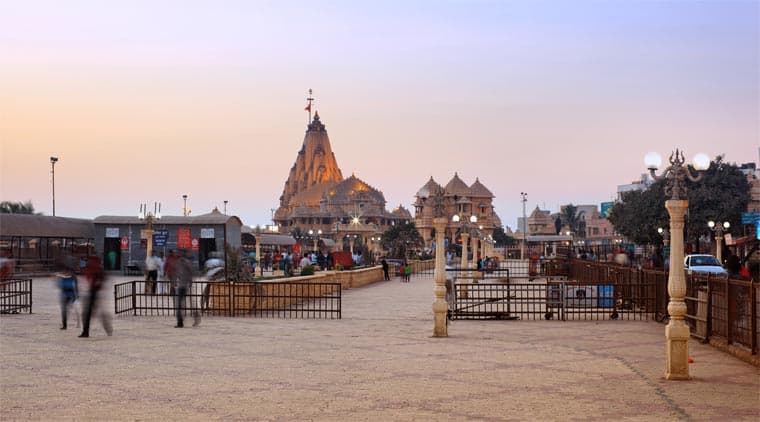
 18D / 17N 5
 All Sacred Circuits
Char Dham · Krishna
Dwarkadhish (Dwarka Dham)
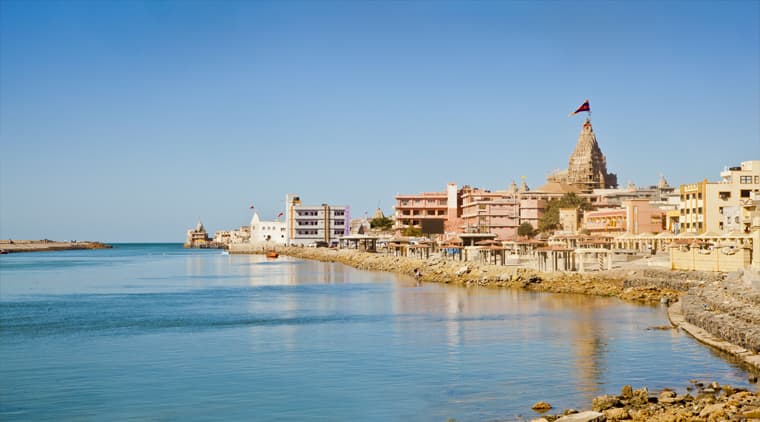
Dwarka is not just a temple town; the tradition remembers it as the city Lord Krishna himself built by the sea, and its people still call him Dwarkadhish, the King of Dwarka. The great Jagat Mandir rises above the Gomti ghat with its huge flag streaming in the sea wind, and one darshan here completes a corner of the Char Dham. This is a place every Krishna devotee should stand in once.
The story of this place
The tradition tells that when Lord Krishna left Mathura, he brought the Yadavas west to the coast of Saurashtra and raised a new city on the shore of the Arabian Sea. That city was Dwarka, and here the Lord ruled not as the playful child of Gokul but as a king, which is why the deity is worshipped as Dwarkadhish, the King of Dwarka. Devotees believe the first temple here was built by Vajranabh, the great grandson of Lord Krishna, over the place of the Lord's own residence.
The temple standing today, called the Jagat Mandir, took its present form around the 16th century, and worship in it has never paused. The scriptures say the old city of Krishna was swallowed by the sea after the Lord left this earth, and marine archaeologists have indeed found submerged structures off the Dwarka coast. Dwarka is one of the four dhams of the Char Dham, with Badrinath, Puri and Rameswaram, and among the seven sacred cities of our tradition, so a yatra here carries very great weight.
What you will see
The Jagat Mandir is a five storeyed temple of limestone and sandstone held up by 72 pillars, its carved walls rising to a tall shikhara that you can see from far across the town. On top flies the great flag of Dwarkadhish, stitched from 52 yards of cloth and marked with the sun and the moon. The flag is changed ceremonially every day in the Dwaja Arohan, and devotees gather just to watch it climb; do not be surprised if the crowd suddenly looks up and cheers.
You enter the temple complex through the Swarg Dwar, the gate of heaven, and inside, in the main sanctum, stands the black form of Dwarkadhish in royal shringar. On the seaward side, a broad flight of more than 50 steps drops from the temple to the Gomti ghat, where the Gomti meets the sea. Devotees traditionally bathe or sprinkle the Gomti water before darshan, and in the evening the ghat fills with lamps and chanting. Give yourself time simply to sit on these steps.
Darshan, timings and temple etiquette
The temple runs on the rhythm of the Lord's day, like a royal household. Doors open with the Mangla aarti around 6:30 in the morning, and darshan continues till about 1 in the afternoon, closing briefly several times when the Lord's bhog is offered. The temple then rests, and evening darshan runs from about 5 till about 9:30 at night, with the Sandhya aarti in between and the Shayan aarti before the doors close. The official website, dwarkadhish.org, publishes the detailed timetable, and timings change on festival days, so check it before you plan.
Do not be restless if the sanctum doors close for a few minutes while you wait; this is the bhog being offered, and they open again shortly. Dress modestly, as you would for any great temple, keep your footwear at the stands outside, and follow the temple's rules on what may be carried inside. Aarti times are the most beautiful and the most crowded; hold the hands of your children and elders.
Gomti ghat, Bet Dwarka and around
Keep a full day for the sacred geography around the temple. Bet Dwarka, the island where the tradition says Lord Krishna lived with his family, lies beyond Okha, about 30 km away. For generations pilgrims crossed by boat; now the Sudarshan Setu, a cable stayed bridge of about 2.3 km inaugurated in 2024, lets you drive across, and the crossing itself, with the sea on both sides, is a joy. The temple of Dwarkadhish on the island is linked by tradition to the meeting of the Lord with his friend Sudama.
Near the main temple, the Sudama Setu footbridge crosses the Gomti to the Panchkui tirth, where five sweet water wells are linked by tradition to the five Pandavas. The footbridge has been closed for repairs in recent years, so ask locally whether it has reopened; the wells can also be reached by boat. On the road to Bet Dwarka fall Rukmini Devi temple, whose carvings deserve a stop, the Nageshwar Jyotirlinga about 16 km out, and Gopi Talav. If you want an hour of quiet sea, Shivrajpur beach near Dwarka holds a Blue Flag certification.
Best time to visit
October to March is the best season, when the coast is cool and the sea breeze is gentle. Summer is hot, though mornings and evenings at the ghat stay bearable.
Janmashtami is the greatest day of the year in Dwarka, when the whole city becomes the Lord's birthday house. The celebration is unforgettable, but the town is packed beyond measure, so book far ahead and come prepared for long, joyful queues. For a calm darshan, choose an ordinary weekday outside the festival season.
How to reach
Dwarka has its own railway station, about 2 km from the temple, on the line that runs from Ahmedabad toward Okha, with trains from Ahmedabad, Rajkot and Jamnagar. The nearest airports are Jamnagar, about 145 km away, and Porbandar, about 95 km; most overseas travellers fly into Ahmedabad or Rajkot and drive.
By road, Dwarka is about 230 km from Rajkot and about 440 km from Ahmedabad on good highways. Many of our guests do the classic Gujarat darshan circuit, joining Dwarka with Somnath, the first Jyotirlinga, down the coastal highway, and we plan the drive so that each dham gets its own unhurried day.
Tips from our travel experts
Attend one aarti at least; the Mangla aarti at dawn, before the town fully wakes, is the memory our guests talk about years later. Reach the temple gate early, because the queue builds quickly after sunrise.
Keep an evening for the Gomti ghat. Sit on the steps as the sun goes down over the sea, watch the lamps come out, and let the yatra slow down inside you. Plan Bet Dwarka and Nageshwar together in one loop the next day, and confirm timings locally, since sea weather can change plans.
For our NRI and OCI travellers
For many NRI families, Dwarka is the emotional summit of a Gujarat trip, the city of the Lord whose stories your grandparents told you. Give it two nights. Fly into Ahmedabad or Rajkot, and let us arrange the drive; the roads are good and the coastal stretch is beautiful.
If you are collecting the Char Dham over your visits to India, Dwarka pairs naturally with Somnath and Nageshwar, so one journey completes a dham and two Jyotirlingas together. During Janmashtami and Diwali weeks, rooms in Dwarka sell out well in advance, so tell us your dates as early as you can, especially if parents or grandparents are travelling with you.
Questions travellers ask us
What are the darshan timings at Dwarkadhish temple?
Morning darshan runs from about 6:30 to 1 in the afternoon and evening darshan from about 5 to 9:30 at night, with short closures through the day when bhog is offered to the Lord. The detailed timetable is on the official website, dwarkadhish.org, and timings change on festival days.
Why is the temple flag changed every day?
The great flag of Dwarkadhish, stitched from 52 yards of cloth and marked with the sun and moon, is changed ceremonially in the Dwaja Arohan ritual. Watching the new flag climb the shikhara is considered auspicious, and devotees gather below for it every day.
How do I visit Bet Dwarka?
Bet Dwarka is an island beyond Okha, about 30 km from Dwarka. Since 2024 you can drive across the Sudarshan Setu, a cable stayed bridge of about 2.3 km, instead of waiting for a boat. Most travellers combine it with Nageshwar Jyotirlinga and Gopi Talav in one day.
Is Sudama Setu open?
The Sudama Setu footbridge over the Gomti, which leads to the Panchkui tirth, has been closed for repairs in recent years and its renovation has been announced. Please ask locally whether it has reopened when you visit; the tirth can also be reached by boat.
Which Char Dham temples does Dwarka belong with?
Dwarka is one of the four dhams of the all India Char Dham, together with Badrinath in the north, Puri in the east and Rameswaram in the south. It is also counted among the seven sacred cities of the Hindu tradition.
Can I combine Dwarka with Somnath?
Yes, and most yatris do. Somnath, the first Jyotirlinga, lies down the coastal highway from Dwarka, and the two together with Nageshwar make a complete Gujarat darshan circuit. Keep at least four days for the full circuit so no day becomes a rush.
A note on the tours below. These packages travel close to Dwarkadhish (Dwarka Dham), but a package may not include a guided visit to the site itself. If you would like this place added to your journey, please tell your Way to India travel consultant and they will happily build it into your itinerary for you.
Yatras where you stay right by the temple
18D / 17N 5You stay at Dwarka
 19D / 18N
12 Jyotirlinga Tour Package from Delhi
● Starts Delhi
From₹85,000* / person
Explore →EMI from ₹4,162/mo
You stay at Dwarka
 18D / 17N
12 Jyotirlinga Tour Package from Mumbai
● Starts Mumbai
From₹90,000* / person
Explore →EMI from ₹4,407/mo
You stay at Dwarka
 8D / 7N
You stay at Dwarka
You stay at Dwarka
 5D / 4N
You stay at Dwarka
 7D / 6N
Fascinating Gujarat Holiday Tour Package
● Starts Ahmedabad
From₹35,923* / person
Explore →EMI from ₹1,759/mo
You stay at Dwarka
 6D / 5N
You stay at Dwarka
Nageshwar Somnath Jyotirlinga Tour Package
● Starts Ahmedabad
From₹25,056* / person
Explore →EMI from ₹1,227/mo
You stay at Dwarka
 13D / 12N
You stay at Dwarka