 7D / 6N
 All Sacred Circuits
Divya Desam · Vishnu
Sarangapani (Kumbakonam) Divya Desam
Kumbakonam is a town of temples on the banks of the Kaveri, and Sarangapani is its largest Vishnu shrine, a Divya Desam that Sri Vaishnavas count in the same breath as Srirangam and Tirupati. The sanctum here is built in the shape of a divine chariot drawn by horses and elephants, as if the Lord has just descended from Vaikuntha. Once you see it, you will understand why the alvars sang of this Lord as Aravamudhan, the nectar that never satiates.
The story of this place
The tradition says that the sage Hemarishi performed penance on the banks of the Potramarai tank, praying for Goddess Lakshmi to be born as his daughter. The Goddess emerged from the tank among a thousand lotuses as Komalavalli, and Lord Vishnu descended from Vaikuntha in a chariot drawn by horses and elephants to marry her. That descent is frozen in stone here: the central shrine itself is shaped as that chariot. The Lord's name, Sarangapani, means the one who holds the bow Saranga in his hand.
The temple's history runs deep. The site was a Vaishnava settlement as early as the 7th or 8th century, the earliest inscriptions belong to the later Chola period, and the Vijayanagara and Nayak rulers expanded the temple into the great complex you see today. The temple is praised in the Divya Prabandham by seven alvars, with Thirumangai Alvar alone singing 25 verses.
Two traditions make devotees especially tender towards this Lord. One says that when Tirumalisai Alvar sang to him, the reclining Lord began to rise, and the alvar begged him to lie back; the Lord stopped midway, and that is why you see him today in a half-risen recline, resting on his right hand. The other says that it was here that the Lord guided Nathamuni to compile the Nalayira Divya Prabandham, the four thousand verses that are the heart of Sri Vaishnava worship.
What you will see
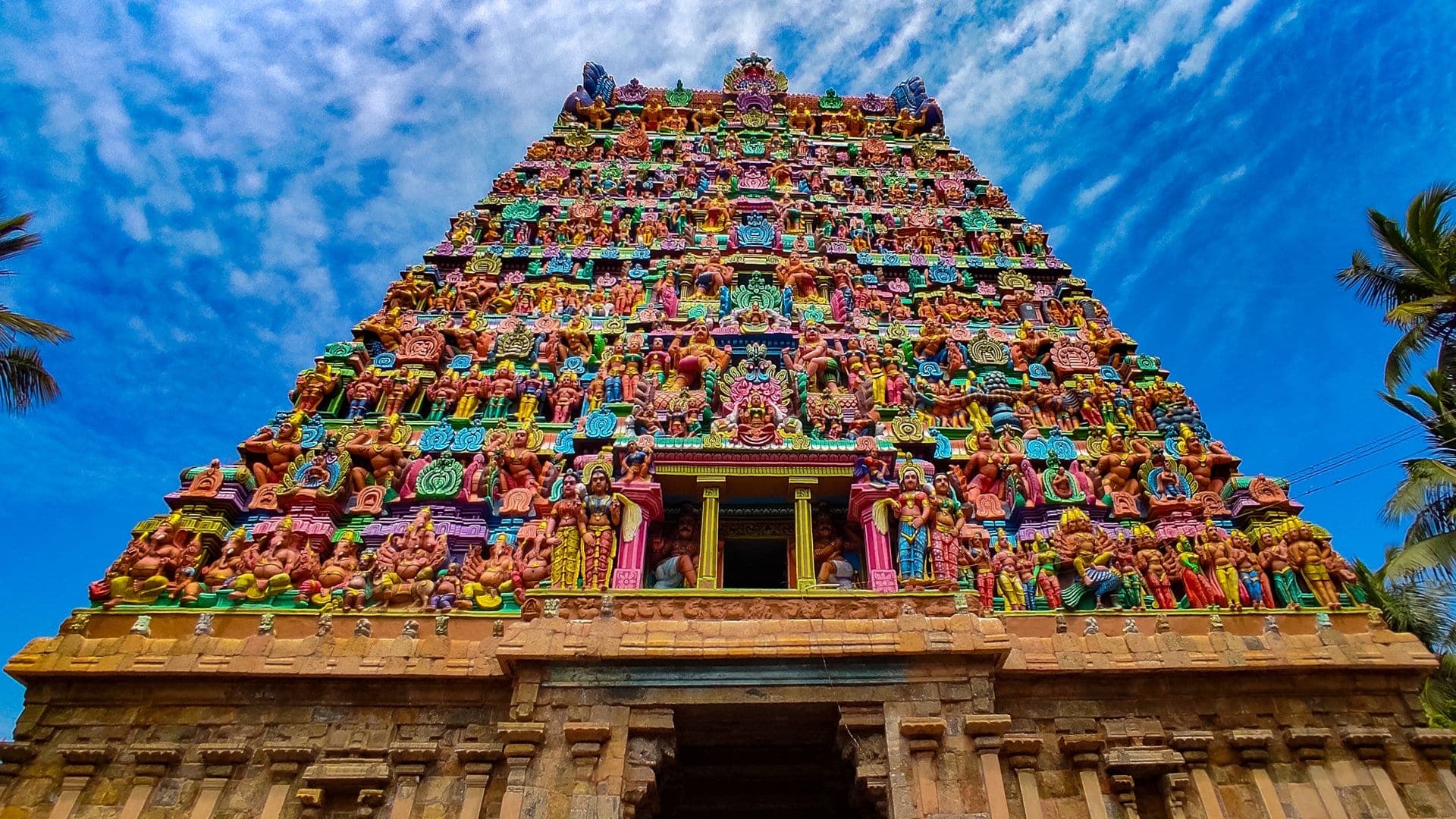
You enter under the rajagopuram, an eleven-tiered tower about 173 feet tall, the tallest in Kumbakonam and one of the tallest among all the Divya Desams. Walk through the pillared halls towards the sanctum and slow down when the chariot appears: stone wheels, rearing horses and elephants carved on the sides of the central shrine, carrying the Lord as he descends from heaven.
The sanctum has two stepped entrances, the Utharayana Vaasal and the Dakshinayana Vaasal. One is kept open from mid January to mid July, the other for the rest of the year, following the sun's northern and southern journeys. Inside, Lord Aravamudhan reclines in his unique half-risen posture. The shrine of Goddess Komalavalli Thayar is in the northern part of the temple, and devotees pay their respects to her as well.
Outside the western entrance lies the Potramarai tank, where the tradition places the birth of Komalavalli. Beside the rajagopuram stand the temple's twin wooden chariots, among the largest in Tamil Nadu, each with a base weighing around 300 tonnes. If you visit during the chariot festivals, you will see hundreds of devotees pulling them through the streets.
Darshan, timings and temple etiquette
The temple follows the usual rhythm of Tamil temples. It opens in the early morning and darshan continues until about 12.30 pm, then the temple closes for the afternoon and reopens around 4.30 to 5 pm, staying open until about 8.30 to 9 pm. Poojas are performed six times a day. Timings shift on festival days, so please check the current schedule with the temple or your consultant before you plan.
Dress modestly and traditionally, leave footwear at the stand, and keep your voice low in the sanctum. The temple follows the Pancharatra agama with great strictness, and the priests will guide you at the sanctum. If you wish to offer an archana, carry the star and name details of your family members.
The Mahamaham connection
Kumbakonam is the town of the Mahamaham, the great bathing festival held once in 12 years, often called the Kumbh Mela of the South. Lakhs of devotees take a holy dip in the Mahamaham tank, which has 20 sacred wells named after the holy rivers of India. The tradition says that the waters of all these rivers gather in this tank on the Mahamaham day.
The last Mahamaham was held in February and March 2016, and the next is expected in 2028. Sarangapani temple is one of the five Vishnu temples of Kumbakonam closely connected with the festival, along with Chakrapani, Ramaswamy, Rajagopalaswamy and Varahaperumal temples, and the deities grace the tank during the festival. Every year in the Tamil month of Masi, around February and March, a smaller Masi Magam festival keeps the tradition alive. If your dates fall near Masi Magam, plan an extra day in Kumbakonam.
Best time to visit
November to February is the kindest season, cool enough to walk the temple streets of Kumbakonam in comfort. Summer afternoons are harsh, so keep temple visits for mornings and evenings if you come between April and June.
For festivals, the Chittirai Brahmotsavam in April and May brings the great chariots onto the streets, and Ratha Saptami in January and February is another chariot day. The Masi Magam season fills the town with pilgrims. Choose festival dates for the spectacle, or quiet weekdays for an unhurried darshan.
How to reach
Kumbakonam is well connected by rail, with its own station on the main line through the Kaveri delta, and by road from Thanjavur, about 40 km away, and Tiruchirappalli, about 90 km away. Trichy airport is the nearest airport, roughly a 2 hour drive, with good connections to Chennai and the Gulf. From Chennai, Kumbakonam is about 280 km, a comfortable morning drive or an overnight train.
Within the town, the great temples sit close together. Sarangapani, Adi Kumbeswarar, Ramaswamy and Chakrapani temples and the Mahamaham tank can all be covered on foot or by auto in a single unhurried day.
Tips from our travel experts
Make Kumbakonam your base for 2 to 3 days. The town itself deserves a full day, and it is the natural starting point for the Navagraha temple circuit and for the Chola trail. The Airavatesvara temple at Darasuram, a UNESCO World Heritage Site, is only about 4 km away, and no traveller should miss it.
Start your Sarangapani darshan by 7.30 or 8 in the morning, before the town warms up. Notice which seasonal doorway of the sanctum is open on your visit; devotees consider entering through the Utharayana Vaasal especially auspicious. And before you leave town, sit down for a tumbler of the famous Kumbakonam degree coffee in one of the old coffee houses; it is a small pleasure the town is genuinely proud of.
For our NRI and OCI travellers
Kumbakonam is the heart of the Kaveri delta temple country, and many of our overseas guests come here for family rituals, ancestral temple visits and the Navagraha circuit in one trip. Plan 3 to 4 days if that is your purpose, and tell us in advance so that we can arrange priests and timings.
Hotels in Kumbakonam are simple but comfortable, and Trichy airport makes arrival easy. If your family's kula deivam temple is anywhere in the delta, this is the base from which to reach it.
Questions travellers ask us
Why is the sanctum shaped like a chariot?
The tradition says Lord Vishnu descended from Vaikuntha in a chariot drawn by horses and elephants to marry Komalavalli, who emerged from the Potramarai tank. The central shrine is built as that chariot, with horses, elephants and wheels carved in stone on its sides.
What does the name Aravamudhan mean?
Aravamudhan means the nectar that never satiates. The alvars sang of the Lord of Kumbakonam by this name, and the tradition says Nathamuni compiled the four thousand verses of the Divya Prabandham at this very temple.
What are the temple timings?
The temple is open in the morning until about 12.30 pm and again from about 4.30 to 5 pm until 8.30 to 9 pm. It stays closed in the afternoon, and festival days follow special schedules, so check current timings before you go.
When is the next Mahamaham?
The Mahamaham comes once in 12 years. The last was held in February and March 2016, and the next is expected in 2028. Every year a smaller Masi Magam festival is held around February and March at the Mahamaham tank.
What else should I see in Kumbakonam?
Adi Kumbeswarar, Ramaswamy and Chakrapani temples and the Mahamaham tank are all within the town. The UNESCO-listed Airavatesvara temple at Darasuram is about 4 km away, and Kumbakonam is also the best base for the nine Navagraha temples.
Is Sarangapani temple part of the Navagraha circuit?
No. Sarangapani is a Divya Desam of Lord Vishnu. But Kumbakonam is the most convenient base for the Navagraha circuit, so most pilgrims take darshan here on the same trip.
A note on the tours below. These packages travel close to Sarangapani (Kumbakonam) Divya Desam, but a package may not include a guided visit to the site itself. If you would like this place added to your journey, please tell your Way to India travel consultant and they will happily build it into your itinerary for you.
Yatras where you stay right by the temple
7D / 6NYou stay at Kumbakonam
 5D / 4N
You stay at Swamimalai