 18D / 17N 5
 All World Heritage Sites
UNESCO World Heritage · Cultural · inscribed 1983
Ellora Caves
At Ellora, 34 monasteries and temples were cut side by side into a two kilometre wall of basalt rock, by Buddhists, Hindus and Jains working across six centuries. At its centre rises the Kailasa temple, the largest structure in the world ever carved out of a single rock. UNESCO protects Ellora as a World Heritage Site, and the Grishneshwar Jyotirlinga is only about a kilometre away.
The story of this place
Ellora, called Verul in Marathi, lies in the Charanandri hills near Aurangabad, now Chhatrapati Sambhajinagar. From about the 6th century CE to the 12th century CE, generation after generation of workers cut caves into this basalt cliff. What makes Ellora unlike any other place on earth is who did the cutting. Caves 1 to 12 are Buddhist. Caves 13 to 29 are Hindu. Caves 30 to 34 are Jain. Three faiths carved their sanctuaries into the same hill, side by side, and UNESCO itself says this shows the spirit of tolerance that marked ancient India.
The hill range actually holds nearly a hundred excavations, but these 34 are the ones opened and celebrated. UNESCO placed Ellora on the World Heritage List in 1983, the same year as Ajanta.
The crown of Ellora is Cave 16, the Kailasa temple. It was conceived as Mount Kailasa, the abode of Lord Shiva, and it is the largest monolithic excavation in the world. The workers did not build it stone upon stone. They started at the top of the cliff and cut downward, removing the mountain and leaving a complete temple behind, with its shrine, pillared halls, gateway and life size elephants, all one single rock. UNESCO calls it a technological achievement without equal, and when you stand in its courtyard you will not argue.
What you will see
Give the Kailasa temple, Cave 16, the largest share of your time. Walk around it slowly, look up at the tower carved from the living rock, and find the famous panel of Ravana shaking Mount Kailasa while Lord Shiva calmly presses it down with his toe. It is one of the boldest sculptures in all of India. On the ceilings of the front mandapa you can still see remains of old paintings.
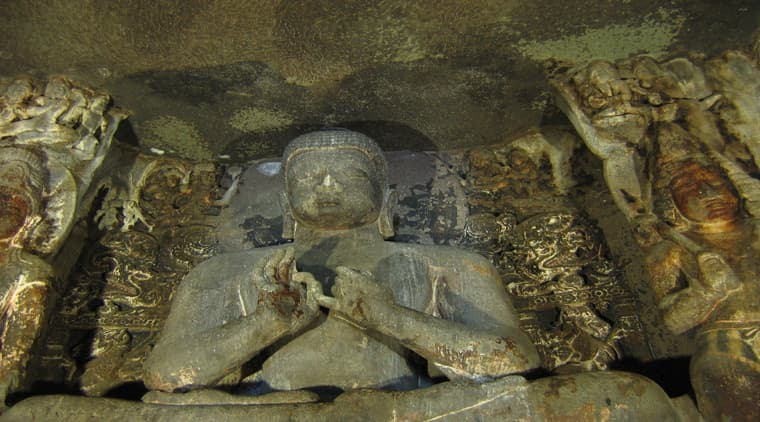
In the Buddhist group, Cave 10 is the Visvakarma cave, a prayer hall with a ribbed, vaulted ceiling that looks like carpentry done in stone, with a serene seated Buddha before the stupa. Cave 12, called Teen Tal, is a monastery three storeys high, cut floor above floor into the cliff. In the Hindu group beyond Kailasa, Cave 21, Ramesvara, and Cave 29, Dumar Lena, hold powerful Shaiva sculpture. At the far end, the Jain caves 30 to 34 are smaller but carved with wonderful delicacy, made for the Digambara tradition.
The caves are spread along more than two kilometres, so you will walk a good deal. Small shuttle arrangements and autos ply between the far cave groups; ask at the entrance for the current arrangement.
Grishneshwar Jyotirlinga, just next door
For our Hindu travellers, Ellora carries a special blessing. The Grishneshwar temple, one of the twelve Jyotirlingas of Lord Shiva, is only about a kilometre from the caves, in the same village. Most of our guests take darshan at Grishneshwar and see the Kailasa temple on the same morning, and the two experiences together, the living Jyotirlinga and the mountain carved for Lord Shiva, make this one of the most satisfying half days in all of Maharashtra.
The temple follows a traditional discipline inside the sanctum, so dress modestly and follow the instructions of the temple staff. Timings follow the usual pattern of morning darshan, afternoon rituals and evening aarti; please check the current schedule locally.
Best time to visit
October to March is the best season, with pleasant weather for the long walk between the cave groups. Summer afternoons are harsh, often near 40 degrees, so in April to June start at opening time and keep the afternoon for rest. The monsoon months turn the hills green and are also a fine time if light rain does not trouble you.
One important note on the weekly closure: Ellora is widely listed as closed on Tuesday, while Ajanta closes on Monday. Official listings have sometimes differed on this, so please confirm the current closed day with your consultant or locally before you drive out. Plan Ajanta and Ellora on separate days in any case.
How to reach
Ellora is about 30 km from Aurangabad, now Chhatrapati Sambhajinagar, a drive of under an hour. The city has the nearest airport, with flights from Mumbai and Delhi, and the nearest major railway station. Taxis and state transport buses run to Ellora through the day.
Because Ellora is so close to the city, you can comfortably combine it with Grishneshwar darshan in a single morning and be back in Aurangabad for a late lunch. If you are also going to Ajanta, keep that for a separate day, since Ajanta lies about 100 km on the other side of the city.
Tips from our travel experts
Go early, and go to Kailasa first. The tour buses reach by late morning, and the difference between a quiet Kailasa courtyard and a crowded one is the difference between darshan and sightseeing. Keep four to five hours for a proper visit covering all three cave groups, or two to three hours if you only want the highlights.
There is an entry fee for the caves, with different rates for Indian citizens and foreign nationals, and children below 15 enter free; please check the current rate on the official ASI website. Wear good walking shoes, carry water and a cap, and take a licensed guide at least for Kailasa; the temple opens up completely once someone shows you its plan.
Carry a small torch if you like reading sculpture in the darker caves, and be patient inside Cave 10; give your eyes a minute to adjust and the seated Buddha will slowly appear out of the gloom.
For our NRI and OCI travellers
Carry your OCI card at the ticket counter; ASI monuments have had special provisions for OCI card holders, and staff will guide you as per the current rule. Foreign passport holders without OCI pay the foreign national rate.
Fly into Mumbai and connect to Aurangabad, and give this circuit two full days with two nights. Many of our overseas families come for the Grishneshwar Jyotirlinga and discover Kailasa as the surprise of their whole India trip. The walking here is on uneven rock in places, so bring sturdy shoes for elders, and keep the visit for the morning hours in the warmer months.
Questions travellers ask us
Which day is Ellora closed?
Ellora is widely listed as closed on Tuesday, while Ajanta closes on Monday. Official listings have sometimes differed, so please confirm the current closed day locally or with your Way to India consultant before you plan your drive.
What is so special about the Kailasa temple?
Kailasa, Cave 16, is the largest monolithic excavation in the world. The whole temple, with its tower, halls, gateway and elephants, was carved downward out of a single rock as a form of Mount Kailasa, the abode of Lord Shiva. UNESCO calls it a technological achievement without equal.
Can I visit Grishneshwar Jyotirlinga on the same trip?
Yes, and you should. The Grishneshwar temple, one of the twelve Jyotirlingas, is only about a kilometre from the caves. Most of our guests take darshan and see Kailasa in the same morning. Dress modestly and follow the temple's instructions inside the sanctum.
How much time do I need at Ellora?
Keep four to five hours to cover the Buddhist, Hindu and Jain groups without rushing, since the caves stretch along more than two kilometres. If you have only limited time, see Kailasa, Cave 10 and Cave 12, which take about two to three hours.
Is Ellora suitable for elderly visitors?
Largely yes. The main caves, including Kailasa, are reachable with modest walking, and vehicles drop you near the entrance. Some caves involve steps and uneven rock, so elders should go with a companion, walk slowly and visit in the cooler morning hours.
What is the entry fee at Ellora?
There is an entry fee, with different rates for Indian citizens and foreign nationals, and children below 15 enter free. Rates are revised from time to time, so please check the current rate on the official ASI website or ask your consultant.
A note on the tours below. These packages travel close to Ellora Caves, but a package may not include a guided visit to the site itself. If you would like this place added to your journey, please tell your Way to India travel consultant and they will happily build it into your itinerary for you.
Tours where you stay right by it
18D / 17N 5You stay at Aurangabad
 4D / 3N
You stay at Aurangabad
 13D / 12N
You stay at Aurangabad
 5D / 4N
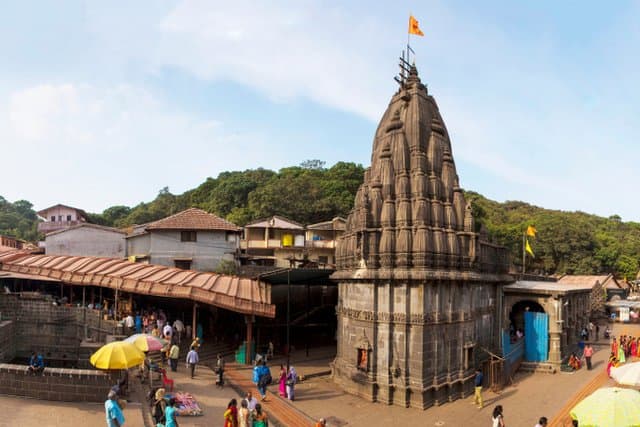
Trimbakeshwar Grishneshwar Bhimashankar Jyotirlinga Tour
From₹25,056* / person
Explore →EMI from ₹1,227/mo
You stay at Aurangabad