 3D / 2N
 All World Heritage Sites
UNESCO World Heritage · Cultural · inscribed 1986
Group of Monuments at Hampi
Hampi is a landscape you will not see anywhere else in the world: golden granite boulders piled to the horizon, the Tungabhadra river winding between them, and the temples and palaces of a vanished empire scattered across it all. It was once among the greatest cities on earth, and for devotees it is older still, for the tradition places the Kishkindha of the Ramayana in these very hills.
The story of this place
Hampi carries two great stories, one from the epics and one from history. The tradition says this rocky land on the Tungabhadra is Kishkindha, the kingdom of the vanaras in the Ramayana. Devotees believe that Anjanadri hill, across the river near Anegundi, is the birthplace of Lord Hanuman, and that it was in these hills that Lord Rama met Hanuman and Sugriva. Long before any empire, this was Pampa kshetra, sacred to Goddess Pampa and to Lord Virupaksha, a form of Lord Shiva.
History then built its own wonder here. In the 14th century, Hampi became the capital of Vijayanagara, the last great Hindu empire of the south. At its height under Krishnadevaraya, who ruled from 1509 to 1530, this was one of the largest and richest cities of its time. Travellers from Persia and Portugal wrote in amazement about its markets, palaces and temples.
In 1565 the empire lost the Battle of Talikota. The victorious armies pillaged the city for about six months, and Hampi was abandoned. What remains today is more than 1,600 structures, temples, royal enclosures, bazaars, stepped tanks and gateways, spread across a vast boulder landscape. UNESCO placed the Group of Monuments at Hampi on the World Heritage List in 1986. And through every century of ruin, worship at the Virupaksha temple never stopped.
Darshan, timings and temple etiquette
The Virupaksha temple is not a ruin. It is a living temple of Lord Shiva where daily worship has continued for centuries, and you should visit it as a devotee first and a sightseer second. The usual pattern is morning darshan, a quieter stretch in the afternoon, and evening worship, but the timings shift with the season and festivals, so please check locally or ask your consultant for the current schedule.
Dress modestly and remove your footwear at the entrance. Photography rules inside the shrines can change, so follow the signs and the temple staff. And remember as you walk the wider site that many small shrines among the boulders are still sacred to local people; climb and sit thoughtfully, and never on a shrine itself.
What you will see
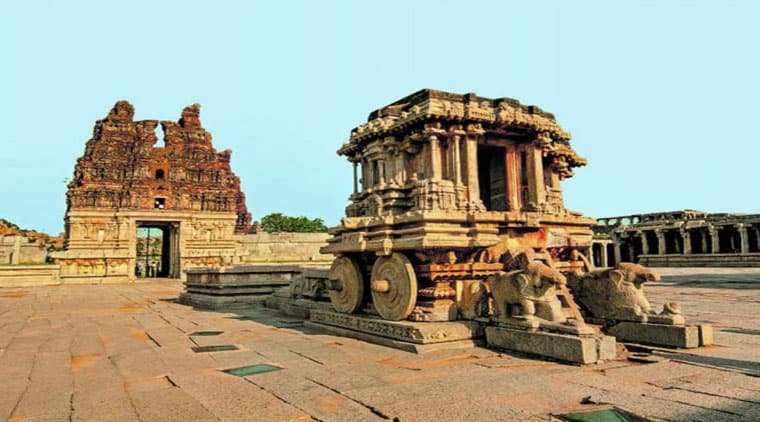
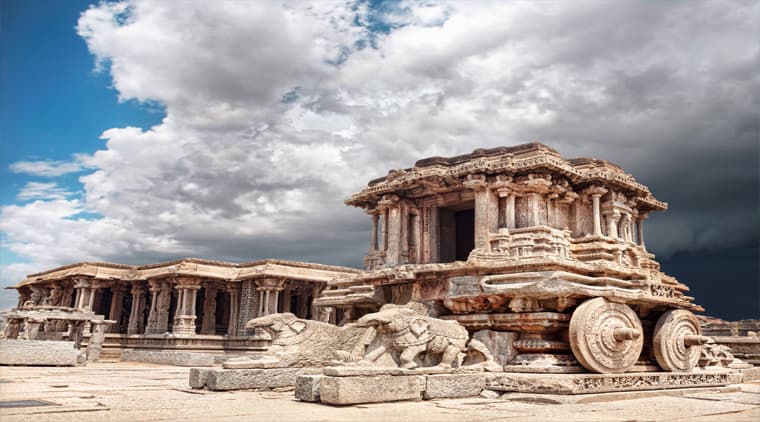
Begin in the sacred centre. The tall gopuram of the Virupaksha temple rises above the old Hampi Bazaar street, and behind it the early shrines on Hemakuta hill catch a lovely light in the morning and at sunset. A walk along the river brings you to the Vitthala temple, the finest building in Hampi. Its famous stone chariot is actually a shrine of Garuda, and it is the image printed on the Indian 50 rupee note. The carved pillars of the Vitthala complex show Vijayanagara art at its very peak.
A few kilometres away lies the royal centre: the Lotus Mahal with its curved arches, the grand Elephant Stables, the Queen's Bath, a beautiful stepped tank, and the Hazara Rama temple, whose walls carry carved panels telling the Ramayana. This side of Hampi shows you the empire's court life, just as the river side shows you its faith.
For sunrise or sunset, climb Matanga hill or sit on Hemakuta; the sight of boulders and temple towers glowing gold is what every traveller carries home. If you have time, cross the river to Anegundi village and climb Anjanadri hill to the Hanuman temple; keep some breath, it is a proper flight of steps. On the river you may also see the round coracle boats, used here since the days of the empire.
Best time to visit
October to February is the season we recommend, with warm days and cool, pleasant mornings and evenings. March to May is very hot; the granite boulders soak up the sun, and walking the open site at midday becomes hard work. July to September, the monsoon, turns the landscape green and the river full; it is a beautiful and quieter time, though you should plan around the showers.
Within the day, keep the first hours of the morning and the last hour before sunset for the open sites, and use the middle of the day for a slow lunch and rest. Hampi rewards the traveller who moves with the light.
How to reach
The nearest railhead is Hosapete Junction, about 13 km from Hampi, with taxis and autos available for the last stretch. Overnight trains connect Hosapete with Bengaluru, which is how many of our guests arrive: sleep on the train, wake up next to Hampi.
By air, Jindal Vijaynagar airport at Toranagallu is about 35 km away with limited flights, and Hubballi airport is another option in the region. For most travellers, and especially our NRI guests, Bengaluru is the main gateway; from there it is about 340 km by road, a comfortable overnight train, or a night bus. We usually plan Hampi with two nights at Hosapete or near the site, so no day is rushed.
Tips from our travel experts
Give Hampi two full days. Day one for the sacred centre, Virupaksha, Hemakuta and the riverside walk to Vitthala; day two for the royal centre and the crossing to Anegundi. Travellers who allot half a day always leave wishing they had stayed.
The site is spread over many kilometres, so hire an auto for the royal centre and keep your walking for the riverside. Start the Vitthala temple early, before the heat and the groups arrive. The main ticketed monuments are generally covered by one ticket for the day, but do confirm at the counter, and please check the current entry rates on the official channels.
The sun here is strong even in winter, so carry a cap, water and sunscreen. Stay at Hosapete or Kamalapura for the more comfortable hotels; lodging close to the site is simple. And take a licensed guide at least for your first morning; the difference between seeing stones and seeing a city is one good storyteller.
For our NRI and OCI travellers
If your children have grown up hearing the Ramayana, Hampi is the place where the story gets a landscape. Standing below Anjanadri hill and telling them that devotees believe Lord Hanuman was born here does more than any book.
Plan Hampi without hurry. It pairs naturally with a Bengaluru arrival, and many of our overseas guests combine it with the temple towns of the south on one journey. Facilities are those of a small town, so carry some cash for village shops and coracle crossings, keep your own water bottle, and expect simple, warm hospitality rather than big-city polish. That, in truth, is Hampi's charm.
Questions travellers ask us
How many days do I need for Hampi?
Two full days is the honest answer. One day for the sacred centre with Virupaksha temple, Hemakuta hill and the Vitthala temple, and one day for the royal centre and the river crossing to Anegundi. A single rushed day leaves too much unseen.
Is the Virupaksha temple still active for worship?
Yes. Virupaksha is a living temple of Lord Shiva where daily worship has continued for centuries, even after the city around it was abandoned. The usual pattern is morning darshan, an afternoon lull and evening worship; please check current timings locally.
What is the famous stone chariot at Hampi?
It is a shrine of Garuda carved in granite, standing before the Vitthala temple. It is the finest single piece of Vijayanagara art at Hampi, and it is the monument printed on the Indian 50 rupee note.
Which is the nearest railway station and airport for Hampi?
Hosapete Junction, about 13 km away, is the nearest railhead, with overnight trains from Bengaluru. Jindal Vijaynagar airport at Toranagallu, about 35 km away, has limited flights, so most travellers use Bengaluru as the gateway, about 340 km by road or an overnight train.
Is Hampi connected to the Ramayana?
The tradition identifies this region with Kishkindha, the kingdom of the vanaras in the Ramayana, and devotees believe Anjanadri hill near Anegundi is the birthplace of Lord Hanuman. There is a Hanuman temple on the hilltop, reached by a long flight of steps.
What is the best time of year to visit Hampi?
October to February, when the days are warm and the mornings pleasant. Summer is very hot on the open granite, and the monsoon months are green and quiet but need flexible planning around showers.
A note on the tours below. These packages travel close to Group of Monuments at Hampi, but a package may not include a guided visit to the site itself. If you would like this place added to your journey, please tell your Way to India travel consultant and they will happily build it into your itinerary for you.
Tours where you stay right by it
3D / 2NYou stay at Hampi
 11D / 10N
You stay at Hampi