Bikaner Travel Guide
The best months are October to March , and the set-piece is the Bikaner Camel Festival in January. Decide early whether you want the festival or the quieter desert city.
When to visit Bikaner, and the festival to plan around
The best months are October to March, and the set-piece is the Bikaner Camel Festival in January. Decide early whether you want the festival or the quieter desert city.
- November to February: cool and clearThe most comfortable time, warm and pleasant by day and genuinely cold at night on the desert plain, so carry a proper layer. January also brings the Camel Festival, so the city is at its liveliest then. This is the window almost everyone should aim for.
- October and March: warm but fineStill good for the fort, the temples and the camel farm, with fewer crowds than festival season. By late March the desert afternoons heat up quickly, so do the open sights and the old-city walk in the morning.
- April to June: fiercely hot, best avoidedHigh summer on the desert is brutal, often above 40 degrees Celsius, tiring for the fort, the open camel farm and the barefoot rat-temple floor. If you must come then, keep the middle of the day for rest and shade and move at dawn and dusk.
- Festival or no festival, decide firstThe Camel Festival is a wonderful spectacle but rooms are scarcer and dearer around it, and a quiet weekday in December or February is gentler. Both are rewarding, so choose the experience you want before you book.
The Bikaner Camel Festival is an annual two-day event run by the Department of Tourism, Government of Rajasthan, in January, with the camel procession from Junagarh Fort, decorated-camel and camel-dance competitions, folk music and fireworks. The 2026 edition is widely listed for about 9 to 11 January 2026, but those dates are not always posted early on the official Rajasthan Tourism calendar and they shift year to year. Treat them as expected, not confirmed, and reconfirm the official dates on the Rajasthan Tourism site before you book flights or rooms. Beware pages that quote a fixed date as fact, since old dates are copied across the web every year.
How to reach Bikaner
Bikaner has a small airport at Nal with limited flights, a strong railhead at Bikaner Junction, and good desert roads from Jaisalmer, Jodhpur and Delhi.
- By train, the easy way inBikaner Junction is well connected, with around twenty-plus pairs of trains a day, including direct overnight and superfast services from Delhi covering roughly 450 to 460 km in about 8 to 11 hours. The overnight train from Delhi is how many travellers arrive. Book on IRCTC ahead in the winter season and around the festival.
- By air, with a caveatBikaner has its own airport at Nal, about 13 to 17 km from the city, but flights are limited; in recent years there has been a daily Delhi service by carriers such as IndiGo and Alliance Air. Check current routes before relying on it. The bigger, more reliable airport is Jodhpur, about 250 km and roughly 4 to 5 hours by road.
- By road from the desert circuitBikaner sits about 330 km from Jaisalmer (about 5 to 6 hours), about 250 km from Jodhpur (about 4 to 5 hours), and about 330 km from Jaipur. The roads are good, and a car with a driver is the natural way to link it with the rest of Rajasthan.
- From DelhiDelhi is about 450 km away. Most travellers take the overnight train straight into Bikaner rather than the long road drive, or fly the short hop to Nal if the schedule suits, and we can arrange a car and driver for the onward desert loop.
Fly into Delhi, the main international gateway, then take the overnight train or a connecting flight to Bikaner, or pick it up by road on a Jaisalmer and Jodhpur loop. Bikaner has no international flights of its own.
Fly into Delhi or Jaipur, then reach Bikaner by train or road. It sits naturally on the desert circuit with Jaisalmer, Jodhpur and the Shekhawati haveli towns around Mandawa.
Take an overnight train to Bikaner Junction from Delhi, or drive from Jaisalmer, Jodhpur or Jaipur. The train is the simplest and most comfortable way in for most domestic travellers.
Junagarh Fort, the rat temple, and the carved old city
Bikaner is its great hilltop-free fort, the sacred rat temple at Deshnoke, the camel farm and the red-sandstone havelis of the old city. A few rules and timings are worth knowing first.
- Junagarh FortFounded in 1589 by Raja Rai Singh, this is the unmissable sight and one of the few major Rajasthan forts not built on a hill, with sumptuous painted palaces and courtyards inside. Entry is about 50 rupees for Indian visitors and about 300 rupees for foreign nationals, with small separate charges for the museum and a camera, and it opens daily, roughly about 10 am to 4:30 pm. Reconfirm fees and hours locally, as they are revised periodically.
- Karni Mata Temple, the rat temple at DeshnokeAbout 30 km south of the city, this is the famous temple where thousands of sacred rats, the kabas, are revered and protected. Entry is free, you remove your footwear and walk barefoot among them, and seeing one of the rare white rats is held to be especially auspicious. Read the safety and overseas sections before you decide to go.
- Lalgarh Palace and the Sadul MuseumThe red-sandstone palace built by Maharaja Ganga Singh from 1902 houses the Sri Sadul Singh Museum and one of the largest private libraries in the country. The museum is generally open about 10 am to 5 pm, usually closed one day a week, commonly Sunday, with a modest entry fee that differs for Indian and foreign visitors.
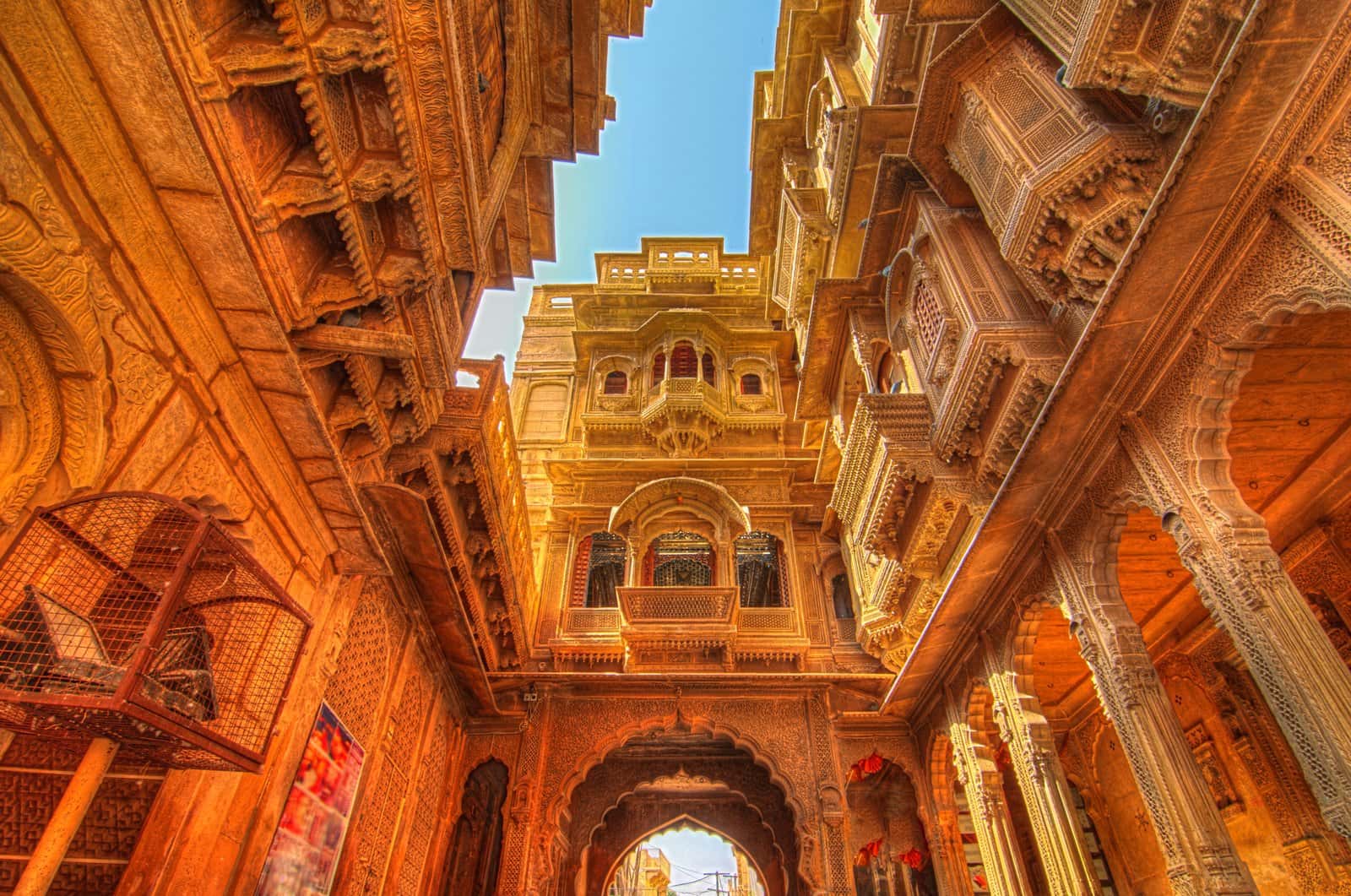
- The Rampuria havelis and the old cityThe carved red-sandstone Rampuria havelis and the lanes of the walled old city are the most photogenic and most overlooked part of Bikaner. Give yourself a slow morning walk here, along with the Bhandasar Jain Temple, before the day heats up.
Bikaner has deeply religious sites. Cover shoulders and knees at the temples, remove shoes where asked, and at Karni Mata expect to walk barefoot on a floor shared with the rats. In the warmer months the open fort and old-city lanes get hot fast, so carry water and sun protection and keep the middle of the day for rest.
Signature experiences in Bikaner
Beyond the fort, these are the experiences people remember, and how to time them right, especially the camel farm and the rat temple.
- The camel farm in the late afternoonThe National Research Centre on Camel, about 8 to 10 km out, is the signature Bikaner experience, but only if you time it. It opens in the afternoon and is closed on Sundays and public holidays, and the herd returns from the desert in the late afternoon, so aim to arrive around 3 pm. There is a small entry charge, a museum, camel rides and a parlour selling camel-milk tea, kulfi and ice cream.
- Junagarh Fort, slowlyGive the fort a couple of unhurried hours for the painted halls, the Anup Mahal and the courtyards. Go in the morning before the heat, take the audio or a guide for the history, and remember the separate museum and camera charges.
- The rat temple at DeshnokeA half-day trip south to Karni Mata Temple is unlike anywhere else: barefoot among thousands of sacred rats, with the white-rat sighting held to be lucky. It is free and quick to walk through. Some travellers find it profound, others give it a miss, so read the honest note in the safety and overseas sections and decide for yourself.
- A morning walk through the havelisThe Rampuria havelis and the carved lanes of the old city, with the Bhandasar Jain Temple, are best on foot early in the day. This is the quiet, authentic Bikaner that most rushed visitors never see.
- A sunset camel ride or desert campShort camel rides and desert camps on the edge of town are a gentle classic at sunset, less commercial than Jaisalmer. Agree the price and length before you set off, as rates are negotiable and quoted high to visitors.
- Bhujia, sweets and the old bazaarsBikaner is the home of Bikaneri bhujia, the spicy snack first made for the royal court around 1877, and of famous rasgulla and other sweets. The bhujia and sweet shops of the old city and Station Road are part of the visit; buy fresh and eat well.
The single thing that ruins a Bikaner plan is turning up at the camel farm in the morning or on a Sunday and finding it shut. It opens only in the afternoon and is closed on Sundays and public holidays, and the herd returns from the desert in the late afternoon, which is the whole point of the visit. Build your day so the farm falls around 3 pm on a working day, and you get the experience instead of a locked gate.
Where to stay in Bikaner, and how many nights
Stay in a heritage palace or haveli for atmosphere, near the station for convenience, or at a desert camp for the dunes. One to two nights is the sweet spot.
- Heritage palaces and havelisBikaner does heritage stays well, from converted wings of Lalgarh Palace to grand old havelis, with character, courtyards and good food. The natural choice if you want the royal-Rajasthan feel and do not mind being a short drive from some sights.
- Near the station and main roadA cluster of mid-range and business hotels near Bikaner Junction and the main road is convenient for arriving and leaving by train and for the old city. Practical and central, if less atmospheric than the palaces.
- Desert camps on the outskirtsTented camps on the edge of town give you the dunes, sunset camel rides and quiet, but you will need transport into the city. Good for couples and anyone wanting a calmer, more scenic base, and the natural pick during the festival.
- How many nights and room budgetsOne night is enough for the essentials, two for a relaxed visit with both the rat temple and the camel farm. Budget rooms run from about 800 to 1,800 rupees, mid-range about 2,000 to 5,000 rupees, and heritage or palace stays about 6,000 to 18,000 rupees and up, all higher around the January festival, so book early.
Around the January Camel Festival, rooms and desert camps are scarcer and dearer, sold well in advance. If your dates fall on the festival, book ahead, or be ready to stay a little out of the centre and drive in.
Bikaner costs and a realistic daily budget
Bikaner is gentle on the wallet outside festival season. Here is what the main things cost, so you can plan and avoid being overcharged.
- A rough daily budgetExcluding your room and long-distance transport, plan on about 1,500 to 2,500 rupees a day as a backpacker, about 3,500 to 6,000 rupees mid-range, and about 7,000 rupees and up for a comfortable day with a car, entry fees and good meals.
- The fixed-price thingsJunagarh Fort entry is about 50 rupees for Indians and about 300 rupees for foreign nationals, with small separate museum and camera charges. The rat temple at Deshnoke is free. The camel farm has a small entry charge of roughly about 20 to 50 rupees. These published fees are the useful anchors in a town where much else is negotiable.
- The negotiable thingsA half-day taxi to Deshnoke and back is typically about 1,200 to 2,000 rupees, agreed in advance. A short sunset camel ride and bazaar goods are quoted high to visitors and come down with gentle bargaining. Settle the price first and the only friction disappears.
- Cash and cardsCafes, hotels and bigger shops take cards or UPI, but taxis, the bhujia and sweet shops and small vendors run on cash. There are bank ATMs in the main market and near the station, so carry enough cash for the day.
Outside the published fort, museum and camel-farm fees, most things in Bikaner are negotiable, so the single habit that saves money is to agree the price before anything begins, whether that is the taxi to the rat temple, a camel ride or a bazaar purchase. Quotes to visitors start high and come down without drama, and a sum agreed in advance turns the town's only friction into a non-event.
Practical logistics: getting around, money, SIM and food
The small things that make a Bikaner day smooth, from getting out to Deshnoke and the camel farm to ATMs, the heat and the famous food.
- Getting aroundThe old city, the fort and the bazaars are walkable, but the rat temple at Deshnoke and the camel farm need transport. Auto-rickshaws cover the city, and a hired taxi for a half or full day is the simplest way to do the out-of-town sights; agree the route and price first.
- Money and ATMsBank ATMs are in the main market and near the station. Carry cash for taxis, the bhujia and sweet shops, camel rides and small eateries, as not everyone takes cards or UPI.
- SIM, signal and languageMobile coverage in the city is generally fine for calls, maps and data, and patchier out in the desert. Hindi and Rajasthani are the local languages, and English is understood in the hotel and tourist trade, so communicating is easy.
- Eat the local foodThis is the home of Bikaneri bhujia and its sweets, so lean into the namkeen, the kachori, the rasgulla and the camel-milk kulfi at the farm. Take the usual care with water and street food, and you will eat very well.
The rat temple at Deshnoke (about 30 km south) and the camel farm (about 8 to 10 km out) are in different directions, so a little planning saves a lot of driving. A common pattern is the fort and old city in the morning, lunch, then Deshnoke or the camel farm in the afternoon, remembering the farm is afternoon-only and closed on Sundays. Fix the taxi and the route in advance and a full Bikaner day runs smoothly.
Safety, the rat temple, the heat, and staying well
Bikaner is an easy, low-pressure city, but the desert heat and the barefoot rat-temple floor are the two things to take seriously. A little awareness keeps the visit happy.
- The rat temple, honestlyAt Karni Mata you walk barefoot on a floor shared with thousands of rats. They are used to people and rarely bite, and the temple is cleaned, but the floor is not always dry underfoot. If rats genuinely distress you, this is not the temple for you and there is no shame in skipping it. If you go, socks help, watch your step, and wash your feet well afterwards.
- The desert heatFrom April to June the heat is severe, often above 40 degrees Celsius. Even in the cooler months the midday sun on the open fort and the camel farm is strong. Carry water, wear a hat and sunscreen, and keep the hottest hours for a rest or an indoor museum.
- Water, food and stomachsDrink bottled or filtered water, take the usual care with street food, and ease into the rich local snacks. A basic medical kit and any personal medicines are worth carrying, as Bikaner is a regional city rather than a major medical hub.
- Everyday safetyBikaner is generally calm and far less touty than the big tourist cities. The usual care with valuables, agreeing taxi fares in advance and keeping an eye on belongings in crowds during the festival is all that is needed.
Most solo women find Bikaner relaxed and manageable, less hassled than the busier Rajasthan tourist hubs. Dress modestly at the temples, agree taxi fares in advance, prefer the busier lanes after dark, and you should find it one of the gentler desert stops to travel alone. As anywhere, trust your instincts and keep someone informed of your day plan.
Bikaner for every kind of traveller, and on access
Bikaner suits very different visitors in different ways. Here is what it offers you, and the one tip that matters for each, including who should skip the rat temple.
- Families with childrenThe fort, the camel farm and camel rides are a hit with children. The rat temple is the judgement call: some children love it, others are frightened, so decide as a family and remember you can wait outside while others go in.
- CouplesA heritage palace or a desert camp, a sunset camel ride and the quiet old-city lanes make Bikaner a calm, characterful stop between the busier desert cities. An overnight lets you slow down.
- Senior travellers and on accessibilityVery doable with planning. Stay central, see the fort and old city in the cool of morning, use a hired car for Deshnoke and the camel farm, and skip the rat temple if the barefoot floor is not for you. The fort has steps and the desert heat is tiring, so pace the day and keep the middle of it for rest.
- PhotographersThe painted halls of Junagarh, the red-sandstone Rampuria havelis at first light, the camel farm and the rats of Karni Mata are all strong subjects. Ask before photographing people at prayer, and respect any signs inside the palaces and museums.
- History and heritage loversBikaner rewards you: a great unspoiled fort, the Sadul Museum and its library, the haveli architecture and the camel-breeding heritage. Take a guide at the fort and give the old city a proper walk.
- Solo female travellersGenerally relaxed and low-pressure. Dress modestly at the temples, agree taxi fares in advance, prefer the busier lanes after dark, and you should find Bikaner one of the easier desert stops for solo women.
A suggested Bikaner itinerary
How to shape one or two days so you catch the fort in the cool morning and the camel farm at the right afternoon hour, without a wasted trip.
- Day one, morningStart early at Junagarh Fort before the heat, give it a couple of unhurried hours, then walk the Rampuria havelis and the old-city lanes and the Bhandasar Jain Temple. Break for a bhujia-and-sweets lunch in the bazaar.
- Day one, afternoonAfter lunch, head out to the National Research Centre on Camel, aiming to arrive around 3 pm for the herd's return, and try the camel-milk kulfi. Remember it is closed on Sundays and public holidays, so plan the day around that.
- Day two, if you have itDrive south to Deshnoke for the Karni Mata rat temple in the morning, then visit the Lalgarh Palace and the Sadul Museum, or take a slower second old-city walk. A second day turns a tick-the-box stop into a proper visit.
- The half-day versionOn a Jaisalmer-to-Jodhpur drive you can stop for Junagarh Fort and a quick old-city look in two or three hours, though you will miss the camel farm and the rat temple, which need the afternoon and a separate drive.
Two timings shape a good Bikaner day: the camel farm is afternoon-only and closed on Sundays and public holidays, with the herd back around the late afternoon, and the rat temple is best in the cooler morning or evening with a midday lull. Slot the fort and old city into the cool morning, the camel farm into the working-day afternoon, and Deshnoke into a separate morning, and you will never find yourself at a shut gate.
The real questions travellers ask about Bikaner
Straight answers to the questions that come up again and again on traveller forums, so you arrive already knowing the score.
- Is one day enough?One full day covers the fort, the old city and one of either the rat temple or the camel farm. Two days lets you do both without rushing, plus the Lalgarh museum. A half-day in transit only gets you the fort and a quick old-city walk.
- Is the rat temple safe, and barefoot really?Yes, the rats are used to people and rarely bite, but you do walk barefoot among them and the floor is not always dry. It is safe but not for everyone; if rats distress you, skip it without guilt. Socks and washing your feet afterwards are sensible.
- What are the camel farm timings, and is it open Sunday?The National Research Centre on Camel opens only in the afternoon and is closed on Sundays and public holidays. The herd returns late afternoon, so aim for around 3 pm on a working day. This is the single most common wasted trip in Bikaner, so plan around it.
- How do I do the day trip to Deshnoke?The rat temple is about 30 km south. A hired taxi for a half day, about 1,200 to 2,000 rupees agreed in advance, is the easiest; there are also trains and buses to Deshnoke if you prefer, with a short walk at the other end.
- Does Bikaner have an airport?Yes, the small Nal airport about 13 to 17 km out, but flights are limited, in recent years a daily Delhi service. Check current routes before relying on it. The overnight train from Delhi or Jodhpur airport, about 250 km away, are the more reliable options.
- Is Bikaner worth it, or should I skip it?It is less touristed and more authentic than the big desert cities, with a superb fort, the unique camel farm and rat temple, and great food. If you want a quieter, more local Rajasthan stop, it is well worth a night between Jaisalmer and Jodhpur.
Planning Bikaner from abroad
Bikaner is the quieter, more authentic desert city of a Rajasthan trip and pairs naturally with Jaisalmer and Jodhpur. A little preparation makes the rat temple, the camel farm and the heat easy to handle.
- Decide on the rat temple before you goKarni Mata at Deshnoke means walking barefoot among thousands of sacred rats. Many overseas visitors find it one of the most memorable things in India; others would rather not, and that is fine. Decide as a group before the drive south, and know that seeing a white rat is held to be lucky.
- Time the camel farm rightThe National Research Centre on Camel opens only in the afternoon and is closed on Sundays and public holidays, with the herd returning in the late afternoon. Build your day around that one fact and you get the experience instead of a locked gate.
- Pair it with Jaisalmer and JodhpurFly into Delhi, then take the overnight train to Bikaner or pick it up by road, and loop it with Jaisalmer and Jodhpur, and the Shekhawati haveli towns around Mandawa. Bikaner is the calmer, less commercial desert stop on that circuit.
- Respect the heat and the templesFrom April to June the desert heat is severe, so come October to March if you can. Cover shoulders and knees at the temples, remove your shoes where asked, and carry water and sun protection for the open fort and the camel farm.
Money, connectivity and timing for foreign visitors
The practical basics an overseas traveller needs for a desert city: cash, cards, a SIM, the fort and museum fees for foreign nationals, and how many days to give it.
- Carry cash, expect to bargainCards and UPI work in hotels, cafes and bigger shops, but taxis, the bhujia shops, camel rides and small eateries are cash places, and prices are negotiable. Draw cash at the main-market and station ATMs and keep small notes for taxis and tips.
- Foreign-visitor fees to expectJunagarh Fort entry is about 300 rupees for foreign nationals against about 50 rupees for Indians, with small separate museum and camera charges, and the museums have a foreign rate too. The rat temple is free. These published fees are worth knowing so the gate price is no surprise.
- Get a SIM at the airportPick up an Indian tourist SIM or an eSIM when you land in Delhi rather than hunting for one in a smaller city. Coverage in Bikaner itself is fine for maps, calls and ride-hailing, and patchier out in the desert.
- How long to give it on a bigger tripOn a desert loop, one to two nights in Bikaner is the right weight between Jaisalmer and Jodhpur: enough for the fort, the old city and one of the camel farm or the rat temple, without slowing the whole itinerary. Come October to March for comfort.
Bikaner is an unusually authentic introduction to desert Rajasthan: a great fort without the crowds of Jaipur or Jaisalmer, a working camel-breeding heritage, and food the rest of India buys by the packet. Slot it after Delhi by the overnight train or onto a Jaisalmer and Jodhpur loop, give it a night or two, and let it be the quieter, more local chapter of the trip.
Why thousands of rats are sacred at Deshnoke
Karni Mata is revered as an incarnation of the goddess Durga and was honoured by the royal houses of Bikaner, Jodhpur and Jaisalmer; she is said to have lived in the fourteenth to sixteenth centuries and the temple at Deshnoke stands where she is believed to have vanished from earthly life. The best-loved story tells that when the son of one of her clan, or in some tellings her own stepson, drowned, Karni Mata pleaded with Yama, the god of death, for his return; Yama agreed that her people would no longer die into his realm but would be reborn as kabas, the rats of the temple, and would return again as her clansmen. So the thousands of rats that live in the temple are held to be the souls of her descendants, fed and protected, and to glimpse one of the rare white rats among them is taken as a special blessing. The legend is preserved in regional oral and temple tradition rather than a single fixed scripture, and the details differ between tellings, which is part of why Deshnoke is unlike any other temple in India.
Planning a Bikaner trip?
Our Rajasthan travel experts plan your full journey for you: route, hotels, darshan timings and transport. You get a free day-by-day plan and an exact quote on WhatsApp, usually within a few hours. No payment is needed to get your plan.
Tour packages that visit Bikaner
Every journey below is private, hand-crafted and fully customizable. Tell us your dates and we tailor the itinerary, the pace and the priests or guides around you.
 15D / 14N
Agra Rajasthan Tour Package From Delhi
- Visit Taj Mahal In Agra
- Visit Amber Fort & Jal Mahal In Jaipur
 8D / 7N
Bikaner Camel Festival Tour
- Sightseeing of Old & New Delhi
- Visit Mandawa
 9D / 8N
Rajasthan Desert Tour
- Visit Amer Fort
- Visit Karni Mata Temple
 10D / 9N
Heritage of Rajasthan Tour Package
- Visit Mandawa Fort
- Visit Junagarh Fort Enjoy Unforgettable Camel Safari
 7D / 6N
Rajasthan Tour Packages From Delhi
- Govind Deoji Temple
- Chokhi Dhani
 10D / 9N
Rajasthan Luxury Tour Package
- Visit City Palace
- Visit Hawa Mahal
 10D / 9N
Rajasthan Holidays
- Visit City Palace
- Visit Chokhi Dhani