Thiruvannamalai Travel Guide
The best months are October to March , pleasant for the temple and the Girivalam walk. The thing to understand is the rhythm: every full-moon night, and above all Karthigai...
When to visit Thiruvannamalai, and the full-moon rule
The best months are October to March, pleasant for the temple and the Girivalam walk. The thing to understand is the rhythm: every full-moon night, and above all Karthigai Deepam in November, draws enormous crowds.
- October to March: the comfortable windowThis is the pleasant season for the temple, the 14 km Girivalam and the cave climbs, with cool mornings and evenings that are kind to bare feet. Karthigai Deepam falls in this window, in November, so the town is at its most charged and most crowded then.
- April to June: hot and drainingHigh summer on the Tamil plain is fierce and tiring for the open temple courtyards, the barefoot walk and the hill climb. If you must come then, keep darshan and the Girivalam to the cool early hours and rest through the middle of the day.
- Full-moon (Pournami) nights are special, and very crowdedOn each full-moon night lakhs of pilgrims walk the Girivalam, moonlight on the hill, a slow river of people on the road. It is a powerful experience, but it is a crush; for a calm, reflective visit, come on an ordinary day and walk before dawn.
- Decide first: festival energy or quietA Pournami or Karthigai Deepam visit is unforgettable but means crowds, scarce rooms and slow traffic. A plain weekday in winter gives you the same hill, the same temple and the same ashram in stillness. Choose the experience you want before you book.
The Girivalam is walked barefoot by tradition, so do it in the cool of the very early morning or after dusk, not in the midday heat. Carry water, and remember April to June is hot. The signature section below explains the fire hill, the route and the eight shrines in full.
How to reach Thiruvannamalai
Thiruvannamalai is reached by road from Chennai, Pondicherry or the temple towns, with the nearest big railheads at Villupuram and Katpadi and a small station in town.
- From Chennai, the main gatewayChennai is the nearest airport, about 185 km away, roughly four to five hours by road, with direct buses from the CMBT terminus and easy car-and-driver hire. It is the simplest way in for most overseas and out-of-state travellers.
- From Pondicherry and BengaluruPondicherry is the closest big town at about 106 km, roughly two to two and a half hours, an easy pairing on a southern loop. Bengaluru is about 205 km, around five to six hours by road or six hours by train, the other practical air gateway.
- By trainThe nearest major railheads are Villupuram Junction (about 76 km) and Katpadi near Vellore (about 65 km), both well served; from either, a taxi or government bus reaches the temple. Thiruvannamalai has its own smaller station too, with limited services, so check timings on IRCTC.
- On the temple routeThiruvannamalai sits within reach of Kanchipuram (about 120 km) and Pondicherry (about 106 km), so it pairs with them and the wider Pancha Bhoota five-element journey. We can arrange a car with an experienced driver to link the towns comfortably.
Fly into Chennai (or Bengaluru), then drive about 185 km to Thiruvannamalai. It is the fire element of the Pancha Bhoota temples and the world-famous seat of self-enquiry through Ramana Maharshi.
Fly into Chennai and continue by road, roughly four to five hours. Thiruvannamalai pairs naturally with Kanchipuram and Pondicherry for a temple-and-spiritual trip.
Trains via Villupuram or Katpadi, and direct buses and cars from Chennai, Pondicherry and Bengaluru, reach Thiruvannamalai easily. The town station has limited services, so the bigger railheads are usually simpler.
The Arunachaleswarar temple, the hill, and the Ramana Ashram
Thiruvannamalai is the great fire temple at the foot of the sacred Arunachala hill, and the world-famous ashram of Ramana Maharshi. A few timings and rules are worth knowing before you go.
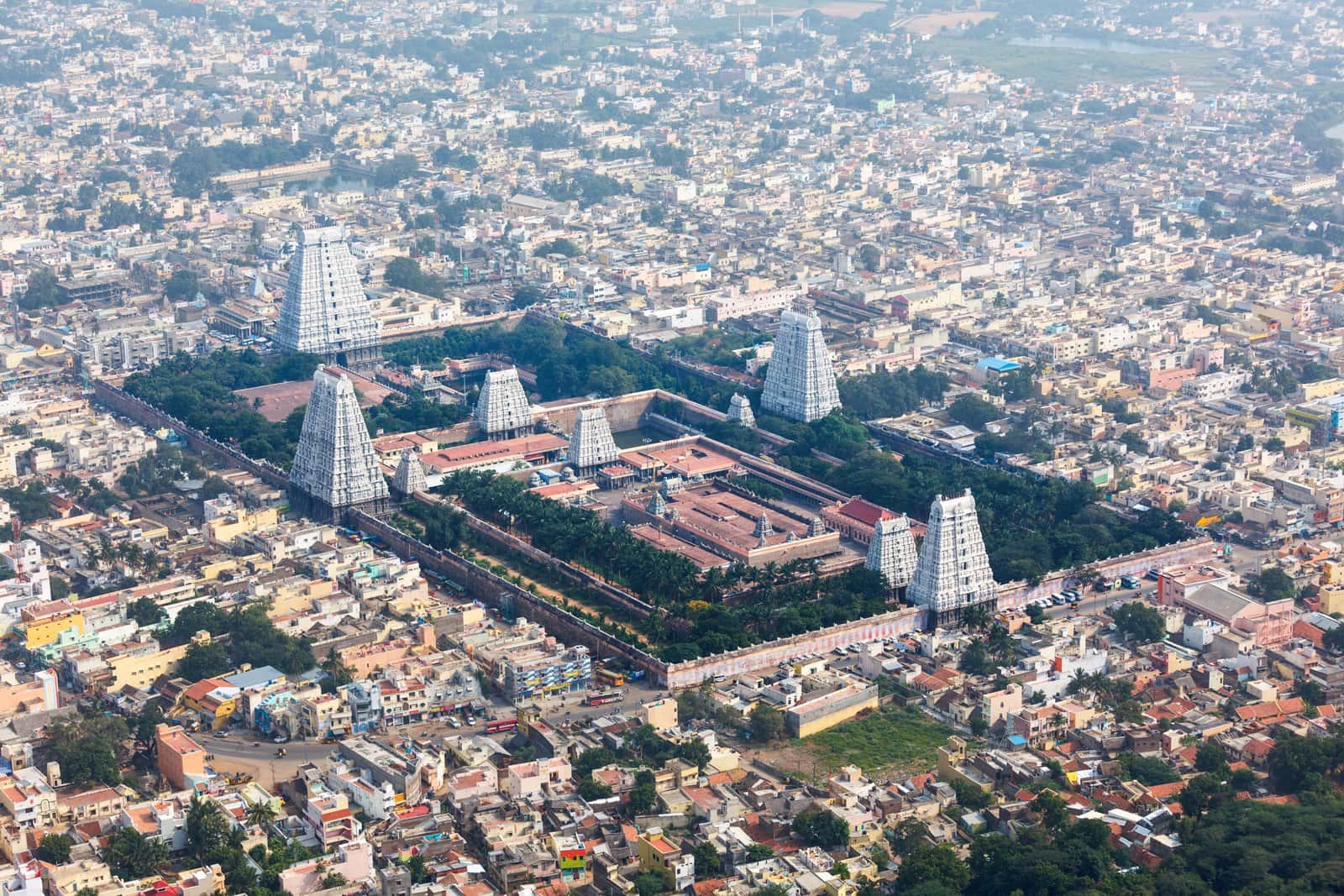
- The Arunachaleswarar (Annamalaiyar) templeThe fire element of the Pancha Bhoota temples, spread over about 25 acres and one of the largest in India, crowned by a towering East Raja Gopuram. It opens about 5:30 am to 12:30 pm and about 3:30 pm to 9:30 pm, with a midday break of roughly three hours; general darshan is free. Visit the thousand-pillared hall and the great tank inside.
- Arunachala, the sacred hillThe hill behind the temple is itself the deity, worshipped as Shiva appearing as a column of fire. Walking around it, the Girivalam, is the great act of devotion here, set out in full in the next section. The hill, not a statue, is the real shrine of Thiruvannamalai.
- The Sri Ramanasramam (Ramana Ashram)At the foot of the hill, the ashram of the sage Ramana Maharshi: a calm, welcoming place of meditation and the Samadhi shrine that draws seekers from across the world. Above it on the slope, the Virupaksha cave and Skandashram where he lived are reached by a walk up, covered below.
- The bazaar and the smaller shrinesThe streets around the temple form a busy pilgrim bazaar of flower stalls, brass, rudraksha and simple eateries. Several smaller ashrams and shrines, including Yogi Ram Surat Kumar's ashram, sit nearby for those who want a quieter hour.
Dress modestly with shoulders and knees covered, leave footwear outside, and keep the quiet, especially at the ashram. General darshan at the temple is free; special darshan, abhishekams and sevas are arranged at the temple counter or the official online booking service, not through gate touts. The next section is the heart of Thiruvannamalai: the fire hill and the Girivalam.
Arunachala, the Girivalam and the Deepam
Thiruvannamalai is the fire element, and its devotion is unusual: you do not just visit a shrine, you walk barefoot around a sacred hill. This is the heart of the place, so here is exactly how it works.
- The fire element, the hill itselfOf the five Pancha Bhoota temples, Arunachala is Agni, fire, and uniquely the deity is the hill itself, said to be the form Shiva took as an endless column of light. To worship here is to circle a mountain rather than to face a statue. The temple sits at its foot; the hill is the shrine.
- How the Girivalam worksThe Girivalam is the barefoot circumambulation of the hill, about 14 km, roughly three to four hours at a gentle pace. You walk clockwise, keeping the hill on your right, usually starting near the Arunachaleswarar temple, and pass the eight Ashta Lingam shrines set at the eight directions. Tea stalls and rest points line the route.
- When to walk itWalk it in the cool of the very early morning (many start around 3:30 to 6 am) or after dusk, never in the midday heat, since the road is hot and your feet are bare. On full-moon (Pournami) nights it becomes a vast, slow procession of lakhs; magical, but a crush, so a calm pre-dawn walk on an ordinary day is gentler.
- Climb to Ramana's cavesFrom near the Ramana Ashram, a stony walk of roughly 30 to 45 minutes up the lower slope reaches the Virupaksha cave and, a little higher, Skandashram, where Ramana Maharshi meditated for years, with fine views over the temple and town. The caves are generally open about 8 am to 5 pm with a midday break, so climb early.
Karthigai Deepam, the Karthigai Brahmotsavam, is a roughly ten-day festival in November when, on the great day, a giant cauldron of fire (the Maha Deepam) is lit atop Arunachala at dusk and seen for miles, the fire element made literal. In 2026 the Maha Deepam day is expected on about Tuesday 24 November 2026; treat that as the rule-plus-panchang date and reconfirm on the temple's official site before you book, as exact ritual timings shift each year. Lakhs to millions attend, so plan months ahead and read the safety section on the crowds.
The walk, the ashram and the stillness
Thiruvannamalai rewards both the devout and the seeker: the great barefoot walk, the sage's ashram, the cave climb, and a town shaped by silence. Here is how to actually have each experience.
- Do the Girivalam at dawnWalk the 14 km circuit barefoot in the cool first light, when the hill glows and the road is quiet. Start near the temple, go clockwise, allow three to four gentle hours, and pause at the Ashta Lingam shrines and the tea stalls. It is the single experience that defines a visit.
- Sit at the Ramana AshramSpend an unhurried hour at the ashram, at the Samadhi shrine and the meditation hall, where silence is the practice. Phones are not allowed in and around the halls, so leave yours away. It is a place to be still, not to tick off; the early morning chanting is especially moving.
- Climb to Virupaksha and SkandashramTake the stony path up from near the ashram, about 30 to 45 minutes, to the caves where Ramana meditated. Start by around 7:30 to 8 am before the heat and the glare, carry water, and remember the caves usually close at midday for a couple of hours.
- See the temple at a quiet hourAway from the full-moon crowds, the great temple is serene. An early-morning or evening darshan, ideally with a guide to read the gopurams, the thousand-pillared hall and the tank, is the best way to take in its scale without the crush.
- Eat simple and freshThiruvannamalai is a strongly vegetarian temple town with excellent, plain South Indian food and ashram-style meals. Eat at clean, busy places, try the local tiffin and filter coffee, and drink bottled or filtered water in the heat.
- Find your own quiet cornerMany seekers simply sit on the lower slopes of the hill at sunrise or sunset, or in one of the smaller ashrams, and let the place do its work. You do not need to fill every hour; the stillness is the point of Arunachala.
If you do only one thing slowly, make it the Girivalam at dawn. The 14 km barefoot circuit of the fire hill, taken gently in the cool first light with a few pauses at the shrines, is what pilgrims and seekers remember long after the bazaar and the photographs fade. Give it an unhurried morning, carry water, and let the hill set the pace.
Where to stay in Thiruvannamalai, and the ashram truth
Stay near the temple to be in the thick of the pilgrim town, or in a calmer hotel or resort with a hill view. The one thing to know: you cannot simply turn up and stay at the Ramana Ashram.
- Near the temple and the ashramPlenty of simple hotels and pilgrim lodges cluster around the Arunachaleswarar temple and the Ramana Ashram, walkable to darshan and the Girivalam start. Best for first-timers who want to step straight into the scene, though the streets are busy and noisy.
- Quieter hotels and hill-view resortsOn the edges of town are calmer mid-range hotels and a few resorts with Arunachala views, pools and yoga or meditation spaces. Better for couples, families and anyone who wants to slow down, though you will use autos to reach the temple.
- Room budgetsOutside festival peaks, simple budget rooms run from about 800 to 1,500 rupees, comfortable mid-range hotels about 2,000 to 4,500 rupees, and the few hill-view resorts about 5,000 to 12,000 rupees a night. All rise steeply and sell out around Karthigai Deepam and busy full moons.
- How many nightsOne full day and night covers the temple, a dawn Girivalam and the Ramana Ashram. A second night adds the cave climb, a quieter temple darshan and time simply to be still, which is what most seekers come for. For Karthigai Deepam, give it more and book far ahead.
Sri Ramanasramam offers limited rooms, but only to registered devotees who apply online weeks to months in advance; requests by phone, on arrival or at short notice are not accepted, and priority goes to long-term sadhakas. So unless you have a confirmed ashram reservation, plan to stay at a hotel and visit the ashram by day. Reconfirm the current accommodation rules on the official ashram site before relying on a stay there.
Thiruvannamalai costs and a realistic daily budget
Thiruvannamalai is one of the gentlest temple towns on the wallet: darshan is free and the Girivalam costs nothing. Here is what the rest comes to, so you can plan.
- A rough daily budgetExcluding your room and long-distance transport, a simple pilgrim day of vegetarian meals, water, autos and small offerings runs about 700 to 1,200 rupees. A comfortable mid-range day with better meals, a guide and a car comes to about 1,500 to 3,000 rupees. It is hard to spend a lot here.
- The free thingsGeneral darshan at the Arunachaleswarar temple is free, the Girivalam costs nothing, and sitting at the Ramana Ashram or on the hill is free too. The real cost of Thiruvannamalai is your time and your feet, not your wallet.
- What you do pay forSpecial darshan, abhishekams and sevas at the temple are paid at the counter or the official booking service; a local guide for the temple is worth it; and autos cost roughly 50 to 150 rupees a hop, agreed before you set off. Rooms are the main expense and the one that spikes at festivals.
- Cash and cardsBigger hotels and some shops take cards or UPI, but the bazaar, the autos, the small eateries and the offerings run on cash. There are bank ATMs in town, so carry enough cash for the day and small notes for offerings and tips.
Practical logistics: the Girivalam route, getting around, food and money
The small things that make a Thiruvannamalai day smooth, from where the Girivalam starts and which way you walk, to autos, ATMs and the festival dates to plan around.
- The Girivalam route and directionStart the 14 km circuit near the Arunachaleswarar temple and walk clockwise, keeping the hill on your right, passing the eight Ashta Lingam shrines. The road is shared with traffic on ordinary days and closed or thronged on full moons, so walk on the inner side and stay alert.
- Getting around townThe temple, the bazaar and the Girivalam start are walkable. Autos handle the short hops to the Ramana Ashram and around town for roughly 50 to 150 rupees a ride, agreed before you set off. Bicycles and two-wheelers can be hired for the day if you prefer to be independent.
- Money, food and waterCarry cash for the bazaar, autos, eateries and offerings; ATMs are in town. The food is strongly vegetarian and good, so eat at clean, busy places and drink bottled or filtered water, especially before a long walk in the heat.
- Dates to plan aroundCheck the full-moon (Pournami) calendar and the Karthigai Deepam date (about 24 November 2026) before you book, since both decide whether your visit is calm or a crush. Reconfirm festival dates and temple timings on the official temple site, as ritual timings shift each year.
Safety, the barefoot walk, the heat and the festival crowds
Thiruvannamalai is gentle and welcoming, but the barefoot night walk, the heat and the festival crowds need real care. A little planning keeps the visit happy and safe.
- The barefoot 14 km walkThe Girivalam is walked barefoot by tradition on a hard road, which is tiring and can blister or cut feet, especially in the heat. Walk it before dawn or after dusk, carry water, pace it gently, and stop if you need to. Older walkers should do a shorter stretch or be driven the circuit with stops.
- Heat, sun and hydrationFrom April to June the heat is fierce and the open temple, the walk and the hill climb drain you fast. Carry and drink plenty of water, wear a hat and cottons, keep the middle of the day for rest, and do the cave climb early before the glare builds.
- Festival and full-moon crowdsKarthigai Deepam draws lakhs to millions and the full-moon Girivalam draws lakhs. In such crowds, keep children close, agree a meeting point, avoid the densest crush near the temple at peak, and follow police and volunteer directions. If you want calm, simply come on an ordinary day.
- The hill and the cavesThe path to Virupaksha and Skandashram is stony and exposed; wear grippy footwear for the climb (you remove it at the caves), watch your step, and be alert to monkeys and, rarely, snakes in the warm months. Do not climb the full Arunachala summit casually; the lower caves are the rewarding, safe goal.
- Touts, guides and offeringsArrange any abhishekam or seva at the temple counter or the official booking service, and a guide through your hotel or operator rather than a gate tout. A polite, firm no handles pushy offers; nothing requires a large payment to worship.
Thiruvannamalai is a calm, devotional town that solo travellers, including women, generally find easy with standard precautions, helped by the large resident seeker community. Seniors can do it comfortably by staying near the temple, taking a gentle dawn stretch of the Girivalam or being driven the circuit with stops, climbing the caves slowly or skipping them, and avoiding the full-moon and Deepam crush.
Thiruvannamalai for every kind of traveller, and on access
Thiruvannamalai draws very different visitors. Here is what it offers you, and the one tip that matters for each, including how a senior pilgrim does it comfortably.
- Shaivite devotees and pilgrimsThe fire element of the Pancha Bhoota temples and the sacred hill. Walk the Girivalam, take a quiet darshan in the cool hours, and consider timing a visit to a full moon or Karthigai Deepam if you can handle the crowds.
- Spiritual seekersThe seat of Ramana Maharshi and his teaching of self-enquiry. Spend unhurried time at the ashram and the caves, and feel why seekers from across the world settle here. Book a hotel; ashram rooms are reservation-only for registered devotees.
- Senior travellers and on accessibilityVery doable with care. The temple courtyards are largely flat, but the Girivalam is 14 km barefoot, so walk a short stretch gently at dawn or be driven the circuit with stops, and take the cave climb slowly or skip it. Stay near the temple, avoid the full-moon and Deepam crush, and keep to the cool hours.
- Families with childrenThe great temple, the hill and the ashram are a gentle, awe-inspiring introduction. Do a short stretch of the Girivalam in the cool morning rather than the full 14 km with little ones, and keep them close in any festival crowd.
- Budget travellers and backpackersOne of the cheapest temple towns in the south: free darshan, a free walk, simple rooms from about 800 rupees and excellent vegetarian meals for very little. A long-loved stop for slow, low-cost spiritual travel.
- PhotographersThe hill behind the gopurams at sunrise, the pilgrims on the Girivalam road, and the Maha Deepam fire at Karthigai. Use early and late light, ask before photographing people at prayer, and respect the no-phone rule inside the ashram halls.
A suggested Thiruvannamalai itinerary
How to shape one or two unhurried days so you catch the Girivalam at dawn, the temple at a quiet hour, and the ashram and caves without rushing.
- Day one, before dawn and morningStart the Girivalam in the cool dark, around 4 to 5 am, walking clockwise from near the temple; allow three to four gentle hours. Then take an early darshan at the Arunachaleswarar temple before the midday closing, and breakfast at a simple eatery.
- Day one, afternoon and eveningRest through the heat. In the later afternoon visit the Ramana Ashram for the Samadhi shrine and the meditation hall, then return to the temple for an evening darshan after about 3:30 pm, and watch the hill glow at sunset.
- Day two, if you have itClimb to the Virupaksha cave and Skandashram early, before the heat and the midday closing, then spend a slow afternoon sitting at the ashram or a smaller shrine. A second night turns a tick-the-box stop into the still pause that Arunachala does best.
- The festival versionFor Karthigai Deepam (about 24 November 2026) or a full-moon Girivalam, give the town more time, book months ahead, arrive before the worst of the crowds, and follow the safety guidance. The energy is extraordinary, but it is not a quiet visit.
The thing that breaks a tight Thiruvannamalai plan is arriving at the Arunachaleswarar temple during its midday closing, roughly 12:30 pm to 3:30 pm, and the caves close around midday too. Build your day so darshan and the climb fall in the morning or after about 3:30 pm, keep the hot middle of the day for rest, and you will never stand at a shut gate with the clock running.
The real questions travellers ask about Thiruvannamalai
Straight answers to the questions that come up again and again on traveller forums and reviews, so you arrive already knowing the score.
- How many days do I need?One full day and night covers the temple, a dawn Girivalam and the Ramana Ashram. Two nights is better and adds the cave climb, a quieter darshan and time to simply be still, which is what most seekers come for. Half a day in transit only scratches the surface.
- Can I stay at the Ramana Ashram?Only with a confirmed online reservation as a registered devotee, applied for weeks to months ahead, with priority for long-term sadhakas. You cannot book on arrival or by phone, so general visitors should stay at a hotel and visit the ashram by day.
- Is the 14 km barefoot walk hard?It is long but flat and walkable at a gentle pace in three to four hours; the difficulty is the bare feet on a hard road and the heat. Walk before dawn or after dusk, carry water, and if it is too much, do a shorter stretch or be driven the circuit with stops at the shrines.
- When exactly is Karthigai Deepam in 2026?The Maha Deepam day is expected on about Tuesday 24 November 2026, the climax of a roughly ten-day festival, when a giant fire is lit atop the hill. Treat it as the panchang date and reconfirm on the official temple site before booking, as exact timings shift each year. Lakhs to millions attend.
- What are the temple darshan timings?The Arunachaleswarar temple is open about 5:30 am to 12:30 pm and about 3:30 pm to 9:30 pm, with a midday break, and general darshan is free. The early morning and the evening after about 7 pm are the calmest, with the shortest queues, on an ordinary day.
- Should I time it to a full moon, or avoid it?A full-moon Girivalam is a powerful, communal experience, but it is a crush of lakhs with scarce rooms and heavy traffic. For a calm, reflective visit, come on an ordinary weekday and walk before dawn; for the energy, plan and book a full moon or Deepam far ahead.
Planning Thiruvannamalai from abroad
Thiruvannamalai is the fire element of the Pancha Bhoota temples and a world-famous seat of self-enquiry through Ramana Maharshi, a deeply rewarding stop for overseas and NRI travellers. A little preparation makes the temple rules, the walk and the ashram easy to handle.
- Come via ChennaiFly into Chennai, then drive about 185 km (roughly four to five hours) to Thiruvannamalai, pairing it with Kanchipuram and Pondicherry on a southern temple loop. It is the fire element of the Pancha Bhoota journey and the seat of Ramana's teaching.
- Walk the hill and sit at the ashramDo the Girivalam at dawn (or a gentle stretch of it), spend unhurried time at the Ramana Ashram and climb to the caves above. The hill itself is the deity, worshipped as a column of light, so to be here is to circle a mountain rather than to face a shrine.
- Book a hotel; do not count on the ashramRamana Ashram rooms are reserved for registered devotees who apply online well ahead, never on arrival, so unless you have a confirmation, book a comfortable hotel and visit the ashram by day. This single fact catches many first-time overseas seekers off guard.
- Time the festival, or avoid itKarthigai Deepam (about 24 November 2026) and the monthly full moons are extraordinary but enormously crowded. Plan far ahead for them, or come on an ordinary day for calm, which is when the place opens up for quiet meditation and the dawn walk.
Many overseas visitors come specifically for Ramana and the hill rather than as part of a temple tour, and Thiruvannamalai rewards that: it is small, walkable, vegetarian and quiet, with a long-established international seeker community. Give it two unhurried nights, stay near the ashram, do a dawn Girivalam, and let the hill set the pace. It is one of the gentlest, most profound introductions to spiritual India.
Money, connectivity and timing for foreign visitors
The practical basics an overseas traveller needs for a small temple town: cash, cards, a SIM, the heat, and how many days to give it on a wider South India trip.
- Carry cash, expect simplicityCards and UPI work at bigger hotels, but the bazaar, the autos, the small eateries and the temple offerings run on cash. Draw rupees at the town ATMs or before you arrive, and keep small notes for autos, tips and offerings. Prices here are low and rarely negotiable in the eateries.
- Get a SIM at the airportPick up an Indian tourist SIM or an eSIM when you land in Chennai or Bengaluru rather than hunting for one in a small town. Coverage in Thiruvannamalai is fine for maps, calls and ride-booking around town and to the ashram.
- Respect the heat and the rulesFrom April to June it is hot, so come October to March if you can, and either way keep darshan and the Girivalam to the cool hours. Dress modestly, go barefoot at the temple, the ashram and on the walk, and keep phones away in the ashram halls.
- How long to give it on a bigger tripOn a South India trip, two nights in Thiruvannamalai is the right weight between Chennai or Pondicherry and Kanchipuram: enough for a dawn Girivalam, the temple, the ashram and the caves, without rushing the stillness that is the whole point of coming.
Why the hill itself is worshipped as a column of light
Arunachala is not a temple with a hill behind it; the hill is the god. The tradition, told in the Shiva Purana and retold by the temple, is that Vishnu and Brahma once quarrelled over who was supreme, and Shiva appeared between them as an endless column of fire and light (the Lingodbhava), challenging each to find its end. Vishnu as a boar dug downward and Brahma as a swan flew upward, and neither could reach it; the fire had no beginning and no end. That infinite column of light is said to be Arunachala itself, which is why here, alone among the five Pancha Bhoota temples, devotees worship the mountain as the fire element of Shiva and walk barefoot around it rather than only facing a shrine. Each year at Karthigai Deepam a giant flame is lit on the summit to make that fire visible again. The story is a living tradition from the Shiva Purana rather than datable history, and that is exactly how the temple itself tells it.
Planning a Thiruvannamalai trip?
Our Tamil Nadu travel experts plan your full journey for you: route, hotels, darshan timings and transport. You get a free day-by-day plan and an exact quote on WhatsApp, usually within a few hours. No payment is needed to get your plan.