Halebid Travel Guide
The clear window is October to February , cool and dry. This is Malnad-edge country, so the monsoon and the heat both work against an open, sun-exposed temple platform.
When to visit Halebid, and why the season matters here
The clear window is October to February, cool and dry. This is Malnad-edge country, so the monsoon and the heat both work against an open, sun-exposed temple platform.
- October to February: cool and clearThe most comfortable months, pleasant by day and cool in the evening, roughly 15 to 28 degrees Celsius. The soapstone friezes read best in soft morning light, so an early start in these months is the ideal combination of good weather and good light.
- March to May: hot and humidThe temple platform is open and sun-exposed, and the pre-monsoon months turn hot and sticky, often into the mid to high thirties. If you must come then, do the temples early and keep the middle of the day for a shaded break in Hassan or Chikmagalur.
- June to September: the monsoonThis part of Karnataka, on the edge of the Malnad hills, gets heavy monsoon rain. The temples stay open and the countryside is green and lovely, but plan for downpours, slippery stone underfoot and grey light that dulls the carving.
- Pick your day around the museumWhatever the month, avoid a Friday if the ASI Archaeological Museum matters to you, because it is closed that day. Most travellers want the museum's sculpture gallery, so a Friday-only visit leaves you looking at a locked door for part of the site.
The single thing that changes how Halebid feels is the light on the stone. Come in the first couple of hours after opening, ideally in the cool months from October to February, and the low sun rakes across the friezes so the thousands of tiny figures stand out in relief. By midday the light is flat and the platform is hot, and the same carving looks ordinary. Start early and you see the temple the way its builders meant it to be seen.
How to reach Halebid
Halebid has no airport or railway of its own worth relying on. Almost everyone comes through Hassan, the base town, or drives down from Bangalore.
- Via Hassan, the base townHassan is the practical hub for the Hoysala circuit. Halebid is about 31 to 33 km away, roughly 45 minutes by road, and Belur about the same. Hassan Junction is the nearest useful railway station, well connected by train to Bangalore, Mysore and Mangalore.
- From Bangalore by roadBangalore is about 184 km from Hassan and about 217 to 220 km from Belur, roughly 3.5 hours on the four-lane NH75. A Bangalore day trip to Belur and Halebid is possible but makes a very long day, so an overnight in Hassan or Chikmagalur is far more comfortable. We can arrange a car with an experienced driver.
- Nearest airportThe nearest usable airport is Mangalore (Mangaluru) at about 160 km, and Bangalore's Kempegowda International Airport at about 220 km is the main gateway for most travellers. There are no flights into Halebid or Hassan themselves, so plan to fly to one of these and drive.
- By train to Hassan, then roadTake a train to Hassan Junction from Bangalore, Mysore or Mangalore, which is a comfortable 3 to 4 hours from Bangalore, then a taxi or local bus to Halebid and Belur. Halebid and Belur have no meaningful rail service of their own, so Hassan is the last rail leg for almost every visitor.
Fly into Bangalore (Bengaluru), the main South India gateway, then drive about 3.5 hours to Hassan or Chikmagalur and visit the Hoysala temples from there. There are no international flights near Halebid itself.
Fly into Bangalore or Mangalore, then drive to Hassan. The temples slot neatly onto a South India loop with Mysore, Coorg and the Karnataka coast.
Take a train to Hassan Junction from Bangalore, Mysore or Mangalore, or drive down the NH75 from Bangalore. Hassan is the simplest way in by rail, and the short hop to the temples is by taxi or bus.
The Hoysaleswara Temple, and the rest of Halebid
Halebid is the Hoysaleswara Temple above all, a 12th-century soapstone masterpiece, plus a smaller Hoysala shrine, Jain basadis and the ASI museum. A few rules are worth knowing first.
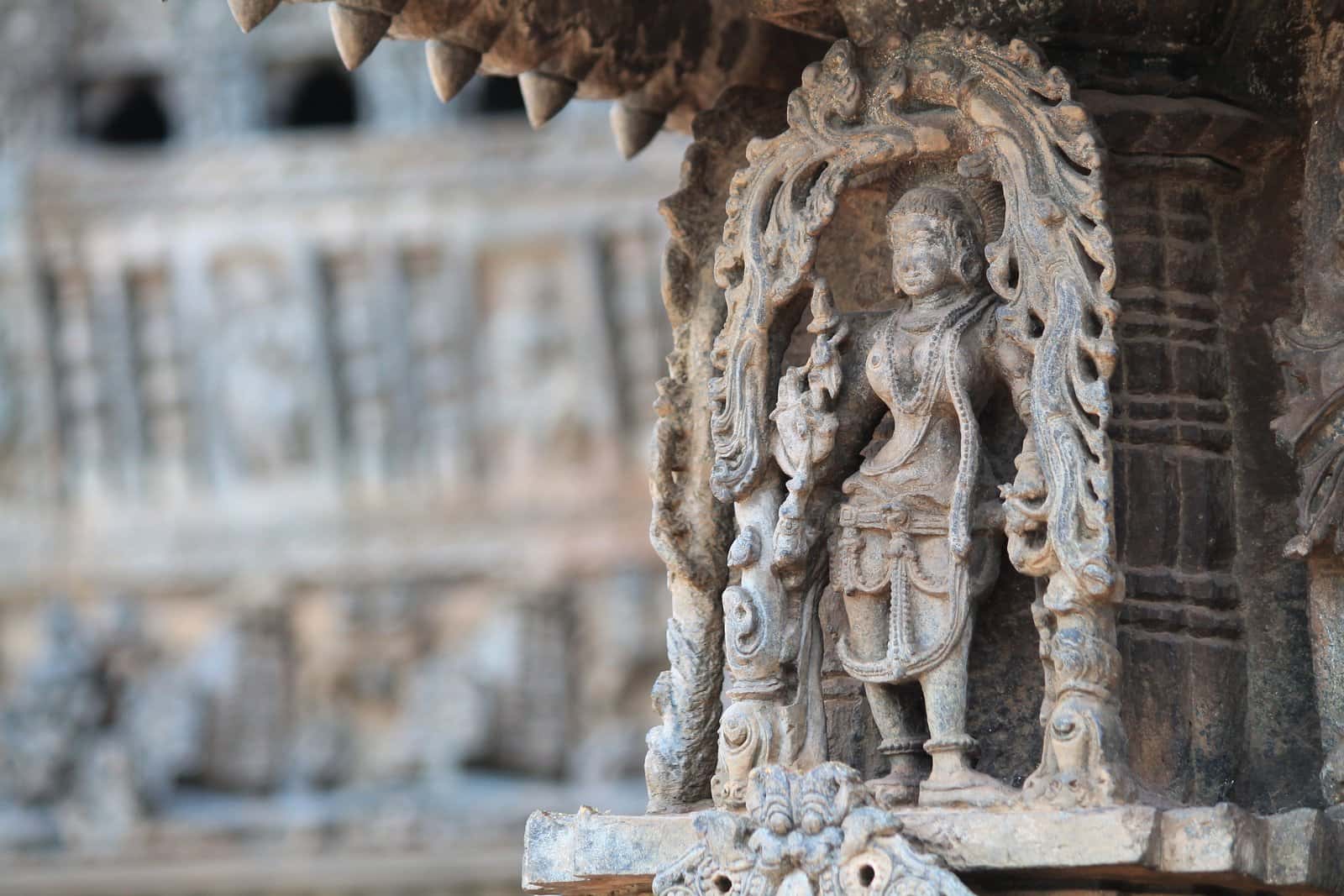
- The Hoysaleswara TempleThe reason to come: a twin-shrine temple built in the 12th century, its walls covered in a continuous band of soapstone sculpture, elephants, riders, gods and epic scenes, carved in extraordinary detail. It is an Archaeological Survey of India monument and, unlike Belur, no longer a place of active worship, so it is open for sightseeing with no darshan queue. It opens daily, commonly around 6:30 am to about 9 pm, and entry to the temple is widely reported as free.
- The ASI Archaeological MuseumIn the same complex, the museum holds Hoysala sculpture, inscriptions and a large seated Nandi. It keeps its own hours of about 9 am to 5 pm, charges a small fee, and is closed on Fridays. Photography is not allowed inside the museum, though you can photograph the open temple freely.
- Kedareshwara Temple and the Jain basadisA short walk away, the smaller Kedareshwara Temple is another fine Hoysala shrine, and a cluster of Jain basadis nearby shows the same craftsmanship in a Jain setting. Both are ASI-protected and easy to add on foot.
- The temple tank and the settingHalebidu, once the Hoysala capital, still has its old temple tank and open surroundings, which UNESCO records as part of the site's protected setting. It is a quiet, uncrowded place compared with the big South Indian temple towns, which is part of its appeal.
First, the ASI Archaeological Museum is closed on Fridays, so if the sculpture gallery matters to you, do not come on a Friday. Second, photography is banned inside the museum, even though you can shoot the open temple as much as you like. Plan the museum around the Friday closure and keep your camera for the temple, and you will not be caught out.
How to actually experience the Hoysala temples
The carving here rewards slow, guided looking more than almost any monument in India. These are the experiences that make the trip, and how to arrange them well.
- Read the friezes with a guideThis is the one thing to get right. The Hoysala sculpture is so dense and so specific that without explanation you walk straight past the finest details, the tiny musicians, the hidden scenes, the artists' signatures. ASI-approved guides wait at the gate for a modest fee, often quoted around 200 rupees, agreed before you start, and they turn a wall of stone into a story.
- See Belur and Halebid togetherThe two temples are about 16 km apart, roughly 30 minutes, and are almost always visited as a pair. Belur's Chennakeshava Temple is a living place of worship, still active since 1117 CE, so it has a different, devotional atmosphere; Halebid is quieter and purely for sightseeing. Seeing both in one outing shows the full range of the Hoysala style.
- Come at opening for the lightArrive in the first couple of hours after opening for the raking morning light that makes the carving stand out, and to beat the tour buses. Departing your base by early morning is the standard advice for exactly this reason.
- Add Shravanabelagola for the Jain colossusAbout 51 km from Hassan, the great Jain hill of Shravanabelagola carries the 57 foot Gomateshwara statue, one of the largest monoliths in the world, reached by a climb of stone steps. It completes the classic Hoysala-and-Jain circuit and is worth the extra half day if you can spare it.
- Slow down in coffee countryIf you base in Chikmagalur, about an hour from Belur, you can pair the temples with the coffee estates and hills of the Western Ghats, turning a heritage day into a relaxed weekend.
If you do only one thing well at Halebid, hire the guide. At most Indian monuments you can wander and still get a good experience, but the Hoysala temples are the exception: the whole point is the sculpture, and the sculpture is a language you cannot read on your own. A modest fee agreed at the gate is the difference between admiring a pretty temple for twenty minutes and being genuinely moved by it for two hours.
Where to stay for the Hoysala temples, and how long
There is little good accommodation in Halebid or Belur themselves, so treat Halebid as a day trip. The two sensible bases are Hassan for convenience and Chikmagalur for scenery.
- Hassan: the convenient baseHassan is the practical hub, roughly 45 minutes from both Halebid and Belur and about an hour from Shravanabelagola, with the railhead and a decent spread of hotels from simple lodges to mid-range and upper properties. It is not a pretty town, but it is the most efficient place to sleep if the temples are your goal.
- Chikmagalur: the scenic baseChikmagalur, about an hour from Belur, sits in coffee-and-hills country with far nicer resorts and homestays. Choose it if you want to pair the temples with the Western Ghats and do not mind a little more driving to reach Halebid and Shravanabelagola.
- Halebid and Belur themselvesThere are only a handful of basic options in the temple towns and they are generally poor value, so almost no one stays overnight in Halebid. Plan to sleep in Hassan or Chikmagalur and visit the temples by day.
- How many daysA full but comfortable day from a Hassan base covers Halebid, Belur and, with an early start, Shravanabelagola. Two nights lets you slow down or add Chikmagalur's coffee estates. A single Bangalore day trip can technically reach Belur and Halebid, but it is a long, tiring day and Shravanabelagola makes it too much.
The circuit works best from a single base rather than moving hotels each night. Sleep in Hassan or Chikmagalur, do Halebid and Belur on one day and Shravanabelagola on another (or squeeze all three into one long, early day), and you avoid the wasted hours of packing and checking in that spoil a short heritage trip. The distances are small enough that a single base reaches everything.
Halebid costs and a realistic budget
The temples are cheap or free to enter; the real cost is the car and the base hotel. Here is what the main things cost so you can plan.
- Entry and museumEntry to the Hoysaleswara Temple is widely reported as free, though a few listings mention a small ASI ticket of about 25 rupees for Indians and about 300 rupees for foreign nationals, so carry small change and reconfirm at the gate. The ASI museum charges a small separate fee and is closed on Fridays.
- The guideAn ASI-approved guide at the gate is the best money you will spend here, often quoted around 200 rupees, agreed before you begin. Given how much you would miss without one, it is close to essential rather than optional at these temples.
- The real cost is transportBecause there is no good stay in Halebid and no direct flight or train, the main expense is the car or taxi that links your base, Hassan or Chikmagalur, with Halebid, Belur and Shravanabelagola. A full-day cab for the circuit is the sensible way to do it and the single biggest line in the budget.
- Cash and cardsCarry cash for the guide, small entry fees, snacks and local transport, as the temple towns are small and not everywhere takes cards or UPI. There are ATMs in Hassan; do not count on one at Halebid itself.
The temples themselves cost almost nothing, so the budget for a Halebid trip is really the budget for the car and the base hotel. Book a full-day cab from Hassan or Chikmagalur, add a modest guide fee and small entry and museum tickets, and the sightseeing itself is one of the best-value world-class experiences in India. Spend where it counts, on the driver and the guide, and the rest is inexpensive.
Practical logistics: food, water, getting around and the circuit
The small things that make a Hoysala day smooth, from where to eat to how to order the circuit and get between the three sites.
- Food and waterHalebid and Belur are small towns with simple South Indian eateries near the temples, good for a dosa or a thali, but not much choice. Carry water, especially in the warmer months, since the temple platform is open and sun-exposed. Hassan and Chikmagalur have the fuller range of restaurants.
- Order the circuit sensiblyFrom Hassan, a clean order is Shravanabelagola first if you start early, then Belur and Halebid, or simply Belur and Halebid together on one day with Shravanabelagola on another. Halebid to Belur is about 16 km, Hassan to Halebid about 31 to 33 km, and Hassan to Shravanabelagola about 51 km, so nothing is far.
- Getting aroundThere is no local metro or app-cab network here; a hired car with driver for the day is by far the easiest way to link the sites. Local buses do run between Hassan, Belur and Halebid for budget travellers, but they eat time on a short trip.
- Language and signalKannada is the local language, with Hindi and English understood in the tourist and hotel trade. Mobile coverage is generally fine in Hassan and the towns; download offline maps in case a stretch of the drive is patchy.
Safety, sun and staying well at Halebid
Halebid is a calm, low-hassle heritage town with few of the touts of the big pilgrimage centres. The real risks here are the sun, the heat and the drive, not crime.
- Sun and heat on the platformThe temple sits on an open, sun-exposed platform with little shade. In the warmer months carry water, wear a hat and sunscreen, and do your looking in the cooler morning hours. This is the main discomfort most visitors report, not any safety concern.
- Underfoot and the museum stepsThe stone platform is flat but can be smooth and, in the monsoon, slippery. You will remove shoes at the living Belur temple, so socks help on hot stone. Take the museum and any steps slowly, especially with older travellers.
- Low hassle, but agree the guide feeHalebid is refreshingly free of the aggressive touts you find at busier sites. The only friction is the occasional freelance guide or trinket seller; use an ASI-approved guide and agree the fee before you start, and there is little to manage.
- The driveThe biggest practical risk on this trip is the road, given the distances and, from Bangalore, a long day. Use a reputable driver, avoid rushing back after dark on rural roads, and build in enough time so no one is racing the clock.
The Hoysala circuit is one of the more relaxed heritage trips in South India for solo and women travellers. The sites are calm and low-hassle, and the main planning point is simply the logistics, a reliable driver and not being stranded after dark, rather than any particular safety worry at the temples themselves. Standard precautions and a pre-arranged car cover it.
Halebid for every kind of traveller, and on access
The Hoysala temples suit very different visitors in different ways. Here is what they offer you, and the one tip that matters for each, including how a senior does the circuit comfortably.
- History and art loversThis is your trip above all. With a guide and an unhurried morning, the Hoysaleswara and Chennakeshava temples are among the most rewarding sculpture in the world. Give the friezes time and read up on the Hoysala style before you go.
- CouplesA quiet, cultured day away from crowds, easily paired with the coffee hills of Chikmagalur for a scenic weekend. An overnight in Chikmagalur turns the temples into a relaxed two-day escape rather than a rush.
- Families with childrenThe open temple is easy for children to walk around, and a guide who tells the stories in the carvings, battles, animals, gods, keeps them engaged. Carry water and sun protection, and keep the museum for when energy is high.
- Senior travellers and on accessibilityVery doable with planning. The temple platform is flat, which helps, but it is open and sunny, so visit early. Base in Hassan to keep the driving short, use a hired car door to door, and consider skipping the long stone climb at Shravanabelagola if steps are difficult, since the temples at Halebid and Belur are the gentler part of the circuit.
- PhotographersCome at opening for the raking light on the friezes, shoot the open temple freely, and remember the ban on photography inside the museum. Overcast monsoon light flattens the carving, so the cool, clear months are best.
- Budget and backpack travellersEntry is cheap or free and local buses link Hassan, Belur and Halebid, so the circuit is very affordable if you have time. The one thing worth paying for even on a tight budget is the guide.
A suggested Hoysala circuit itinerary
How to shape one or two days so you catch the temples in good light, fit the museum around its Friday closure, and add Shravanabelagola without a rushed day.
- The comfortable one-day plan from HassanLeave Hassan early, reach Belur at opening for the morning light and the living temple, take a guide, then drive the 16 km to Halebid for the Hoysaleswara Temple, the Kedareshwara Temple and the Jain basadis, with the ASI museum if it is not a Friday. Back to Hassan by evening.
- Adding ShravanabelagolaIf you want all three, start very early and do Shravanabelagola first, climbing to the Gomateshwara statue before the heat, then Belur and Halebid in the afternoon. It is a full day, so consider splitting it across two if you have the time.
- The two-day, slower versionDay one, Belur and Halebid unhurried with a guide; day two, Shravanabelagola in the morning and a Chikmagalur coffee estate in the afternoon. This is the most relaxed way and turns the circuit into a proper weekend.
- The Bangalore day trip, honestlyBangalore to Belur and Halebid and back in a day is possible on the NH75 but it is a very long day of about 7 hours driving plus the temples, so leave before dawn and skip Shravanabelagola. An overnight in Hassan is far more comfortable and lets you see the temples in good morning light.
The single thing that quietly breaks a tight Hoysala plan is arriving at the ASI Archaeological Museum on a Friday, when it is closed. Build your circuit so the museum falls on any day but Friday, keep the open temples for a Friday if that is the only day you have, and you will not find yourself standing at a locked museum door having driven a long way to see the sculpture gallery.
The real questions travellers ask about Halebid
Straight answers to the questions that come up again and again on traveller forums, so you arrive already knowing the score.
- Is Halebid worth it?Yes, emphatically, if you like architecture and sculpture. The Hoysala carving is among the most extraordinary anywhere, and the 2023 UNESCO inscription confirms what art lovers have long said. Many visitors come away wondering why the temples are not far more famous.
- Bangalore day trip or overnight?You can reach Belur and Halebid from Bangalore in a day, but it is a very long day of driving, so most people enjoy it far more with an overnight in Hassan or Chikmagalur. Do not try to add Shravanabelagola to a single Bangalore day.
- Hassan or Chikmagalur as a base?Hassan is the convenient, efficient base closest to all three sites. Chikmagalur is the scenic base, about an hour from Belur, better if you want coffee country and nicer resorts. Both work; pick by whether you want convenience or scenery.
- Do I really need a guide?At these temples, yes, more than almost anywhere in India. The sculpture is so dense that without a guide you miss the best of it. An ASI-approved guide at the gate, often around 200 rupees agreed first, is the best value on the whole trip.
- What is the difference between Belur and Halebid?Belur's Chennakeshava Temple is a living place of worship, active since 1117 CE, so it has darshan and a devotional feel. Halebid's Hoysaleswara Temple is no longer used for worship and is purely for sightseeing. See both; they show the full range of the Hoysala style.
- Timings, fees and photos?The Hoysaleswara Temple opens daily, commonly around 6:30 am to about 9 pm, with entry widely reported as free (a small ASI ticket is mentioned by some listings, so reconfirm at the gate). The museum runs about 9 am to 5 pm, is closed on Fridays, and bans photography inside, though the open temple can be photographed freely.
Planning the Hoysala temples from abroad
The Hoysala temples are a genuine UNESCO discovery still missed by most foreign itineraries. A little preparation on the guide, the day-trip logistics and the circuit makes them easy to fit into a South India trip.
- Know it is a UNESCO World Heritage Site nowThe Sacred Ensembles of the Hoysalas, Belur, Halebidu and Somanathapura, were inscribed on the UNESCO World Heritage List on 18 September 2023 as India's 42nd site. That recency is exactly why they are still uncrowded by international visitors, which is a rare thing for a monument of this quality.
- Hire the guide, alwaysThis is the one piece of advice to act on. The sculpture is a dense visual language, and an ASI-approved guide at the gate, for a modest fee, is what turns the temple from a pretty building into an unforgettable one. Do not skip it to save a small amount.
- Treat Halebid as a day tripThere is no comfortable stay in Halebid or Belur, so base in Hassan or the coffee hills of Chikmagalur and visit by day. Fly into Bangalore or Mangalore, drive to your base, and do the temples from there.
- Fit it into a South India loopThe circuit pairs naturally with Mysore, Coorg and the Karnataka coast. Give the Hoysala temples a full day with a guide, add Shravanabelagola if you can, and they become one of the most memorable stops on a southern trip.
Money, timing and access for foreign visitors
The practical basics an overseas traveller needs for a small heritage circuit: cash, timing, how the fees and rules work, and how many days to give it on a wider India trip.
- Carry cash, expect small feesThe temple towns are small, so carry cash for the guide, the museum fee and any temple ticket, snacks and local transport. Entry to the Hoysaleswara Temple is widely reported as free, but some listings mention a small ASI ticket of about 300 rupees for foreign nationals, so keep change and reconfirm at the gate. Draw cash in Hassan; do not rely on an ATM at Halebid.
- Photography rulesYou can photograph the open Hoysaleswara Temple freely, which is a photographer's dream in the morning light, but photography is banned inside the ASI museum. Belur is a living temple, so be discreet and follow any signs near the sanctum.
- How long to give itOn a South India trip, one full day covers Belur and Halebid well with a guide, and a second day adds Shravanabelagola or Chikmagalur. That is the right weight between Mysore and the coast, enough to do the temples justice without slowing the whole itinerary.
- Time your visit to the seasonOctober to February is the comfortable window, cool and dry with the best light on the carving. Avoid the June to September monsoon if you can, when heavy rain and grey skies dull the sculpture and make the stone slippery underfoot.
The Hoysala temples are one of India's great under-visited treasures, and for an overseas traveller they offer something rare: world-class art with almost no crowds. Slot them into a Karnataka loop after Mysore, give them a full day with a guide, and let Halebid and Belur be the quiet, astonishing chapter that most first-time itineraries skip. Many visitors say the carving here is the thing they remember most from the south.
The temples the artists signed
What sets the Hoysala temples apart is not only the density of the carving but that the artists signed their work, an unusual practice in the Indian subcontinent. Along the friezes and beneath the sculptures you can find the names of the sculptors who made them, a mark of the standing they enjoyed in Hoysala society. UNESCO cites these signatures directly in the Outstanding Universal Value of the Sacred Ensembles of the Hoysalas, noting that they point to the artists' high degree of artistic agency and prestige. The recurring emblem of the dynasty, Sala striking down a tiger, appears again and again as a kind of maker's crest on the temples. To stand at Halebid and have a guide point out a nine-hundred-year-old signature in the stone is to feel the distance between you and the maker collapse. It is the detail that turns a wall of sculpture into the work of named human hands.
Planning a Halebid trip?
Our Karnataka travel experts plan your full journey for you: route, hotels, darshan timings and transport. You get a free day-by-day plan and an exact quote on WhatsApp, usually within a few hours. No payment is needed to get your plan.