Pavagarh Travel Guide
The comfortable window is October to March . The monsoon greens the hill and brings waterfalls but can suspend the ropeway, and high summer on the plain is hot, so plan the...
When to visit Champaner-Pavagadh
The comfortable window is October to March. The monsoon greens the hill and brings waterfalls but can suspend the ropeway, and high summer on the plain is hot, so plan the season around how you want to climb.
- October to March: the comfortable windowCool and pleasant, roughly 15 to 30 degrees Celsius, with clear air and the best views from the ropeway and the summit. This is the easiest time for both the darshan and a proper walk around the Champaner ruins, and it takes in the Navratri and winter pilgrimage season. Days are short, so start early to fit both the temple and the monuments.
- April to June: hot on the plainHigh summer is fierce on the open plain and tiring for the steps that remain after the ropeway. If you must come then, be at the base for the early ropeway start and be off the hill before the midday heat, and carry water and sun protection for the exposed climb to the shrine.
- July to September: green but slipperyThe monsoon turns the hill lush and brings seasonal waterfalls that many Gujarati visitors love, but the trek gets slippery and the ropeway can be suspended for safety in bad weather. It is a beautiful time to see the hill, but treat the climb with respect and check the ropeway service a day ahead.
- Navratri and weekends: expect crowdsAs a living Shakti Peetha the temple is busiest at Navratri and on Sundays and public holidays, when queues can run to a couple of hours. If you want a calmer darshan, come on a weekday and go early; if you want the devotional atmosphere at its fullest, Navratri is the time, but plan for the rush.
The monsoon is genuinely lovely on Pavagadh, but the passenger ropeway can be suspended in heavy rain or high wind, and the trek is slippery. Before you build a wet-season day around the cable car, check that the Usha Breco service is running normally, ideally the day before and again on the morning of your visit, and have the all-steps climb as a fallback only if you are fit and the path is safe.
How to reach Champaner-Pavagadh
The site is an easy road trip from Vadodara. Almost everyone comes by car or bus through Vadodara or Halol, then reaches the Manchi ropeway station by hill road or shared jeep.
- From Vadodara, the practical baseChampaner-Pavagadh is about 45 to 50 km east of Vadodara, roughly one hour by road, which makes Vadodara the natural base. State buses run from Vadodara Central bus station roughly every 30 minutes, and taxis and self-drive are easy on the good highway. The ancient city of Champaner sits right by the Pavagadh bus stand.
- From Ahmedabad and GodhraAhmedabad is about 150 km away, a common day-trip or weekend origin, and Halol and Godhra also have road connections. Many visitors do it as a guided day trip from Ahmedabad, though an overnight in Vadodara makes for a far less rushed visit.
- Nearest airport and railheadVadodara airport is the closest at about 48 to 55 km, and Vadodara Junction, about 54 km away, is the reliable railhead with wide connections. There is a small Champaner Road station on the branch line nearer the site, but most travellers arrive via Vadodara. There are no flights or mainline trains to Pavagadh itself.
- The last leg up to ManchiFrom the base you reach the Manchi ropeway station either by driving up the steep hill road to the top car park or by taking a shared jeep, about 3 km for roughly 40 rupees per person. The hill road is good but steep, so if you are not confident with steep hill starts and stop-start traffic, take the shared jeep rather than your own car.
Fly into Delhi or Mumbai, then connect to Vadodara by domestic flight or train, and drive about an hour to Champaner-Pavagadh. It fits neatly into a wider Gujarat heritage loop with the Statue of Unity.
Fly into Ahmedabad or Mumbai, then reach Vadodara by train or road and drive to the site. Vadodara is the closest airport at about 48 to 55 km.
Take a train to Vadodara Junction or drive from Ahmedabad, then continue by road. State buses from Vadodara Central run to Pavagadh roughly every 30 minutes.
The temple, the ropeway and the UNESCO ruins
Pavagadh is really two sites in one: the living Kalika Mata shrine on the summit, and the UNESCO-listed ruined city of Champaner at its foot. Knowing which is which saves confusion at the ticket counter.
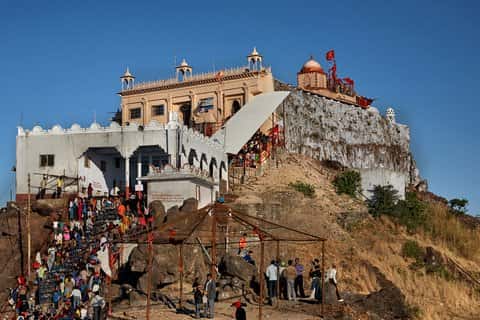
- Kalika Mata (Mahakali) temple on the summitThe reason most pilgrims come: a revered Shakti Peetha atop Pavagadh Hill, about 800 m above the plain, redeveloped and reopened in 2022 with a new spire and, after about five centuries, a dhwaja flag once more. Darshan itself is free. You are only a few seconds before the deity on busy days, so temper expectations and enjoy the climb and the view.
- The ropeway and the viewThe Usha Breco Udan Khatola cable car lifts you about 297 m up the hill from Manchi in a roughly 6-minute ride, with sweeping views over the forested hill and the plains below. It is the easy way up, but remember it is not the whole way up: about 250 steps still separate the top station from the shrine.
- Champaner: the Jama Masjid and the ruinsAt the foot of the hill lies the abandoned 16th-century capital of Champaner, the World Heritage half of the site. Its Jama Masjid (Jami Masjid) is one of the finest mosques in western India and a model for later Indian mosque design. Around it are forts, gates, palaces, tombs, stepwells and water tanks, most of them quiet and largely unexcavated.
- Stepwells, tanks and the fort wallsThe scattered water-retaining structures and the fortification walls that run from the hilltop down to the plain are a highlight for anyone interested in medieval engineering and Indo-Islamic architecture. A guide or a good map helps, as the monuments are spread across a wide area rather than clustered in one enclosure.
It is easy to arrive thinking of Champaner-Pavagadh as one place with one ticket. It is not. The Kalika Mata darshan on top is free; the ropeway that takes you most of the way up is a paid Usha Breco ticket; and the ASI-protected Champaner monuments below, including the Jama Masjid, carry a separate archaeological-park ticket. Budget and plan for all three separately, covered in the costs section below.
Signature experiences at Champaner-Pavagadh
Beyond the darshan, these are the experiences people remember, and how to arrange them honestly, from the ropeway ride to a quiet morning among the ruins.
- The darshan at Kalika MataThe heart of a Pavagadh visit is the darshan at the summit shrine. On weekdays and early mornings it is calm; on Sundays and at Navratri it is a slow, crowded shuffle. Go early, keep valuables close, and remember the view over the plains from the top is part of the reward.
- The ropeway rideThe roughly 6-minute cable-car ride from Manchi is a small thrill in itself, with the hill and the ruins falling away below. Buy the ticket at the window just before you board rather than the booths in the car park, and consider the VIP ticket, about 210 rupees, on a busy day to skip much of the queue.
- A morning among the Champaner ruinsGive the archaeological park a proper half-day. Start at the Jama Masjid, then wander the gates, stepwells and tombs. The ruins are peaceful and photogenic, and because most visitors rush straight to the temple, you often have the monuments almost to yourself.
- The monsoon-green hillIn a good monsoon the hill turns emerald and seasonal waterfalls appear, a favourite of Gujarati day-trippers. It is genuinely beautiful, but the trek is slippery and the ropeway can be suspended, so treat it as a scenic drive-and-look rather than a guaranteed climb.
- The full trek, for the fitPurists and trekkers can still climb the whole way, a moderate ascent of roughly 2,000 or more steps and paths from the base to the summit. It is a rewarding half-day for anyone fit, best done early and not in the monsoon or the peak heat.
- A simple thali on the way downThere are clean, reasonably priced eateries near the ropeway stations serving a fixed vegetarian thali for around 160 rupees plus snacks like vada pav and pav bhaji. A sit-down meal on the way down, after the darshan, is the traveller-tested way to time it.
Most visitors do the temple and leave, and miss the reason this is a World Heritage Site at all. If you do only one extra thing, walk the Champaner ruins below the hill, above all the Jama Masjid. Give it an unhurried hour or two in the cool of the morning or the late afternoon, and you come away with the whole story of the place, the living shrine on top and the vanished city below, rather than half of it.
The Pavagadh ropeway: fare, timings, steps and safety
The Usha Breco Udan Khatola ropeway is the easy way up, but the fare has changed, about 250 steps remain at the top, and there have been serious accidents, so here is the honest picture.
- Operator, length and timingsThe ropeway is the Maa Mahakalika Udan Khatola, run by Usha Breco Limited since 1986, about 774 m long, lifting you about 297 m up the hill in a roughly 6-minute ride in enclosed 6-seat gondolas. The operator lists timings of about 6:00 am to 6:45 pm; on busy days go early to beat the queue.
- The fare, hedged honestlyThe commonly cited fare is about 150 rupees for 2025 (Wikipedia infobox), while long-standing traveller reports cite about 116 rupees for a return and a special skip-the-queue VIP ticket of about 210 rupees. The fare has been hiked more than once over the years, so treat any figure as approximate; note the official Udan Khatola site now sells by date slot rather than a published fixed fare, so confirm the current price there before you travel.
- The steps that remainThis is the detail most pages leave out: the ropeway does not deliver you to the temple door. From the top station you still climb about 250 steps to reach the shrine, so the trip is not step-free. Seniors, families with young children and anyone who cannot manage stairs should plan for this last stretch.
- Reconfirm the service after 2025Safety is a live issue here. Seven people were killed in a cabin accident in January 2003, and in September 2025 six people died when a cargo ropeway cable snapped. Before you rely on the passenger cable car, check that the service is operating normally, especially in the monsoon and on high-crowd days, and reconfirm on the morning of your visit.
Travellers report that the useful ticket window is the one just before you board at the top car park, not the booths scattered around the parking area. On a busy Sunday the standard queue can run to a couple of hours, and the VIP ticket of about 210 rupees lets you jump much of it. Confirm the current fares and the VIP option at the counter or on the official Udan Khatola booking site, as prices are revised from time to time.
Where to stay, and how long to give it
Most travellers base in Vadodara and visit on a day trip, though there are simple stays at the hill and near Champaner. One day covers the essentials; a night nearby lets you do the ruins properly.
- Vadodara: the comfortable baseAbout an hour away, Vadodara has the widest choice of hotels across budgets, good food and the nearest airport and railhead. For most visitors, and for anyone pairing the trip with the Statue of Unity, basing in Vadodara and driving out for the day is the easiest plan.
- At the hill and near ChampanerThere are simpler options closer in, including Gujarat Tourism accommodation at Manchi on the hill and basic guesthouses near the base and Champaner. These put you first in the ropeway queue in the morning, but the choice and comfort are limited, so set expectations accordingly.
- How long to give itA focused day covers the darshan, the ropeway and a look at the Champaner ruins. If you want to do the archaeological park justice as well as the temple, an early start from Vadodara or a night nearby turns a rushed tick-box visit into a proper heritage day.
- Pair it, do not cram itThe Statue of Unity is about 90 km from Vadodara on the other side, so it does not combine comfortably with Champaner-Pavagadh in a single day. Base in Vadodara and give each a day rather than trying to do both at once.
The single upgrade that changes a Champaner-Pavagadh visit is staying close enough to be at the ropeway when it opens or in the ruins before the day-trippers arrive. The early morning is cooler, calmer and far better for both the darshan queue and photographs of the empty monuments, and it is the one thing a rushed day trip from Ahmedabad cannot give you.
Costs: what is free, what is paid
The confusing part of Champaner-Pavagadh is that the darshan is free while the ropeway and the ASI monuments are paid. Here is the honest breakdown so nothing surprises you at the counter.
- The free partThe Kalika Mata darshan itself is free, and so is the climb if you choose to walk up. If you are a fit pilgrim happy to trek the roughly 2,000 or more steps, the temple visit can cost you almost nothing beyond transport and food.
- The ropewayThe Usha Breco ropeway is the main paid item on the hill, about 150 rupees for 2025 per the Wikipedia infobox, with older reports citing about 116 rupees return and a VIP skip-the-queue ticket of about 210 rupees. The fare has been hiked more than once over the years, so confirm the current price on the official Udan Khatola booking site.
- The ASI archaeological-park ticketThe Champaner monuments are separately ticketed by the Archaeological Survey of India: about 40 rupees per head for Indian, SAARC and BIMSTEC visitors and about 600 rupees for other foreign nationals, with children below 15 free. This is quite separate from the temple and the ropeway.
- The small extrasThe shared jeep up to Manchi is about 40 rupees per person, a fixed vegetarian thali near the ropeway is around 160 rupees, and you will want cash for parking, prasad and snacks. Carry small notes, as hill-top mobile signal and card payments can be patchy.
Three separate charges, not one: free darshan, an approximately 150 rupee ropeway that has changed recently, and an ASI monument ticket of about 40 rupees for Indians and about 600 rupees for other foreign nationals. Keep those three buckets straight in your head and carry a little cash for each, and the counter holds no surprises. Confirm the live ropeway fare on the official booking site, as it is the one figure that moves.
Practical logistics: food, signal, parking and getting around
The small things that make the day smooth, from where the mobile signal drops to how to handle the steep hill road and where to eat.
- Mobile signal and cashPhone signal is generally fine up to the top car park but tends to drop near the temple at the summit. Digital payments can fail in the hills, so carry enough cash for the ropeway, parking, prasad and food. There are clean toilets at the ropeway stations.
- The steep hill road and parkingThe road up to the top car park is good but steep, with central dividers. It rewards confident drivers comfortable with hill starts and stop-start traffic; if that is not you, leave the car at the base and take the shared jeep. Parking at the top can be tight on busy days but is usually findable.
- Food and restThere are eateries along the way and clean, reasonably priced sit-down restaurants near the ropeway stations, with a fixed vegetarian thali around 160 rupees. The traveller-tested plan is to do the darshan first and eat on the way down.
- Getting between the temple and the ruinsThe summit temple and the Champaner ruins below are separate stops, not a single walk. Plan the darshan and the ropeway as the hill half of your day and the archaeological monuments as the plain half, with your car or a local auto linking the two.
Safety, the ropeway record, and temple etiquette
Champaner-Pavagadh is a welcoming, well-run pilgrimage site, but the ropeway has a real accident history and the summit involves stairs and crowds, so a little awareness matters.
- The ropeway record, stated plainlySeven people were killed in a cabin accident in January 2003, and in September 2025 six people died when a cargo ropeway cable snapped. The passenger service runs under maintenance regimes, but the sensible traveller checks that it is operating normally before relying on it, particularly in the monsoon and on very crowded days, and reconfirms on the morning of travel.
- The steps and the crowdsEven with the ropeway, about 250 steps remain to the shrine, and on Sundays and at Navratri the queues and the crush can be heavy. Wear proper footwear, keep children close and valuables secure, and go early to avoid both the heat and the worst of the crowd.
- Heat, water and the monsoon pathThe climb is exposed, so carry water and sun protection in the warmer months. In the monsoon the steps and trails get slippery, so hold the handrails, take it slowly, and do not attempt the full trek in heavy rain.
- Temple etiquetteThis is a deeply revered Shakti Peetha. Dress modestly, remove shoes where required, follow the queue discipline, and be respectful with photography around the shrine and worshippers. At the Jama Masjid and the other monuments, treat them as the protected heritage they are and leave nothing behind.
After the September 2025 accident, the one non-negotiable safety habit here is to confirm that the passenger ropeway is operating normally before you build your day around it, especially in the monsoon. Check the day before and again on the morning of your visit through the official operator, and keep the option of the all-steps climb or a later day in reserve if the service is suspended. It is a small step that keeps a pilgrimage a happy one.
Champaner-Pavagadh for every kind of traveller
The site suits pilgrims, history lovers, families and trekkers in very different ways. Here is what it offers each, and the one tip that matters, including how a senior does the darshan comfortably.
- PilgrimsThe main draw: a revered Mahakali Shakti Peetha with a redeveloped 2022 temple. Go early or on a weekday for a calmer darshan, or at Navratri for the fullest devotional atmosphere, accepting the crowds that come with it.
- History and architecture loversThe Champaner ruins are the real prize, an unexcavated Indo-Islamic capital with the superb Jama Masjid at its heart. Give it a proper half-day with a guide or a good map, as the monuments are spread across a wide area.
- Families with childrenThe ropeway is a hit with children and the darshan is straightforward, but remember the roughly 250 steps at the top and the crowds on holidays. Go early, carry water, and keep little ones close in the queue.
- Senior travellers and on accessibilityVery doable with planning, but not step-free: use the ropeway rather than the trek, but know that about 250 steps still remain to the shrine, so pace it, rest often, and consider skipping the peak Navratri and Sunday crowds. Anyone who cannot manage stairs at all should be aware they may not reach the shrine even with the cable car.
- Trekkers and the fitThe full climb of roughly 2,000 or more steps and paths is a rewarding moderate trek, best done early and not in the monsoon or peak heat. It is the old pilgrim route and still the most satisfying way up for anyone fit.
- PhotographersThe ropeway views, the empty Champaner ruins at dawn, and the monsoon-green hill are the standout shots. Ask before photographing worshippers at the shrine, and treat the monuments with care.
A suggested Champaner-Pavagadh itinerary
How to shape a day so you catch the darshan before the crowds, do the ruins in the cool hours, and are not caught out by the steps or the queues.
- Early morning: up the hillLeave Vadodara at first light, reach the base, take the shared jeep or drive up to Manchi, and be on an early ropeway before the queue builds. Do the darshan, allowing for the roughly 250 steps that remain, then enjoy the summit view.
- Late morning: down and a mealCome down by the ropeway, and take the traveller-tested sit-down thali near the station, around 160 rupees, before the afternoon. This is the natural break between the hill half and the plain half of the day.
- Afternoon: the Champaner ruinsSpend the cooler afternoon in the archaeological park, starting at the Jama Masjid and taking in the gates, stepwells and tombs. Buy the ASI ticket, about 40 rupees for Indians and about 600 rupees for other foreign nationals, and give it an unhurried couple of hours.
- The half-day versionIf you only have half a day, do the ropeway, the darshan and a quick look at the Jama Masjid, and save the rest of the ruins for another visit. Try to avoid Sunday and Navratri peaks if your time is tight, as the queue alone can eat your afternoon.
The thing that breaks a tight Champaner-Pavagadh plan is not the driving, which is easy, but the ropeway queue and the summit crowd on a Sunday or at Navratri, which can run to a couple of hours. Build the day so the darshan falls early, keep the VIP ropeway ticket in mind for a busy day, and hold the archaeological park for the calmer afternoon. Do that and you see the whole site comfortably in a day.
The real questions travellers ask about Champaner-Pavagadh
Straight answers to the questions that come up again and again on traveller forums, so you arrive already knowing the score.
- How many steps after the ropeway?About 250 steps remain from the top ropeway station to the Kalika Mata shrine, so the cable car takes you most of the way up but not all the way. Plan for that last climb, especially for seniors and young children.
- What does the ropeway cost and when does it run?About 150 rupees for 2025 per the Wikipedia infobox, with older reports of about 116 rupees return and a VIP skip-the-queue ticket of about 210 rupees; the fare has been hiked more than once over the years. Timings are about 6:00 am to 6:45 pm. Confirm the current fare on the official Udan Khatola site.
- Is the ropeway safe and can it be suspended?There were fatal accidents in January 2003 and September 2025, so check the passenger service is operating normally before you rely on it, particularly in the monsoon when it can be suspended for weather. Reconfirm on the morning of your visit.
- Free darshan or paid monuments, which is which?The Kalika Mata darshan is free; the ropeway is a paid Usha Breco ticket; and the Champaner archaeological monuments below carry a separate ASI ticket, about 40 rupees for Indians and about 600 rupees for other foreign nationals. Three separate things.
- Is it worth it, and how long do I need?Yes, for both the living shrine and the underrated UNESCO ruins. A focused day covers the darshan, the ropeway and the Jama Masjid; a fuller day or an overnight lets you do the whole archaeological park justice.
- Can I combine it with the Statue of Unity?Not comfortably in one day, as they sit on opposite sides of Vadodara, the statue about 90 km away and Champaner-Pavagadh about 45 to 50 km. Base in Vadodara and give each a day.
Planning Champaner-Pavagadh from abroad
Champaner-Pavagadh is one of India's most underrated UNESCO sites and an easy add to a Gujarat trip. A little preparation on the fees, the etiquette and the two-in-one nature of the place makes it simple.
- Know it is two sites in oneOn top is a crowded, living Hindu shrine, the Kalika Mata Shakti Peetha; below is a quiet, largely unexcavated Indo-Islamic ruined city, the reason for the World Heritage listing. Plan to see both: the darshan and ropeway on the hill, the Jama Masjid and monuments on the plain.
- The foreign-national ASI feeThe Champaner archaeological monuments carry an ASI ticket of about 600 rupees for foreign nationals other than SAARC and BIMSTEC citizens, who pay about 40 rupees; children below 15 are free. The temple darshan is free, and the ropeway is a separate Usha Breco ticket.
- Temple etiquette and the stepsDress modestly, remove shoes where required, and be respectful with photography at the shrine. Remember the ropeway is not step-free: about 250 steps remain to the temple, which matters for older travellers.
- Pair it with the Statue of UnityFly into Vadodara via Delhi, Mumbai or Ahmedabad, base there, and do Champaner-Pavagadh one day and the Statue of Unity, about 90 km away, another. It is one of the best two-day heritage-and-landmark loops in Gujarat.
Money, timing and the ropeway caution for foreign visitors
The practical basics an overseas traveller needs: cash for a hill site, the comfortable season, and the honest ropeway safety picture after the 2025 accident.
- Carry cash, expect patchy signalCard and UPI payments can fail in the hills and the signal drops near the summit, so draw cash in Vadodara and carry small notes for the ropeway, the ASI ticket, parking, prasad and food. There are clean toilets at the ropeway stations.
- Come October to MarchThe comfortable window is October to March, roughly 15 to 30 degrees Celsius, with clear views. Summer is hot and best done at first light; the monsoon is green but can suspend the ropeway, so time your visit for the cool, dry months if you can.
- The ropeway safety pictureThere were fatal ropeway accidents in January 2003 and September 2025, so confirm the passenger service is running normally before you rely on it, and reconfirm on the morning of your visit. It is a standard, sensible check, not a reason to avoid the site.
- How long to give it on a Gujarat tripOne focused day from Vadodara covers the temple, the ropeway and the Jama Masjid; add time or a second visit for the full archaeological park. It slots neatly between Vadodara's palaces and the Statue of Unity on a wider Gujarat itinerary.
Champaner-Pavagadh is an unusually rich stop for a single day: a major living shrine, a dramatic hill and cable car, and a genuine World Heritage ruin-city, all within an hour of Vadodara. Many overseas visitors expect a temple and are surprised by the empty, atmospheric Indo-Islamic monuments below. Give it a proper day, keep some cash for the three separate charges, and it becomes one of the more memorable and least crowded UNESCO days in western India.
The Shakti Peetha, the fallen spire, and the flag raised after five centuries
Pavagadh Hill, a volcanic outcrop rising some 800 m above the Gujarat plain, has been a place of worship since antiquity, and the Kalika Mata temple at its summit is revered as one of the Shakti Peethas, the seats of the goddess. In tradition the hill is where a part of the goddess is enshrined as Mahakali, the guardian deity of the mountain. The hill was a Rajput fortress before Sultan Mahmud Begda took it in 1484 and moved his capital to Champaner below; around that time, in the fighting, the shikhara or spire of the Kalika Mata temple was lost, and for roughly five centuries the shrine stood without its crowning flag. Only in 2022, after a two-phase redevelopment, was the temple rebuilt and a dhwaja hoisted once more on the restored spire, a moment widely reported as the flag returning after about five hundred years. So the shrine you climb to today is both very old and very new: an ancient Shakti Peetha with a spire and a flag raised again within living memory.
Planning a Pavagarh trip?
Our Gujarat travel experts plan your full journey for you: route, hotels, darshan timings and transport. You get a free day-by-day plan and an exact quote on WhatsApp, usually within a few hours. No payment is needed to get your plan.