Mahabalipuram Travel Guide
The best months are October to February , pleasant on the open coast, and the best hours of any day are early morning and the golden light of late afternoon. December and January...
When to visit Mahabalipuram, and the best hours of the day
The best months are October to February, pleasant on the open coast, and the best hours of any day are early morning and the golden light of late afternoon. December and January bring the dance festival against the floodlit monuments.
- October to February: cool and clearThe comfortable season on the coast, ideal for wandering an open-air site with little shade. December and January are the peak, with the most pleasant weather and the dance festival against the floodlit temples. This is when most overseas visitors come.
- Early morning and late afternoon are goldenBecause the monuments are mostly open-air, come at opening for the soft light and cool air, or in the late afternoon for the golden hour and a sunset by the Shore Temple. The hot middle of the day across bare granite is the part to avoid.
- March to June: hot and humid, go earlyLate spring and summer on the Tamil coast are hot and sticky, hard going across the open rock. If you must come then, start at dawn, keep the midday for a cafe or your hotel, and carry plenty of water and sun protection.
- The monsoon and the shoulderThe northeast monsoon brings most of the year's rain roughly from October into December, usually in short heavy bursts rather than all-day washouts, so a wet morning often clears. September and early October can be warm but quieter, a fair shoulder choice.
The Mamallapuram Dance Festival stages classical and folk Indian dance on evenings against the floodlit Arjuna's Penance, roughly from the third week of December into the second week of January; the 2025 to 2026 edition ran about 21 December 2025 to 19 January 2026, and entry to the temple complex during the event is free. Exact dates shift each year, so reconfirm with Tamil Nadu Tourism before planning a trip around it. Even outside the festival the whole cool season is lovely.
How to reach Mahabalipuram from Chennai
Mahabalipuram is an easy trip down the coast from Chennai, and the first stop on the lovely East Coast Road drive to Pondicherry. There is no airport or railway in the town itself.
- By car down the East Coast RoadMahabalipuram is about 55 to 60 km south of Chennai on the East Coast Road, roughly 1.5 to 2 hours by car, a scenic coastal drive past beach resorts and fishing villages. A car with a driver is the easiest way to see the monuments at your own pace, and we can arrange one. The inland highway is a touch faster but the coastal road is the prettier run.
- By bus, the budget wayGovernment and private buses run frequently from Chennai, including from the Koyambedu (CMBT) terminus and the Thiruvanmiyur depot, and are cheap and easy if you do not mind a slower, busier ride. There are no trains and no airport in Mahabalipuram itself, so road is the only way in.
- A day trip or an overnightMany people visit on a half-day or full-day trip from Chennai. An overnight in one of the East Coast Road beach resorts is gentler and lets you catch the Shore Temple at both sunrise and sunset, and to slow down with the carvers and the beach.
- On the way to PondicherryMahabalipuram is the natural first stop on the East Coast Road run from Chennai down to Pondicherry, about 95 km further on, so it slots neatly into a Tamil Nadu coastal loop of a couple of days.
Fly into Chennai, the gateway about 55 to 60 km away, then drive down the coast. Mahabalipuram is the easiest UNESCO day trip from the city, and the start of the coastal road south.
Fly into Chennai and drive down the East Coast Road. It pairs beautifully with Pondicherry for a short, gentle coastal trip, or with Kanchipuram for a temple-and-heritage day.
Chennai is the hub by air and rail; from there it is a short, scenic drive south on the East Coast Road to the monuments, easy as a day from the city or a weekend on the coast.
The monuments, and the one ticket you need
Mahabalipuram is an open-air gallery of Pallava stone. The good news for your wallet: most of it is free, and a single small ticket covers the two walled temples for the same day.
- The Shore TempleThe granite temple complex right on the beach, built under Pallava Rajasimha around the early 8th century and one of the oldest stone temples in South India, especially beautiful at sunrise and sunset. It is one of the two walled, ticketed monuments.
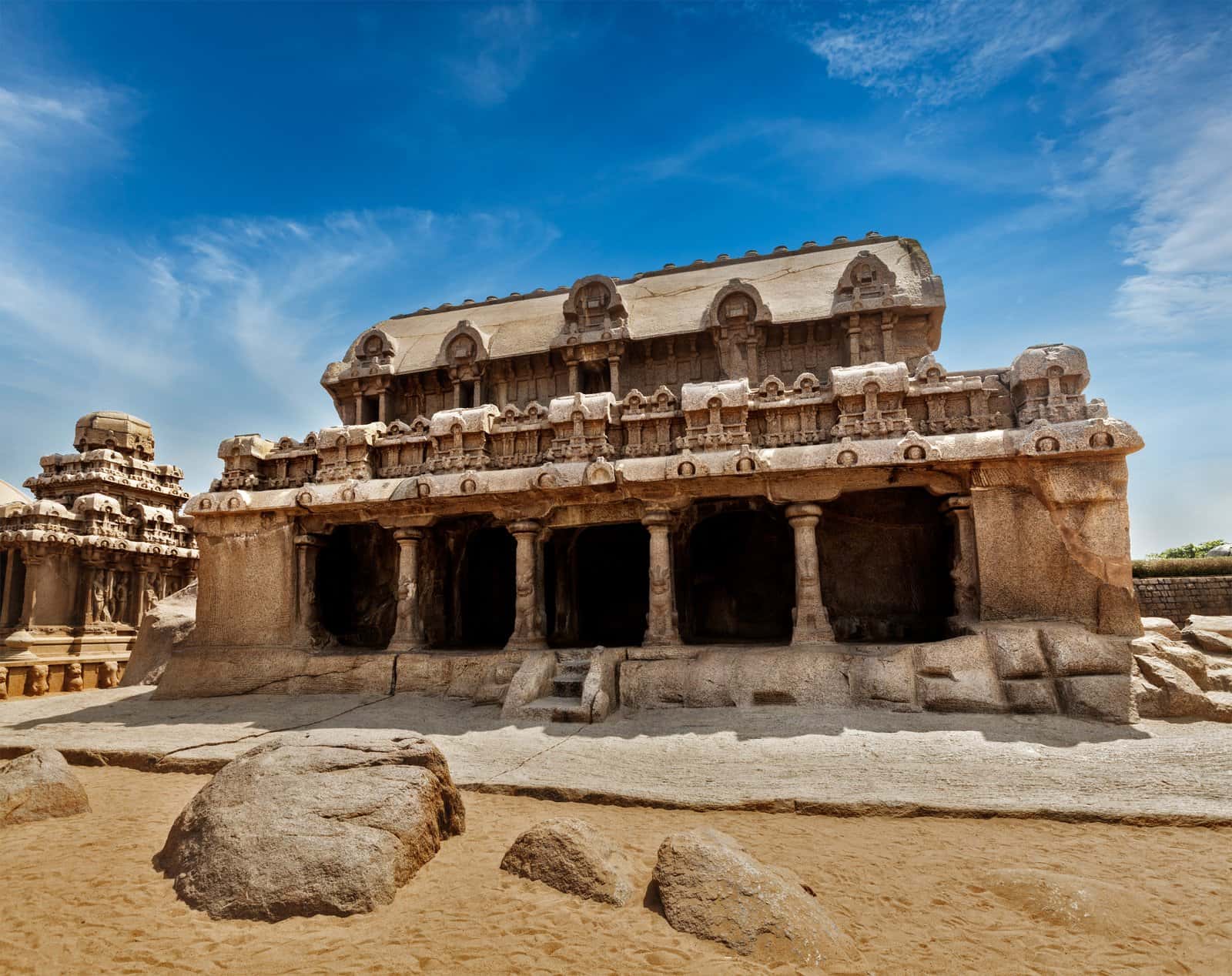
- The Pancha Rathas (Five Rathas)Five monolithic chariot-shaped shrines, each carved from a single rock and named for the Pandavas and Draupadi, with stone elephants and lions alongside. The second walled monument, covered by the same combined ticket on the same day.
- Arjuna's Penance and the caves, freeThe giant bas-relief of Arjuna's Penance, also called the Descent of the Ganges, Krishna's Butterball (the great balancing boulder) and most of the rock-cut cave mandapas are free and open, so you can wander much of the site at no cost. These are the most photographed parts of the whole place.
- The one combined ticketA single Archaeological Survey of India ticket covers the Shore Temple and the Five Rathas for the same day: per the ASI, about 40 rupees per head for Indian, SAARC and BIMSTEC nationals and about 600 rupees for other foreign visitors, with children below 15 free. Video filming is about 25 rupees extra; still photos for personal use are free. The site is open about 6 am to 6 pm daily.
Only the walled Shore Temple and the Five Rathas need a ticket, and one combined ticket covers both for the same day. Arjuna's Penance, Krishna's Butterball and the caves are open and free, so do not let anyone sell you a separate ticket for them. Beware older pages still quoting the much lower fees of years past; those are out of date, and the current ASI figures are above. The next section is the signature experience of the place.
The open-air gallery and the living carvers
Mahabalipuram is not a museum behind glass. It is a working stone town where the same granite craft that carved the monuments is still practised on the street, and the great relief still tells its whole story.
- Watch the carvers at workAlong the main streets toward the sea, sculptors still cut granite by hand, the very craft that shaped the monuments and has continued here for centuries. Stop to watch, talk to them, and buy a piece directly if you wish. A small carving makes the most living souvenir of the visit; agree the price before you commit.
- Read the great bas-reliefArjuna's Penance is one of the largest open-air rock reliefs in the world, a whole mythology carved across two boulders, with elephants, gods, ascetics and a cleft down which the Ganges seems to flow. A good guide brings the crowded scene to life and is worth it here more than anywhere else on the site.
- Marvel at Krishna's ButterballA huge natural boulder balanced on a slope as if frozen mid-roll, a favourite for photographs and a fun spot to clamber the surrounding rock. It is free, open and right in the middle of the site, a few minutes from the great relief.
- Sunset at the Shore TempleEnd the day at the Shore Temple as the light softens over the sea. The granite glows, the crowds thin, and it is the photograph everyone remembers. The early morning, just after the roughly 6 am opening, is the other magic hour, with the temple almost to yourself.
The beach, Tiger Cave, the lighthouse and the East Coast Road
Beyond the monuments, the coast and the road add a beach, a quiet cave shrine, a lighthouse view and one of India's prettiest drives.
- The beach, for a walk not a swimThe sandy shore by the Shore Temple is lovely for a stroll and to watch the fishing boats, but the sea has strong currents and is often rough, and it is not a patrolled swimming beach, so keep any paddling shallow and children close. The safety section below has the detail.
- Tiger Cave, free and quietAbout 5 km north near Saluvankuppam, the 7th century Tiger Cave, with its crown of carved tiger-like heads, is a peaceful, free little shrine in a grove by the sea, an easy add-on if you have a car.
- Climb the lighthouse for the viewThe old Mahabalipuram Lighthouse, a separate paid climb of about 10 rupees for Indians and about 25 rupees for foreign visitors plus about 20 rupees for a camera, gives a fine view over the monuments and the sea. It usually shuts for a lunch break in the early afternoon, so go in the morning or later.
- The Crocodile Bank and the East Coast RoadOn the East Coast Road back toward Chennai, the Madras Crocodile Bank is a well-known reptile park and an easy stop for families. The road itself, south to Pondicherry, is one of India's loveliest coastal drives, and Mahabalipuram is the perfect first stop on that loop. Eat at busy, clean seafood places and drink bottled or filtered water.
Where to stay in Mahabalipuram, and how many nights
Stay in the walkable town core to be among the monuments and the carvers, or in an East Coast Road beach resort for sea views and calm. A day trip works, but one night is the sweet spot.
- The town core: among the monumentsGuesthouses and small hotels in the town put you walking distance from the Shore Temple, the Rathas, the carvers and the seafood cafes. Atmospheric and convenient, and the best base if you want both sunrise and sunset light without a drive. Good for budget and mid-range travellers.
- East Coast Road beach resorts: space and seaJust north and south of town, the East Coast Road is lined with beach resorts with pools, gardens and sea views, a relaxed choice for couples, families and anyone wanting to slow down. You will want a car or autos to reach the monuments, a short hop away.
- Day trip or overnightA day trip from Chennai works well for the highlights. An overnight is gentler: it lets you catch the Shore Temple at both ends of the day, linger with the carvers, add Tiger Cave or the beach, and avoid the rushed there-and-back. For a coastal loop, one night here and on to Pondicherry is a lovely rhythm.
- Booking notesThe town fills on weekends and over the December to January season, including the dance-festival weeks, so book ahead then. Outside those peaks rooms are easy to find across budgets, from simple guesthouses to the bigger resorts.
Mahabalipuram costs and a realistic budget
Mahabalipuram is one of India's best-value UNESCO sites: most of it is free, and the few paid things are cheap. Here is what the main things cost so you can plan and avoid being overcharged.
- The fixed entry costsThe combined ASI ticket for the Shore Temple and the Five Rathas is about 40 rupees per head for Indian, SAARC and BIMSTEC nationals and about 600 rupees for other foreign visitors, with under-15s free and video filming about 25 rupees extra. The lighthouse is a separate climb of about 10 rupees for Indians and about 25 rupees for foreign visitors plus about 20 rupees for a camera. Arjuna's Penance, the Butterball and the caves are free.
- Guides, carvings and the negotiable bitsA licensed guide for the main monuments is a reasonable add for history lovers; agree the fee before you start and use a guide who carries a government ID. Stone carvings, autos and seafront shopping are negotiable, so settle the price first. A simple seafood meal in town is easy on the wallet.
- Getting there and aroundThe Chennai bus is the cheapest way in; a car with a driver for the day costs more but lets you cover the monuments, Tiger Cave and the Crocodile Bank at your own pace. Note that Chennai autos quote high and call-taxis usually need pre-booking rather than hailing, so plan transport ahead.
- A near-free day outBecause the most famous monuments are free, a budget visitor can see the heart of Mahabalipuram for the price of the bus and a meal. Even a comfortable day, with the combined ticket, the lighthouse, a guide and lunch, stays modest by UNESCO-site standards.
Everything fixed here, the ASI ticket and the lighthouse, is cheap and non-negotiable, which makes them a useful anchor. Everything else, a carving, an auto, a guide, is negotiable, so ask the price and agree it before anything begins. Settle the number first and Mahabalipuram's only friction, the gentle sales pressure near the carvers and the monuments, turns into a non-event.
Practical logistics: getting around, food, money and language
The small things that make a Mahabalipuram day smooth, from moving between the clusters to water, cash and the language note that catches some visitors.
- Getting around the siteThe main monuments, the great relief, the Butterball, the caves and the carvers, cluster within easy walking distance in the town. The Shore Temple, the Rathas, Tiger Cave and the Crocodile Bank are a little apart, so autos or a hired car handle the short hops between them comfortably.
- Food and waterThe town has easy cafes and seafood shacks; eat at busy, clean places and drink bottled or filtered water, as is wise across the Chennai coast, especially in the monsoon when water contamination is more likely. The fresh seafood is a highlight.
- Money and connectivityCarry some cash for autos, carvings, the lighthouse and small eateries, though cards and UPI work in bigger places. There are ATMs in town and in Chennai. Mobile coverage is fine for maps and calls.
- Language and the local noteTamil is the local language and Hindi is far less widely spoken here than in the north, so do not assume Hindi; English works well in the tourist trade. A few words of thanks in Tamil go a long way, and a smile and patience smooth any small misunderstanding.
Safety: the beach currents, the sun, and the touts
Mahabalipuram is easygoing and welcoming, but two honest warnings, the sea and the sun, matter more than any scam, and a little awareness keeps the day happy.
- The sea is for paddling, not swimmingThe Bay of Bengal here has strong currents and is often rough, and this is not a patrolled, lifeguarded swimming beach. Travellers and local advice flag the water to the right of the Shore Temple as especially risky. Enjoy the shore, the boats and the temple, keep any paddling shallow, and supervise children closely. If you are ever caught in a current, do not fight it; swim parallel to the shore until it eases.
- Sun and heat on the open rockThe site is open with very little shade and the granite radiates heat. Come early or late, wear a hat and sturdy shoes for the uneven rock, carry water, and rest in the shade between clusters. This matters most for older travellers and children, and in the summer months it matters for everyone.
- Guides and gentle toutsNear the monuments and the carvers you may be offered guiding or carvings. A friendly no is fine. If you want a guide, use one with a government ID and agree the fee first; be wary of a very cheap or free offer that ends at a particular shop. There is no aggressive scam culture here, just ordinary sales pressure.
- General wellbeingTake the usual care with street food, drink packaged water, and carry sun protection and any personal medicines. The town is calm and generally safe to walk, including for solo and women travellers, with normal evening common sense.
If you remember one safety note about Mahabalipuram, make it the sea. The beach looks gentle in photographs, but the Bay of Bengal here has strong currents, the surf can be rough, and there are no lifeguards. Every season the coast sees avoidable incidents from people wading too far. Walk the shore, watch the fishing boats, photograph the Shore Temple at sunset, and leave the serious swimming for a patrolled beach elsewhere.
Mahabalipuram for every kind of traveller, and on access
Mahabalipuram suits very different visitors. Here is what it offers you, and the one tip that matters for each, including how an older visitor sees it comfortably.
- Families with childrenAn open-air adventure: Krishna's Butterball to marvel at, rocks to clamber, the free monuments to roam, and the Crocodile Bank on the East Coast Road as an easy add-on. Keep little ones away from the sea edge and bring sun cover.
- Senior travellers and on accessibilityVery doable with care. The Shore Temple and much of the site are fairly flat, the combined ticket is simple, and a car can move you between the clusters. Go early to beat the heat, wear sturdy shoes for the uneven rock, skip the rock-clambering bits, and rest in the shade between sights. The cave and relief area has uneven ground, so take it slowly.
- CouplesSunrise or sunset at the Shore Temple by the sea is quietly romantic, and an East Coast Road beach resort makes a relaxed overnight away from the city, with the carvers and a seafood dinner to fill the evening.
- History loversA complete Pallava open-air gallery, best with a good guide to read Arjuna's Penance and the Ratha temple styles. Allow a full half-day at least, longer if you linger, and add Tiger Cave and the lighthouse.
- PhotographersThe Shore Temple against the sea at golden hour, the monolithic Rathas, the giant bas-relief and the carvers at work. Early and late light are best, and a video pass is worth it if you film. Ask before photographing people at work or prayer.
- Budget travellersMost of the site is free, the bus from Chennai is cheap, and the seafood shacks are easy on the wallet. A near-free UNESCO day out, one of the best-value heritage stops in India.
A suggested Mahabalipuram itinerary, and how long it needs
How to shape a half-day, a full day, or a Kanchipuram combine, so you catch the monuments at the right light without rushing.
- The honest answer on timeMost travellers need about 3 to 4 hours to see the main monuments at a steady pace. A relaxed half-day covers the highlights well; a full day adds the beach, Tiger Cave, the lighthouse, the carvers and both sunrise and sunset. A rushed two-hour stop only scratches the surface.
- A good half-dayStart early at the Shore Temple just after opening, then walk to Arjuna's Penance, Krishna's Butterball and the cave mandapas, then the Five Rathas. Break for a seafood lunch, browse the carvers, and you have seen the heart of the place by early afternoon.
- A full day or overnightAdd Tiger Cave, the lighthouse view, time with the carvers, and a return to the Shore Temple for sunset. An overnight in an East Coast Road resort lets you do the temple at both sunrise and sunset and travel unhurried.
- Combining Kanchipuram in a dayYou can pair Mahabalipuram with Kanchipuram, about 65 to 75 km inland, in one long day from Chennai (a loop of roughly 200 to 220 km), but it is a full, early start, so set off around dawn and accept that each gets a focused visit rather than a leisurely one.
The single thing that makes a Mahabalipuram day memorable is the light. The granite is at its loveliest just after the roughly 6 am opening and again in the last hour before the about 6 pm close, and the Shore Temple by the sea is the photograph everyone remembers. Keep the hot middle of the day for lunch and the carvers, and build the temple into a cooler hour at either end. Do that, and even a half-day feels rich rather than rushed.
The real questions travellers ask about Mahabalipuram
Straight answers to the questions that come up again and again on traveller forums, so you arrive already knowing the score.
- How many hours do I really need?About 3 to 4 hours sees the main monuments comfortably, and a relaxed half-day is the usual answer. Give it a full day or an overnight if you want the beach, Tiger Cave, the carvers and both ends of the day's light. Two hours only lets you glance and rush.
- What does the ticket cost and cover?One combined ASI ticket covers the Shore Temple and the Five Rathas for the same day: about 40 rupees for Indian, SAARC and BIMSTEC nationals and about 600 rupees for other foreign visitors, under-15s free, video about 25 rupees extra. Arjuna's Penance, the Butterball and the caves are free.
- Can I add Kanchipuram in one day?Yes, many travellers combine Kanchipuram and Mahabalipuram in one long day from Chennai, a loop of roughly 200 to 220 km. Start at dawn, see Kanchipuram's temples and silk first or the coast first, and accept it is a full day with focused stops rather than a lazy one.
- Is the beach safe to swim?No, not for serious swimming. The Bay of Bengal here has strong currents and is often rough, with no lifeguards, and the water to the right of the Shore Temple is flagged as risky. Walk the shore and paddle shallow only, and keep children close.
- Is a guide worth it, and how do I avoid touts?A good guide genuinely helps you read Arjuna's Penance and the temple styles, so it is worth it for history lovers. Use a guide with a government ID, agree the fee first, and politely decline the free or very cheap offers that end at a shop.
- Day trip or overnight, and is it worth it?Mahabalipuram is well worth a visit and a day trip from Chennai works fine for the highlights. An overnight is the nicer version, giving you the temple at sunrise and sunset and a slower pace. On a coastal loop, one night here on the way to Pondicherry is ideal.
Planning Mahabalipuram from abroad
Mahabalipuram is the easiest UNESCO day trip from Chennai and the gateway to the lovely East Coast Road, a gentle, rewarding stop for overseas and NRI visitors. A little preparation makes the ticket and the beach easy to handle.
- Make it a day from ChennaiDrive down the East Coast Road from Chennai, about 55 to 60 km and 1.5 to 2 hours, for a half-day or full day among the monuments. It is the most rewarding short trip from the city, and the gentlest introduction to South India's temple architecture.
- Carry your passport for the ticketThe combined ASI ticket is about 600 rupees for foreign visitors, against about 40 rupees for Indian, SAARC and BIMSTEC nationals, with under-15s free; the rest of the site is free and open. Carry your passport, as the foreign-national fee and counter can ask for ID, and the counter takes cash easily.
- Continue to Pondicherry or add KanchipuramMahabalipuram is the first stop on the East Coast Road loop down to Pondicherry, about 95 km on, and pairs with Kanchipuram inland for a temple-and-silk day. Together they make a gentle, beautiful couple of days out of Chennai.
- Mind the sea and the sunThe beach is for walking, not swimming, with strong currents and no lifeguards, so enjoy the shore and the Shore Temple rather than a dip. The open site has little shade, so come early or late and carry water and sun protection.
Comfort, seniors and timing for foreign visitors
The practical basics an overseas or NRI traveller needs for a gentle UNESCO coast: how senior-friendly it is, how it fits a wider South India trip, and when to come.
- Gentle and senior-friendly with planningMostly flat, walkable, at sea level with no altitude and only short drives, Mahabalipuram is comfortable for parents and grandparents. Stay to the flat paths, use a car to skip between the clusters, come early for the cool, wear sturdy shoes for the uneven rock, and rest in the shade. The combined ticket keeps the visit simple.
- How it fits a South India tripGive it a half-day or a relaxed full day, or one night on a coastal loop. Many overseas visitors do Chennai, then Mahabalipuram, then Pondicherry on the East Coast Road, an easy, low-stress introduction to Tamil Nadu before heading to the bigger temple towns inland.
- Time your visit to the cool seasonOctober to February is the comfortable window on the coast; December and January are the loveliest, with the dance festival on some evenings. April to June is hot and humid and hard on the open rock, so avoid high summer if comfort matters.
- Money, SIM and languagePick up an Indian tourist SIM or eSIM on arrival in Chennai. Carry some cash for the ticket counter, autos and carvings, though cards and UPI work in bigger places. Tamil is the local language and English is widely understood in the tourist trade, so communicating is easy.
Mahabalipuram is an unusually gentle way into South India: a compact, walkable UNESCO site on the sea, easy to reach from Chennai, with most of the wonder free and open. Slot it on the first day or two, give it a relaxed half-day or a night, and let the carvers, the great relief and the sunset at the Shore Temple set the tone before you head to the grander temple cities inland. Many visitors say it ends up being the calm, memorable opening chapter of a Tamil Nadu trip.
The stone the carvers never stopped cutting
Mahabalipuram is the work of the Pallava kings of the 7th and 8th centuries, above all Narasimhavarman I, whose title Mamalla, the great wrestler, gave the town its name of Mamallapuram. Here their sculptors turned whole granite hills into temples and stories: the Five Rathas each cut from a single rock, the cave shrines, and the Descent of the Ganges, a relief so large that elephants, gods and ascetics seem to move across the living stone toward a cleft down which the river pours. What makes the place rare is that the craft never died. Walk the main streets today and you still hear the chisel; the families who carve granite by hand are the inheritors of that Pallava tradition, and a small carving from them carries a thread fourteen centuries long. Sailors long called this coast the Seven Pagodas, and a popular legend holds that six temples lie drowned beneath the waves with only the Shore Temple left standing; offshore finds after the 2004 tsunami stirred the story, but how many temples once stood, and whether the sea truly swallowed them, remains tradition and conjecture rather than settled history.
Planning a Mahabalipuram trip?
Our Tamil Nadu travel experts plan your full journey for you: route, hotels, darshan timings and transport. You get a free day-by-day plan and an exact quote on WhatsApp, usually within a few hours. No payment is needed to get your plan.
Tour packages that visit Mahabalipuram
Every journey below is private, hand-crafted and fully customizable. Tell us your dates and we tailor the itinerary, the pace and the priests or guides around you.
 5D / 4N
Tamil Nadu Temples Tour
- Visit Srirangam Temple
- Visit Rock Fort Temple
 13D / 12N
South India Tour
- Visit Shore Temple
- Visit Manakula Vinayagar Temple