 18D / 17N 5
 All Sacred Circuits
Arupadai Veedu · Murugan
Thiruparankundram Murugan Temple
Thiruparankundram is the wedding hall of the gods. The tradition says Lord Murugan married Deivanai, the daughter of Indra, on this rocky hill near Madurai, and the ancient Tamil poets counted it first among his six abodes. The sanctum here is not built but carved, cut straight into the living rock more than a thousand years ago.
The story of this place
After Lord Murugan destroyed the asura Surapadman at Thiruchendur, the grateful Indra gave his daughter Deivanai in marriage to the Lord. The tradition says the divine wedding took place here, at Thiruparankundram. Because of this, devotees consider the hill deeply auspicious for marriage, and to this day couples come here for weddings and for blessings on their married life. The tradition also says Lord Murugan himself worshipped Lord Shiva on this hill as Parangirinathar.
The Sangam poem Tirumurukatruppadai, which sings of the six abodes of the Lord, names Thiruparankundram first among them. The hill has drawn seekers for over two thousand years: caverns near the top carry Tamil Brahmi inscriptions dated to the 1st century BCE. The rock-cut cave shrine at the heart of the temple was created under the Pandyas in the 6th century CE, and the grand pillared halls and the towering gateway were added by the Madurai Nayaks a thousand years later. The Shaiva saint Sambandar sang of the Shiva of this hill in the Tevaram, and Arunagirinathar praised the Lord here in his Thiruppugazh.
What you will see
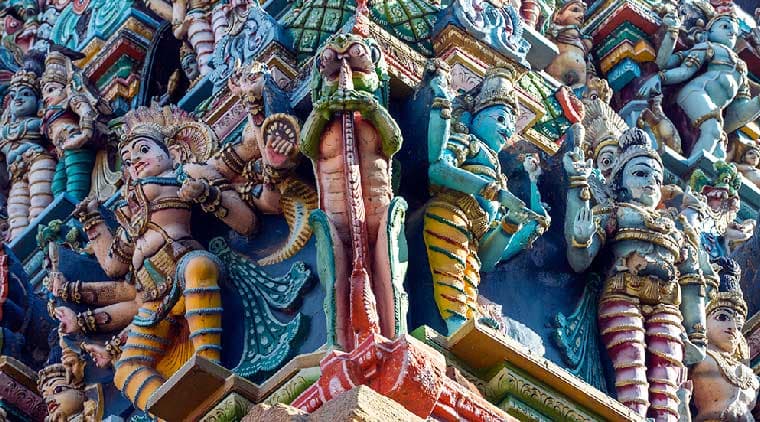
You enter through a seven tier rajagopuram about 150 feet high, and then rise through a series of pillared halls, each at a higher level than the last, with beautifully carved columns from the Nayak period. It feels like climbing into the hill itself, because that is exactly what you are doing.
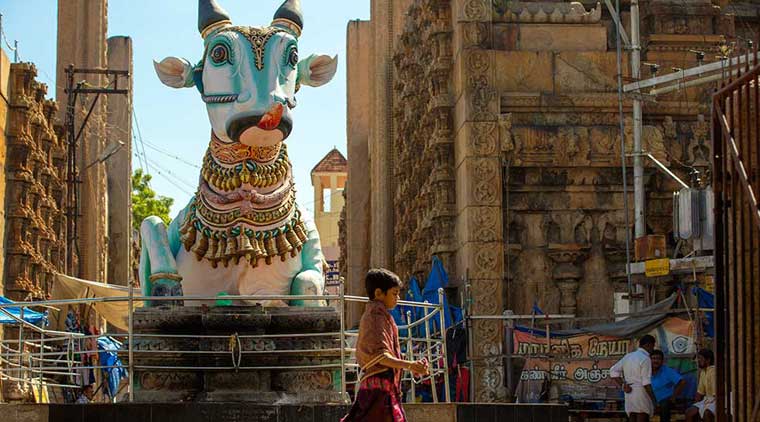
At the top of the halls is the ancient rock-cut sanctum. Within its carved cells are Lord Murugan with Deivanai, and around them Lord Shiva, Lord Vishnu, Vinayaka and Goddess Durga, all sculpted from the living rock. A rare feature here is that Lord Shiva and Lord Vishnu face each other in the main shrine, a sight worth pausing over. Before the flagstaff you will see the vahanas carved in stone: Nandi, the peacock and the mouse.
Outside, the temple tank draws families in the evenings, where children love feeding the fish with puffed rice. The granite hill behind rises about 1,050 feet, with the small Kasi Viswanathar shrine at its crown; the tradition holds that the siddhar Macchamuni attained samadhi on this hill.
Darshan, timings and temple etiquette
The temple follows the usual rhythm of Tamil temples: it opens early in the morning, around 5:30, stays open until about 1 in the afternoon, closes for the afternoon, and opens again from about 4 to 9 in the evening. The three main pujas fall in the morning, at midday and at dusk. Timings can shift on festival days, so check the current schedule with the temple or your consultant.
Dress modestly and traditionally, as you would in Madurai's temples. Weddings take place in the temple's mandapams on auspicious days, so do not be surprised to walk past a beaming couple and a nadaswaram troupe on your way to darshan; it is part of the joy of this shrine. The walk to the sanctum is up broad steps through the halls, gentle enough for elders taken slowly. Photography rules inside are strict near the sanctum, so follow the temple staff's directions.
Best time to visit
October to March is the pleasant season in Madurai. Summer afternoons are very hot, so keep darshan for early morning or evening year round.
The Kanda Sashti festival in the Tamil month of Aippasi, usually October or November, is the most important festival here, ending with the enactment of the Lord's victory. Panguni, in March or April, brings the Brahmotsavam, when the deities of this temple join Madurai's great Chithirai celebrations. On Karthigai Deepam evenings a lamp is lit on top of the hill, a lovely sight from below. The float festival in the month of Thai is another sweet local occasion.
How to reach
Thiruparankundram is only about 8 km from Madurai city, a drive of 20 to 30 minutes. Madurai airport is close by, about 10 to 15 minutes away, which makes this the easiest of all the six abodes to reach by air.
Thiruparankundram has its own small railway station on the line out of Madurai, but for most travellers Madurai Junction is the practical railhead, with excellent connections across India. City buses and autos run constantly between Madurai and Thiruparankundram, and our Madurai drivers treat it as a standard half day trip along with the city's own temples.
Tips from our travel experts
Pair Thiruparankundram with Madurai. Take darshan here in the morning when the rock halls are cool, rest in the afternoon, and be at the Meenakshi Amman temple for the evening. If you are attending or planning a wedding blessing here, fix the muhurtham and the mandapam well in advance through the temple.
Spend a few minutes at the tank feeding the fish with the children; it is a small tradition of this place. And look up as you climb through the halls: some of the finest carving is above your head, where most visitors never look.
For our NRI and OCI travellers
If your family traces its roots to the Madurai region, Thiruparankundram is often the shrine where marriage blessings and thanksgiving pujas are offered, and we can arrange these with the temple in advance. The temple's closeness to Madurai airport means you can land in the morning, take darshan, and still have the evening for Meenakshi Amman. Couples who married abroad often come here for a simple blessing on an anniversary visit; tell us the date and we will check the auspicious days.
Questions travellers ask us
Why is Thiruparankundram linked with marriage?
The tradition says Lord Murugan married Deivanai, the daughter of Indra, on this hill after his victory at Thiruchendur. Because of this, the temple is considered deeply auspicious for weddings, and couples come here for marriage ceremonies and blessings on married life.
Is Thiruparankundram really a rock-cut temple?
Yes. The sanctum and its surrounding cells were carved into the living rock of the hill under the Pandyas in the 6th century CE. The pillared halls and the 150 foot rajagopuram in front were added later, mainly by the Madurai Nayaks. The images of Lord Murugan, Lord Shiva, Lord Vishnu, Vinayaka and Goddess Durga are all sculpted from the rock itself.
What are the temple timings?
The temple opens around 5:30 in the morning and stays open until about 1 in the afternoon, then reopens from about 4 to 9 in the evening, with the main pujas in the morning, at midday and at dusk. Festival days follow special schedules, so confirm the current timings before you go.
How far is Thiruparankundram from Madurai?
About 8 km, a drive of 20 to 30 minutes from the city and only 10 to 15 minutes from Madurai airport. It is the easiest of the six abodes to reach, and fits naturally into a Madurai day along with the Meenakshi Amman temple.
What is special inside the sanctum?
Apart from Lord Murugan with Deivanai, the rock-cut shrine houses Lord Shiva, Lord Vishnu, Vinayaka and Goddess Durga, and Lord Shiva and Lord Vishnu face each other in the main shrine, which is rare. Panels of Lord Shiva's cosmic dance are carved outside the sanctum.
A note on the tours below. These packages travel close to Thiruparankundram Murugan Temple, but a package may not include a guided visit to the site itself. If you would like this place added to your journey, please tell your Way to India travel consultant and they will happily build it into your itinerary for you.
Yatras where you stay right by the temple
18D / 17N 5You stay at Madurai
 19D / 18N
12 Jyotirlinga Tour Package from Delhi
● Starts Delhi
From₹85,000* / person
Explore →EMI from ₹4,162/mo
You stay at Madurai
 18D / 17N
12 Jyotirlinga Tour Package from Mumbai
● Starts Mumbai
From₹90,000* / person
Explore →EMI from ₹4,407/mo
You stay at Madurai
 5D / 4N
You stay at Madurai
 5D / 4N
Madurai Rameshwaram Kanyakumari Tour Package
● Starts Madurai
From₹25,056* / person
Explore →EMI from ₹1,227/mo
You stay at Madurai
 3D / 2N
You stay at Madurai
 5D / 4N
You stay at Madurai
 6D / 5N
You stay at Madurai
 13D / 12N
You stay at Madurai
 5D / 4N
You stay at Madurai
 7D / 6N
Tirupati Madurai Rameshwaram Kanyakumari Tour Package
● Starts Chennai
From₹20,500* / person
Explore →EMI from ₹1,004/mo
You stay at Madurai
 14D / 13N
You stay at Madurai